Saylor Unveils Global Push To Make Bitcoin Quantum-Ready

bitcoinistОпубліковано о 2026-02-06Востаннє оновлено о 2026-02-06

Анотація

Michael Saylor, during MicroStrategy's Q4 2025 earnings call, announced a global initiative to prepare Bitcoin for the future threat of quantum computing. While acknowledging the seriousness of the quantum risk, which he estimates is at least a decade away, Saylor warned against panic and rushed protocol changes that could introduce new vulnerabilities. Instead of advocating for a specific technical solution or timeline, MicroStrategy will launch a "Bitcoin security program" to coordinate with global cybersecurity and crypto communities. The goal is to build consensus and develop solutions responsibly when the time is right. The company also reported holding 713,502 BTC after purchasing an additional 32,470 BTC in Q4 and establishing a $2.25 billion cash reserve.

Strategy used its Q4 2025 earnings call to spotlight what Michael Saylor framed as the next long-horizon security agenda for Bitcoin: coordinating a global “Bitcoin security program” aimed at quantum readiness, while warning against rushed protocol changes that could create more risk than they remove.

The remarks came as Strategy reported a quarter shaped by Bitcoin’s drawdown under fair-value accounting, even as it continued to add to its treasury. CFO Andrew Kang said the company ended 2025 with 713,502 Bitcoin—about 3.4% of all Bitcoin that will ever exist—after buying an additional 32,470 BTC in Q4 for roughly $3.1 billion.

Kang added that Strategy raised more than $25 billion of total capital during 2025 and established a $2.25 billion cash reserve designed to cover roughly 2.5 years of interest and dividend obligations.

Strategy Will Initiate A Bitcoin Security Program

Saylor addressed quantum computing directly at the end of the call, calling it the latest in a long sequence of recurring existential narratives around Bitcoin. His message was twofold: treat the risk seriously, but resist a “stampede” into premature changes.

“The concern today is quantum computers and many people ask if quantum computers represent a threat to Bitcoin,” Saylor said, before arguing the debate fits a familiar pattern. “What I would say is whenever dealing with each of these concerns we have to take them seriously... but we have to remember two things. One... ‘Don’t panic.’... The second observation, the hypocratic oath, does no harm... You don’t want an iatrogenic intervention where the cure is worse than the disease.”

In his view, the timing matters as much as the engineering. “Our position on quantum computing... we think it’s probably 10 or more years away before there’s a threat. That is the consensus,” he said. Saylor added that quantum-resistant work is happening broadly across industries that rely on conventional cryptography, and that Bitcoin-specific R&D is already underway, but emphasized that there is not yet “global consensus that existing cryptographic libraries are at risk.”

That lack of consensus, he argued, is precisely why Strategy won’t advocate a specific quantum roadmap today. “To stampede into a hypothetical fix before there is consensus would introduce new attack surfaces and new complexity and new failure modes that don’t currently exist,” Saylor said.

Pressed by Fundstrat’s Tom Lee on how Bitcoin might handle quantum-vulnerable wallet types, Saylor reiterated that Strategy would not try to steer the technical outcome. “I don’t think it’s appropriate for us to advocate a particular solution or a particular approach nor a particular time frame,” he said. “Our role is to support all of the various communities and facilitate the evolution of consensus about what should be done, how it should be done, when it should be done.”

The most concrete announcement was a commitment to formalize that support into an organized effort. “Strategy is going to initiate a Bitcoin security program that coordinates with the global cyber security community, the global crypto security community and the global Bitcoin security committee... to contribute to consensus and solutions to address the quantum computing threat as well as any other emergent security threats that evolve,” Saylor said.

He framed the initiative as a responsibility commensurate with Strategy’s scale as a holder, but also as a coordination problem: the goal is to engage “very brilliant minds,” align with the work already being done, and help solutions emerge “at the right time in a responsible fashion.”

At press time, BTC traded at $65,183.
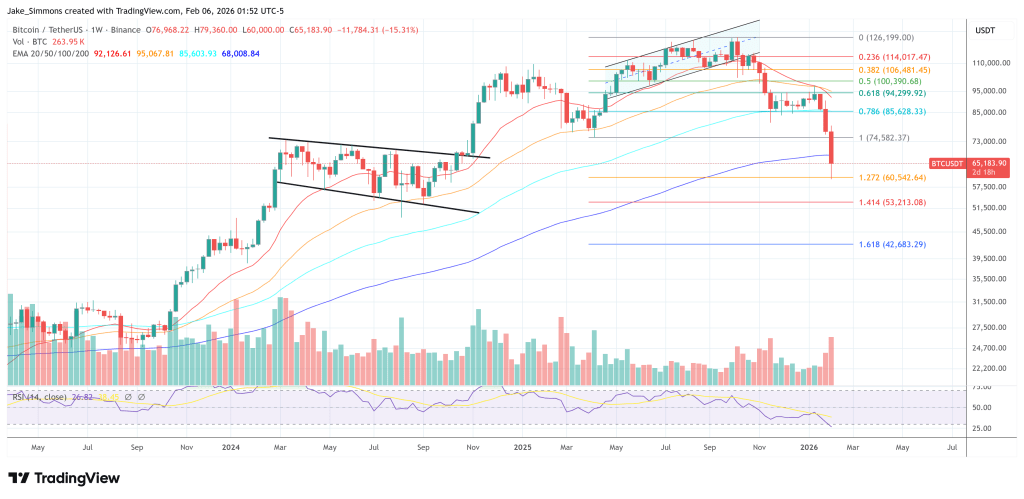
BTC needs a weekly closer above the 200-week EMA ideally, 1-week chart | Source: BTCUSDT on TradingView.com

Трендові криптовалюти

Пов'язані питання

QWhat is the main focus of Michael Saylor's new Bitcoin security initiative announced during the Q4 2025 earnings call?

AThe main focus is coordinating a global 'Bitcoin security program' aimed at achieving quantum readiness and addressing emergent security threats, while cautioning against rushed protocol changes.

QHow many Bitcoin did MicroStrategy hold by the end of 2025, and what percentage of the total supply does this represent?

AMicroStrategy held 713,502 Bitcoin by the end of 2025, representing about 3.4% of all Bitcoin that will ever exist.

QWhat is Michael Saylor's estimated timeline for when quantum computing might pose a threat to Bitcoin?

AMichael Saylor estimates that a quantum computing threat to Bitcoin is probably 10 or more years away, which he states is the consensus view.

QAccording to Saylor, why is MicroStrategy not advocating for a specific quantum-resistant solution for Bitcoin at this time?

AMicroStrategy is not advocating for a specific solution because there is not yet a global consensus that existing cryptographic libraries are at risk, and rushing a fix could introduce new attack surfaces and complexity.

QWhat specific financial preparation did MicroStrategy's CFO mention regarding the company's obligations?

ACFO Andrew Kang stated that MicroStrategy established a $2.25 billion cash reserve designed to cover roughly 2.5 years of interest and dividend obligations.

Пов'язані матеріали

In Conversation with Ray Dalio: We Are Currently in an AI Bubble, with 1% of My Portfolio in Bitcoin

Ray Dalio, founder of Bridgewater Associates, warns in an interview that the current AI boom shows classic bubble characteristics, which could lead to significant economic downturns as seen in past cycles like 1929 or 2000. He explains that speculative enthusiasm, fueled by debt and overvaluation, often precedes a crash when rising rates or taxation force asset sales, causing widespread losses and recession. Dalio also outlines his "Big Cycle" theory, describing an approximate 80-year pattern where widening wealth gaps, massive government deficits, and shifting geopolitical power (like China's rise) create internal conflict and global instability. He emphasizes that we are in a late-cycle, transitional phase where traditional powers like the US and UK face decline. For personal wealth protection, Dalio advises diversification beyond cash into assets like stocks, bonds, real estate, and particularly gold, which he prefers over Bitcoin. While he holds about 1% of his portfolio in Bitcoin as a non-printable hard asset, he views gold as more secure from technological or governmental threats. Regarding AI's impact, Dalio believes it will disproportionately benefit capital owners, worsening inequality by replacing both physical and cognitive labor. He suggests that human intuition and emotional intelligence, combined with AI, will be key for future workers. On taxation, Dalio argues that wealth taxes are impractical and risk triggering asset sell-offs, reducing productive investment. He points to the UK as a cautionary example of debt, low productivity, and political strife. Geopolitically, Dalio foresees a more regionalized world, with the US showing weakness in prolonged conflicts like with Iran, akin to past imperial declines. The ideal outcome, he suggests, is coexisting powerful blocs (e.g., Americas, China-Asia Pacific) without major war.

marsbit1 год тому

In Conversation with Ray Dalio: We Are Currently in an AI Bubble, with 1% of My Portfolio in Bitcoin

marsbit1 год тому

Daily 7.2 Trillion KRW: Foreign Capital's Record Net Buying on Friday! Wall Street Says Headwinds for Korean Stock Fund Flows Have Subsided

South Korean stock market sees a dramatic shift in fund flows. On July 31, foreign investors made a record net purchase of approximately KRW 7.2 trillion in KOSPI stocks, marking a fundamental reversal from the persistent large-scale net outflows seen in previous months. This contributed to a significant narrowing of foreign net selling in July to KRW 9.8 trillion, down sharply from KRW 48.4 trillion in June and KRW 44.5 trillion in May. Simultaneously, domestic institutional pressure eased. South Korean pension funds and asset managers turned to a net buying position in July, purchasing KRW 1.0 trillion worth of KOSPI shares, contrasting with net sales in May and June. Market volatility is expected to be dampened by new financial regulations. Effective July 31, the Financial Services Commission tightened access for retail investors to single-stock leveraged ETFs by raising the minimum cash deposit requirement. Trading volumes for these products subsequently dropped to about 50% of their monthly average. Citigroup Research maintains its year-end KOSPI target of 10,000 points. The firm cites several supportive factors: the substantial easing of headwinds from capital outflows, a robust fundamental outlook for the semiconductor sector, historically low market valuations, strong economic fundamentals, and the potential for policy support from financial authorities if needed.

marsbit1 год тому

Daily 7.2 Trillion KRW: Foreign Capital's Record Net Buying on Friday! Wall Street Says Headwinds for Korean Stock Fund Flows Have Subsided

marsbit1 год тому

Thanks to Dice Rolls, Bitcoin Keys Are Stored Offline, But Not Everyone Will Do It

The article discusses using dice rolls to generate secure Bitcoin wallet seeds, providing entropy independent of potentially flawed hardware random number generators. It explains that each fair dice roll offers about 2.585 bits of entropy, with around 50 rolls needed for a standard 12-word seed phrase and 99+ recommended for higher security. This method gained attention after a vulnerability was revealed in some Coldcard hardware wallets, where a faulty firmware RNG (dating back to 2021) compromised generated keys. The analysis notes that while a dice-generated main seed was safe from this specific flaw, other Coldcard functions (like creating paper wallets, backup keys, or passwords) could still be vulnerable if they used the defective RNG. The piece argues that while dice-based entropy is technically robust, the manual process is error-prone, tedious, and unrealistic for most new users, who might make mistakes in recording or inputting rolls. It concludes that while manual entropy generation should remain an option for advanced users, the long-term goal is to develop reliable, user-friendly hardware and software that securely generates randomness without requiring specialized knowledge. Coldcard users are advised to check their firmware version and replace any secondary secrets (like paper wallet keys) created with vulnerable devices, while also considering multi-signature setups with devices from different manufacturers for added security.

cryptonews.ru6 год тому

Thanks to Dice Rolls, Bitcoin Keys Are Stored Offline, But Not Everyone Will Do It

cryptonews.ru6 год тому

Торгівля

Спот

Популярні статті

Як купити PUSH

Ласкаво просимо до HTX.com! Ми зробили покупку Push Protocol (PUSH) простою та зручною. Дотримуйтесь нашої покрокової інструкції, щоб розпочати свою криптовалютну подорож.Крок 1: Створіть обліковий запис на HTXВикористовуйте свою електронну пошту або номер телефону, щоб зареєструвати обліковий запис на HTX безплатно. Пройдіть безпроблемну реєстрацію й отримайте доступ до всіх функцій.ЗареєструватисьКрок 2: Перейдіть до розділу Купити крипту і виберіть спосіб оплатиКредитна/дебетова картка: використовуйте вашу картку Visa або Mastercard, щоб миттєво купити Push Protocol (PUSH).Баланс: використовуйте кошти з балансу вашого рахунку HTX для безперешкодної торгівлі.Треті особи: ми додали популярні способи оплати, такі як Google Pay та Apple Pay, щоб підвищити зручність.P2P: Торгуйте безпосередньо з іншими користувачами на HTX.Позабіржова торгівля (OTC): ми пропонуємо індивідуальні послуги та конкурентні обмінні курси для трейдерів.Крок 3: Зберігайте свої Push Protocol (PUSH)Після придбання Push Protocol (PUSH) збережіть його у своєму обліковому записі на HTX. Крім того, ви можете відправити його в інше місце за допомогою блокчейн-переказу або використовувати його для торгівлі іншими криптовалютами.Крок 4: Торгівля Push Protocol (PUSH)Легко торгуйте Push Protocol (PUSH) на спотовому ринку HTX. Просто увійдіть до свого облікового запису, виберіть торгову пару, укладайте угоди та спостерігайте за ними в режимі реального часу. Ми пропонуємо зручний досвід як для початківців, так і для досвідчених трейдерів.

627 переглядів усьогоОпубліковано 2024.12.13Оновлено 2026.06.02

Як купити PUSH

Обговорення

Ласкаво просимо до спільноти HTX. Тут ви можете бути в курсі останніх подій розвитку платформи та отримати доступ до професійної ринкової інформації. Нижче представлені думки користувачів щодо ціни PUSH (PUSH).

活动图片













