Saylor Says ‘Don’t Sell Your Bitcoin’, as LiquidChain Unites Liquidity for Utility

bitcoinistОпубліковано о 2026-02-03Востаннє оновлено о 2026-02-03

Анотація

Michael Saylor advocates holding Bitcoin as long-term "economic energy," but this creates capital inefficiency. DeFi needs high-quality collateral, yet moving Bitcoin across chains is complex and risky. LiquidChain ($LIQUID) addresses this with a Layer 3 solution that unifies liquidity from Bitcoin, Ethereum, and Solana into a single execution layer. Its Cross-Chain VM allows developers to build applications that use assets from all three chains simultaneously, reducing friction and counterparty risk. The protocol also enables liquidity staking, letting users earn yield without selling their assets. $LIQUID tokens power the network and offer staking rewards, positioning LiquidChain as infrastructure for connected, multi-chain DeFi.

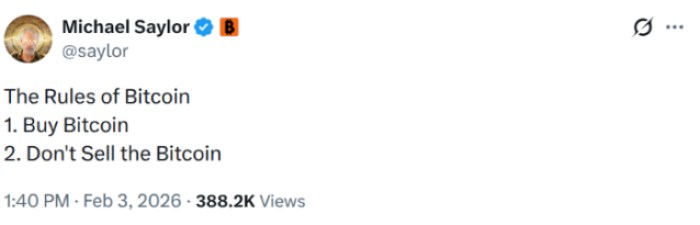
Michael Saylor says that Bitcoin isn’t currency for spending, it’s ‘economic energy’ meant to be preserved for 100 years.

The Strategy chairman’s thesis is simple: you don’t sell the winner to buy the losers. While this ‘Diamond Hand’ philosophy has shifted Bitcoin from speculative toy to treasury reserve asset, it creates a massive friction point: capital inefficiency.

While Saylor advocates for indefinite holding, the broader DeFi ecosystem is starving for high-quality collateral. Right now, traders face a binary choice: leave Bitcoin gathering dust in cold storage, or risk it in a maze of bridges, wrapped tokens, and centralized custodians just to chase yield on Ethereum. (Sound familiar?)
This fragmentation is the bottleneck of the current cycle. Liquidity is trapped in silos, making cross-chain moves slow, expensive, and technically risky.
We’re seeing a shift from ‘store of value’ to ‘productive assets.’ As institutional flows stabilize, the next frontier isn’t just owning crypto; it’s using it across ecosystems without selling the bag.

This demand is fueling Layer 3 (L3) infrastructure designed to smash these barriers. Enter LiquidChain ($LIQUID), a protocol engineering a fusion of Bitcoin, Ethereum, and Solana liquidity into a single execution environment.

Breaking Down The Silos With A Unified Liquidity Layer

The real risk in the DeFi landscape today isn’t price drops, it’s execution complexity. Moving value from Bitcoin to Solana usually involves multiple hops, slippage, and ‘wrapped’ assets that introduce sketchy counterparty risk. This fragmentation means billions in liquidity remain trapped on their native chains.

LiquidChain fixes this by deploying a Cross-Chain VM (Virtual Machine) that serves as a unified execution layer.
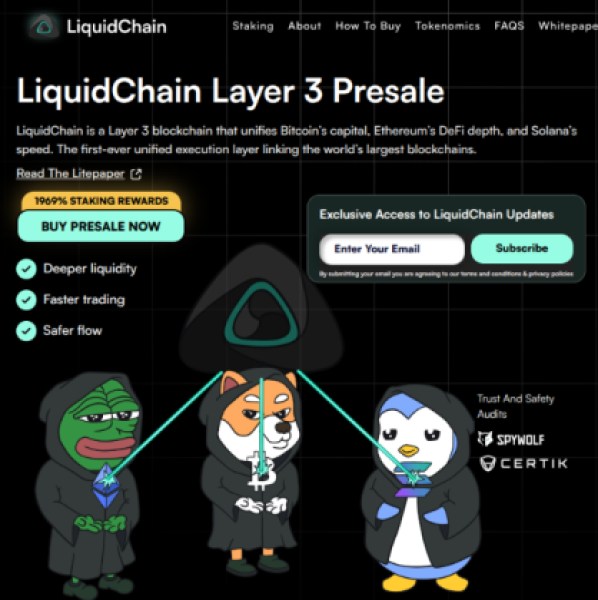
Instead of forcing users to bridge assets manually, LiquidChain’s ‘Deploy-Once Architecture’ allows developers to build applications that tap into $BTC, $ETH, and $SOL simultaneously. That’s critical for removing the friction that kills adoption.

In the LiquidChain model, you could theoretically pledge Bitcoin collateral to access Solana-speed execution or Ethereum-based DeFi protocols in a single step.
The protocol’s architecture focuses on verifiable settlement. By operating as Layer 3 infrastructure, it aggregates security from the underlying chains while offering a single interface.

If you’re a developer, this ends the headache of maintaining different codebases for different ecosystems. Instead of having to choose between Ethereum’s TVL (Total Value Locked) or Solana’s speed, LiquidChain offers a venue where they coexist.

EXPLORE UNIFIED LIQUIDITY WITH $LIQUID.

Unlocking Capital Efficiency Through Liquidity Staking

Saylor’s advice to ‘never sell’ is a solid strategy, but it doesn’t solve the cash flow problem. Investors holding large caps are often asset-rich but liquidity-poor. LiquidChain tackles this through its native utility model, which centers on Liquidity Staking.

The protocol is designed to use the $LIQUID token not just for governance, but as transaction fuel powering the network. By staking liquidity, you can earn rewards derived from the economic activity passing through the Layer 3 infrastructure. It matches the ‘productive crypto’ narrative perfectly, assets generate yield without you having to sell a dime.

You can buy your $LIQUID now for $0.0135 and don’t miss the staking opportunities currently sitting at 1966%.

Plus, the platform aims to include a grant system for developers, incentivizing dApps that use this cross-chain fluidity. This ecosystem approach suggests the future of DeFi isn’t about which chain ‘wins,’ but which infrastructure connects them.

By enabling single-step execution across the industry’s three largest liquidity pools, LiquidChain positions itself as the connective tissue for the next phase of market maturity. To paraphrase an adage, it appears in crypto, it’s no longer what you have but how its connected.’

JOIN THE LIQUIDCHAIN ECOSYSTEM.

Disclaimer: This article is for informational purposes only and does not constitute financial advice. Cryptocurrency investments, including presales and new protocols, carry high risks, including the potential for total loss. Always verify smart contract audits and conduct your own due diligence.


Трендові криптовалюти

Пов'язані питання

QWhat is Michael Saylor's main thesis regarding Bitcoin, as mentioned in the article?

AMichael Saylor's main thesis is that Bitcoin isn't currency for spending, but 'economic energy' meant to be preserved for 100 years. He advocates for not selling the winner (Bitcoin) to buy the losers, promoting a 'Diamond Hand' philosophy of indefinite holding.

QWhat problem does the article identify with the current DeFi ecosystem in relation to Bitcoin?

AThe article identifies that the current DeFi ecosystem suffers from capital inefficiency and fragmentation. Liquidity is trapped in silos, making cross-chain moves slow, expensive, and technically risky. Traders face a binary choice: either leave Bitcoin idle in cold storage or risk it through complex bridges, wrapped tokens, and centralized custodians to chase yield.

QHow does LiquidChain aim to solve the problem of fragmented liquidity across different blockchains?

ALiquidChain aims to solve fragmentation by deploying a Cross-Chain VM (Virtual Machine) that serves as a unified execution layer. Its 'Deploy-Once Architecture' allows developers to build applications that can tap into Bitcoin ($BTC), Ethereum ($ETH), and Solana ($SOL) liquidity simultaneously, enabling single-step execution across these ecosystems.

QWhat is the role of the $LIQUID token within the LiquidChain ecosystem?

AThe $LIQUID token is used not just for governance but also as transaction fuel powering the network. Users can stake their liquidity to earn rewards derived from the economic activity on the Layer 3 infrastructure, allowing them to generate yield without having to sell their underlying assets.

QWhat specific benefit does LiquidChain's Liquidity Staking offer to investors who follow a 'never sell' strategy like Saylor's?

ALiquidity Staking offers a solution to the 'cash flow problem' for investors who are asset-rich but liquidity-poor due to holding large caps like Bitcoin. It allows them to earn yield on their assets by staking liquidity, generating rewards from network activity without having to sell any of their principal holdings.

Пов'язані матеріали

In Jinjiang, Fujian, a Storage Super Unicorn Lies Quiet

In Fujian's Jinjiang, a city known for sportswear, lies a quiet semiconductor giant: Fujian Jinhua Integrated Circuit Co. (JHICC). Once a promising domestic DRAM manufacturer alongside Yangtze Memory and ChangXin Memory Technologies (CXMT), its journey was derailed in 2018 when the U.S. placed it on an Entity List and filed criminal charges for alleged trade secret theft. This halted production for years. A turning point came in February 2024 when a U.S. federal court found JHICC not guilty. However, it had lost crucial time. While CXMT soared to become a top-valued A-share company in 2024, JHICC, with an estimated valuation of 80 billion RMB, was just restarting. Its current output is primarily customized DDR4 chips, not the advanced DDR5/HBM demanded for AI, but it still benefits from the broader memory chip upcycle. JHICC's story is tied to Chen Zhengkun, a veteran engineer who left Micron to lead the venture. Founded in 2016 with state-backed funding, JHICC partnered with Taiwan's UMC to develop DRAM technology. Rapid progress was cut short by the U.S. actions, which Micron initiated, partly due to its heavy reliance on the Chinese market. Post-sanctions, Chen's team worked to rebuild the production line with reduced reliance on U.S. technology. According to its records, JHICC achieved small-scale production and revenue growth under immense pressure. It now focuses on the stable "niche" DRAM market (e.g., TVs, routers) with a monthly capacity of ~40,000 wafers, aiming for 60,000 by 2026. It holds over 1,000 patents but remains on the Entity List. For Jinjiang, investing in JHICC was a bold industrial leap. The local government provided unwavering financial and logistical support during the crisis, helping the company survive. JHICC has become the anchor for a growing local semiconductor cluster. Though its scale lags behind domestic peers, JHICC's persistence symbolizes a hard-won foothold in a global market long dominated by Samsung, SK Hynix, and Micron. Having missed one boom, it seeks a place in the new AI-driven memory supercycle.

marsbit5 хв тому

In Jinjiang, Fujian, a Storage Super Unicorn Lies Quiet

marsbit5 хв тому

Must-Watch Events Next Week|CLARITY Act Could Face Senate Vote; SpaceX, Circle to Report Earnings (8.3-8.9)

**Summary: Key Events and Developments to Watch (August 3-9)** The upcoming week is marked by significant financial disclosures, key legislative deadlines, and notable product updates. **Major Financial Events:** Several companies are scheduled to release their Q2 2026 earnings. American Bitcoin (ABTC) will report on August 3, followed by SpaceX and Hut 8 Mining Corp. on August 4, and Circle on August 5. Notably, a significant portion of SpaceX shares (up to 12% of total shares) will be unlocked on August 6 following their earnings release. **Key Legislative Deadline:** The U.S. Senate faces an August 7 deadline to secure 60 votes for the CLARITY Act, a bipartisan bill aiming to establish a federal regulatory framework for cryptocurrencies. The Senate may hold a full vote on the bill during the week. **Economic Data:** The U.S. July Non-Farm Payrolls report will be released on August 7, providing crucial labor market data. **Technology & Product Updates:** * **Shutdowns:** DeFi portfolio tracker Zapper and wallet app Ctrl Wallet will cease operations on August 3. * **Upgrades:** LayerZero will deprecate its v1 relayers on August 3. XRP Ledger's new version 3.3.0, featuring five new functions, is expected next week. * **AI:** Elon Musk announced that the advanced Grok 4.6 AI model is set for release around August 7. * **Bitcoin:** The BIP-110 forced signaling for a potential Bitcoin network change is scheduled to begin around August 8. **Other Notable Events:** Chinese robotics firm Unitree Tech has set its preliminary price inquiry for its IPO for August 5. South Korean exchange Upbit will delist AQT and AERGO tokens on August 3.

marsbit2 год тому

Must-Watch Events Next Week|CLARITY Act Could Face Senate Vote; SpaceX, Circle to Report Earnings (8.3-8.9)

marsbit2 год тому

Торгівля

Спот

Популярні статті

Як купити T

Ласкаво просимо до HTX.com! Ми зробили покупку Threshold Network Token (T) простою та зручною. Дотримуйтесь нашої покрокової інструкції, щоб розпочати свою криптовалютну подорож.Крок 1: Створіть обліковий запис на HTXВикористовуйте свою електронну пошту або номер телефону, щоб зареєструвати обліковий запис на HTX безплатно. Пройдіть безпроблемну реєстрацію й отримайте доступ до всіх функцій.ЗареєструватисьКрок 2: Перейдіть до розділу Купити крипту і виберіть спосіб оплатиКредитна/дебетова картка: використовуйте вашу картку Visa або Mastercard, щоб миттєво купити Threshold Network Token (T).Баланс: використовуйте кошти з балансу вашого рахунку HTX для безперешкодної торгівлі.Треті особи: ми додали популярні способи оплати, такі як Google Pay та Apple Pay, щоб підвищити зручність.P2P: Торгуйте безпосередньо з іншими користувачами на HTX.Позабіржова торгівля (OTC): ми пропонуємо індивідуальні послуги та конкурентні обмінні курси для трейдерів.Крок 3: Зберігайте свої Threshold Network Token (T)Після придбання Threshold Network Token (T) збережіть його у своєму обліковому записі на HTX. Крім того, ви можете відправити його в інше місце за допомогою блокчейн-переказу або використовувати його для торгівлі іншими криптовалютами.Крок 4: Торгівля Threshold Network Token (T)Легко торгуйте Threshold Network Token (T) на спотовому ринку HTX. Просто увійдіть до свого облікового запису, виберіть торгову пару, укладайте угоди та спостерігайте за ними в режимі реального часу. Ми пропонуємо зручний досвід як для початківців, так і для досвідчених трейдерів.

559 переглядів усьогоОпубліковано 2024.12.10Оновлено 2026.06.02

Як купити T

Обговорення

Ласкаво просимо до спільноти HTX. Тут ви можете бути в курсі останніх подій розвитку платформи та отримати доступ до професійної ринкової інформації. Нижче представлені думки користувачів щодо ціни T (T).

活动图片