Lately, Sailor has repeatedly rejected BIP-110. On Tuesday, August 4th, the executive chairman of Strategy posted a message on X stating:
"At block 961,022, BIP-110 has 38 signals (2.70%). Reaching the 55% threshold voluntarily is impossible. At block 961,632, BIP-110 nodes will begin rejecting blocks without signals. If major miners do not change their stance, Bitcoin will continue operating normally, while BIP-110 will remain stuck or fork, becoming irrelevant. Its supporters should abandon this idea."
What BIP-110 Actually Aims For
BIP-110 is a proposed software change that would limit the amount of non-transaction-related data users can attach to Bitcoin transactions. Currently, Bitcoin allows users to embed images, tokens, and other non-financial data using tools like Ordinals inscriptions and large OP_RETURN messages. The proposal seeks to limit the volume of most such data by about a year, while regular payments and Lightning Network transactions would remain unchanged.
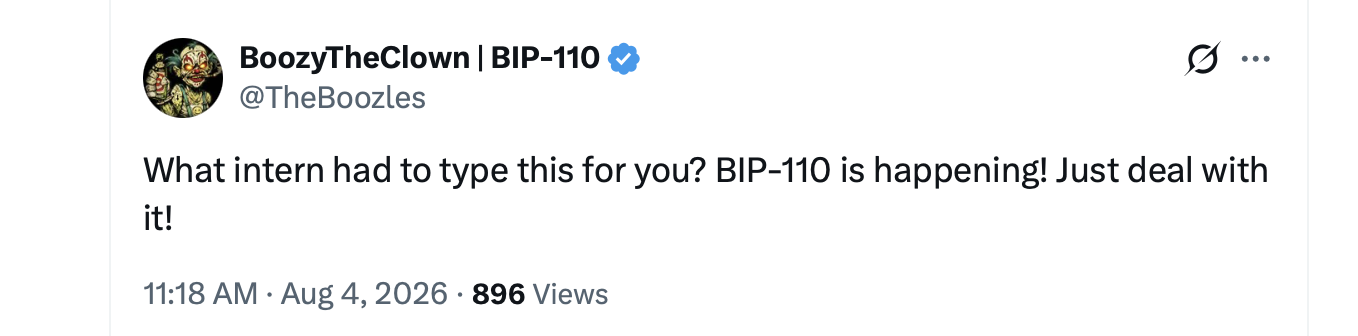
Supporters, including developers of Bitcoin Knots software and the Ocean mining pool, argue that the limits will reduce the load on node operators and lower fees, which have been rising due to high-data-volume transactions. Critics, including Sailor, claim these rules would allow the network to begin evaluating the purpose of a transaction, rather than simply processing it.
Why the Math Doesn't Add Up
For BIP-110 to be activated via the normal pathway, 55% of Bitcoin's mining power must vote for it within a specified block window. As of block 961,022, only 38 blocks out of approximately 1,400 in the current period have signaled support, amounting to about 2.7%. Major mining pools, including Foundry, AntPool, F2Pool, and ViaBTC, have not signaled at all.
Thus, the voluntary path remains closed. In his post, Sailor explicitly points out: at the current rate, the 55% threshold cannot be reached before this window closes.
A Deadline That Could Lead to a Chain Split
Since the voluntary threshold seems unattainable, BIP-110 moves into its second phase around block 961,632, forecasted for early August. At that point, nodes operating under BIP-110 rules will begin rejecting blocks that do not signal support for the change. All others continue to follow the existing rules.
If major miners do not switch to the new protocol, Bitcoin's main chain will continue functioning as it does today. Nodes enforcing BIP-110 may well end up on a separate, shorter chain—a scenario known as a chain split. It is precisely because of this risk that Sailor urges the proposal's supporters to abandon it now, rather than wait for the mandatory enforcement deadline to arrive.
Sailor's Broader Argument
Sailor laid out more detailed arguments against BIP-110 in a mid-July post on X titled "110 Reasons Why BIP-110 is a Bad Idea." He stated that he shares some of the proposal's goals, including lowering node operation costs and protecting Bitcoin's use as sound money. However, he argues that Bitcoin's rules cannot and should not attempt to interpret the intent behind any given transaction.

He compared Bitcoin's consensus rules to a constitution that protects all economic activity equally, warning that a precedent for filtering transactions by their presumed purpose could later be used against privacy tools, storage methods, or new financial contracts built on the network. Many others have voiced similar concerns regarding the proposal's structure.
What Observers Should Watch For
The mandatory signaling window is expected to open around block 961,632, likely between August 7th and 9th, depending on block mining speed. If none of the major mining pools change course, BIP-110 is expected to fail to gain control of Bitcoin's main chain, and any nodes enforcing its protocol will potentially split off on their own.
Bitcoin users can monitor the signaling and watch to see if any major mining pool alters its stance in the coming days, as well as track updates from Bitcoin Knots developers and monitors that record the number of signals per block as this period approaches.
end-content