
Retail Investors' 'Lead Brother' Serenity vs. Newly Minted Stock God Leopold: How Are the Two Top Hunters Mining AI's 'Physical Limits'?

marsbitОпубліковано о 2026-05-27Востаннє оновлено о 2026-05-27

Анотація

The article profiles two prominent figures, Serenity and Leopold Aschenbrenner, who are gaining attention for their unconventional investment strategies focused on the physical constraints of the AI boom, moving beyond mainstream software narratives. Serenity, an anonymous online trader, advocates a "shiso leaf" theory. He targets small-cap companies with monopolies on critical, overlooked components in the AI hardware supply chain, such as specific semiconductor materials. His deep, technical analysis of bottlenecks in areas like co-packaged optics (CPO) has reportedly yielded massive returns, though his anonymity and focus on illiquid micro-cap stocks pose significant risks for followers. Leopold Aschenbrenner, a former OpenAI researcher, founded a multi-billion dollar hedge fund. His macro thesis argues that physical infrastructure—power grids, land, data centers—is the true bottleneck for AI growth, lagging far behind chip production. Consequently, his fund employs an infrastructure arbitrage strategy: heavily investing in storage and compute infrastructure companies while placing massive bearish bets (put options) against major semiconductor stocks, betting their valuations will correct as physical constraints become apparent. While their methods differ—Serenity drills into microscopic supply chain details, while Leopold takes a macroscopic, infrastructure-focused view—both share a core belief: the real power and investment alpha in the AI era lie in controlling scarc...

Author: Jae, PANews

Over the past two years, the simplest, most profitable first-generation bull strategy was to buy NVIDIA, but this playbook is becoming ineffective. When everyone knows the H100 is in short supply and every earnings report beats expectations like a carbon copy, the alpha disappears.

Truly smart money is beginning to penetrate the software layer and PPT narratives, re-examining the physical foundations underpinning AI operations. This year, two individuals with vastly different styles have become the most-watched new bellwethers in AI investing.

One is an anonymous trader hidden behind a female anime avatar on platform X. He claims to have turned down a job offer from NVIDIA and published a Nature paper, achieving a staggering 45x return this year by dissecting the most fundamental components of the supply chain. No one knows his true identity, only that he goes by Serenity.

The other is a 24-year-old former OpenAI "disciple," who transformed from a frustrated researcher into the founder of a hedge fund now managing

tens of billions of dollars, placing bets based on physical constraints on the repricing of energy, computing infrastructure, and storage. His name is Leopold Aschenbrenner, an anomaly among Silicon Valley elites.

One hunts for "bottleneck" points from the microscopic level; the other bets on the restructuring of "physical bottlenecks" from a macro perspective. Their rise to prominence is not just a clash of two investment strategies, but also a clarion call for the revaluation of underlying assets in the AI era.

Serenity: Mining Invisible Dark Horses with the "Shiso Leaf" Theory

If you have been following the U.S. stock community on X recently, you almost certainly have come across an account named Serenity (@aleabitoreddit). Anime avatar, frequent posts, content mostly about semiconductor materials, optical module substrates, edge computing boards—rarely discussing popular AI applications.

No one knows his true identity. He claims to have a programming and academic background, is a Nature paper author, a RISC-V Foundation member, and even turned down an offer to lead an AI team at NVIDIA back in 2018 when the stock was only $6.

Serenity's claim to fame began in early 2022 on the famous retail investor forum r/wallstreetbets (WSB) on Reddit. At that time, edge indium phosphide substrate producer AXTI was largely ignored. Under the username "AleaBito," he posted an in-depth research thread, pointing directly to it as the material foundation for AI optical modules. Subsequently, this obscure micro-cap stock soared from $12 to nearly $70, a nearly 6x increase. His accurate prediction, however, got him banned from the platform for "inducing hype." In July last year, he moved to platform X and quickly grew into an "AI supply chain detective" with over 400,000 followers, becoming the new leading figure for retail investors in the AI investment circle on X. Some have even created research dashboards based on his tweets.

More impressive than the gains themselves is the research methodology Serenity has impressed upon the market. He condensed his investment philosophy into his self-created "Shiso Leaf Theory."

He uses Tokyo's top sushi restaurants as a metaphor. The ingredient diners crave most is undoubtedly tuna belly (toro). However, the presentation of the entire plate of sushi entirely depends on shiso leaves supplied by specific small farms on the Izu Peninsula: they remove fishy smells, provide decoration, and are indispensable. If these farms' supply is cut off due to weather or logistics, even the finest tuna belly cannot be served, forcing high-end sushi shops to close.

Simply put, the most expensive part is the tuna, but the indispensable part is the shiso leaf.

Mapping this to the AI supply chain, the shiso leaf refers to those small-cap, thinly traded, invisible manufacturers that hold absolute technological monopolies in specific, crucial manufacturing segments.

Compared to conventional data-dumping from financial reports, Serenity's research methodology involves diving deep to the very bottom of the industry chain: digesting materials science papers, mastering physical principles, mapping supply chain diagrams, and even feeding research drafts into multiple AIs for adversarial testing, all to identify every "irreplaceable" bottleneck point (chokepoint).

Over the past two years, Serenity has focused primarily on co-packaged optics (CPO). He believes that as AI cluster scales expand, traditional copper wire connections and pluggable optical modules will hit physical walls in terms of power consumption and speed. CPO, which packages optical devices and silicon chips on the same substrate, will be an inevitable path for the industry.

Based on this thesis, he has successively identified and recommended to the market three high-potential bottleneck targets: Sivers, Raspberry Pi, and Soitec.
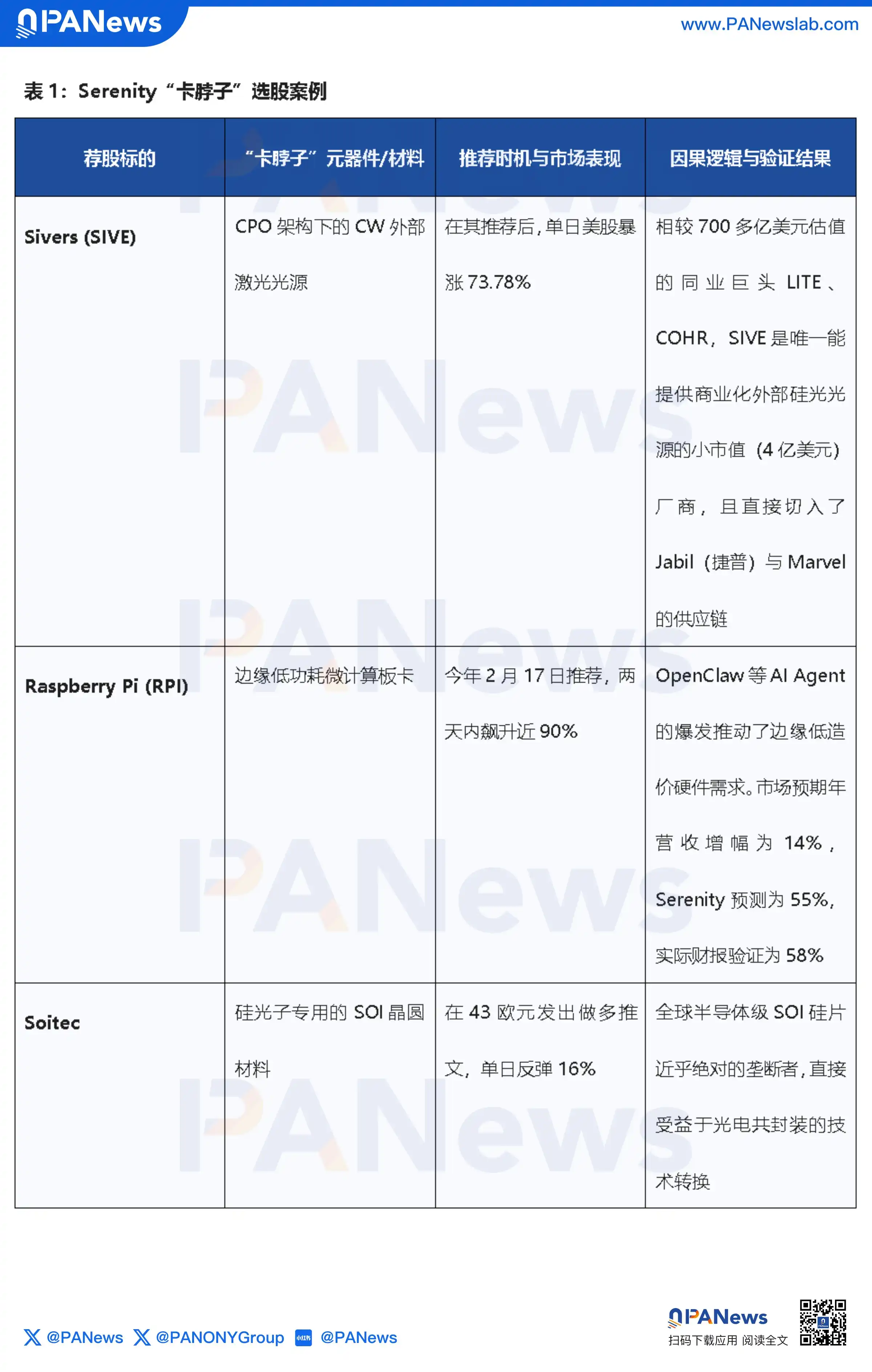
Serenity continues to delve deeper into the very bottom of the supply chain. He has also unearthed NCI, a Japanese chemical company producing semiconductor-grade high-purity phosphorus precursor materials, pushing the "bottleneck point" to the molecular material level.

Leopold: From $200M to $10B, Mastering the Infrastructure Arbitrage Strategy

Unlike Serenity, the elusive folk hunter hidden in the depths of the internet, Leopold Aschenbrenner is a Silicon Valley genius standing in the spotlight, commanding tens of billions in capital.

His resume reads like an "elite template." Graduated top of his class from Columbia University at 19, worked at FTX Future Fund and OpenAI's Superalignment team. In April 2024, however, Leopold was reportedly fired from OpenAI over suspected information leaks.

This event catalyzed his transition into investing. In June 2024, he published a 165-page industry manifesto, "Situational Awareness: The Next Decade." In it, Leopold boldly predicted that AGI would arrive around 2027, with superintelligence emerging by 2030. The real bottleneck to achieving this, he argued, lies not in algorithms and models, but in physical resources like the power grid, land, data centers, and high-bandwidth memory.

Based on this highly forward-looking thesis, he founded the hedge fund Situational Awareness LP. Silicon Valley heavyweights like Nat Friedman, Daniel Gross, and Stripe founders the Collison brothers generously opened their wallets, and a $225 million seed round was swiftly secured.

Leopold's circles are also noteworthy. His fiancée, Avital Balwit, previously worked at the University of Oxford's Future of Humanity Institute (FHI), focusing on issues related to transformative AI, and later joined Anthropic as Chief of Staff to CEO Dario Amodei. FTX was once one of Anthropic's earliest and most important investors. Before FTX's collapse, both Leopold and Avital also held key roles at its philanthropic arm, the FTX Future Fund.

This network provides Leopold with a unique flow of information, cognitive perspective, and resources for his subsequent research framework and investment positioning—perhaps his greatest and most difficult-to-replicate alpha.

On May 18th, Situational Awareness LP filed its Q1 13F holdings report, revealing Leopold's fund now manages over $10 billion. This document gave the market its first glimpse of his highly concentrated long positions in memory stocks, along with a massive portfolio of put options totaling nearly $8.5 billion targeting the entire semiconductor and chip manufacturing sector.

Judging by his portfolio layout, Leopold employs an infrastructure arbitrage strategy. On one hand, he has made significant purchases of memory hardware manufacturer SanDisk and specialized compute cloud CoreWeave, solidly positioning himself at the hard barriers of physical storage.
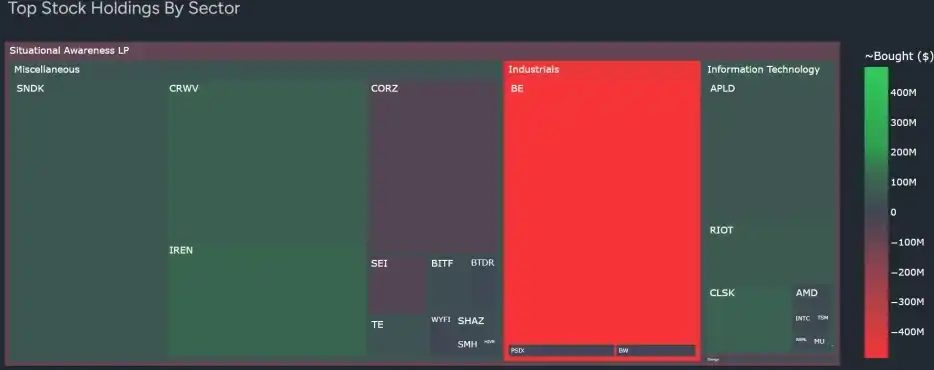
On the other hand, he has allocated billions of dollars to put options against NVIDIA (NVDA), TSMC (TSM), Broadcom (AVGO), ASML (ASML), and the Semiconductor ETF (SMH), essentially shorting the entire semiconductor sector.
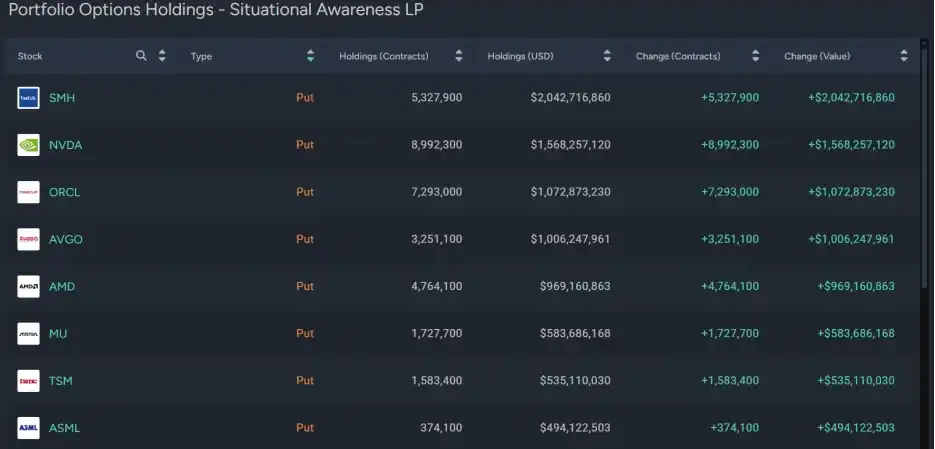
In his view, current valuations in the chip sector have severely detached from the actual construction speed of physical infrastructure like the power grid and data centers. The deployment of AI compute clusters relies on stable electricity, ample land, and mature cooling systems. The construction cycles for these physical infrastructures span 3-5 years, far slower than chip shipment rates. In the short term, the high growth of chip giants is unsustainable, and valuations may face a pullback. Put options would capture profits from this sector downturn.

Crypto enterprises are also part of Leopold's investment map. He has placed a roughly $1 billion long bet on Bitcoin mining companies, heavily buying into IREN, Core Scientific, Riot, CleanSpark, and others. In his eyes, Bitcoin miners are discounted substitutes for AI compute centers, severely undervalued by the market.

Abandoning Software, Emphasizing Physicality: The Hidden Peril of AI Computing's "Toll"

Despite their different "toolkits," the core of Serenity's and Leopold's AI investing is highly similar: abandoning the software layer lacking physical barriers, and heavily investing in hardware constrained by physical laws.

Whether it's the external CW laser light source and high-purity phosphorus in Serenity's view, or the substations and land in Leopold's, they both reveal one point: Regardless of innovation at the model layer, whoever controls scarce resources in the physical world holds the power to levy a "compute toll" on tech giants in the AI era.

However, no strategy is perfect. Both their approaches will face tests on different fronts.

For Serenity, his biggest vulnerability lies in the "liquidity abyss" of micro-cap stocks. When he recommends a micro-cap stock with a market cap of only a few hundred million dollars to his 400,000 followers on X, even a small influx of retail capital can push up the stock price. However, this "frenzy" is built on low liquidity. Once overall market liquidity tightens, or if a recommended company faces setbacks in technology validation, the prices of these micro-cap stocks can plummet, potentially wiping out retail investors who jumped in at high points.

Furthermore, while Serenity's supply chain research is technically thorough, his identity, background, and track record remain unverified. Investors should not worship him as a "stock god" and blindly copy his portfolio wholesale. Blindly following his calls carries high risk. While the micro-cap "bottleneck" strategy is highly explosive, the high capital expenditures, thin margins, and potential customer attrition risks behind these companies mean this strategy is only suitable as a "high-beta catalyst" within an asset allocation framework, complemented by large-cap blue-chip stocks for risk hedging and executed with strict position sizing.

For Leopold, his biggest enemy is the "time lag" in macro dynamics. The fact that physical infrastructure construction lags significantly behind compute demand is entirely valid in terms of causality and is an objective reality. However, capital markets are often driven by irrational sentiment and exhibit longer lag effects, which could allow the high valuations of chip giants to persist longer than expected. When faced with stronger-than-expected earnings reports and short squeezes in stocks like NVIDIA, his massive short positions via put options could incur significant paper losses.
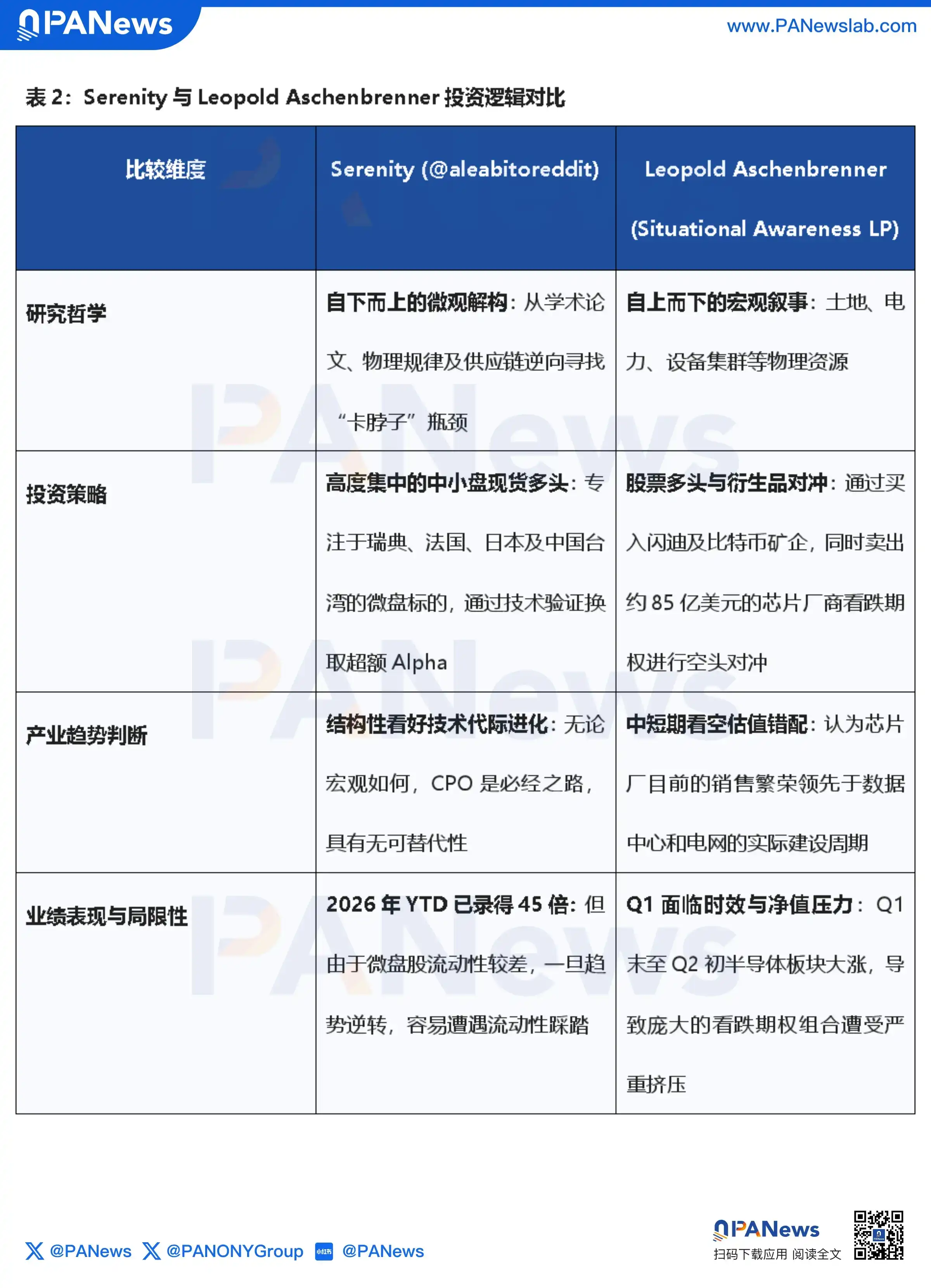
In a way, Serenity and Leopold represent a new phase of AI investment logic. Value capture in the AI industry is shifting from semiconductors themselves to the materials, equipment, power, and land behind the chips.

As model scales and compute demands continue to grow, key links within the AI industry that possess scarcity, technological barriers, and supply constraints are likely to receive increasing market attention in the future.


Пов'язані питання

QAccording to the article, what is the core similarity between Serenity and Leopold Aschenbrenner's investment strategies in the AI sector?

ABoth Serenity and Leopold Aschenbrenner's investment strategies share a core similarity: they abandon the software layer, which lacks physical barriers, and instead heavily invest in hardware constrained by physical laws. They focus on the underlying physical bottlenecks and scarce resources of the AI industry.

QHow does Serenity's "Perilla Leaf Theory" apply to finding investment opportunities in the AI supply chain?

ASerenity's "Perilla Leaf Theory" uses the analogy of a top Tokyo sushi restaurant where the most expensive ingredient is tuna belly, but the indispensable item is the perilla leaf from specific small farms. Applied to the AI supply chain, it means targeting small-cap, low-liquidity, hidden champion companies that possess absolute technological monopolies in critical, niche manufacturing segments—the indispensable "chokepoints."

QWhat is Leopold Aschenbrenner's main investment thesis regarding the semiconductor sector, as revealed by his fund's 13F filing?

ALeopold Aschenbrenner's main thesis, revealed in his fund's 13F filing, is that semiconductor sector valuations have become severely disconnected from the actual construction speed of physical infrastructure like power grids and data centers. He believes the slower 3-5 year build cycle for this infrastructure will cause chip companies' high growth to become unsustainable, leading to potential valuation corrections. This is why he holds a massive portfolio of put options against major semiconductor companies and ETFs.

QWhat are the potential risks associated with Serenity's investment approach, as mentioned in the article?

AThe primary risks associated with Serenity's approach are the "liquidity abyss" of micro-cap stocks and unverified personal background. His recommendations can cause sharp price spikes in low-liquidity stocks, but these prices can plummet if market liquidity tightens or the companies face technical setbacks, potentially causing significant losses for followers. Additionally, his identity, background, and track record are unverified, making blind copy-trading highly risky.

QWhy does Leopold Aschenbrenner invest heavily in Bitcoin mining companies, according to the article?

ALeopold Aschenbrenner invests heavily in Bitcoin mining companies because he views them as deeply undervalued, discounted alternatives to AI compute centers. These companies possess critical infrastructure assets like access to stable power and land, which are also essential for AI data centers, making them attractive investment targets within his physical infrastructure-focused strategy.

Пов'язані матеріали

Trade.xyz's Rebase Refusal Sparks Controversy, On-Chain Pre-IPO Market Faces Major Pricing Test

The debate surrounding Trade.xyz's refusal to adjust its SPCX (SpaceX pre-IPO) perpetual contract pricing amid updated share count revelations highlights a key challenge for on-chain pre-IPO markets. While several centralized exchanges (CEXs) paused and repriced their contracts after SpaceX's filing showed a ~10% increase in total shares, Trade.xyz maintained its market-driven pricing logic, which tracks expected per-share price sentiment rather than fundamental valuation metrics like market cap. This discrepancy triggered cross-platform arbitrage and caused leveraged long positions on Trade.xyz to suffer significant losses, as the platform's HIP-3 architecture lacks a native "Rebase" mechanism to neutrally adjust all user positions following such corporate actions. The incident underscores the difficulty for decentralized perpetual exchanges (Perp DEXs) to implement Rebase—a process CEXs handle by centrally pausing markets and adjusting ledger data. On-chain, this requires complex smart contract modifications, increasing gas costs, complexity, and potential attack surfaces. While some DEXs have managed similar adjustments, Trade.xyz's current design does not natively support it, though the team is reportedly exploring solutions for future events like stock splits. Ultimately, the controversy serves as a critical case study for the nascent on-chain pre-IPO sector, raising questions about price discovery reliability, transparent rule disclosure, and the readiness of DeFi infrastructures to handle traditional corporate actions as real-world assets (RWAs) gain traction.

marsbit7 хв тому

Trade.xyz's Rebase Refusal Sparks Controversy, On-Chain Pre-IPO Market Faces Major Pricing Test

marsbit7 хв тому

The 'Middle Eastern Prince' Swindles a Wealthy Woman: Renting Planes and Rolls-Royces, Scamming 120 Million Over Three Years

Two brothers who posed as "Middle Eastern princes" have been sentenced in the United States to 24 and 23 years in prison, respectively, and ordered to pay over $21.2 million in restitution and back taxes. Over three years, they fraudulently obtained approximately $21 million, primarily by promoting fictitious investment projects, including a non-existent cryptocurrency mining operation in a former General Electric industrial park in East Cleveland. The brothers, aged 42 and 33, created elaborate personas: one claimed to be a wealthy royal family heir and the city's "International Economic Advisor," while the other posed as a hedge fund manager with expertise from watching the TV show *Billions*. They bolstered their image by renting luxury cars and private jets and cultivating a relationship with a local mayor's chief of staff, who provided official-looking documents and government event access. A significant portion of the victims' funds, about $18 million, came from a single Chinese investor, a woman from Sichuan with experience in Bitcoin mining. The brothers also defrauded several women, including one former girlfriend. Their scheme unraveled when the primary investor discovered her $6 million worth of mining equipment had been sold off. The case highlights a trend of impostors using fabricated "Middle Eastern royal" identities to target wealthy individuals. Similar incidents include a "Dubai prince" who recently promoted a $500 million family office in Hong Kong and a Colombian man who impersonated a Saudi prince for decades in the US before being caught and sentenced in 2019.

marsbit21 хв тому

The 'Middle Eastern Prince' Swindles a Wealthy Woman: Renting Planes and Rolls-Royces, Scamming 120 Million Over Three Years

marsbit21 хв тому

a16z Partner: Being in the Flow of Capital Is the True Moat

A16z Partner: Standing in the Cash Flow is the True Moat Historically, many of the strongest companies built their moats by positioning themselves within "cash flows"—facilitating value creation and transfer in a network and taking a cut. The more value flows, the larger they grow. Crypto is the first modern technology natively built for this. With open ledgers, programmable settlement, and stablecoins enabling internet-speed global value transfer, it allows startups to inherit network effects from day one. Well-designed tokens align users, developers, and the protocol towards network growth, distributing value to contributors. This model isn't new (e.g., railroads, Visa, Google, AWS) but Crypto democratizes it. It lets entrepreneurs target areas with high inefficiency and profit extraction—like traditional finance's payments, custody, FX, and settlement—to compress costs, increase speed, and redistribute value by standing in the new flow. The opportunity extends beyond finance to emerging markets like GPU/compute, AI training data, energy, and space, where new, programmable infrastructure can be built without legacy constraints. Key questions for founders: Are you already in the cash flow? Does your revenue scale 10x with network activity? Where is profit extraction highest relative to value created in your market? The strategy is clear: compress the old cost structure, position yourself in the new value stream, and let the network compound.

marsbit48 хв тому

a16z Partner: Being in the Flow of Capital Is the True Moat

marsbit48 хв тому

Capturing 15 Top-Tier Zero-Day Vulnerabilities: A Consensus Protocol Debug Agent Framework Built by 0G Lab in Collaboration with Teams from NUS, PKU, and BUPT

"Agents Capture 15 Critical Zero-Day Bugs: 0G Lab's Multi-Agent Framework Automates Debugging in Consensus Protocols" Distributed consensus protocols are notoriously difficult to debug due to complex, intertwined states. A novel framework, Agora, developed by 0G Labs with researchers from NUS, Peking University, and Beijing University of Posts and Telecommunications, tackles this by fusing deep domain expertise with a collaborative multi-agent LLM architecture. Agora moves beyond the limitations of single LLMs and traditional testing like fuzzing. It employs three specialized agents: an Orchestrator for global state, a Strategy agent for generating attack scenarios using distributed systems knowledge, and a TestGen agent that creates executable tests. A core innovation is its efficient "Succinct Memory & Communication" mechanism and a dynamic test harness. This allows the system to translate abstract hypotheses into concrete tests across languages like Go and Rust, run them, capture failures, and refine the approach in a closed loop—all with minimal token overhead. In rigorous evaluations on production-level protocols including Raft, EPaxos, and components from etcd and Sui, Agora discovered 15 previously unknown deep logic bugs (e.g., execution divergence, liveness violations). In stark contrast, powerful standalone LLMs like GPT-5.2 and Claude 4.5 found zero such bugs. Agora achieved this with a high precision of 73.9% and at an average cost of only about $40 per bug found. The framework demonstrates high generalizability. Its decoupled design allows the "Multi-Agent + Hypothesis-Driven Testing" paradigm to be applied to other complex domains like database concurrency control, OS kernels, and Web3 smart contract auditing. By enabling efficient, automated detection of deep logic flaws, Agora points the way for AI-powered security in critical infrastructure, aligning with the growing trends of agentic systems and automated quality control.

marsbit52 хв тому

Capturing 15 Top-Tier Zero-Day Vulnerabilities: A Consensus Protocol Debug Agent Framework Built by 0G Lab in Collaboration with Teams from NUS, PKU, and BUPT

marsbit52 хв тому

Торгівля

Спот
Ф'ючерси
活动图片




