Report Analysis: Semiconductor Sector Surges 155%, Bernstein Says NVDA and AVGO Are 'Absurdly Cheap'

marsbitОпубліковано о 2026-06-24Востаннє оновлено о 2026-06-24

Анотація

Title: Bernstein's Semiconductor Quarterly Review: AI is the "Only Game in Town," Highlights "Absurdly Cheap" NVDA and AVGO Bernstein's June 23 semiconductor industry review asserts AI is the sector's dominant driver, fueling record gains. The SOX index rose 155.6% over the past year, primarily driven by a 75% increase in forward EPS, not just valuation expansion. While sector-wide valuations are high, Bernstein identifies a significant valuation gap. Despite leading the AI chip market, Nvidia (NVDA) and Broadcom (AVGO) have lagged in performance this year. Based on their 2027 EPS projections and critical roles in the AI supply chain, Bernstein rates both as "Outperform," calling their current valuations "absurdly cheap." The report notes extreme divergence within the sector, with memory chips up 500% YTD, while GPUs/ASICs gained 115%. Bernstein upgraded AMD to "Outperform" due to its dual opportunity in both AI/GPU and CPU markets. However, it remains cautious on Qualcomm (QCOM), citing smartphone market pressures. Key risks highlighted include historically high sector crowding and elevated inventory levels, which could pressure the supply chain if demand softens. The conclusion stresses selective stock-picking over broad directional bets, given current high valuations.

Author: Rita

Trend Insights

Bernstein published its quarterly semiconductor industry review on June 23. Core view: AI has become the "only game" for the semiconductor sector, with strong fundamentals, but valuations and crowding are at historical highs. The report also recommends NVDA and AVGO (rated "Outperform"), believing that although they have relatively underperformed this year, they are the most core beneficiaries in the AI supply chain, and current valuations are "absurdly cheap". Upgraded AMD, but remains cautious on QCOM due to pressure on its mobile business.

AI Demand Drives Record Gains in Semiconductor Sector

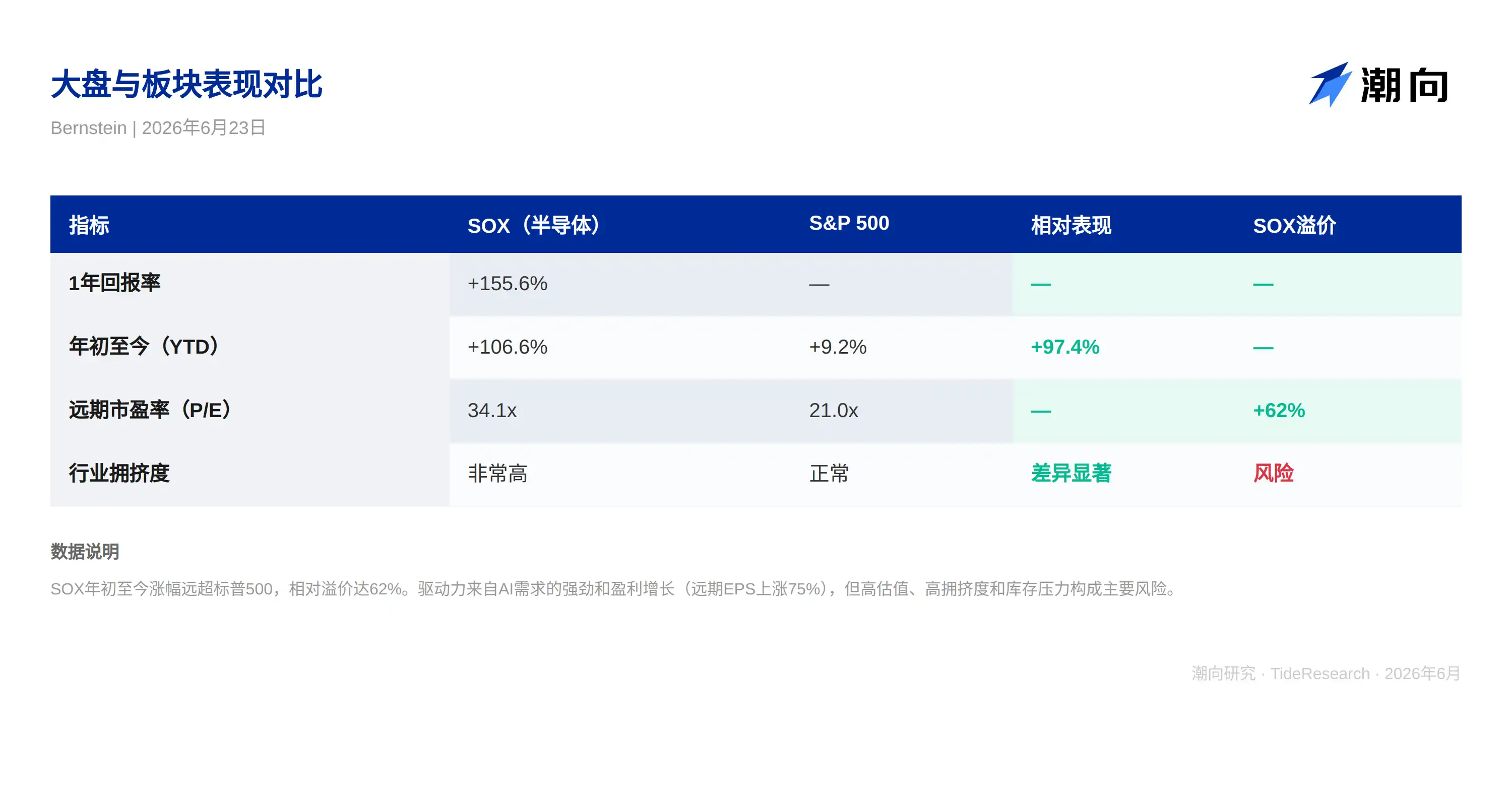
The Philadelphia Semiconductor Index (SOX) has risen 155.6% over the past year and is up 106.6% year-to-date. Over the same period, the S&P 500 rose only 9.2%. The premium of SOX relative to the S&P 500 reached 62%.

This rally is driven by fundamentals, not a bubble. Bernstein's data shows that the forward EPS of SOX has increased by 75% from the beginning of the year, with valuation expansion itself being only a small part.

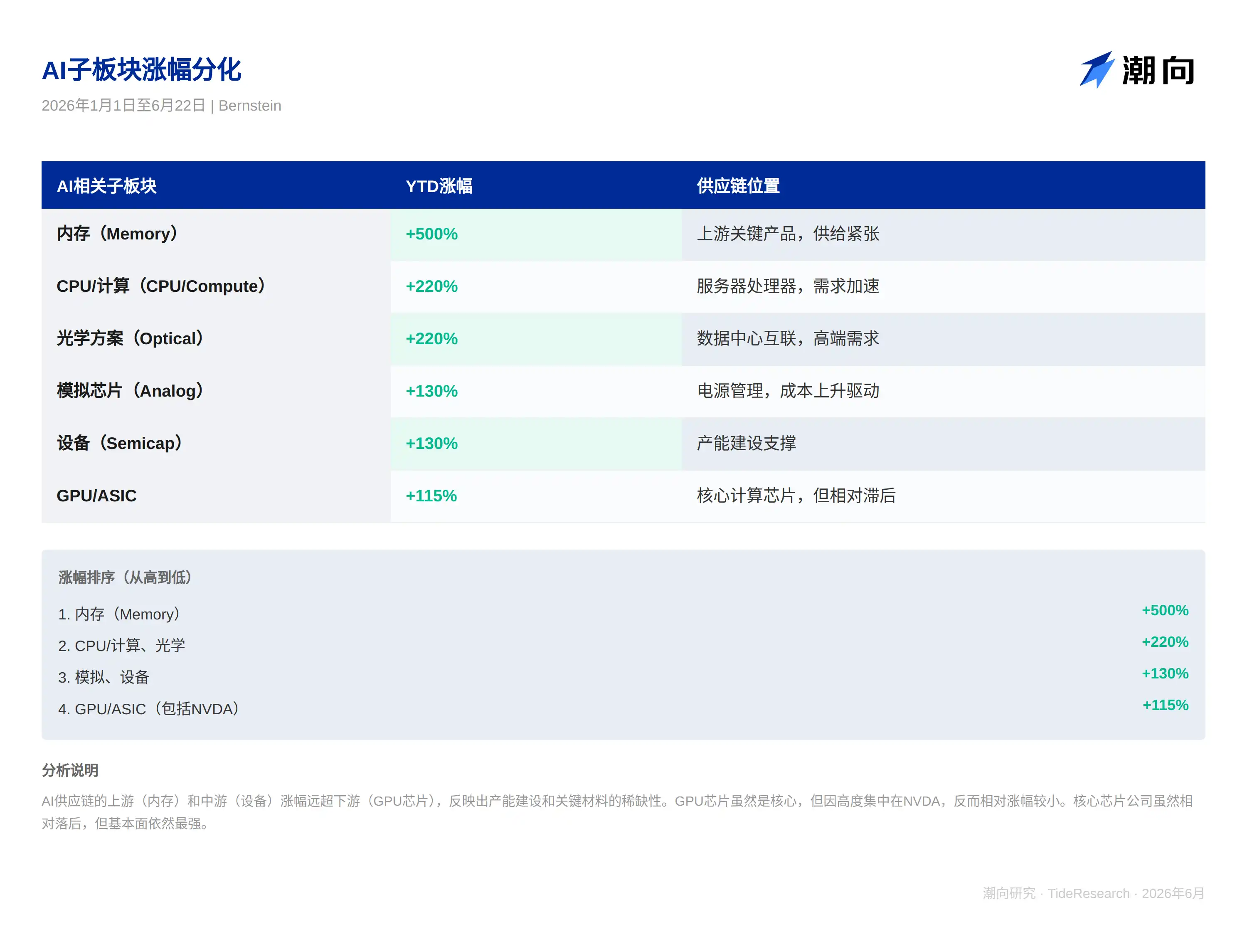
The divergence within the semiconductor sector has reached an exaggerated level. From the beginning of the year to June 22, memory chips rose 500%, CPUs and optical solutions each rose 220%, while GPUs and ASICs rose only 115%. The entire AI supply chain is making money, but the parts that make money and the degree of profitability are not uniform. The farthest upstream and downstream of the supply chain benefit the most; building new production lines requires memory and semiconductor equipment, where supply is relatively tight. GPUs rose only 115%, despite NVDA holding the vast majority of the AI chip market share.
Actual Purchasing Power Under High Valuations

The forward P/E of SOX is now 34.1x, compared to 21.0x for the S&P 500, a premium of 62%. This sounds expensive, but look at specific companies: NVDA's adjusted EPS expectation for 2026 is $9.19 and $12.52 for 2027. Based on Bernstein's price target of $315, the 2027 P/E is 25x, while the sector's forward P/E is 34x. NVDA is not the most expensive; it's relatively cheap.

Bernstein analyst Stacy Rasgon used the phrase: "absurdly cheap".

His reasoning is straightforward: NVDA's Blackwell chip series is expected to reach a $1 trillion revenue scale by 2027. The situation with AVGO is similar, with a price target of $550, but if it reaches its $100 billion AI-related revenue target by 2030, the current valuation looks very cheap.

This is why Bernstein rates both companies "Outperform". Although they have underperformed this year, they are the most core links in the AI demand chain. For comparison, Apple's forward P/E is about 28x, Microsoft's is about 30x, while NVDA's is 25x. Considering the continuity of Blackwell and Rubin generations, and AVGO's monopoly in switch chips, these valuation discounts appear extremely unreasonable. The market has ignored a core fact: without NVDA and AVGO chips, the entire AI infrastructure cannot operate.

CPU's Dual Story, QCOM's Single Dilemma

AMD was recently upgraded by Bernstein to "Outperform". The reason for the upgrade? Because AMD has opportunities not only in AI/GPUs but also in the proxy AI trend for CPUs. CPU shipments improved quarter-over-quarter in Q1 2026, slightly exceeding PC shipments. Bernstein believes AMD's fundamentals are strong enough to support reaching $20 in EPS by 2028, and the current stock price still has room to rise relative to this target.

QCOM is stuck in a single dilemma. Smartphone shipments fell 3% year-over-year in Q1 2026, and rising memory chip prices mean higher phone costs, which is negative for chipset suppliers' pricing power. Bernstein admits that downgrading QCOM earlier was a "poor decision" but maintains a "Market-Perform" rating. The problem is that the weakness in consumer electronics is a given, and QCOM finds it difficult to find a new growth engine. Even if a new data center story can be told at a future analyst day, compared to AMD's dual drivers and the structural position of chipmakers, QCOM's story lacks conviction.
Realistic Considerations for Sub-sectors

Semiconductor equipment (AMAT, LRCX, KLAC) continues to be favored, with demand for capacity construction remaining strong. All three companies are rated "Outperform", with target price increases ranging from 30% to 70%.

The situation for analog chips (ADI, TXN) is more complex. They are indeed in a recovery cycle, achieving double-digit growth for over a year consecutively, but the data center business share remains small, about 10%. TXN and ADI have P/Es of 30 to 40x, appearing quite expensive. Bernstein gives both a "Market-Perform" rating, choosing to wait and see.

Two Risks: Crowding and Inventory

Bernstein's industry sentiment indicators show that the crowding level of the semiconductor sector is already at a historical high. Days of inventory have risen again, far above the upper limit of the normal historical range; while channel inventory has decreased somewhat, it remains above average levels. What does this mean? It means that if any signs of weakness appear in downstream demand, the entire supply chain will face pressure for active inventory reduction. PCs and consumer segments have already shown weakness, and phones have declined year-over-year. Once inventory pressure spreads to data center procurement, the threat of price wars becomes real. At that point, the pricing power of companies near the bottleneck (NVDA, AVGO) could be severely weakened.

The strength of AI demand is undeniable, but the current high valuations of the semiconductor sector have already priced in this good news. Although NVDA and AVGO are relatively cheap, it's conditional on believing they can achieve the analysts' targets. AMD's story is attractive, but execution risks also exist. QCOM has become a forgotten character with unclear catalysts. Bernstein's stance is selective bullishness; at this point, stock selection is more important than getting the direction right.
Disclaimer

This article is TideResearch's collation and interpretation of a third-party brokerage research report. The ratings, price targets, earnings forecasts, and related judgments cited in the article are the views of Bernstein analysts, representing only the stance of their institution. They do not represent the views of TideResearch and do not constitute any investment advice.

Please note three points when reading: First, price targets are analysts' expectations for approximately the next 12 months; they are forecasts, not promises, and will be adjusted repeatedly with performance and market conditions. Second, sell-side research reports are inherently bullish, and some covered companies may have investment banking relationships with the brokerage. Third, the value of a research report lies in its mainline logic and underlying assumptions, not just a single price target. Focus on the logic, not just the price.

The market carries risks, and decisions must be independent. This article should not be used as a basis for buying or selling any securities.

Data Source: Bernstein Report (Stacy A. Rasgon et al., June 23, 2026) · Public Market Data

TideResearch · 2026 June

Пов'язані питання

QAccording to Bernstein's report, why are NVDA and AVGO considered 'absurdly cheap' despite the overall semiconductor sector's high valuation?

ABernstein believes NVDA and AVGO are 'absurdly cheap' because they are the most core beneficiaries of the AI supply chain. NVDA's 2027 P/E based on their $315 target price is 25x, lower than the SOX index's forward P/E of 34.1x. This discount is considered unreasonable given their critical role in AI infrastructure, NVDA's upcoming Blackwell/Rubin product roadmap, and AVGO's dominant position in switching chips.

QWhat is the main driver behind the record performance of the Philadelphia Semiconductor Index (SOX) over the past year?

AThe main driver is strong fundamentals, specifically demand from AI. Bernstein's data shows that the forward EPS of the SOX index has increased by 75% year-to-date, with valuation expansion contributing only a small part. This indicates the rally is driven by actual earnings growth, not a bubble.

QWhat are the two key risks for the semiconductor sector highlighted in Bernstein's report?

AThe two key risks are 1) High crowding, as sector sentiment indicators are at historical highs, and 2) High inventory levels. Inventory days are significantly above the normal historical range, meaning any sign of demand weakness could trigger an inventory correction and potential price wars, especially impacting pricing power.

QWhat is the primary reason Bernstein upgraded AMD to 'Outperform' while maintaining a cautious stance on QCOM?

ABernstein upgraded AMD due to its 'dual story' in both AI/GPUs and the proxy-AI trend in CPUs, with a potential path to $20 EPS by 2028. They remain cautious on QCOM due to its 'single dilemma': weakness in its core smartphone market, where shipments declined, and it lacks a clear new growth engine despite potential data center narratives.

QWhat is Bernstein's view on semiconductor equipment and analog chip stocks as mentioned in the report?

ABernstein is positive on semiconductor equipment stocks (AMAT, LRCX, KLAC), rating them 'Outperform' due to strong capacity build-out demand. They are neutral ('Market-Perform') on analog chip stocks (ADI, TXN), acknowledging their recovery but noting their high P/E multiples (30-40x) and still-small data center business exposure (~10%).

Пов'язані матеріали

Dialogue with Yihui Capital, SoundAI Technology, Ling Universe, and Zhongbo Jili: Opportunities and Challenges in the AI Smart Hardware Track

On June 28, 2026, an event titled "New Opportunities in AI Hardware: The Battle for Interactive Entry Points Begins" was held in Beijing. It featured a report from ITJuzi and discussions with experts from SoundAI, Ling Universe, One Reed Capital, and Zhongbo Juli on the opportunities and challenges in China's AI hardware sector. Key report findings highlight the sector's intense activity: 327 out of 431 startups founded post-2023 have secured funding, with 179 investments in H1 2026 alone. The landscape is dominated by embodied intelligent robots, while wearable tech like smart rings and AI glasses shows rapid growth. Geographically, Shenzhen leads, leveraging its superior hardware supply chain, followed by Beijing and Shanghai. The overarching trend is for companies to focus on micro-innovations within specific scenarios rather than reinventing foundational technology. Industry leaders shared several critical insights: 1. **Balancing Innovation & Market Readiness**: Entrepreneurs face the "hammer looking for a nail" dilemma. Success requires balancing technical capability with user acceptance, cost control, and incremental design improvements rather than chasing disruptive innovation. 2. **Competitive Landscape**: The future interactive entry point may not be a single super-device but a mix of universal terminals and specialized, scenario-specific hardware. While large companies have ecosystem advantages, startups can win by deeply targeting vertical markets and specific user groups. 3. **Core Challenges & Business Models**: Key hurdles include deep understanding of AI models and navigating non-transparent hardware supply chains. Viable business models may involve selling hardware at cost and generating revenue through software subscriptions, but this requires tight control over both hardware BOM and model inference costs. 4. **The Road to Commercialization**: The ultimate test is market validation—achieving sales growth and sustainable cash flow. Companies must find the right application scenario, use edge computing effectively, and close the loop from technology to commercial success. 5. **The Future of Interaction**: Proactive, context-aware interaction is the next frontier, though it's currently limited by issues like model hallucinations and environmental perception. The near-term focus should be on identifying target users and creating a coherent experience in specific domains, such as health wearables. In summary, to succeed in the competitive AI hardware arena, companies must strategically choose their niche, build a team with the right geographical advantages (e.g., leveraging Shenzhen's supply chain), and most importantly, execute a flawless commercialization strategy that translates technology into market-accepted products and sustainable business growth.

marsbit32 хв тому

Dialogue with Yihui Capital, SoundAI Technology, Ling Universe, and Zhongbo Jili: Opportunities and Challenges in the AI Smart Hardware Track

marsbit32 хв тому

CryptoQuant Founder: The Cost to Double BTC Has Increased by 20,000 Times, Where Will the $100 Billion Buying Power Come From?

CryptoQuant founder Ki Young Ju analyzes Bitcoin's current capital challenge. He notes that the cryptocurrency market has grown too large for retail-driven momentum alone to generate massive price increases as in past cycles. His calculations show that in 2011, approximately $2.7 million in capital inflow could push BTC's price up by 550x, whereas the current cycle requires an estimated $101 billion in new capital just for a 100% price increase. This shift underscores that sustaining a bull run now depends on attracting large-scale, long-term institutional capital rather than short-term speculative trading. Recent outflows from US spot Bitcoin ETFs, totaling nearly $10 billion since May, highlight the fragility of current demand and challenge the narrative of deep institutional support. While surveys indicate continued institutional interest, these entities prioritize regulated products, risk management, and portfolio integration over speculative gains. For the next significant bull market, Bitcoin must transition to being a core macro asset. The key drivers are no longer just more buyers, but capital allocation from larger, slower-moving entities like wealth advisors, corporate treasuries, banks, and sovereign wealth funds. This new phase pits Bitcoin against other major asset classes like AI for a share of institutional capital, making its growth trajectory dependent on sustained, high-quality inflows from diversified financial balance sheets.

marsbit36 хв тому

CryptoQuant Founder: The Cost to Double BTC Has Increased by 20,000 Times, Where Will the $100 Billion Buying Power Come From?

marsbit36 хв тому

Торгівля

Спот
活动图片