Remember NFTs? New Project's Price Has Surpassed Bored Apes

marsbitОпубліковано о 2026-08-14Востаннє оновлено о 2026-08-14

Анотація

Remember NFTs? On the Robinhood blockchain, new projects are now surpassing the price of Bored Ape Yacht Club (BAYC). The recent catalyst was an interaction on X between Robinhood CEO Vlad Tenev and digital artist Beeple, which boosted the floor price of the 'Cash Cat' NFT series. Meanwhile, the leading NFT collection on the chain, 'StonkBroker', saw its floor price exceed 13 ETH (~$25,000), briefly giving it a higher single-NFT price and a total market cap surpassing $100 million, exceeding older blue-chip NFTs like Pudgy Penguins. The article identifies three main categories of Robinhood NFTs gaining attention: 1. **Meme Coin Companions:** NFTs linked to successful meme coins, like Cash Cat (tied to $CASHCAT). Their value is heavily dependent on the performance and community acceptance of the related token. 2. **The StonkBroker Ecosystem:** High-floor-price projects like Chain Mancers and Yardkeepers, which are endorsed by and integrated with the StonkBroker protocol. They follow a "token + NFT" model where NFTs promise future utility or revenue sharing from the projects being built. 3. **Established Creators' New Ventures:** Veteran NFT founders and artists, such as a former Pudgy Penguins co-founder and creators from other ecosystems, are launching new collections on Robinhood, leveraging their existing reputations and communities. The author notes that while there is renewed interest, true momentum for a sustained NFT wave on Robinhood requires further catalysts. Ke...

NFTs on Robinhood are gaining increasing attention, with the most direct catalyst being an interaction between Robinhood CEO Vlad Tenev and beeple on a tweet.
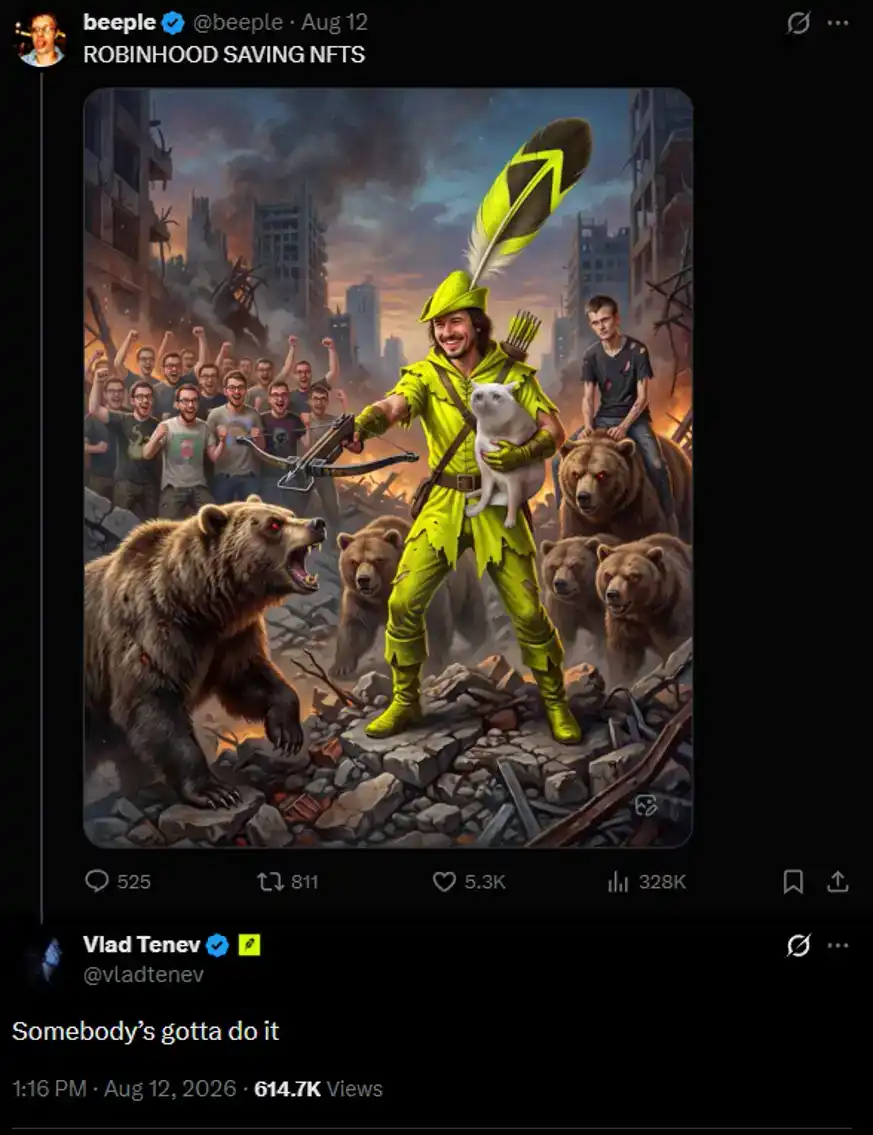
NFTs have been in decline for a long time, and beeple is one of the very few individuals who can still generate a boosting effect for NFT assets, somewhat having the feeling of "whatever beeple draws, rises". In the above tweet, Vlad appears as an NFT savior figure, holding a Cash Cat, with the caption "Robinhood is saving NFTs". Vlad replies, "Somebody's gotta do it."

As the "secondary protagonist" in the picture, the floor price of the Cash Cat NFT series surged to a high of around $660, a 5x increase in 2 days.
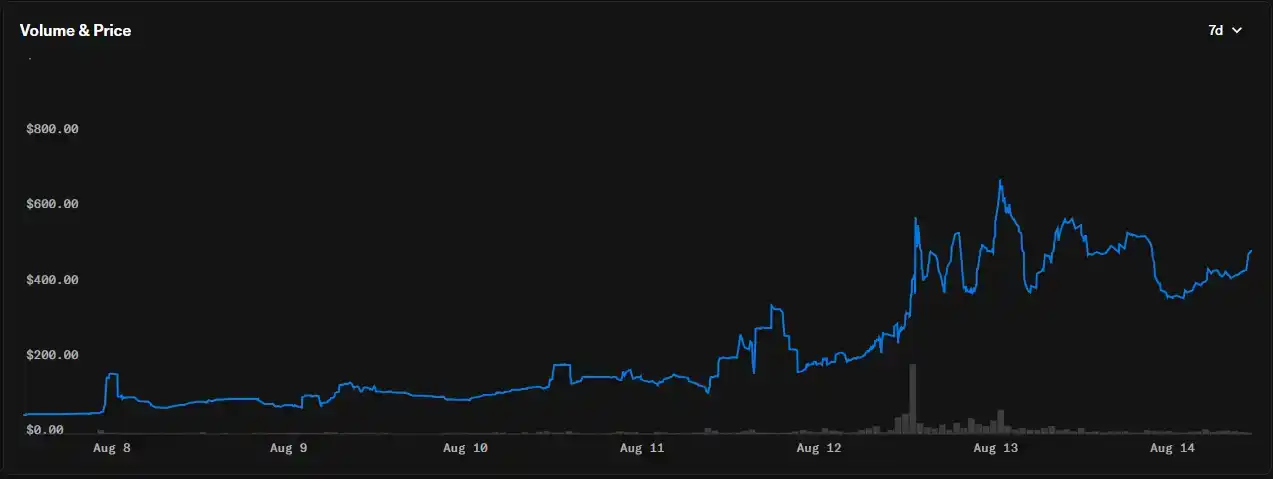
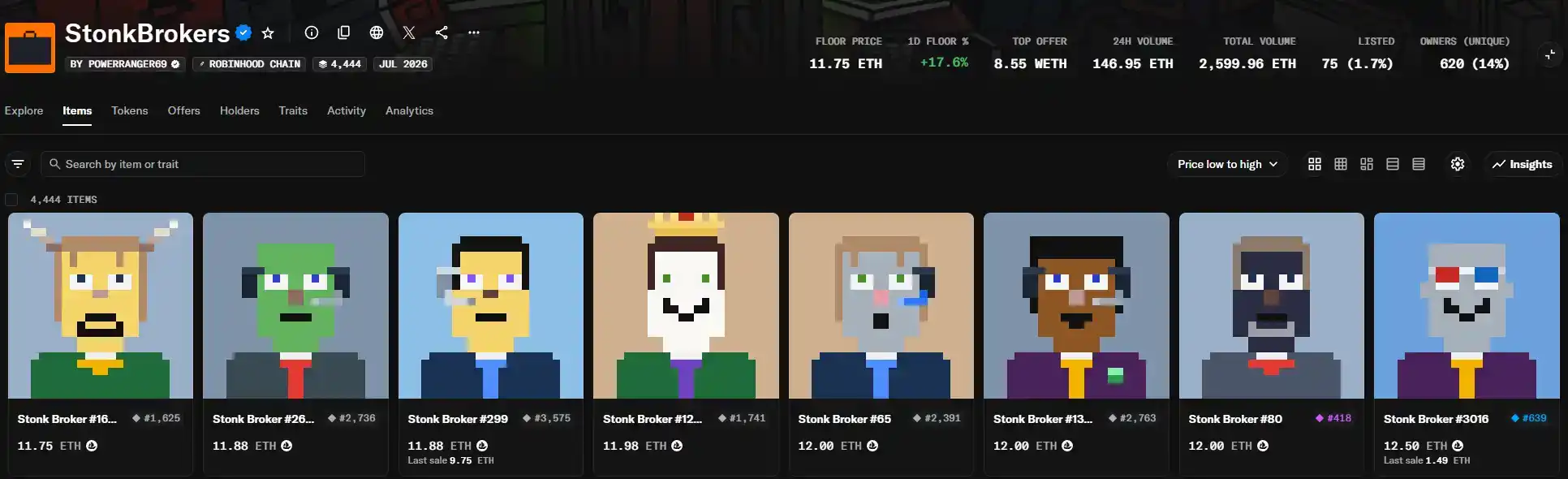
Prior to this direct catalyst of Vlad's tweet, the floor price of StonkBroker, the NFT leader on the Robinhood chain, once exceeded 13 ETH (approximately $25,000) and still remains at 11.75 ETH. In terms of single NFT price, this series has already surpassed BAYC, and its total market cap once surpassed $100 million, exceeding old blue-chip NFTs like Pudgy Penguins and Milady.
Are NFTs really coming back to life on the Robinhood chain? How can one quickly get started with this long-forgotten sector?

Meme Coin/NFT


The model of pairing a meme coin with an NFT series is the first category of Robinhood NFT projects worth noting in this article. Besides CashCat, others like $HOODRAT have also launched accompanying NFT series. Moreover, this one is directly launched by the meme coin project team, so there's no need to worry about community recognition, but $HOODRAT's current market cap is only around $3 million, making it difficult for the corresponding NFT to rise significantly.

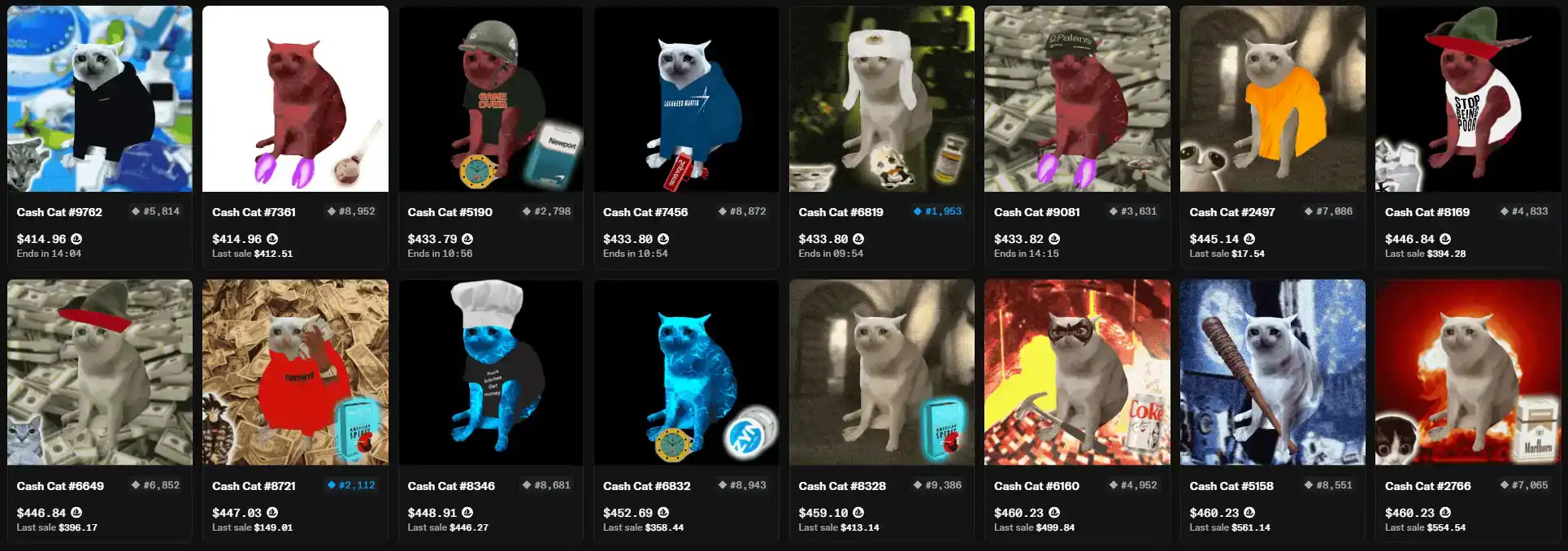
At the beginning of the article, we mentioned the Cash Cat NFT. Although this NFT series does not come from the official Cash Cat meme coin team, after Vlad's tweet, it gained three short-term speculative narratives:

- Currently, the market cap of $CASHCAT is around $150-160 million. Based on the highest floor price of around $660 in recent days, the total corresponding market cap of the entire NFT series is only $6.6 million. If the price of $CASHCAT can remain stable, or even break new highs and continue to rise, then the NFT price will appear increasingly cost-effective.

- What if Vlad changes his X profile picture to a Cash Cat NFT?

- Although it's not created by the $CASHCAT project team, there are examples where a successful meme coin spawns a successful NFT project not from the original team. The most typical example is $SPX6900/AEON. AEON once reached a market cap of around $25 million, with a corresponding single floor price of about $7,500.

After the short-term FOMO, the floor price of Cash Cat NFT has retraced to around $375. This is a normal pullback. It will likely remain a key NFT series on the Robinhood chain, but its potential depends heavily on the success of $CASHCAT and whether it can gain widespread recognition within the $CASHCAT community.
Therefore, tracking this type of project should focus on two aspects:

- Coins that are performing well and have meme appeal. Recently, for example, $hmm on Pons surged significantly. If it can withstand the current major correction, the associated NFT might also be picked up, though it's uncertain which series.

- NFT series already spearheaded by meme coin project teams or those that have already gained traction in price for their associated meme coins. Monitor the price action of the meme coin itself and assess the risk/reward ratio of the corresponding NFT.

The StonkBroker Family

Currently, the top 3 NFT series by floor price are all part of the "StonkBroker Family."

The token of StonkBroker itself has a high market cap. It operates on a flywheel logic of token and image synergy. For details, please refer to our recent article analysis by BlockBeats:

"Is StonkBroker Undoubtedly the Robinhood Chain's Second-in-Command?"

Chain Mancers and Yardkeepers are called the "StonkBroker Family" due to three characteristics:

- They all utilize StonkBroker's Anvil NFT AMM. Both NFT series combine image and token.

- They are not merely images. Chain Mancers claims to be building a DEX, and Yardkeepers claim to be building the best cross-chain route for RWA-focused assets. Holding their NFTs purportedly gives holders a role in the protocol, or more directly, a share of the revenue.

- The reason StonkBroker labels them as Special Projects is that some portion of their protocol revenue flows back into the StonkBroker ecosystem.

To put these three points more simply: they all claim to be building actual projects, they all have some level of endorsement/partnership with StonkBroker, and they all play the narrative of combining image with token, where the NFT provides dividends. Based on these points, the current speculation has less to do with whether the project is live or its revenue situation; instead, they are being traded as smaller speculative plays within the StonkBroker ecosystem.

Therefore, opinions on whether the current price offers a good risk/reward ratio will vary. As for whether such opportunities can be discovered early? Yes, pay more attention to StonkBroker's official X account and community discussions. However, such early discovery comes at a cost. Chain Mancers required burning designated tokens and NFTs for a whitelist spot. Yardkeepers conducted its public sale entirely through the Anvil NFT AMM, meaning all tokens were placed in a liquidity pool; to acquire them, you had to buy tokens to exchange for NFTs. This scenario is akin to a public sale, making it difficult to avoid early "snipers" getting in at low cost.

Veterans Starting Anew

Cole Villemain, co-founder of Pudgy Penguins, was voted out and removed by the project's holders in January 2022. Early this Tuesday morning, his 44,444-piece NFT series, Spritehood, launched on the Robinhood chain sold out in less than an hour. According to on-chain transaction statistics, the revenue from this NFT mint was approximately $1.28 million.

The Saudis, an older Saudi-themed project from 2022, once had a glorious period where one sold for over $2,000. Since 2024, its price has mostly been below $200, essentially "dead" for a long time. Upon news of launching a new project on the Robinhood chain, its price surged up to 3x, jumping from around $100 to $440.

Besides the two projects mentioned above, many veterans and old projects are preparing to seek fortune on Robinhood. For example, Pizza Ninja, which was once a first-tier project in the Bitcoin ecosystem, and meme artist @boldleonidas, among others. The previously mentioned Chain Mancers and Yardkeepers are not new developers either; they are considered familiar faces in the space.

My view is: if the mint price is reasonable, leveraging the current interest in NFT assets on the Robinhood chain, veterans bringing new projects can be a viable play. The veterans' own influence and the support from their old project communities provide initial support for the project.

However, often by the time information is widely seen, the price of the old project may have already risen due to people scrambling for whitelist spots, making it difficult to judge if the risk/reward ratio is still favorable. This type of project might also bring back the era of grinding for whitelists in the NFT space.

Conclusion

Finally, it's important to note that for players not very familiar with NFTs, the liquidity of NFTs is incomparable to that of meme coins. A floor price might look cheap, and you might sweep a bunch, but when it comes time to sell, listing at floor price might be difficult to execute, and accepting offers often involves high slippage.

For this reason, it's challenging to invest in NFT assets in the early stages with the same capital as meme coins, such as buying thousands of dollars worth or taking larger positions, especially for NFT series with a total supply of less than 10,000.

Overall, Robinhood NFTs have gained attention recently, but a standout project that captures the market's imagination has yet to emerge. StonkBroker qualifies, but its token attracts even more attention than its NFTs. To conclude whether the Robinhood chain is experiencing an NFT market trend, I believe further observation is needed. At the very least, we need to see more attention-driving events pushing the market or witness a project outside the image-token combination model (pure NFT) reaching greater heights.

Пов'язані питання

QWhat was the primary catalyst for the recent surge in attention towards NFTs on the Robinhood chain?

AThe primary catalyst was an interaction on social media platform X (formerly Twitter) between Robinhood CEO Vlad Tenev and digital artist Beeple. Vlad Tenev posted an image referencing the 'Cash Cat' NFT with the caption 'Robinhood is saving NFTs,' to which Beeple responded.

QAccording to the article, what is one specific reason the StonkBroker NFT series is considered significant on the Robinhood chain?

AThe StonkBroker NFT series is considered significant because its floor price reached over 13 ETH (approximately $25,000), surpassing even the Bored Ape Yacht Club (BAYC) at the time. Its total market capitalization also briefly exceeded $100 million, outpacing other established 'blue-chip' NFT collections like Pudgy Penguins and Milady.

QWhat are the two main aspects an investor should track when considering NFT projects tied to memecoins, as suggested in the article?

AFirst, track well-performing memecoins with distinctive character imagery (like $hmm on Pons), as their success could spill over to related NFT collections. Second, monitor existing NFT collections that are officially launched by the memecoin project or have already gained traction, paying close attention to the price movement of the underlying memecoin to assess the NFT's risk-reward potential.

QWhat are the three common characteristics that define the 'StonkBroker' ecosystem NFT projects mentioned in the article?

AThe three common characteristics are: 1) They utilize StonkBroker's Anvil NFT AMM (Automated Market Maker) and combine NFTs with a native token ('picture + token model'). 2) They claim to build actual utility or protocols (e.g., a DEX, cross-chain routing for RWA), with NFTs granting holders benefits like revenue sharing. 3) They have some level of collaboration or endorsement from StonkBroker, with a portion of their protocol revenue flowing back into the StonkBroker ecosystem.

QWhat key caution does the article give to new NFT investors regarding the differences between NFTs and memecoins?

AThe article cautions that NFTs have significantly lower liquidity compared to memecoins. Investors might see a low floor price and buy several NFTs, but find it difficult to sell them quickly at that price. Accepting offers often involves high slippage. Therefore, it's risky to invest large sums (like thousands of dollars) in an NFT collection, especially those with a total supply under 10,000, in the same way one might with a memecoin.

Пов'язані матеріали

Selling Block Space Is No Longer Profitable, Arbitrum and MegaETH Venture into Applications

Selling block space is no longer a sustainable core business for blockchains, as it is easily commoditized and generates insufficient revenue to support their valuations, especially when compared to the high fees generated by applications built on them. This report, following up on the "Verticalization" thesis, examines how chains like Arbitrum, Polygon, MegaETH, and Sophon are adapting. It categorizes their strategies into two main paths: **Ecosystem Expansion** and **Product Expansion**. **Ecosystem Expansion** involves chains extending their reach by offering their technology stack to others. Examples include Arbitrum, which earns revenue from chains like Robinhood's L2 built on Arbitrum Stack, and Polygon, which is positioning itself as a payment chain for fintech. However, this model faces challenges, as seen with Optimism's revenue drop after Base left its Superchain, and often fails to translate chain success into sustained token value due to ongoing emissions. **Product Expansion** sees chains vertically integrating by building their own applications to capture more value internally. MegaETH shifted focus to developing first-party consumer apps and launched a native stablecoin, USDm, to capture yield. Similarly, Sophon pivoted from being an independent chain to becoming an application builder on Base. The goal is to directly own the lucrative application fee streams that typically don't flow back to the underlying chain. The conclusion is that with hundreds of chains offering similar block space, differentiation through liquidity alone is not enough. To justify high valuations and ensure sustainability, chains are moving beyond their foundational role. They are evolving into broader ecosystems or application builders themselves, actively working to internalize the value generated within their networks. This represents a pragmatic shift towards utility, where chains are becoming more than just infrastructure providers in a highly competitive landscape.

marsbit2 хв тому

Selling Block Space Is No Longer Profitable, Arbitrum and MegaETH Venture into Applications

marsbit2 хв тому

A Glimpse into Crypto Miners in Q2: Rushing into AI Data Centers – Are They Profiting?

Mining companies presented mixed Q2 results as they navigate the shift towards AI data centers alongside their core Bitcoin mining operations. While mining output increased for some, declining Bitcoin prices and rising network difficulty pressured revenues. For instance, MARA mined more Bitcoin year-over-year but saw a 27% revenue drop and a significant net loss, partly due to unrealized losses on Bitcoin holdings. The standout trend is the growing contribution of AI/high-performance computing (HPC) hosting revenue. Core Scientific now derives over 80% of its revenue from high-density hosting, while TeraWulf generates about 71% from HPC leasing. However, the transition is at varying stages. Companies like Riot Platforms and Cipher Digital are in earlier phases, with AI-related revenue still a smaller portion of their total income. The article cautions against conflating massive, long-term AI hosting contracts (often valued in billions) with current quarterly revenue, as income recognition depends on capacity delivery and lease commencement. Financially, net losses were common but driven by different factors: some by Bitcoin price revaluations or warrant fair value changes, others by operational costs exceeding revenue. The sector is diverging into three paths: pure-play miners focusing on efficiency, companies successfully transitioning to AI hosting, and those in a challenging transitional phase where legacy mining income is declining before new AI revenue scales up. The key to future performance lies in reliable power access, timely data center delivery, and converting long-term contracts into consistent quarterly income.

marsbit5 хв тому

A Glimpse into Crypto Miners in Q2: Rushing into AI Data Centers – Are They Profiting?

marsbit5 хв тому

DeepSeek's "Self-Evolution" Blueprint, Revealed

DeepSeek, in collaboration with Peking University, has unveiled a new research paper titled "A Programming Paradigm for Spatiotemporal Composability," which outlines the core architecture behind its "Harness" agent platform. The paper introduces **Cordis**, a foundational "Lego-like baseboard" that enables a highly modular and composable system where **everything is a plugin and everything can be reassembled**. The core innovation addresses two major challenges for self-evolving AI agents: **temporal composability** (the ability to dynamically load, unload, and update plugins at runtime without restarting the entire process) and **spatial composability** (managing complex, dynamic dependencies between components). Cordis solves these using two key theoretical concepts adapted for dynamic environments: **revertible effects** (which allow state changes to be cleanly rolled back) and **reactive coeffects** (which enable automatic, declarative dependency resolution). This design is not merely theoretical. It has been validated over four years in the **Koishi** chatbot framework, which is built on Cordis and hosts over 4,000 community plugins. The framework demonstrates live plugin management—enabling, disabling, or updating plugins without disrupting others—and robust handling of dependencies across a decentralized ecosystem. The paper represents DeepSeek's vision for a foundational infrastructure that supports true **self-evolution** in AI agents, allowing them to dynamically modify their own capabilities and tools at runtime. The authors are Yifan Shi (Peking University/DeepSeek, creator of Koishi), Wei Zhang (Peking University), and Tianyi Cui (DeepSeek Harness team lead).

marsbit7 хв тому

DeepSeek's "Self-Evolution" Blueprint, Revealed

marsbit7 хв тому

On-Chain Finance Finally Posts a Profitable Ledger: Figure's Quarterly Revenue Doubles, Net Profit Hits $87 Million

Blockchain finance firm Figure Technology Solutions reported a strong second-quarter earnings report, potentially serving as the first major proof of profitability for the sector. The company’s GAAP net revenue reached $226 million, up 113% year-over-year, while net profit surged 192% to $87.4 million, yielding a net profit margin of 38.8%. Its quarterly consumer loan origination volume hit $4.3 billion, marking 132% growth. Figure's business focuses on streamlining the U.S. Home Equity Line of Credit (HELOC) market by shifting the entire loan lifecycle—from origination to securitization—onto its proprietary Provenance blockchain. This backend infrastructure significantly reduces processing time and costs while remaining invisible to end borrowers, who simply benefit from faster, cheaper loans. A key growth driver is the Figure Connect platform, a blockchain-based marketplace connecting loan originators and institutional investors. It accounted for 65% ($2.8 billion) of the quarter's volume, demonstrating strong network effects with 489 partner firms. The company is building an integrated on-chain finance ecosystem that includes its SEC-approved yield-generating stablecoin, YLDS. Notably, Figure has achieved this scale and profitability without relying on token sales or speculative crypto economics, instead choosing a traditional IPO path. Its success suggests blockchain's most practical application in finance may be as an efficient, invisible infrastructure layer that solves specific real-world inefficiencies rather than attempting to overhaul the entire system.

marsbit8 хв тому

On-Chain Finance Finally Posts a Profitable Ledger: Figure's Quarterly Revenue Doubles, Net Profit Hits $87 Million

marsbit8 хв тому

Торгівля

Спот
活动图片