A Glimpse into Crypto Miners in Q2: Rushing into AI Data Centers – Are They Profiting?

marsbitОпубліковано о 2026-08-14Востаннє оновлено о 2026-08-14

Анотація

Mining companies presented mixed Q2 results as they navigate the shift towards AI data centers alongside their core Bitcoin mining operations. While mining output increased for some, declining Bitcoin prices and rising network difficulty pressured revenues. For instance, MARA mined more Bitcoin year-over-year but saw a 27% revenue drop and a significant net loss, partly due to unrealized losses on Bitcoin holdings. The standout trend is the growing contribution of AI/high-performance computing (HPC) hosting revenue. Core Scientific now derives over 80% of its revenue from high-density hosting, while TeraWulf generates about 71% from HPC leasing. However, the transition is at varying stages. Companies like Riot Platforms and Cipher Digital are in earlier phases, with AI-related revenue still a smaller portion of their total income. The article cautions against conflating massive, long-term AI hosting contracts (often valued in billions) with current quarterly revenue, as income recognition depends on capacity delivery and lease commencement. Financially, net losses were common but driven by different factors: some by Bitcoin price revaluations or warrant fair value changes, others by operational costs exceeding revenue. The sector is diverging into three paths: pure-play miners focusing on efficiency, companies successfully transitioning to AI hosting, and those in a challenging transitional phase where legacy mining income is declining before new AI revenue scales up. The ...

In the mining farms, the loudest noise still comes from the mining rigs; yet in the Q2 financial reports, the AI business of most crypto mining companies is becoming increasingly prominent.

MARA recorded a net loss of $611.3 million for the quarter, which included $343 million in unrealized fair value losses on Bitcoin. On the other hand, Core Scientific's high-density colocation revenue increased from $10.6 million in the same period last year to $136.7 million, becoming the company's primary revenue source.

On one side, there is the contraction in mining revenue and the fair value losses on held coins due to falling cryptocurrency prices; on the other side, there is the long-term rent recognized upon the delivery of data center facilities. These financial reports simultaneously present two sets of report cards: one belonging to the Bitcoin mining rigs that are still 'putting food on the table,' and the other to the gradually ramping-up AI data centers.

The market is no longer short of multi-billion-dollar contracts. What needs to be verified next is how much capacity the mining companies have delivered, how much rent they have recognized, and ultimately, how much profit remains after deducting construction investments, depreciation, and interest expenses.

Mining More Doesn't Equal Earning More

The most direct pressure in Q2 came from the Bitcoin price.

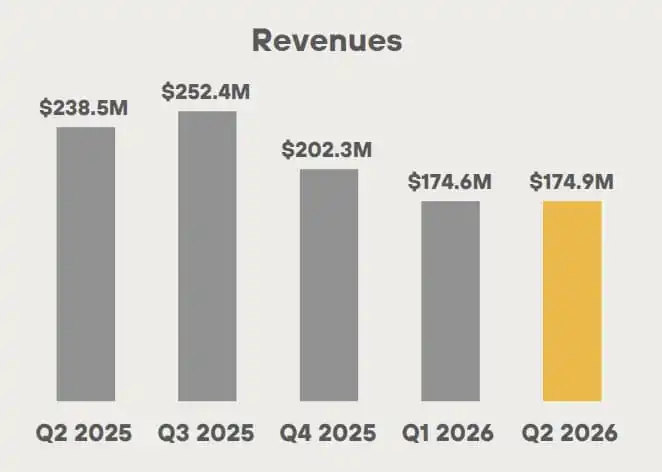
MARA mined 2,422 Bitcoins during the quarter, a slight increase from 2,358 Bitcoins in the same period last year, but its revenue still fell 27% year-over-year to $174.9 million. MARA's net loss for the quarter was $611.3 million, which also included $343 million in unrealized Bitcoin fair value losses. In other words, increased production could only partially offset the price decline and could not fully safeguard revenue.
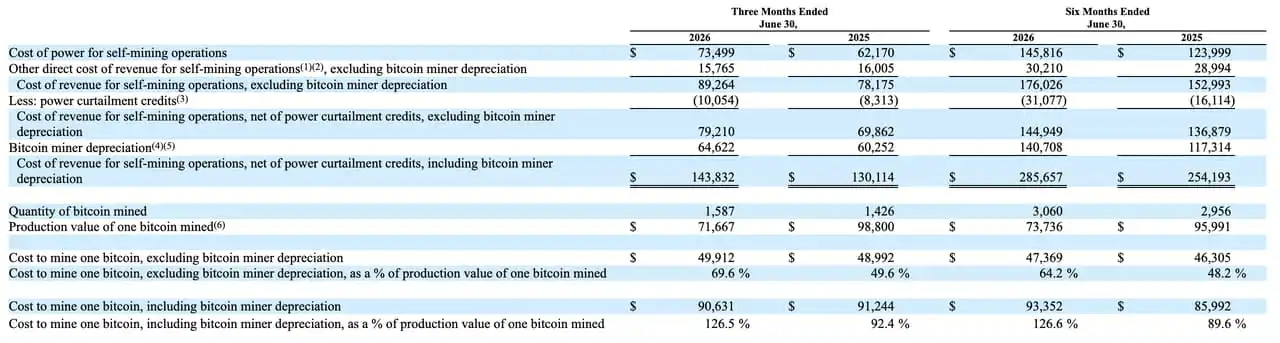
Riot Platforms presents a more typical case. The company produced 1,587 Bitcoins in Q2, an increase of about 11% year-over-year, but its mining revenue actually fell from $140.9 million to $113.7 million. The main reasons were the same: a decline in the average Bitcoin price and an increase in the global network hash rate. The production value per Bitcoin decreased from $98,800 to $71,667, while the mining cost per Bitcoin excluding rig depreciation increased from $48,992 to $49,912. Consequently, the cost-to-production-value ratio rose from 49.6% to 69.6%.
This doesn't mean the mining model is no longer viable, but rather that scale, machine efficiency, and electricity costs must work in tandem. American Bitcoin mined approximately 932 Bitcoins in Q2, a sequential increase of about 14%; mining revenue was approximately $67 million, up about 8% sequentially. Its mining cost per Bitcoin was around $36,500, with a gross margin close to 50%.

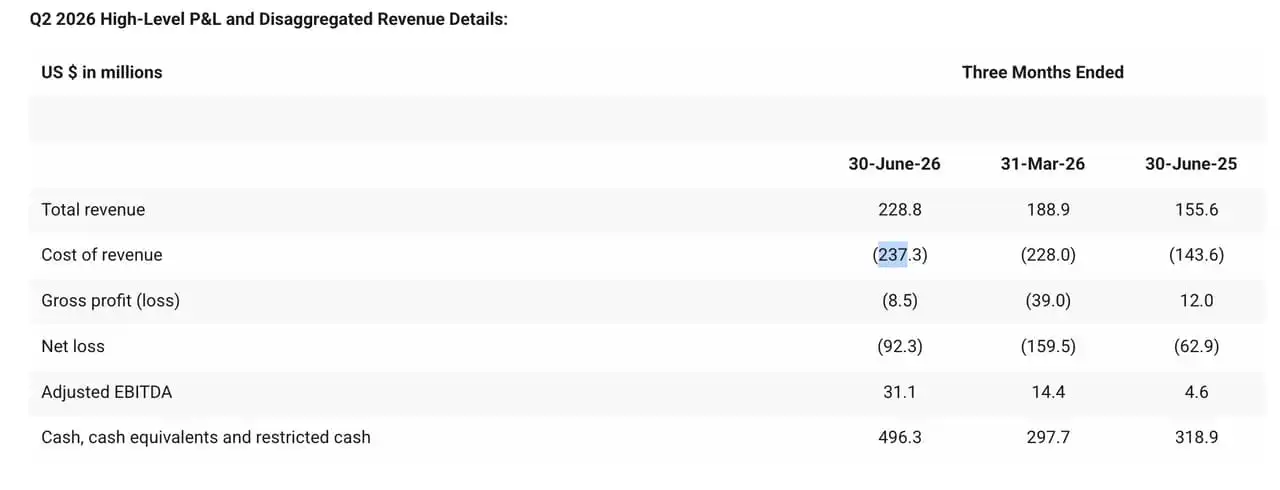
Bitdeer, however, shows another side: hash rate and production can expand rapidly, but profits may not follow synchronously. The company mined 2,694 Bitcoins in Q2, compared to 565 in the same period last year; total revenue increased 47% year-over-year to $228.8 million, with self-mining revenue contributing $168.4 million. However, the company's cost of revenue for the quarter reached $237.3 million, resulting in a gross loss of $8.5 million and a net loss of $92.3 million. Looking solely at production and revenue, it's easy to overlook that electricity costs, depreciation, and expansion costs had already exceeded current-period revenue.
AI Revenue Has Emerged, but Companies Are Not Starting from the Same Line

What is truly changing the industry landscape is that some miners have shifted from 'selling the Bitcoins they mine' to 'renting out power and data center space.'

Core Scientific is the most evident example of progress. The company's total revenue in Q2 was $164.2 million, of which high-density colocation revenue reached $136.7 million, accounting for approximately 83% of total revenue; self-mining revenue was only $21.5 million. In the same period last year, Core Scientific's colocation revenue was only $10.6 million. This signifies that its primary revenue source has shifted from mining to data center colocation, not merely the announcement of a future project.

A similar structural shift has occurred at TeraWulf. The company's Q2 revenue was $44.73 million, of which HPC leasing revenue was $31.93 million, accounting for about 71%, while digital asset revenue was $12.83 million. In contrast, in 2025, mining still constituted 90% (approximately $150 million) of TeraWulf's total revenue of $168.5 million, although it had already recorded its first HPC leasing revenue ($16.9 million) that year. The company has clearly stated that capital allocation and operational focus will primarily revolve around HPC data centers, and some existing mining farm infrastructure is also being repurposed.

Riot's transition is still in the ramp-up phase. Its Q2 total revenue was $174.2 million, up 14% year-over-year; of this, data center revenue was $23.2 million, while mining revenue remained at $113.7 million. It's worth noting that Riot's data center revenue includes $4.9 million in leasing revenue and $18.3 million in customer data center construction revenue – both are actual revenues recognized in the quarter's financials – but they are not yet sufficient to replace the mining business.

Cipher Digital reminds the market that 'commencing construction' and 'already generating HPC revenue' are two different things. The company's Q2 revenue was approximately $24.84 million, entirely from Bitcoin mining, with adjusted EBITDA at negative $30 million and a net loss of $267 million. Cipher only began delivering the first capacity of its Black Pearl project and started billing rent in early August, so this revenue was not yet reflected in Q2.

Hut 8's Q2 revenue increased from $41.3 million in the same period last year to $74.9 million, of which $72.5 million was categorized under Computing Operations. However, this category simultaneously includes ASIC computing, AI cloud, and traditional cloud services, meaning the entire $72.5 million cannot be directly labeled as AI revenue. Hut 8 still recorded a net loss of $177.1 million for Q2, of which $138.6 million was due to unrealized losses from digital assets.

AI Mega-Deals Dominate Headlines, but Revenue Realization Takes Time

The most common misinterpretation during miners' transition is mistaking the total value of long-term contracts for realized revenue.

Core Scientific disclosed leased customer power capacity of approximately 1.1GW, corresponding to potential contract revenue exceeding $24 billion, but its recognized colocation revenue for Q2 remained at $136.7 million; TeraWulf signed a 20-year lease with Anthropic post-quarter with an initial contract value of approximately $19 billion, but the company's Q2 HPC leasing revenue was only $31.9 million; Riot signed a 191MW data center lease post-quarter with an initial value of approximately $9.1 billion, while its Q2 data center revenue was $23.2 million.

These figures are not contradictory. The total contract value represents the potential revenue over the entire base lease term, typically recognized quarter-by-quarter into the financial statements only after the data center is built, delivered in phases, and billing commences. Project delays, construction cost variations, financing arrangements, and customer fulfillment can all affect the actual recognition pace. Therefore, when comparing miners' AI businesses, it's essential to distinguish at least three things: how much contract value has been signed, how much capacity has been delivered, and how much revenue was recognized in the current quarter.

Net profit also cannot be read in isolation from accounting items. For example, Core Scientific's Q2 net loss of $1.1553 billion was mainly affected by changes in the fair value of warrants; Cipher's net loss of $267.5 million included $150.5 million in fair value losses on warrants; MARA's loss was impacted by Bitcoin price revaluation. In contrast, Bitdeer's gross loss for the quarter reflects a situation where the cost of revenue already exceeded revenue, which is a different nature of loss.

Miners Are Evolving into Three Types of Companies

The Q2 financial reports show that listed mining companies can no longer be measured by the same standard.

American Bitcoin still primarily focuses on expanding hash rate, increasing production, and lowering the cost per coin; Core Scientific and TeraWulf already have a significant proportion of colocation or HPC revenue entering their current-period financials; companies like Riot and Cipher are in the intermediate stage of gradually delivering new projects.

Keel Infrastructure has taken an even more drastic path. This company, renamed from Bitfarms, has completed the shutdown of its US Bitcoin mining operations. Its Q2 revenue was approximately $30.43 million, down 50% year-over-year, due to the Bitcoin price decline and the closure of cryptocurrency mining operations in the Moses Lake area, USA, in April 2026; adjusted EBITDA was negative $23.7 million. The company has chosen to become an HPC infrastructure developer, but the new business has not yet formed a revenue stream sufficient to replace mining.
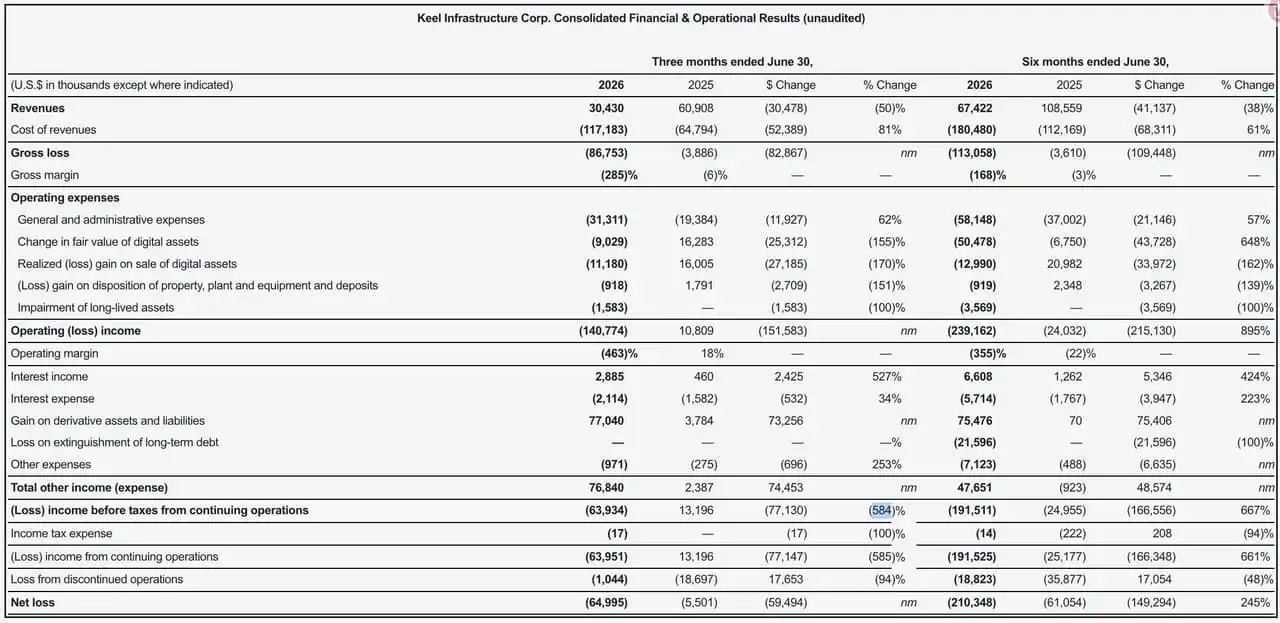
Therefore, what is truly noteworthy this quarter is not whether miners are all talking about AI, but rather the stage they have reached: some still rely on mining rigs to boost production, some have started collecting monthly data center rent, and others are experiencing a transitional period where old revenue streams are disappearing while new ones have not yet taken over.

The mining rigs are still roaring, but what will determine financial performance in the next phase is becoming: who possesses stable power, who can deliver data center capacity on time, and who can truly turn a long-term contract into current-period revenue.

Трендові криптовалюти

Пов'язані питання

QWhat is the main factor that put pressure on mining companies' revenues in Q2, despite some companies increasing their Bitcoin production?

AThe main factor was the drop in Bitcoin price. Although companies like MARA and Riot Platforms produced more Bitcoin compared to the same period last year, their mining revenues decreased because the average price per Bitcoin was lower. The decline in price outweighed the gains from increased production.

QAccording to the article, which company saw the most significant shift in its primary revenue source in Q2, moving away from Bitcoin mining?

ACore Scientific saw the most significant shift. In Q2, its high-density hosting revenue reached $136.7 million, accounting for approximately 83% of its total revenue of $164.2 million. In the same period last year, its hosting revenue was only $10.6 million, while now its self-mining revenue was just $21.5 million.

QWhy does the article caution against directly equating the total value of announced long-term AI/HPC contracts with a company's current revenue?

ABecause the contract total value represents the potential revenue over the entire lease term (e.g., 20 years). Revenue is only recognized in the financial statements quarterly after the data center capacity is built, delivered to the client, and billing begins. Project delays, construction costs, and client performance can all affect the actual timing and amount of revenue recognized.

QWhat are the three different strategic paths or stages that crypto mining companies are diverging into, as illustrated by the Q2 reports?

A1. Companies like American Bitcoin continue to focus on expanding hash rate, increasing Bitcoin production, and lowering the cost per coin. 2. Companies like Core Scientific and TeraWulf have already transitioned, with a large proportion of their current quarterly revenue coming from hosting/HPC rentals. 3. Companies like Riot and Cipher are in an intermediate stage, with new AI/HPC projects being gradually delivered, but mining still constitutes a major part of their revenue.

QWhat does the example of Keel Infrastructure (formerly Bitfarms) demonstrate about the risks of transitioning completely to the HPC/AI data center business?

AKeel Infrastructure demonstrates the transitional risk where old revenue streams disappear before new ones are fully established. The company shut down its US Bitcoin mining operations, leading to a 50% drop in Q2 revenue. While it has pivoted to becoming an HPC infrastructure developer, this new business has not yet generated sufficient revenue to replace the lost mining income, resulting in a negative adjusted EBITDA.

Пов'язані матеріали

Podcast Notes | U.S. Stocks Hit Another Record High: Senior Fund Manager Nancy Tengler's Portfolio Picks for the Second Half of the Year

Podcast Summary: Veteran fund manager Nancy Tengler (CEO/CIO of Laffer Tengler Investments) discusses her investment outlook for the second half of the year, amidst the S&P 500 reaching new highs. She is bullish on the market, citing strong, productivity-driven earnings growth and the current economic transformation. Tengler emphasizes that this rally differs from the 1990s bubble, as fundamentals (earnings) and price appreciation have been aligned. She outlines four key investment themes: 1. **AI Infrastructure:** Companies like Quanta Services (PWR), GE Vernova (GEV), Williams (WMB), and Deere (DE) to benefit from massive capital expenditures ($7.5 trillion over five years) in data centers and electrification. 2. **Growth Stocks at Value Prices:** Names like Nvidia (NVDA) and Amazon (AMZN), which she views as undervalued based on forward earnings and growth rates (e.g., NVDA's PEG ratio of 0.25). 3. **Cybersecurity:** Prefers CrowdStrike (CRWD) over Palo Alto Networks (PANW) while acknowledging growing competition. 4. **Financials & Consumer Discretionary:** Sees catch-up potential in Goldman Sachs (GS), JPMorgan (JPM), Brookfield Asset Management (BAM), Starbucks (SBUX), and Home Depot (HD). She avoids sectors like consumer staples, utilities, and most REITs in this strong growth environment. Key risks are a potential credit market breakdown or a resurgence of inflation. Tengler believes market leadership will broaden beyond mega-cap tech and advises long-term investors to stay invested.

marsbit42 хв тому

Podcast Notes | U.S. Stocks Hit Another Record High: Senior Fund Manager Nancy Tengler's Portfolio Picks for the Second Half of the Year

marsbit42 хв тому

Selling Block Space Is No Longer Profitable, Arbitrum and MegaETH Venture into Applications

Selling block space is no longer a sustainable core business for blockchains, as it is easily commoditized and generates insufficient revenue to support their valuations, especially when compared to the high fees generated by applications built on them. This report, following up on the "Verticalization" thesis, examines how chains like Arbitrum, Polygon, MegaETH, and Sophon are adapting. It categorizes their strategies into two main paths: **Ecosystem Expansion** and **Product Expansion**. **Ecosystem Expansion** involves chains extending their reach by offering their technology stack to others. Examples include Arbitrum, which earns revenue from chains like Robinhood's L2 built on Arbitrum Stack, and Polygon, which is positioning itself as a payment chain for fintech. However, this model faces challenges, as seen with Optimism's revenue drop after Base left its Superchain, and often fails to translate chain success into sustained token value due to ongoing emissions. **Product Expansion** sees chains vertically integrating by building their own applications to capture more value internally. MegaETH shifted focus to developing first-party consumer apps and launched a native stablecoin, USDm, to capture yield. Similarly, Sophon pivoted from being an independent chain to becoming an application builder on Base. The goal is to directly own the lucrative application fee streams that typically don't flow back to the underlying chain. The conclusion is that with hundreds of chains offering similar block space, differentiation through liquidity alone is not enough. To justify high valuations and ensure sustainability, chains are moving beyond their foundational role. They are evolving into broader ecosystems or application builders themselves, actively working to internalize the value generated within their networks. This represents a pragmatic shift towards utility, where chains are becoming more than just infrastructure providers in a highly competitive landscape.

marsbit1 год тому

Selling Block Space Is No Longer Profitable, Arbitrum and MegaETH Venture into Applications

marsbit1 год тому

Торгівля

Спот

Популярні статті

Як купити DATA

Ласкаво просимо до HTX.com! Ми зробили покупку DATA Network (DATA) простою та зручною. Дотримуйтесь нашої покрокової інструкції, щоб розпочати свою криптовалютну подорож.Крок 1: Створіть обліковий запис на HTXВикористовуйте свою електронну пошту або номер телефону, щоб зареєструвати обліковий запис на HTX безплатно. Пройдіть безпроблемну реєстрацію й отримайте доступ до всіх функцій.ЗареєструватисьКрок 2: Перейдіть до розділу Купити крипту і виберіть спосіб оплатиКредитна/дебетова картка: використовуйте вашу картку Visa або Mastercard, щоб миттєво купити DATA Network (DATA).Баланс: використовуйте кошти з балансу вашого рахунку HTX для безперешкодної торгівлі.Треті особи: ми додали популярні способи оплати, такі як Google Pay та Apple Pay, щоб підвищити зручність.P2P: Торгуйте безпосередньо з іншими користувачами на HTX.Позабіржова торгівля (OTC): ми пропонуємо індивідуальні послуги та конкурентні обмінні курси для трейдерів.Крок 3: Зберігайте свої DATA Network (DATA)Після придбання DATA Network (DATA) збережіть його у своєму обліковому записі на HTX. Крім того, ви можете відправити його в інше місце за допомогою блокчейн-переказу або використовувати його для торгівлі іншими криптовалютами.Крок 4: Торгівля DATA Network (DATA)Легко торгуйте DATA Network (DATA) на спотовому ринку HTX. Просто увійдіть до свого облікового запису, виберіть торгову пару, укладайте угоди та спостерігайте за ними в режимі реального часу. Ми пропонуємо зручний досвід як для початківців, так і для досвідчених трейдерів.

519 переглядів усьогоОпубліковано 2026.07.01Оновлено 2026.07.01

Як купити DATA

Обговорення

Ласкаво просимо до спільноти HTX. Тут ви можете бути в курсі останніх подій розвитку платформи та отримати доступ до професійної ринкової інформації. Нижче представлені думки користувачів щодо ціни DATA (DATA).

活动图片