Range Judgment Realized, Strategy Fully Executed | Guest Analysis

marsbitОпубліковано о 2026-01-09Востаннє оновлено о 2026-01-09

Анотація

In his weekly analysis, Cody Feng, a quantitative trading expert, reviews Bitcoin's price action from January 5 to 11. BTC movement aligned closely with his initial forecast, trading within a range of $84,000 to $94,500. The price faced strong resistance at the $93,000–$94,500 zone and later pulled back toward the mid-to-lower part of the range. A short position was executed near $94,000 based on signals from momentum and spread trading models, and the trade was closed around $90,584, capturing a profit of approximately 3.4%. The strategy emphasized pre-planned execution and disciplined risk management. Currently, Bitcoin has found support around $86,500, with technical indicators suggesting oversold conditions and a potential bounce. However, the overall structure remains a broad consolidation. A rebound toward $92,000–$93,000 is anticipated, where renewed selling pressure may emerge. A break above $94,500 would require a reassessment of the market outlook. Feng concludes that in a ranging market, executing well-defined strategies with strict risk controls is more critical than predicting directional moves.

Odaily guest market analyst Cody Feng, Master of Financial Statistics from Columbia University, has focused on quantitative trading of US stocks since college and gradually expanded to digital assets such as Bitcoin. He has built a systematic quantitative trading model and risk control system through practical experience; possesses keen data insight into market fluctuations, and is committed to continuous growth in the professional trading field, pursuing stable returns. He will delve into BTC technical, macroeconomic, and capital flow changes weekly, review and showcase practical strategies, and preview noteworthy upcoming developments for reference.
Bitcoin Mid-Week Review(01.05~01.11)

Conclusion First:

This week, Bitcoin's overall price action largely operated within the 84,000~94,500 USD oscillation range we provided at the beginning of the week. The price precisely encountered resistance in the 93,000~94,500 USD pressure zone and subsequently fell back to the middle-lower part of the range. Our core level judgments were verified by actual market performance.

In this trade, we established short positions near 94,000 USD and exited all positions near 91,000 USD, capturing approximately 3.4% profit (spot) from the range, completing a high-probability, low-drawdown profit realization in a ranging market.

I. Validation of This Week's Core Range and Key Levels

At the beginning of the week, we clearly stated that this week required close attention to the battle between bulls and bears at the upper and lower boundaries of the 84,000~94,500 USD range.

The actual movement showed that Bitcoin clearly met resistance after rebounding to the 93,000~94,500 USD pressure zone, with multiple failed attempts to break higher, subsequently leading to a pullback under pressure, validating the effectiveness of this area as a阶段性 "ceiling".

Regarding support levels, the price showed clear signs of stopping declines and stabilizing after falling to the 86,000~86,500 USD area, where buying interest began to emerge. The more critical support level at 84,000 USD has not been touched yet, and the overall structure remains within the wide-range oscillation framework.

II. Execution of Plan A (From Entry to Exit)

Based on the range oscillation judgment, our Plan A formulated at the start of the week was effectively executed.

When the price rebounded to the 93,000~94,500 USD zone showing signs of upward exhaustion, and both the (momentum, spread trading) models simultaneously issued top signals, we immediately established short positions at 93,771 USD. The market subsequently declined as expected.

When the "Spread Trading" model issued a bottom signal, we finally exited all positions at 90,584 USD, completing a full, emotion-free short trade. The entire trading process was not "hindsight analysis" but involved pre-planning, in-execution, and post-verification.

III. Operational Thoughts for the Latter Half of the Week

Bitcoin 4-Hour Chart: (Momentum Quantitative Model + Spread Trading Model)
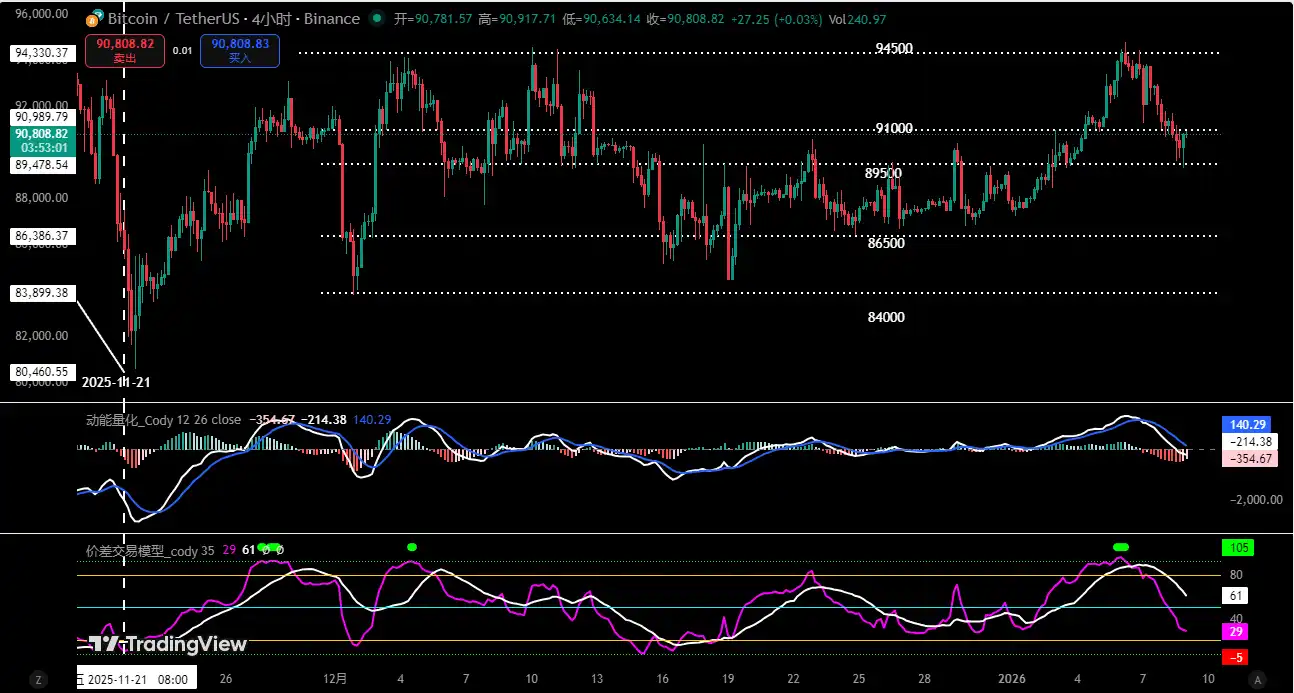
From the 4-hour technical structure (see chart above), Bitcoin has currently found effective support near 86,500 USD. Multiple technical indicators have entered oversold territory, indicating short-term selling pressure has been released. The market has a demand for a technical rebound correction (oscillatory rebound), but this is not yet sufficient to confirm a reversal of the downtrend.

Based on this, we anticipate the price may first rebound to test the 92,000~93,000 USD area. This level also coincides with the middle-upper part of the previous oscillation range and is expected to form resistance again.

For short-term operations, maintain a range-trading mindset: if the price reaches this zone and shows signs of momentum exhaustion or failed breakouts, consider building short positions on rallies; if it effectively breaks above 94,500 USD, stop loss decisively and reassess the market structure.

IV. Summary

Overall, Bitcoin continues to operate within the wide-range oscillation pattern defined at the beginning of the week: lower support provides room for rebounds, while upper resistance limits the upside. At present, rather than betting on a unilateral trend, it is more important to respect the range structure, focus on high-probability levels, and maintain strict risk control.

In ranging markets, formulating flexible response strategies and achieving stable profits is far more important than predicting direction.

Disclaimer: The above content is solely personal market opinion sharing and does not constitute any investment advice. Cryptocurrencies are highly volatile; please make independent judgments and strictly control risks.


Пов'язані питання

QWhat was the price range for Bitcoin's consolidation as predicted by analyst Cody Feng at the beginning of the week?

AThe predicted consolidation range for Bitcoin was between $84,000 and $94,500.

QAt what price level did the analyst establish a short position and what was the profit from this trade?

AA short position was established near $94,000 and closed near $91,000, capturing a profit of approximately 3.4%.

QWhat are the two technical models mentioned that provided signals for the trade execution?

AThe two technical models mentioned are the Momentum Quant Model and the Spread Trading Model.

QAccording to the 4-hour chart analysis, what is the expected next move for Bitcoin's price and the key resistance area to watch?

AA technical rebound or震荡反弹 (oscillatory rebound) is expected to test the $92,000 to $93,000 area.

QWhat is the overarching trading philosophy emphasized for the current market conditions described in the article?

AThe philosophy is to focus on high-probability price points and strict risk control within the range-bound structure, rather than betting on a one-directional trend, as formulating flexible strategies for stable profits is more important than predicting direction.

Пов'язані матеріали

In Conversation with Ray Dalio: We Are Currently in an AI Bubble, with 1% of My Portfolio in Bitcoin

Ray Dalio, founder of Bridgewater Associates, warns in an interview that the current AI boom shows classic bubble characteristics, which could lead to significant economic downturns as seen in past cycles like 1929 or 2000. He explains that speculative enthusiasm, fueled by debt and overvaluation, often precedes a crash when rising rates or taxation force asset sales, causing widespread losses and recession. Dalio also outlines his "Big Cycle" theory, describing an approximate 80-year pattern where widening wealth gaps, massive government deficits, and shifting geopolitical power (like China's rise) create internal conflict and global instability. He emphasizes that we are in a late-cycle, transitional phase where traditional powers like the US and UK face decline. For personal wealth protection, Dalio advises diversification beyond cash into assets like stocks, bonds, real estate, and particularly gold, which he prefers over Bitcoin. While he holds about 1% of his portfolio in Bitcoin as a non-printable hard asset, he views gold as more secure from technological or governmental threats. Regarding AI's impact, Dalio believes it will disproportionately benefit capital owners, worsening inequality by replacing both physical and cognitive labor. He suggests that human intuition and emotional intelligence, combined with AI, will be key for future workers. On taxation, Dalio argues that wealth taxes are impractical and risk triggering asset sell-offs, reducing productive investment. He points to the UK as a cautionary example of debt, low productivity, and political strife. Geopolitically, Dalio foresees a more regionalized world, with the US showing weakness in prolonged conflicts like with Iran, akin to past imperial declines. The ideal outcome, he suggests, is coexisting powerful blocs (e.g., Americas, China-Asia Pacific) without major war.

marsbit2 год тому

In Conversation with Ray Dalio: We Are Currently in an AI Bubble, with 1% of My Portfolio in Bitcoin

marsbit2 год тому

Daily 7.2 Trillion KRW: Foreign Capital's Record Net Buying on Friday! Wall Street Says Headwinds for Korean Stock Fund Flows Have Subsided

South Korean stock market sees a dramatic shift in fund flows. On July 31, foreign investors made a record net purchase of approximately KRW 7.2 trillion in KOSPI stocks, marking a fundamental reversal from the persistent large-scale net outflows seen in previous months. This contributed to a significant narrowing of foreign net selling in July to KRW 9.8 trillion, down sharply from KRW 48.4 trillion in June and KRW 44.5 trillion in May. Simultaneously, domestic institutional pressure eased. South Korean pension funds and asset managers turned to a net buying position in July, purchasing KRW 1.0 trillion worth of KOSPI shares, contrasting with net sales in May and June. Market volatility is expected to be dampened by new financial regulations. Effective July 31, the Financial Services Commission tightened access for retail investors to single-stock leveraged ETFs by raising the minimum cash deposit requirement. Trading volumes for these products subsequently dropped to about 50% of their monthly average. Citigroup Research maintains its year-end KOSPI target of 10,000 points. The firm cites several supportive factors: the substantial easing of headwinds from capital outflows, a robust fundamental outlook for the semiconductor sector, historically low market valuations, strong economic fundamentals, and the potential for policy support from financial authorities if needed.

marsbit2 год тому

Daily 7.2 Trillion KRW: Foreign Capital's Record Net Buying on Friday! Wall Street Says Headwinds for Korean Stock Fund Flows Have Subsided

marsbit2 год тому

Thanks to Dice Rolls, Bitcoin Keys Are Stored Offline, But Not Everyone Will Do It

The article discusses using dice rolls to generate secure Bitcoin wallet seeds, providing entropy independent of potentially flawed hardware random number generators. It explains that each fair dice roll offers about 2.585 bits of entropy, with around 50 rolls needed for a standard 12-word seed phrase and 99+ recommended for higher security. This method gained attention after a vulnerability was revealed in some Coldcard hardware wallets, where a faulty firmware RNG (dating back to 2021) compromised generated keys. The analysis notes that while a dice-generated main seed was safe from this specific flaw, other Coldcard functions (like creating paper wallets, backup keys, or passwords) could still be vulnerable if they used the defective RNG. The piece argues that while dice-based entropy is technically robust, the manual process is error-prone, tedious, and unrealistic for most new users, who might make mistakes in recording or inputting rolls. It concludes that while manual entropy generation should remain an option for advanced users, the long-term goal is to develop reliable, user-friendly hardware and software that securely generates randomness without requiring specialized knowledge. Coldcard users are advised to check their firmware version and replace any secondary secrets (like paper wallet keys) created with vulnerable devices, while also considering multi-signature setups with devices from different manufacturers for added security.

cryptonews.ru7 год тому

Thanks to Dice Rolls, Bitcoin Keys Are Stored Offline, But Not Everyone Will Do It

cryptonews.ru7 год тому

Торгівля

Спот
活动图片




