Pro-Cryptocurrency PAC Wins Primaries but Loses $2M Race in Florida

cryptonews.ruОпубліковано о 2026-08-19Востаннє оновлено о 2026-08-19

Анотація

A pro-cryptocurrency political action committee (PAC), Fairshake, achieved mixed results in recent U.S. primary elections, spending millions to influence races ahead of the 2026 midterms. Fairshake's affiliated PACs, Protect Progress and Defend American Jobs, supported candidates in Alaska, Florida, and Wyoming, spending approximately $3.6 million. Four out of five candidates backed by their ads won their primaries or advanced. These included Democrat Lois Frankel in Florida, Republican Nick Begich in Alaska, Republican Sydney Gruters in Florida, and Representative Harriet Hageman in Wyoming's Senate race. However, a high-profile $2 million negative ad campaign by Protect Progress failed to defeat Democrat Oliver Gilbert in Florida's 24th District. Gilbert won despite the ads, which he attributed to "Trump's techie-billionaire friends" and "crypto-scammers trying to buy a Democratic primary." A PAC representative defended the ads' factual accuracy. Fairshake, with a reported $193 million war chest, has spent over $130 million in the 2024 cycle supporting pro-crypto candidates and opposing critics. A spokesperson stated the PAC is "just getting started" to build the largest pro-crypto Congress in history. The outcomes could impact future crypto legislation, such as the pending CLARITY Act, as the 2026 elections may shift congressional control and determine which parties advance or block industry-related bills.

Four out of five candidates supported by advertising funded by the pro-cryptocurrency political action committee (PAC) Fairshake won their primaries or otherwise advanced on Tuesday. This could indicate the industry's influence on the 2026 midterm elections.

On Tuesday, Democratic and Republican candidates supported by advertising funded by the Fairshake-affiliated PACs Protect Progress and Defend American Jobs won victories in three U.S. states. In total, these PACs spent approximately $3.6 million on House and Senate races in Alaska, Florida, and Wyoming.

Democrat Lois Frankel was re-elected in Florida's 23rd congressional district after Protect Progress spent over $150,000 on advertising in her support. Defend American Jobs also spent a total of $1.5 million on advertising supporting Republican Nick Begich in Alaska's at-large congressional district, Republican candidate Sydney Gruters in Florida's 16th congressional district, and Representative Harriet Hageman in the U.S. Senate race for Wyoming. Gruters and Hageman won their primaries, and Begich is expected to advance to the next round in Alaska.

All four candidates are likely to continue competing with rivals in the November 2026 midterm elections. A Democrat in Florida's 24th district also won, despite over $2 million worth of negative advertising funded by Protect Progress. Oliver Gilbert defeated opponents Shevrin Jones and Kendrick Meek, receiving 34.4% of the vote, in a race that raised questions about the potential influence of the crypto industry.
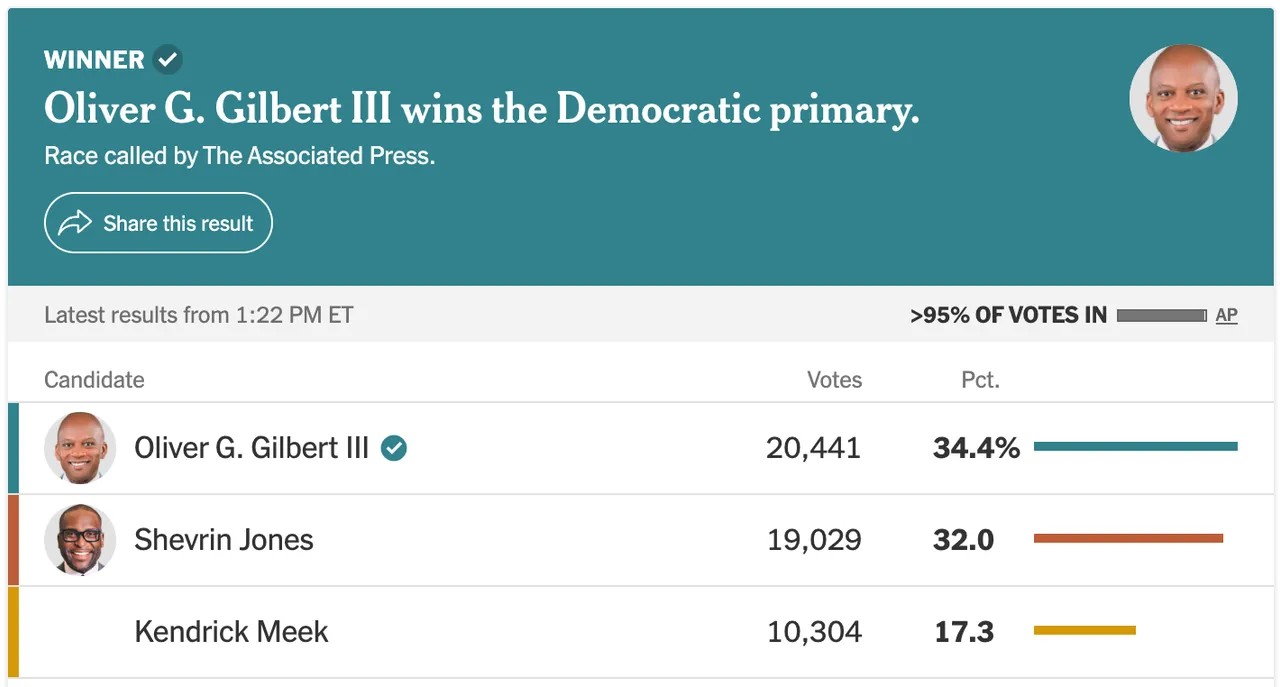
Results of the Democratic primary in Florida's 24th congressional district. Source: The New York Times

According to an August 12 report by the Miami Herald, Gilbert stated that '[Donald] Trump's buddies — the tech billionaires' were behind 'crypto crooks trying to buy the Democratic primary' through Protect Progress advertising. The publication reported that the ads used fake Miami Herald headlines that misrepresented Gilbert's policy positions, although a PAC spokesperson stated that 'the facts underlying our advertising are accurate.'

The Fairshake PAC, which reported having a war chest of $193 million in January, funded over $130 million in advertising in support of candidates it considered pro-cryptocurrency during the 2024 election cycle. The committee also ran ads against many candidates who spoke negatively about the industry or voted against its interests. By June, the committee had spent over $82 million on upcoming elections ahead of the 2026 midterms.

Related content: UK authorities continue investigation into Nigel Farage's cryptocurrency 'gifts' after by-election win

Gilbert did not mention the crypto industry or the advertising in his victory speech on Tuesday night. Fairshake spokesperson Jeff Vetter stated that after the primaries in three states and the victories of other candidates in 2026, the PAC is 'just getting started building the biggest pro-crypto Congress in history.'

Will the Composition of the Next Congress Affect the Crypto Market Structure Bill?

Both chambers of the U.S. Congress — the Senate and the House of Representatives — are on recess until September. The Senate is then expected to consider a cloture motion on the Digital Asset Regulatory Clarity Act (CLARITY Act), which is meant to establish comprehensive rules for digital assets. Although the House passed the bill with bipartisan support in July by a vote of 294–134, many Senate Democrats are pushing for stricter ethical rules related to the Trump family's cryptocurrency investments.

Following the 2026 elections, the U.S. Congress could shift from a Republican majority to a Democratic one depending on the outcome of key races that may be influenced by PACs like Fairshake. Lawmakers elected in November could accelerate or block legislative initiatives affecting the crypto industry, including the CLARITY Act, if the current session does not address the bill before 2027.

Magazine: 200,000 fake AI 'victims' used to scam internet scammers

end-content

Пов'язані питання

QWhich PAC, affiliated with the cryptocurrency industry, financed advertising campaigns in the primaries mentioned in the article?

AThe advertising campaigns were financed by the cryptocurrency-aligned Political Action Committee (PAC) Fairshake and its affiliated PACs, Protect Progress and Defend American Jobs.

QIn the Florida primaries, what was the outcome for candidate Oliver Gilbert, despite negative advertising funded by a crypto-aligned PAC?

AOliver Gilbert, a Democrat, won the primary in Florida's 24th district despite facing over $2 million in negative advertising funded by the Protect Progress PAC.

QWhat is the total amount reportedly spent by the Fairshake PAC and its affiliates on House and Senate elections in the mentioned states?

AThe Fairshake-affiliated PACs, Protect Progress and Defend American Jobs, spent about $3.6 million on House and Senate elections in Alaska, Florida, and Wyoming.

QWhat is the significance of the CLARITY Act mentioned in the article for the digital asset market in the U.S.?

AThe CLARITY Act (Clarity for Regulatory Understanding of Digital Assets) aims to establish a comprehensive regulatory framework for digital assets in the U.S., providing market clarity and rules for the industry.

QWhat is the stated goal of the Fairshake PAC's spokesperson regarding the composition of the next U.S. Congress?

AThe spokesperson for the Fairshake PAC, Jeff Vetter, stated that after the primary wins, the PAC is 'just beginning to build the largest pro-crypto Congress in history.'

Пов'язані матеріали

China Pinches the Vital Point of CPO

The article "China Grips the Achilles' Heel of CPO" details how China holds a strategic position in the global indium phosphide (InP) supply chain, a critical material for high-speed optical modules and CPO (Co-Packaged Optics) technology used in AI data centers. China controls over 70% of global indium reserves and produces more than half of the world's primary indium, primarily as a by-product of zinc/tin smelting. It further refines 70-80% of the globe's refined indium. This upstream dominance is compounded by the fact that key InP wafer producer AXT operates its primary production through its Chinese subsidiary, Beijing Tongmei. Adding to this leverage are China's export controls, first on InP products and later extending to high-purity indium (6N+ grade). These restrictions have created supply bottlenecks and uncertainty, straining foreign manufacturers like Japan's Sumitomo and Dowa, who rely heavily on Chinese materials. The resulting shortage has led to intense demand, with industry figures like Lumentum's CEO warning of severe constraints and companies like Coherent seeking direct assurances from China. This situation benefits Chinese InP supply chain companies. Firms like Yunnan Chihong Zinc & Germanium (a leading domestic InP wafer producer) and Zhuzhou Keneng (high-purity indium) report surging domestic revenues and orders. They are also making progress in high-end product validation and capacity expansion. However, challenges remain, including lengthy customer qualification cycles and a significant capacity gap compared to foreign leaders. The article frames the current AI-driven demand surge as a pivotal moment for China's InP industry. It references a historical lesson where China, despite controlling indium resources, once ceded value-add and pricing power to Japanese processors. The current scenario is seen as an opportunity to leverage upstream resource control to develop advanced manufacturing capabilities and secure greater influence in the global semiconductor materials market.

marsbit3 хв тому

China Pinches the Vital Point of CPO

marsbit3 хв тому

Russian Suspected of Stealing Cryptocurrency from Cold Wallet Worth Almost 10 Million Rubles

Russian authorities are investigating a suspect accused of stealing nearly 10 million rubles worth of cryptocurrency from a cold wallet. According to investigators, the wallet belonged to an unnamed commercial company executive's assistant. In March, the suspect allegedly gained access to the victim's wallet by "an unidentified method" and transferred the digital assets to another address. During a search of the suspect's home, police seized three computers and three mobile phones for forensic examination, as they may contain important digital evidence. The case is being investigated as grand larceny under the Russian Criminal Code, carrying a potential sentence of up to ten years in prison. Police are also checking the suspect's possible involvement in other cryptocurrency thefts and identifying potential accomplices. The article notes that while cold wallets (hardware wallets storing private keys offline) are considered more secure against remote hacking, they remain vulnerable if a perpetrator gains physical or direct access to the keys. In a related case earlier in June, a court in Tomsk sentenced two men to 8 and 9.5 years in a strict-regime colony for a robbery and cryptocurrency theft. They forced an acquaintance at knifepoint to log into a crypto exchange account and transfer over 85 bitcoins, valued at approximately $5.1 million at the time.

cryptonews.ru51 хв тому

Russian Suspected of Stealing Cryptocurrency from Cold Wallet Worth Almost 10 Million Rubles

cryptonews.ru51 хв тому

Bitwise Names Three Mistakes Investors Make When Assessing the Cryptocurrency Market

Bitwise's chief investment officer, Matt Hougan, identifies three common mistakes investors make when evaluating the cryptocurrency market, all stemming from a disconnect between its current perception and potential evolution. First, investors often view crypto applications like Uniswap or Aave solely through the lens of the $2 trillion crypto market. However, with the tokenization of traditional assets (like $150 trillion in equities and $350 trillion in bonds), the potential market for these platforms could become 100 times larger. Second, there's an underestimation of crypto-native companies. Despite entry by major financial firms (e.g., PayPal in stablecoins, Fidelity in custody), native players like Tether, Circle, and Coinbase retain dominant market shares due to speed, focus, and established user bases (though exceptions like BlackRock's Bitcoin ETF success exist). Third, future blockchain transaction volumes are underestimated. Tokenized securities could trade 24/7, not just 33 hours per week, and the rise of AI agents managing portfolios could increase transaction activity by 50-100 times. Hougan concludes that investors assess the sector based on its present state while the underlying infrastructure is rapidly changing through tokenization, expanding use cases, and increased operational scale. This gap between current perception and future potential creates significant investment opportunities.

cryptonews.ru54 хв тому

Bitwise Names Three Mistakes Investors Make When Assessing the Cryptocurrency Market

cryptonews.ru54 хв тому

Торгівля

Спот
活动图片