Pricing Mechanism Failure: Bitcoin Lost in Conflicting Narratives

marsbitОпубліковано о 2026-02-05Востаннє оновлено о 2026-02-05

Анотація

Bitcoin's identity crisis is causing its pricing mechanism to fail, as it simultaneously tries to function as four conflicting assets: an inflation hedge, a tech stock, digital gold, and an institutional reserve asset. This confusion was starkly exposed on January 29, 2026, when Bitcoin crashed 15% amid contradictory market events—falling both when it should have risen (as a safe haven during a stock market crash) and when it should have fallen (as a risk asset on hawkish signals). The article argues that Bitcoin's price is no longer driven by fundamentals like adoption or scarcity, but by institutional algorithmic trading and correlation assumptions with equities. Its volatility now moves in lockstep with stock market volatility (correlation of 0.88 with VIX), amplifying portfolio losses instead of providing diversification. Four potential resolution paths are outlined: Bitcoin could solidify as a strategic reserve asset (pushing price to $150K), normalize as a risk asset ($80K-$110K), become a true inflation hedge ($110K-$140K), or fail as a diversifier ($40K-$60K). The market's direction will be determined by key indicators like correlation shifts, government adoption announcements, on-chain activity, and volatility decoupling from stocks. Until Bitcoin’s identity is clearly defined, it will remain prone to reflexive price swings disconnected from utility.

Original Author: Luis Flavio Nunes

Original Compilation: Deep Tide TechFlow

Guide: On January 29, 2026, Bitcoin plummeted 15% in a single day, falling from $96,000 to $80,000. The strangeness lies in this: when the stock market crashed, it should have risen as a safe-haven asset, but it fell; when the Fed sent hawkish signals, it should have fallen as a risk asset, but it also fell. Bitcoin collapsed in both opposing events.

This article points out that Bitcoin is simultaneously playing four conflicting identities: inflation hedge, tech stock, digital gold, and institutional reserve asset. When these four identities vie for control, the result is chaos.

The author proposes four possible resolution paths and analyzes which path would push Bitcoin to $150,000.

Full Text Below:

On January 29, 2026, Bitcoin plummeted 15% in a single day, falling from $96,000 to $80,000. What is striking is not the crash itself, but that Bitcoin fell during the simultaneous occurrence of two opposing events.

The stock market crashed. This should have helped Bitcoin as a safe-haven asset.

The Fed signaled a tightening policy. This should have hit Bitcoin as a risk asset.

Bitcoin collapsed in both events. It moved with stocks when it should have moved opposite to them. It fell on hawkish news when digital gold should have risen. The fundamental logic of the market's understanding of what Bitcoin actually is was broken.

Four Incompatible Identities

Bitcoin is simultaneously trading as four different assets. Each identity demands different price behavior. When all four identities vie for control, the result is chaos.

Identity One: Inflation Hedge

Bitcoin has a fixed supply of 21 million coins. When governments print money and devalue currency, Bitcoin should rise. This was the original promise. Digital scarcity triumphs over government printing presses.

The data tells a different story. In 2025, when inflation panic dominated the markets, gold rose 64%. Bitcoin fell 26%. When the Consumer Price Index (CPI) showed unexpected increases, Bitcoin sometimes rose. When Core Personal Consumption Expenditures (Core PCE) showed inflation, Bitcoin sometimes fell. The reaction was random, not consistent.

If Bitcoin were truly an inflation hedge, it should react the same way to all inflation signals. Instead, it reacts to some signals and ignores others. This suggests Bitcoin is reacting to something else, perhaps energy prices that affect mining costs and consumer inflation.

Identity Two: Tech Stock

Bitcoin moves in sync with the Nasdaq. The 30-day correlation reached 0.68. When tech stocks fall due to growth concerns, Bitcoin falls. When the Fed hints at tightening and tech stocks sell off, Bitcoin sells off harder.

If Bitcoin were a tech stock, investors might as well buy the Nasdaq index directly. Tech stocks don't pay dividends, but they generate revenue and profits. Bitcoin generates neither. A pure tech bet through actual tech stocks makes more sense.

The problem goes deeper. Bitcoin was supposed to be uncorrelated with traditional markets. That was the whole value proposition. If Bitcoin is just a leveraged Nasdaq bet, then it has no place in a portfolio already holding stocks.

Identity Three: Digital Gold

In late January, when investors fled risk, gold soared to $5,500. Bitcoin crashed to $80,000. At the exact moment digital gold should have proven its value, the two assets moved in opposite directions.

Bitcoin's correlation with gold turned negative in 2026. Precisely negative 0.27. When gold rose 3.5% on hawkish Fed news, Bitcoin fell 15%. The Bitcoin-to-gold ratio hit a record low of 16.68x.

If Bitcoin is digital gold, it failed the most basic test. Gold works as a crisis hedge because it moves away from risk assets when panic rises. Bitcoin moves with risk assets, proving it is not gold in any meaningful sense.

Identity Four: Institutional Reserve Asset

Some companies and governments hold Bitcoin as a strategic reserve. Japan's Metaplanet holds 35,100 Bitcoins. The U.S. government integrates seized Bitcoin into its strategic reserves. This narrative suggests Bitcoin will become a core holding for pension funds and central banks.

The behavior doesn't match the story. Institutional investors are not holding through volatility. They are running basis trades, selling volatility, and treating Bitcoin as a trading tool. ETF flows mainly show arbitrage activity, not long-term conviction buying.

If institutions truly saw Bitcoin as a reserve asset like gold, they would accumulate during crashes and never sell. Instead, they sell during crashes and buy during rallies. This is trader behavior, not reserve manager behavior.

Valuation Paradox

Each identity implies a different fair value for Bitcoin.

If Bitcoin is an inflation hedge, based on gold's performance under similar monetary conditions, the price should be $120,000 to $150,000.

If Bitcoin is a tech stock, based on correlation with the Nasdaq and lack of cash flow, the price should be $50,000 to $70,000.

If Bitcoin is digital gold, based on gold's 65-year value trajectory applied to digital scarcity, the price should exceed $150,000.

If Bitcoin is an institutional reserve asset, the price should track government and corporate adoption rates, suggesting $100,000 to $120,000 by year-end.

The current price of $80,000 satisfies none of these frameworks. It is in the middle, pleasing no model and validating no thesis. This isn't the market finding equilibrium. This is a market that cannot agree on what it is pricing.

When Wall Street Can't Define What It Owns

Robbie Mitchnick manages digital asset strategy at BlackRock, the world's largest asset manager. In March 2025, he said something remarkable:

"Bitcoin fundamentally looks like digital gold. But some days it doesn't trade like it. Tariffs were announced, and it fell like a stock, which confused me because I don't understand why tariffs would affect Bitcoin. The answer is they don't."

Even Bitcoin's primary institutional advocates admit confusion. If BlackRock doesn't understand what Bitcoin is, how can retail investors be expected to know?

This confusion creates a mechanical problem. When institutions cannot classify an asset, they default to correlation-based risk models. These models assume historical correlations persist. When correlations shift suddenly, as in January, institutions must rebalance their portfolios. Rebalancing during a crash means forced selling. Forced selling creates a cascading effect.

Think of it like a ship's autopilot. The autopilot steers based on past wind patterns. When the wind suddenly changes direction, the autopilot overcorrects, causing violent swings. Human judgment could smooth the course, but the autopilot only knows historical patterns. Bitcoin's identity crisis is the changing wind, and institutional algorithms are the autopilot overcorrecting in the storm.
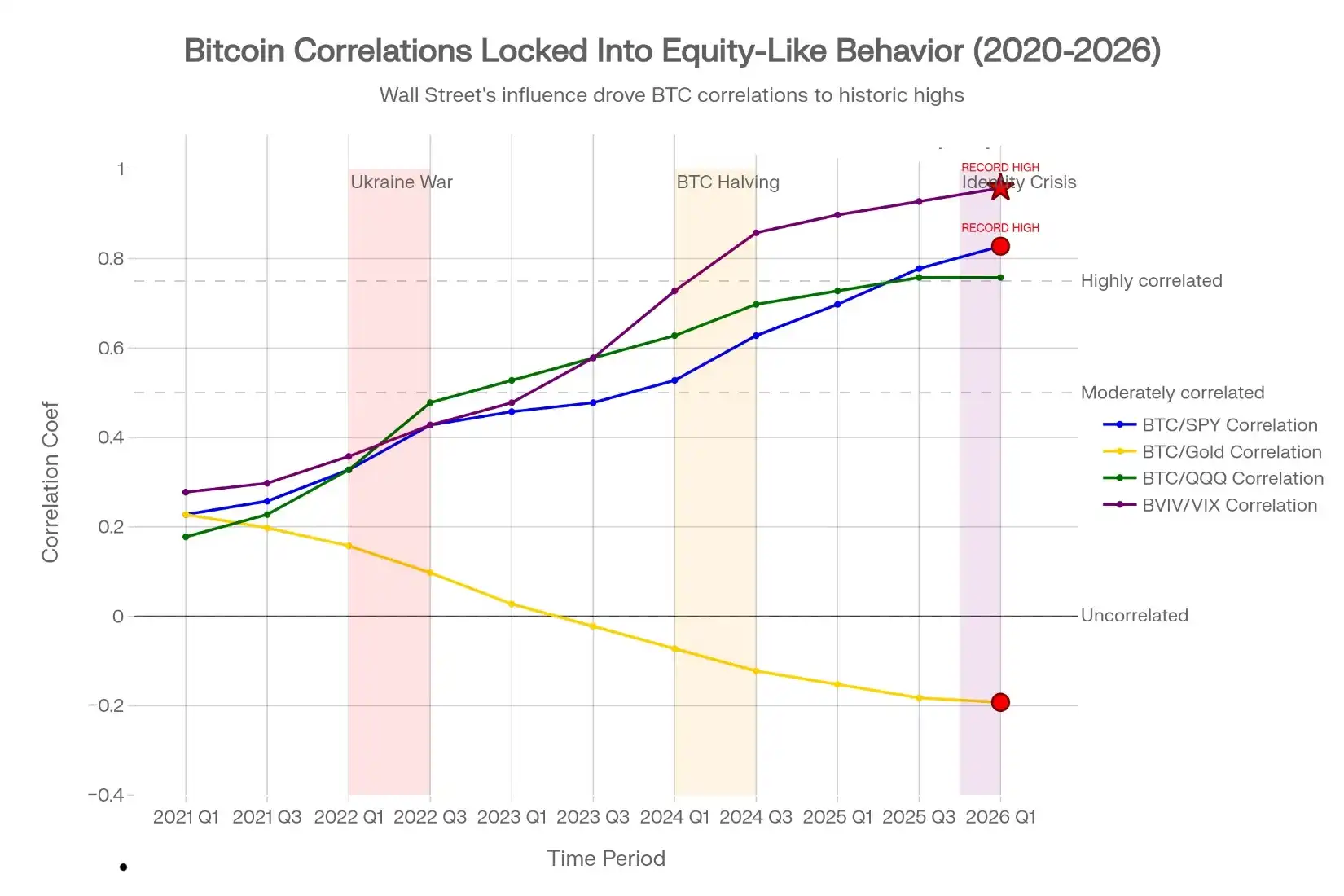
The Death of Diversification: Bitcoin's correlation with stocks surged from 0.15 (2021) to 0.75 (January 2026), a five-year shift driven entirely by institutional risk management, not Bitcoin adoption or fundamentals. A more destructive metric: Bitcoin volatility now correlates with stock volatility at 0.88 (purple line), the highest level ever recorded. This proves Bitcoin is traded mechanically based on stocks, not its own utility. Investors buying Bitcoin as a hedge are actually buying a leveraged, volatile stock bet that amplifies losses during crashes rather than offsetting them.

Volatility Homogenization

Bitcoin's volatility now moves in sync with stock market volatility. The correlation between Bitcoin volatility and the VIX stock volatility index reached 0.88 in January 2026. This is the highest reading ever recorded.

In 2020, this correlation was 0.2. Bitcoin volatility was independent. By 2026, it had become identical to stock volatility.

This is because institutional traders sell volatility across all asset classes simultaneously. When the VIX rises above certain levels, algorithms automatically sell Bitcoin, stocks, and commodities to reduce portfolio volatility. This mechanical selling has nothing to do with Bitcoin fundamentals. It is pure risk management, applied equally across all assets.

The result is that Bitcoin has lost independent price discovery. Its price is no longer driven by adoption, usage, or scarcity. It is driven by correlation assumptions and volatility control algorithms.

The data proves this. In January 2026, even as the price rebounded to $96,000, Bitcoin's daily active addresses were declining. Trading volume was falling even as institutional adoption was supposedly accelerating. The Lightning Network, which processes actual Bitcoin payments, grew 266% year-over-year. Yet the price fell.

Usage is up. Price is down. This proves that what drives the price is positioning and correlation, not fundamentals.

Reflexivity Trap

George Soros described reflexivity as a feedback loop where price movements themselves drive further movements, independent of fundamentals.

Bitcoin is caught in reflexivity.

Institutions assume a 0.75 correlation between Bitcoin and stocks. Option traders build hedges based on this assumption. When stocks move 2%, algorithms trigger a 2% move in Bitcoin. This creates a self-fulfilling prophecy. Bitcoin moves with stocks, so traders think it's a stock. Retail investors adopt this view and trade accordingly. Actual Bitcoin fundamentals become irrelevant. The price is completely detached from utility.

This is not temporary confusion. It is structural. Until institutions agree on what Bitcoin is, the reflexivity loop will persist. Every rally will contain the seeds of the next crash because the market cannot agree on why the rally is happening.

What Retail Investors Actually Own

Most retail investors think they own diversification when they buy Bitcoin. They believe Bitcoin protects against inflation and reduces stock exposure. The math proves otherwise.

Take a simple example. An investor holds $100,000 in stocks and allocates $5,000 to Bitcoin, expecting diversification.

When stocks fall 10%, the portfolio loses $9,000. But Bitcoin, with a 0.75 correlation, falls 15%. The Bitcoin position loses $750. Total loss: $9,750.

Without Bitcoin, the loss would have been $9,000. Bitcoin made the portfolio worse, not better. This correlation means Bitcoin amplifies stock losses rather than offsetting them.

True diversification requires negative correlation. Bonds are negatively correlated with stocks during risk-off periods. Gold is negatively correlated during crises. Bitcoin is positively correlated, making it useless as a hedge.

The Inevitable Resolution

Bitcoin cannot sustain four conflicting identities. The market will force a resolution in 2026 through one of four paths.

Path One: Strategic Reserve

Governments and corporations treat Bitcoin like gold reserves. They buy and never sell. Price volatility becomes irrelevant because holders measure success in decades, not quarters. Institutions stop trading Bitcoin and start hoarding it. Price finds equilibrium based on slow, steady accumulation. This path leads to $120,000 to $150,000 by year-end.

Path Two: Risk Asset Normalization

Institutions formally classify Bitcoin as a commodity derivative or stock analogue. They build risk models that account for extreme volatility. They accept that Bitcoin is not a hedge but a leveraged bet on monetary expansion. Position sizing adjusts accordingly. Correlations become predictable because everyone agrees on what Bitcoin is. Price trades in an $80,000 to $110,000 range with lower volatility.

Path Three: Inflation Hedge Acceptance

After resolving which inflation metric matters, the market agrees Bitcoin reacts to monetary debasement, not consumer price changes. Correlation with stocks falls to 0.3 or 0.4. Bitcoin becomes a true alternative to gold. This path leads to $110,000 to $140,000 as portfolio managers allocate for inflation protection.

Path Four: Diversification Failure

Institutions realize Bitcoin cannot diversify a stock portfolio. A 0.75 correlation is too high to justify an allocation. Capital flows reverse as portfolio managers exit. Retail investors understand Bitcoin is not a hedge. Price falls to $40,000 to $60,000 as the strategic allocation story collapses.

The most likely outcome is a slow resolution in 2026. Bitcoin will gradually shift from a risk asset to a reserve asset, with periodic corrections as institutions recalibrate. Price will consolidate between $80,000 and $110,000 until one path dominates.

What to Watch

Four indicators will show which path Bitcoin takes.

  • Correlation Inflection: If Bitcoin stops moving with stocks and correlation drops below 0.5, it becomes a hedge again. This favors Path Three.
  • Government Announcements: If a major government formally allocates Bitcoin to reserves, Path One accelerates. Watch for announcements from the U.S., E.U., or Japan.
  • On-Chain Metrics: If daily active addresses and transaction volume reverse upward while price is flat or falling, fundamentals are improving even as speculation decreases. This indicates long-term strength.
  • Volatility Normalization: If the correlation between Bitcoin volatility and stock volatility drops below 0.60, institutional volatility selling is easing. This allows true price discovery to return.

These indicators don't require capital to track. They provide better insight than price charts.

Conclusion

Bitcoin's fall to $80,000 was no accident. It was Bitcoin confronting a question it has avoided since institutional money arrived: What am I?

Until there is a clear answer to this question, every rally will contain the seeds of the next crash. Bitcoin will move with stocks when it should diverge. It will fall on news that should help it. It will rise on developments that shouldn't matter.

This is not temporary confusion. It is a structural identity crisis that defines the entire 2026 narrative.

Investors buying Bitcoin as an inflation hedge will be disappointed during inflation panics. Investors buying it for diversification will be disappointed when it amplifies stock losses. Investors buying it as digital gold will be disappointed when it trades like a tech stock.

The only investors who will succeed are those who understand Bitcoin is currently none of these things. It is a positioning-driven, correlation-dependent, volatility-controlled instrument that has temporarily lost its connection to its fundamental purpose.

The crash exposed this truth. The recovery will depend on Bitcoin's ability to answer what it is before institutions decide the answer for it.


Пов'язані питання

QWhat are the four conflicting identities that Bitcoin is simultaneously trying to embody according to the article?

AThe four conflicting identities are: 1) Inflation hedge, 2) Tech stock, 3) Digital gold, and 4) Institutional reserve asset.

QWhy did the author describe Bitcoin's price drop on January 29, 2026, as particularly significant?

AIt was significant because Bitcoin crashed in response to two opposing events simultaneously: a stock market crash (where it should have risen as a safe-haven asset) and a hawkish signal from the Fed (where it should have fallen as a risk asset). This broke the fundamental logic of how the market understood Bitcoin.

QWhat is the article's main argument for why Bitcoin's price action has become chaotic and disconnected from its fundamentals?

AThe main argument is that institutional algorithms and risk models, which trade Bitcoin based on its high correlation to stocks and volatility control mechanisms, have taken over price discovery. This creates a reflexive loop where price movements are driven by positioning and correlation assumptions rather than adoption, utility, or scarcity.

QWhat does the 'volatility homogenization' phenomenon refer to in the context of Bitcoin's trading behavior?

AVolatility homogenization refers to the phenomenon where Bitcoin's volatility has become highly correlated (0.88) with stock market volatility (VIX). This means algorithms automatically sell Bitcoin along with stocks when volatility spikes to manage portfolio risk, making its price movements mechanical and detached from its own fundamentals.

QAccording to the author, what are the four possible paths for a resolution to Bitcoin's identity crisis, and which one would push its price toward $150,000?

AThe four paths are: 1) Strategic Reserve (price target $120K-$150K), 2) Risk Asset Normalization ($80K-$110K), 3) Inflation Hedge Acceptance ($110K-$140K), and 4) Diversification Failure ($40K-$60K). The path that would push the price toward $150,000 is Path One, the Strategic Reserve path, where governments and corporations treat it like gold and accumulate it long-term without selling.

Пов'язані матеріали

How Many Tokens Away Is Yang Zhilin from the 'Moon Chasing the Light'?

The article explores the intense competition between two leading Chinese AI companies, DeepSeek and Kimi (Moon Dark Side), and the mounting pressure on Yang Zhilin, the founder of Kimi. While DeepSeek re-emerged after 15 months of silence with its powerful V4 model—boasting 1.6 trillion parameters and low-cost, long-context capabilities—Kimi has been focusing on long-context processing and multi-agent systems with its K2.6 model. Yang faces a threefold challenge: technological rivalry, commercialization pressure, and investor expectations. Despite Kimi’s high valuation (reaching $18 billion), its revenue heavily relies on a single product with low paid conversion rates, while DeepSeek’s strategic silence and open-source influence have strengthened its market position and valuation prospects, now targeting over $20 billion. Both companies reflect broader trends in China’s AI ecosystem: Kimi aims for global influence through open-source contributions and agent-based advancements, while DeepSeek prioritizes foundational innovation and hardware independence, notably shifting to Huawei’s chips. Their competition is seen as vital for China’s AI progress, with the gap between top Chinese and U.S. models narrowing to just 2.7% on the Elo rating scale. Ultimately, the article argues that this rivalry, though anxiety-inducing for leaders like Zhilin, is essential for driving innovation and solidifying China’s role in the global AI landscape.

marsbit2 год тому

How Many Tokens Away Is Yang Zhilin from the 'Moon Chasing the Light'?

marsbit2 год тому

TechFlow Intelligence Bureau: ChatGPT Helps Amateur Mathematician Crack 60-Year-Old Problem, CFTC Sues New York Regulator Over Coinbase and Gemini

An amateur mathematician, with the assistance of ChatGPT, has solved a combinatorial mathematics puzzle originally proposed by Hungarian mathematician Paul Erdős in the 1960s. This marks another milestone in AI-aided mathematical research, demonstrating the evolving capabilities of large language models in formal reasoning. In other AI developments, OpenAI introduced a new privacy filter tool for enterprise API usage, automatically screening sensitive data. Meanwhile, the Qwen3.6-27B model achieved 100 tokens per second on a single RTX 5090 GPU using quantization, significantly lowering the cost barrier for local AI deployment. In crypto and Web3, the U.S. CFTC sued New York’s financial regulator, challenging its oversight of Coinbase and Gemini—a first-of-its-kind federal-state regulatory clash. Following a vulnerability, KelpDAO and major DeFi protocols established a recovery fund. Tether froze $344 million in assets linked to Iran’s central bank upon U.S. Treasury request, highlighting the centralized control risks in stablecoins. Separately, Litecoin underwent a 3-hour chain reorganization to undo a privacy-layer exploit. In the U.S., former President Trump invoked the Defense Production Act to address power grid bottlenecks affecting AI data centers and dismissed the entire National Science Board, raising concerns over research independence. A retail trader gained 250% on a $600k Intel options bet amid AI-related speculation. Xiaomi announced its first performance electric vehicle, targeting rivals like Tesla. Meanwhile, iPhone users reported devices automatically reinstalling a hidden app daily, suspected to be MDM-related. A Chinese securities report noted that A-share institutional crowding has reached its second-longest streak since 2007, signaling high valuations and potential style rotation. The day’s developments reflect a dual narrative: AI is enabling unprecedented individual breakthroughs, while centralized power structures—whether governmental or corporate—are becoming more assertive, underscoring that decentralization is as much a political-economic challenge as a technical one.

marsbit2 год тому

TechFlow Intelligence Bureau: ChatGPT Helps Amateur Mathematician Crack 60-Year-Old Problem, CFTC Sues New York Regulator Over Coinbase and Gemini

marsbit2 год тому

Торгівля

Спот
Ф'ючерси

Популярні статті

Що таке BITCOIN

Розуміння HarryPotterObamaSonic10Inu (ERC-20) та його позиції у крипто-просторі Останніми роками ринок криптовалют спостерігав за зростанням популярності мем-коінів, які привертають інтерес не тільки трейдерів, але й тих, хто шукає спілкування та розважальну цінність. Серед цих унікальних токенів є HarryPotterObamaSonic10Inu (ERC-20), інтригуючий проект, що поєднує культурні посилання з тканинами криптовалюти. Ця стаття досліджує ключові аспекти HarryPotterObamaSonic10Inu, вивчаючи його механізми, спільноту та його взаємодію з ширшим крипто-ландшафтом. Що таке HarryPotterObamaSonic10Inu (ERC-20)? Як випливає з його назви, HarryPotterObamaSonic10Inu є мем-коіном, побудованим на блокчейні Ethereum, класифікованим за стандартом ERC-20. На відміну від традиційних криптовалют, які можуть підкреслювати практичну корисність або інвестиційний потенціал, цей токен процвітає завдяки розважальній цінності та силі своєї спільноти. Проект спрямований на створення середовища, де зацікавлені користувачі можуть об'єднуватися, ділитися ідеями та брати участь у заходах, натхненних різноманітними культурними явищами. Однією з примітних особливостей HarryPotterObamaSonic10Inu є нульовий податок на транзакції. Цей привабливий елемент має на меті заохочувати торгівлю та участь у спільноті, позбавлену додаткових витрат, які можуть відлякувати дрібних трейдерів. Загальна пропозиція монет становить один мільярд токенів, що позначає намір підтримувати суттєву циркуляцію в межах спільноти. Творець HarryPotterObamaSonic10Inu (ERC-20) Походження HarryPotterObamaSonic10Inu дещо окутане таємницею; деталі про творця залишаються невідомими. Розвиток цього токена позбавлений впізнаваної команди або чіткої стратегії, що не є рідкістю в секторі мем-коінів. Натомість проект виник органічно, а його розвиток значною мірою залежить від ентузіазму та участі його спільноти. Інвестори HarryPotterObamaSonic10Inu (ERC-20) Щодо зовнішніх інвестицій та підтримки, HarryPotterObamaSonic10Inu також залишається невизначеним. Токен не зазначає жодних відомих інвестиційних фондів або значної організаційної підтримки. Натомість життєва сила проекту полягає в його базовій спільноті, яка інформує про його зростання та стійкість через колективні дії та залученість у крипто-просторі. Як працює HarryPotterObamaSonic10Inu (ERC-20)? Як мем-коін, HarryPotterObamaSonic10Inu функціонує передусім поза традиційними рамками, що часто регулюють вартість активів. Є кілька відмінних аспектів, що визначають, як працює проект: Транзакції без податку: Завдяки відсутності податкових зборів на транзакції, користувачі можуть вільно купувати та продавати токен, не турбуючись про приховані витрати. Залучення спільноти: Проект процвітає завдяки взаємодії спільноти, використовуючи соціальні медіа для створення шуму та сприяння залученню. Обговорення, обмін контентом та залученість є ключовими елементами, що допомагають розширити його охоплення та зміцнити лояльність серед прихильників. Відсутність практичної корисності: Слід зазначити, що HarryPotterObamaSonic10Inu не пропонує конкретної корисності в рамках фінансової екосистеми. Натомість він класифікується як токен, що призначений в основному для розваги та спільнотних активностей. Культурне посилання: Токен кмітливо вплітає елементи популярної культури, щоб привернути інтерес, зв'язуючи з ентузіастами мемів та крипто-стежками. HarryPotterObamaSonic10Inu ілюструє, як мем-коіни функціонують інакше, ніж традиційні криптовалютні проекти, увійшовши на ринок як інноваційні соціальні конструкти, а не утилітарні активи. Хронологія HarryPotterObamaSonic10Inu (ERC-20) Історія HarryPotterObamaSonic10Inu відзначена кількома значними етапами: Створення: Токен виник з вірусного мему, захопивши уяву багатьох крипто-ентузіастів. Конкретні дати створення недоступні, що підкреслює його органічний розвиток. Лістинг на біржах: HarryPotterObamaSonic10Inu з'явився на різних біржах, дозволяючи зручніший доступ і торгівлю спільноти. Ініціативи залучення спільноти: Ведення діяльності, спрямованої на покращення взаємодії спільноти, включаючи конкурси, кампанії в соціальних мережах та створення контенту від фанатів та прихильників. Плани на майбутнє: Дорожня карта проекту включає запуск колекції NFT, мерчандайзинг та електронну комерцію, пов'язану з його культурними темами, що далі залучає спільноту та намагається додати більше вимірів до його екосистеми. Ключові моменти про HarryPotterObamaSonic10Inu (ERC-20) Спільнотний підхід: Проект надає пріоритет колективному внеску та креативності, забезпечуючи, щоб участь користувачів була в центрі його розвитку. Класифікація як мем-коін: Це є його епігенез розважальної криптовалюти, що відрізняється від традиційних інвестиційних інструментів. Жодного прямого відношення до Bitcoin: Незважаючи на схожість у назві, HarryPotterObamaSonic10Inu є відмінним і не має жодного зв’язку з Bitcoin або іншими усталеними криптовалютами. Зосередженість на співпраці: HarryPotterObamaSonic10Inu створено для того, щоб надати простір для співпраці та обміну історіями серед його власників, забезпечуючи шлях для творчості та спільного зв'язку. Перспективи на майбутнє: Амбіція розширитися за межі початкової концепції в NFT та мерчандайз відкриває шлях для проекту потенційно потрапити в більш мейнстрімні сфери цифрової культури. Оскільки мем-коіни продовжують захоплювати уяву спільноти криптовалют, HarryPotterObamaSonic10Inu (ERC-20) вирізняється своїми культурними зв'язками та орієнтованим на спільноту підходом. Хоча він може не відповідати типовій моделі утилітарного токена, його суть полягає в радощах і товариськості, що підтримуються серед його прихильників, підкреслюючи еволюційну природу криптовалют в усе більш цифрову епоху. Оскільки проект продовжує розвиватися, важливо спостерігати за тим, як динаміка спільноти вплине на його траєкторію в постійно змінюваному ландшафті технології блокчейн.

1.7k переглядів усьогоОпубліковано 2024.04.01Оновлено 2024.12.03

Що таке BITCOIN

Як купити BTC

Ласкаво просимо до HTX.com! Ми зробили покупку Bitcoin (BTC) простою та зручною. Дотримуйтесь нашої покрокової інструкції, щоб розпочати свою криптовалютну подорож.Крок 1: Створіть обліковий запис на HTXВикористовуйте свою електронну пошту або номер телефону, щоб зареєструвати обліковий запис на HTX безплатно. Пройдіть безпроблемну реєстрацію й отримайте доступ до всіх функцій.ЗареєструватисьКрок 2: Перейдіть до розділу Купити крипту і виберіть спосіб оплатиКредитна/дебетова картка: використовуйте вашу картку Visa або Mastercard, щоб миттєво купити Bitcoin (BTC).Баланс: використовуйте кошти з балансу вашого рахунку HTX для безперешкодної торгівлі.Треті особи: ми додали популярні способи оплати, такі як Google Pay та Apple Pay, щоб підвищити зручність.P2P: Торгуйте безпосередньо з іншими користувачами на HTX.Позабіржова торгівля (OTC): ми пропонуємо індивідуальні послуги та конкурентні обмінні курси для трейдерів.Крок 3: Зберігайте свої Bitcoin (BTC)Після придбання Bitcoin (BTC) збережіть його у своєму обліковому записі на HTX. Крім того, ви можете відправити його в інше місце за допомогою блокчейн-переказу або використовувати його для торгівлі іншими криптовалютами.Крок 4: Торгівля Bitcoin (BTC)Легко торгуйте Bitcoin (BTC) на спотовому ринку HTX. Просто увійдіть до свого облікового запису, виберіть торгову пару, укладайте угоди та спостерігайте за ними в режимі реального часу. Ми пропонуємо зручний досвід як для початківців, так і для досвідчених трейдерів.

4.3k переглядів усьогоОпубліковано 2024.12.12Оновлено 2025.03.21

Як купити BTC

Що таке $BITCOIN

ЦИФРОВЕ ЗОЛОТО ($BITCOIN): Комплексний аналіз Вступ до ЦИФРОВОГО ЗОЛОТА ($BITCOIN) ЦИФРОВЕ ЗОЛОТО ($BITCOIN) — це проект на основі блокчейну, що працює в мережі Solana, який має на меті поєднати характеристики традиційних дорогоцінних металів з інноваціями децентралізованих технологій. Хоча він має таку ж назву, як і Bitcoin, який часто називають “цифровим золотом” через його сприйняття як засобу збереження вартості, ЦИФРОВЕ ЗОЛОТО є окремим токеном, розробленим для створення унікальної екосистеми в ландшафті Web3. Його мета — позиціонувати себе як життєздатний альтернативний цифровий актив, хоча деталі щодо його застосувань і функціональностей все ще розробляються. Що таке ЦИФРОВЕ ЗОЛОТО ($BITCOIN)? ЦИФРОВЕ ЗОЛОТО ($BITCOIN) — це токен криптовалюти, спеціально розроблений для використання в блокчейні Solana. На відміну від Bitcoin, який виконує широко визнану роль зберігання вартості, цей токен, здається, зосереджується на більш широких застосуваннях і характеристиках. Помітні аспекти включають: Інфраструктура блокчейну: Токен побудований на блокчейні Solana, відомому своєю здатністю обробляти швидкі та низьковартісні транзакції. Динаміка постачання: ЦИФРОВЕ ЗОЛОТО має максимальне постачання, обмежене 100 квадрильйонами токенів (100P $BITCOIN), хоча деталі щодо його обігового постачання наразі не розголошуються. Утиліта: Хоча точні функціональності не викладені, є вказівки на те, що токен може бути використаний для різних застосувань, потенційно пов'язаних з децентралізованими додатками (dApps) або стратегіями токенізації активів. Хто є творцем ЦИФРОВОГО ЗОЛОТА ($BITCOIN)? На даний момент особа творців і команди розробників, що стоять за ЦИФРОВИМ ЗОЛОТОМ ($BITCOIN), залишається невідомою. Ця ситуація є типовою для багатьох інноваційних проектів у сфері блокчейну, особливо тих, що пов'язані з децентралізованими фінансами та феноменом мем-коінів. Хоча така анонімність може сприяти культурі, орієнтованій на спільноту, вона посилює занепокоєння щодо управління та підзвітності. Хто є інвесторами ЦИФРОВОГО ЗОЛОТА ($BITCOIN)? Доступна інформація вказує на те, що ЦИФРОВЕ ЗОЛОТО ($BITCOIN) не має жодних відомих інституційних спонсорів або помітних венчурних капіталовкладень. Проект, здається, працює за моделлю “рівний до рівного”, зосереджуючись на підтримці та прийнятті спільноти, а не на традиційних шляхах фінансування. Його активність і ліквідність переважно розташовані на децентралізованих біржах (DEX), таких як PumpSwap, а не на встановлених централізованих торгових платформах, що ще більше підкреслює його підхід знизу вгору. Як працює ЦИФРОВЕ ЗОЛОТО ($BITCOIN) Операційні механізми ЦИФРОВОГО ЗОЛОТА ($BITCOIN) можна детальніше розглянути на основі його дизайну блокчейну та характеристик мережі: Механізм консенсусу: Використовуючи унікальний proof-of-history (PoH) Solana в поєднанні з моделлю proof-of-stake (PoS), проект забезпечує ефективну валідацію транзакцій, що сприяє високій продуктивності мережі. Токеноміка: Хоча конкретні дефляційні механізми не були детально описані, велике максимальне постачання токенів вказує на те, що воно може задовольняти мікротранзакції або нішеві випадки використання, які ще потрібно визначити. Інтероперабельність: Існує потенціал для інтеграції з більш широкою екосистемою Solana, включаючи різні платформи децентралізованих фінансів (DeFi). Однак деталі щодо конкретних інтеграцій залишаються невизначеними. Хронологія ключових подій Ось хронологія, яка підкреслює значні віхи, пов'язані з ЦИФРОВИМ ЗОЛОТОМ ($BITCOIN): 2023: Початкове розгортання токена відбувається на блокчейні Solana, позначене його адресою контракту. 2024: ЦИФРОВЕ ЗОЛОТО набуває видимості, оскільки стає доступним для торгівлі на децентралізованих біржах, таких як PumpSwap, що дозволяє користувачам торгувати ним проти SOL. 2025: Проект спостерігає спорадичну торгову активність і потенційний інтерес до ініціатив, очолюваних спільнотою, хоча на даний момент не зафіксовано жодних значних партнерств або технічних досягнень. Критичний аналіз Сильні сторони Масштабованість: Основна інфраструктура Solana підтримує високі обсяги транзакцій, що може підвищити утиліту $BITCOIN у різних сценаріях транзакцій. Доступність: Потенційно низька торгова ціна за токен може привабити роздрібних інвесторів, сприяючи більш широкій участі завдяки можливостям дробового володіння. Ризики Відсутність прозорості: Відсутність публічно відомих спонсорів, розробників або процесу аудиту може викликати скептицизм щодо стійкості та надійності проекту. Волатильність ринку: Торгова активність сильно залежить від спекулятивної поведінки, що може призвести до значної волатильності цін і невизначеності для інвесторів. Висновок ЦИФРОВЕ ЗОЛОТО ($BITCOIN) постає як цікавій, але неоднозначний проект у швидко розвиваючійся екосистемі Solana. Хоча він намагається використати наратив “цифрового золота”, його відхід від встановленої ролі Bitcoin як засобу збереження вартості підкреслює необхідність чіткішого розмежування його передбачуваної утиліти та структури управління. Майбутнє прийняття та адаптація, ймовірно, залежатиме від вирішення поточної непрозорості та більш чіткого визначення його операційних та економічних стратегій. Примітка: Цей звіт охоплює синтезовану інформацію, доступну станом на жовтень 2023 року, і можуть відбутися події, що виходять за межі дослідницького періоду.

75 переглядів усьогоОпубліковано 2025.05.13Оновлено 2025.05.13

Що таке $BITCOIN

Обговорення

Ласкаво просимо до спільноти HTX. Тут ви можете бути в курсі останніх подій розвитку платформи та отримати доступ до професійної ринкової інформації. Нижче представлені думки користувачів щодо ціни BTC (BTC).

活动图片













