Price Cut Just 20%, Bill Drops 80%: GPT-5.6 Steps into Claude's Turf to Recalculate the Programming Bill

marsbitОпубліковано о 2026-08-28Востаннє оновлено о 2026-08-28

Анотація

While the official price for GPT-5.6 Terra only dropped by 20%, developer costs for successful coding tasks have reportedly been slashed by 82% when using the model within AWS's Kiro platform. This dramatic reduction stems not from model price cuts alone, but from significant efficiency gains within the integrated "agent + model" system. By optimizing the workflow—reducing unnecessary tokens, tool calls, and failed attempts—the collaboration between OpenAI and AWS has minimized costly computational detours. Key to this efficiency is Kiro's "spec-driven" approach, which refines vague user requests into clear technical specifications before the model begins coding, preventing expensive misunderstandings and rewrites. Benchmark results highlight that the choice of AI agent framework significantly impacts cost, with different frameworks yielding vastly different bills for similar performance scores. The integration marks OpenAI's entry into Kiro, a platform previously dominated by Anthropic's Claude. AWS now offers developers a choice between GPT-5.6 models (Sol, Terra, Luna) and Claude, fostering direct competition. This shift reframes the model selection question from "cost per million tokens" to "total cost to complete the task," emphasizing end-to-end efficiency over raw benchmark scores.

For the same model, the official price is reduced by only 20%, but your bill shrinks by eighty percent.
On August 24th, OpenAI announced test results conducted jointly with AWS:

On Terminal-Bench 2.1, the cost for GPT-5.6 Terra to successfully complete a task in Kiro was reduced by approximately 82%.

Kiro is AWS's intelligent software developer agent platform, covering IDE, CLI, and Web.

The three siblings of the GPT-5.6 family—Sol, Terra, and Luna—have been running inside for over a month.

This 82% reduction is not the official price cut.

Terra's last price adjustment was on July 30th, by 20%.
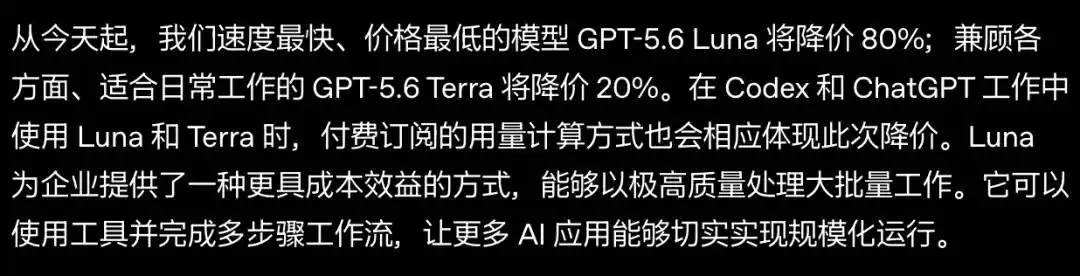
OpenAI price adjustment announcement on July 30th, Terra lowered by 20%.

The unit price dropped only 20%, but the bill could be slashed by eighty percent.

The source of the remaining sixty percentage points saved in the middle is what truly deserves our attention.

GPT-5.6 landed on Kiro in July this year.

First, on the 13th, AWS announced that GPT-5.6 Sol, Terra, and Luna were officially available on Amazon Bedrock.

The very next day, Kiro published a blog post announcing the availability of the three models on IDE, CLI, and Web.
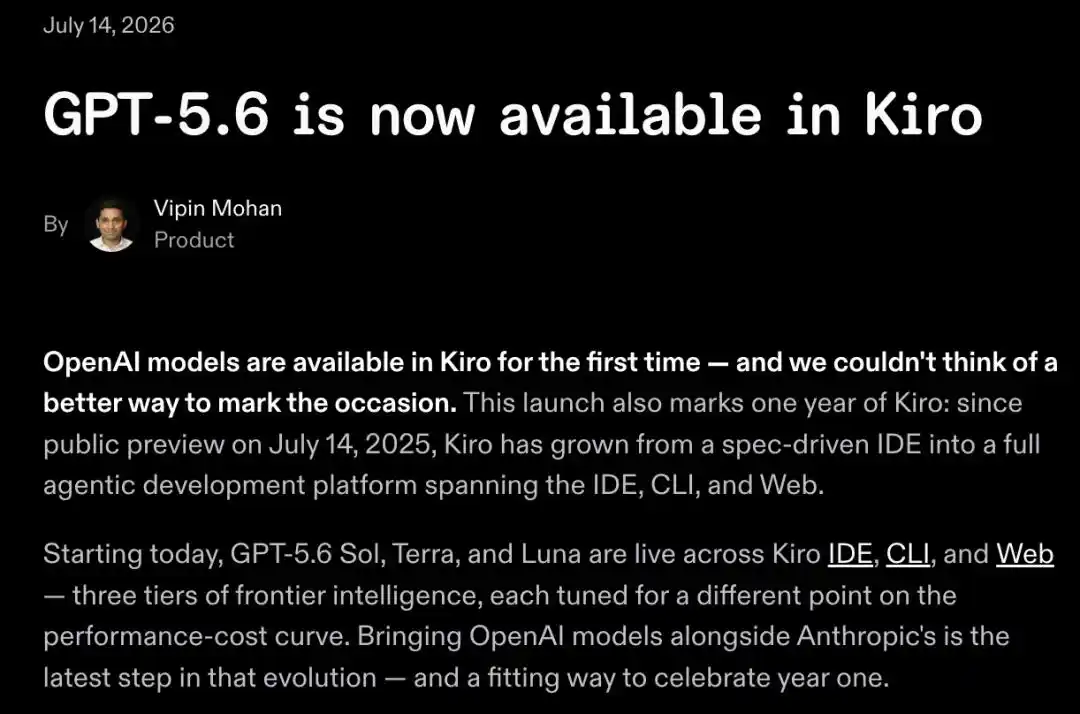
This marked the first time OpenAI models entered Kiro, coinciding with Kiro's one-year public preview anniversary.

First, put the models on the shelf, then put them to work. Over a month later, OpenAI came back with its homework:

The two companies jointly tuned the Kiro environment and OpenAI models, reducing the cost for Terra to complete a successful task by about 82%.

What's Saved

Is the Money Spent on Detours

During the price adjustment on July 30th, Terra was reduced by 20%, but in Kiro's tests, the cost per task dropped by 82%.

Where did the extra sixty percent savings come from?

The directions are limited:

The model generated fewer tokens, the number of back-and-forth tool calls decreased, and there were fewer retries and detours after failures.

Therefore, the large chunk saved is not the cost per call, but the cost of those calls that would have been wasted.

The logic is simple: if an AI agent fails a task once, the bill is still charged. If it chooses the wrong path, goes off-track three times, and then circles back, those tokens are also billed.

In real development, money often leaks out this way.

OpenAI has pointed out the same logic in its official blog: efficiency comes from three layers:

The agent framework that initiates requests and organizes context, the orchestration system that schedules requests in the middle, and finally the model itself running on GPUs.
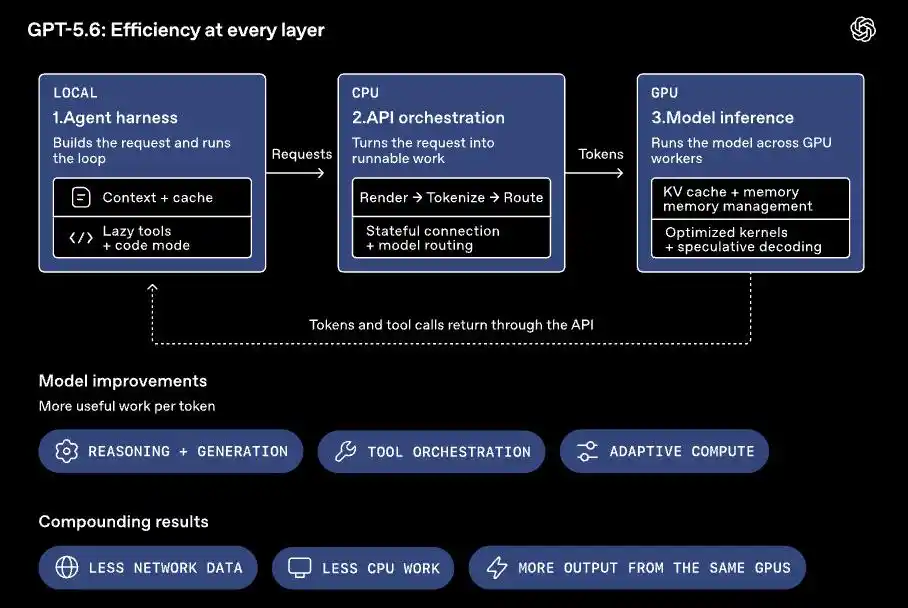
OpenAI breaks down the sources of GPT-5.6's efficiency: requests start from the agent framework, are scheduled by the orchestration system, and finally run the model on GPU, saving at every layer.

Savings can also come from model specialization.

OpenAI also gave an example of usage: a coding workflow can first use Sol to think through the problem and define the plan, then switch to Luna to implement the well-defined changes, write tests, and run evaluations.

Same pipeline, different levels of intelligence allocated to different stages.

The Model Accounts for Only Half the Bill

Change the Framework, Change the Price

The Terminal-Bench 2.1 benchmark doesn't ask the model to answer questions alone.

It places the model in a terminal environment with a vague objective, letting it plan its own path, call tools, write scripts, handle errors, and iterate repeatedly.

So the resulting score is the performance of the "agent + model" combination.
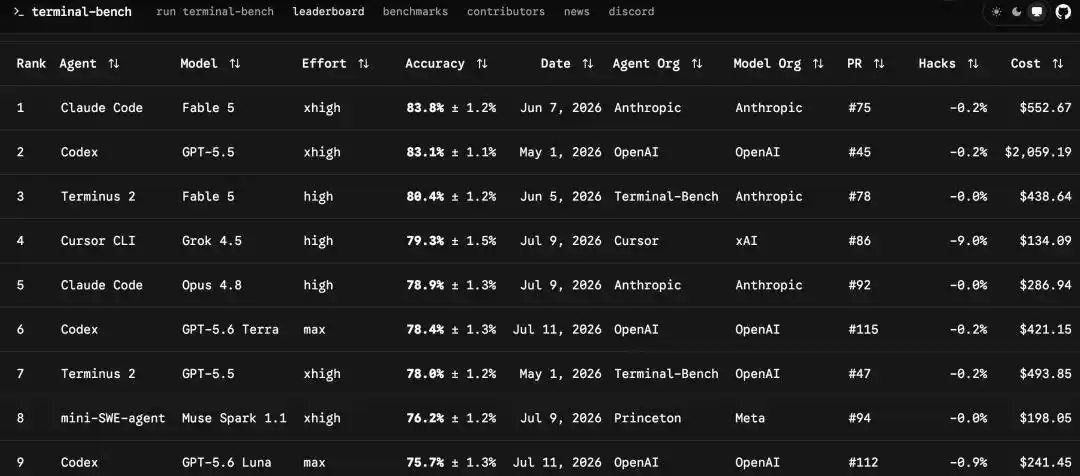
The public Terminal-Bench 2.1 leaderboard, with cost added to the right of accuracy. (Source: Terminal-Bench)

The four lines of numbers in the leaderboard illustrate the point best:

Claude Code with Fable 5, 83.8%, $552.67;

Codex with GPT-5.5, 83.1%, $2059.19;

Codex with GPT-5.6 Terra, 78.4%, $421.15;

Codex with GPT-5.6 Luna, 75.7%, $241.45.

The scores in the first two rows differ by only 0.7 percentage points, but the bills differ by nearly 4 times.

The same model, placed into different frameworks with different context organization and tool strategies, results in completely different prices.

According to data provided by Kiro, Terra scored 77.4 on the Coding Agent Index, only slightly higher than Claude Fable 5's 77.2.

Its selling point isn't the score, but the price corresponding to that score.

This is also where Kiro's spec-driven focus lies. The core approach is simple: don't start writing code immediately.

It first breaks down the user's vague goal into a formal requirements document, technical design, and executable task list before handing it over to the model.

Thus, the model receives not a vague statement, but a well-defined job.

Those familiar with Agents will immediately realize that this step saves the most expensive part of the expenditure.

Models going off-track, reworking, and starting over often burn more tokens than doing the actual work.

Kiro also includes two checkpoints in the process: pause for human review before code is actually modified; and automatically run a round of tests after the work is done to verify correctness.

Each rework stopped by these two checkpoints saves real money.

Claude in Amazon's Territory

GPT Takes Half

A year ago, Kiro was just a spec-driven IDE, and the model selector was Anthropic's domain.

A year later, AWS placed three tiers of OpenAI models into its own developer agent platform at once.

Sol, Terra, Luna listed alongside Claude in the same dropdown menu—a scene hard to imagine a year ago.

Although GPT-5.6 is "fully deployed" this time, it's not "fully open."

The three models are released progressively and experimentally, targeting Pro, Pro+, Pro Max, and Power users. Availability is limited to two regions: US North Virginia and Europe Frankfurt, supporting cross-region inference.

There's also a point many find hard to adjust to: these models in Kiro operate with a hidden chain-of-thought; you can't see its reasoning steps, only the final result.

Those accustomed to watching the Agent reason step-by-step feel like throwing work into an opaque box.

The official statement is that this is expected behavior and doesn't affect output quality.

The three model tiers are clearly priced in Kiro.

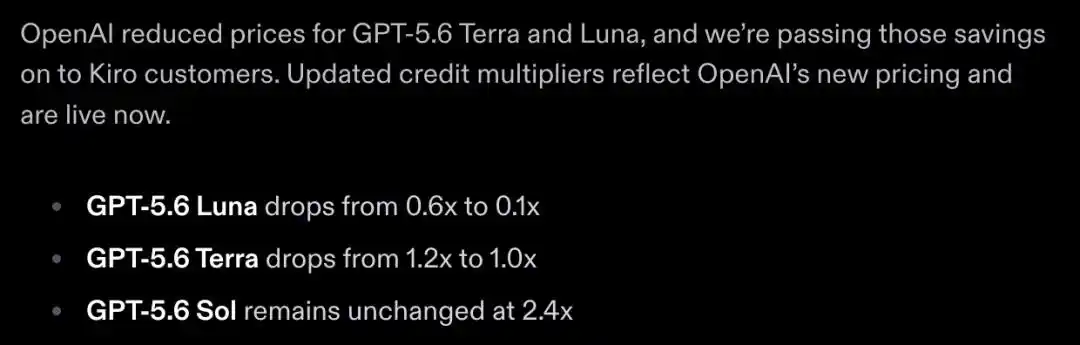
When they first launched on July 14th, the same task cost 2.4x for Sol, 1.2x for Terra, and 0.6x for Luna.

After OpenAI's price reduction on July 30th took effect, Kiro followed the next day: Luna was slashed from 0.6x all the way to 0.1x, Terra reduced from 1.2x to 1.0x, with only Sol unchanged.
AWS's stance is clear: a development platform cannot be tied to just one model.

In the same selector, two cutting-edge models are beginning to undercut each other on price.

The evaluation criteria for models is also changing: a higher score no longer guarantees a win; spending less can also win.

For developers, the question used to be "How much per million tokens for this model?" Now it must be "How much will it actually cost me to get this thing done?"

References:

https://x.com/OpenAIDevs/status/2091966982015103068

https://openai.com/index/gpt-5-6-in-kiro/

This article is from WeChat Official Account "AI_era" (ID: AI_era), author: ASI Revelation, editor: Yuanyu


Трендові криптовалюти

Пов'язані питання

QAccording to the article, the cost of completing a successful task with GPT-5.6 Terra in Kiro decreased by 82%, but the official price reduction was only 20%. Where did the additional 60% cost saving come from?

AThe additional 60% cost saving primarily came from optimizations that reduced wasted token usage. These savings were achieved by minimizing the number of tokens generated, reducing unnecessary tool calls, and decreasing the frequency of failed attempts and inefficient detours. Essentially, the savings came from avoiding the costs associated with the AI agent making mistakes, choosing wrong paths, or having to backtrack, all of which would have incurred charges.

QWhat is the primary difference in how Kiro approaches coding tasks compared to a traditional AI agent, and how does this contribute to cost savings?

AKiro uses a spec-driven approach. Instead of letting the AI write code immediately from a vague user instruction, it first breaks down the instruction into a formal requirements document, technical design, and a list of executable tasks. This provides the model with a clear and structured job description upfront. This method saves costs by significantly reducing the expensive overhead of the model going off-track, needing rework, or starting over, which consumes a large number of tokens.

QWhat was a notable change in the Kiro platform's model offerings one year after its public preview, and what does this signify?

AA notable change was the introduction of three OpenAI GPT-5.6 models (Sol, Terra, Luna) into Kiro's model selector, where previously Anthropic's Claude models were dominant. This signifies a strategic move by AWS to avoid being tied to a single model provider on its development platform. It creates direct competition between leading models, which can drive performance improvements and price reductions for developers.

QHow does the article explain the layered efficiency improvements for AI agents like GPT-5.6 in platforms such as Kiro?

AThe article explains that efficiency gains come from three layers: 1) The agent framework that initiates requests and organizes context. 2) The orchestration system that schedules and dispatches these requests. 3) The model itself running on the GPU. Cost savings are achieved through optimizations at every one of these layers, not just the model's raw processing cost.

QAccording to the Terminal-Bench 2.1 data cited, why might a developer's choice of agent framework be as important as the choice of model itself for overall cost?

AThe Terminal-Bench 2.1 data shows that different frameworks paired with the same or similar models can result in vastly different costs. For example, Claude Code with Fable 5 achieved 83.8% accuracy at a cost of $552.67, while Codex with GPT-5.5 achieved 83.1% accuracy but at a much higher cost of $2059.19. This demonstrates that the framework's context organization, tool strategies, and workflow efficiency have a massive impact on the final bill, making the framework choice critically important.

Пов'язані матеріали

Not Just Trading and Meme: These 5 Projects on Base Are Exploring New On-Chain Use Cases

Beyond Trading and Memes: 5 Projects Exploring New On-Chain Use Cases on Base While much of the crypto space is dominated by speculation, Base—Coinbase's Ethereum Layer 2 with over $5B TVL—is fostering innovative projects beyond the usual categories. Here are five notable examples: 1. **Hydrex**: A MetaDEX/AMM aggregator that pools native and external liquidity (e.g., from Uniswap, Morpho) to offer optimal swap rates. It features a ve(3,3)-style incentive model and single-signature transactions. 2. **SwapRoyale**: A fantasy trading competition app where users pay a fixed entry fee to trade with a virtual $100k portfolio in real-time contests. It gamifies trading with various tournament formats and has already distributed over $100k in prizes. 3. **BlockRun**: A permissionless AI gateway and payment layer for the on-chain agent economy. It allows autonomous systems to discover, pay for, and execute services using USDC on Base via the x402 micropayment standard, enabling pay-per-use AI. 4. **PixieChess**: A play-to-earn digital chess game where each piece is a collectible NFT with unique abilities that alter classic rules. Value is kept within the ecosystem, with a treasury funding real ETH prizes for winners. 5. **Tokensto**: A platform that lets users sell their unused AI API credits (e.g., from OpenRouter) for cash. It automatically prices credits and facilitates direct payouts to crypto wallets. These projects demonstrate that builders on Base are actively experimenting with consumer experiences, the agent economy, and novel gaming mechanics, suggesting the surface area for meaningful on-chain activity is broader than current narratives imply.

marsbit33 хв тому

Not Just Trading and Meme: These 5 Projects on Base Are Exploring New On-Chain Use Cases

marsbit33 хв тому

Торгівля

Спот

Популярні статті

Як купити BILL

Ласкаво просимо до HTX.com! Ми зробили покупку Billions Network (BILL) простою та зручною. Дотримуйтесь нашої покрокової інструкції, щоб розпочати свою криптовалютну подорож.Крок 1: Створіть обліковий запис на HTXВикористовуйте свою електронну пошту або номер телефону, щоб зареєструвати обліковий запис на HTX безплатно. Пройдіть безпроблемну реєстрацію й отримайте доступ до всіх функцій.ЗареєструватисьКрок 2: Перейдіть до розділу Купити крипту і виберіть спосіб оплатиКредитна/дебетова картка: використовуйте вашу картку Visa або Mastercard, щоб миттєво купити Billions Network (BILL).Баланс: використовуйте кошти з балансу вашого рахунку HTX для безперешкодної торгівлі.Треті особи: ми додали популярні способи оплати, такі як Google Pay та Apple Pay, щоб підвищити зручність.P2P: Торгуйте безпосередньо з іншими користувачами на HTX.Позабіржова торгівля (OTC): ми пропонуємо індивідуальні послуги та конкурентні обмінні курси для трейдерів.Крок 3: Зберігайте свої Billions Network (BILL)Після придбання Billions Network (BILL) збережіть його у своєму обліковому записі на HTX. Крім того, ви можете відправити його в інше місце за допомогою блокчейн-переказу або використовувати його для торгівлі іншими криптовалютами.Крок 4: Торгівля Billions Network (BILL)Легко торгуйте Billions Network (BILL) на спотовому ринку HTX. Просто увійдіть до свого облікового запису, виберіть торгову пару, укладайте угоди та спостерігайте за ними в режимі реального часу. Ми пропонуємо зручний досвід як для початківців, так і для досвідчених трейдерів.

761 переглядів усьогоОпубліковано 2026.05.07Оновлено 2026.06.02

Як купити BILL

Обговорення

Ласкаво просимо до спільноти HTX. Тут ви можете бути в курсі останніх подій розвитку платформи та отримати доступ до професійної ринкової інформації. Нижче представлені думки користувачів щодо ціни BILL (BILL).

活动图片