Prediction markets emerge as speculative ‘arbitrage arena’ for crypto traders

cointelegraphОпубліковано о 2025-12-08Востаннє оновлено о 2025-12-08

Анотація

Blockchain-based prediction markets are becoming a popular speculative arena for crypto traders seeking higher returns than holding spot cryptocurrencies. According to 10X Research, these markets create significant information asymmetry and arbitrage opportunities, pitting retail traders against data-driven professionals. While sports betting dominates activity, crypto-related outcome markets—like whether BNB will hit $1,500 by December 2025—offer asymmetric payoffs, such as potential 100x returns. However, concerns about insider trading are rising, with accounts like 'AlphaRaccoon' making over $1 million in a day with a near-perfect win rate. Others, such as 'ilovecircle,' are suspected of using AI and machine learning for cross-niche arbitrage, raising questions about market fairness.

Blockchain-based prediction markets are drawing in more speculators as traders hunt for returns that can beat simply holding spot cryptocurrencies, according to a new report.

Prediction markets are emerging as a new speculative arena for traders, pitting casual retail participants against data-driven, professional traders, creating “extreme information asymmetry and meaningful arbitrage windows,” according to a Monday report from crypto research company 10X Research.

While sports bets account for the lion’s share of activity on these platforms, Bitcoin (BTC) and crypto-outcome related events are presenting more niche opportunities that digital asset traders can’t ignore, according to 10X.

“It is a valuable reminder that nearly every major crypto trading venue operated its own market-making or ‘treasury’ desk, not just to provide liquidity, but to stand on the other side of retail flow, and rarely at a loss,” the company wrote.
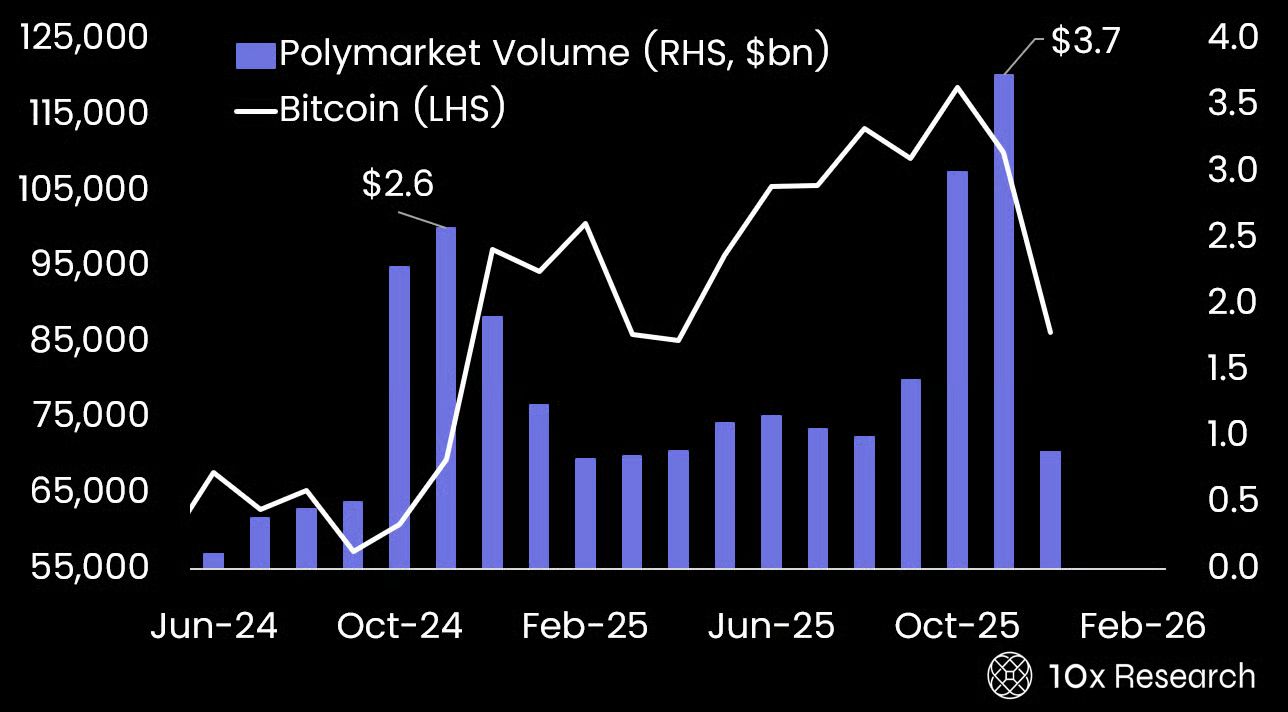
Polymarket volume, right-hand-side price, Bitcoin left-hand-side price. Source: 10x Research

Related: BTC poised for December recovery on ‘macro tailwinds,' Fed rate cut: Coinbase

For quantitative traders, prediction markets can offer asymmetric payoffs that compare favorably with the upside on underlying spot tokens, the report suggested.

For instance, traders on decentralized prediction market Polymarket are betting on whether the BNB (BNB) token will hit $1,500 by Dec. 31, 2025. “Yes” shares on that market recently traded around $0.01, implying a potential 100x payout if the event happens. By comparison, a spot BNB holder would see roughly a 1.65x gain if the token climbed to the same level from current prices.

Related: BitMine buys $199M in Ether as smart money traders bet on ETH decline

High win-rate accounts, AI bots raise Insider trading concerns

However, some prediction market accounts are showing concerning signs of insider trading, particularly a newly emerged account that made over $1 million in a single day by betting on Google search trends.

Polymarket user ‘AlphaRaccoon’ generated $1 million by successfully winning 22 out of 23 placed bets, according to crypto investors Haeju.

“This isn’t a lucky streak. He previously made $150K+ predicting the early release of Gemini 3.0 before results were out,” he wrote in a Thursday X post.

Source: haeju.eth

Others are employing artificial intelligence bots to increase their chances of winning.

Polymarkt user “ilovecircle” earned over $2.2 million during the past two months, boasting a 74% win rate through bets encompassing politics, sports and cryptocurrency.

The user’s volume and winning consistency “almost guarantees” that it is employing a machine learning (ML) model for “cross-niche arbitrage and auto trading,” wrote prediction market trader Archive, in a Sunday X post.

Magazine: Train AI agents to make better predictions... for token rewards

Пов'язані матеріали

Dialogue with Jia Hang | Looking Back at Two Decades of Chinese Payment Going Global

**Summary: A Conversation with Jia Hang on Two Decades of China's Payment Globalization** Jia Hang, a veteran with over twenty years in payments, reflects on China's attempts to build a global payment network through three key phases: UnionPay (card networks), Alipay+ (digital wallets), and now, stablecoins. His journey began at UnionPay International, aiming to establish China's card network abroad. While successful in following Chinese tourists ("where Chinese go, UnionPay goes"), it struggled to achieve true global scale. The core lesson: card networks like Visa/Mastercard's unassailable advantage isn't just technical standards, but their deeply entrenched **governance and profit-sharing models** that create powerful network effects. Competing as the "same species" is nearly impossible. At Ant Group, he led Alipay+, a strategy to bypass card networks by interconnecting local e-wallets worldwide. While innovative, it faced a similar ceiling. Mobile QR payments and card swipes were essentially **the same species competing for the same pie**, lacking a disruptive value proposition for users or a sustainable new incentive model to replace the card networks' established flywheel. Today, at Singapore's DCS, Jia focuses on stablecoin-based payments. He argues stablecoins represent a fundamental shift. They are not competing with Visa for consumer payments but challenging the **traditional banking and account system for value movement**. Products like "U Cards" (stablecoin-linked payment cards) are transitional, leveraging existing card networks for acceptance while building new rails. The real potential lies in stablecoins enabling seamless, low-cost global value transfer, potentially reorganizing the financial infrastructure around **accounts rather than cards**. Jia believes stablecoin adoption for local retail payments, cross-border transactions, and as high-yield savings vehicles is becoming irreversible. This could gradually reduce reliance on traditional fiat channels, especially in regions with weak currencies or capital controls. The quest for the "next global payment network" continues, now centered on whether stablecoins can successfully bridge Web2 and Web3, establish new governance, and create compelling user value beyond mere cost reduction.

marsbit26 хв тому

Dialogue with Jia Hang | Looking Back at Two Decades of Chinese Payment Going Global

marsbit26 хв тому

Circle's Stock Price Plunges 76%, Hong Kong Dollar Stablecoin Set to Launch Within Two Weeks

Circle's stock price has plunged approximately 76% from its 2023 peak, reflecting a major market revaluation. Despite this, Circle President Heath Tarbert emphasized the company's focus on long-term execution and its dominant position with USDC's $73 billion circulation across 34 blockchains. The competitive landscape is intensifying. A new consortium-backed stablecoin, Open USD, is attempting to challenge incumbents by sharing reserve yields with partners. More significantly, Visa's new stablecoin platform, initially supporting Open USD while also being compatible with USDC, could erode Circle's network effects. In response, Circle is expanding into real-world payments through partnerships like the one with Japan's JCB. Separately, Tether (USDT) faces a two-year compliance window under new U.S. regulations, requiring it to adjust its reserve composition away from assets like Bitcoin and loans towards cash and U.S. Treasuries. Meanwhile, in Hong Kong, Standard Chartered-backed fintech firm Dian Dian is poised to launch a licensed HKD-pegged stablecoin (HKDAP), moving the industry into a phase where the real test is integrating licensed stablecoins into actual payment flows and corporate treasury systems. The sharp decline in Circle's stock underscores a broader shift: the stablecoin market is moving from a winner-takes-all dynamic to a multi-player competitive arena where execution, compliance, and real-world utility are becoming paramount.

marsbit26 хв тому

Circle's Stock Price Plunges 76%, Hong Kong Dollar Stablecoin Set to Launch Within Two Weeks

marsbit26 хв тому

Amidst Capital's Encirclement, Decentralization is the Sole Defense for Public Blockchains

In a landscape dominated by power and profit motives, the author argues that decentralization is not merely one desirable feature among many in blockchain design—it is the singular, non-negotiable defense against corporate and capital capture. The article adopts a Machiavellian, realist perspective on human institutions, positing that businesses will inevitably attempt to co-opt any valuable network to protect their profits and dominance. While external attacks like 51% forks are often discussed, the greater existential risk is internal capture—the gradual erosion of a protocol’s neutrality by vested interests, as seen historically with platforms like Visa and Google. The piece critiques permissioned chains, highly centralized “permissionless” layer-1s, and layer-2s without sufficient decentralization (e.g., single sequencers) as inherently vulnerable. These compromised systems, promoted by established financial players, are framed as delaying tactics to stifle truly open networks that threaten existing high-fee, inefficient business models. Real-world examples, such as closed enterprise consortiums that exclude competitors, illustrate how such systems cement oligopolies rather than foster innovation. The author concludes that while decentralized protocols like Ethereum are imperfect and costly to operate, they represent the only viable long-term equilibrium. In a market where value naturally flows to the most secure and neutral settlement layer, only maximally decentralized public blockchains can resist being subsumed by capital and powerful incumbents.

Foresight News36 хв тому

Amidst Capital's Encirclement, Decentralization is the Sole Defense for Public Blockchains

Foresight News36 хв тому

Торгівля

Спот
活动图片