Predicting the Dormant Period of Market Heat, Polymarket Prepares a Killer Move to Catch Up with Kalshi

marsbitОпубліковано о 2026-08-12Востаннє оновлено о 2026-08-12

Анотація

Following a period of lower trading activity after the World Cup and during a sports offseason, Polymarket is restructuring in preparation for upcoming major sports events and the US midterm elections in November. Key personnel changes include the appointment of Travis VanderZanden, former Bird founder and Uber/Lyft executive, as Chief Growth Officer to oversee marketing. The company has also hired executives from Robinhood, Coinbase, Nasdaq, and the FBI to strengthen compliance, risk management, and regulatory functions. This push supports Polymarket's renewed focus on the US market after its 2022 exit due to regulatory issues. Its US re-entry accelerated with the 2025 acquisition of licensed exchange QCEX, rebranded as Polymarket US. After launching on iOS in May, a web version recently went live. Trading volume on Polymarket US has surged, growing from $1.77 billion in May to approximately $5 billion in July. This represents 62% of the international platform's volume, up from just 25% two months prior. VanderZanden's immediate task involves addressing past marketing controversies, including CFTC investigations into promotional practices that used simulated trades. The company has since reformed its marketing rules and partner vetting. Despite rapid growth, Polymarket US still trails the US prediction market leader, Kalshi, which saw about $37.7 billion in July volume compared to Polymarket's combined ~$13 billion. Kalshi's valuation also significantly outpaces Polymark...

Author | Asher(@Asher_ 0210)
After the World Cup, with most other popular sports events also being in the off-season recently, trading enthusiasm on Polymarket has declined. The platform recently conducted a round of intensive adjustments to management, market direction, and promotion strategies to prepare for upcoming popular sports events and the US midterm elections in November.

In terms of personnel, Travis VanderZanden, founder of shared electric scooter company Bird and former executive at Uber and Lyft, has joined Polymarket as Chief Growth Officer, responsible for the company's marketing system. Additionally, Polymarket has recruited several executives from institutions like Robinhood, Coinbase, Nasdaq, and the FBI, covering compliance, regulation, investigation, and risk management roles.

Furthermore, Polymarket continues to exert efforts in returning to the US market. The series of upcoming sports events and political events are also expected to further boost trading heat for its US business.

One Year After Returning to the US, Polymarket US Enters Growth Phase

From Acquiring a Licensed Exchange to Launching a Web Version, Polymarket US Accelerates Rollout

In 2022, Polymarket reached a settlement with the CFTC for unregistered derivatives trading business and exited the US market.

It wasn't until July 2025 that Polymarket paved the way for its US return by acquiring CFTC-licensed derivatives exchange and clearing agency QCEX for $112 million. Subsequently, QCX LLC operated under the name Polymarket US and, in November of that year, obtained an amended order from the CFTC, further solidifying its foundation for conducting regulated trading in the US.

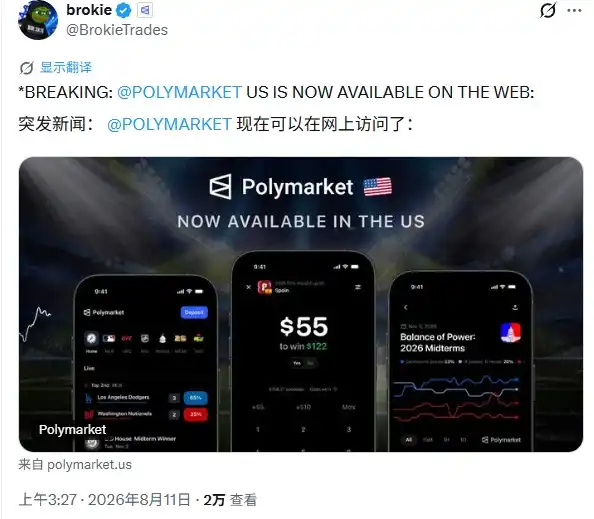
In December of the same year, Polymarket US began opening to users on the waitlist; in May this year, Polymarket US was fully opened to US iOS users. Just yesterday, community members reported that Polymarket US has launched a web version, continuing to expand channels accessible to US users.
Polymarket US Trading Volume Continues to Grow, Gradually Approaching Polymarket International

In May this year, as access for US users gradually opened, Polymarket US trading volume began to show significant growth.

According to Dune data, Polymarket US trading volume in May was $1.769 billion, while Polymarket International's volume was $7.077 billion during the same period, with US volume being about 25% of International's. By June, Polymarket US trading volume rapidly increased to $4.041 billion, more than doubling from May. International volume for the same period was $10.773 billion, bringing the ratio to about 38%.

In July, this gap narrowed further. Polymarket US monthly trading volume reached approximately $5 billion, setting a new high, while International's July volume was only $8.044 billion. US volume was equivalent to 62% of International's, whereas just two months prior this ratio was only 25%.
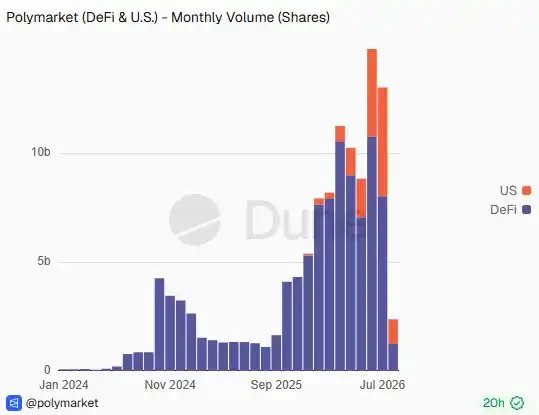
With user access increasing and trading scale continuing to rise, Polymarket now needs not only to further acquire US users but also to face a series of more specific issues like marketing, compliance, and risk management. Therefore, growth, marketing, compliance, and risk control have become the most concentrated areas in this round of team adjustments.

Simultaneously Adding Staff for Growth and Compliance, But First Must Address Previous Marketing Issues

After taking over marketing operations, Travis VanderZanden, founder of Bird and former Uber and Lyft executive, must first deal with the promotional controversies left from earlier actions.

Previously, a Wall Street Journal investigation found that Polymarket had used promotional partners to have content creators display simulated trading. Some videos used website interfaces highly similar to the real Polymarket, leading viewers to believe the creators were conducting real trades and making profits. The related investigation stated that approximately $1.9 million in bets shown across over 1,100 related videos were simulated trades. Subsequently, the CFTC launched an investigation into Polymarket's related marketing practices.

Polymarket then began rectifying its marketing system, including restructuring the marketing department, updating rules for promotion partners, and conducting relevant training for employees. The company also hired consulting firm AlixPartners to review content released by partners, checking for compliance with new promotion guidelines.

Therefore, VanderZanden's task upon joining Polymarket is not merely to continue expanding the user base. He is taking over a marketing system still under adjustment. Polymarket US is currently continuing to expand user access, with trading volume also in a growth phase. With more sports events and political events on the horizon, the platform hopes to further attract US users and increase trading activity. However, previous regulatory investigations also mean that some of the more aggressive promotion methods used in the past can no longer be readily employed.

Autumn is the Real Test, Polymarket Still Needs to Catch Up with Kalshi

In the US prediction market, Kalshi still holds a significant lead over Polymarket US. In July, Kalshi's monthly trading volume was approximately $37.7 billion, Polymarket US about $5 billion, and Polymarket International about $8 billion for the same period—the two platforms combined about $13 billion, less than one-third of Kalshi's. Moreover, Kalshi's business is almost entirely concentrated in the US market.

This gap is also reflected in capital market valuations. At the end of June, Kalshi was negotiating a new round of financing with a target valuation of about $40 billion; just a month earlier, the company had completed a $1 billion funding round with a valuation of $22 billion at that time. In contrast, Polymarket was valued at about $9 billion in October 2025. After completing approximately $1 billion in financing in April this year, its valuation rose to $15 billion. Entering August, it began seeking another round of about $1 billion in financing, targeting a valuation exceeding $20 billion.

After September, a series of popular sports events and the US midterm elections in November will arrive. The US compliant prediction market is Kalshi's foundation and is also becoming Polymarket's most important growth engine. For Polymarket, the next few months will be a critical window for US to further expand trading scale. How effective this round of team adjustments will be will also soon be put to the test.


Трендові криптовалюти

Пов'язані питання

QAccording to the article, what was the key reason behind Polymarket's recent management and strategy adjustments?

AThe article states that Polymarket is adjusting its management, market direction, and promotion strategies in preparation for upcoming hot sports events and the US mid-term elections in November.

QWhat steps did Polymarket take to facilitate its return to the US market in 2025?

AIn 2025, Polymarket acquired CFTC-licensed derivatives exchange and clearing agency QCEX for $112 million, paving the way for its US return. The entity QCX LLC then operated as Polymarket US and obtained a revised CFTC Designation Order in November of that year.

QHow did the trading volume of Polymarket US change from May to July, and how did it compare to Polymarket International?

AThe trading volume of Polymarket US grew significantly from $1.769 billion in May to over $5 billion in July. Its proportion compared to Polymarket International's volume increased from 25% in May to 62% in July.

QWhat was the main marketing controversy Polymarket faced, and what actions did the company take in response?

APolymarket faced a controversy where promotional partners used simulated trading on websites that looked very similar to the real Polymarket platform, misleading viewers. Over 1,100 videos showcased about $1.9 million in simulated bets. In response, Polymarket restructured its marketing department, updated partner rules, trained employees, and hired AlixPartners to audit partner content for compliance.

QWhat is the competitive landscape between Polymarket and Kalshi in the US prediction market as described in the article?

AKalshi holds a significant lead over Polymarket in the US. In July, Kalshi's monthly trading volume was about $37.7 billion, while Polymarket US and International combined had about $13 billion, which is less than one-third of Kalshi's volume. Kalshi's valuation was also much higher, targeting around $40 billion in June compared to Polymarket's valuation of over $20 billion in August.

Пов'язані матеріали

ArthurHayes新文:押注日元升值,ENA未来几月或涨5至10倍

Arthur Hayes argues that the Japanese Yen is significantly undervalued and posits that its appreciation against the US Dollar is imminent. He outlines three potential mechanisms for this shift, dismissing the first two—the Bank of Japan raising interest rates and domestic institutions selling foreign assets—as politically or economically unfeasible. He identifies the third and preferred method: the Japanese Ministry of Finance (MOF) using its holdings of US Treasuries as collateral in the Fed's FIMA repo facility to borrow US dollars, then selling those dollars to buy Yen in the forex market. Hayes believes US Treasury Secretary Bessant has signaled support for this approach, which requires the Fed's Foreign Currency Subcommittee, led by Chairman Walsh, to remove lending limits on the FIMA tool. Hayes asserts that implementing this "Scheme 3" would lead to a significant expansion of US dollar liquidity. He predicts this surge in liquidity will act as a catalyst, driving up the prices of assets like Bitcoin and physical gold. Within the crypto space, he views Ethereum (ETH) as undervalued and singles out Ethena's ENA token as a speculative play with potential for 5-10x gains in the coming months, contingent on a recovery in Bitcoin basis trades that would boost demand for its USDe stablecoin. He concludes that investors should watch for the Fed's rule change as the key trigger for these market movements.

marsbit13 хв тому

ArthurHayes新文:押注日元升值,ENA未来几月或涨5至10倍

marsbit13 хв тому

Is It Time to End the Era of Perp DEXes Burning Cash for Growth?

The article questions whether the era of perpetual decentralized exchanges (Perp DEXes) relying heavily on token incentives for growth should end. It argues that while token incentives (points, airdrops, farming) are useful for bootstrapping liquidity and attracting users, they often attract short-term, incentive-driven behavior rather than genuine, long-term traders. The piece analyzes how platforms use future token value to acquire current trading volume and liquidity, but notes this creates data that is difficult to interpret. A key test comes after the Token Generation Event (TGE), when the removal of incentive expectations reveals whether user retention is based on product quality or continued subsidies. Data from platforms like Hyperliquid, Lighter, and edgeX shows varying success in converting airdrop attention into sustained trading relationships post-TGE. Post-TGE, the focus often shifts from distributing tokens to supporting the token's value through mechanisms like fee revenue buybacks and burns. However, this ties value redistribution to token holdings rather than direct trading contributions. Analysis of user behavior on platforms like Hyperliquid reveals that holding a platform's token, participating in its financial products, and engaging in perpetual trading are often distinct activities, indicating that broad token ownership does not equate to genuine trading demand. This creates a tension for platforms, which must manage both a trading market and a token market with potentially conflicting goals. The article concludes by introducing PopDEX, an approach backed by Foresight Ventures, which proposes a different model. Instead of channeling value first through a platform token, PopDEX aims to establish a "100% value return" framework. This system is designed to directly and transparently redistribute the value generated from trading fees back to those who create it—such as active traders, referrers, and affiliates—based on verifiable market contributions. The piece suggests that as the Perp DEX industry matures, exploring alternative incentive structures that move beyond pure token-driven growth is a necessary evolution.

marsbit22 хв тому

Is It Time to End the Era of Perp DEXes Burning Cash for Growth?

marsbit22 хв тому

Chinese Data Generation Team Makes Debut in Nature Journal

A Hong Kong-based startup, Weina AI, has become China's first and the world's fourth data-generation technology company to publish in a leading Nature journal (IF>10 in recent three years) with a paper on AI-assisted kidney cancer surgery decision-making. Founded by Professor Liu Qifeng, who previously led the creation of the world's first thousand-card H800 SuperPod cluster at HKUST, the company focuses on enhancing AI's "questioning" ability to generate high-quality reasoning Q&A data, which is key for AI self-learning. The published Nature Communications paper, co-authored with medical experts, addressed a clinical challenge in renal surgery. Using an RDPM model on multi-source data from 1,621 patients, the AI achieved high predictive accuracy for long-term kidney function decline, providing a quantitative basis for surgical decisions. Professor Liu outlines AI development in three stages: from data to models, from models to token generation, and crucially, from tokens back to data—where AI actively generates questions, reasoning steps, and verified answers (cQrA: context, Question, reasoning, Answer). Weina AI's mission is to create this "data → model → token → data" feedback loop, enabling Agentic AI to autonomously evolve in professional domains. This moves beyond costly manual data annotation by using AI agents to generate scalable, chain-of-thought data. The company raised a HK$50 million seed round led by Lenovo Capital. Instead of focusing deeply on one sector, it adopted a "breadth-first" strategy, successfully deploying its technology across four high-accuracy, disparate fields: value-alignment safety, government affairs, insurance, and horse racing, proving cross-industry replicability. Liu argues that the future core of AI is not the model or data alone, but this self-reinforcing closed loop. This logic extends to embodied AI, where training shifts from imitation to autonomous generation of action data (cTrA: context, Task, reasoning, Action) through trial, error, and feedback. Weina AI's vision is to leverage this paradigm to "generate the world."

marsbit22 хв тому

Chinese Data Generation Team Makes Debut in Nature Journal

marsbit22 хв тому

Торгівля

Спот

Популярні статті

Як купити MOVE

Ласкаво просимо до HTX.com! Ми зробили покупку Movement (MOVE) простою та зручною. Дотримуйтесь нашої покрокової інструкції, щоб розпочати свою криптовалютну подорож.Крок 1: Створіть обліковий запис на HTXВикористовуйте свою електронну пошту або номер телефону, щоб зареєструвати обліковий запис на HTX безплатно. Пройдіть безпроблемну реєстрацію й отримайте доступ до всіх функцій.ЗареєструватисьКрок 2: Перейдіть до розділу Купити крипту і виберіть спосіб оплатиКредитна/дебетова картка: використовуйте вашу картку Visa або Mastercard, щоб миттєво купити Movement (MOVE).Баланс: використовуйте кошти з балансу вашого рахунку HTX для безперешкодної торгівлі.Треті особи: ми додали популярні способи оплати, такі як Google Pay та Apple Pay, щоб підвищити зручність.P2P: Торгуйте безпосередньо з іншими користувачами на HTX.Позабіржова торгівля (OTC): ми пропонуємо індивідуальні послуги та конкурентні обмінні курси для трейдерів.Крок 3: Зберігайте свої Movement (MOVE)Після придбання Movement (MOVE) збережіть його у своєму обліковому записі на HTX. Крім того, ви можете відправити його в інше місце за допомогою блокчейн-переказу або використовувати його для торгівлі іншими криптовалютами.Крок 4: Торгівля Movement (MOVE)Легко торгуйте Movement (MOVE) на спотовому ринку HTX. Просто увійдіть до свого облікового запису, виберіть торгову пару, укладайте угоди та спостерігайте за ними в режимі реального часу. Ми пропонуємо зручний досвід як для початківців, так і для досвідчених трейдерів.

434 переглядів усьогоОпубліковано 2024.12.13Оновлено 2026.06.02

Як купити MOVE

Обговорення

Ласкаво просимо до спільноти HTX. Тут ви можете бути в курсі останніх подій розвитку платформи та отримати доступ до професійної ринкової інформації. Нижче представлені думки користувачів щодо ціни MOVE (MOVE).

活动图片