Polymarket New Rules Released: How to Build a New Trading Bot

marsbitОпубліковано о 2026-02-25Востаннє оновлено о 2026-02-25

Анотація

Polymarket has removed the 500ms taker delay and introduced dynamic taker fees, rendering many existing trading bots obsolete. The new meta shifts advantage from taker arbitrage to market making. A profitable bot in 2026 must be a maker bot, leveraging zero fees and USDC rebates. Key requirements include using WebSocket (not REST), fee-aware order signing with the `feeRateBps` field, and a sub-100ms cancel/replace loop to avoid adverse selection. The architecture involves connecting to the CLOB, querying fee rates per market, and placing maker orders on both YES/NO sides. For 5-minute BTC markets, a deterministic strategy involves placing maker orders at $0.90–0.95 with 10 seconds remaining, capitalizing on ~85% directional certainty. Critical mistakes to avoid are using REST, omitting feeRateBps, high-latency infrastructure, and outdated taker strategies. AI can assist in implementation, but must be guided by the new technical constraints.

Editor's Note: Polymarket removed the 500ms delay without prior announcement and introduced dynamic fees, instantly rendering a large number of existing bots obsolete overnight. This article systematically outlines the correct way to build trading bots under these new rules, providing a clear and actionable path—from the fee mechanism and order signing to market-making logic and low-latency architecture.

After publication, the article garnered 1.1M views, sparking widespread discussion. Under Polymarket's new rules, the advantage is shifting from taker arbitrage to long-term structures centered around market making and liquidity provision.

Original text below:

Polymarket Quietly Removed the 500ms Delay

Here’s the clear explanation: How to build a bot that actually runs and makes money under the new rules.

Two days ago, Polymarket removed the 500ms taker quote delay in crypto markets. No announcement, no warning. Overnight, half the bots on the platform stopped working. But at the same time, this created the biggest opportunity window for new bots since Polymarket launched.

Today I will explain in detail: How to build a bot that still works under the new rules.

Because every solution you saw before February 18th is now outdated.

If you ask an AI model to write Polymarket bot code for you right now, it will give you a solution based on the old rules: REST polling, no fee handling, completely unaware the 500ms buffer is gone.

Such a bot will lose money from the very first trade.

Let me explain: What exactly changed, and how to redesign your bot around these changes.

What Changed?

Three key changes happened over the past two months:

1. The 500ms Taker Delay Was Removed (February 18, 2026)

Previously, all taker orders waited 500ms before execution. Market makers relied on this buffer time to cancel "stale" quotes, which was almost like free insurance.

Now it's different. Taker orders execute immediately, with no cancellation window.

2. Dynamic Taker Fees Introduced in Crypto Markets (January 2026)

15-minute and 5-minute crypto markets now charge taker fees. The formula is: Fee = C × 0.25 × (p × (1 - p))²

Peak fee: ~1.56% around 50% probability

Fee approaches 0 in extreme probability ranges (near 0 or 1)

Remember that bot that arbitraged the price delay between Binance and Polymarket, making $515,000 in a month with a 99% win rate?

That strategy is completely dead. Because the fee alone is now higher than the arbitrageable spread.

What is the New Meta?

In one sentence: Be a maker, not a taker.

The reasons are simple:

· Makers pay no fees

· Makers earn daily USDC rebates (subsidized by taker fees)

· With the 500ms delay gone, maker order execution is actually faster

The top bots now profit just from rebates, without even needing the spread. If you're still running a taker bot, you're facing a constantly rising fee curve. Around 50% probability, you need at least a 1.56% edge just to break even.

Good luck.

So, How Should a Truly Viable 2026 Bot Be Built?

Here is a design思路 (design approach) for a bot architecture that remains effective in 2026:
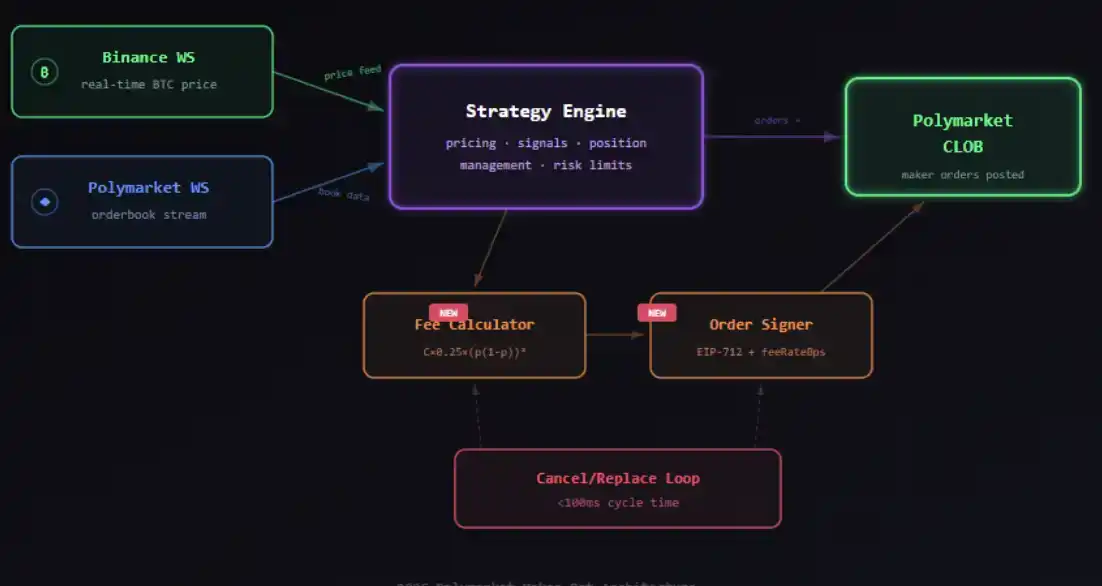
Core Components:

1. Use WebSocket, Not REST

REST polling is completely obsolete. By the time your HTTP request completes a round trip, the opportunity is long gone. You need a real-time order book data stream based on WebSocket, not intermittent pulling.

2. Fee-Aware Order Signing

This is a new requirement that didn't exist before. Now, the feeRateBps field must be included in the payload of the order you sign. If you omit this field, orders will be outright rejected in markets where fees are enabled.

3. Ultra-Fast Cancel/Replace Loop

With the 500ms buffer removed: If your cancel-replace process takes over 200ms, you will suffer from adverse selection. Others will snatch your stale quotes before you can update them.

How to Build It

1. Get Your Private Key

Use the same private key you use to log in to Polymarket (EOA / MetaMask / Hardware Wallet)

export POLYMARKET_PRIVATE_KEY="0xyour_private_key_here"

2. Set Up Approvals (One-Time Operation)

Before Polymarket can execute your trades, you need to approve the following contracts: USDC, Conditional Tokens.

This only needs to be done once per wallet.

3. Connect to the CLOB (Central Limit Order Book)

The official Python client can be used directly: pip install py-clob-client

However, there are now faster options in the Rust ecosystem:

· polyfill-rs (Hot path zero-allocation, SIMD JSON parsing, ~21% performance boost)

· polymarket-client-sdk (Official Polymarket Rust SDK)

· polymarket-hft (Complete HFT framework, integrates CLOB + WebSocket)

Which one you choose isn't critical; the key is to pick the one you can get up and running the fastest.

4. Query the Fee Rate Before Placing Every Order

GET /fee-rate?tokenID={token_id}

Never hardcode fees.
Fees vary by market, and Polymarket can adjust them at any time.

5. Include the Fee Field in Order Signing

When signing the order, the fee field must be written into the payload. Missing this will cause the order to be rejected in fee-enabled markets.

{
"salt": "...",
"maker": "0x...",
"signer": "0x...",
"taker": "0x...",
"tokenId": "...",
"makerAmount": "50000000",
"takerAmount": "100000000",
"feeRateBps": "150"
}

The CLOB will validate your order signature based on feeRateBps. If the fee rate in the signature doesn't match the current actual rate, the order will be rejected outright.

If you use the official SDK (Python or Rust), this logic is handled automatically; but if you implement the signing logic yourself, you must handle this, otherwise the order simply won't go through.

6. Place Maker Orders on Both Sides (Bid and Ask)

Provide liquidity to the market by placing limit orders: On both YES and NO tokens; Place both BUY and SELL orders. This is the core way you earn rebates.

7. Run a Cancel/Replace Loop

You need to monitor simultaneously: External price feeds (e.g., Binance WebSocket); Your current open orders on Polymarket.

Once the price changes: Immediately cancel outdated quotes; Re-place orders at the new price. The goal: Keep the entire cycle under 100ms.

Special Note on 5-Minute Markets

The 5-minute cycle BTC up/down markets are deterministic.

You can directly calculate the specific market just from the timestamp:
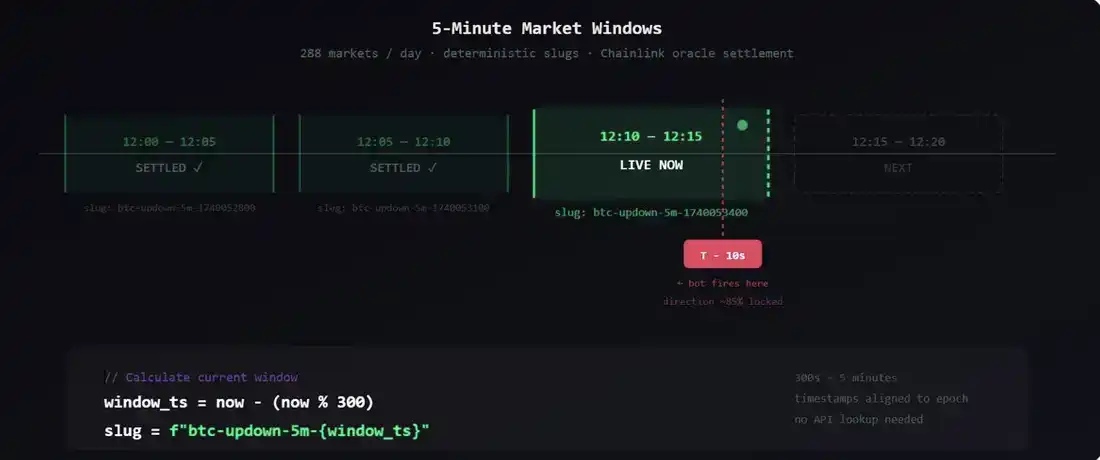
There are 288 markets per day. Each one is a fresh opportunity.

Currently validated effective strategy: By T–10 seconds before the window closes, the direction of BTC's move is about 85% determined, but the odds on Polymarket haven't fully reflected this information yet.

The method is: On the side with the higher probability; Place maker orders at a price of $0.90–0.95.

If filled: Profit $0.05–0.10 per contract at settlement; Zero fees; Plus you get rebates.

The real advantage comes from: Figuring out BTC's direction faster than other market makers, and getting your orders up sooner.

Common Mistakes That Will Get You Wiped Out

· Still using REST instead of WebSocket

· Not including feeRateBps in order signing

· Running the bot on home Wi-Fi (150ms+ latency, vs. <5ms for datacenter VPS)

· Market making near 50% probability without considering adverse selection risk

· Hardcoding fee rates

· Not merging YES/NO positions (locking up capital)

· Still using 2025's taker arbitrage mindset

The Right Way to Use AI

The technical part ends here. Now you understand: The architecture design, fee calculation method, and new market rules.

Next, you can open Claude or any reliable AI model and give it a sufficiently clear and specific task description, for example: "Here is the Polymarket SDK. Please write a maker bot for the 5-minute BTC market that: Listens to Binance WebSocket for prices; Places maker orders on both YES and NO sides; Includes feeRateBps in order signing; Uses WebSocket for order book data; Keeps the cancel/replace cycle under 100ms."

The correct workflow is: You define the tech stack, infrastructure, and constraints, and the AI generates the specific strategy and implementation logic on top of that.

Of course, no matter how perfectly you describe the bot's logic, you must test it before going live. Especially at this stage, where fees are already materially eroding profit margins, backtesting under the real fee curve is a mandatory step before deployment.

The bots that will truly win in 2026 are not the fastest takers, but the best liquidity providers.

Build your system accordingly.

Пов'язані питання

QWhat are the key changes in Polymarket's rules that have made old trading bots obsolete?

AThe key changes are: 1) Removal of the 500ms taker delay on February 18, 2026, which eliminated the free 'insurance' period for market makers to cancel stale quotes. 2) Introduction of a dynamic taker fee schedule in January 2026, calculated as `fee = C × 0.25 × (p × (1 - p))^2`, which peaks at ~1.56% near 50% probability. These changes rendered taker arbitrage strategies, like the one that previously profited from Binance-Polymarket delays, unprofitable.

QWhat is the new 'meta' or recommended approach for building a profitable bot on Polymarket in 2026?

AThe new meta is to be a maker, not a taker. This is because makers pay no fees, earn USDC rebates (subsidized by taker fees), and benefit from faster order execution with the 500ms delay removed. The most successful bots can now profit from rebates alone, even without capturing price spreads.

QWhat are the critical technical components of a viable 2026 Polymarket bot architecture?

AThe critical components are: 1) Using WebSocket for real-time data instead of REST polling. 2) Implementing fee-aware order signing by including the `feeRateBps` field in the signed payload. 3) Establishing an ultra-fast cancel/replace loop (aiming for under 100ms) to avoid adverse selection and update stale quotes before they are taken.

QWhat is a specific, effective strategy mentioned for the 5-minute BTC markets?

AAn effective strategy is to identify the likely direction of BTC price movement (which is ~85% determined in the last 10 seconds of the window) and place maker orders on the higher probability side at prices between $0.90–$0.95. If filled, this yields a profit of $0.05–$0.10 per contract at settlement, plus rebates, with zero fees.

QWhat are some common mistakes that will cause a bot to fail under the new rules?

ACommon fatal mistakes include: using REST instead of WebSocket; omitting the `feeRateBps` field in order signing; running the bot on high-latency home Wi-Fi (>150ms) instead of a low-latency VPS (

Пов'язані матеріали

Only 153 Venture Capital Firms Invested in July: Is the Crypto VC Industry Experiencing a 'Mass Extinction'?

In July 2026, only 153 unique venture capital firms participated in disclosed crypto funding rounds, marking the lowest monthly count since November 2020. This figure represents an 87% decline from the peak of 1,177 firms in 2022. Overall, the first seven months of 2026 saw crypto projects raise approximately $11.78 billion across 481 rounds. This crypto VC contraction contrasts sharply with the broader venture capital landscape, where global VC investment reached a record $560.4 billion in H1 2026, heavily fueled by major AI company financings. This shift in capital allocation has drawn funds away from the crypto sector. Within crypto, funding is highly concentrated. Trading platforms, prediction markets, and payment sectors absorbed 53% of the total capital. While early-stage deals remain frequent, the largest sums flow to a few late-stage rounds and mergers & acquisitions, which surged to $7.23 billion in Q2 2026. The market is consolidating around top funds like a16z crypto and Dragonfly, which successfully raised new multi-billion dollar funds, while many smaller firms have retreated. Analysts describe this as a "great extinction" for crypto VCs, where capital is becoming more selective, favoring proven business models and assets over early-stage speculation. This raises the bar for project quality, funding efficiency, and viable exit paths.

marsbit21 хв тому

Only 153 Venture Capital Firms Invested in July: Is the Crypto VC Industry Experiencing a 'Mass Extinction'?

marsbit21 хв тому

Strategy's Loss in the Second Quarter Reaches $8.22 Billion Amid Bitcoin Decline

Strategy, the largest corporate holder of Bitcoin, reported a net loss of $8.22 billion for the second quarter. This loss was primarily driven by an $8.32 billion unrealized loss on its Bitcoin holdings due to a decline in the asset's price during the period. Despite these paper losses, the company increased its Bitcoin holdings to 843,775 BTC, a 25% growth since the start of the year. As part of a new monetization strategy, Strategy sold approximately $218.4 million worth of Bitcoin, mainly to fund dividends for preferred shareholders, with $216 million of that sold after Q2 ended. The company also built a $3.75 billion cash reserve, which it claims is sufficient to cover over two years of dividend and interest payments, aiming to insulate itself from Bitcoin's volatility while meeting obligations. Following the earnings release, Strategy's stock (MSTR) rose 4.7% in regular trading but corrected slightly after-hours. This pattern reflects how the company's accounting results are heavily tied to Bitcoin's price swings, even as its long-term strategy remains unchanged. The report indicates that Strategy is maintaining its core strategy of accumulating Bitcoin while building a financial buffer. This quarterly loss follows a recognizable pattern, with the company posting significant unrealized losses in previous quarters (e.g., $12.4 billion in Q4 2025 and ~$12.5 billion in Q1 2026) due to fair-value accounting. A key technical shift is its new monetization program, which introduces periodic selling pressure on the market, transitioning Strategy from a pure accumulator to a participant that occasionally adds supply. A critical question remains: how long can the cash reserve cover dividend obligations if a Bitcoin price downturn persists beyond two years?

cryptonews.ru41 хв тому

Strategy's Loss in the Second Quarter Reaches $8.22 Billion Amid Bitcoin Decline

cryptonews.ru41 хв тому

Will Terrorist Durov Ban Russian Officials?

Telegram founder Pavel Durov publicly reacted to being labeled a "terrorist" by Russian authorities, stating the designation came after he refused demands for mass surveillance and censorship on the platform. In a Telegram post, he highlighted that this status formally bans him from "publishing information online." Durov concluded with a statement widely circulated: Russian officials "clearly don't understand who can ban whom on the internet." This remark suggests Durov could potentially restrict official Russian government and officials' channels on Telegram, which continue to operate on the platform despite its formal blocking in Russia. The situation parallels previous, slow-moving state directives, like switching officials to domestic cars, contrasted with the current push to migrate all government communication to the Russian-made messenger MAX by 2030. However, reports indicate many officials still use Telegram via workarounds, fearing surveillance on MAX, while alternatives like BiP and KakaoTalk recently became inaccessible in Russia without a VPN. Durov has not specified any immediate actions against state channels. His statement is an initial response, with further developments depending on the authorities' reaction. The dynamic differs from 2020 when Russian regulators lifted a block on Telegram; now, Durov implies control from within the platform itself over the official accounts that persisted through that earlier blockade.

cryptonews.ru41 хв тому

Will Terrorist Durov Ban Russian Officials?

cryptonews.ru41 хв тому

DeepSeek V4 Official Version Arrives, New Capabilities Emerge, Value-for-Money King Enters the Fray

On July 31st, DeepSeek officially launched the public API beta for its DeepSeek-V4-Flash model. A key highlight is its performance on multiple Agent benchmark tests, reportedly nearing or even surpassing the level of the V4-Pro preview version from three months ago. Notably, the Flash model achieves this with significantly smaller scale (130B active parameters vs. Pro's 490B), suggesting that post-training optimization and data quality may be as crucial as raw model size. DeepSeek emphasized that the V4-Flash-0731 uses the same model architecture and size as its preview version, with improvements attributed solely to "re-trained post-training." The update also marks the official debut of DeepSeek's self-developed Agent framework, "Harness." The move signals DeepSeek's strategic push to position its cost-effective Flash model as a competitive base for Agent applications—scenarios requiring autonomous planning, tool usage, and complex task execution—where inference speed and cost are critical. By natively supporting OpenAI's Responses API format and adapting for code-generation scenarios, DeepSeek aims not just to be a cheaper alternative but to establish its own ecosystem in the Agent era. This release follows DeepSeek's record-breaking ~$50 billion fundraising round roughly two months prior, underscoring market confidence in its technology and commercialization prospects. The company is reportedly preparing for another funding round at a valuation of approximately $71 billion. The Flash model's advancement represents a step in fulfilling the high expectations that come with this valuation, setting the stage for the impending release of the V4-Pro official version and intensifying competition in the global Agent landscape.

marsbit45 хв тому

DeepSeek V4 Official Version Arrives, New Capabilities Emerge, Value-for-Money King Enters the Fray

marsbit45 хв тому

Торгівля

Спот
活动图片