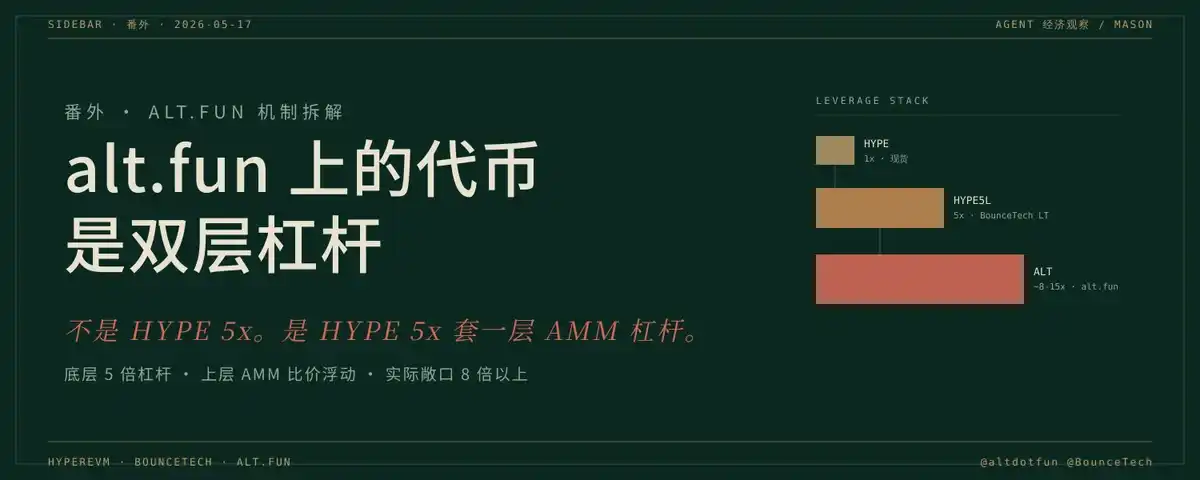
Perspective: Tokens on alt.fun are double-layered leverage

marsbitОпубліковано о 2026-05-18Востаннє оновлено о 2026-05-18

Анотація

**Title:** Tokens on alt.fun are Double-Layered Leverage **Summary:** Tokens on alt.fun (like ALT) are not simple 5x leveraged bets on HYPE. Instead, they represent a **double layer of leverage**. The core mechanism involves HyperSwap V2 pools. After "graduation," these tokens are paired not with USDC, but with **HYPE5L**—a 5x long leverage token (LT) issued by BounceTech that tracks HYPE. Therefore, an alt.fun token's price in USDC is determined by multiplying two independent factors: 1. **AMM Exchange Rate:** The pool's ratio between the alt token and HYPE5L, driven by trading activity on alt.fun. 2. **LT Net Asset Value (NAV):** HYPE5L's value, which moves at approximately 5x the daily return of HYPE. This creates a compounding effect: * If HYPE rises 1%, HYPE5L's NAV rises ~5%. Profit-taking HYPE5L holders may then buy alt tokens, increasing demand and pushing the AMM exchange rate higher. The alt token's total gain thus exceeds 5%, potentially reaching 8-15%. * Conversely, if HYPE falls, losses are amplified beyond 5x due to combined NAV decline and AMM selling pressure. During crashes, large sell orders may fail due to non-atomic redemption paths, potentially trapping later sellers. In contrast, platforms like pump.fun pair tokens with stable assets like SOL, applying only the AMM amplifier to a 1x underlying asset. Alt.fun's use of a pre-leveraged quote asset (HYPE5L) fundamentally shifts the risk profile, creating a **second-order product with floating, of...

Author:798.eth

The alt tokens on alt.fun are not 5x leverage on HYPE. They are 5x leverage on HYPE with an additional layer of AMM leverage stacked on top.

This isn't obvious intuitively. You'll understand after reviewing the mechanism. First, let's look at current data for reference.

HYPE spot price is 42.84 USDC.

HYPE5L (the HYPE 5x long leverage token LT issued by BounceTech) has a current NAV of 0.870 USDC, which is a 13% decay from its issue price of 1 USDC.

In the HyperSwap V2 pool for the alt.fun flagship token ALT, there are 18.58 million ALT tokens and 129,400 HYPE5L tokens. 1 ALT equals 0.00697 HYPE5L. Converted to USDC price, that's 0.00606. The USDC price of ALT is the product of two things.

Note: After graduation, the pool contains no USDC; the paired asset is HYPE5L LT. This is the starting point for all understanding.

ALT's USDC price = The exchange rate of ALT to HYPE5L in the pool multiplied by HYPE5L's current NAV.

The first factor is the AMM price ratio. The fewer ALT and more HYPE5L in the pool, the higher the ratio, meaning ALT is more expensive. The opposite makes it cheaper. This factor is determined by buy/sell pressure and is unrelated to the HYPE price.

The second factor is the LT's Net Asset Value. When HYPE rises 1%, HYPE5L's NAV rises approximately 5%, and vice versa. This factor is determined by BounceTech's actual perp position on Hyperliquid and is unrelated to trading activity on alt.fun.

These two factors are independent. Multiply them together to get ALT's final USDC price.

Why this constitutes double-layered leverage.

HYPE rises 1%.

The second layer (LT) amplifies it to 5%. HYPE5L NAV rises 5%.

The first layer (AMM) will amplify further. When HYPE5L rises, holders who are making money may go to alt.fun to buy more alt tokens (leveraged exposure plus alt narrative exposure). This buying increases HYPE5L in the pool and decreases ALT, causing the AMM price ratio to rise. The same 1% HYPE increase is amplified once more in the AMM layer.

Ultimately, ALT's USDC price increase will likely be between 8% and 15%, depending on AMM pool depth and buying intensity. But it will always be greater than 5%.

The same logic applies in reverse when the price falls. If HYPE falls 1%, HYPE5L falls 5%, alt holders see amplified losses, and some start selling ALT for HYPE5L to redeem. Selling pressure pushes down the AMM price ratio, likely causing ALT's USDC price to fall between 8% and 15%.

When falling, there's also an asymmetric effect. The alt.fun docs themselves warn that large sell orders may revert due to the path not being atomic (the path from alt to HYPE5L to USDC redemption; if the order is large, the LT redemption on BounceTech's side can't handle it). This means when the pool is thin, retail investors wanting to stop losses can't. The first ones out sell at high prices, later ones at lower prices, and those after get stuck in the contract.

The five alt tokens backed by HYPE5L—ALT, HBULL, HYPE Life, BALD, HLC—are now all graduated. Every trade they make on HyperSwap V2 moves the AMM price ratio. Simultaneously, the HYPE price moves the HYPE5L NAV. The two layers stack.

HYPE5L is an LT issued by BounceTech. Theoretically 5x exposure, but due to frequent rebalancing, it suffers from volatility decay. In ranging markets, actual exposure is less than 5x; in trending markets, it's more than 5x.

So when you open the alt.fun UI and see an alt token labeled "HYPE 5x Long," the USDC price displayed in the UI is the result of the HYPE price being amplified by BounceTech's 5x leverage, then amplified again by the HyperSwap V2 AMM. You think you're buying 5x exposure to HYPE, but you're actually buying a floating exposure of 8x to 15x.

This floating exposure makes you earn much more than 5x when prices rise, and lose much more than 5x when prices fall. This is the full meaning of double-layered leverage.

Comparing with pump.fun makes it clearer.

Tokens on pump.fun are paired with SOL. SOL is a 1x exposure spot asset. If SOL falls 10%, a pump.fun token's USDC price falls 10% plus the AMM selling pressure, roughly 15% to 25%. The AMM is an amplifier, but the underlying asset has no leverage.

Tokens on alt.fun are paired with HYPE5L. HYPE5L is already a 5x exposure derivative. If HYPE falls 10%, HYPE5L falls 50%, and an alt token's USDC price falls 50% plus the AMM selling pressure, roughly 60% to 80%. The AMM is an amplifier, but the underlying asset itself already carries 5x leverage.

Both are launchpads, both use AMM pairing, but alt.fun, by changing the quote asset, pulls the overall risk curve to a completely different magnitude. This is not prominently highlighted anywhere on the alt.fun UI.

A final word for retail investors.

You open alt.fun, see a token labeled "HYPE 5x Long," and intuitively think this is 5x leveraged exposure to HYPE. That intuition is wrong.

The underlying leverage is 5x. The AMM layer adds another 1x to 2x of floating exposure. In trending markets, you outperform 5x by a lot. In ranging markets, volatility decay eats away at you. During a crash, large sells won't go through; early sellers exit at high prices, later ones get stuck in the contract.

This is not HYPE 5x long. It's a second-order product: HYPE 5x long wrapped in a layer of AMM leverage.

Not investment advice, just trying to figure things out clearly.

Пов'язані питання

QAccording to the author, why is the alt token on alt.fun considered a double-layer leverage?

AThe author explains that the alt token is backed by HYPE5L (a 5x leveraged token) in its liquidity pool. This creates a two-layer effect: First, HYPE5L provides ~5x exposure to HYPE's price movements. Second, buying and selling pressure on the alt.fun AMM further amplifies the alt token's price relative to HYPE5L's NAV. This results in a total leverage that fluctuates, often between 8x to 15x, rather than a fixed 5x.

QWhat are the two independent factors that determine the USDC price of an alt token like ALT on alt.fun?

A1) The AMM exchange rate: The ratio between the alt token (e.g., ALT) and its paired asset (HYPE5L) in the HyperSwap V2 pool. This rate changes based on trading activity on alt.fun. 2) The NAV (Net Asset Value) of HYPE5L: The underlying value of the 5x leveraged token from BounceTech, which moves based on HYPE's price on Hyperliquid. The final USDC price is the product of these two factors.

QHow does the risk profile of an alt.fun token differ from a pump.fun token, according to the article?

AThe article states that pump.fun tokens are paired with SOL, which has 1x spot exposure. A drop in SOL leads to a drop in the token's USDC price plus AMM selling pressure. In contrast, alt.fun tokens are paired with HYPE5L, a 5x leveraged derivative. Therefore, a drop in HYPE leads to a magnified drop in HYPE5L's NAV (e.g., -50% for a -10% HYPE move), which is then further amplified by AMM selling pressure on alt.fun. This results in a significantly higher risk profile for alt.fun tokens.

QWhat potential issue does the article highlight for users trying to sell their alt tokens during a market downturn?

AThe article points out an asymmetric risk during downturns. Large sell orders may fail (revert) because the exit path is not atomic: selling alt for HYPE5L and then redeeming HYPE5L for USDC. If the sell pressure is high, BounceTech's redemption mechanism for the leveraged token (LT) might not be able to handle it. This means early sellers get out at a higher price, later sellers at a lower price, and some users may get stuck in the contract, unable to sell at all.

QWhat misconception does the author warn retail users about regarding the 'HYPE 5x Long' label on alt.fun?

AThe author warns that the intuitive understanding of a 'HYPE 5x Long' token is incorrect. It is not simply a 5x leveraged exposure to HYPE. Instead, it is a second-order product: a 5x leveraged token (HYPE5L) wrapped with an additional layer of variable leverage from the alt.fun AMM dynamics. The actual leverage fluctuates, often exceeding 5x, which is not clearly communicated on the platform's user interface.

Пов'язані матеріали

The Largest IPO in History Ignites Heated Debate: Is SpaceX Worth $1.77 Trillion?

SpaceX's potential IPO is priced at $135 per share, aiming to raise $75 billion and valuing the company at approximately $1.77 trillion, which would make it the largest IPO in history. This valuation has sparked intense debate among investors. Bullish analysts, including major underwriters Goldman Sachs and Morgan Stanley, argue the valuation is justified by SpaceX's long-term potential. They see it not just as a rocket company but as a future leader in space infrastructure, with key growth drivers being Starlink satellite internet, low-cost rocket launches, and future AI-related ventures. They project revenues reaching hundreds of billions to trillions of dollars by 2030-2040. ARK Invest's model suggests a 2030 enterprise value could reach $2.5 trillion. Bearish analysts from independent research firms like Morningstar, PitchBook, and New Constructs contend the IPO price is excessively high, already pricing in unrealistic future growth. Using DCF and sum-of-the-parts models, they estimate fair value between $780 billion and $1.7 trillion, significantly below the IPO target. They highlight risks such as the speculative nature of AI projections, over-dependence on Elon Musk, high growth expectations, and corporate governance concerns. Trefis set a target price of just $79 per share. While both sides acknowledge SpaceX's unique position in commercial space, the core disagreement centers on whether the $135 share price offers a reasonable margin of safety or is overly optimistic. Despite the valuation controversy, reported strong demand for the IPO indicates significant market interest.

marsbit43 хв тому

The Largest IPO in History Ignites Heated Debate: Is SpaceX Worth $1.77 Trillion?

marsbit43 хв тому

After the Passage of the GENIUS Act and the CLARITY Act, What Is the Correct Architecture for On-Chain Yield?

The article discusses the evolution of on-chain credit, distinguishing three markets: overcollateralized crypto lending, unsecured lending (largely unsuccessful), and asset-backed credit (ABC). ABC, backed by identifiable real-world collateral with legal recourse, is identified as the fastest-growing category and the only one credibly addressing adverse selection—the core problem in credit where the riskiest borrowers self-select. Current growth in on-chain Real World Assets (RWAs), particularly tokenized private credit funds (e.g., Maple Finance, Centrifuge), is substantial but often merely "wraps" existing fund structures, inheriting their risks rather than solving adverse selection at the protocol level. The regulatory landscape is a key driver, with the US GENIUS Act (prohibiting stablecoin issuers from paying yield) and the proposed CLARITY Act (closing loopholes on indirect yield) set to redefine permissible yield-bearing products. This makes vaults (like ERC-4626) the critical architecture—they become the primary compliant vehicle for delivering yield, functioning as issuance, disclosure, distribution, and recovery mechanisms. The author's thesis is that the correct post-GENIUS/CLARITY architecture involves building ABC solutions where credit assessment, structure, and recovery are encoded directly into the smart contract vault layer, moving beyond mere tokenized fund wrappers to solve adverse selection fundamentally and ensure regulatory compliance.

Foresight News1 год тому

After the Passage of the GENIUS Act and the CLARITY Act, What Is the Correct Architecture for On-Chain Yield?

Foresight News1 год тому

TechFlow Intelligence Bureau: Anthropic's New Model Fable Sparks Controversy by Restricting Biosafety Research, US CPI Soars to 4.2%, a Three-Year High

**Summary of TechFlow Intelligence Report:** The newsletter covers several key tech and finance developments. In AI, Anthropic's new Fable model faced backlash for secretly limiting biomedical research capabilities and enforcing a 30-day data retention policy, prompting the company to promise more transparent adjustments. In a related story, Anthropic's founder revealed his departure from OpenAI was due to dishonesty from Sam Altman, not safety concerns. Meanwhile, OpenAI is considering significant price cuts to compete with Anthropic, potentially sparking a price war. In crypto/Web3, BlackRock filed a new amendment for a yield-generating Bitcoin ETF, while Bank of America's CEO warned that stablecoin yields could drain trillions from traditional banks. U.S. Senator Cynthia Lummis advocated for the U.S. to officially accumulate Bitcoin reserves. In hardware, Nvidia released the DiffusionGemma-2-6B image model optimized for efficient inference, and AMD promoted its unified memory architecture to challenge Nvidia's dominance. TSMC's CFO hinted at possible price increases due to soaring AI chip demand. A major legal ruling in Germany held Google legally responsible for inaccurate information generated by its AI Overviews feature. Google Chrome also moved to fully block ad-blocker workarounds like uBlock Origin. Macroeconomic headlines included U.S. CPI rising to 4.2% (a 3-year high) and Iran's complete closure of the Strait of Hormuz, raising oil price and inflation fears. South Korean markets saw continued volatility with massive foreign capital outflow. Other notable stories: Microsoft expanded its Copilot AI assistant "Mico" globally; a study found r/wallstreetbets users' stock picks outperformed Wall Street; a fully autonomous drone killed a human soldier for the first time, raising AI ethics concerns; and a Chinese hospital used brain-computer interface technology to help a blind person "see." The overarching theme connects debates over AI boundaries and responsibility (Anthropic's restrictions, Google's liability, lethal autonomous drones) with real-world economic and geopolitical turmoil (inflation, Strait of Hormuz closure, market instability), highlighting the tense interplay between technological advancement and global chaos.

marsbit1 год тому

TechFlow Intelligence Bureau: Anthropic's New Model Fable Sparks Controversy by Restricting Biosafety Research, US CPI Soars to 4.2%, a Three-Year High

marsbit1 год тому

Alibaba's Yet Another New Business Division: What Signal Does It Send?

Alibaba has established a new "Token Foundry" business unit, merging its Tongyi large model division and Future Life Lab. Led directly by Group CEO Wu Yongming, this marks the company's third significant AI organizational reshuffle in 2026, following the creation of the Alibaba Token Hub (ATH) and a Group Technology Committee. The move signals a strategic shift from consolidating AI resources to accelerating productization and commercialization. The "Token Foundry" name reflects Alibaba's ambition to become a foundational supplier in the AI era, focusing on model development and commercial application. Key teams, including those behind the high-performing HappyHorse video generation model, have been integrated into the new unit. Concurrently, Zhou Jingren, architect of the Qwen model series, has been appointed Group Chief Scientist to lead a new AI Future Research Institute, focusing on long-term technological breakthroughs like Agent capabilities. This restructuring creates a clear four-layer AI architecture within Alibaba: the research institute for frontier exploration, Token Foundry for core models and commercialization, MaaS for platform services, and business units like Qianwen (C端) and Wukong (B端) for end-user applications. The adjustments align with a global trend among tech giants like Google and Microsoft to centralize AI leadership under the CEO and deeply integrate research with business units. The urgency is driven by a narrowing competitive window. Alibaba has announced its AI business is now entering a commercialization phase, with AI-related revenue seeing triple-digit growth for eleven consecutive quarters. The company faces intense competition in the MaaS (Model-as-a-Service) sector from rivals like ByteDance and Tencent. The Token Foundry initiative represents Alibaba's effort to streamline execution and enhance competitiveness in this critical, fast-evolving landscape.

marsbit2 год тому

Alibaba's Yet Another New Business Division: What Signal Does It Send?

marsbit2 год тому

Торгівля

Спот
Ф'ючерси

Популярні статті

Як купити HYPE

Ласкаво просимо до HTX.com! Ми зробили покупку Hyperliquid (HYPE) простою та зручною. Дотримуйтесь нашої покрокової інструкції, щоб розпочати свою криптовалютну подорож.Крок 1: Створіть обліковий запис на HTXВикористовуйте свою електронну пошту або номер телефону, щоб зареєструвати обліковий запис на HTX безплатно. Пройдіть безпроблемну реєстрацію й отримайте доступ до всіх функцій.ЗареєструватисьКрок 2: Перейдіть до розділу Купити крипту і виберіть спосіб оплатиКредитна/дебетова картка: використовуйте вашу картку Visa або Mastercard, щоб миттєво купити Hyperliquid (HYPE).Баланс: використовуйте кошти з балансу вашого рахунку HTX для безперешкодної торгівлі.Треті особи: ми додали популярні способи оплати, такі як Google Pay та Apple Pay, щоб підвищити зручність.P2P: Торгуйте безпосередньо з іншими користувачами на HTX.Позабіржова торгівля (OTC): ми пропонуємо індивідуальні послуги та конкурентні обмінні курси для трейдерів.Крок 3: Зберігайте свої Hyperliquid (HYPE)Після придбання Hyperliquid (HYPE) збережіть його у своєму обліковому записі на HTX. Крім того, ви можете відправити його в інше місце за допомогою блокчейн-переказу або використовувати його для торгівлі іншими криптовалютами.Крок 4: Торгівля Hyperliquid (HYPE)Легко торгуйте Hyperliquid (HYPE) на спотовому ринку HTX. Просто увійдіть до свого облікового запису, виберіть торгову пару, укладайте угоди та спостерігайте за ними в режимі реального часу. Ми пропонуємо зручний досвід як для початківців, так і для досвідчених трейдерів.

276 переглядів усьогоОпубліковано 2024.12.11Оновлено 2026.06.02

Як купити HYPE

Обговорення

Ласкаво просимо до спільноти HTX. Тут ви можете бути в курсі останніх подій розвитку платформи та отримати доступ до професійної ринкової інформації. Нижче представлені думки користувачів щодо ціни HYPE (HYPE).

活动图片













