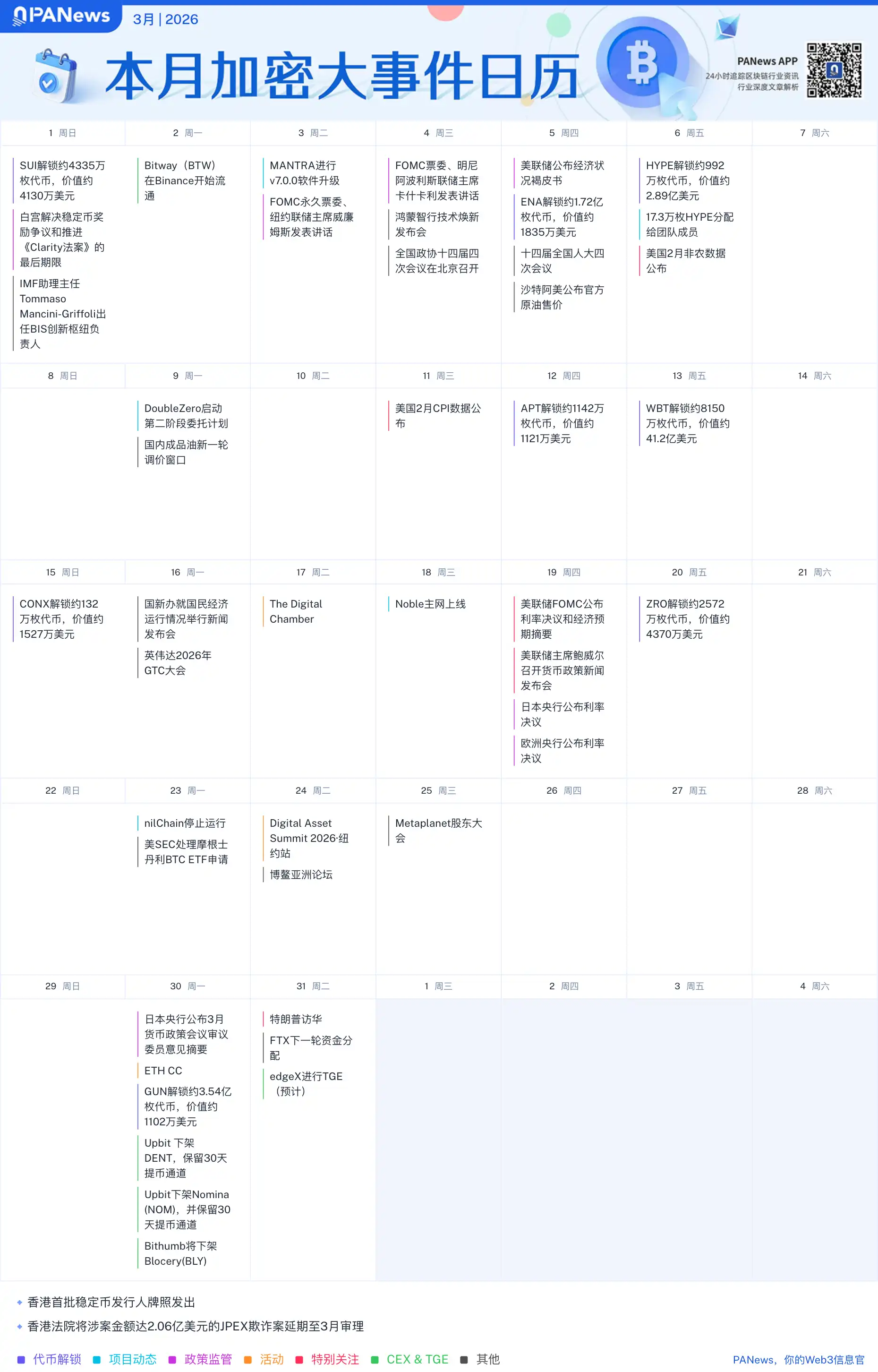
PA Infographic | A Glance at Major Web3 Events in March 2026

marsbitОпубліковано о 2026-03-01Востаннє оновлено о 2026-03-01

Анотація

PA Graphic | Key Web3 Events to Watch in March 2026 March 2026 is set to be a critical month for the crypto market, shaped by policy, macroeconomic trends, and liquidity dynamics. Major events include: - The FOMC interest rate decision and subsequent press conference by Jerome Powell, a key moment for global risk assets. - The upcoming vote on the Clarity Act, which could define US regulatory frameworks for stablecoins and digital assets. - The release of US February non-farm payroll and CPI data, influencing ongoing macro liquidity expectations. - Hong Kong issuing its first batch of stablecoin licenses. - Major token unlocks, including SUI and HYPE, totaling billions of dollars, potentially increasing selling pressure. - Metaplanet’s shareholder meeting, focusing on its Bitcoin strategy and capital market moves. - FTX’s new round of fund distributions, which may impact market sentiment and liquidity. With policy updates, economic data, token unlocks, and industry events unfolding simultaneously, market volatility is expected to intensify in March. For a concise overview of the core Web3 developments in March 2026, this graphic has you covered.

More comprehensive coverage, flexible filtering, and convenient export. Welcome to experience PANews' new crypto calendar 👇

Click to view PA Calendar

In March, the crypto market enters a phase intertwined with policy, macroeconomics, and liquidity. Key highlights:

  • FOMC interest rate decision and Powell's press conference, a critical window for global risk assets
  • Imminent vote on the Clarity Act, a crucial moment for US stablecoin and digital asset regulatory framework
  • US releases February non-farm payroll and CPI data, ongoing博弈 in macro liquidity expectations
  • Hong Kong issues first batch of stablecoin licenses
  • SUI, HYPE tokens, and others face large unlocks, totaling over billions of dollars in a single month, watch for potential selling pressure
  • Metaplanet holds general meeting, focus on its Bitcoin strategy and capital market movements
  • FTX's new round of fund distribution, potential impact on market sentiment and liquidity

With policy, data, unlocks, and industry conferences advancing in parallel, volatility may further amplify in March.

Global focal events converge. Lock in the core narrative of Web3 for March 2026 with just this one graphic!
Пов'язані питання

QWhat are the key highlights of the Web3 market in March 2026 according to the article?

AThe key highlights include the FOMC interest rate decision and Powell's press conference, the vote on the Clarity Act, the release of US non-farm payrolls and CPI data, the issuance of the first stablecoin licenses in Hong Kong, large token unlocks for SUI and HYPE, the Metaplanet shareholders meeting, and FTX's new round of fund distribution.

QWhich US regulatory framework for stablecoins and digital assets is entering a critical moment in March 2026?

AThe Clarity Act is entering a critical moment, with its vote imminent, which will shape the US regulatory framework for stablecoins and digital assets.

QWhat potential market impact is mentioned regarding SUI and HYPE tokens in March 2026?

ASUI and HYPE tokens are experiencing large-scale unlocks, with a total value exceeding billions of US dollars, potentially leading to significant selling pressure on the market.

QWhat major event is happening with Metaplanet in March 2026 and why is it noteworthy?

AMetaplanet is holding its shareholders meeting, which is noteworthy due to the focus on its Bitcoin strategy and capital market movements.

QHow does the article characterize the overall market conditions for March 2026?

AThe article states that with policy, data, token unlocks, and industry conferences all happening concurrently, market volatility in March is expected to further increase.

Пов'язані матеріали

US and Japan's Unprecedented Joint Action in 30 Years Marks End of Yen Carry Trade Era

Japan and the U.S. conducted a rare coordinated intervention in the foreign exchange market around August 3rd to stem the yen's sharp depreciation. U.S. Treasury Secretary Scott Bessette's notepad, photographed by Reuters, revealed plans for a $5-10 billion yen-buying operation. Following official confirmation, the USD/JPY pair plunged from near 164 to around 155-156. The intervention marks a significant shift as the U.S. moved from verbal support to practical coordination. While the core carry trade logic—exploiting the higher U.S. interest rates—remains intact, the risk structure has changed. Traders must now account for potential repeated bilateral actions, altering the risk-reward calculation for yen shorts. The intervention's immediate effect is forcing leveraged positions to unwind, amplifying the yen's rebound. However, analysts note this does not signal the end of the yen carry trade. The fundamental driver—the wide interest rate differential between the U.S. (3.50%-3.75%) and Japan (1%)—persists. The action is seen more as buying time for the Bank of Japan's gradual policy normalization while mitigating imported inflation pressures. To avoid destabilizing the U.S. Treasury market during intervention, authorities utilized the Fed's FIMA repo facility, allowing Japan to obtain dollar liquidity using its Treasury holdings as collateral instead of selling them. The move aims to contain spillover risks. While creating short-term volatility and compressing leverage for yen bears, the long-term trend for the yen will ultimately depend on the convergence of U.S. and Japanese monetary policies, not unilateral market operations. The current action is narrower in scope than historical agreements like the Plaza Accord, focused on curbing excessive yen weakness rather than engineering a broad-based dollar decline.

marsbit20 хв тому

US and Japan's Unprecedented Joint Action in 30 Years Marks End of Yen Carry Trade Era

marsbit20 хв тому

Why Hasn't Bitcoin Made the Expected Surge? There Are Both Positive and Negative Data

Analytical firm Glassnode reports Bitcoin retreated to around $62,600 after failing to sustain above $66,000. Weak spot market demand and defensive positions in derivatives are applying downward pressure. However, structural support remains from resilient long-term holders, surging on-chain activity, and renewed inflows into Bitcoin ETFs. The price action reflects weakened spot momentum, with low trading volume and persistent seller pressure keeping Bitcoin in a consolidation phase with limited breakout potential. While open interest in derivatives has fallen, funding rates have risen again, and options investors maintain a cautious stance. Demand for downside protection has increased. Positively, Bitcoin ETFs have seen renewed net inflows and trading volume, indicating institutional repositioning. On-chain metrics show a significant spike in active addresses and adjusted transaction volume, pointing to increased network usage. The historically low ratio of short-term to long-term holders suggests long-term conviction remains firm. However, overall market profitability continues to decline as the proportion of Bitcoin in profit nears cycle lows, indicating a trend of loss realization and de-risking by investors. Glassnode concludes the Bitcoin market is in a transitional phase. Structural support is present, but valuation pressure, insufficient spot demand, and defensive derivatives positioning continue to limit overall risk appetite.

cryptonews.ru51 хв тому

Why Hasn't Bitcoin Made the Expected Surge? There Are Both Positive and Negative Data

cryptonews.ru51 хв тому

Торгівля

Спот
活动图片