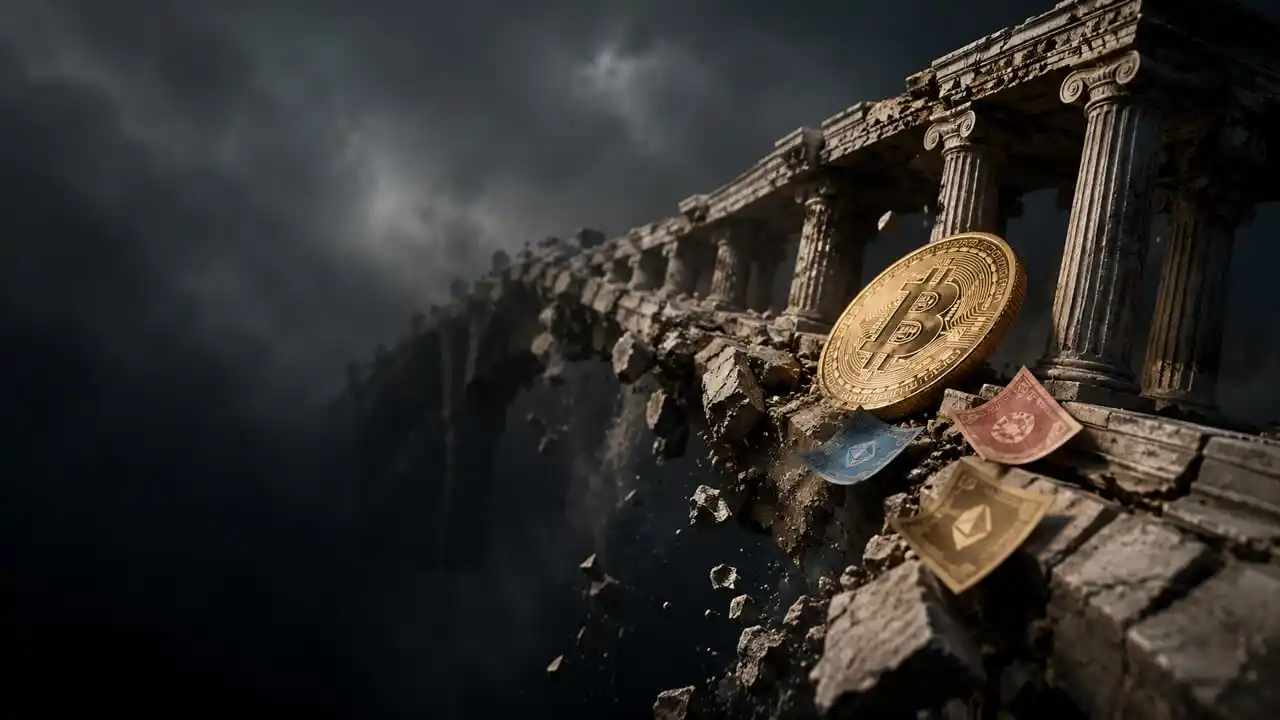
Ozak AI Presale Price Expansion of Over 1,300% Triggers Whale Accumulation Ahead of the Final Sales Phases

TheNewsCryptoОпубліковано о 2026-03-31Востаннє оновлено о 2026-03-31

Анотація

The OZ token presale for Ozak AI has surged by over 1,300%, rising from an initial price of $0.001 to $0.014 across seven phases. This significant price expansion has triggered substantial accumulation by large investors, with over 1.15 billion tokens sold, totaling more than $6.58 million. The project's AI-driven technology, including DePIN for secure financial data and the x402 Protocol for autonomous agents, is a key factor attracting whale interest. Strategic partnerships with entities like Openledger, Phala Network, and others have further boosted investor confidence. OZ is projected to potentially increase by 71x to reach $1 upon public listing, accelerating momentum as it enters its final phases.

The OZ presale price has expanded by over 1,300% across 7 different phases. This has triggered whale accumulation in the Ozak AI ecosystem before the AI-powered crypto project transitions into the final listing phase. Whale accumulation, for reference, pertains to strategic purchases by large investors.

OZ Whale Accumulation

The initial offer value of OZ was $0.001. It then surged to $0.014 in the 7th phase, demonstrating an expansion of more than 1,300%. Ozak AI tokens are now estimated to jump by 71x and reach the target price of $1 – paving the way for a higher multiplier within months from public listing.

Such a potential of OZ has started attracting whales before the conclusion of the final presale phase. This is evident from the sale of over 1.15 billion tokens for a collective worth of more than $6.58 million throughout 7 different presale phases.

Ozak AI Technology Fueling Whale Accumulation

Whale accumulation is simultaneously being fueled by Ozak AI’s technology, like DePIN and the x402 Protocol. DePIN, for starters, keeps the financial data structure intact by safeguarding it from malicious tampering and loss. Decentralized Physical Infrastructure Network also helps to orchestrate payments, staking, and work on Ozak AI Contracts.

The x402 Protocol is a hardcore technical component of the ecosystem, which can be briefly understood as a new open standard aimed at making agents truly autonomous. For developers, the protocol brings an economical option to build projects with Ozak AI.

Ozak AI Partnerships Helping in Price Expansion

Partnerships established by Ozak AI to this point have helped in OZ price expansion by boosting confidence among investors. And, it has helped to strengthen the foundation for future growth momentum. For reference, an association with Openledger, the AI-blockchain infrastructure, is a progressive step in coming up with a better way to handle AI training.

Ozak AI and Openledger, through this partnership, have agreed to combine Prediction Agents and on-chain data/model tools for the said purpose. The AI crypto project has established similar alliances with Phala Network, SINT, and HIVE, to mention a few.

Key Takeaways

The expansion of more than 1,300% in the OZ price during Ozak AI presale has triggered accumulation by whales. The AI token is now moving towards the public listing phase at an accelerated pace. It has surged by 14x, and it is projected to soar by 71x to the value of $1. AI-powered technology and strategic alliances are two more factors that are triggering whale accumulation.

  • Website: https://ozak.ai/
  • Twitter/X: https://x.com/OzakAGI
  • Telegram: https://t.me/OzakAGI

Disclaimer: TheNewsCrypto does not endorse any content on this page. The content depicted in this Press Release does not represent any investment advice. TheNewsCrypto recommends our readers to make decisions based on their own research. TheNewsCrypto is not accountable for any damage or loss related to content, products, or services stated in this Press Release.

TagsBlockchainCryptocurrencyOzak AI

Пов'язані питання

QWhat is the percentage increase in the OZ presale price across the 7 phases mentioned in the article?

AThe OZ presale price has increased by over 1,300% across the 7 different phases.

QWhat is the initial offer price of the OZ token and what did it surge to in the 7th phase?

AThe initial offer price of OZ was $0.001, and it surged to $0.014 in the 7th phase.

QWhat are the two key technological components of Ozak AI that are fueling whale accumulation?

AThe two key technological components fueling whale accumulation are DePIN (Decentralized Physical Infrastructure Network) and the x402 Protocol.

QWhich company did Ozak AI partner with to combine Prediction Agents and on-chain data/model tools for better AI training?

AOzak AI partnered with Openledger to combine Prediction Agents and on-chain data/model tools.

QWhat is the projected target price for the OZ token and the estimated growth multiplier from its initial offer price?

AThe OZ token is projected to reach a target price of $1, which represents an estimated 71x multiplier from its initial offer price of $0.001.

Пов'язані матеріали

Senior Trader's Confession: How to Trade Market's False Expectations?

Veteran trader's case study: trading the market's "wrong expectations". This trade centered on a textbook "expectation error" after a weak CPI report. While the market initially priced in broad monetary easing (sending Nasdaq to 30,060), the crucial 30-year real yield hit a 20-year high. This signaled a fractured transmission mechanism: short-term rates eased, but long-term funding costs (vital for tech valuations) refused to fall. The trader executed five short positions on the Nasdaq (NQ) as it fell from 30,060 to 28,768. The core methodology: don't just trade the data, but analyze the market's implied causal chain and identify where it breaks. In this case, the chain was: Weak CPI → Policy Easing → Lower Long-Term Funding Costs → NQ Valuation Expansion. The break occurred between policy easing and long-term rates. The "veto variable" – long-term real yields – refused to confirm the bullish narrative. Trades were structured around "fast variables" (price) temporarily repairing while "slow variables" (funding conditions) remained broken. The article outlines a repeatable framework: 1) Map the market's implied causal chain. 2) Identify the veto variable. 3) Observe if it rejects the narrative. 4) Enter when price still follows the old script. 5) Choose the cleanest asset expression (e.g., short NQ, not broad S&P). 6) Define both invalidation and fulfillment exit conditions. The key insight: Alpha often comes not from an information edge, but from a "reaction function edge" – recognizing when the market is applying an outdated causal logic to new data. The critical question: What causal chain is the market's first reaction relying on, and is that chain still valid today?

marsbit25 хв тому

Senior Trader's Confession: How to Trade Market's False Expectations?

marsbit25 хв тому

Opinion: The Hedging Relationship Between U.S. Treasuries and Stocks Has Broken Down, and BTC, as a Risk Asset, Is Under Dual Pressure

For the past 20 years, U.S. investors relied on a free insurance policy: when stocks fell, bonds rose, cushioning portfolio losses. This reliable inverse correlation underpinned entire financial strategies. However, this mechanism broke down around 2020 and has not recovered. Currently, the two-month rolling correlation between the S&P 500 and 10-year Treasury yields is at -0.69, its lowest level since 1996, indicating stocks and bonds are moving in sync to an unprecedented degree, eliminating the traditional portfolio shock absorber. The失效 of this hedge is not simply due to lost confidence in U.S. debt. The key driver is the shift from growth-dominated to inflation-dominated market narratives. When growth fears prevail, stocks and bonds move inversely. Since 2022, persistent inflation volatility has been the dominant factor, causing both asset classes to suffer simultaneously from higher inflation expectations. Investors now seek safety without duration risk, favoring cash, dollars, and short-term Treasuries while selling long-duration bonds. Record U.S. deficits, rising net interest payments, and waning foreign demand (e.g., from Japan) are pressuring long-term yields, with the 30-year yield surpassing 5%. This environment places Bitcoin, as a risk asset on the far end of the risk curve, under dual pressure. Higher risk-free rates increase the opportunity cost of holding non-yielding assets like Bitcoin, while falling equities reduce overall risk appetite. Bitcoin's performance has become highly sensitive to macro conditions such as real yields, dollar strength, and financial conditions. While its long-term thesis as a fixed-supply asset outside the sovereign credit system is strengthened by these fiscal trends, the same conditions hurt it in the short term. The return of bonds as a effective hedge requires inflation volatility to subside, growth risks to retake dominance, and the Fed to have room to ease policy. Until then, Bitcoin trades in a market where the deepest asset class no longer absorbs shocks, removing the safety floor for all risk assets, especially those that pay nothing to wait.

marsbit26 хв тому

Opinion: The Hedging Relationship Between U.S. Treasuries and Stocks Has Broken Down, and BTC, as a Risk Asset, Is Under Dual Pressure

marsbit26 хв тому

Funding Weekly | Crypto.com Secures $400M Investment, CeFi and Stablecoin Sectors Continue to Attract Capital

Crypto Weekly Investment Recap: Funds Converge on CeFi, Stablecoins, and AI Last week's crypto and AI investment landscape saw significant capital concentration, with a few large deals dominating. **Crypto/Web3 Highlights (July 13-19):** Total investment exceeded **$812 million** across 17 deals. Key trends: * **Centralized Finance (CeFi) & Stablecoins** remained a major magnet, led by **Crypto.com**'s massive **$400 million** raise from Citadel Securities, valuing the exchange at $20B. * **Infrastructure & Tools** saw 7 deals, including **Cyclops** ($20M for stablecoin payments) and **ADI Chain** ($50M for stablecoin settlement infrastructure). * **DeFi** had 2 deals, such as AI-native DEX **Quote Trade** ($4M). * Other notable raises: API broker **Alpaca** ($135M), cross-border platform **Flex** ($70M), treasury firm **ORANGE JUICE** ($40M), and prediction market **Pascal** ($9M). * **Acquisitions:** Keyrock bought BlockFills' trading unit, SBI Holdings acquired Singapore exchange Coinhako, and MoonPay bought startup Glide. **AI & Robotics Highlights:** Investment momentum in AI remained very strong. * Nvidia-backed AI cloud service **Fireworks** raised a massive **$1.5 billion** at a $17.5B valuation. * In robotics, **Walden Robotics** (spun out from Toyota) secured **$300 million**, and Chinese humanoid firm ****逐际动力** **(Climax Dynamics) raised nearly **$200 million** in a Pre-IPO round. * Other significant AI raises included Indian programming platform **Emergent** ($130M) and drone company **Brinc** ($125M), backed by Sam Altman. Overall, the trend shows capital flowing heavily into established crypto financial services, stablecoin infrastructure, and large-scale AI/robotics commercialization.

marsbit1 год тому

Funding Weekly | Crypto.com Secures $400M Investment, CeFi and Stablecoin Sectors Continue to Attract Capital

marsbit1 год тому

The Gentlest Bear Market? BTC Bears Exit, ARK and Bitwise Collectively Bullish

**Title: The Mildest Bear Market? BTC Shorts Exit, ARK and Bitwise Collectively Bullish** Bitcoin continues to consolidate around $75,000 while Ethereum struggles near $1,900. Market data shows $116 million in liquidations over 24 hours, with $62.7 million from short positions, and the Fear & Greed Index remains at 35 (Fear). According to Polymarket, there's a 33% probability BTC falls below $50,000 this year. ARK Invest's Q2 2026 Bitcoin report notes technical weakness but identifies potential bottoming signals, including a record high in long-term holder supply, suggesting selling exhaustion. Bitwise's Juan Leon calls this the "structurally mildest bear market" on record, with a ~50% drawdown from highs, less severe than past cycles. He highlights institutional accumulation and a shift in investor dialogue from survival to entry points. Technical analysis from Bit suggests a potential C-wave low may have formed, with an ideal bottoming range between $50,000-$55,000. However, glassnode's CryptoVizArt warns that failure to break $66,000 could signal a local top, as new buyer accumulation is concentrated there. Analyst Darkfost identifies a critical support band between $59,000-$70,000, where 50% of BTC's circulating supply has changed hands. Notably, trader Doctor Profit announced closing all crypto short positions—including BTC shorts from $115k-$125k and over 100 altcoin shorts—for significant profit. He has begun a phased accumulation of Bitcoin spot starting at $64,000, reversing his previous $40k-$50k target, citing structural positives like regulatory clarity and institutional adoption. He argues the anticipated September/October bottom may arrive earlier than the herd expects.

Foresight News2 год тому

The Gentlest Bear Market? BTC Bears Exit, ARK and Bitwise Collectively Bullish

Foresight News2 год тому

Торгівля

Спот
活动图片