OpenSea Launches ERC-8257: A Tool Store for AI Agents, Unlock APIs by Buying an NFT

marsbitОпубліковано о 2026-05-27Востаннє оновлено о 2026-05-27

Анотація

OpenSea has merged the ERC-8257 standard, an on-chain "Agent Tool Registry" that enables AI Agents to autonomously discover, pay for, and access tools. This standard allows developers to publish tools with programmable access rules (e.g., NFT ownership, subscriptions) and pricing directly on-chain. For example, an AI Agent needing a premium API can buy the required NFT itself and gain access without human intervention, turning NFTs into keys for the agent economy. The system works with complementary standards like ERC-8004 for agent identity and x402 for payments. A live demo shows an NFT appraisal tool offering discounted rates to holders of a specific NFT collection. ERC-8257 aims to decentralize tool distribution and access control, allowing any on-chain asset to grant utility to AI agents. The SDK is available for building on Ethereum and Base.

Author: OpenSea

Compiled by: TechFlow

TechFlow Introduction: When an AI Agent is denied by an API due to insufficient permissions, it goes and buys an NFT on-chain, then retries and succeeds — this is not science fiction; OpenSea's newly merged ERC-8257 standard makes this a reality. For NFT holders, the JPGs you own might suddenly become keys to the Agent economy. For developers, tool publishing, pricing, and access control are all placed on-chain, no longer requiring endorsement from centralized platforms.

App Store provides developers with a place to publish tools, users with a place to browse, and built-in access control and payment. The AI Agent tool ecosystem requires similar infrastructure.

But today, Agent tools are scattered across documentation, GitHub repositories, and centralized directories. There is no open tool registry, no standardized access control, and Agents cannot browse available tools and acquire them as needed.

Watching a software pay another software autonomously for access, with no human intervention — it feels a bit strange indeed. But that's precisely the point.

ERC-8257: Agent Tool Registry is the foundational layer that makes all this work. This is the newly merged open Ethereum standard: an on-chain registry where anyone can publish tools, declare access rules and pricing, allowing Agents to autonomously meet these requirements.

For Tool Developers: Publish once, set access thresholds for your NFT holders, offer subscription packages, limit seat counts, let them trade in open markets. Your rules, executed on-chain.

For Agents: Browse the registry, see what's required, then handle it. Purchase an NFT, mint a subscription, sign a payment. No human intervention needed.

Imagine This Scenario

An AI Agent is helping you evaluate NFT prices. It tries to call a professional pricing tool. The tool responds: Access denied, you need to hold a specific NFT for a discounted price. The Agent immediately buys one on-chain, retries, and gets the answer.

Seconds, not days. No human involvement throughout.

This is the world ERC-8257 makes possible. Not five years from now. Today.

Why On-Chain?

Crypto is the only infrastructure that allows access rules to be both rich and self-service. x402 proved it: pay-per-call, immediate access. But pay-per-call is just one form of access. Trading signals might need limited seats. Partner APIs might be open only to holders. Research subscriptions might require tiered pricing. ERC-8257 handles it all.

How It Works

You register a tool with a manifest (tool functions, invocation methods, fees) and an "access predicate." The access predicate is a smart contract that answers one question: Does this address have access?

A predicate can check any condition: NFT ownership, active subscription (ERC-5643), whitelist, ZK proof, DAO vote, staking amount. Predicates are pluggable, following the same pattern as Seaport zones and Uniswap v4 hooks: an extension point, an open design space.

ERC-8257 handles discovery and access control. Payment is handled by the most suitable protocol: x402 for micropayments, MPP for metered billing, others join as needed. These layers are composable.

What This Means for NFTs

Every NFT collection just gained new potential utility.

Hold the right token, and your Agent gets cheaper API packages. Mint a limited seat, and your Agent gains access that others can't buy at any price. PFP collections, membership passes, CC0 artwork — any on-chain asset can become a key to tools your Agent needs to do its job.

Projects built around community identity now have a way to extend membership into the Agent economy.

Its Place in the Tech Stack
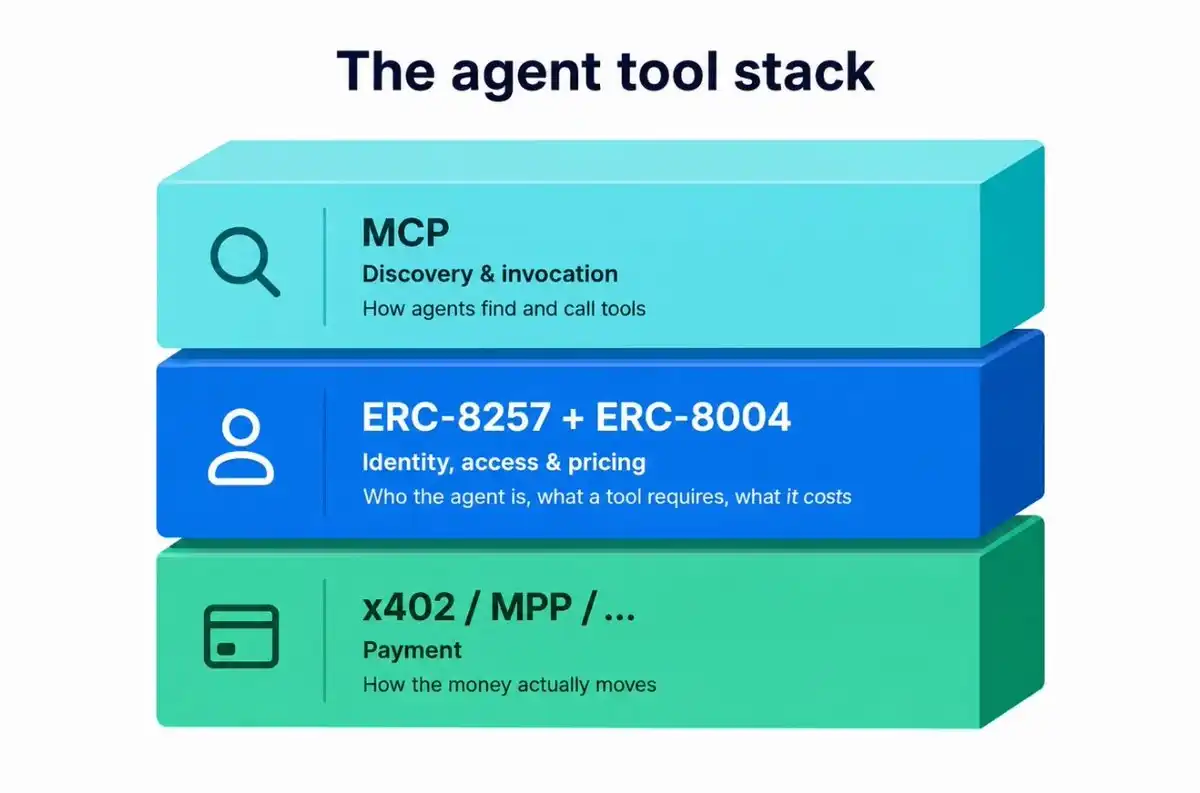
MCP tells your Agent what tools exist. ERC-8004 defines your Agent's identity. ERC-8257 explains how to actually use a tool. x402 handles payment. Each layer is composable.

An Agent registered via ERC-8004 can link to restricted tools from the ERC-8257 registry in its services array. You don't need to choose between them. They are different layers of the same tech stack.

See It in Action

nft-appraisal-tool: Point it to any NFT, it returns a price appraisal including low/mid/high ranges, confidence, recent trades, and comparable cases. Two tiers: 0.05 USD/call for anyone, 0.01 USD/call for CHONK holders on Base.

An Agent without CHONK calls the holder endpoint. Response: 403 — predicate gate denied. You need CHONK on Base.

The Agent buys one, retries, and the same call returns success.

$ npx @opensea/tool-sdk pay https://nft-appraisal-tool.vercel.app/api/holder --auth siwe \

--body '{"chain":"ethereum","contractAddress":"0x79fcdef22feed20eddacbb2587640e45491b757f","tokenId":"4707"}'

Wallet: 0x3184...0465

Response (403):

{"error":"Predicate gate: access predicate denied","toolId":"2","predicate":"0xc872..."}

The predicate explicitly tells it what's needed: CHONK on Base. The Agent buys one on OpenSea and retries, the call goes through.

$ npx @opensea/tool-sdk pay https://nft-appraisal-tool.vercel.app/api/holder --auth siwe \
--body '{"chain":"ethereum","contractAddress":"0x79fcdef22feed20eddacbb2587640e45491b757f","tokenId":"4707"}'
Wallet: 0x5eca...e2a8

Response (200):
{
"low": {"amount": "1.8", "currency": "ETH", "usd": 5460},
"mid": {"amount": "2.3", "currency": "ETH", "usd": 6970},
"high": {"amount": "3.1", "currency": "ETH", "usd": 9400},
"confidence": "medium",
"reasoning": "Comparable Squiggles in this color band sold between 1.9 and 2.6 ETH...",
...
}

No human between the 403 and the 200. Whoever holds the access NFT has the access.

What Can Be Built Next?

Professional pricing oracles. On-chain analytics subscriptions. Research subscriptions. Partner whitelist APIs. Limited-seat tools traded in open markets like any other asset.

None of these needed to exist a year ago. The moment the registry goes live, they all become possible.

Start Building

Live on Ethereum and Base.

@opensea/tool-sdk handles the low-level details, providing scaffolding, gating, registration, deployment to Vercel, Cloudflare, or Express. Includes usable examples.

npx @opensea/tool-sdk init my-tool

Full specification at 8257.ai.

Get Involved

ERC-8257 is still in draft. Help us improve the spec before we launch Registry 1.0. Publish a tool, even a small one. We'll promote interesting projects.

Join the Telegram group t.me/ERC8257 to discuss ERC, tool SDK, and more with the authors @CodinCowboy and @ralxz.

Disclaimer: This content is for informational purposes only and does not constitute financial or trading advice. Mention of specific projects, products, services, or tokens does not constitute endorsement, sponsorship, or recommendation by OpenSea. OpenSea does not guarantee the accuracy or completeness of the information presented, and readers should independently verify any statements before taking action. Readers should conduct their own due diligence and assume full responsibility for any decisions made.

Пов'язані питання

QWhat is the main purpose of ERC-8257 introduced by OpenSea?

AThe main purpose of ERC-8257 is to serve as an on-chain registry for AI agent tools. It allows developers to publish tools, set access rules (like requiring a specific NFT for access), define pricing, and manage subscriptions. This enables AI agents to autonomously discover, pay for, and use these tools without human intervention.

QHow does an AI agent gain access to a restricted tool according to the article's example?

AIn the article's example, an AI agent is initially denied access (403 error) to an NFT appraisal tool because it lacks the required CHONK NFT on Base. The agent autonomously purchases the necessary NFT on-chain and retries the request. With the NFT now in its possession, the access predicate grants permission, and the tool call succeeds (200 response), providing the price assessment.

QWhat is an 'access predicate' in the context of ERC-8257?

AAn 'access predicate' in ERC-8257 is a smart contract that defines the conditions for accessing a tool. Its sole function is to answer the question: 'Does this address have access?' It can check for various conditions such as NFT ownership, active subscriptions (e.g., ERC-5643), inclusion in a whitelist, ZK proofs, DAO votes, or staking amounts, making the access control system flexible and pluggable.

QHow does ERC-8257 potentially change the utility of existing NFTs?

AERC-8257 gives existing NFT collections new potential utility by allowing them to act as keys or passes for AI agent tool access. Holding a specific NFT could grant an agent discounted API rates, exclusive tool access, or membership privileges. This extends the value of PFP collections, membership passes, and other on-chain assets into the emerging agent economy.

QWhat role does the x402 protocol play in the ERC-8257 ecosystem?

AThe x402 protocol handles the payment layer within the ERC-8257 ecosystem. It is designed for micro-payments, enabling per-use, immediate payment for tool access. While ERC-8257 manages tool discovery and access control, x402 (alongside other protocols like MPP for metered billing) provides the financial infrastructure for agents to autonomously pay for the services they consume.

Пов'язані матеріали

Samsung Relies on Technology Cycles, SK Hynix on HBM, How Did Micron Win a Trillion-Dollar Market Cap?

Micron Technology, the third-largest memory chip maker alongside Samsung and SK Hynix, recently saw its market cap surpass $1 trillion. Founded in 1978 in Boise, Idaho, Micron survived brutal industry cycles while American peers and Japan's memory sector faltered. Its survival is attributed to a dual strategy: leveraging political and legal avenues for critical breathing room, coupled with relentless manufacturing cost control. Historically, Micron sought U.S. government intervention three times. In 1985, it filed an anti-dumping complaint against Japanese firms, leading to the U.S.-Japan Semiconductor Agreement. Ironically, this created an opening for Samsung, which later became its toughest competitor. In 2002, Micron turned "whistleblower" in a DRAM price-fixing investigation, escaping penalties while rivals were fined. In 2017, it sued China's Fujian Jinhua, contributing to its placement on a U.S. entity list, stifling a nascent competitor. However, a major strategic misstep occurred in 2013 with the acquisition of bankrupt Japanese firm Elpida. Integrating Elpida's mobile-DRAM-focused technology diverted resources, causing Micron to miss the critical early decade of development for High Bandwidth Memory (HBM)—the high-performance memory essential for AI chips like NVIDIA GPUs. By the time AI demand exploded in 2022, SK Hynix, which launched the first HBM in 2013, held about 85% of the HBM3 market, leaving Micron with roughly 3%. Micron now faces a triple squeeze. In the high-end HBM market, it lags significantly behind SK Hynix and Samsung. In the mid-to-low end DRAM market, it faces aggressive price competition from China's CXMT. Furthermore, a 2023 Chinese cybersecurity ban on its products slashed its revenue from China, a once-core market, from over 10% to just 7.1% by FY2025, causing it to exit China's data center server business. Beneath its political maneuvering lies Micron's core strength: exceptional manufacturing efficiency and cost control. Decades of engineering have yielded DRAM chips with a smaller cell area than rivals, meaning more chips per wafer and lower unit costs. This efficiency, not subsidies, has allowed it to withstand price wars. While political leverage bought time, Micron is now paying a "time debt" in the HBM race. It is racing to ramp up HBM3E production and develop HBM4, but catching up to competitors who started a decade earlier is a monumental challenge. Its future hinges on whether its expertise in cost control and political strategy can compensate for the lost time in a technology race where early-mover advantage is decisive.

链捕手23 хв тому

Samsung Relies on Technology Cycles, SK Hynix on HBM, How Did Micron Win a Trillion-Dollar Market Cap?

链捕手23 хв тому

New AMD Paper Overturns Conventional Wisdom: FP4 Training Instability's Cause Is Not Insufficient Randomness

AMD's new research challenges the conventional understanding of FP4 training instability. While reducing precision from FP8 to FP4 promises doubled computational throughput and is supported by new hardware like NVIDIA Blackwell and AMD MI350 series, training large language models natively with FP4 has been notoriously unstable, often attributed to insufficient stochasticity. The paper "Pretraining large language models with MXFP4 on Native FP4 Hardware" demonstrates successful end-to-end FP4 pre-training of Llama 3.1-8B on AMD MI355X GPUs using the MXFP4 format, achieving a 9-10% overall speedup over FP8. Crucially, it identifies the root cause of instability: not randomness, but the accumulation of *structural micro-scaling errors* along the sensitive weight gradient (Wgrad) path. Through controlled experiments, researchers found that quantizing the Wgrad operation to FP4 caused significant convergence degradation. Counterintuitively, common stochasticity-based mitigation techniques like stochastic rounding and randomized Hadamard transforms worsened performance. In contrast, applying a *deterministic* Hadamard transform successfully stabilized training by ensuring consistent error patterns, reducing the extra token cost from 26-27% to just 8-9%. This work has significant implications: 1) It provides a clear diagnostic for low-precision training instability, steering focus towards structural errors. 2) It pushes FP4 from a primarily inference-focused format into the realm of viable training. 3) It leverages the open OCP Microscaling (MX) standard, promoting cross-vendor compatibility. The research marks a critical step towards more economical large model training by further pushing the boundaries of low-precision computation.

marsbit43 хв тому

New AMD Paper Overturns Conventional Wisdom: FP4 Training Instability's Cause Is Not Insufficient Randomness

marsbit43 хв тому

Will ONDO's 'Tokenization Narrative' Change After Its CEO's Unexpected Passing?

Ondo Finance founder and CEO Nathan Allman has passed away unexpectedly. Allman, a Brown University graduate with a background in private credit and Goldman Sachs' digital asset team, was a key architect of Ondo's pivot from DeFi structured yield products to becoming a leading Real-World Asset (RWA) protocol. He drove the strategy to tokenize traditional financial assets like US Treasuries (OUSG), yield-generating dollar assets (USDY), and US stocks/ETFs (Ondo Global Markets) for on-chain accessibility. The company announced that President Ian De Bode, a former McKinsey partner with a strong institutional strategy and operations background, will succeed Allman as CEO. While Allman's sudden departure presents a near-term challenge, testing market confidence and Ondo's continuity, the project is seen as more than a founder-driven narrative. It has an established product suite and a management team with deep traditional finance experience. The long-term impact hinges on the new leadership's ability to execute. De Bode's expertise in compliance, distribution, and institutional partnerships aligns with RWA's next phase of scaling infrastructure. The core question is whether Ondo can maintain its product momentum and institutional relationships. Ondo's native ONDO token represents governance and RWA narrative value, not direct revenue from the underlying assets. Its future as a "top tokenization play" will depend on the team's continued delivery of product growth, asset scale, and real-world demand, moving beyond the initial emotional shock.

marsbit1 год тому

Will ONDO's 'Tokenization Narrative' Change After Its CEO's Unexpected Passing?

marsbit1 год тому

Bankless Co-founder's Confession on Selling Off ETH: Ethereum Did the Right Thing, but 'ETH as Money' Has No Future

Bankless co-founder David Hoffman recently sold his remaining ETH holdings, sparking debate within the Ethereum community. In a detailed explanation, Hoffman clarifies that his decision was not based on bearish sentiment towards Ethereum itself, which he remains highly optimistic about, but rather on the conclusion that the "ETH is Money" narrative has largely run its course. Hoffman argues that for ETH to achieve its envisioned status as global money, Ethereum needed to execute flawlessly across multiple layers—governance, technology, and market dominance—in a highly coordinated manner. He acknowledges Ethereum's significant successes and current justified valuation but suggests the window for a major revaluation based on this monetary narrative is closing. The post examines several challenges: the strong correlation between L1 chain activity/fees and native token value; the perceived failure of the "strong version" of crypto (user-owned, egalitarian systems) versus the rise of a "weak version" (efficient ledger technology for traditional finance); and the possibility that ETH's momentum as money was uniquely tied to the distorted conditions of the 2020-2021 period. Crucially, Hoffman highlights a structural tension: Ethereum is architected as a "giver, not a taker," providing critical infrastructure like secure block space and tokenization at cost. This ethos benefits the broader ecosystem (applications, L2s) but doesn't prioritize extracting maximum value for ETH itself. The "ETH is Money" thesis required Ethereum to win a war of overwhelming market dominance—a war its design philosophy refuses to explicitly fight. Therefore, while he sees continued immense success for the Ethereum network and its ecosystem (following a "fat application" theory where value accrues to apps and L2s), Hoffman finds it increasingly difficult to foresee a structural upward revaluation for the ETH asset based on the monetary narrative. His capital reallocation reflects a belief that this particular investment thesis has played out.

Odaily星球日报1 год тому

Bankless Co-founder's Confession on Selling Off ETH: Ethereum Did the Right Thing, but 'ETH as Money' Has No Future

Odaily星球日报1 год тому

Торгівля

Спот
Ф'ючерси

Популярні статті

Як купити NFT

Ласкаво просимо до HTX.com! Ми зробили покупку APENFT (NFT) простою та зручною. Дотримуйтесь нашої покрокової інструкції, щоб розпочати свою криптовалютну подорож.Крок 1: Створіть обліковий запис на HTXВикористовуйте свою електронну пошту або номер телефону, щоб зареєструвати обліковий запис на HTX безплатно. Пройдіть безпроблемну реєстрацію й отримайте доступ до всіх функцій.ЗареєструватисьКрок 2: Перейдіть до розділу Купити крипту і виберіть спосіб оплатиКредитна/дебетова картка: використовуйте вашу картку Visa або Mastercard, щоб миттєво купити APENFT (NFT).Баланс: використовуйте кошти з балансу вашого рахунку HTX для безперешкодної торгівлі.Треті особи: ми додали популярні способи оплати, такі як Google Pay та Apple Pay, щоб підвищити зручність.P2P: Торгуйте безпосередньо з іншими користувачами на HTX.Позабіржова торгівля (OTC): ми пропонуємо індивідуальні послуги та конкурентні обмінні курси для трейдерів.Крок 3: Зберігайте свої APENFT (NFT)Після придбання APENFT (NFT) збережіть його у своєму обліковому записі на HTX. Крім того, ви можете відправити його в інше місце за допомогою блокчейн-переказу або використовувати його для торгівлі іншими криптовалютами.Крок 4: Торгівля APENFT (NFT)Легко торгуйте APENFT (NFT) на спотовому ринку HTX. Просто увійдіть до свого облікового запису, виберіть торгову пару, укладайте угоди та спостерігайте за ними в режимі реального часу. Ми пропонуємо зручний досвід як для початківців, так і для досвідчених трейдерів.

376 переглядів усьогоОпубліковано 2024.12.10Оновлено 2025.03.21

Як купити NFT

Що таке AINFT

EternaFi Agents та $AINFT: Комплексний аналіз інфраструктури NFT на базі штучного інтелекту в екосистемі Web3 Перетворення штучного інтелекту (ШІ) та технології блокчейн швидко розвивається, створюючи інноваційні платформи, які переосмислюють моделі власності та економічної участі. EternaFi Agents, разом зі своїм рідним токеном $AINFT, є прикладом революційного підходу до токенізації інфраструктур ШІ за допомогою незамінних токенів (NFT). Запущений у липні 2025 року командою розробників Nova Club, EternaFi об'єднує досягнення ШІ з децентралізованими фінансовими механізмами блокчейн, представляючи унікальну інвестиційну можливість для учасників екосистеми web3. Ця стаття має на меті надати глибоку оцінку EternaFi Agents, охоплюючи його основні компоненти, функціональність та значення в крипто-ландшафті. Вступ та огляд проекту EternaFi Agents є яскравим прикладом того, як технологія блокчейн може демократизувати доступ до передових можливостей ШІ. Проект прагне змінити парадигму власності на ШІ, диверсифікуючи економічну участь, роблячи складні системи ШІ доступними для більшої кількості зацікавлених сторін. В основі проекту лежить токенізація власної великої мовної моделі (LLM), розробленої Nova Club, що дозволяє власникам NFT отримувати частковий доступ до економічної продуктивності моделі. Використовуючи NFT, які представляють частки в LLM, EternaFi Agents сприяє моделі, в якій зацікавлені сторони не лише беруть участь у споживанні послуг ШІ, але й насолоджуються економічними винагородами, отриманими платформою. Цей трансформаційний підхід дозволяє розробляти стійкі моделі доходу для послуг ШІ, одночасно сприяючи широкій участі громади та забезпечуючи прозоре управління. Що таке EternaFi Agents? EternaFi Agents представляє проект інфраструктури AI-NFT, який прагне поєднати можливості ШІ з технологією блокчейн в єдиній екосистемі. Основною рисою цього проекту є створення NFT, які слугують фінансовими інструментами, що представляють частки власності в власній інфраструктурі ШІ Nova Club. Кожен NFT символізує прямий доступ до економічної продуктивності базової системи ШІ, надаючи вигідну можливість для інвесторів. Проект працює на блокчейні Base, відомому своєю масштабованістю та ефективністю, що забезпечує прийнятні транзакційні витрати, одночасно полегшуючи безперебійну операційну діяльність. Однією з помітних рис є механізм розподілу доходів, за яким власники NFT можуть отримувати частини доходу від підписки, отриманого від послуг ШІ, наданих на платформі. Цей інноваційний підхід встановлює зв'язок між успіхом послуг ШІ та економічними дивідендами, розподіленими серед власників, забезпечуючи таким чином узгодженість інтересів у громаді. Хто є творцем EternaFi Agents? Творчою силою за EternaFi Agents є Nova Club, команда розробників, що базується в Сінгапурі, яка спеціалізується на поєднанні ШІ та технології блокчейн. Їхній попередній досвід у розробці ШІ та аналізі криптовалют надає проекту вагомість, вносячи широкий спектр експертизи у створення EternaFi Agents. Місія Nova Club полягає в демократизації доступу до передових технологій ШІ, одночасно створюючи стійкі економічні моделі, які приносять користь користувачам разом із розробниками. Їхня прихильність до прозорості, управління громадою та інновацій відображається в дизайні та реалізації платформи EternaFi, яка прагне створити унікальну екосистему, що сприяє позитивній взаємодії та створенню довгострокової цінності. Хто є інвесторами EternaFi Agents? Конкретні деталі щодо інвесторів або інвестиційних організацій, які підтримують EternaFi Agents, не є публічно доступними. Проте EternaFi прийняла інклюзивний підхід до фінансування свого розвитку через продаж NFT громадськості, що дозволяє широкому колу учасників інвестувати в екосистему. Архітектура проекту забезпечує відповідальне фінансування основної інфраструктури, одночасно дозволяючи членам громади брати участь у власності та економічних доходах, отриманих від послуг ШІ. Ця модель підкреслює залученість громади, узгоджуючи інтереси інвесторів та розробників проекту, створюючи співпрацююче середовище, де заохочується довгострокова участь. Як працює EternaFi Agents? EternaFi Agents функціонує через багатогранну екосистему, де NFT слугують основним засобом представлення власності в проекті. Кожен власник NFT має право на частку місячного доходу від підписки, отриманого від базової платформи на базі ШІ, тим самим позиціонуючи власність NFT як вигідний інвестиційний інструмент. Механізм генерації доходу Основним джерелом генерації доходу для платформи EternaFi є плати за підписку, пов'язані з наданими послугами ШІ. Користувачі можуть отримати доступ до різних послуг з різними рівнями, починаючи від базових інструментів ринкового аналізу до комплексних рішень для торгівлі з підтримкою ШІ. Ці послуги монетизуються і формують основу для механізму розподілу доходів, який розподіляє прибутки серед власників NFT через автоматизовані смарт-контракти. Інноваційною рисою екосистеми EternaFi є механізм розподілу доходів, який працює прозоро, забезпечуючи, щоб винагороди розподілялися на основі перевіряємих метрик з операцій платформи ШІ. Це створює прямий зв'язок між продуктивністю послуг ШІ та доходами, доступними інвесторам громади, встановлюючи стійку економічну модель. Механізми стейкінгу та вестингу Учасники EternaFi можуть брати участь у стейкінгу своїх NFT, щоб отримати додаткові економічні переваги. Графік вестингу розроблений для заохочення довгострокової прихильності серед учасників, винагороджуючи тих, хто демонструє постійну підтримку проекту. Це забезпечує міцну узгодженість інтересів і сприяє почуттю залученості громади, що є необхідним для досягнення довгострокових цілей проекту. Прозоре управління EternaFi Agents підтримує децентралізоване управління, дозволяючи власникам NFT активно брати участь у прийнятті рішень щодо розвитку платформи та її майбутніх напрямків. Управлінська структура включає механізми голосування громади, надаючи власникам NFT можливість впливати на важливі рішення та сприяючи співпраці в зростанні проекту. Хронологія EternaFi Agents Розробницька траєкторія EternaFi Agents демонструє систематичний підхід до створення стійкої інфраструктури ШІ, задовольняючи потреби учасників громади. Нижче наведено хронологію важливих етапів в історії проекту: Липень 2025: Запуск EternaFi Agents, включаючи публічний продаж NFT та впровадження токена $AINFT на блокчейні Base. Q4 2025: Створення ринкової інфраструктури, включаючи ліквідні пулі та запуск панелей стейкінгу для власників NFT. 2026: Ініціація програм залучення громади, розширення можливостей ШІ та інтеграція з крос-ланцюговими технологіями. Q4 2026: Впровадження системи розподілу дивідендів, що дозволяє власникам NFT отримувати економічні вигоди від своїх інвестицій. Ці етапи підкреслюють акцент на створенні функціональної та участевої екосистеми, забезпечуючи при цьому безперервну еволюцію для задоволення вимог ринку. Технологічна інфраструктура та інтеграція блокчейн EternaFi Agents закріплений в просунутій технологічній структурі, що поєднує системи ШІ з можливостями блокчейн. Працюючи на блокчейні Base, проект використовує переваги масштабованості та низьких транзакційних витрат. Основна архітектура смарт-контрактів регулює власність NFT, розподіл доходів та функції управління громадою, забезпечуючи ефективність і прозорість. Розробка системи ШІ Власна велика мовна модель, на якій базується EternaFi Agents, була незалежно розроблена та спроектована для задоволення потреб у генерації доходу без залежності від сторонніх фреймворків. Це зусилля відображає прагнення створити універсальну та адаптивну інфраструктуру ШІ, здатну надавати значущі послуги користувачам, тим самим генеруючи економічну цінність для інвесторів. Заходи безпеки Надійність інфраструктури безпеки EternaFi є надзвичайно важливою. Регулярні аудити та суворі заходи безпеки забезпечують цілісність систем ШІ та механізмів блокчейн, захищаючи від потенційних вразливостей, одночасно сприяючи довірі серед учасників. Висновок EternaFi Agents є знаковою інновацією в сфері штучного інтелекту та технології блокчейн, відкриваючи можливості для власності громади та економічної участі в передових можливостях ШІ. Комплексна стратегія проекту щодо токенізації інфраструктури ШІ через NFT встановлює прецедент для майбутніх децентралізованих екосистем. Поєднуючи технічну складність з економічними моделями, орієнтованими на користувача, EternaFi не лише сприяє залученню, але й генерує стійку структуру розподілу доходів для учасників громади. Значення EternaFi виходить далеко за межі його операційного успіху, оскільки він демонструє, як блокчейн може демократизувати передові технології ШІ, прокладаючи шлях для майбутніх проектів у цій перетворювальній сфері. Еволюція EternaFi Agents може ознаменувати нову еру розвитку ШІ, що характеризується управлінням, орієнтованим на учасників, стійкими економічними моделями та прозорою верифікацією, в кінцевому підсумку сприяючи більшій демократизації ШІ та доступності технологій у різних галузях.

546 переглядів усьогоОпубліковано 2025.08.14Оновлено 2025.08.14

Що таке AINFT

Обговорення

Ласкаво просимо до спільноти HTX. Тут ви можете бути в курсі останніх подій розвитку платформи та отримати доступ до професійної ринкової інформації. Нижче представлені думки користувачів щодо ціни NFT (NFT).

活动图片