Strive Executive: Rethinking the Bitcoin Price Flywheel

marsbitОпубліковано о 2026-08-29Востаннє оновлено о 2026-08-29

Анотація

"Strive Executive: Rethinking Bitcoin's Price Flywheel" Bitcoin's maturation process may not follow a simple trend of ever-shrinking returns, as suggested by its long-term power-law trajectory. Instead, a multi-stage "flywheel" effect could emerge, driven by falling volatility. In its early stages, Bitcoin exhibited extreme returns and high volatility, limiting large-scale investment and its use as collateral. As it matures (Stage 2), both returns and volatility decline, improving its risk-adjusted returns. While this seems to point toward diminishing gains, it crucially enhances Bitcoin's appeal to institutional capital and its quality as collateral for loans. Lower volatility allows existing investors to allocate more capital without increasing portfolio risk. More importantly, it significantly increases the amount of debt the system can safely issue against Bitcoin holdings. With shallower potential drawdowns, lenders can extend more credit against the same collateral value, making leveraged Bitcoin accumulation strategies more feasible and resilient. This sets the stage for Stage 3: a self-reinforcing cycle. Improved fundamentals attract more equity capital. Simultaneously, Bitcoin's enhanced collateral status enables the expansion of dollar-denominated credit (e.g., bank loans, bonds) used to acquire more Bitcoin. Fixed Bitcoin supply meets growing demand from both equity and newly created debt, potentially reigniting price acceleration. Thus, the very process of ma...

Author: Joe Burnett, Vice President of Bitcoin Strategy at Strive

Compiled by: Jiahuan, ChainCatcher

Last quarter, when Bitcoin retreated more than 50% from its highs, I argued that bear markets are not a system defect but part of Bitcoin's early adoption process. At the beginning of this year, I explained why Bitcoin could potentially reach $11 million by 2036. I still believe this scenario is possible, but a more worthwhile question is: What path will Bitcoin take to get there?

Bitcoin's early cycles saw hundred-fold gains, but the returns in recent cycles have narrowed significantly. If this trend continues, Bitcoin will eventually resemble a mature asset more closely, with returns gradually normalizing.

The power law model aptly summarizes this change. (Referring to the long-term, relatively stable power function relationship between Bitcoin price and time.) As the asset's size expands, its returns also decline. For over a decade, Bitcoin has been moving along a highly stable long-term trajectory.
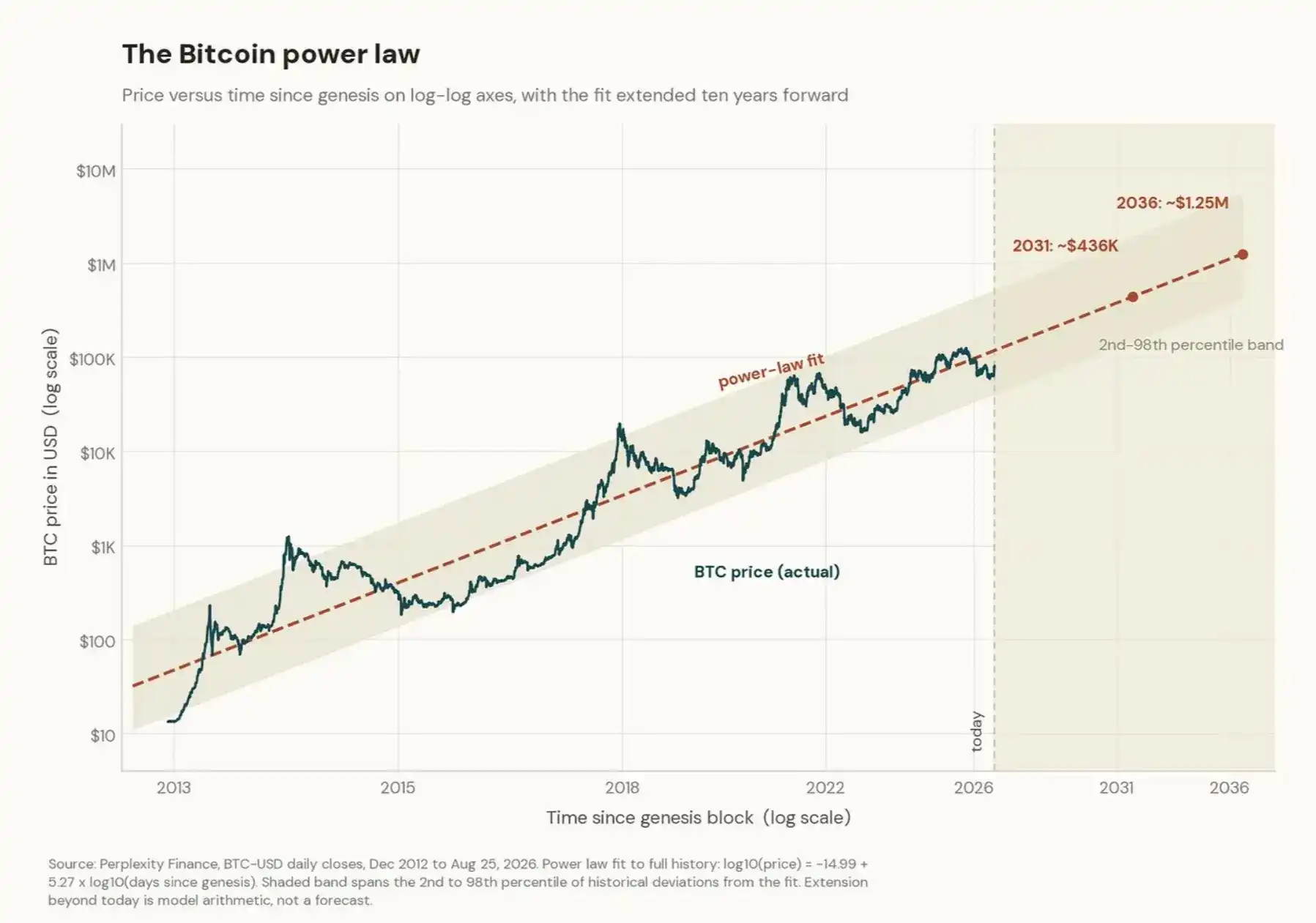
I acknowledge the explanatory power of the power law framework and believe Bitcoin may continue roughly along this trajectory for many years to come. However, I am no longer convinced that the power law sufficiently describes Bitcoin's endgame.

As Bitcoin matures, returns are declining, and volatility is also decreasing. The decline in volatility will not only change the scale of capital Bitcoin can attract but also expand its uses within the financial system.

Lower volatility improves Bitcoin's risk-adjusted returns and makes it easier to obtain financing using Bitcoin as collateral. When Bitcoin becomes high-quality collateral in the global financial system, the scale of dollar-denominated credit backed by it could expand dramatically.

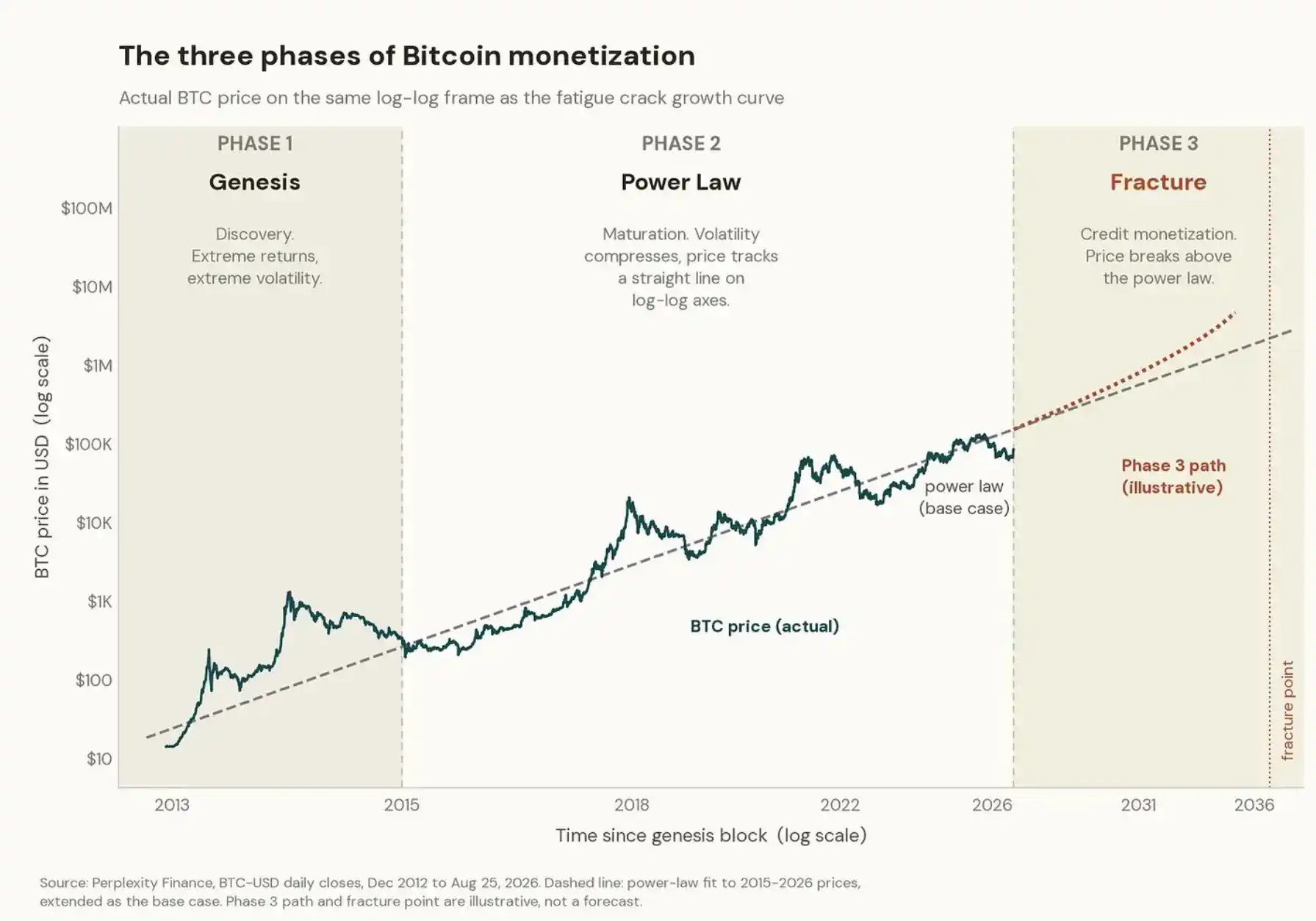
Diminishing returns suppress volatility, declining volatility attracts more capital, and expands the financing scale Bitcoin can support. Ultimately, these forces may conversely drive a reacceleration of Bitcoin's price, breaking upwards from the power law trajectory.
Diminishing Returns May Only Be the Prelude to the Next Phase

There is an interesting analogy in materials science.

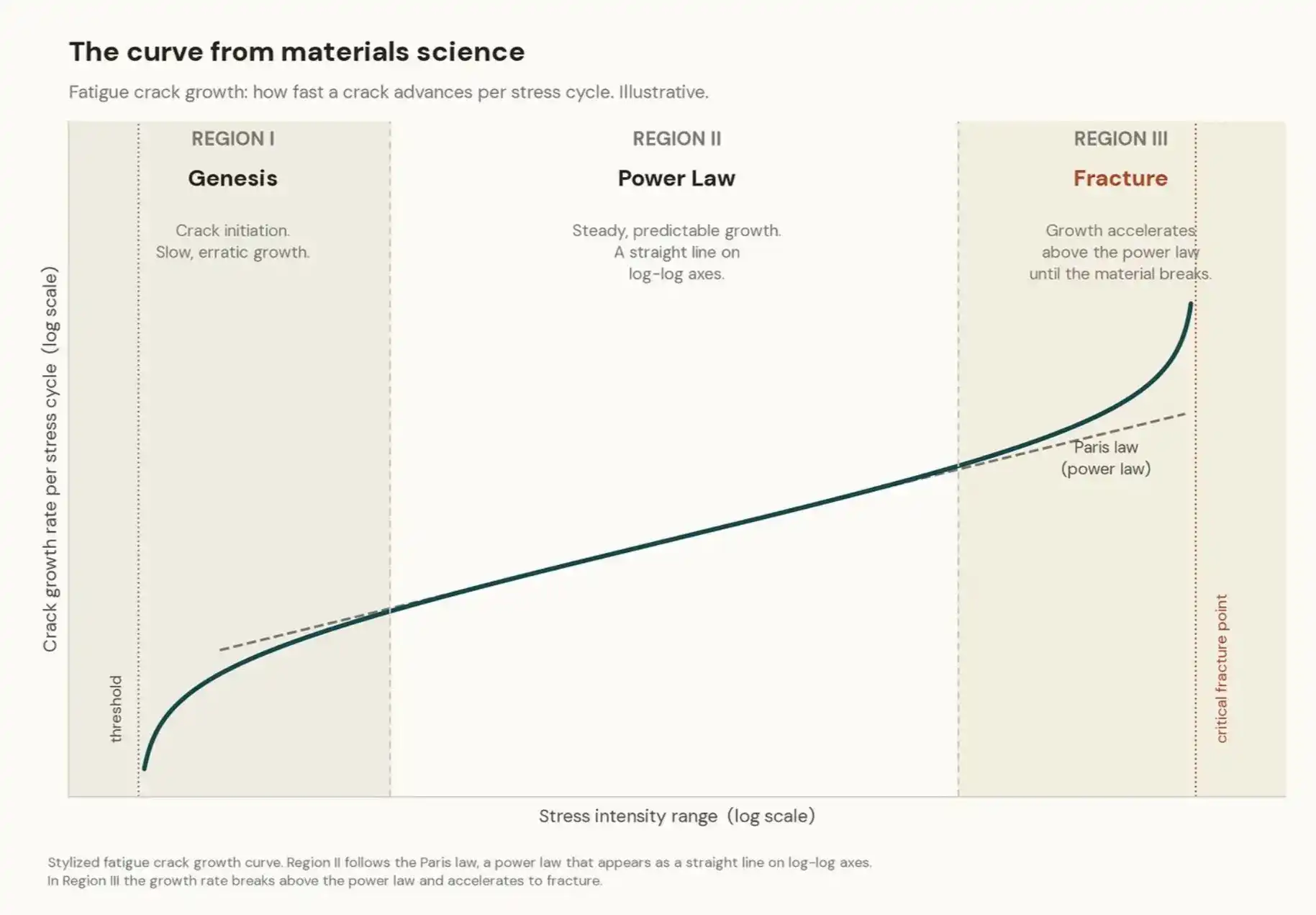
Engineers studying metal fatigue observe how cracks propagate under repeated stress. An airplane wing bends slightly with each flight, and a bridge deck repeatedly compresses and unloads as vehicles pass over. Each stress causes minimal damage, but this damage accumulates, eventually forming expanding cracks. Engineers typically divide the crack growth curve into three zones.

Zone I is the crack initiation period, where propagation is irregular and difficult to model.

In Zone II, crack growth becomes more predictable, known in engineering as the Paris' law regime. Here, crack propagation approximates a straight line on a log-log plot.

In Zone III, the crack reaches a critical point and expands rapidly. The power law that described the intermediate stage no longer applies, and the material ultimately fractures.
I believe Bitcoin's monetization process follows a similar trajectory. In this analogy, the material under continuous stress is the dollar credit system.

Stage I is Discovery. Returns and volatility are extremely high. Large capital struggles to allocate to Bitcoin, and it is difficult to use as collateral for financing.

Stage II is Maturation. Both returns and volatility narrow. Bitcoin's risk-adjusted returns improve, allowing investors to increase allocations. It gradually becomes more attractive as collateral.

Stage III is System-Driven Monetization. Equity-driven and credit-driven buying begins entering the Bitcoin market on a large scale. A self-reinforcing cycle kicks in, price growth reaccelerates, and breaks upwards from the power law trajectory.

Most people see Stage II and assume diminishing returns will continue forever. But in my view, Stage II is precisely creating the conditions for Stage III. As Bitcoin matures, with lower volatility, improved risk-adjusted returns, and enhanced collateral quality, it becomes easier for existing capital to allocate to Bitcoin, and financing to buy more becomes more feasible.

Declining Volatility is Reshaping Bitcoin's Asset Attributes

Bitcoin's volatility has declined significantly.

In March 2014, Bitcoin's one-year realized volatility once approached 147%; as of the article's publication, data from Perplexity Finance shows this figure has fallen to around 44%. Fidelity also recently noted that Bitcoin's current volatility is lower than it was on 98.5% of its historical trading days.
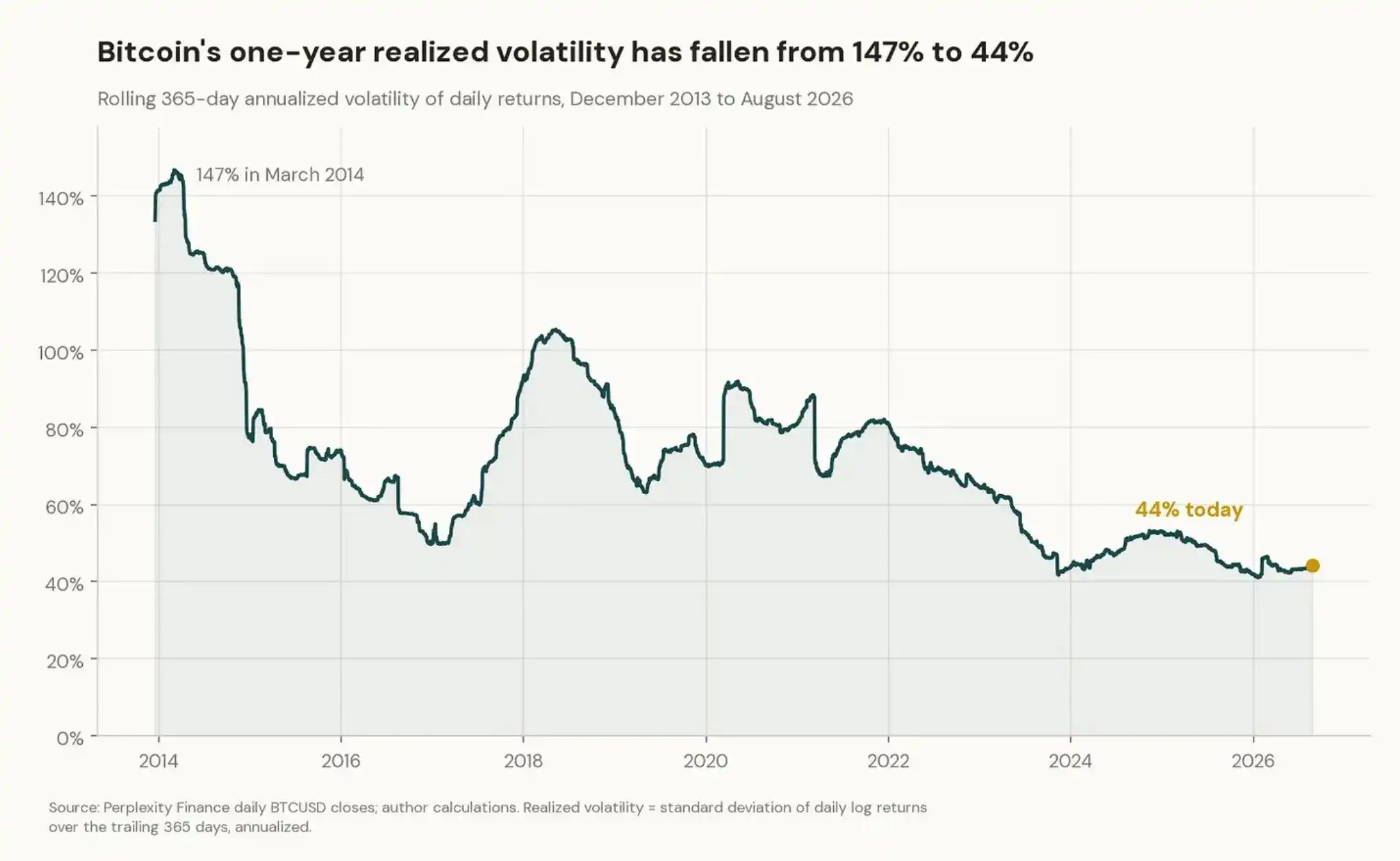
With long-term returns still compelling, Bitcoin's declining volatility has increased its Sharpe ratio. This means Bitcoin can attract more capital simply by improving its risk-return profile, without relying on new credit. A similar sign appeared between 2016 and early 2017: volatility narrowed significantly, and strong performance began attracting more capital.

Volatility also acts like a hidden tax on position size. For an investor with a fixed risk budget, if Bitcoin's volatility halves, they can theoretically double their allocation without increasing their portfolio's risk contribution. Therefore, even without creating any new credit, declining volatility itself expands the capacity for existing capital to allocate to Bitcoin.

Historical maximum drawdowns illustrate the same point. Bitcoin's three previous major bear markets saw maximum drawdowns of approximately 85%, 84%, and 77%. In this cycle, Bitcoin fell from a high of around $125,000 in October 2025 to a low of about $58,500 in June 2026, a drawdown of about 53%.

NYDIG reached a similar conclusion around the June low: this drawdown was 52.7%, compared to 77.6% in 2021-2022, and between 84% and 94% in earlier cycles. Each cycle's decline has moderated, and bottoms have risen. NYDIG identifies this long-term decline in volatility as one of the most distinctive features of the current phase.
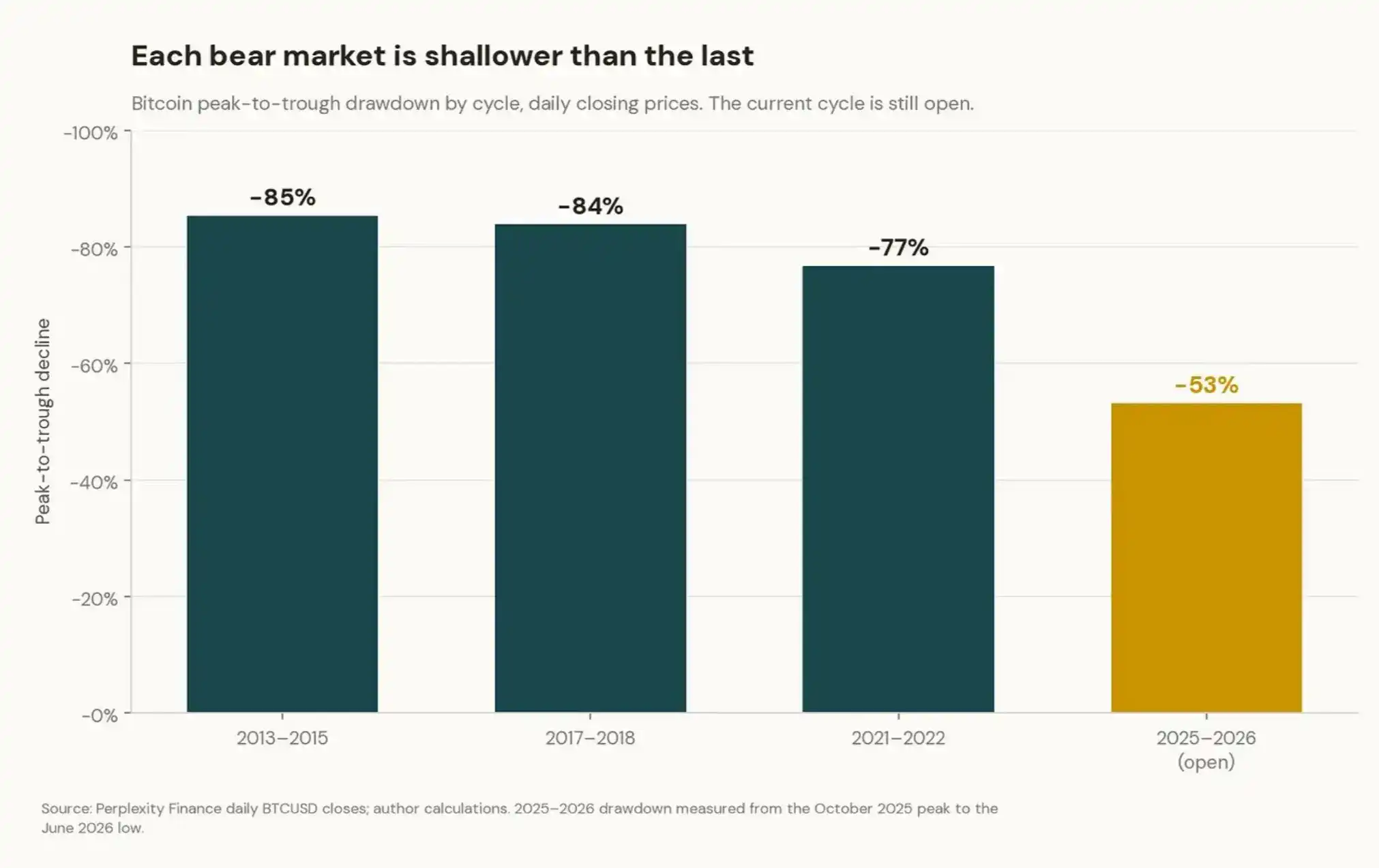
For Bitcoin holders, this change might be disappointing: bull market gains are smaller, bear market losses are smaller, and overall returns are declining.

But in the eyes of lenders, the same trend is highly attractive because Bitcoin is becoming higher-quality collateral.

Lower Volatility, Larger Credit Scale Bitcoin Can Support

From a lender's perspective, the most important question is: How much can Bitcoin fall before the collateral value approaches the loan balance?

Suppose someone holds $100,000 worth of Bitcoin and borrows $20,000 against it, with an initial loan-to-value ratio of 20%; when the LTV rises to 80%, the lender liquidates the collateral.

The smaller the worst-case drawdown Bitcoin might experience, the higher the loan amount a lender can safely issue against the same collateral. With unchanged liquidation rules, if the expected worst drawdown falls from 80% to 50%, the safely issuable loan amount increases 2.5 times.
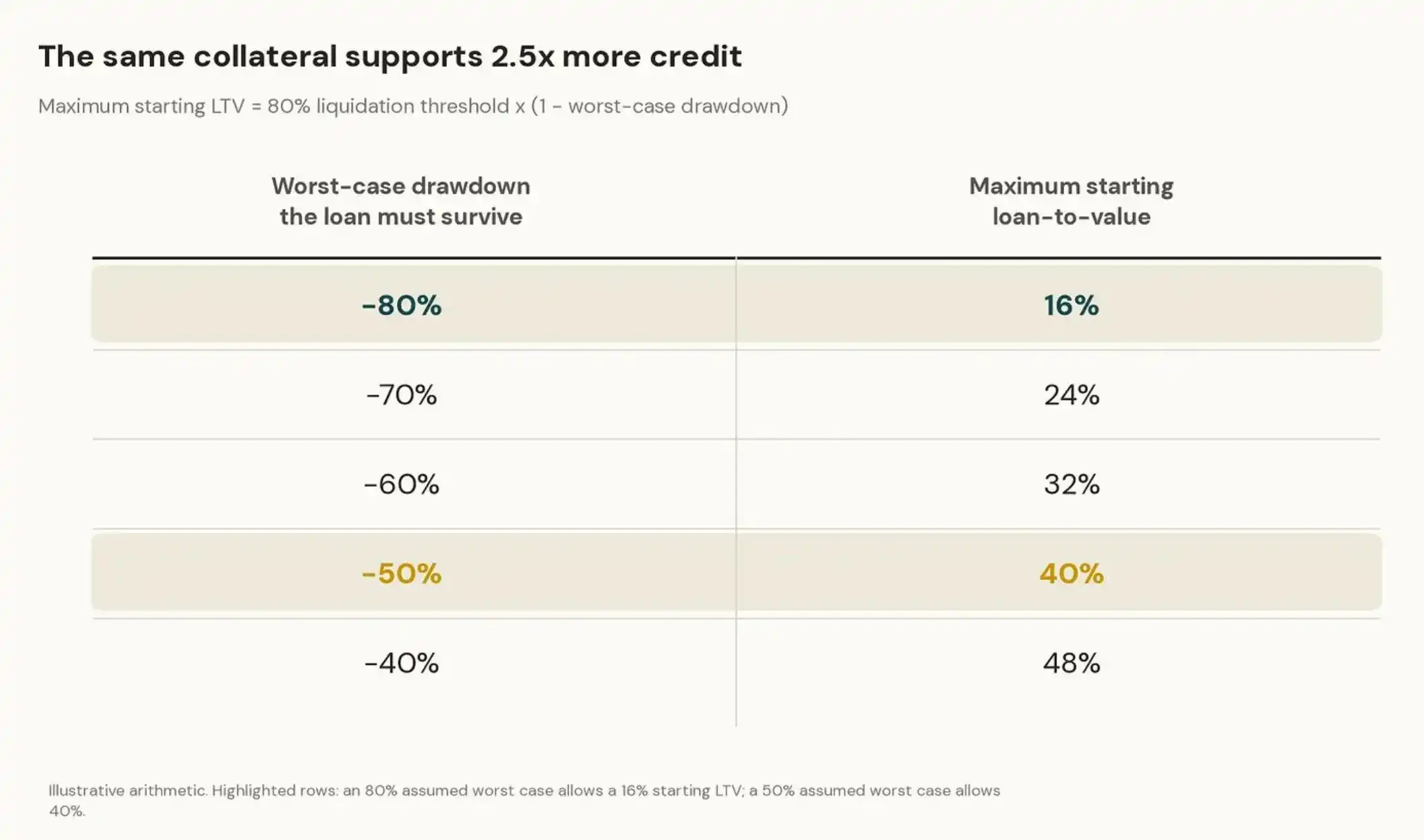
The same logic applies to borrowers. Financing structures adopted by companies like Strategy and Strive can increase Bitcoin exposure through financing without taking on short-term liquidation risk; shallower drawdowns strengthen these structures' resilience. Therefore, lower volatility can support larger financing scales while reducing credit risk.

Price increases further amplify this effect. If the Bitcoin price doubles while the corresponding dollar debt remains unchanged, the LTV halves. The same amount of Bitcoin can thus support more borrowing, providing funds for subsequent buying.

Even as Bitcoin matures and annual returns no longer reach 100%, this financing logic may still hold, and the expandable credit scale could remain substantial.

Suppose Bitcoin's expected annual return drops to 30%, and the financing cost for Bitcoin-related preferred shares is around 13%, leaving an expected return spread of about 17 percentage points.
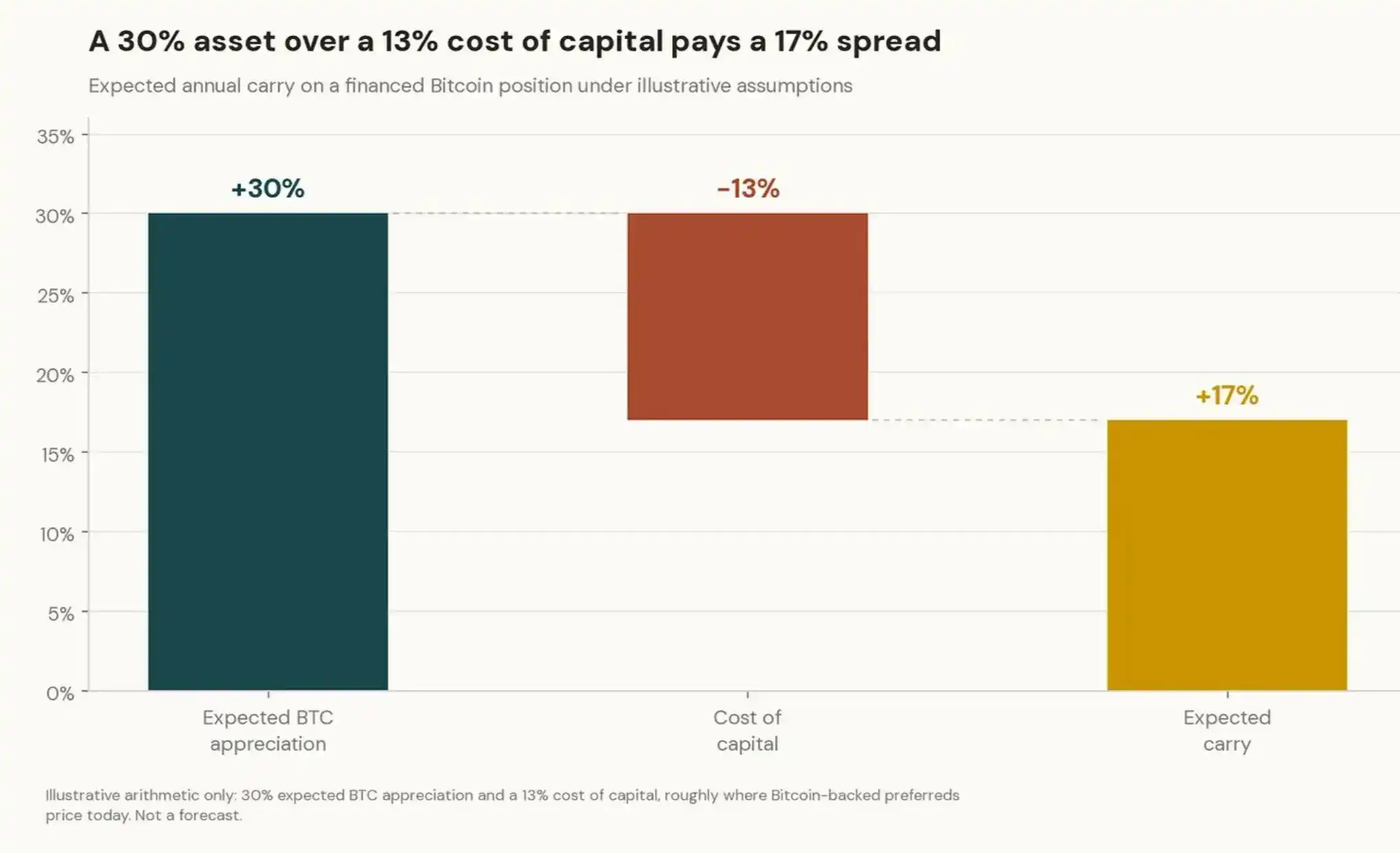
As extreme drawdowns for the collateral continue to narrow, such a return spread remains sufficient to support large-scale financing. As the market's assessment of collateral risk decreases, lower-cost financing channels may gradually open, including bank credit lines, investment-grade bonds, and securitization of Bitcoin-backed loans.

This mechanism is already beginning to show in public markets. Strategy published an illustrative credit model that uses assumed Bitcoin volatility to derive credit spreads for its preferred shares.

Under the same assumptions, when Bitcoin volatility is 60%, the model yields a STRC credit spread of 360 basis points (1 basis point equals 0.01 percentage points), falling into non-investment grade territory. When volatility decreases to around 40%, near current realized levels, the spread rapidly narrows to 56 basis points, entering investment-grade territory. When volatility further drops to 30%, the spread is only 6 basis points. Concurrently, the model's probability of collateral failing to cover the claim also drops from about 26% to less than 0.5%.
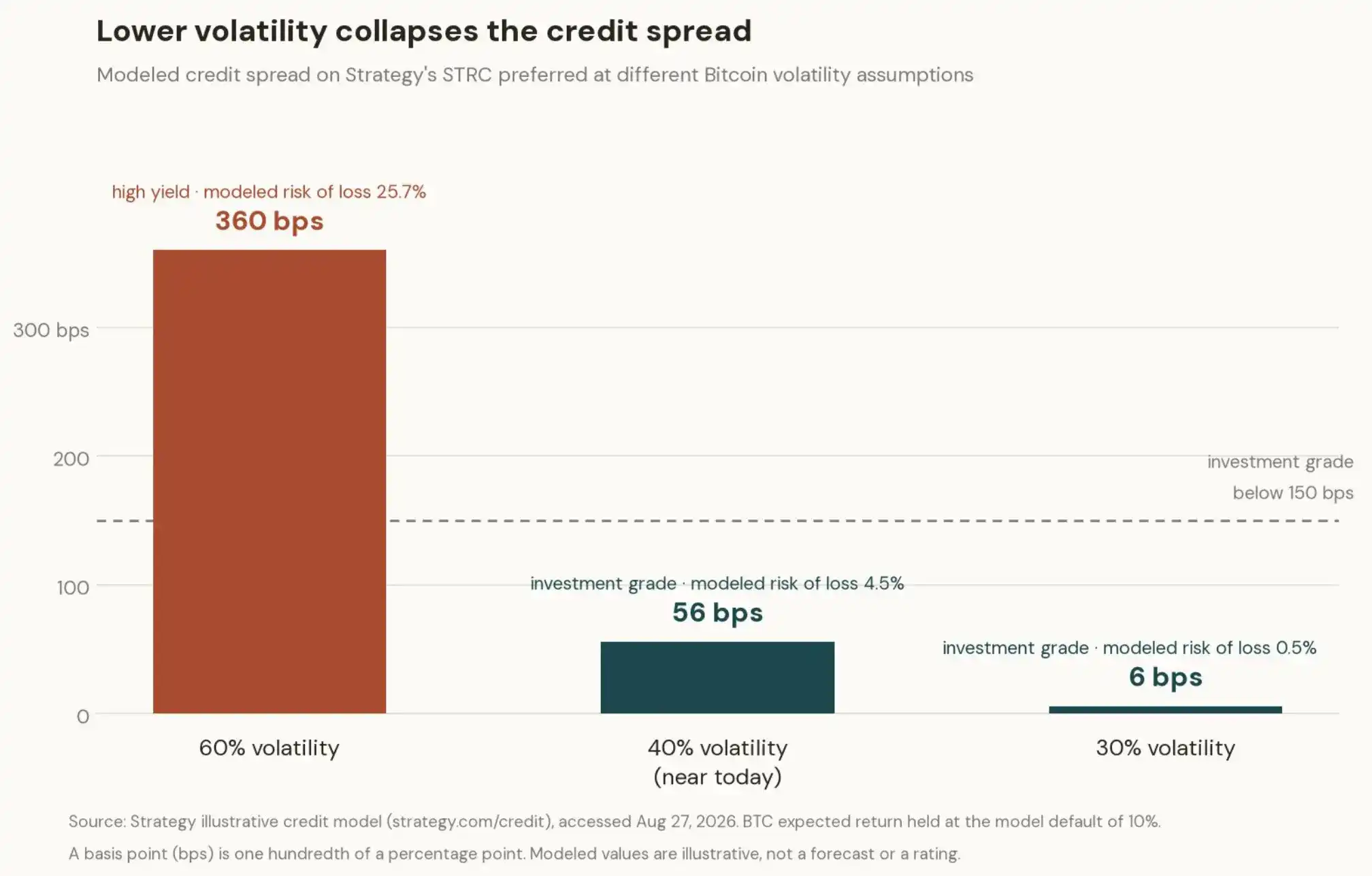
Declining volatility makes the same instrument exhibit lower credit risk; lower credit risk typically leads to more capital the financial system is willing to provide.

The starting point is declining returns and volatility, but the result may be a reacceleration of returns.

The Capital and Credit Flywheel Drives Price Reacceleration

These factors combine to form a self-reinforcing cycle.

Bitcoin continues to grow and mature, volatility decreases; improved risk-adjusted returns allow investors to commit more capital; enhanced collateral quality makes financing cheaper and more abundant. Existing capital and buying supported by newly created dollar credit begin competing for the fixed supply of 21 million Bitcoins, driving up prices. Higher prices increase collateral value, releasing more financing capacity, perpetuating the cycle.
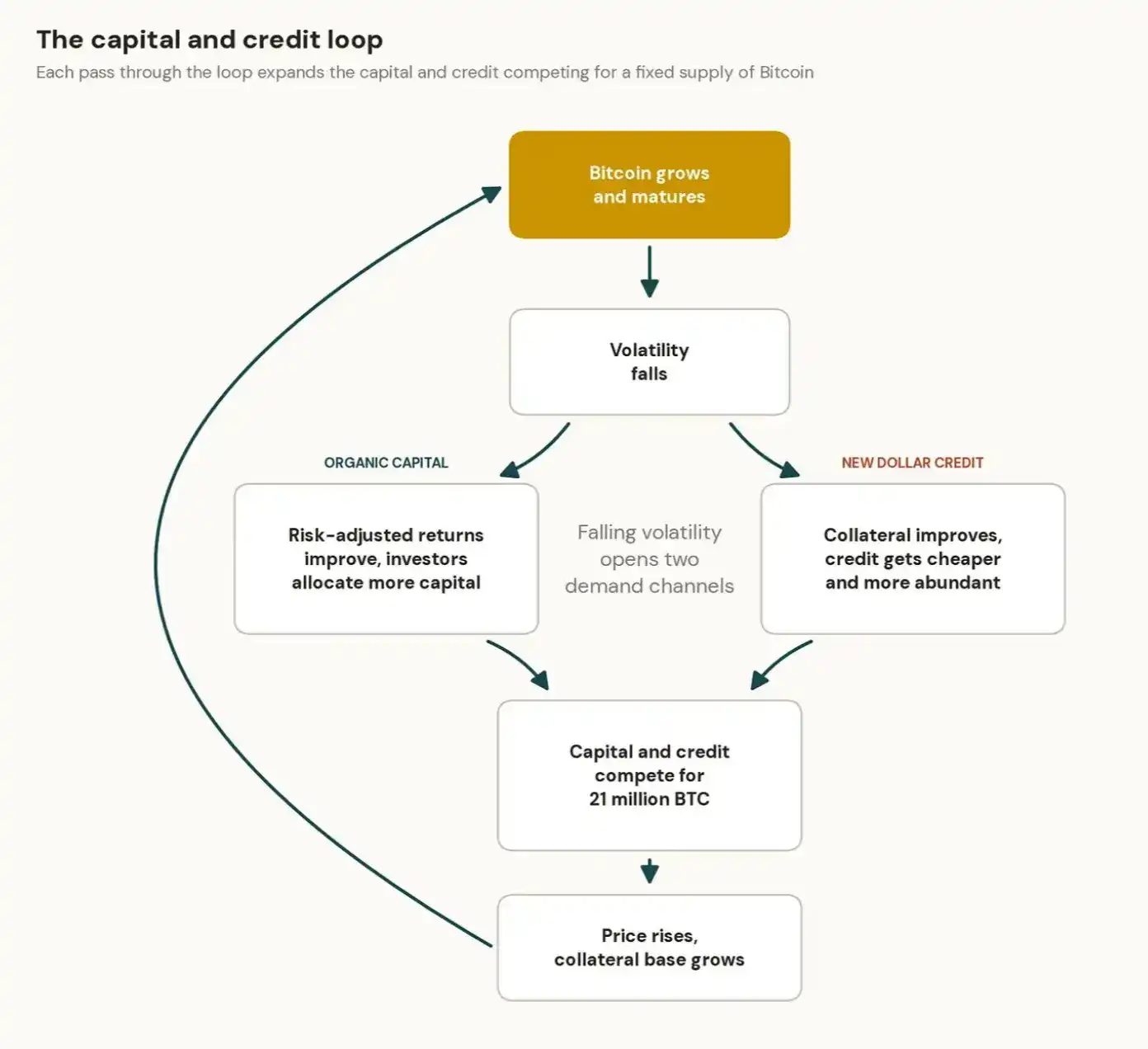
From a credit expansion perspective, this cycle resembles a speculative attack in macrofinance (borrowing a relatively weaker currency to buy assets more resistant to dilution, forming a self-reinforcing trading mechanism).

Credit expansion could come from multiple paths. Banks can issue Bitcoin-backed loans, and as the Bank of England explained in "Money Creation in the Modern Economy", commercial banks create deposit money when they issue loans. Companies can also issue convertible bonds and perpetual preferred shares, using the proceeds to buy Bitcoin. Both paths expand dollar-denominated credit while taking more Bitcoin out of circulating supply.

The Moment of Breaking the Power Law

So, what will be the end of this process?

New technology adoption typically follows an S-curve: slow initially, rapid adoption, then saturation. Many thus assume Bitcoin's price will follow the same curve and eventually flatten. But this overlooks that the dollar side of BTC/USD is not static: the pool of dollar capital and credit available to buy or finance Bitcoin can still expand.

Bitcoin's quantity is fixed, but the scale of dollar capital and credit available to buy Bitcoin has no fixed upper limit. Lower volatility allows more existing capital to allocate to Bitcoin rationally; higher collateral quality enhances the financial system's ability to expand dollar credit against it.

Even if Bitcoin's adoption rate eventually saturates, the amount of capital willing to hold Bitcoin directly or finance its purchase may continue to expand. The dollar-denominated Bitcoin price may reaccelerate, breaking upwards from the power law trajectory that previously described Stage II.

This is Zone III in the metal fatigue curve. Cracks don't propagate forever at the speed described by Paris' law but accelerate upon reaching a critical point, ultimately causing fracture. Declining volatility first broadens the space for capital allocation and credit expansion; when these forces compete for the fixed Bitcoin supply, returns and upside volatility may rebound simultaneously.

In this analogy, the material under continuous stress is the dollar credit system; the so-called "fracture" is the moment Bitcoin's dollar price breaks upwards from the power law.


Пов'язані питання

QWhat are the three stages of Bitcoin's monetization process described in the article, and how do they relate to material science?

AThe article compares Bitcoin's monetization to material fatigue, outlining three stages. Stage 1 is Discovery, characterized by high returns and high volatility, making Bitcoin unsuitable for large capital allocation or as collateral. Stage 2 is Maturation, where returns and volatility narrow, improving Bitcoin's risk-adjusted returns and making it more attractive as an asset and collateral. Stage 3 is a financial system-driven monetization, where lower volatility enables massive capital inflows and credit expansion using Bitcoin as collateral, potentially restarting an accelerating price cycle. This final stage is analogous to the third region in a material fatigue curve where a crack accelerates toward failure, representing a potential breakout from established price trends.

QAccording to the article, how does decreasing Bitcoin volatility affect its role as collateral and the potential for credit expansion?

ADecreasing Bitcoin volatility significantly improves its quality as collateral. From a lender's perspective, a lower expected worst-case price drawdown means they can safely issue larger loans against the same amount of Bitcoin while maintaining the same Loan-to-Value (LTV) safety threshold. The article provides a model showing that as Bitcoin's volatility drops from 60% to 40% and then 30%, the credit spread for related debt instruments shrinks dramatically, moving from non-investment grade to investment grade. This lower perceived risk allows the financial system to provide more and cheaper credit, potentially financing further Bitcoin purchases.

QWhat self-reinforcing cycle (or 'flywheel') does the article propose could lead Bitcoin's price to accelerate upwards?

AThe article proposes a self-reinforcing capital and credit flywheel. As Bitcoin matures, its volatility decreases, improving its risk-adjusted returns and collateral quality. This attracts more direct capital allocation from investors (who can allocate larger sums for the same risk budget) and enables cheaper, more abundant credit using Bitcoin as collateral. This influx of capital and credit competes for the fixed supply of Bitcoin, pushing prices up. Higher prices, in turn, increase the value of the collateral base, which allows for even more credit to be issued, perpetuating the cycle and potentially causing price appreciation to re-accelerate.

QWhy does the author argue that the 'Power Law' model might not describe Bitcoin's ultimate price trajectory?

AThe author argues that the Power Law model, which describes a long-term, stable decline in Bitcoin's returns over time, effectively captures its maturation phase (Stage 2). However, he suggests this stage may be a precursor to a more explosive third phase. The maturation process itself—by lowering volatility and improving Bitcoin's attributes as collateral—creates the conditions for massive financial system integration. When large-scale credit expansion based on Bitcoin collateral enters the market, the dynamic changes. The fixed supply of Bitcoin meets an expanding pool of dollar-denominated capital and credit, which could cause the price to break upward from the established Power Law trajectory, entering a new regime of acceleration.

QWhat evidence does the article cite to show that Bitcoin's volatility is decreasing over time?

AThe article cites several pieces of evidence for decreasing Bitcoin volatility. First, it notes that the 1-year realized volatility has dropped from a peak near 147% in March 2014 to approximately 44% at the time of writing, according to Perplexity Finance data. Second, it references Fidelity's analysis indicating current volatility is lower than it was on 98.5% of Bitcoin's historical trading days. Third, it points to diminishing maximum drawdowns in bear markets: previous cycles saw drawdowns of ~85%, 84%, and 77%, while the most recent cycle's drawdown was about 53% (from ~$125k to ~$58.5k). Data from NYDIG confirms this trend of shallower drawdowns and rising price floors across cycles.

Пов'язані матеріали

Anthropic Eyes 'Training Chips'? Reportedly Considered Acquiring AI Chip Company MatX for $7 Billion

AI giant Anthropic reportedly discussed acquiring AI chip startup MatX for approximately $7 billion to accelerate its in-house chip development, specifically targeting "training chips" for large language models. This move follows OpenAI's recent unveiling of its own inference chip, "Jalapeño," highlighting a growing trend of major AI companies vertically integrating into hardware. However, the MatX deal was ultimately abandoned, with talks shifting toward potential collaboration instead. Anthropic's interest in MatX, a company founded in 2023 by former Google TPU engineers, underscores its strategic push to secure faster and more cost-efficient computing power for its Claude model. The company's broader chip ambitions are further evidenced by its recruitment of key industry veterans, including former Google TPU leader Amir Salek and ex-OpenAI chip engineer Clive Chan, to build an internal chip team. Anthropic is also actively meeting with several other AI chip startups to evaluate different architectures. Despite this significant investment in chip design capabilities, Anthropic reportedly plans to maintain a multi-vendor strategy, continuing its partnerships with major suppliers like Nvidia and Google. Developing advanced chips remains a costly and time-intensive endeavor, making the acquisition of an established startup like MatX an attractive, though currently unrealized, shortcut to gain expertise and potentially reduce long-term costs.

marsbit7 хв тому

Anthropic Eyes 'Training Chips'? Reportedly Considered Acquiring AI Chip Company MatX for $7 Billion

marsbit7 хв тому

Weekly Editor's Picks (0822-0828)

**Weekly Editor's Picks (Aug 22-28)** **Theme:** This weekly digest curates in-depth analysis from the fast-moving information flow, filtering noise to deliver insights. **Macro & Geopolitics** * **US Treasury Strategy:** Wall Street expects potential signals in November regarding future borrowing through more short-term bills and notes, alongside expanded bond buybacks to ease long-term yield pressure. A direct cut in long-term bond issuance is also a rising possibility. * **Gold Outlook:** Goldman Sachs sees fundamental buying, ETF inflows, and options activity driving gold above $4,600/oz. They maintain a year-end target of $4,900, noting potential upside from increased macro hedging demand. Options positions could amplify moves in either direction. **Investment & Crypto** * **Arthur Hayes Interview:** The BitMEX co-founder argues crypto is the primary release valve for central bank liquidity. He predicts ETH could reach $30,000 and sees FLOP potentially surpassing ETH. The Clarity Act is criticized as harmful to US crypto innovation. He views war as the biggest market risk. * **Crypto Leverage Plays:** Analysis of crypto-correlated stocks (MSTR, COIN, etc.) during BTC's 24% weekly surge, ranking their leverage and risk profiles. * **Altcoin Season:** The altcoin market cap surpassed $1 trillion, with 92% of tokens rising. The rally is becoming more fundamentals-driven. * **ZEC & TAO ETFs:** Zcash hit an 8-year high, fueled by Grayscale's progress in converting its Zcash Trust to a spot ETF. A similar "trust-to-ETF" path is noted for Bittensor (TAO). * **Tokenomics Shifts:** Hyperliquid (HYPE) activated a new revenue stream for buybacks. Ethena (ENA) announced a buyback of locked VC tokens and canceled future monthly unlocks, significantly reducing sell-side pressure. **AI & Semiconductors** * **NVIDIA Earnings:** Approaching $100B in quarterly revenue, with growth potentially continuing at 70% next year. Demand is broadening beyond major cloud providers. Supply remains a constraint. * **SK Hynix:** A technical and fundamental analysis following a significant pullback. The company announced a major share buyback. Key risks include competition from Samsung and high stock volatility. **CeFi & DeFi** * **DeFi Picks:** Highlights protocols with strong revenue metrics (UNI, AAVE, JUP, etc.) as potential opportunities. * **Crypto Credit Lines:** Galaxy Digital launched a credit line product allowing users to borrow against BTC, ETH, and SOL portfolios at 8.99% APR, targeting holders needing liquidity without selling assets. **Ethereum & Scaling** * **BitMine's ETH Holdings:** The public company is nearing a 5% stake in all ETH. Analysis discusses the lack of direct network control but highlights concentration risks, regulatory implications, and the company's leveraged bet on a single asset. Fundstrat's Tom Lee suggests buying won't stop at 5% and sees a $10,000 price target for ETH. **Other Notable Topics** * **Meme Coin Drama:** The cycle of rumors, pumps, and dumps around potential "Trump-themed" tokens. * **SOL Burn Proposal:** A vote could significantly increase the daily SOL burn rate. * **Security Incident:** A high-profile Chinese influencer alleged a multi-million dollar crypto scam. * **Weekly Recap:** Key events included BTC reclaiming $80k, speculation about crypto trading on X, and significant altcoin market cap growth.

marsbit22 хв тому

Weekly Editor's Picks (0822-0828)

marsbit22 хв тому

Breaking News: OpenAI Completely Cuts Off Cursor

OpenAI has announced it will completely terminate its direct model supply to Cursor, the AI-powered code editor, on November 12. This decision follows the acquisition of Cursor by SpaceX (and thus Elon Musk) in a $60 billion deal two weeks prior. OpenAI cites Musk's history of contractual violations as the core reason, including past instances where xAI (now part of SpaceX) used OpenAI data for model training against terms of service. The move severs Cursor's official bundled access to OpenAI models like GPT. Crucially, it also explicitly excludes access to OpenAI's upcoming, highly capable "Astra" model, which is considered a strategic asset. Developers can continue using OpenAI models within Cursor by supplying their own API key, but this shifts costs from a bundled subscription to a direct, usage-based payment model, effectively raising prices for heavy users. Cursor's CEO confirmed negotiations are ongoing and emphasized Cursor's long-standing relationship with OpenAI, framing the decision as a departure from OpenAI's claimed platform neutrality. The article frames this event as part of a broader industry trend where model providers (like OpenAI and Anthropic) are increasingly cutting off integrated access to their models in tools owned by competitors or entities they distrust. The conclusion is that control over the foundational AI models has become the ultimate source of power, deciding who gets access to the most advanced capabilities.

marsbit1 год тому

Breaking News: OpenAI Completely Cuts Off Cursor

marsbit1 год тому

Торгівля

Спот
活动图片