OpenAI Proposes Transferring 5% Equity to the U.S. Government

marsbitОпубліковано о 2026-07-06Востаннє оновлено о 2026-07-06

Анотація

OpenAI has reportedly proposed to sell 5% of its equity to the U.S. government, a stake valued at over $40 billion based on its $852 billion valuation. According to the Financial Times, CEO Sam Altman has engaged in preliminary discussions with senior officials, including the Commerce and Treasury Secretaries, framing public ownership as a way for Americans to share in AI's economic benefits. The proposal includes a broader vision where other major U.S. AI companies like Anthropic, Google, and Meta would contribute a similar percentage of their equity to a public investment vehicle, modeled on the Alaska Permanent Fund, to distribute dividends to citizens. However, there is no indication of interest from these rivals. This move is seen as an attempt to navigate increasing regulatory pressure and scrutiny over AI safety and societal impact. It contrasts with more radical proposals, such as one from Senator Bernie Sanders advocating for up to 50% public ownership. While the discussions are conceptual and would likely require congressional action, they signify a strategic shift: OpenAI is offering a financial stake to align government interests and potentially secure a more stable regulatory relationship ahead of a possible future IPO. The outcome could reshape how AGI development is governed and who benefits from its profits.

OpenAI proposes transferring 5% equity to the U.S. government, valued at over $40 billion based on an $852 billion valuation. Altman also wants to bring all U.S. AI giants on board—how will this move reshape the industry landscape?

OpenAI, valued at $852 billion, is actively offering its equity to the White House.

According to a report by the Financial Times, OpenAI has initiated preliminary talks with the U.S. government, proposing to transfer 5% of the company's equity—worth approximately $42.6 billion at the current valuation.
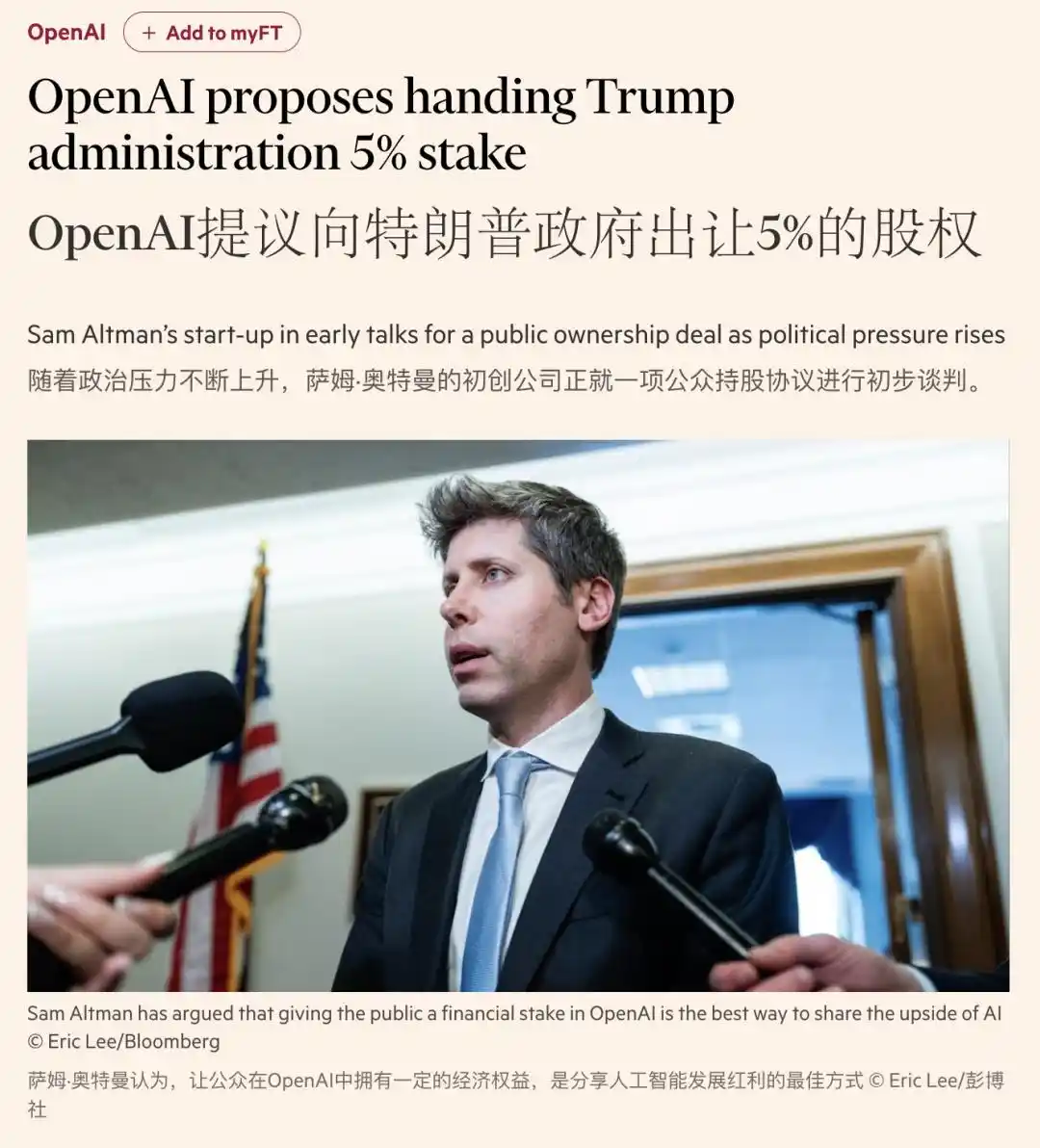
https://www.ft.com/content/7c803eab-8e80-4431-9a87-e943bf00e00b?syn-25a6b1a6=1

The core argument Altman presented in the discussion was that public ownership of AI company equity is the best way to share the dividends of AI development.

This proposal contains an even greater ambition: Altman suggested that all major U.S. AI companies contribute an equal proportion of their equity to a public investment vehicle, similar to the Alaska Permanent Fund, to distribute dividends to the U.S. government and its residents.

The AI industry in the U.S. is facing growing regulatory pressure, and Altman's chosen strategy is to make the U.S. government a stakeholder in the industry.

Exchanging Equity for Trust: Altman's Big Calculation

Altman has discussed this proposal directly with several senior U.S. government officials, including Commerce Secretary Howard Lutnick and Treasury Secretary Scott Bessent.
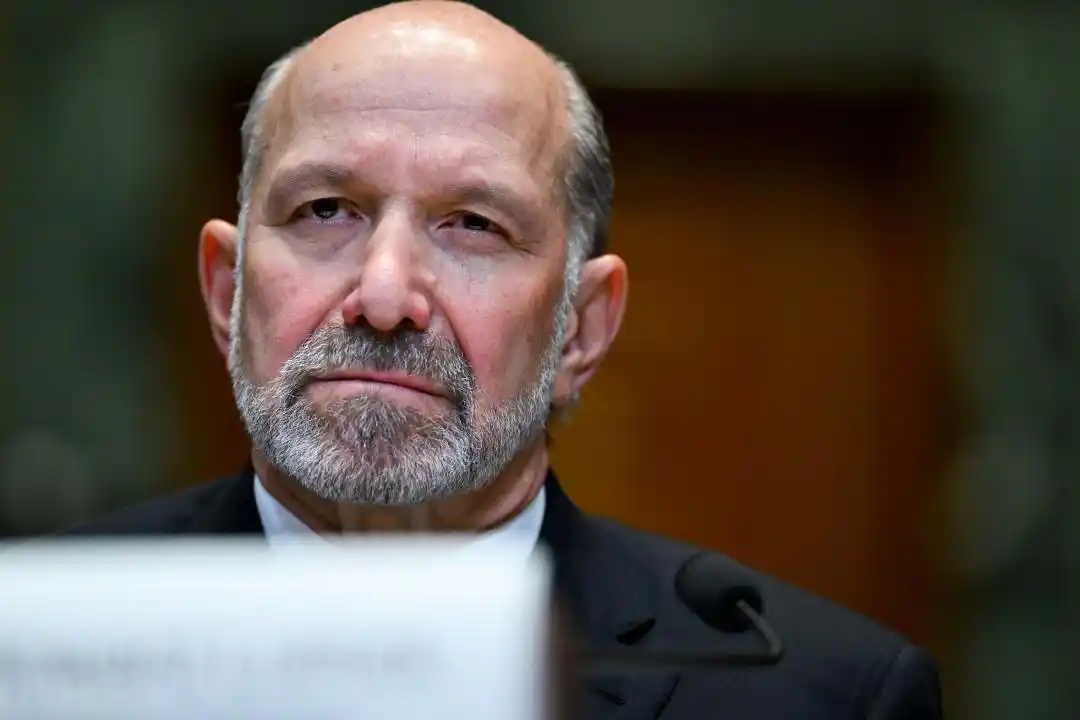
Howard Lutnick

Scott Bessent

Negotiations are currently at a "conceptual" stage, and any transaction would likely require Congressional legislation to proceed.

However, the mere existence of these talks sends a signal: OpenAI is willing to exchange tangible financial interests for a more stable relationship with the U.S. government.

The specific model proposed by Altman references the Alaska Permanent Fund. This fund invests Alaska's oil revenues in the stock market and distributes dividends to the state government and its residents.

Altman envisions that AI company equity could be managed similarly—held by a public investment vehicle to allow ordinary American citizens to benefit from AI growth, even if they have never invested in the stock market.

This vision is not limited to OpenAI.

Altman suggested that major U.S. AI companies like Anthropic, Google, and Meta join the same arrangement, each transferring 5% of their equity.

However, there is currently no evidence that these companies have any interest in this proposal.

The implementation difficulty of a proposal requiring collective concessions from competitors is self-evident.

5% vs 50%

A Divergence in Strategy Behind a Number

Altman is not the only one advocating for public ownership in AI.

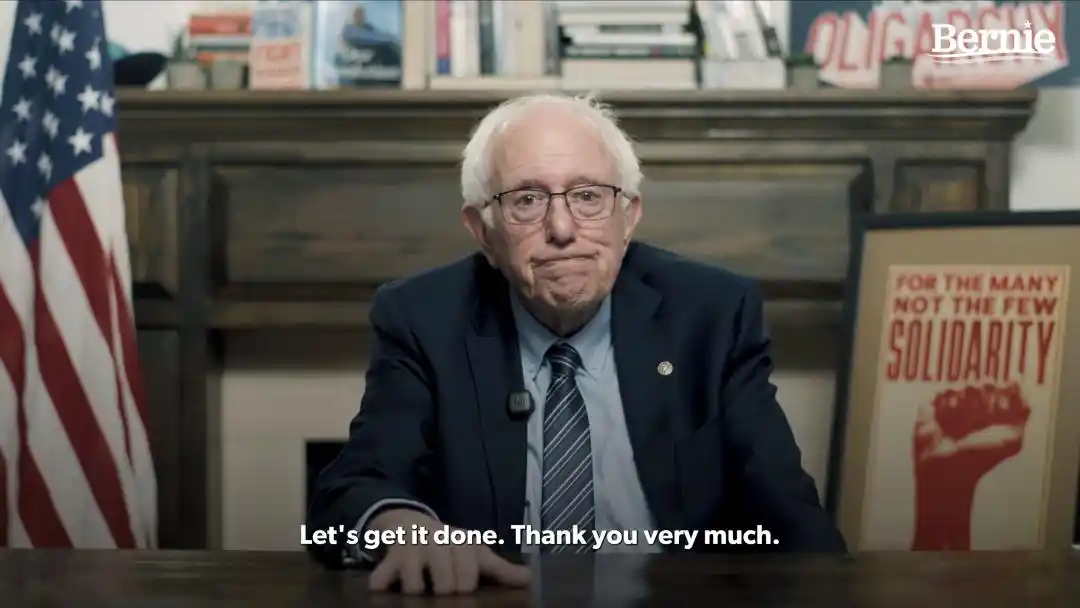
U.S. Senator Sanders has also engaged in conversations with Altman in recent weeks, but Sanders' stance is far more radical—he believes the public should hold nearly half of the equity in U.S. AI companies through a sovereign wealth fund.

Further Reading: New U.S. Proposal: "Nationalize" AI Giants, "Public Ownership" of 50%
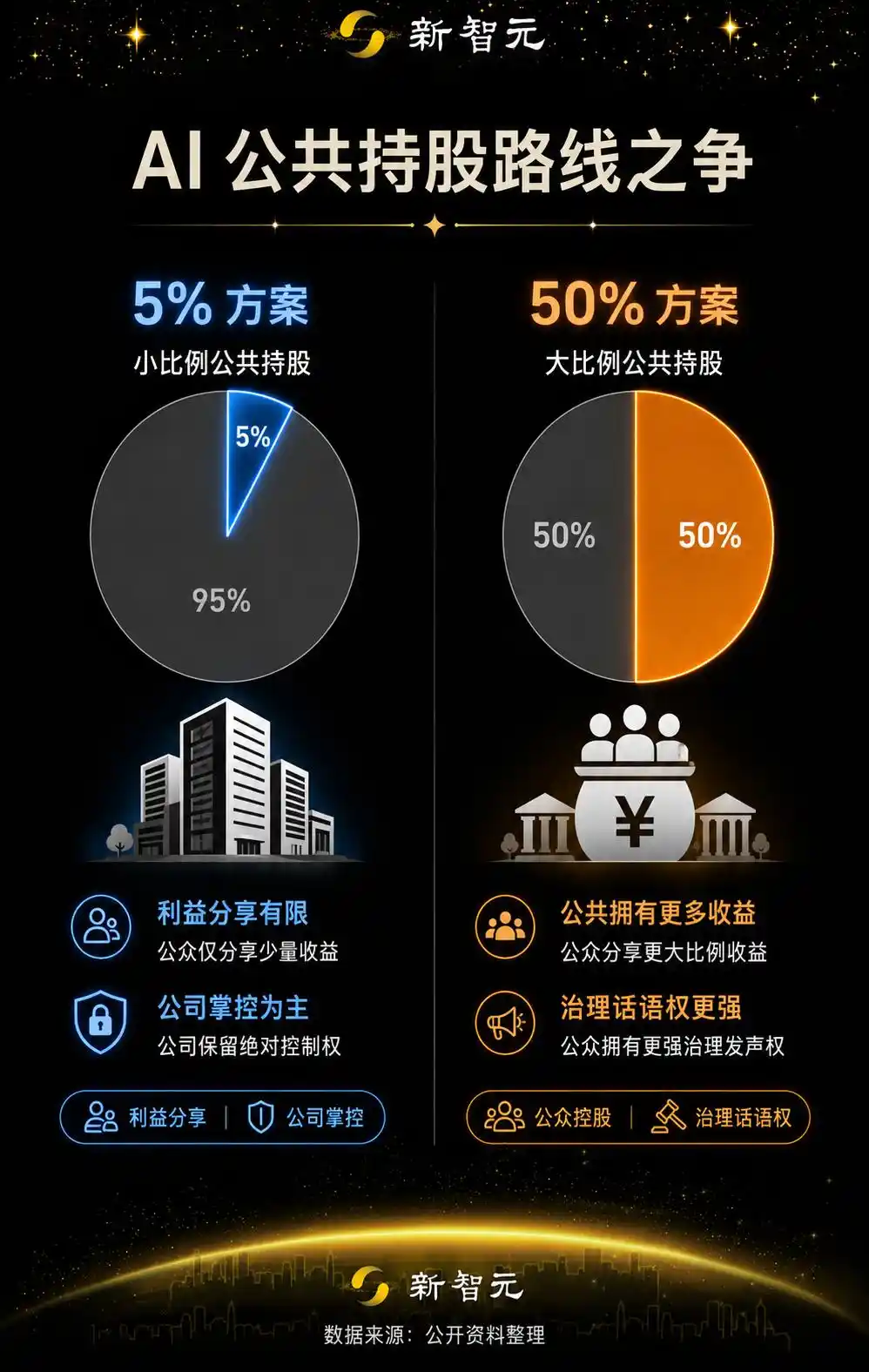
The gap between 5% and 50% reflects two fundamentally different approaches.

Altman's 5% proposal is a gesture of profit-sharing, allowing the U.S. government and public to "participate" in AI growth while control remains firmly in the hands of the companies.

Senator Sanders' 50% proposal would make the public a substantial majority shareholder, granting them genuine influence over corporate governance.
Intriguingly, OpenAI's own policy documents hint that 5% might not be enough.

In April of this year, OpenAI proposed establishing a "Public Wealth Fund" to allow "every citizen—including those not invested in financial markets—to benefit from AI-driven economic growth."

In May, the OpenAI Foundation went further in an official blog post: "Society may need new ways for people to gain enduring stakes in value-creating systems."

The foundation also stated the goal is "to give people both a stake and a voice in shaping the transformation, rather than just picking up the pieces after decisions have been made."

Judging from OpenAI's own statements, 5% appears more like an opening offer than a final solution.

The AI Industry's Regulatory Dilemma

To understand the true driving force behind this proposal, one must look at what the AI industry in the U.S. is currently experiencing.

Both OpenAI and Anthropic recently faced delays by the U.S. government in releasing their frontier models (GPT-5.6, Mythos 5, Fable 5) for review.
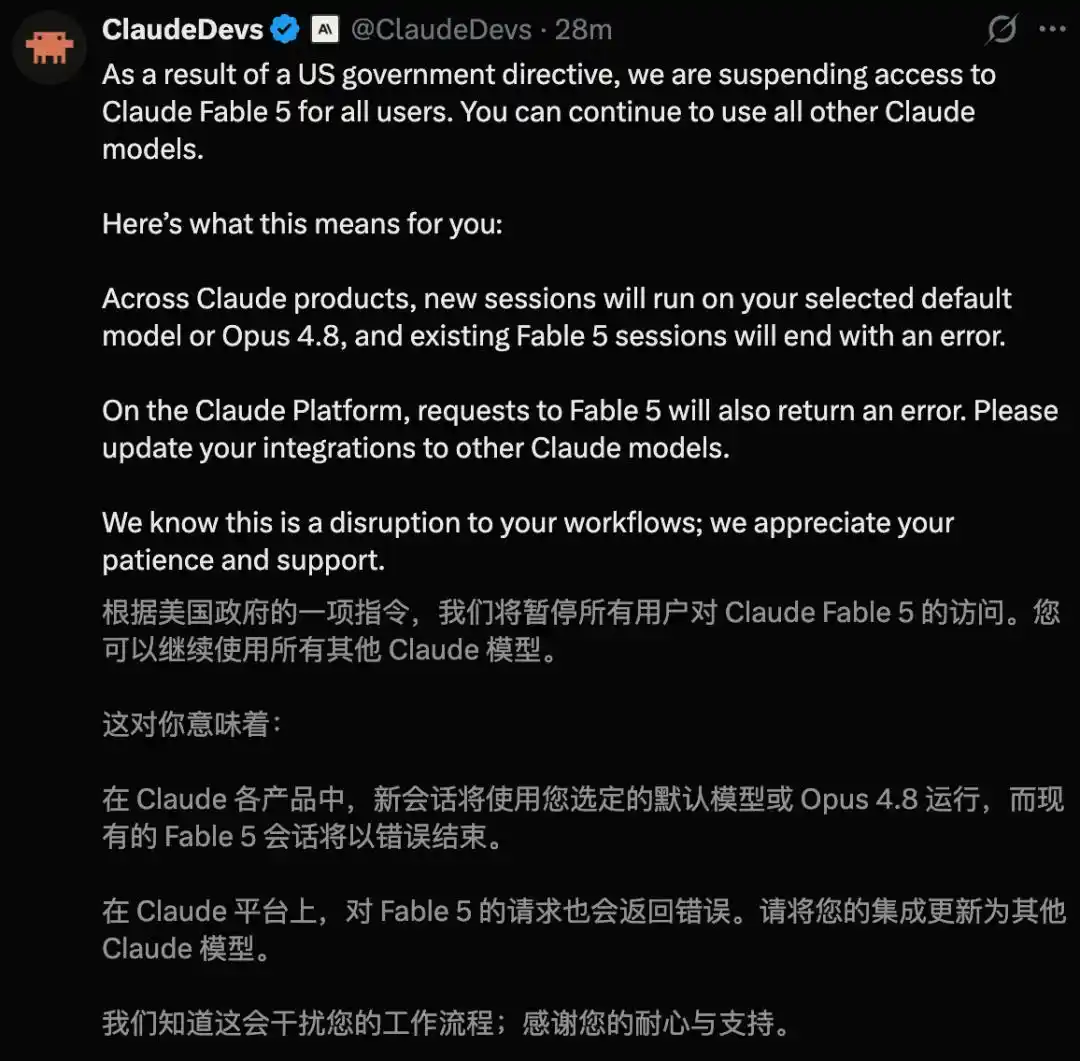
Concerns in U.S. society regarding large-scale data center construction, AI's impact on employment, and cybersecurity risks continue to escalate. Some members of Congress and White House advisors have explicitly leaned towards imposing stricter regulations on the AI industry.

A relevant precedent is Intel.

After the U.S. government acquired a 10% stake in Intel, the White House's attitude towards the chip giant noticeably shifted towards support.

Government equity ownership as a tool to improve relations already has a ready-made case study.

https://cn.wsj.com/articles/%E7%89%B9%E6%9C%97%E6%99%AE%E4%B8%8E%E8%8B%B1%E7%89%B9%E5%B0%94%E8%BE%BE%E6%88%90%E5%8D%8F%E8%AE%AE-%E6%94%BF%E5%BA%9C%E6%8C%81%E8%82%A110-8954b92d

OpenAI and Anthropic are also preparing for public listings, which would broaden their shareholder bases and bring substantial returns to existing investors—though OpenAI's IPO might not occur until next year.

Offering equity to the U.S. government at this juncture is a telling move: is it to secure stable external relationships before an IPO, or a strategic preemptive move ahead of tightening regulations?

Both interpretations point to the same conclusion—Altman believes the relationship with regulators has become urgent enough to require maintenance through equity.

A New Variable in the AGI Race

The figure of 5% may seem small, but its impact will extend far beyond the financial realm.

AGI development is currently the core race within the AI industry.

OpenAI, Anthropic, and Google DeepMind are all sprinting towards this goal, with each leap in frontier model capabilities accompanied by sharper safety debates.

When the government holds equity in these companies, it gains an institutionalized window to intervene in decision-making—from the release pace of frontier models and safety evaluation standards to data usage norms and export controls, government influence will find its points of application.

Accepting the transfer of 5% equity can, in the short term, alleviate regulatory pressure and address public discontent over the perceived windfall profits of the U.S. AI industry.

Senator Sanders' 50% proposal already shows that discussions about how much equity the government should hold in AI companies have only just begun.

The development path for AGI will no longer be driven purely by technical judgment and commercial logic; considerations from regulatory and public interest perspectives will become hard constraints.

This proposal is still in its early conceptual stages, far from any formal agreement, and may never materialize.

However, it marks the entry of the relationship between the AI industry and the government into a new dimension—the focus of debate shifts from "whether to regulate AI" to "whether the government should become a shareholder in AI."

The answer to this question will determine who ultimately develops, owns, and sets the boundaries for AGI.

The 5% offered by Altman might become the beautiful butterfly that flaps its wings.

References:

https://www.ft.com/content/7c803eab-8e80-4431-9a87-e943bf00e00b

This article is from the WeChat public account "新智元", author: ASI启示录, editor: 马可

Пов'язані питання

QAccording to the article, what specific proposal has OpenAI made to the U.S. government?

AOpenAI has proposed offering a 5% equity stake in the company to the U.S. government, valued at approximately $42.6 billion based on its current $852 billion valuation.

QWhat broader initiative did Sam Altman suggest alongside OpenAI's own equity offer?

ASam Altman suggested that all major U.S. AI companies, such as Anthropic, Google, and Meta, should contribute an equal proportion (5%) of their equity to a public investment vehicle, modeled on the Alaska Permanent Fund, to benefit the U.S. government and its citizens.

QWhat is a key motivation behind OpenAI's proposal, as indicated by the context of the article?

AA key motivation is to navigate growing regulatory pressure in the U.S. By making the government a stakeholder, OpenAI aims to build trust, stabilize its relationship with regulators, and potentially ease the path for its operations and future developments, including a potential IPO.

QHow does the proposal from Senator Sanders differ from Sam Altman's?

ASenator Sanders advocates for a much more substantial public stake, proposing that a sovereign wealth fund should hold close to 50% of the equity in U.S. AI companies. This contrasts with Altman's 5% proposal, which is more about profit-sharing while retaining company control, whereas 50% would grant the public significant governance power.

QWhat potential precedent does the article mention for government equity ownership in a tech company?

AThe article cites the example of the U.S. government taking a 10% stake in Intel. Following this investment, the White House's stance toward the chip giant notably shifted to one of greater support, demonstrating how equity ownership can be used as a tool to improve government-company relations.

Пов'язані матеріали

DeepMind's Classic Masterpiece Crowned Again, ICML 2026 Awards Announced

ICML 2026 has announced its annual awards, with diffusion models and AI safety ethics taking center stage. The Outstanding Paper Award was shared by two diffusion model studies. One challenges a core assumption of diffusion language models (DLMs), arguing that their touted "arbitrary order generation" is a "flexibility trap" that harms performance. The other provides a high-accuracy sampling method, pushing the technical ceiling for diffusion models and log-concave distributions. A position paper winning the Outstanding Award raises a critical ethical concern: AI alignment research is unintentionally building a "censor's toolkit," where safety tools like RLHF can be repurposed for content control. Several papers received Honorable Mentions, spanning key areas: mapping where honesty emerges in RLHF-trained models, motion attribution in video generation, quantifying how much language models memorize, analyzing diffusion model consistency via random matrix theory, and providing a mathematical proof for the "grokking" phenomenon in a simple model. The Test of Time Award was given to DeepMind's 2016 seminal work "Asynchronous Methods for Deep Reinforcement Learning," recognizing the enduring impact of the A3C algorithm. Overall, the awards signal a shift in AI research from rapid expansion to deeper scrutiny—validating diffusion models as a major architectural contender while prompting serious ethical reflection within the safety community.

marsbit14 хв тому

DeepMind's Classic Masterpiece Crowned Again, ICML 2026 Awards Announced

marsbit14 хв тому

ARK's Massive Buying Spree in Crypto-Linked Stocks: Lower Risk, or Double the Pressure?

ARK Invest, led by Cathie Wood, significantly increased its holdings in crypto-related public stocks in June, purchasing $77 million worth of shares in Coinbase, Circle, and Bullish during Bitcoin's worst monthly performance in four years. The investment thesis is that these stocks offer regulated exposure to the crypto cycle without direct Bitcoin ownership. However, data analysis reveals significant downsides: these stocks exhibit nearly double the volatility of Bitcoin (68%-90% vs. 37.6% 30-day annualized volatility) and carry substantial company-specific risks like earnings, competition, and equity dilution, which account for much of their price movement. Only MicroStrategy closely tracks Bitcoin, acting as a leveraged proxy. Coinbase shows moderate correlation, while Circle and Robinhood have low correlation, being more influenced by stablecoin competition and diversified brokerage operations, respectively. Mining companies like RIOT and MARA have surged due to AI-related ventures, decoupling from Bitcoin's price. The case of Strategy highlights additional equity-structure risks, such as potential value erosion when its market value falls below its net asset value. Ultimately, investing in crypto stocks often means accepting amplified Bitcoin volatility or layering on unrelated business risks, rather than obtaining a safer alternative to direct cryptocurrency ownership.

Foresight News18 хв тому

ARK's Massive Buying Spree in Crypto-Linked Stocks: Lower Risk, or Double the Pressure?

Foresight News18 хв тому

Karpathy's Latest Outburst: A Single Sentence That Silenced the Entire Agent Developer Community

Andrej Karpathy, a core researcher at Anthropic, recently critiqued the current AI agent development frenzy. He argues that the biggest mistake is forcing agents to perform tasks without first thoroughly understanding the underlying large language models. Drawing from his 2016 "World of Bits" project at OpenAI—an early attempt at web-based agents that ultimately failed due to premature technology—he emphasizes that foundational model work is crucial. Karpathy offers three key pieces of advice: First, focus on getting the base models right before pushing agents. Second, recognize that creating a demo is easy, but building a real product takes a decade, akin to the journeys of autonomous driving and VR. Third, the product is the core capability, not the agent shell; a robust foundation will naturally enable advanced agents. He also suggests looking to neuroscience for inspiration, comparing agent components to brain structures like the hippocampus and thalamus. Despite his caution, Karpathy concludes that independent developers and startups, not large labs like OpenAI, are at the forefront of agent innovation. This is because the agent field is new, with no entity having a five-year head start, leveling the playing field for agile experimenters. His core message is not to abandon agent work, but to build it on a solid, deeply understood foundation.

marsbit18 хв тому

Karpathy's Latest Outburst: A Single Sentence That Silenced the Entire Agent Developer Community

marsbit18 хв тому

Tsinghua University's Special Award Winner, Gu Yuxian, Joins DeepSeek

Tsinghua University's prestigious Graduate Special Scholarship recipient and 2021 Ph.D. candidate, Yuxian Gu, has officially joined DeepSeek. This news coincides with DeepSeek's major recruitment drive and the imminent launch of DeepSeek V4, on whose research paper Gu is listed as an author. A doctoral student in the Conversational AI group under Professor Minlie Huang at Tsinghua, Gu's research focuses on enhancing efficiency throughout the entire lifecycle of large language models. His key contributions span three areas: innovative methods for pre-training data selection (e.g., PDS), advanced knowledge distillation techniques for model compression (notably MiniLLM), and the development of efficient model architectures like Jet-Nemotron. His work has gained significant recognition, with nearly 5,000 citations on Google Scholar. Key publications include the highly cited surveys and papers on pre-trained models and the MiniLLM distillation method. As first author, he has presented at top-tier AI conferences including NeurIPS, ICLR, and ACL. One of his notable achievements is the Jet-Nemotron architecture, which combines Post-Neural Architecture Search (PostNAS) and a novel linear attention module called JetBlock. This model series demonstrates state-of-the-art performance rivaling larger models while achieving substantial efficiency gains in inference. Gu's expertise in creating powerful yet efficient AI systems aligns with industry needs, as evidenced by the adoption of his MiniLLM method by leading tech companies. His move to DeepSeek is anticipated to contribute further advancements in the field.

marsbit44 хв тому

Tsinghua University's Special Award Winner, Gu Yuxian, Joins DeepSeek

marsbit44 хв тому

Торгівля

Спот
活动图片





