Not Chasing AI or Buying Back Shares, Can 'Stingy' Jingdong Still Succeed?

marsbitОпубліковано о 2026-08-17Востаннє оновлено о 2026-08-17

Анотація

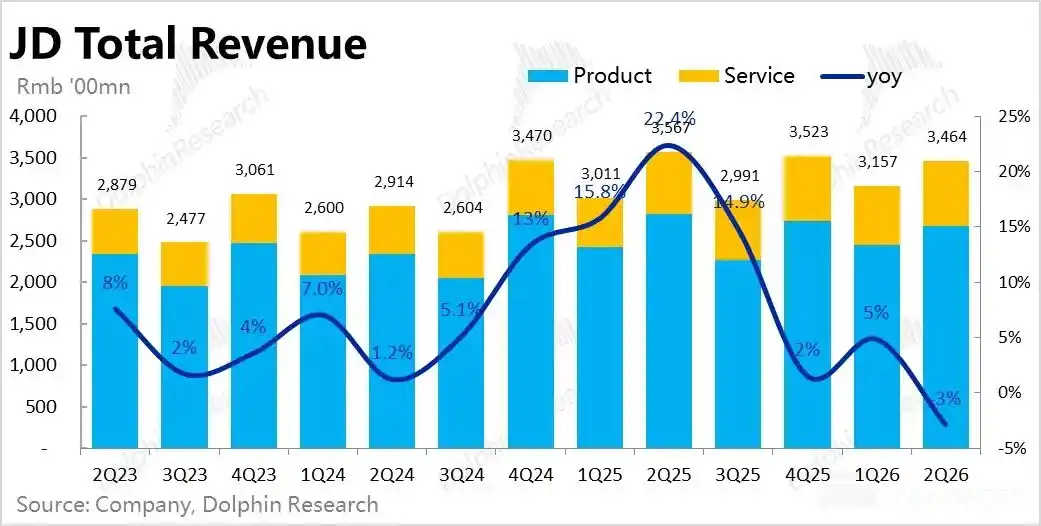
On August 13th, JD.com (JD.US) released its Q2 2026 earnings, delivering a mixed and generally "flat" performance that met low expectations but offered few positives. Overall revenue declined by approximately 3% year-over-year (YoY) to ~¥346.4 billion, aligning with weakened domestic consumption trends. While group operating profit saw a YoY improvement, this was primarily due to reduced losses in the food delivery segment compared to the high-cost "delivery war" period of the previous year. Key details reveal deeper concerns: revenue from JD's core domestic retail segment fell 4.7% YoY. While electronics sales declined less than feared (~12% YoY), growth in daily necessities and advertising services plummeted by about 10 percentage points each, raising doubts about the segment's mid-term growth momentum post-subsidy adjustments. Logistics revenue growth also slowed to 5.9% as the delivery boom faded. Profitability presented a nuanced picture. The retail segment's operating margin edged up slightly YoY but failed to deliver the significant beats seen in past quarters, suggesting efficiency gains may be nearing limits. Losses from the New Businesses segment (including food delivery and overseas ventures) remained elevated at ~¥9.9 billion, as increased overseas investment partially offset reductions in delivery subsidies. Notably, JD's shareholder returns weakened significantly, with share buybacks in H1 2026 annualizing to only about 5% of market cap. The company opted to ...

Perhaps currently the 'most grounded' e-commerce platform in China—Jingdong (JD.US)—announced its Q2 2026 results on the evening of August 13. Overall, they could be described as 'steady' or perhaps 'flat.' In terms of variance from expectations, both revenue and overall profit slightly exceeded Bloomberg's estimates, but only matched or slightly fell short of some major banks' expectations.

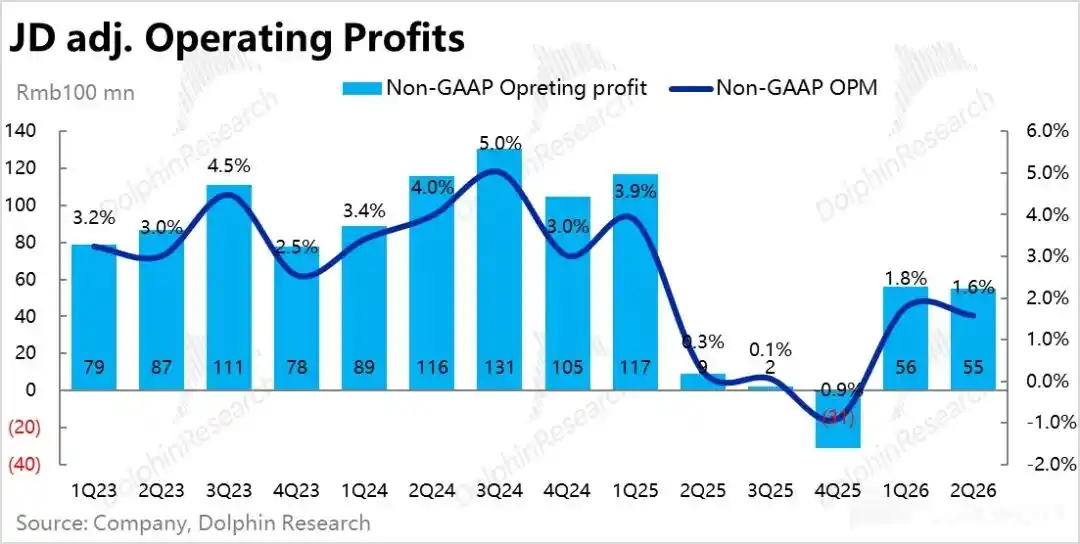
In terms of trends, due to the overall weakening of domestic consumption in Q2, total revenue for the quarter declined. However, soft retail sales figures had already set expectations, so this was not a surprise. Although profits from the Mall segment declined year-over-year, compared to last year when profits were nearly exhausted due to the food delivery war, the group's overall profit showed a significant recovery on a year-over-year basis.

Looking at the specifics:

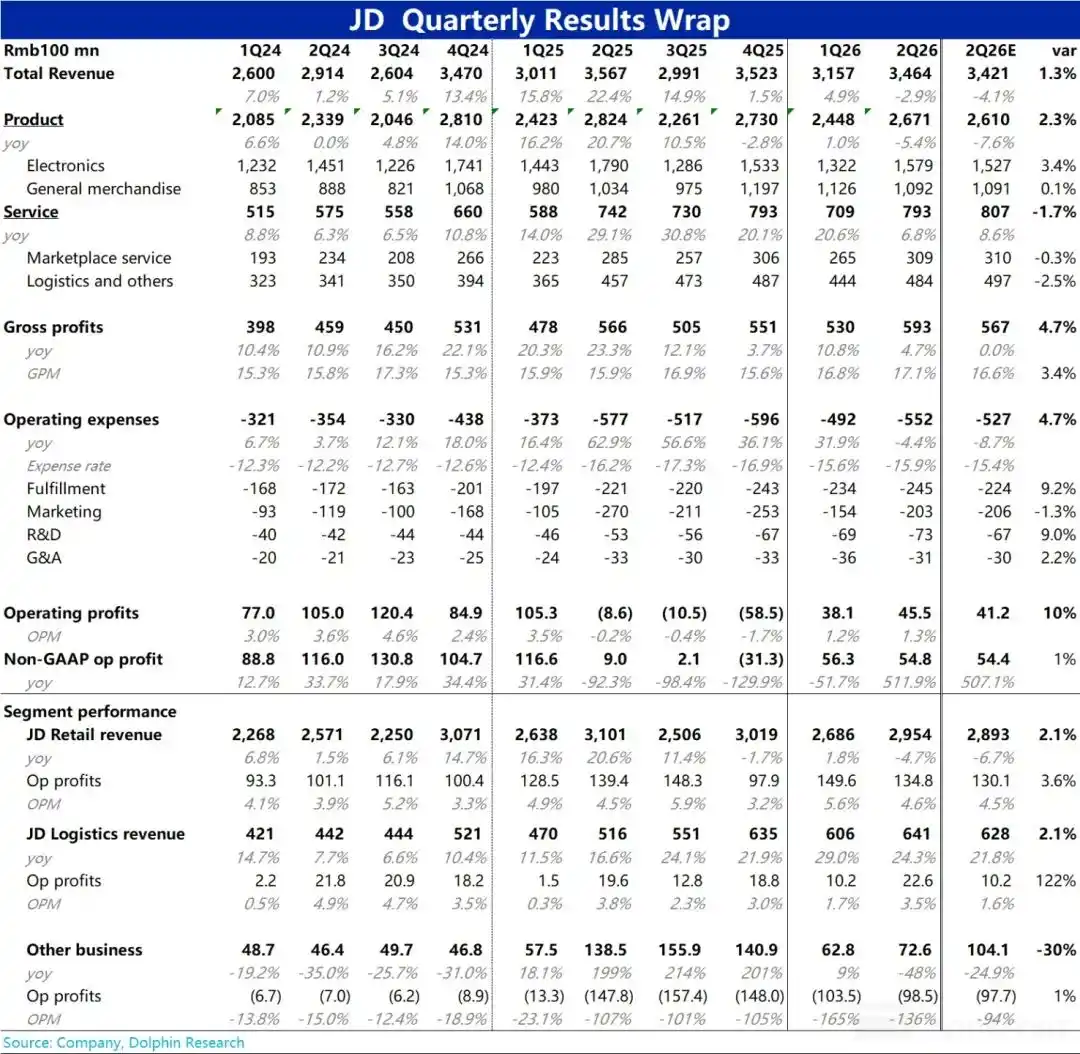
1. Both revenue and profit declined, but without major shocks: Jingdong's total revenue this quarter was approximately 346.4 billion yuan, a year-over-year decrease of 3%, a significant slowdown compared to the 5% growth last quarter, but largely in line with market expectations and not a shock, consistent with the overall retail sales trend this quarter.

The group's overall operating profit was 4.55 billion yuan, or 5.48 billion yuan on an adjusted basis. On an adjusted basis, this was slightly better than Bloomberg's expectations but weaker than some major banks' forecasts. Specifically, the main drag was higher-than-expected losses from new business initiatives.
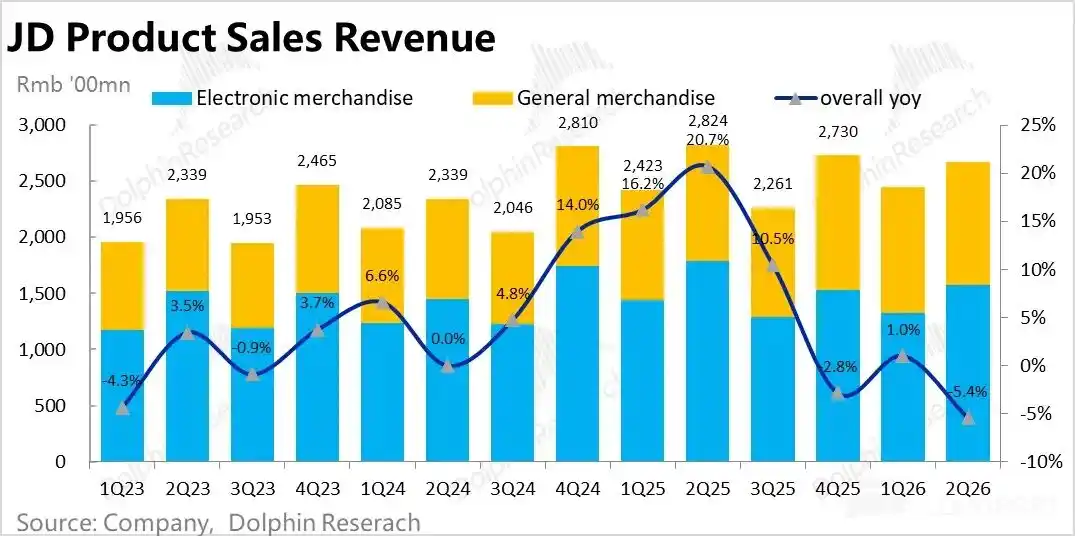
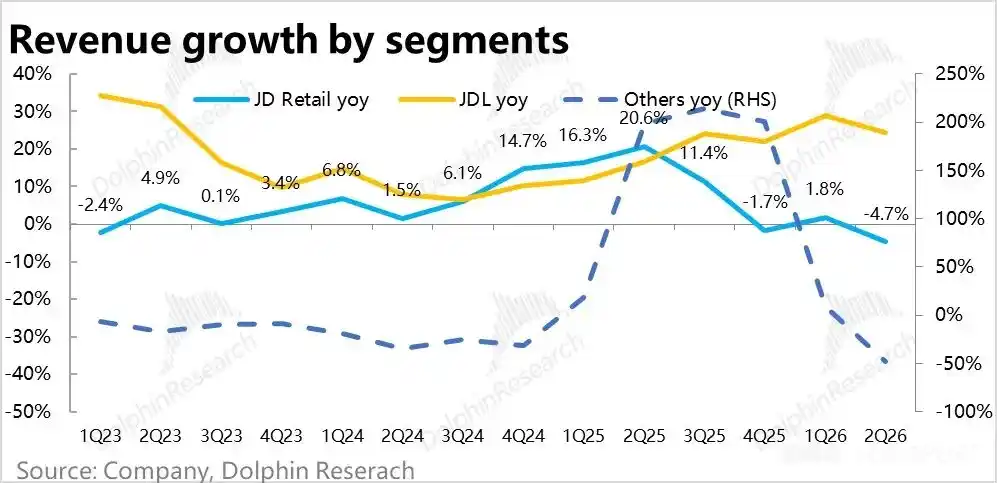
2. Sharp slowdown in daily essentials and advertising growth: For the most important domestic Mall segment, revenue this quarter fell by about 4.7% year-over-year, continuing the expected deceleration. The decline was lower than some market expectations but broadly in line with top-tier bank forecasts.

Looking closer, the actual deterioration in electronics & home appliance sales was limited, with sales falling by less than 12% YoY this quarter vs. an 8.4% decline last quarter. This might be due to a marginal rebound from national subsidy benefits, which previously mainly favored offline channels but recently began flowing back online.

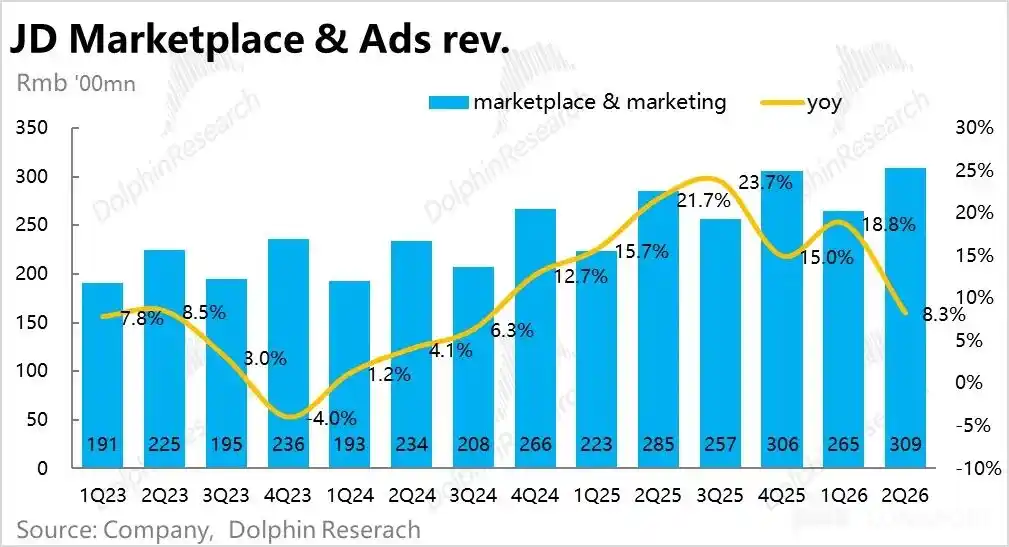
In contrast, daily essentials & general merchandise sales and service & advertising revenue—businesses theoretically not directly impacted by the subsidy phase-out—saw a more pronounced slowdown. Daily essentials sales growth dropped from 15% to 5.6%, while advertising service growth fell from nearly 19% to about 8%. The slowdown for both was around 10 percentage points.

While the market had anticipated this, and the slowdown has its reasons (reduced traffic diversion to the platform from electronics and food delivery), these two segments are the primary drivers for Jingdong's medium-term growth. This may lead the market to question whether, even after the negative impact of the subsidy phase-out passes, the Mall segment's core growth rate can reaccelerate (e.g., back above 10%).
3. Food delivery war cools, logistics and new business growth also slows: As the period of high comparables from the food delivery war has begun, and this year's food delivery order volume has not increased but rather decreased, growth in logistics revenue and new business also slowed this quarter.

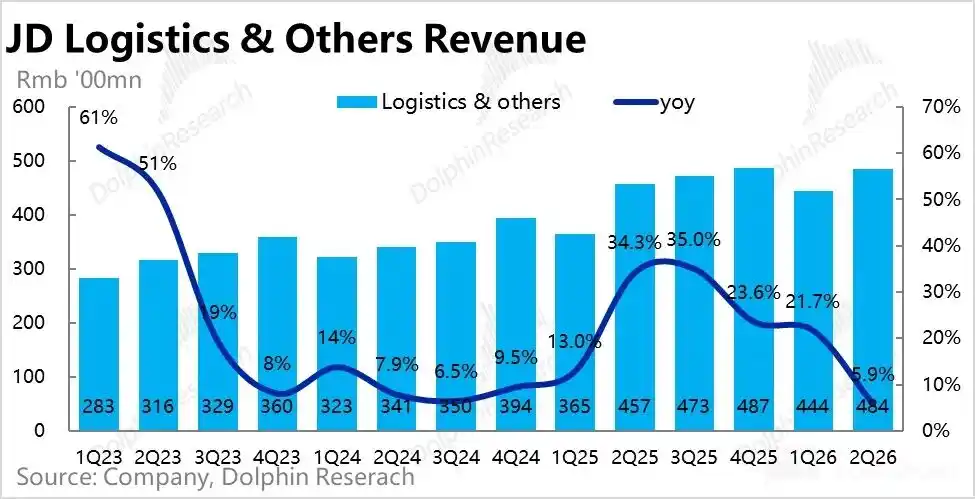
Logistics & other services revenue growth slowed to 5.9%, essentially returning to the mid-to-high single-digit growth rate seen before 2025 after the boost from food delivery subsided.

However, looking at new business revenue alone, it increased sequentially by about 15%, suggesting overseas business contributed to the growth.
4. Mall segment profitability still improved, new business losses slightly higher: Overall, the group's profit this quarter was largely in line with expectations.

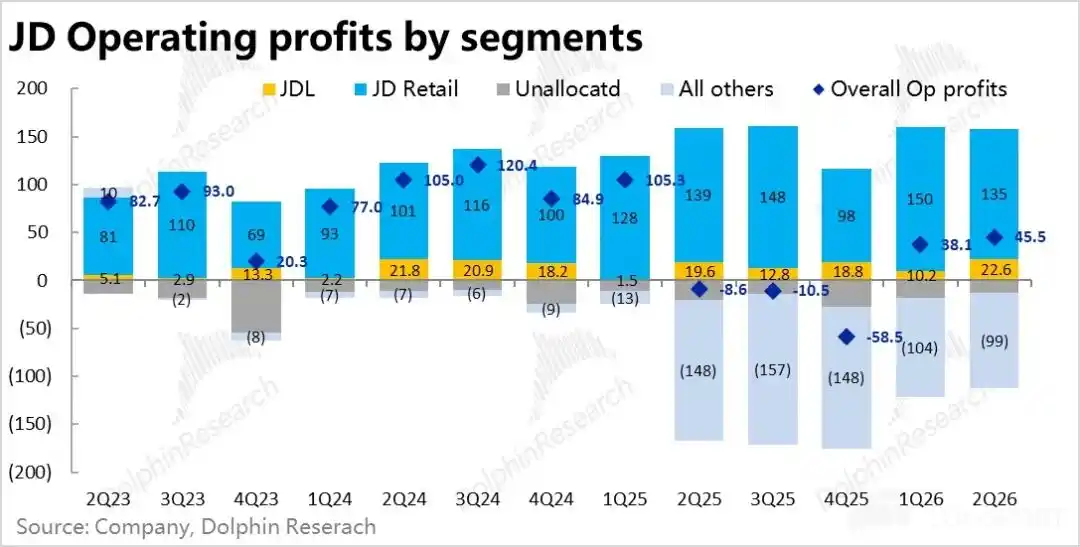
Breaking it down by segment, the Jingdong Mall segment's operating profit this quarter was nearly 13.5 billion yuan, slightly beating Bloomberg's expectation of about 13.0 billion. Trend-wise, unable to withstand the revenue contraction, profit also declined by about 3% year-over-year, failing to deliver another significantly better-than-expected result.

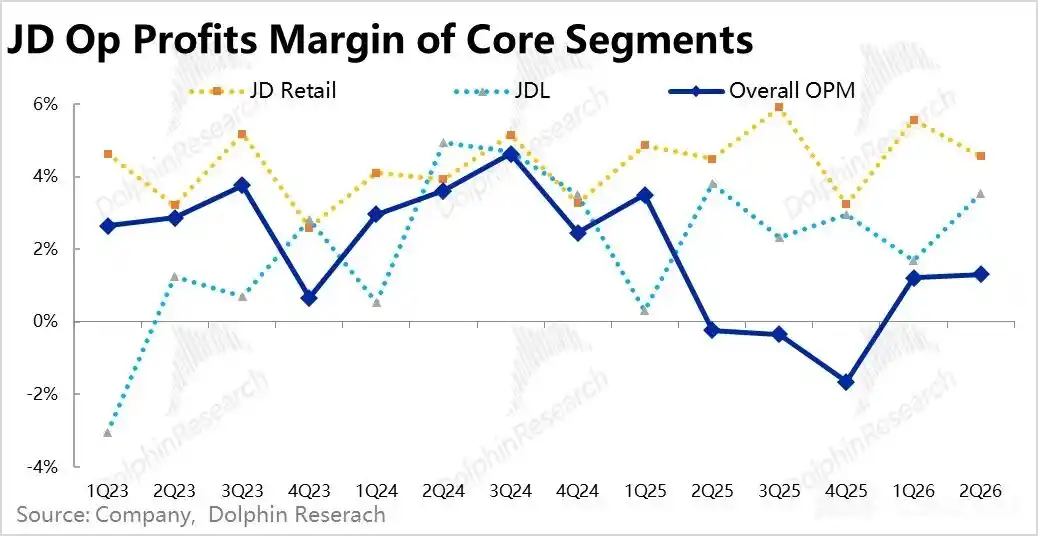
However, the operating margin still improved slightly year-over-year by less than 0.1 percentage point. Optimists might say that Jingdong managed to improve profitability while revenue shrank; pessimists might argue that there seems limited room for further margin expansion in the Mall segment.

Based on the company's explanation, the continued margin improvement is still mainly attributed to a revenue mix shift toward higher-margin businesses and supply chain optimization.

The New Business segment, which includes food delivery, reported a loss of nearly 9.9 billion yuan this quarter. As Dolphin Research expected, the loss narrowed little compared to last quarter and was also slightly higher than Bloomberg's consensus estimate.

According to common market expectations, Jingdong's food delivery losses this quarter should have decreased sequentially by about 1 billion yuan, implying that investments in overseas and other new businesses likely increased sequentially by about 500 million yuan (which doesn't seem like a huge amount).
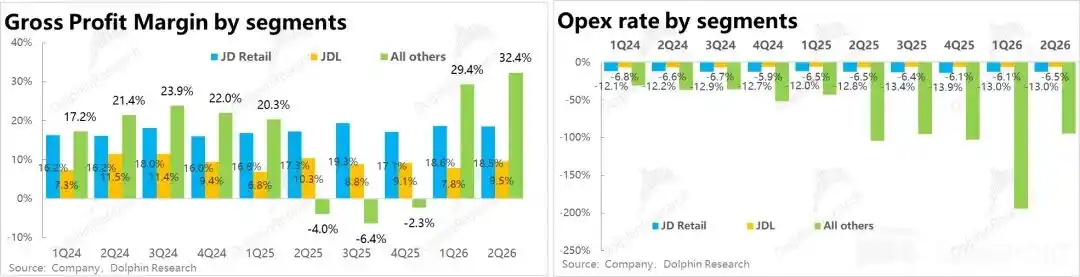
5. Cost and expense perspective: First, on gross margin, the group's overall gross margin continued to improve sequentially, from 16.8% to 17.1%. Consequently, gross profit still achieved about 5% year-over-year growth.

Specifically, this was mainly due to improved gross margins in both the New Business and Logistics segments after food delivery subsidies decreased, with the New Business segment contributing more significantly, seeing a sequential gross margin increase of 3 percentage points. In contrast, the Mall segment's gross margin declined slightly by about 0.1 percentage point sequentially (though it was still up 1.2 percentage points year-over-year), suggesting limited room left for squeezing gross margin from the upstream supply chain.

From an expense perspective, the company's total operating expenses decreased by 4.4% year-over-year this quarter, a larger drop than the revenue decline, helping profit release. Specifically, marketing expenses decreased by a predictable 25% year-over-year. Another notable point is that R&D expenses maintained rapid growth of 38%. It appears that while not investing heavily in large AI model development, Jingdong is still putting money into some internal AI applications.

By segment, the Mall segment's total expense ratio increased both year-over-year and sequentially by about 1 percentage point. This indicates greater pressure on the company to subsidize users itself after the national subsidy phase-out, which is the main reason the Mall segment's profitability couldn't improve more significantly.

The group's overall expense reduction was also mainly due to decreased investment in new businesses, down about 1.8 billion yuan year-over-year.
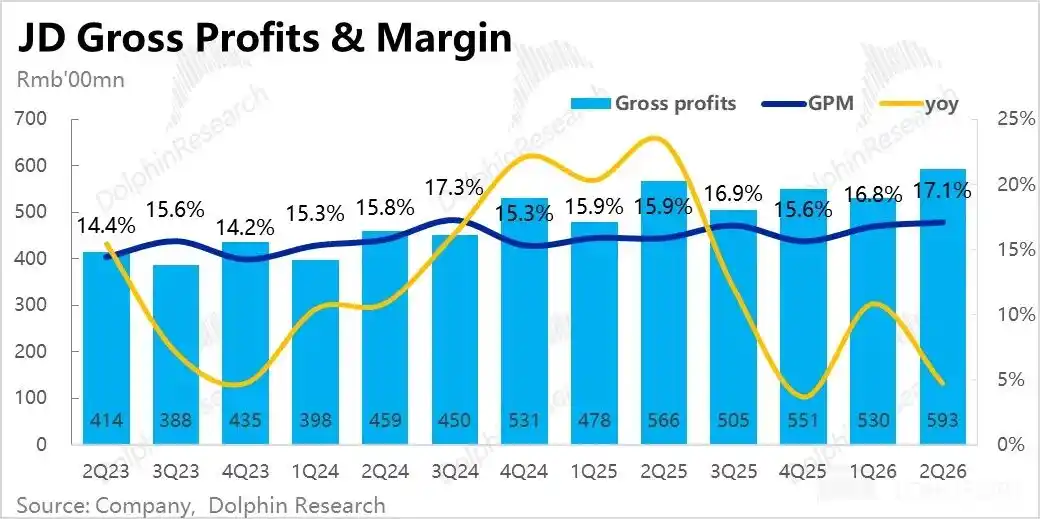
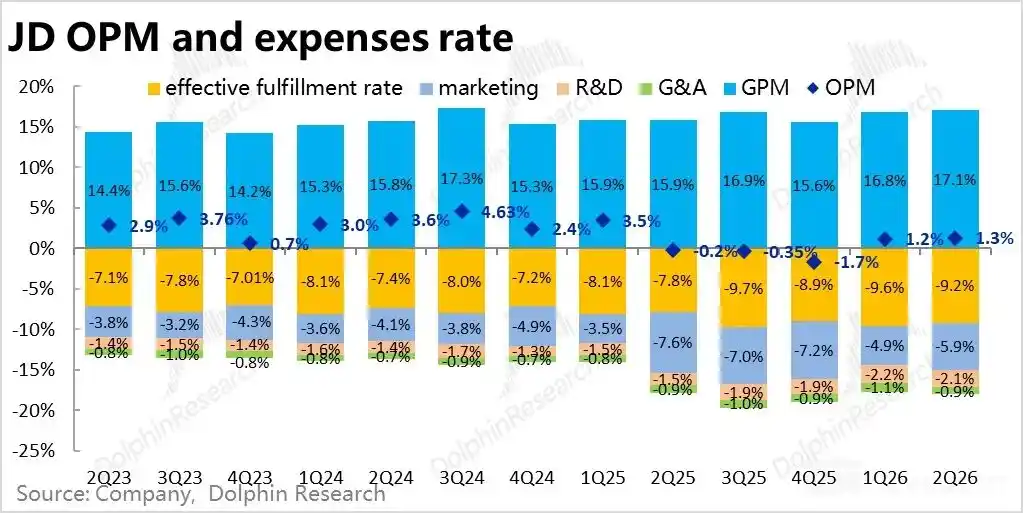
6. Shareholder returns decline, investing overseas instead of in AI: Another previous strength for Jingdong was its shareholder returns, among the best in the US-listed Chinese internet sector. However, in the entire first half of 2026, the company repurchased only about $1 billion worth of shares. Annualized against the current market cap, the return rate is only around 5%, a clear decline.

Unlike Alibaba or Tencent, Jingdong does not have massive AI-related capital expenditures, so its cash flow pressure isn't particularly high. On the cash flow statement this quarter, Jingdong's cash outflow for investments was about 29.5 billion yuan, but the vast majority of this was for purchasing short-term investments and wealth management products, not truly strategic investments. The perception of preferring to buy financial products rather than returning cash to shareholders is obviously poor.
Dolphin Research Viewpoint:

1. As seen above, Jingdong's results this time were unremarkable in terms of variance from expectations, with no highlights. In terms of trends, growth slowed due to macroeconomic headwinds. While overall profit seemingly improved due to reduced food delivery losses, core Mall segment profit declined. So, the overall results are certainly not good.

The core shortcomings can be summarized as follows: a. The Mall revenue decline was expected, but past Mall segment profits typically far exceeded expectations and guidance. This time was quite flat, suggesting the trend of improving Mall profitability may have hit a bottleneck; b. While food delivery losses narrowed, due to overseas investments, overall new business losses barely decreased; c. Daily essentials and advertising revenue growth slowed significantly. While understandable, this is bad news for medium-term revenue growth prospects; d. Preferring to buy financial products rather than pay dividends.

2. Outlook & Logical Assessment

This quarter's results weren't good, so what about the outlook? Dolphin Research believes the decisive factors influencing future performance and stock price are essentially two points:

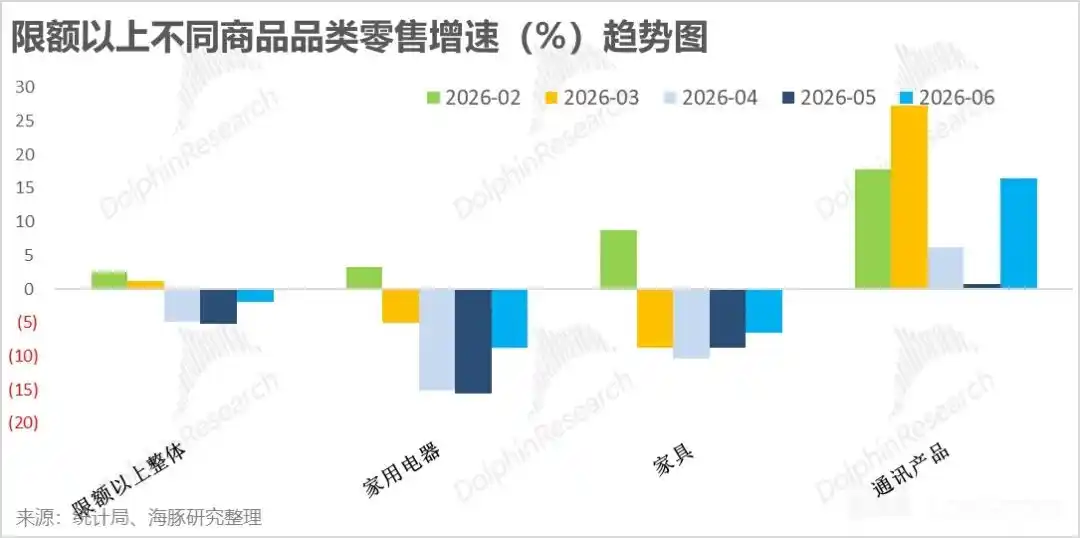
1) Whether a significant inflection point in domestic e-commerce business sentiment can emerge in the second half of the year. Looking at macro retail sales data, both overall and online consumption in Q2 were indeed at their weakest in recent years. However, the latest June retail sales growth rate showed some recovery compared to May. Overall growth improved from -0.6% to +1%, and online physical goods sales growth increased from 2.6% to 3.9%.

For categories particularly important to Jingdong, like electronics & appliances, statistics bureau data showed clear improvement (narrowing declines) in sales growth for household appliances, furniture, and communication equipment in June. This quarter's decline in electronics & appliance sales wasn't very large either.

According to research by an overseas bank, national subsidy allocation in the second half will shift marginally back from offline to online channels. Also, comparables will become increasingly easier. Therefore, Jingdong's medium-term performance trend will likely show signs of stabilization and recovery.
2) The other key factor is the attitude toward investment in new businesses & how losses will change, thereby impacting the group's overall profit.

Currently, as all participants in the food delivery war are scaling back investments and improving unit economics, losses from Jingdong's food delivery business will likely continue to narrow. However, since Jingdong's food delivery order volume has now fallen below 20 million daily orders, and it will likely be difficult to significantly increase volume without heavy subsidies again, unless Jingdong completely abandons the food delivery business, losses from this segment could be perpetual, reaching a "minimum loss level" that is difficult to reduce further.

But because the domestic main platform business has a clear ceiling, the company will likely not stop its diversified "tinkering." Therefore, one source of profit elasticity is the level of investment in "Jingxi" and its overseas businesses. In the near to medium term, Jingdong's overseas investments are unlikely to decline significantly, as JoyBuy is still in the early stages of business expansion, reportedly already operating in about 30 cities across 7 countries.

Thus, in the near term, overall new business losses will likely only trend down slowly, with a low probability of a sharp drop, which was indeed the case this quarter.

3) However, the Mall segment's profitability, which had consistently exceeded expectations for several quarters, failed to improve further this time. For investors hoping Jingdong could rely on internal efficiency gains to offset external pressures, this is undoubtedly disappointing.

Fortunately, Jingdong is not embroiled in the "AI model war," so it will not see its future profits and cash flow significantly impacted by "crazy" AI-related capital expenditures. Although this quarter's results were flat, they were largely as expected. If domestic e-commerce sentiment warms in the second half, Jingdong, with its relatively focused and domestic-centric business, can still be considered one of the companies in China's e-commerce sector with relatively high earnings certainty and defensive value.

3. On valuation, since this quarter's results were largely as expected, we haven't made major changes to our full-year forecasts. We still expect full-year 2026 operating profit for the Mall segment to be around 56 billion yuan, representing high single-digit year-over-year growth.

For new business losses (including food delivery, Jingxi, and overseas businesses), as mentioned above, due to continued overseas investment, a significant decline is unlikely. Therefore, we expect full-year new business losses of 36.5 billion yuan, resulting in group consolidated operating profit of about 19.5 billion yuan (no additional tax deduction).

In the near to medium term, Jingdong's performance fluctuations, both upward and downward, are unlikely to be very large, prioritizing stability. If it maintains good shareholder returns, it holds some allocation value for investors seeking safety and certainty. However, given the poor attitude toward shareholder returns this time, Dolphin Research finds it difficult to identify a compelling reason to invest in the company at present. While one could speculate on improved e-commerce sentiment in the second half, Jingdong may not be the stock with the highest potential upside.

This article is from the WeChat public account "Dolphin Investment Research" (ID: haituntouyan), author: Dolphin Research.


Трендові криптовалюти

Пов'язані питання

QBased on the article's analysis, what are the key concerns regarding JD.com's core e-commerce business following its Q2 2026 results?

AThe key concerns are: 1) The core JD Retail (shangcheng) segment's profit growth appears to have hit a bottleneck, failing to significantly exceed expectations this quarter. 2) The growth rates for General Merchandise sales and Advertising service revenue, which are key mid-term growth drivers, decelerated sharply by around 10 percentage points. This raises doubts about whether the segment's growth can re-accelerate beyond 10% even after the impact of government subsidy adjustments fades.

QHow did JD.com's cost and expense structure change in Q2 2026, and what drove these changes?

AOverall expenses decreased by 4.4% year-over-year, a larger drop than the revenue decline, which helped boost profits. This was primarily driven by a 25% reduction in marketing expenses. However, R&D expenses grew rapidly at 38%, indicating ongoing investment in AI applications internally. For the core JD Retail segment, the total expense ratio increased by about 1 percentage point, indicating greater pressure for user subsidies post-government support.

QWhat is the article's outlook for JD.com's new business segment, particularly regarding losses and investment strategy?

AThe article expects new business losses to decline only gradually. While losses from the food delivery war are narrowing, the business likely has a 'minimum loss level' that is hard to reduce further unless JD exits. Meanwhile, JD is shifting investment focus, with overseas expansion (e.g., JoyBuy) still in its early stages. Therefore, the overall new business segment's losses are not expected to drop significantly in the near term as overseas investments offset gains from reduced food delivery subsidies.

QAccording to the article, why is JD.com's approach to shareholder returns described negatively, and how does it compare to its peers?

AJD's shareholder returns have weakened significantly. In H1 2026, it repurchased only about $1 billion worth of shares, translating to an annualized return rate of only ~5% of its market cap. Unlike peers like Alibaba or Tencent, JD does not face massive AI-related capital expenditure pressures, implying strong cash flow. The article criticizes that JD is choosing to invest cash in short-term investments and wealth management products instead of returning more to shareholders, creating a poor perception.

QWhat factors does the article suggest could lead to a potential recovery or stabilization in JD.com's performance in the second half of 2026?

ATwo main factors are highlighted: 1) A potential recovery in China's domestic e-commerce sentiment in H2. Positive signs include improved retail sales and home appliance/communication device sales growth in June, and expectations that government subsidies will shift marginally back to online channels. 2) A continued, albeit slow, reduction in losses from the new business segment as food delivery subsidies wind down. However, the article notes that due to ongoing overseas investments, a sharp drop in new business losses is unlikely.

Пов'язані матеріали

Wall Street Morning Report: S&P Earnings Growth Hits 30-Year High, Nvidia Becomes SpaceX's 6th Largest Shareholder

Wall Street Morning Report: S&P 500 earnings growth hits a 30-year high; Nvidia becomes SpaceX's 6th largest shareholder. Market Summary: U.S. stocks ended slightly lower on Friday after record highs, with the S&P 500 posting a weekly gain. Weaker-than-expected July retail sales data significantly reduced market expectations for a September Fed rate hike. Key Themes: * **Macro & Rates:** The probability of the Fed holding rates steady in September rose to ~70%. Geopolitical tensions in the Middle East supported oil prices near $90. Focus this week is on a $16B 20-year Treasury auction testing investor demand amid high yields. * **Corporate Earnings:** S&P 500 Q2 earnings grew 31%, the fastest pace since 1992 excluding recession recoveries, driving a valuation reset. * **AI & Tech Sector Rotation:** The AI investment narrative faces scrutiny over financing and return timelines. Semiconductor stocks saw divergence: memory (SanDisk, Micron) and optical communication (Applied Optoelectronics) surged, while Broadcom fell sharply on credit rating downgrade concerns over AI leasing exposure. * **Notable Moves:** Nvidia disclosed a ~$21B stake in SpaceX. AMD rose 6.5% after a record debt issuance. Reddit rallied ahead of its S&P 500 inclusion. This Week's Highlights: * **Fed Minutes (Thu):** Key for gauging policy divergence and September rate outlook. * **Key Earnings:** Alibaba, Walmart, Nvidia, AMD. * **Events:** Seoul AI Summit, World Robot Conference, potential恒生指数 rebalancing. * **Data:** U.S. jobless claims, Japan core CPI, Korea early export data (a leading indicator for semiconductors).

marsbit50 хв тому

Wall Street Morning Report: S&P Earnings Growth Hits 30-Year High, Nvidia Becomes SpaceX's 6th Largest Shareholder

marsbit50 хв тому

BTC in Range-Bound Consolidation, HYPE Daily Rebound Confirmed | Invited Analysis

**Market Analysis: BTC Consolidates in Range, HYPE Shows Daily Rebound Confirmation (Weekly Outlook)** **BTC Analysis:** The market is at a key juncture. Bitcoin is undergoing a daily correction, with a critical focus on whether it can find support and stabilize above the $60,950 level. The adjustment that began from the May 6th high has formed a complex seven-segment structure on the daily chart. Three potential paths are identified: 1. **Continuation of the c-wave rally** (primary scenario), targeting $67,300 initially, then $69,500-$71,000. 2. **Range-bound consolidation** between $60,950 and $65,500, forming an "ascending中枢" before an upward breakout. 3. **Breakdown and secondary探底** if support at $60,950-$61,500 fails. Analysis favors the first two scenarios. The 4-hour chart suggests the current adjustment phase is nearing completion near the strong $60,950-$61,500 support zone. **BTC Strategy:** * **Key Levels:** Support at $62,268, $60,950-$61,500, $57,820. Resistance at $65,500, $67,300, $69,500-$71,000. * **Mid-term:** Current model indicates a bearish structure with ~20% short exposure. Consider adding to shorts (up to 50%) only if price rallies to $69,500-$71,000, shows clear stagnation, and model confirms. * **Short-term (30% capital):** Two tactical plans: * **A) Test shorts** near strong resistance ($69,500-$71,000) upon signs of weakness. * **B) Test longs** near strong support ($60,950-$61,500) upon stabilization signals. **HYPE Analysis:** HYPE has established a daily rebound from the August 2nd low. The 4-hour chart shows a five-segment上升 structure with a formed "ascending中枢". The current (76-77) segment is crucial. Two outcomes are possible: 1. **Breakout (Central离开段):** If price breaks and holds above the $58-$58.5 resistance zone, the uptrend continues. Monitor for momentum背驰 between the initial and breakout segments. 2. **Consolidation (Central Extension):** Failure to hold above $58-$58.5 leads to a return to中枢 consolidation, requiring new signals for direction. **HYPE Strategy:** * **Key Levels:** Support at $50-$52, $45. Resistance at $58.5-$60, descending channel upper rail, $72.97. * **Watch:** Whether price can break/hold above $58-$58.5 to confirm the breakout. * **Action:** * **Existing longs (from $50-$52):** Move stop-loss above entry cost. * **New entrants:** Consider light longs only on a confirmed breakout above $58.5-$60 with a tight stop-loss. Exit quickly if momentum背驰 appears. **General Risk Management:** * Set initial stop-loss immediately upon entry. * Move stop-loss to breakeven at +1% profit. * Trail stop-loss upwards by 1% for every subsequent 1% gain to lock in profits. **Disclaimer:** Market conditions change rapidly. This analysis is for informational purposes only and not investment advice. Trading carries significant risk.

marsbit53 хв тому

BTC in Range-Bound Consolidation, HYPE Daily Rebound Confirmed | Invited Analysis

marsbit53 хв тому

Торгівля

Спот

Популярні статті

Що таке GROK AI

Grok AI: Революція в розмовних технологіях ери Web3 Вступ У швидко змінюваному ландшафті штучного інтелекту Grok AI вирізняється як помітний проєкт, що поєднує сфери передових технологій та взаємодії з користувачами. Розроблений компанією xAI, яку очолює відомий підприємець Ілон Маск, Grok AI прагне переосмислити, як ми взаємодіємо зі штучним інтелектом. Оскільки рух Web3 продовжує процвітати, Grok AI має на меті використати потужність розмовного ШІ для відповіді на складні запитання, надаючи користувачам досвід, який є не лише інформативним, але й розважальним. Що таке Grok AI? Grok AI — це складний розмовний чат-бот, розроблений для динамічної взаємодії з користувачами. На відміну від багатьох традиційних систем ШІ, Grok AI охоплює ширший спектр запитів, включаючи ті, які зазвичай вважаються недоречними або виходять за межі стандартних відповідей. Основні цілі проєкту включають: Надійне міркування: Grok AI акцентує увагу на здоровому глузді, щоб надавати логічні відповіді на основі контекстуального розуміння. Масштабоване управління: Інтеграція допоміжних інструментів забезпечує моніторинг та оптимізацію взаємодій користувачів для покращення якості. Формальна верифікація: Безпека є пріоритетом; Grok AI впроваджує методи формальної верифікації для підвищення надійності своїх результатів. Розуміння довгого контексту: Модель ШІ відзначається здатністю зберігати та згадувати обширну історію розмов, що сприяє змістовним та контекстуально обізнаним дискусіям. Стійкість до атак: Зосереджуючись на покращенні своїх захистів від маніпульованих або зловмисних вхідних даних, Grok AI прагне зберегти цілісність взаємодій з користувачами. По суті, Grok AI — це не просто пристрій для отримання інформації; це занурюючий розмовний партнер, який заохочує динамічний діалог. Творець Grok AI Геній, що стоїть за Grok AI, — це ніхто інший, як Ілон Маск, особа, яка стала синонімом інновацій у різних сферах, включаючи автомобільну промисловість, космічні подорожі та технології. Під егідою xAI, компанії, що зосереджена на розвитку технологій ШІ на користь суспільства, бачення Маска прагне переосмислити розуміння взаємодій з ШІ. Лідерство та основоположна етика глибоко впливають на прагнення Маска розширити технологічні межі. Інвестори Grok AI Хоча конкретні деталі щодо інвесторів, які підтримують Grok AI, залишаються обмеженими, загальновідомо, що xAI, інкубатор проєкту, заснований і підтримується переважно самим Ілоном Маском. Попередні підприємства та активи Маска забезпечують надійну підтримку, що додатково зміцнює довіру до Grok AI та потенціал для зростання. Однак наразі інформація про додаткові інвестиційні фонди або організації, що підтримують Grok AI, не є доступною, що позначає область для потенційного майбутнього дослідження. Як працює Grok AI? Операційна механіка Grok AI є такою ж інноваційною, як і його концептуальна структура. Проєкт інтегрує кілька передових технологій, які сприяють його унікальним функціональним можливостям: Надійна інфраструктура: Grok AI побудований з використанням Kubernetes для оркестрації контейнерів, Rust для продуктивності та безпеки, і JAX для високопродуктивних числових обчислень. Ця трійка забезпечує ефективну роботу чат-бота, його масштабованість та швидке обслуговування користувачів. Доступ до знань у реальному часі: Однією з відмінних рис Grok AI є його здатність отримувати дані в реальному часі через платформу X — раніше відому як Twitter. Ця можливість надає ШІ доступ до останньої інформації, що дозволяє надавати своєчасні відповіді та рекомендації, які можуть бути пропущені іншими моделями ШІ. Два режими взаємодії: Grok AI пропонує користувачам вибір між “Розважальним режимом” та “Звичайним режимом”. Розважальний режим дозволяє більш ігровий та гумористичний стиль взаємодії, тоді як Звичайний режим зосереджується на наданні точних і правильних відповідей. Ця універсальність забезпечує індивідуальний досвід, що відповідає різним уподобанням користувачів. По суті, Grok AI поєднує продуктивність із залученням, створюючи досвід, який є одночасно збагачуючим і розважальним. Хронологія Grok AI Шлях Grok AI відзначений важливими етапами, які відображають його розвиток та етапи впровадження: Початковий розвиток: Фундаментальна фаза Grok AI тривала приблизно два місяці, протягом яких проводилося початкове навчання та налаштування моделі. Випуск бета-версії Grok-2: У значному досягненні була оголошена бета-версія Grok-2. Цей випуск представив дві версії чат-бота — Grok-2 та Grok-2 mini — кожна з яких оснащена можливостями для спілкування, кодування та міркування. Публічний доступ: Після бета-розробки Grok AI став доступним для користувачів платформи X. Ті, хто має акаунти, підтверджені номером телефону та активні принаймні сім днів, можуть отримати доступ до обмеженої версії, що робить технологію доступною для ширшої аудиторії. Ця хронологія відображає систематичний розвиток Grok AI від початку до публічної взаємодії, підкреслюючи його прагнення до постійного вдосконалення та взаємодії з користувачами. Ключові особливості Grok AI Grok AI охоплює кілька ключових особливостей, які сприяють його інноваційній ідентичності: Інтеграція знань у реальному часі: Доступ до актуальної та релевантної інформації відрізняє Grok AI від багатьох статичних моделей, забезпечуючи захоплюючий та точний досвід для користувачів. Універсальні стилі взаємодії: Пропонуючи різні режими взаємодії, Grok AI задовольняє різноманітні уподобання користувачів, запрошуючи до творчості та персоналізації у спілкуванні з ШІ. Передова технологічна основа: Використання Kubernetes, Rust та JAX надає проєкту надійну основу для забезпечення надійності та оптимальної продуктивності. Етичні міркування в дискурсі: Включення функції генерації зображень демонструє інноваційний дух проєкту. Однак це також піднімає етичні питання, пов'язані з авторським правом та поважним зображенням впізнаваних фігур — триваюча дискусія в спільноті ШІ. Висновок Як піонер у сфері розмовного ШІ, Grok AI втілює потенціал трансформаційних користувацьких досвідів в цифрову епоху. Розроблений компанією xAI та керований візією Ілона Маска, Grok AI інтегрує знання в реальному часі з передовими можливостями взаємодії. Він прагне розширити межі того, що може досягти штучний інтелект, зберігаючи при цьому акцент на етичних міркуваннях та безпеці користувачів. Grok AI не лише втілює технологічний прогрес, але й представляє нову парадигму спілкування в ландшафті Web3, обіцяючи залучити користувачів як глибокими знаннями, так і ігровою взаємодією. Оскільки проєкт продовжує розвиватися, він слугує свідченням того, що може досягти перетин технологій, творчості та людської взаємодії.

638 переглядів усьогоОпубліковано 2024.12.26Оновлено 2024.12.26

Що таке GROK AI

Що таке ERC AI

Euruka Tech: Огляд $erc ai та його амбіцій у Web3 Вступ У швидко змінюваному ландшафті технології блокчейн та децентралізованих додатків нові проекти з'являються часто, кожен з унікальними цілями та методологіями. Одним з таких проектів є Euruka Tech, який працює у широкій сфері криптовалют та Web3. Основна увага Euruka Tech, зокрема його токена $erc ai, зосереджена на представленні інноваційних рішень, розроблених для використання зростаючих можливостей децентралізованих технологій. Ця стаття має на меті надати всебічний огляд Euruka Tech, дослідження його цілей, функціональності, ідентичності його творця, потенційних інвесторів та його значення в ширшому контексті Web3. Що таке Euruka Tech, $erc ai? Euruka Tech характеризується як проект, який використовує інструменти та функціональність, що пропонуються середовищем Web3, зосереджуючи увагу на інтеграції штучного інтелекту у своїй діяльності. Хоча конкретні деталі про структуру проекту дещо неясні, він розроблений для покращення залучення користувачів та автоматизації процесів у крипто-просторі. Проект має на меті створити децентралізовану екосистему, яка не лише полегшує транзакції, але й включає прогностичні функції через штучний інтелект, звідси і назва його токена, $erc ai. Мета полягає в тому, щоб надати інтуїтивно зрозумілу платформу, яка сприяє розумнішим взаємодіям та ефективній обробці транзакцій у зростаючій сфері Web3. Хто є творцем Euruka Tech, $erc ai? На даний момент інформація про творця або засновницьку команду Euruka Tech залишається невизначеною та дещо непрозорою. Ця відсутність даних викликає занепокоєння, оскільки знання про бекграунд команди часто є важливим для встановлення довіри в секторі блокчейн. Тому ми класифікували цю інформацію як невідому, поки конкретні деталі не стануть доступними в публічному домені. Хто є інвесторами Euruka Tech, $erc ai? Аналогічно, ідентифікація інвесторів або організацій, які підтримують проект Euruka Tech, не надається через доступні дослідження. Аспект, який є критично важливим для потенційних зацікавлених сторін або користувачів, які розглядають можливість співпраці з Euruka Tech, - це впевненість, що походить від встановлених фінансових партнерств або підтримки від авторитетних інвестиційних компаній. Без розкриття інформації про інвестиційні зв'язки важко зробити всебічні висновки про фінансову безпеку або довговічність проекту. Відповідно до знайденої інформації, цей розділ також має статус невідомий. Як працює Euruka Tech, $erc ai? Незважаючи на відсутність детальних технічних специфікацій для Euruka Tech, важливо враховувати його інноваційні амбіції. Проект прагне використовувати обчислювальну потужність штучного інтелекту для автоматизації та покращення досвіду користувачів у середовищі криптовалют. Інтегруючи ШІ з технологією блокчейн, Euruka Tech має на меті надати такі функції, як автоматизовані угоди, оцінка ризиків та персоналізовані інтерфейси користувачів. Інноваційна суть Euruka Tech полягає в його меті створити безшовний зв'язок між користувачами та величезними можливостями, які пропонують децентралізовані мережі. Завдяки використанню алгоритмів машинного навчання та ШІ, він має на меті мінімізувати труднощі для нових користувачів і спростити транзакційні досвіди в рамках Web3. Ця симбіоз між ШІ та блокчейном підкреслює значення токена $erc ai, який виступає як міст між традиційними інтерфейсами користувачів та розвиненими можливостями децентралізованих технологій. Хронологія Euruka Tech, $erc ai На жаль, через обмежену інформацію про Euruka Tech ми не можемо представити детальну хронологію основних подій або досягнень у подорожі проекту. Ця хронологія, яка зазвичай є безцінною для відстеження еволюції проекту та розуміння його траєкторії зростання, наразі недоступна. Як тільки інформація про значні події, партнерства або функціональні доповнення стане очевидною, оновлення, безумовно, підвищать видимість Euruka Tech у крипто-сфері. Роз'яснення щодо інших проектів “Eureka” Варто зазначити, що кілька проектів та компаній мають схожу назву з “Eureka”. Дослідження виявило ініціативи, такі як AI-агент від NVIDIA Research, який зосереджується на навчанні роботів складним завданням за допомогою генеративних методів, а також Eureka Labs та Eureka AI, які покращують користувацький досвід в освіті та аналітиці обслуговування клієнтів відповідно. Однак ці проекти відрізняються від Euruka Tech і не повинні бути змішані з його цілями чи функціональністю. Висновок Euruka Tech, разом із його токеном $erc ai, представляє обіцяючого, але наразі невідомого гравця в ландшафті Web3. Хоча деталі про його творця та інвесторів залишаються невідомими, основна амбіція поєднання штучного інтелекту з технологією блокчейн є центром інтересу. Унікальні підходи проекту до сприяння залученню користувачів через передову автоматизацію можуть виділити його на фоні прогресу екосистеми Web3. Оскільки крипто-ринок продовжує еволюціонувати, зацікавлені сторони повинні уважно стежити за новинами, пов'язаними з Euruka Tech, оскільки розвиток задокументованих інновацій, партнерств або визначеного дорожньої карти може представити значні можливості в найближчому майбутньому. На даний момент ми чекаємо на більш суттєві інсайти, які можуть розкрити потенціал Euruka Tech та його позицію в конкурентному крипто-ландшафті.

618 переглядів усьогоОпубліковано 2025.01.02Оновлено 2025.01.02

Що таке ERC AI

Що таке DUOLINGO AI

DUOLINGO AI: Інтеграція вивчення мов з Web3 та інноваціями штучного інтелекту В епоху, коли технології змінюють освіту, інтеграція штучного інтелекту (ШІ) та блокчейн-мереж відкриває нові горизонти для вивчення мов. З'являється DUOLINGO AI та його асоційована криптовалюта, $DUOLINGO AI. Цей проект прагне об'єднати освітні можливості провідних платформ для вивчення мов з перевагами децентралізованих технологій Web3. У цій статті розглядаються ключові аспекти DUOLINGO AI, його цілі, технологічна структура, історичний розвиток та майбутній потенціал, зберігаючи чіткість між оригінальним освітнім ресурсом та цією незалежною криптовалютною ініціативою. Огляд DUOLINGO AI В основі DUOLINGO AI лежить прагнення створити децентралізоване середовище, де учні можуть отримувати криптографічні винагороди за досягнення освітніх етапів у мовній компетенції. Застосовуючи смарт-контракти, проект має на меті автоматизувати процеси перевірки навичок та розподілу токенів, дотримуючись принципів Web3, які підкреслюють прозорість та власність користувачів. Модель відрізняється від традиційних підходів до вивчення мов, акцентуючи увагу на структурі управління, що базується на спільноті, що дозволяє власникам токенів пропонувати поліпшення змісту курсів та розподілу винагород. Деякі з помітних цілей DUOLINGO AI включають: Гейміфіковане навчання: Проект інтегрує досягнення на блокчейні та невзаємозамінні токени (NFT), щоб представляти рівні мовної компетенції, сприяючи мотивації через захоплюючі цифрові винагороди. Децентралізоване створення контенту: Це відкриває можливості для викладачів та мовних ентузіастів вносити свої курси, сприяючи моделі розподілу доходів, яка вигідна всім учасникам. Персоналізація на основі ШІ: Використовуючи сучасні моделі машинного навчання, DUOLINGO AI персоналізує уроки, щоб адаптуватися до індивідуального прогресу навчання, подібно до адаптивних функцій, що є в усталених платформах. Творці проекту та управління Станом на квітень 2025 року команда, що стоїть за $DUOLINGO AI, залишається псевдонімною, що є поширеною практикою в децентралізованому криптовалютному середовищі. Ця анонімність має на меті сприяти колективному розвитку та залученню зацікавлених сторін, а не зосереджуватися на окремих розробниках. Смарт-контракт, розгорнутий на блокчейні Solana, зазначає адресу гаманця розробника, що свідчить про зобов'язання до прозорості щодо транзакцій, незважаючи на те, що особи творців залишаються невідомими. Згідно з його дорожньою картою, DUOLINGO AI прагне перетворитися на Децентралізовану Автономну Організацію (DAO). Ця структура управління дозволяє власникам токенів голосувати з важливих питань, таких як реалізація функцій та розподіл скарбниці. Ця модель узгоджується з етикою розширення прав і можливостей спільноти, що спостерігається в різних децентралізованих додатках, підкреслюючи важливість колективного прийняття рішень. Інвестори та стратегічні партнерства На даний момент немає публічно відомих інституційних інвесторів або венчурних капіталістів, пов'язаних з $DUOLINGO AI. Натомість ліквідність проекту в основному походить з децентралізованих бірж (DEX), що є різким контрастом до стратегій фінансування традиційних компаній у сфері освітніх технологій. Ця модель знизу вгору вказує на підхід, орієнтований на спільноту, що відображає зобов'язання проекту до децентралізації. У своєму білому документі DUOLINGO AI згадує про формування співпраці з неуточненими “блокчейн-освітніми платформами”, спрямованими на збагачення своїх курсів. Хоча конкретні партнерства ще не були розкриті, ці спільні зусилля натякають на стратегію поєднання інновацій блокчейну з освітніми ініціативами, розширюючи доступ та залучення користувачів у різноманітні навчальні напрямки. Технологічна архітектура Інтеграція ШІ DUOLINGO AI включає два основні компоненти на основі ШІ для покращення своїх освітніх пропозицій: Адаптивний навчальний двигун: Цей складний двигун навчається на основі взаємодій користувачів, подібно до власних моделей великих освітніх платформ. Він динамічно регулює складність уроків, щоб вирішувати конкретні проблеми учнів, зміцнюючи слабкі місця через цілеспрямовані вправи. Розмовні агенти: Використовуючи чат-боти на базі GPT-4, DUOLINGO AI надає платформу для користувачів, щоб брати участь у симульованих розмовах, сприяючи більш інтерактивному та практичному досвіду вивчення мови. Інфраструктура блокчейну Побудований на блокчейні Solana, $DUOLINGO AI використовує комплексну технологічну структуру, яка включає: Смарт-контракти для перевірки навичок: Ця функція автоматично нагороджує токенами користувачів, які успішно проходять тести на компетентність, підкріплюючи структуру стимулів для справжніх навчальних результатів. NFT значки: Ці цифрові токени позначають різні етапи, яких досягають учні, такі як завершення розділу курсу або оволодіння конкретними навичками, що дозволяє їм обмінюватися або демонструвати свої досягнення в цифровому форматі. Управління DAO: Члени спільноти, наділені токенами, можуть брати участь в управлінні, голосуючи за ключові пропозиції, що сприяє культурі участі, яка заохочує інновації в курсах та функціях платформи. Історичний хронологічний графік 2022–2023: Концептуалізація Основи DUOLINGO AI закладаються з створення білого документа, що підкреслює синергію між досягненнями ШІ у вивченні мов та децентралізованим потенціалом блокчейн-технологій. 2024: Бета-реліз Обмежений бета-реліз представляє пропозиції з популярних мов, винагороджуючи ранніх користувачів токенами в рамках стратегії залучення спільноти проекту. 2025: Перехід до DAO У квітні відбувається повний запуск основної мережі з обігом токенів, що спонукає обговорення в спільноті щодо можливих розширень на азійські мови та інші розробки курсів. Виклики та майбутні напрямки Технічні труднощі Незважаючи на свої амбітні цілі, DUOLINGO AI стикається з суттєвими викликами. Масштабованість залишається постійною проблемою, особливо в балансуванні витрат, пов'язаних із обробкою ШІ, та підтриманням чутливої, децентралізованої мережі. Крім того, забезпечення якості створення контенту та модерації в умовах децентралізованої пропозиції створює складнощі у підтримці освітніх стандартів. Стратегічні можливості Дивлячись у майбутнє, DUOLINGO AI має потенціал використовувати партнерства з мікрокреденційними академічними установами, надаючи блокчейн-верифіковані підтвердження мовних навичок. Крім того, розширення через різні блокчейни може дозволити проекту залучити ширші бази користувачів та додаткові екосистеми блокчейну, покращуючи його взаємодію та охоплення. Висновок DUOLINGO AI представляє інноваційне злиття штучного інтелекту та блокчейн-технологій, пропонуючи альтернативу, орієнтовану на спільноту, традиційним системам вивчення мов. Хоча його псевдонімна розробка та нова економічна модель несуть певні ризики, зобов'язання проекту до гейміфікованого навчання, персоналізованої освіти та децентралізованого управління освітлює шлях вперед для освітніх технологій у сфері Web3. Оскільки ШІ продовжує розвиватися, а екосистема блокчейну еволюціонує, ініціативи на кшталт DUOLINGO AI можуть переосмислити, як користувачі взаємодіють з мовною освітою, наділяючи спільноти та винагороджуючи залучення через інноваційні механізми навчання.

651 переглядів усьогоОпубліковано 2025.04.11Оновлено 2025.04.11

Що таке DUOLINGO AI

Обговорення

Ласкаво просимо до спільноти HTX. Тут ви можете бути в курсі останніх подій розвитку платформи та отримати доступ до професійної ринкової інформації. Нижче представлені думки користувачів щодо ціни AI (AI).

活动图片