New Capital Incentive Pathways Under the New System: The True Picture of Crypto Investment and Financing in 2025

Odaily星球日报Опубліковано о 2026-01-05Востаннє оновлено о 2026-01-05

Анотація

"New Capital Incentive Paths Under New Regulations: The True Picture of Crypto Investment and Financing in 2025" In 2025, the cryptocurrency market achieved substantial regulatory breakthroughs, moving away from its wild growth phase and aligning more closely with mainstream finance. The global crypto market cap reached $3.2 trillion, while stablecoin transaction volumes surpassed $50 trillion, exceeding those of traditional payment giants like Visa and PayPal. This growth was underpinned by two key legislative developments: the enactment of stablecoin legislation, which provided clear legal frameworks for issuers and reserves, and the advancement of a crypto market structure bill, which established a classified regulatory approach. Despite these improvements, the secondary market remained volatile, with Bitcoin experiencing sharp price swings and altcoins performing weakly. In contrast, the primary market displayed a "cautiously active" stance, characterized by a significant shift in investment patterns. A review of the past four years shows a notable decoupling between funding rounds and amounts. In 2024, the number of financing events increased, but the total amount raised remained restrained. By 2025, this trend reversed: the number of deals declined significantly, but the total capital raised increased, with quarterly financing ranging between $3.7 billion and $5.1 billion. This indicates that investors are concentrating their bets on fewer, high-potential projects. ...

Original | Odaily Planet Daily (@OdailyChina)

Author | Ding Dang (@XiaMiPP)
2025 is a year of substantial breakthroughs at the institutional level for the cryptocurrency market, and a year of gradual departure from wild growth and convergence towards the mainstream financial system. In terms of scale, the total global crypto asset market capitalization has reached $3.2 trillion, while stablecoin trading volume has exceeded $50 trillion—a figure far surpassing traditional payment giants like Visa and PayPal. Behind these numbers lies the support of two core legislative advancements.

First, stablecoin-related legislation has been formally enacted. The bill clarifies the issuing entities, reserve requirements, and regulatory mechanisms, providing a clear legal status for "on-chain dollars." This not only reduces policy uncertainty for stablecoin businesses but also directly stimulates investment and financing activity in stablecoin, payment, and settlement-related sectors. Second, the cryptocurrency market structure bill is steadily progressing, incorporating crypto assets into a classified regulatory framework to avoid a "one-size-fits-all" approach, providing project teams and investors with a predictable compliance path.

The combination of these two legislative advancements will, to some extent, reshape the primary market's assessment of risk and return.

However, in contrast to the improved institutional environment, the secondary market in 2025 did not respond with strong performance. Bitcoin prices fluctuated sharply, and altcoins performed weakly. Against this backdrop, the primary market did not exhibit the widespread frenzy seen in the previous bull market but instead showed a cautiously active态势, with明显的 changes in financing节奏 and preferences.

Four-Year "Cycle" Review: Two Instances of Divergence in Financing Count and Amount
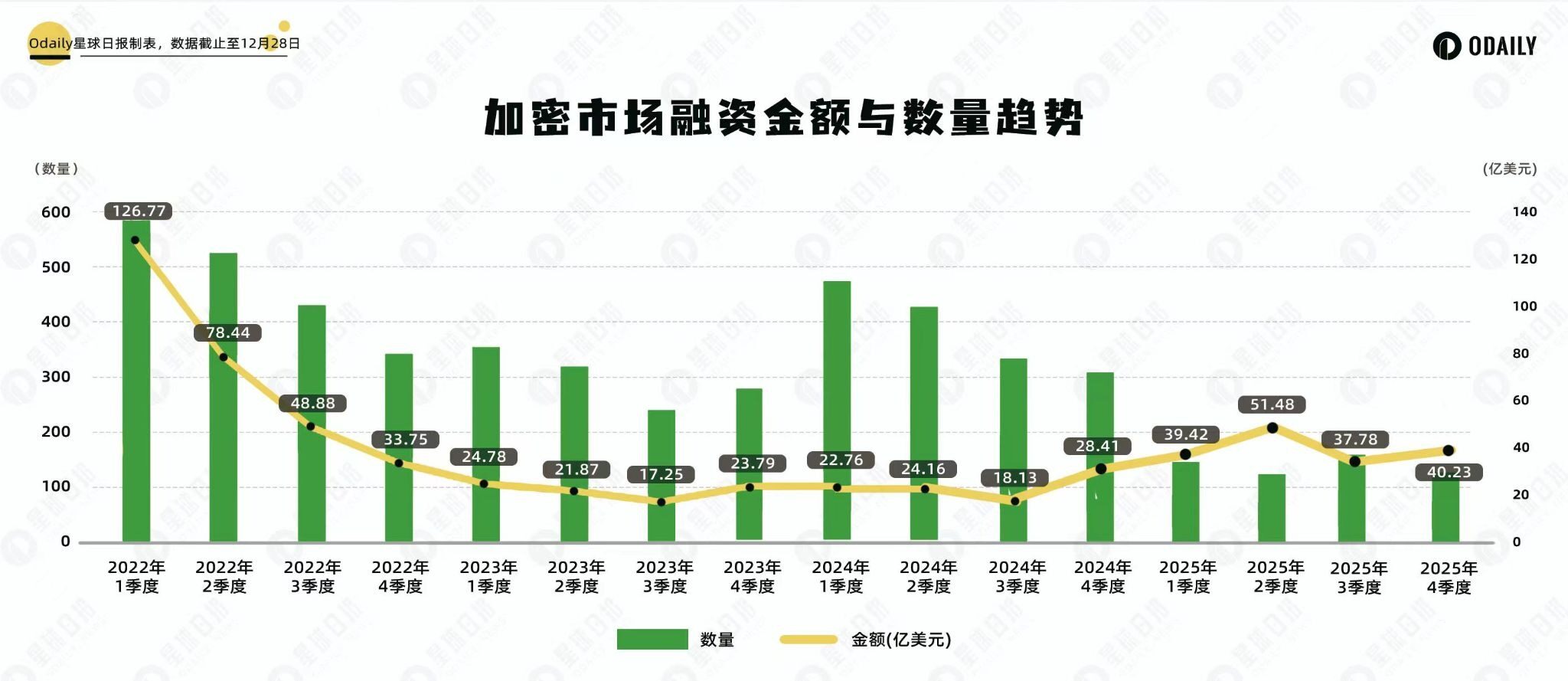
Reviewing the trends in crypto financing over the past four years, the evolution of the relationship between the primary market and secondary market performance becomes clear.

Early 2022 still benefited from the residual heat of the bull market, with both the number of financing events and the amounts raised remaining high; subsequently, as Bitcoin entered a downward cycle, financing activity gradually萎缩. Between 2022 and 2023, investment and financing activities were highly correlated with price movements, remaining overall低迷 under bear market pressure.

2024 became a significant turning point, marking the first divergence between the amount raised and the number of deals.

This year, with the restart of the Bitcoin halving narrative, the number of financing events明显回暖, but the amount raised remained consistently克制. Quarterly financing规模 hovered in the range of $1.8 billion to $2.8 billion, even similar to levels during the bear market. The main reason was that during this period, the crypto market行情 was dominated by Bitcoin and the Meme sector, which stood in stark contrast to the performance of the previous cycle. In the previous cycle, VC-backed projects were often the core of market hotspots, whereas in 2024, VC projects overall performed低迷, struggling to substantially impact the market, which to some extent also抑制了大额融资的出现.

Entering 2025, the divergence phenomenon reappeared, but this time the direction reversed.

The number of financings saw a significant decline, but the amount raised began to回升. Quarterly financing规模 returned to the range of $3.7 billion to $5.1 billion. This means that the average financing size increased significantly; investors are actively reducing the number of investments and instead concentrating their bets on a few projects deemed to have certainty and scalability.

12 Sectors, $178.9 Billion: Structural Changes in the Primary Market

According to incomplete statistics from Odaily Planet Daily, the total primary market investment and financing in 2025 reached $178.9 billion, with a total of 569 financing events. To more accurately depict changes in financing preferences, we have categorized all disclosed financing projects (the actual close time is often earlier than the announcement) into 12 sectors based on business type, target audience, and business model dimensions. These include: CeFi, Infrastructure, RWA, AI, DeFi, SocialFi, Prediction Markets, PayFi, DePIN, BTCFi, L1, and GameFi.
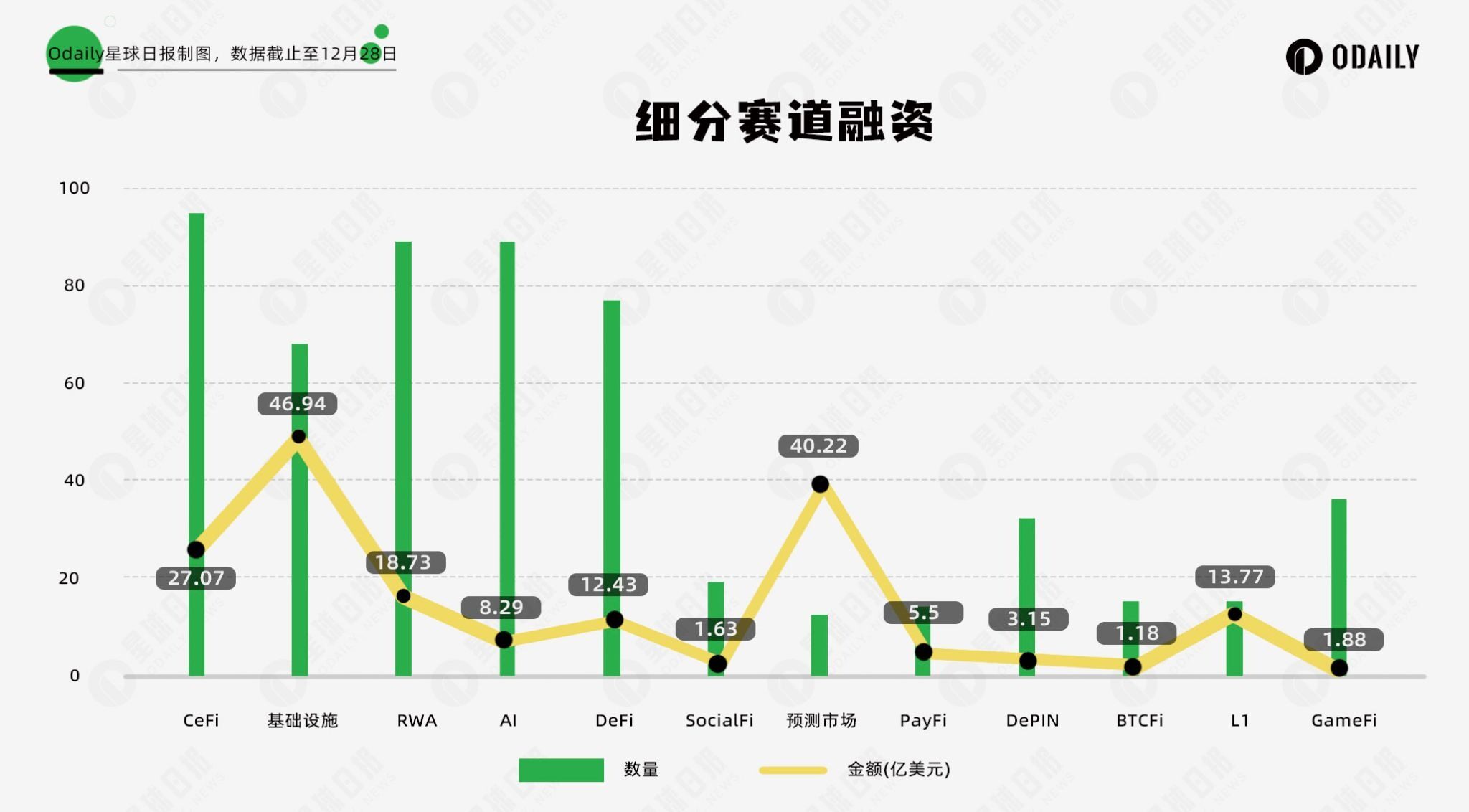
Looking at the financing situation in细分 sectors:

  • CeFi and Infrastructure ranked at the top in terms of both financing amount and number of deals. Underlying capabilities such as trading, custody, clearing, security, and cross-chain remain key areas for continuous capital investment. The market consensus on "infrastructure first" has not wavered.
  • DeFi projects continue to maintain high activity levels. The market still has high demand for innovation in new DeFi protocols, especially as the success of Hyperliquid directly demonstrated to the market that decentralized exchanges can also effectively handle large-scale capital inflows. Perp DEX has become a new financing hotspot.
  • AI and RWA have become new narrative pillars. The former aligns with the main theme of the global tech cycle, while the latter directly benefits from the institutional红利 of tokenizing traditional financial assets. Both paths share a common characteristic: their growth logic no longer relies entirely on the crypto-native market but extends into the broader tech and traditional financial systems.
  • The real dark horse is the Prediction Market sector. Although the number of projects in this sector is not particularly突出 compared to others, the amount raised jumped to become the second-largest sector,仅次于 infrastructure. This indicates that capital is being高度集中地押注 on a few leading projects.
  • In contrast, once-hot sectors like DePIN and GameFi, while still seeing many projects emerge, have experienced a sharp decline in financing appeal, as capital shifts towards areas with greater certainty and economies of scale.

Overall, the primary market is shifting from "casting a wide net" to "intensive cultivation."

Polymarket: Consensus Changes Behind the Top Financing of 2025

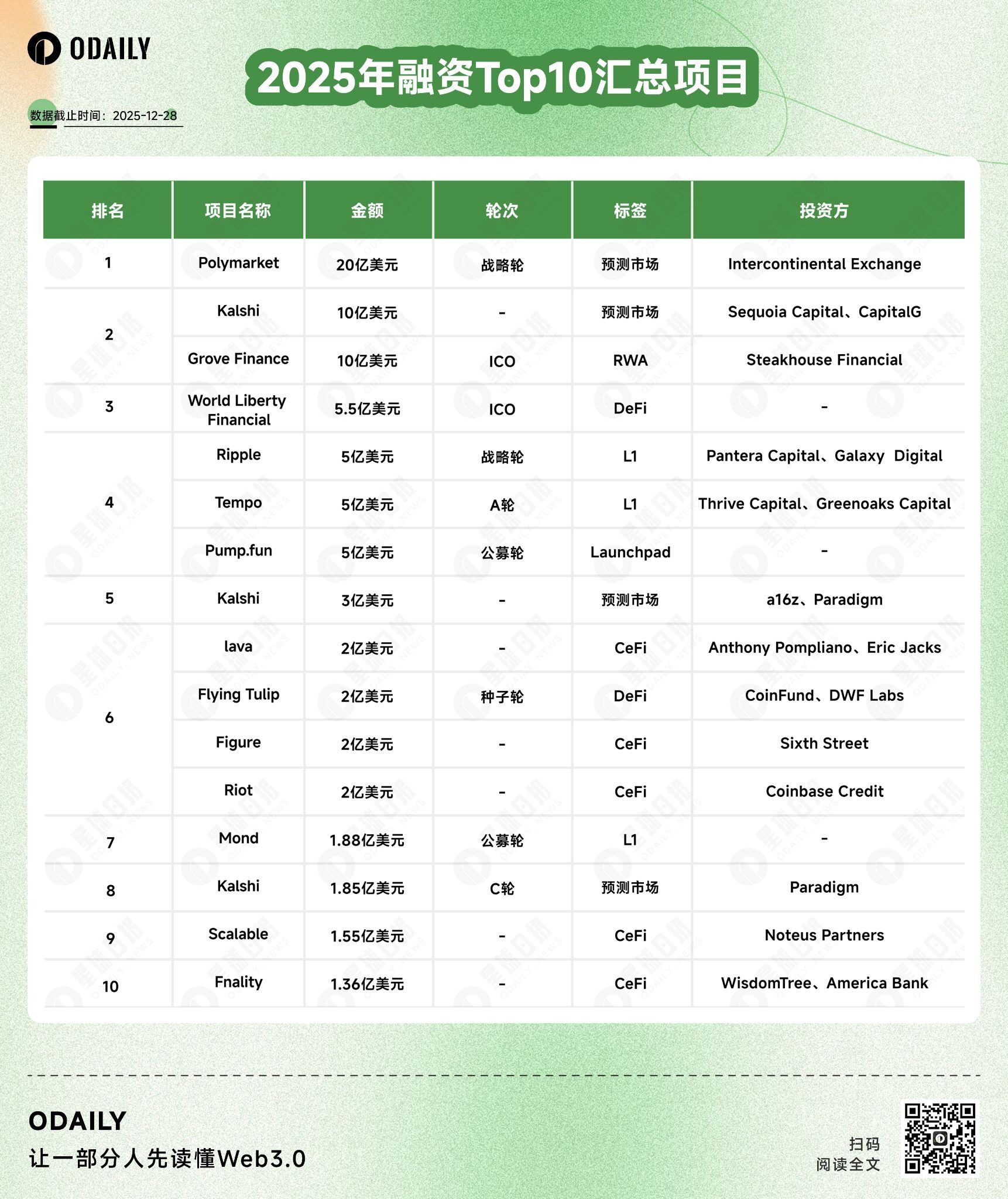
From the list of Top 10 financing amounts in 2025, it can be seen that Polymarket and Kalshi almost constitute the entire narrative of 2025 financing.

Among them, Polymarket has completed nearly $2.5 billion in multiple rounds of financing, with investors including知名加密风投 funds like Polychain, Dragonfly, and Coinbase; Kalshi began to gain momentum in 2025, completing approximately $1.5 billion in financing, supported by Paradigm, a16z, and Coinbase. Unlike Polymarket, Kalshi emphasizes compliance with federal regulation. However, what they share is that prediction markets are being viewed as a financial form with real demand and have now become the most vibrant and positively trending sector.

In the L1 sector, capital preferences similarly persist. On the list, besides the established public chain Ripple, others like Tempo and Mond are new-generation projects. Among them, Mond has already issued tokens, while Tempo has not. This reflects investors' continued investment in underlying infrastructure, with high-performance L1s still seen as the long-term cornerstone for ecosystem expansion.
Conclusion

Overall, the primary market in 2025 did not cool down but is undergoing active convergence and restructuring.

Capital is still flowing, but it is no longer chasing quantity; instead, it is being allocated集中 around certainty, compliance, and scalability potential. This change does not necessarily mean fewer opportunities but may instead signal that the crypto market is entering a more rational and mature stage.


Пов'язані питання

QWhat were the two key legislative developments that supported the growth of the cryptocurrency market in 2025?

AThe two key legislative developments were the formal enactment of the stablecoin-related bill, which provided a clear legal framework for 'on-chain dollars,' and the steady advancement of the cryptocurrency market structure bill, which incorporated crypto assets into a classified regulatory framework.

QHow did the trend of financing events and amounts change from 2024 to 2025?

AIn 2024, there was a first divergence where the number of financing events increased significantly, but the total amount raised remained restrained. In 2025, a second divergence occurred in the opposite direction: the number of financing events dropped significantly, but the total amount of financing increased, indicating a rise in the average deal size as investors concentrated their bets on fewer projects.

QWhich two sectors emerged as new narrative focal points in the 2025 crypto funding landscape, and what was their common characteristic?

AAI and RWA (Real World Assets) emerged as new narrative focal points. Their common characteristic was that their growth logic no longer relied entirely on the crypto-native market but extended into the broader technology and traditional financial systems.

QWhich sector, despite having a relatively low number of projects, saw a massive concentration of funding, becoming the second-largest sector by amount raised?

AThe prediction market sector, with projects like Polymarket and Kalshi, saw a massive concentration of funding, making it the second-largest sector by amount raised, just behind infrastructure.

QWhat overall shift in investment strategy does the 2025 crypto venture capital market represent?

AThe market shifted from a 'wide net' strategy of numerous small bets to a 'precision cultivation' strategy, where capital is concentrated and allocated around projects with regulatory clarity, certainty, and potential for scale, indicating a move towards a more rational and mature stage.

Пов'язані матеріали

380,000 Apps Exposed, 2,000+ Apps Leaked Secrets: AI Programming Turns 'Intranet' into Public Internet

Israeli cybersecurity firm RedAccess uncovered a severe data exposure trend linked to "vibe coding" or AI-powered software development tools. Their research found approximately 38,000 publicly accessible web applications built with platforms like Lovable, Base44, Netlify, and Replit. Of these, an estimated 2,000 apps exposed sensitive corporate and personal data, including medical records, financial information, internal strategic documents, and customer chat logs. In some cases, access even granted administrative privileges. The core issue stems from default privacy settings that make applications public by default, combined with a lack of built-in security controls (like authentication) in the AI-generated code. This allows employees without security expertise—"citizen developers"—to easily create and deploy applications that bypass standard corporate security reviews. The exposed apps, often indexed by search engines, are trivially discoverable. While some platform providers (Replit, Lovable, Wix/Base44) argue that security configuration is the user's responsibility and question the validity of some findings, security researchers confirm the widespread reality of such exposures. This pattern, also noted in prior studies, highlights a critical security gap as AI democratizes app creation, potentially leading to massive, unintentional data leaks.

marsbit12 хв тому

380,000 Apps Exposed, 2,000+ Apps Leaked Secrets: AI Programming Turns 'Intranet' into Public Internet

marsbit12 хв тому

Attracting Global Capital, Asia's New 'Super Cycle' Is Unfolding

Investors are turning to Asia as the next frontier for global equity growth, with a new "super cycle" unfolding across the region. Driven by the AI revolution, Asian markets, particularly South Korea, have seen significant rallies. According to Morgan Stanley analysis, the underlying drivers of Asia's industrial cycle are shifting from traditional sectors like real estate and manufacturing to massive investments in AI infrastructure, energy security and transition, and supply chain resilience. Fixed asset investment in Asia is projected to grow from around $11 trillion in 2025 to $16 trillion by 2030, with a 7% annual growth rate from 2026-2030. The AI wave is a primary catalyst, driving immense capital expenditure for chips, servers, data centers, and power systems. Asia is central to this hardware supply chain. In China, AI investment is focused on building a full-system domestic capability, with the local AI chip market potentially reaching $86 billion by 2030. Beyond AI, China's export story is expanding from EVs and batteries to robotics. The country already captures about half of new global industrial robot demand and over 90% of humanoid robot shipments. This growth phase mirrors the early stages of China's EV export boom. Simultaneously, energy security investments, spurred by AI's massive power needs, are rising, with China benefiting from its leadership in solar, batteries, and EVs. Regional defense spending is also increasing structurally, supporting demand for advanced manufacturing. The main beneficiaries are China, South Korea, and Japan, positioned in core supply chain areas. However, risks remain, including potential overcapacity, profit margin pressures from competition, persistent technological restrictions, geopolitical friction, and workforce displacement due to AI-driven automation. Market volatility is also expected to increase as investor expectations diverge on the realization of these capital investment and export themes.

marsbit13 хв тому

Attracting Global Capital, Asia's New 'Super Cycle' Is Unfolding

marsbit13 хв тому

Funding Weekly Report | 14 Public Funding Events, Kalshi Completes $10B New Funding Round at $220B Valuation Led by Coatue Management

Weekly Funding Roundup: 14 Deals and $10.49B+ in Total Funding, Led by Kalshi's $1B Round Last week (5.4-5.10) saw 14 notable funding events in the global blockchain ecosystem, raising over $10.49 billion in total. Key highlights include Kalshi, a prediction market platform, securing a $1 billion round led by Coatue Management, reaching a $22 billion valuation. The platform now boasts ~2 million MAUs and $178B in annualized trading volume. In DeFi, regulated on-chain reinsurer OnRe raised $5 million in Series A funding, and Bitcoin-backed credit protocol Saturn Credit completed a $2 million seed round. For Infrastructure & Tools, OpenTrade raised $17 million to expand its stablecoin yield infrastructure, and RWA platform Balcony secured $12.7 million to deploy its property settlement service in the US. Centralized Finance saw one deal: AI-driven trading platform Stockcoin.ai completed a seed round led by Amber Group. In the prediction market sector alongside Kalshi, AI-powered platform Elastics raised $2 million. Other notable deals include SC Ventures' strategic investment in crypto market maker GSR and Centrifuge securing a "seven-figure" investment from Coinbase to become a core RWA partner for Base. On the investor side, Haun Ventures raised a new $1 billion fund targeting crypto and AI, and Multi Investment raised ~$616 million to focus on blockchain and Web3 investments.

marsbit1 год тому

Funding Weekly Report | 14 Public Funding Events, Kalshi Completes $10B New Funding Round at $220B Valuation Led by Coatue Management

marsbit1 год тому

Торгівля

Спот
Ф'ючерси
活动图片