MSTR Earnings Review: The 'Flywheel' Now Has a 'Safety Valve', Arbitrage Opportunity Emerges

marsbitОпубліковано о 2026-05-08Востаннє оновлено о 2026-05-08

Анотація

MicroStrategy's recent earnings call has fundamentally changed its strategy. Management has explicitly stated a key metric: a 1.22x premium to its mNAV (adjusted net asset value). This acts as a trigger for the company's actions regarding its Bitcoin holdings. If MicroStrategy's stock trades at a premium **above** 1.22x mNAV, the company will continue its established playbook: issuing equity to raise capital and buying more Bitcoin. However, if the premium falls **below** 1.22x, the strategy reverses. Management committed to selling Bitcoin to generate cash, which would then be used for debt management, dividends, or stock buybacks. This clear threshold creates a potential arbitrage opportunity. Should the premium dip below 1.22x, a trade involving going long MSTR stock while shorting an equivalent value of Bitcoin could profit. The logic is that the company's promised actions (selling BTC, buying back stock) would directly work to close that valuation gap, providing a catalyst for the trade. For holders of MicroStrategy's high-yield preferred stock (STRC), this policy introduces a significant safety net. The commitment to sell BTC to protect the balance sheet and meet obligations reduces the prior risk of the company facing a liquidity crisis during a deep Bitcoin downturn, making STRC resemble a more traditional corporate bond. Regarding Bitcoin's market impact, the announcement has mixed implications. In the short term, it is sentimentally bearish as it ends the narrat...

This MicroStrategy (MSTR) earnings report has completely changed its game: it used to be "mindlessly print shares to buy Bitcoin," but now the company has provided a clear-cut metric – a 1.22x mNAV (asset value premium). This number will determine whether MSTR buys or sells coins next.

● For MSTR:

○ Premium > 1.22x: Continue the old playbook: issue high-priced shares, take the money to buy BTC.

○ Premium < 1.22x (the core reversal): It no longer makes sense for the company to issue more shares. Management has explicitly stated that if the premium falls below this level, they will sell BTC, use the cash to repay debt or repurchase shares.

● How to arbitrage: If MSTR's premium falls below 1.22x, it will trigger a conditional arbitrage opportunity: "long MSTR, short BTC." Because at that point, the company will personally step in to "sell Bitcoin, buy its own shares." The company's selling action will close the price gap. Management's stance is the core confidence behind this arbitrage trade.

● For STRC (Preferred Stock): Previously, people feared that a MicroStrategy blow-up would render these 11.5% dividend preferred shares worthless. Now, the official statement "will sell Bitcoin to repay debt if necessary" means STRC has a solid safety net; it's no longer a Ponzi gamble.

● For the broader BTC market: The myth of "MicroStrategy will never sell" is shattered, which is negative for short-term sentiment. The benefit is that the company's proactive selling to reduce leverage completely eliminates the future risk of a "forced, cascading liquidation" during a deep bear market.

Diamond Hands No More: The 1.22x mNAV is the Lifeline and Bitcoin's Bull/Bear Dividing Line

Over the past two years, there has been much FUD in the market regarding MSTR, particularly about how they manage their leverage and interest expenses. Bitcoin is an asset without cash flow, yet MSTR has to pay significant interest for financing it. Where would this come from? In this Q1 earnings call, management personally declared: they will sell Bitcoin if the mNAV premium falls below 1.22x.

This is equivalent to revealing the company's "bottom card" and "auto-execution program":

● Above the waterline (balance sheet expansion phase): The company is a die-hard BTC bull. As long as retail investors are willing to give a premium higher than 1.22x, MicroStrategy can engage in "risk-free arbitrage balance sheet expansion." Issue shares to raise capital -> massively buy BTC -> increase book assets -> push the stock price higher. This positive flywheel keeps spinning.

● Below the waterline (defensive balance sheet contraction phase): The flywheel slams on the brakes. If MSTR trades at too steep a discount relative to its Bitcoin holdings, issuing more shares would mean selling company assets at a discount. Management very rationally stated that at this point, selling BTC for cash, using it to pay dividends, manage debt, or directly repurchase MSTR common shares at low prices would provide the greatest value enhancement for existing shareholders.

This means MSTR finally has a hard "value support line." It is no longer a runaway train without brakes.

Arbitrage Opportunity: Long MSTR / Short BTC when the mNAV premium falls below 1.22

What is the biggest fear in arbitrage? It's finding an excellent price discrepancy, but the market remains irrational for an extended period (e.g., MSTR stays at a discount), and eventually, your hedge position gets worn down by funding rates or interest costs.

However, the 1.22x threshold provided by MSTR this time offers an arbitrage opportunity with strong certainty.

In-depth practical logic:

● Strict trigger condition: Only when MSTR's mNAV premium falls significantly below 1.22x.

● Position entry: At this point, MSTR's price is "excessively undervalued" relative to its underlying BTC assets. Traders should go long MSTR and simultaneously short an equivalent market value of BTC.

● The winning underlying logic: Even if market participants don't close the gap, MicroStrategy's management will force it to converge. Once the threshold is breached, to maximize "Bitcoin per share," management will initiate their promised self-rescue operation – "sell BTC, repurchase undervalued MSTR shares." Do you see it? The direction of your long/short position will be completely synchronized with the official market intervention direction of MicroStrategy's tens of billions of dollars. You don't need to predict whether BTC will rise or fall tomorrow; you just need to calmly capture the "price gap convergence" profit, which is essentially risk-free.
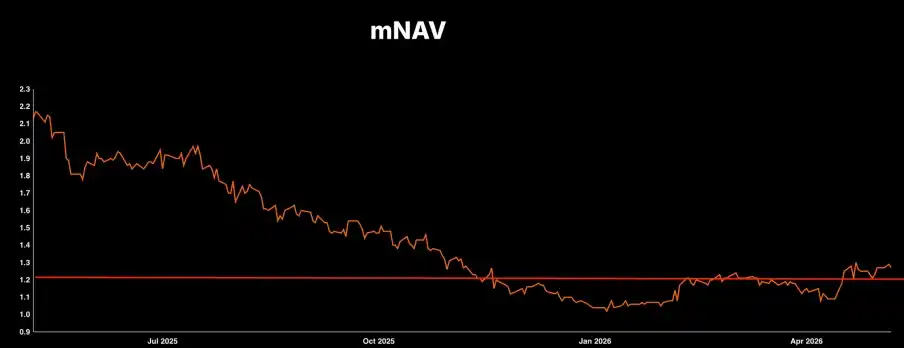
Monitoring tip: Currently, MSTR's premium is fluctuating around 1.28x, not yet triggering the arbitrage condition. Blindly opening positions is premature. However, it has already entered an excellent targeting zone. Set up price alerts and wait for it to drop below the threshold before acting.

3. Significantly Enhanced Safety Net for STRC (Preferred Shares)

STRC offers a high dividend yield of 11.5%. In the previous bearish narrative, MicroStrategy was a gambler with massive leverage. Once Bitcoin faced a black swan event like a halving or more in price, MicroStrategy's cash flow would break, and STRC preferred shares would instantly become worthless.

But the Q1 earnings report completely revealed the company's true financials, not only refuting the shorts but also giving fixed-income investors a dose of confidence:

● Impressive asset thickness: On the liabilities side, the company has $13.5 billion in preferred shares and $8.2 billion in convertible bonds. On the asset side, there is a corresponding $64 billion in BTC reserves. The net leverage ratio is a negligible 9%, which is considered extremely robust in traditional finance.

● Extreme downside stress test: Even if the crypto market experiences another major crash, with BTC plummeting 90% from current levels (all the way down to $7,300), selling their coins would still be enough to repay all net debt.

● Cash moat: As a last resort, even if Bitcoin liquidity dries up and they can't sell quickly, the company still holds $2.25 billion in pure cash on its books. The interest earned from this cash alone, even at a savings rate, would be enough to cover the future 1.5 years (annual $1.5 billion) of debt interest and preferred dividends without lifting a finger. Overall, as long as BTC appreciates by a mere 2.3% annually, STRC's interest obligations can be perfectly covered.

The most crucial expectation reversal lies in this: management has broken the dogma of "never selling coins." This means they will proactively and gradually sell Bitcoin to preserve the company's credit rating and ability to pay interest before an extreme crisis hits. STRC has completely shed the label of "crypto Ponzi high-yield debt." Its risk pricing logic is now moving closer to that of traditional high-quality corporate bonds, making it highly likely to attract allocation buys from traditional institutional funds.

4. Impact on the Broader BTC Market: Losing a "Die-hard Buyer," Removing a "Cascade Liquidation Landmine"

The sentiment shock from this earnings call on the broader BTC spot market is two-sided, requiring traders to view it through different timeframes:

● Short-term pain (sentiment negative): Retail investors previously viewed MicroStrategy as a "bottomless pit" that only buys and never sells, providing perpetual support. Now, management's admission that "they will sell if valuation is wrong" directly shatters this bullish totem. In the short term, this is a significant blow to market optimism and speculative hype.

● Long-term benefit (structural upgrade of the foundation): Traders who understand a bit of cycle history know why the last bear market (2022) fell so hard. Because giants like LUNA, Three Arrows Capital, and Celsius "held on to the bitter end," until liquidity completely dried up and they were forcibly liquidated, leading to cascading sell-offs. The current MicroStrategy is no longer a "believer" swept up by狂热; it's a savvy "Wall Street veteran" who knows how to crunch numbers. It has set a clear early warning line for selling and understands how to proactively reduce leverage by adjusting its portfolio at the onset of a crisis. This is equivalent to defusing the largest "systemic liquidation nuke" hanging over the crypto market in advance.

Summary: MicroStrategy remains the largest "BTC bull commander-in-chief" in the entire U.S. stock market. However, it has evolved from a reckless charger into a precise calculator that knows when to advance and retreat, even harvesting market sentiment in reverse.


Пов'язані питання

QWhat is the significance of the 1.22x mNAV threshold for MicroStrategy, according to the article?

AThe 1.22x mNAV (premium to net asset value) is a critical threshold that dictates MicroStrategy's capital allocation strategy. If MSTR's premium is above 1.22x, the company will continue its historical playbook of issuing stock to buy more Bitcoin (BTC). If the premium falls below 1.22x, management has explicitly stated they will reverse course, selling BTC to raise cash for debt repayment, stock buybacks, or dividends. This provides a hard 'value floor' and removes uncertainty for investors.

QHow does the article describe the arbitrage opportunity related to MSTR and BTC?

AThe article describes a conditional arbitrage strategy triggered when MSTR's premium to its Bitcoin holdings falls below the 1.22x mNAV threshold. At that point, a trader would go long on MSTR stock while simultaneously shorting an equivalent amount of BTC. The 'sure win' logic is that if the market doesn't correct the price disparity, MicroStrategy's management will force it to converge by executing their promised action of selling BTC to buy back their own undervalued shares, aligning with the trader's position.

QWhy is the STRC (Series 2 Preferred Stock) considered to have a significantly improved safety cushion after MicroStrategy's Q1 report?

ASTRC's safety cushion improved because the Q1 report and management commentary changed the risk profile. Previously, STRC, which pays an 11.5% dividend, was seen as risky if a crypto crash forced MSTR into insolvency. Now, management's commitment to sell BTC if necessary to manage liabilities provides a concrete backstop. The article highlights that MSTR's leverage is low (9%), and even a 90% drop in BTC's price would still leave enough value to cover net debt, while the company's cash reserves could cover interest and preferred dividends for 1.5 years without selling any BTC.

QWhat are the two-sided impacts of MicroStrategy's new policy on the broader Bitcoin (BTC) market, as outlined in the article?

AThe impacts are twofold: 1) Short-term negative sentiment (bearish): The policy shatters the myth of MicroStrategy as a 'diamond hands' perpetual buyer that would never sell, removing a key psychological and speculative support pillar for the market. 2) Long-term structural positive (bullish): By establishing a clear selling threshold and showing willingness to de-leverage proactively, MicroStrategy eliminates the risk of a future 'forced liquidation cascade' during a deep bear market. This removes a major potential systemic risk, making the market's foundation healthier.

QHow has MicroStrategy's role in the market evolved, according to the article's conclusion?

AAccording to the article's conclusion, MicroStrategy has evolved from being a reckless, dogma-driven 'believer' or 'charging fool' into a strategic 'Wall Street veteran' or 'actuary.' It remains the largest 'BTC bull commander' in the stock market, but it has transformed into a more rational entity that calculates carefully, advances and retreats with discipline, and can even profit from market sentiment reversals, rather than just blindly accumulating Bitcoin at any cost.

Пов'язані матеріали

AI PC Battle: Bet on the Toll Booth, Not the Camp

**Title:** The AI PC Battle: Don't Bet on Sides, Bet on the Tollbooth **Summary:** The AI PC competition is moving beyond simple "x86 vs. Arm" narratives. The core investment thesis should focus on identifying which players can sustain margins, cash flow, and pricing power throughout the upgrade cycle, rather than backing a particular architecture. The opportunity is analyzed in three layers: 1. **The Advanced Foundry Tollbooth:** TSMC is positioned to collect "tolls" regardless of which chip designer wins, due to its dominant ~70% share in advanced semiconductor manufacturing, which is essential for high-end AI PC chips. 2. **Compute & Platform Spillover:** AMD represents an offensive in the x86 CPU+GPU space, while NVIDIA leverages its GPU and CUDA software stack dominance. Both benefit from the demand for increased local AI compute. 3. **Architecture Diffusion & Turnaround Plays:** ARM and Intel offer potential for significant upside (elasticity), but investments here require stricter discipline due to higher execution risks and competitive challenges. The industry is transitioning from concept to shipment validation. While short-term forecasts for AI PC adoption have been revised down slightly due to tariffs and procurement delays, the long-term trend towards AI becoming a standard PC feature remains intact. The key driver for upgrade cycles will be whether compelling enterprise applications (e.g., privacy-sensitive computing, low-latency inference) emerge beyond consumer-focused features like meeting summarization. Investment strategy should prioritize companies with platform-level advantages and recurring revenue streams. TSMC offers high certainty as the foundational tollbooth. AMD presents a strong offensive play within the established ecosystem. ARM and Intel are higher-risk, higher-potential-reward turnaround bets. The report cautions against chasing short-term hype and emphasizes a disciplined, long-term approach focused on buying ecosystem strength and cash-flow certainty after market enthusiasm subsides. **Key Risks:** Underwhelming AI PC applications slowing upgrade cycles; slow improvement in Windows on Arm compatibility; macro/tariff impacts on PC demand; potential advanced node supply-demand mismatches affecting TSMC; high overall AI sector valuations making stocks vulnerable to a risk-off shift in markets.

marsbit16 хв тому

AI PC Battle: Bet on the Toll Booth, Not the Camp

marsbit16 хв тому

Ten-Thousand-Word Analysis: From $10 to $290, MRVL Wins the Entire AI Era by 'Not Making GPUs'

Marvell Technology's stock price surged from under $10 in 2016 to a record $290 in June 2026, fueled not by making GPUs, but by dominating AI infrastructure connectivity. This analysis argues the market misvalues MRVL as merely a smaller Broadcom in custom AI chips, overlooking its true, unique position. Marvell's core strength lies in enabling high-speed data flow for AI clusters through three interconnected businesses. First, it holds a commanding ~70% market share in high-speed optical DSPs (essential for data center light modules), a deep-moat business with accelerating growth. Second, its custom AI chip design business serves hyperscalers like AWS, Microsoft, and Google, with a significant revenue pipeline despite lower margins. Third, stable cash flows come from Ethernet switch chips and enterprise storage controllers. Together, they form a full-stack "AI data movement" platform. CEO Matt Murphy's transformative leadership since 2016, involving strategic divestments, key acquisitions (like Inphi for optical DSPs), and securing long-term agreements with major cloud providers, repositioned the company. A pivotal $2 billion strategic investment from NVIDIA in 2026 underscored Marvell's critical role in the AI ecosystem, particularly through collaborations like NVLink Fusion. While Marvell faces risks—including client concentration (losing the Amazon Trainium3 design), lower-margin business mix, competitive threats, insider selling, and complex supply chains—its fundamentals remain strong. The optical interconnect moat is widening with the acquisition of Celestial AI (photonics fabric), and financial metrics show accelerating revenue growth and operating leverage. With a PEG ratio suggesting undervaluation relative to its growth, the thesis is that the market undervalues Marvell's monopolistic position in AI "plumbing" while overemphasizing its competitive custom chip segment. The story transcends investing, symbolizing how in any complex system—from the internet to AI—the value of "connection" ultimately surpasses that of individual "nodes."

marsbit46 хв тому

Ten-Thousand-Word Analysis: From $10 to $290, MRVL Wins the Entire AI Era by 'Not Making GPUs'

marsbit46 хв тому

AI Relay Stations Spark Heated Debate on Zhihu: Behind Cheap Tokens, What Are Users Really Worried About?

A discussion on Zhihu about "AI relay stations" shifted the niche developer topic of "cheap tokens" into broader user awareness. Users moved beyond simply questioning the legitimacy of these services to focus on practical concerns: Where do cheap tokens truly come from? Is the model being accessed the real one? Can relay stations see prompts, code, and API keys? For occasional users, are the risks worth it? The core debate centered less on price and more on trust. A primary worry is model authenticity—the risk of "model swapping," where users paying for a premium model might be routed to a cheaper one, creating an information asymmetry. Others argued that cost comparisons matter; while cheaper than official pay-as-you-go APIs, relay stations may not be the lowest-cost option versus subscriptions, domestic models, or free tiers, making user needs assessment crucial. Speculation about token sources ranged from legitimate bulk discounts to gray-area methods like account sharing or exploiting regional pricing. This opacity makes risk assessment difficult for users. Data security emerged as a critical concern, especially for enterprise use. When processing sensitive information like code, contracts, or client data, the inability to verify a relay station's data handling, retention, or access policies poses significant compliance and confidentiality risks. The evolving consensus suggests relay stations can be used cautiously for low-sensitivity, disposable tasks (e.g., summarizing public info, simple translation). However, they should not be the default for sensitive, professional, or production workflows involving proprietary data, Agents, or automated systems. Recommendations include avoiding large prepayments, not relying on a single service, using test prompts to monitor quality, anonymizing data where possible, and keeping official channels as backups. Ultimately, the discussion framed tokens not just as a billing unit but as a measure of real cost encompassing price, model integrity, data security, and service stability. The popularity of relay stations highlights user demand for affordable access, but the debate underscores a key trade-off: the savings from cheap tokens may come at the price of trust, transparency, and control over one's data and AI experience.

marsbit1 год тому

AI Relay Stations Spark Heated Debate on Zhihu: Behind Cheap Tokens, What Are Users Really Worried About?

marsbit1 год тому

In-Depth Research Report on TradFi: The Convergence Wave of Crypto and Traditional Finance

In 2026, the crypto industry is undergoing a profound infrastructure-level transformation—TradFi assets are migrating on-chain at an unprecedented pace. According to CoinGecko's Q1 2026 report, the total value locked (TVL) of tokenized real-world assets (RWA) has surpassed $31 billion, a nearly 4x increase from $7.8 billion at the beginning of 2025, with the sector’s aggregate market capitalization reaching $19.3 billion. Among these, the market cap of tokenized stocks surged from $2 million to $486 million, with Q1 spot trading volume reaching $15.1 billion—a single quarter already surpassing the entire second half of 2025. RWA perpetual contract Q1 trading volume reached a staggering $524.8 billion, far exceeding the $313 billion for all of 2025. Meanwhile, BlackRock's BUIDL fund has reached $2.3 billion in scale and has filed for two new tokenized funds, signaling that the world's largest asset manager's tokenization strategy is evolving from pilot to product suite expansion. HTX, as a core participant in the crypto exchange sector, officially launched TradFi perpetual futures products including NVDA, AAPL, MSFT, META, and SPY in 2026, enabling crypto users to gain 24/7 trading access to core U.S. equities. Boston Consulting Group predicts that global tokenized asset scale could reach $16 trillion by 2030, while McKinsey offers a conservative estimate of approximately $2 trillion. The on-chain migration of TradFi assets is no longer a "future narrative" but a structural transformation unfolding in real time, as crypto exchanges evolve from single crypto asset trading platforms toward "multi-asset-class trading infrastructure."

HTX Learn1 год тому

In-Depth Research Report on TradFi: The Convergence Wave of Crypto and Traditional Finance

HTX Learn1 год тому

Торгівля

Спот
Ф'ючерси
活动图片