Morgan Stanley Bitcoin ETF to Launch Tomorrow, Recommends Clients Allocate Up to 4% to Crypto Assets

marsbitОпубліковано о 2026-04-08Востаннє оновлено о 2026-04-08

Анотація

Morgan Stanley is set to launch its own spot Bitcoin ETF (ticker: MSBT) on NYSE Arca on April 8, making it the first major U.S. bank to directly issue such a product. With an annual management fee of 0.14%, it becomes the lowest-cost Bitcoin ETF on the market. The fund will hold Bitcoin directly and track the CoinDesk Bitcoin price index. The bank’s vast network of approximately 16,000 financial advisors, who manage around $6.2 trillion in client assets, can begin recommending the ETF immediately upon launch. Morgan Stanley’s Global Investment Committee has already advised clients to allocate up to 4% of their portfolios to crypto assets. Analysts suggest this distribution capability could unlock substantial institutional and advisory-driven capital into Bitcoin. Beyond Bitcoin, Morgan Stanley is building a broader crypto infrastructure, having also filed for Solana and staked Ethereum ETFs, applied for a national trust bank charter, and plans to offer direct crypto trading via E*Trade in 2026. The move is seen as a significant step in the institutional adoption of Bitcoin and a shift in traditional finance’s approach to cryptocurrency.

Author: Curry, Deep Tide TechFlow

Deep Tide Guide: The SEC has approved the registration statement for the Morgan Stanley Bitcoin Trust (ticker: MSBT), which will begin trading on NYSE Arca on April 8th, with an annual management fee of 0.14%, the lowest in the market.

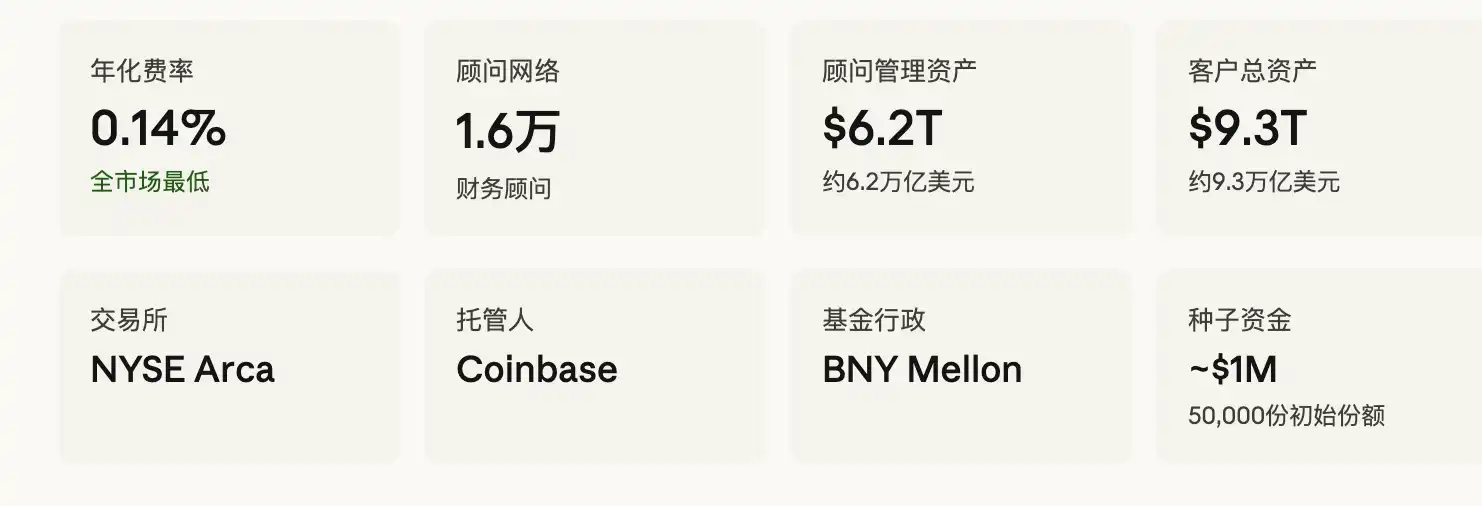
Morgan Stanley thus becomes the first major U.S. bank to directly issue a Bitcoin spot ETF. Its approximately 16,000 financial advisors, managing $6.2 trillion in client assets, will be able to recommend the product to clients starting on the first day of trading.

The countdown to Morgan Stanley's Bitcoin spot ETF has officially begun.

According to a CoinDesk report on April 8th, the U.S. Securities and Exchange Commission (SEC) has declared the registration statement for the Morgan Stanley Bitcoin Trust (MSBT) effective. The bank submitted its final prospectus on the same day. Bloomberg ETF analyst Eric Balchunas confirmed on platform X that MSBT will begin trading on NYSE Arca on April 8th (Wednesday).

This comes just three months after Morgan Stanley initially filed the S-1 registration document in January of this year. The speed from application to listing far exceeded market expectations.
Lowest Fee in the Market, First Major Bank to Self-Issue

MSBT's annual management fee is set at 0.14%, which is 1 basis point lower than Grayscale's Bitcoin Mini Trust (0.15%) and 11 basis points lower than BlackRock's IBIT (0.25%), making it the product with the lowest fee among all U.S. Bitcoin spot ETFs.

Fee comparison of major competitors: Grayscale Bitcoin Mini Trust 0.15%, Bitwise BITB 0.20%, ARK/21Shares ARKB 0.21%, BlackRock IBIT and Fidelity FBTC both 0.25%, Grayscale's flagship product GBTC 1.5%.
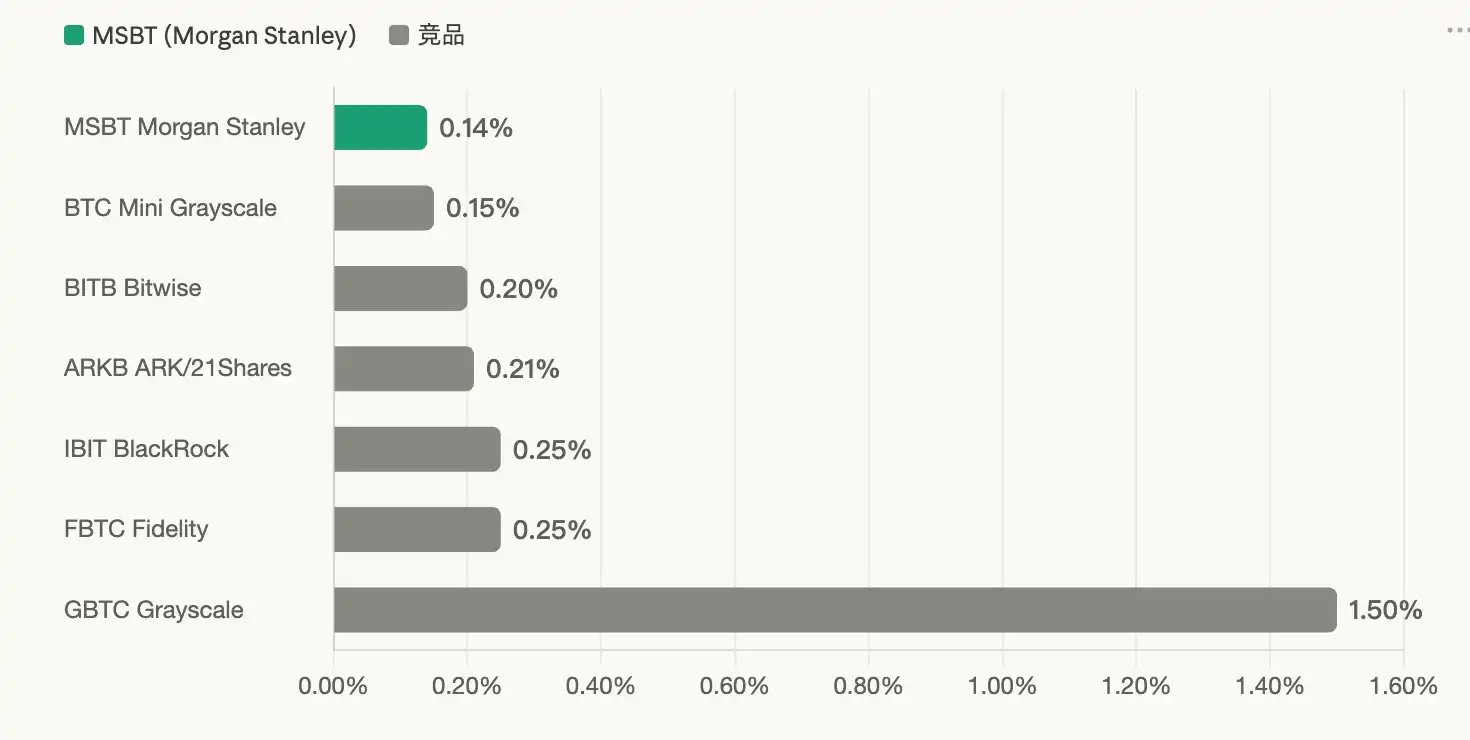
The fee is one of the few core differentiating factors in the Bitcoin spot ETF market. All products directly hold Bitcoin and track the spot price, with highly homogeneous investment strategies. Cost differences become significant in large allocations and long-term holdings. For a $100,000 investment, MSBT saves approximately $110 in management fees compared to IBIT annually.

Historical data has proven the driving force of fees on fund flows: Grayscale's flagship product GBTC charges 1.5% and has seen its assets under management (AUM) shrink from about $29 billion to less than half since its conversion to an ETF in January 2024.

Regarding the MSBT product structure, the fund directly holds Bitcoin, tracking the CoinDesk Bitcoin Benchmark 4:00 PM New York Settlement Price, without using leverage, derivatives, or active trading strategies. Coinbase serves as the custodian and prime broker, BNY Mellon is responsible for cash custody and fund administration, and the initial seed capital is approximately $1 million, corresponding to 50,000 creation baskets.

More importantly, MSBT is the 12th product of its kind since the first batch of Bitcoin spot ETFs were listed in January 2024, and the first Bitcoin spot ETF directly issued and listed by a major U.S. bank. Previously, the issuers of listed products were all asset management companies or crypto-native institutions. Morgan Stanley's entry means that Wall Street banks are moving from "distributing others' products" to "making their own products."

The Distribution Network is the Real Weapon

The fee is just one card on Morgan Stanley's table; the real differentiator is the distribution network.

Morgan Stanley's approximately 16,000 financial advisors manage about $6.2 trillion in client assets (total client assets for the entire bank are about $9.3 trillion). MSBT will receive distribution support from this network starting on its first trading day. Bloomberg ETF analyst Balchunas referred to Morgan Stanley as a "captive audience" for the Bitcoin ETF market and pointed out that while Fidelity also has a partial advisor network, "Morgan Stanley is a whole other level."

Amy Oldenburg, the bank's Head of Digital Asset Strategy, previously revealed that currently about 80% of crypto ETF trading activity comes from self-directed investors, not advisor-managed accounts.

A self-owned product with the lowest fee in the market is expected to eliminate cost concerns advisors might have when recommending Bitcoin allocations, thereby unlocking the incremental space of the advisor channel, which has not yet been fully activated.

Morgan Stanley's Global Investment Committee had already recommended that clients allocate 0-4% of their investment portfolio to crypto assets. Phong Le, CEO of Strategy (formerly MicroStrategy), provided a more aggressive calculation on platform X: based on $6.2 trillion in client assets and a 2% allocation ratio, the potential capital scale is approximately $160 billion, nearly three times the current AUM of BlackRock's IBIT. He called MSBT the "Monster Bitcoin".

However, the actual allocation pace still holds uncertainty. Multiple steps are typically required between product availability and large-scale recommendation through the advisor channel, including compliance approval, investment policy adjustments, and client education.

More Than One ETF: Morgan Stanley's Full-Scale Crypto Layout

MSBT is not an isolated product. Morgan Stanley is systematically building crypto asset infrastructure.

The bank submitted applications for both Bitcoin and Solana spot ETFs in January of this year, followed by an application for a staking Ethereum ETF. In February, Morgan Stanley applied for a National Trust Bank charter (Morgan Stanley Digital Trust) to directly provide clients with digital asset custody, trading, and staking services.

On the retail side, the bank plans to open spot trading for Bitcoin, Ethereum, and Solana to retail investors through the E*Trade platform in the first half of 2026, partnering with Zero Hash. Jed Finn, Head of the Wealth Management Division, called direct crypto trading the "tip of the iceberg," hinting that more services such as custody, wallets, and tokenized assets will follow.

The logic of this multi-channel strategy is clear: institutional clients get MSBT allocations through advisors, self-directed investors trade cryptocurrencies directly through E*Trade, all completed within Morgan Stanley's ecosystem. CEO Ted Pick has already communicated with the U.S. Treasury regarding product development.

Reddit Community: 'Traditional Finance Has Surrendered'

The news sparked heated discussion in the Reddit crypto community. Several users interpreted Morgan Stanley's self-issuance of a Bitcoin ETF as a "surrender signal" from traditional finance towards Bitcoin, believing that the shift from resistance and观望 (wait-and-see) to active embrace by major Wall Street banks marks an irreversible institutionalization process for Bitcoin as an asset class.

Other users offered pragmatic views: the trading volume on the first day and the net inflows in the first month will be key indicators to test whether the distribution network can truly translate into actual allocations.


Пов'язані питання

QWhat is the ticker symbol and management fee for Morgan Stanley's Bitcoin ETF?

AThe ticker symbol is MSBT, and it has an annual management fee of 0.14%, which is the lowest in the market.

QHow much client assets do Morgan Stanley's financial advisors manage, and what is the potential impact on the Bitcoin ETF market?

AMorgan Stanley's approximately 16,000 financial advisors manage about $6.2 trillion in client assets. The bank's global investment committee has recommended clients allocate 0-4% of their portfolio to crypto assets, potentially unlocking significant new capital into the Bitcoin ETF market.

QWhat makes Morgan Stanley's Bitcoin ETF (MSBT) unique compared to other existing Bitcoin ETFs?

AMSBT is the first Bitcoin spot ETF to be directly issued and listed by a major U.S. bank. Its key differentiators are its lowest-in-market fee (0.14%) and its immediate access to the bank's massive network of financial advisors and their clients.

QBesides the Bitcoin ETF, what other crypto-related products and services is Morgan Stanley developing?

AMorgan Stanley is building a full crypto infrastructure. This includes applications for a Solana spot ETF, a staking Ethereum ETF, a national trust bank charter (Morgan Stanley Digital Trust) for custody services, and plans to offer direct spot trading of Bitcoin, Ethereum, and Solana on its E*Trade platform for retail investors in 2026.

QWho are the key service providers (custodian, administrator) for the Morgan Stanley Bitcoin Trust (MSBT)?

ACoinbase serves as the custodian and prime broker for the MSBT, while BNY Mellon is responsible for cash custody and fund administration.

Пов'язані матеріали

Anthropic Cries Wolf: Is the AGI Threat Real, or Just an IPO Story?

Anthropic has published an article titled "When AI builds itself," discussing the emerging concept of "recursive self-improvement," where AI begins to actively participate in designing, training, testing, and optimizing its own subsequent versions. The company presents internal data showing that by May 2026, over 80% of code merged into its codebase was written by Claude, its AI model. Claude's capabilities have expanded to handling complex, open-ended engineering tasks, achieving a 76% success rate in such areas, and even contributing to research processes, such as optimizing code performance and conducting AI safety experiments. Anthropic outlines an evolution from human-driven development to AI-assisted workflows, culminating in the current stage where AI agents can autonomously write, run, and delegate code. The company cautions that the path toward a "closed loop," where AI continuously improves itself, is becoming visible. It calls for coordinated global mechanisms to potentially slow or pause frontier AI development to allow safety research and societal structures to catch up. However, the timing of this warning coincides with Anthropic's preparations for an IPO, framing the narrative not just as a safety concern but also as a demonstration of Claude's advanced capabilities and its integral role in accelerating Anthropic's own R&D—creating a potential "flywheel" effect for competitive advantage. This contrasts with OpenAI's recent, more policy-oriented discussion of the same risks, highlighting the competitive dynamics in the AI industry as companies position themselves in both the technological and regulatory landscape.

marsbit56 хв тому

Anthropic Cries Wolf: Is the AGI Threat Real, or Just an IPO Story?

marsbit56 хв тому

BIT Research: ETF Purchases Have Slowed, Strategy (MicroStrategy) Has Slowed, What Else Can Drive Bitcoin's Rise?

Market Refocus on Inflation and Rate Expectations Weighs on Bitcoin Currently, the market is in a phase of macro-repricing dominated by inflation and interest rate expectations. Bitcoin, which previously benefited from easy liquidity and low inflation, is seeing its core bullish drivers weaken. These drivers were market expectations for interest rate cuts and strong inflows from Bitcoin ETFs and institutions like MicroStrategy (referred to as "Strategy" in the text). The logic has shifted. Recent high inflation data (e.g., CPI hitting 3.8% in a May 2026 report) has caused the market to sharply reduce its rate cut expectations for 2025 and even price in potential hikes. This is a key constraint for Bitcoin, as it lacks cash flows and is highly sensitive to rate expectations. Concurrently, institutional capital flows have slowed significantly. Following the hot CPI data, Bitcoin ETFs saw accelerated outflows, with around $4.3 billion leaving over a period. MicroStrategy's ability to keep adding substantial Bitcoin to its balance sheet is also diminishing. Together, ETF and MicroStrategy holdings total roughly $110 billion, but their momentum as growth engines is cooling. In summary, Bitcoin's current pressure stems not from its own fundamentals but from a changing macro environment. As long as inflation stays elevated, Bitcoin is likely to remain in a consolidating phase. However, historically, inflation eventually peaks. Once it recedes and rate cut expectations rebuild, institutional capital could return, potentially fueling a new and more robust recovery phase for Bitcoin.

marsbit1 год тому

BIT Research: ETF Purchases Have Slowed, Strategy (MicroStrategy) Has Slowed, What Else Can Drive Bitcoin's Rise?

marsbit1 год тому

Earning 1000 Trillion in Half a Year, 'Pocketing' 20 Million per Capita: This Round of Wealth Creation in the Korean Stock Market is Unprecedented in Scale

The South Korean stock market is experiencing an unprecedented wealth surge in 2026, with household equity and fund asset values soaring by over 1,000 trillion KRW (~$730bn) year-to-date. This translates to an average per capita wealth increase of roughly 20 million KRW, fueled by a historic 109% rally in the KOSPI index. The boom is driven by three converging forces: an AI-driven semiconductor supercycle boosting giants like Samsung and SK Hynix; the government's "Value-Up" market reforms addressing long-standing corporate governance issues; and aggressive real estate regulations that have locked capital within financial markets, preventing profits from flowing back into property. This has triggered a wealth effect, boosting high-end consumption significantly. However, the gains are highly concentrated. The two semiconductor behemoths account for over half the index's value, but retail investors own relatively low stakes in them, systematically missing the biggest rallies. Wealth and consumption benefits are skewed towards luxury goods and imported cars, bypassing mainstream retail. Further risks stem from excessive leverage, with high trading volume in leveraged ETFs, and a market sentiment heavily reliant on the AI sector's fortunes and speculative rumors. While this cycle marks a potential shift from real estate to equities as a primary wealth generator for Koreans, its sustainability, amid structural imbalances and leverage, remains a critical test.

marsbit1 год тому

Earning 1000 Trillion in Half a Year, 'Pocketing' 20 Million per Capita: This Round of Wealth Creation in the Korean Stock Market is Unprecedented in Scale

marsbit1 год тому

Behind ZEC's Over 30% Plunge: An 'Unlimited Minting' Vulnerability with No Way to Prove if It Was Ever Exploited

A critical vulnerability was discovered in Zcash's Orchard privacy pool, allowing for the theoretical creation of undetectable counterfeit ZEC. Researcher Taylor Hornby found the flaw on May 29th, 2024, within the Orchard circuit's cryptographic constraints, which could let an attacker bypass asset conservation rules. Although a rapid emergency fix was deployed within days via a coordinated soft and hard fork, a core uncertainty remains: due to Orchard's privacy features, it is impossible to cryptographically prove whether this "unlimited mint" flaw was exploited in the nearly four years since the pool's 2022 launch. This uncertainty, rather than the patched flaw itself, triggered a market panic, causing ZEC's price to drop over 30%. While the Zcash Foundation stated no evidence of exploitation was found, independent entity Shielded Labs emphasized the impossibility of definitively proving no counterfeit ZEC was ever created. The incident highlights the unique trust challenge in privacy systems. To address this, developers are proposing a new network upgrade with enhanced auditing to allow verifiable proof of supply integrity. Notably, the researcher utilized the newly released AI model Claude Opus 4.8 as a tool during the security review, signaling the growing role of advanced AI in uncovering complex cryptographic vulnerabilities.

marsbit1 год тому

Behind ZEC's Over 30% Plunge: An 'Unlimited Minting' Vulnerability with No Way to Prove if It Was Ever Exploited

marsbit1 год тому

Торгівля

Спот
Ф'ючерси

Популярні статті

Як купити 4

Ласкаво просимо до HTX.com! Ми зробили покупку 4 (4) простою та зручною. Дотримуйтесь нашої покрокової інструкції, щоб розпочати свою криптовалютну подорож.Крок 1: Створіть обліковий запис на HTXВикористовуйте свою електронну пошту або номер телефону, щоб зареєструвати обліковий запис на HTX безплатно. Пройдіть безпроблемну реєстрацію й отримайте доступ до всіх функцій.ЗареєструватисьКрок 2: Перейдіть до розділу Купити крипту і виберіть спосіб оплатиКредитна/дебетова картка: використовуйте вашу картку Visa або Mastercard, щоб миттєво купити 4 (4).Баланс: використовуйте кошти з балансу вашого рахунку HTX для безперешкодної торгівлі.Треті особи: ми додали популярні способи оплати, такі як Google Pay та Apple Pay, щоб підвищити зручність.P2P: Торгуйте безпосередньо з іншими користувачами на HTX.Позабіржова торгівля (OTC): ми пропонуємо індивідуальні послуги та конкурентні обмінні курси для трейдерів.Крок 3: Зберігайте свої 4 (4)Після придбання 4 (4) збережіть його у своєму обліковому записі на HTX. Крім того, ви можете відправити його в інше місце за допомогою блокчейн-переказу або використовувати його для торгівлі іншими криптовалютами.Крок 4: Торгівля 4 (4)Легко торгуйте 4 (4) на спотовому ринку HTX. Просто увійдіть до свого облікового запису, виберіть торгову пару, укладайте угоди та спостерігайте за ними в режимі реального часу. Ми пропонуємо зручний досвід як для початківців, так і для досвідчених трейдерів.

410 переглядів усьогоОпубліковано 2025.10.20Оновлено 2026.06.02

Як купити 4

Обговорення

Ласкаво просимо до спільноти HTX. Тут ви можете бути в курсі останніх подій розвитку платформи та отримати доступ до професійної ринкової інформації. Нижче представлені думки користувачів щодо ціни 4 (4).

活动图片