Mining Scale Skyrockets: Why Can't Bitdeer Hold onto Its Bitcoin?

Foresight NewsОпубліковано о 2026-06-22Востаннє оновлено о 2026-06-22

Анотація

Bitdeer's May 2026 operational data reveals a stark contrast: while its Bitcoin mining output surged to 921 BTC, a 370% year-over-year increase, its end-of-month holdings plummeted to just 171 BTC. This significant disparity highlights that the company, amidst a strategic pivot towards AI cloud infrastructure, continues to rely heavily on selling newly mined Bitcoin to fund operations and expansion, despite reporting a steady $69 million in annualized recurring AI revenue. The trend is consistent with Q1 2026 figures, where mining output reached 2,033 BTC but holdings were a mere 31 BTC, with $206.8 million from digital asset disposals. While the AI business, showing 90% GPU utilization, offers a potential future cash flow buffer to reduce dependency on Bitcoin sales, its current contribution to actual confirmed revenue remains limited. The transformation introduces new risks related to client acquisition, capital-intensive data center projects like Tydal, and delivery timelines. The core question raised is whether the AI venture will successfully generate sufficient stable cash flow to allow Bitdeer to retain more of its mining proceeds as Bitcoin treasury assets, or if the shift merely changes the form of financial pressure while Bitcoin reserves continue to dwindle.


Written by: Liam Akiba Wright

Compiled by: Chopper, Foresight News


TL;DR


  • Bitdeer mined 921 bitcoins in May 2026, but held only 171 bitcoins by month-end.
  • Behind this data discrepancy, Bitdeer is simultaneously developing its AI cloud business, which in theory could reduce the need to sell bitcoin for liquidity.
  • However, May's operational data shows that Bitdeer's bitcoin holdings remain low. Whether AI business revenue can support corporate expansion and reduce bitcoin selling remains uncertain.


The latest operational data from Bitdeer reveals the realistic contradiction behind the collective pivot of bitcoin mining companies to the AI track: while mining output has soared, the total bitcoin holdings at month-end have shrunk significantly compared to the same period last year.


Bitdeer disclosed that it mined a cumulative 921 bitcoins in May 2026, a 370% year-on-year surge; yet its month-end bitcoin holdings were only 171. In contrast, the company's financial report for May 2025 showed mining output of 196 bitcoins and holdings as high as 1,351.


The stark contrast between output and holdings points directly to the selling pressure in the context of mining companies' transition to AI. The valuation logic Bitdeer conveys to investors is that a complete business map will be formed by its computing power mining farms, self-developed mining machines, power sites, AI cloud computing resources, and future data center colocation revenue. However, the bitcoin holding data on the balance sheet indicates that this transformation strategy still heavily relies on selling newly mined bitcoins to maintain operational cash flow.


The current situation presents both encouraging and concerning aspects. In theory, AI business revenue could create a cash buffer, alleviating the pressure for companies to sell tokens during downturns in the mining industry. A combined look at May and Q1 disclosure data shows: Bitdeer's mining output continues to rise, but its book bitcoin inventory has plummeted; simultaneously, the newly developing AI infrastructure business introduces a new dimension of risk.


The Discrepancy Between Bitcoin Production and Holdings is the Clearest Signal


Comparing the May data from the two years, the two core metrics show completely opposite trends. Mining output increased from 196 to 921 bitcoins, while bitcoin holdings plunged from 1,351 to 171.


Supplementary note: The May 2026 mining statistics include both proprietary and pooled mining output, while the May 2025 period only counted proprietary mining. Even after adjusting for this statistical difference, the vast disparity in holding size remains highly pronounced.
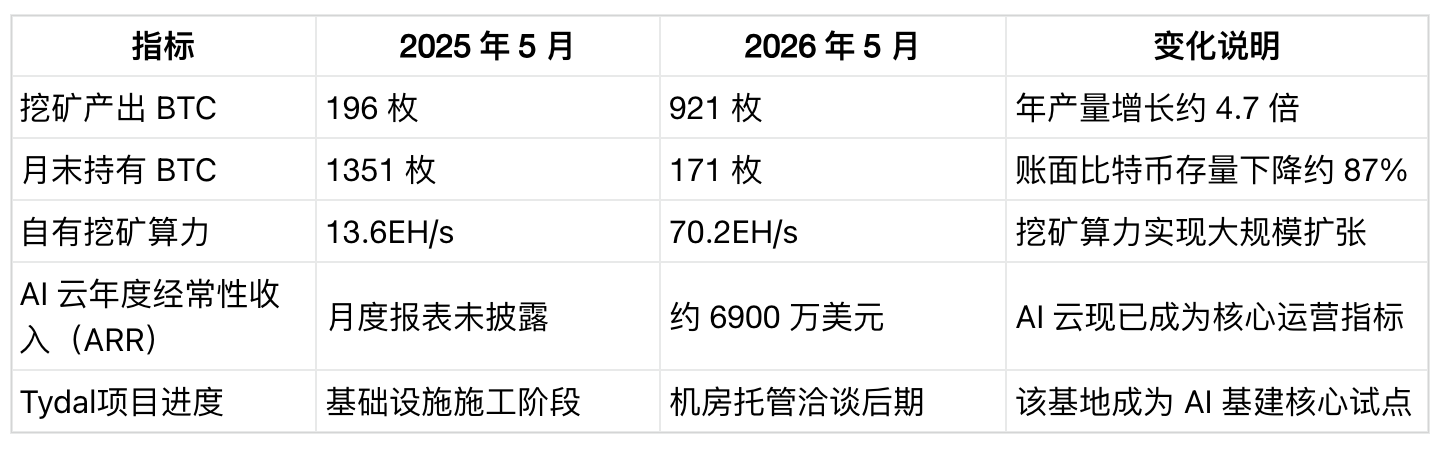


A rough estimate based on Bitcoin's price range of approximately $62,700 to $62,900 on June 19th: the total value of Bitdeer's May mining output was about $57.9 million, while the market value of its month-end bitcoin holdings was only $10.7 million.


This is merely an estimation based on spot prices and not official financial data disclosed by the company, yet it sufficiently illustrates the scale difference. While the monthly mining output volume is substantial, the retained bitcoin size on the books is severely mismatched with the company's overall operational scale.


Monthly holdings are a static point-in-time data point, unable to fully depict the entire flow of funds or precisely calculate how much of the month's output was sold, pledged, retained, or used for other purposes. However, this data is enough to prove that expanding computing power and increasing mining output have not translated into bitcoin treasury reserves for the company.


For a bitcoin miner transitioning to AI infrastructure, this data gap alters the investment logic: new AI revenue should either help the company retain more bitcoin or be used to fund capital-intensive infrastructure expansion.


Bitdeer's Q1 2026 financial report further confirms the trend seen in the May data. In Q1, Bitdeer mined 2,033 BTC, compared to only 350 BTC in the same period of 2025; quarter-end bitcoin holdings were a mere 31 BTC, compared to 1,156 BTC a year earlier. The company also disclosed the disposal of digital assets, realizing a total of $206.8 million.


As mining farm scale expands, Bitdeer's mining revenue has grown significantly, while bitcoin holdings on the balance sheet continue to decline, indicating the company is consistently converting mined bitcoins into funds needed for operations and expansion.


The company reported a net cash outflow of $346.9 million from operating activities in Q1; capital expenditures were $93.7 million, used for data center infrastructure, GPU procurement, tariff payments, and mining machine deployment; total corporate liabilities reached $1.9 billion. Total Q1 revenue was $188.9 million, with adjusted EBITDA at $14.4 million, and cash, cash equivalents, and restricted cash combined amounted to $297.7 million.


The company is progressing with a large-scale capital investment plan, where bitcoin reserves, debt financing, and infrastructure investment are interlinked, forming a unified development strategy.


Can AI Business Cash Flow Alleviate Bitcoin Selling Pressure?


Bitdeer's AI cloud business data is the core argument supporting market optimism. In May, the company disclosed that its AI Cloud Annual Recurring Revenue (ARR) remained stable at $69 million, with GPU utilization at 90%. It had deployed 4,248 GPUs, with an additional 3,305 GPUs under external lease agreements; two Nvidia GB300 NVL72 computing clusters were launched, and its Model Studio had been adapted for the Nvidia Nemotron 3 large language model.


AI cloud revenue had seen rapid growth prior to May. March monthly data showed ARR at about $43 million, rising to $69 million in April and maintaining that level in May. The growth rhythm shifted from high-speed expansion to steady operation, testing the business's sustainability.


Annual Recurring Revenue is merely an annualized projection metric. In Q1, the company's recognized AI cloud revenue booked into the income statement was only $3.7 million. There is a clear gap between the two: annualized revenue represents potential future revenue space, while recognized revenue is actual cash flow recorded in the profit and loss statement. A $69 million ARR figure might seem to reduce reliance on bitcoin sales, but the cash flow must still cover electricity costs, interest, capital expenditures, and costs associated with the cyclical volatility of the mining industry.


This monthly data from Bitdeer also raises an industry-wide debate about miners transitioning to AI. As CryptoSlate previously reported, even though most AI computing facilities are not yet operational, Wall Street is willing to assign higher valuations to bitcoin miners laying out AI and High-Performance Computing (HPC) plans. Bitdeer's May operational report localizes this industry question onto a single company: when AI business scale has reached a level warranting separate disclosure, yet the company's bitcoin treasury remains meager, how should this be interpreted?


The benefits for bitcoin miners venturing into AI cloud and data center colocation are apparent: long-term computing power lease contracts can smooth cash flow, reduce the need to sell bitcoin during market downturns, and allow proprietary power resources to generate additional value beyond the simple pricing system of mining.


However, the transition path also presents challenges: building AI infrastructure requires substantial capital, stable clients, mature delivery capabilities, and sufficient time. During this transition period, the bitcoin treasury likely serves more as a liquidity reserve rather than a long-term value asset.


The Tydal Project: Hidden Implementation Risks


The Tydal data center is the most tangible project illustrating Bitdeer's business model transformation. In March, the company disclosed that its Tydal data center subsidiary had partnered with a third-party institution to convert the campus into a 180-megawatt AI computing center, primarily to host Nvidia Vera Rubin equipment in a colocation model, with the project expected to be completed as early as December 2026.


The latest update in May indicated that the Tydal site had entered advanced negotiations with potential colocation clients. This project also serves as the company's core evidence: power sites originally serving bitcoin mining can be transformed to host client computing power leases, generating long-term contract revenue, no longer relying solely on bitcoin mining profits.


The bitcoin mining business exposes Bitdeer to risks related to computing power unit price, mining difficulty, transaction fees, energy costs, mining machine performance, and bitcoin price. The AI data center colocation business, however, introduces new risks: client creditworthiness, delivery milestones, GPU supply, construction timelines, power allocation, contract terms, and financing costs. Overall risk volatility might be reduced, but the sources of risk have shifted.


Therefore, Bitdeer's May operational report is less of a stellar report card and more akin to an ongoing stress test of its operations. CryptoSlate's report in February about Bitdeer's large-scale reduction in bitcoin reserves also addressed the market's core question: even as miners continuously produce bitcoin, they will still sell tokens to raise funds to support operational expansion.


Currently, Bitdeer's mining computing power continues to expand, bitcoin holdings saw a slight recovery after the March low, AI ARR stabilized at $69 million, and the AI data center colocation business continues to advance. However, the critical gap remains unfilled: AI annualized revenue cannot stably translate into sustained cash flow, and mining output hasn't accumulated as corporate bitcoin reserves.


If this profitability link is successfully established in the future, the AI business will become a safety cushion buffering the company's routine bitcoin selling operations. If this link fails to materialize, the transformation merely changes the form of risk: book bitcoin continues to dwindle, the company becomes highly dependent on computing power leasing business, while simultaneously bearing pressure from power parks, client development, and capital markets.


This is precisely the core question Bitdeer's May operational data leaves for the market: while mining 921 BTC in a month is certainly noteworthy, the mere 171 BTC held by month-end is the number that warrants deeper reflection.


Трендові криптовалюти

Пов'язані питання

QAccording to Bitdeer's May 2026 operational data, what was the significant discrepancy between its Bitcoin mining output and its end-of-month Bitcoin holdings?

AIn May 2026, Bitdeer mined 921 BTC, but its end-of-month holdings were only 171 BTC, showing a large disparity between production and retained inventory.

QWhat is the core argument presented in the article regarding why Bitdeer cannot retain more of its mined Bitcoin despite its AI cloud business?

AThe article argues that while Bitdeer's AI cloud business theoretically provides a cash buffer, its operational data shows the company is still largely dependent on selling newly mined Bitcoin to fund its capital-intensive expansion plans and cover operational expenses.

QWhat is the key metric Bitdeer disclosed for its AI cloud business in May, and what caveat does the article mention about this figure?

ABitdeer disclosed an Annual Recurring Revenue (ARR) of $69 million for its AI cloud business in May. The article cautions that ARR is a forward-looking, annualized projection, distinct from the actual $3.7 million in AI cloud revenue recognized on the income statement for Q1.

QWhat is the Tydal data center project, and what new business risks does it introduce for Bitdeer according to the article?

AThe Tydal project involves converting a 180MW site into an AI computing center for client hosting. It introduces new risks like client qualification, project delivery timelines, GPU supply, construction schedules, and contract terms, shifting the company's risk profile away from pure Bitcoin mining volatility.

QWhat does the article conclude is the 'core question' left by Bitdeer's May operational data?

AThe article concludes that the core question is not the impressive mining output of 921 BTC, but the meaning behind the company holding only 171 BTC at month-end, highlighting the ongoing challenge of transforming its business model to rely less on Bitcoin sales for cash flow.

Пов'язані матеріали

Report Interpretation: J.P. Morgan Details Micron's Pre-Earnings Sentiment, Current Hardware Sector Dynamics

Morgan Stanley analyst Joshua Meyers' report (June 21, 2026) highlights key trends in the hardware and semiconductor sector ahead of Micron's earnings. The core takeaways are: 1. **Micron & Memory:** Memory remains a high-conviction long theme, driven by strong AI demand and rising ASPs. However, investor focus is shifting to the sustainability of Micron's >80% gross margins and the specifics of potential new long-term supply agreements (SCAs). 2. **Hardware Supply Chain:** AI-related demand for servers, networking, and storage remains robust, but company performance is diverging. Celestica (CLS) shows improved margin confidence, Western Digital and Seagate benefit from pricing, Fabrinet (FN) sees predictable AI optics growth, and Teradyne (TER) anticipates a new Google customer. 3. **AI Capex & WFE Forecasts:** JPMorgan increased its Wafer Fab Equipment (WFE) market growth forecasts to 28% in 2026 and 29% in 2027. AI infrastructure financing is evolving, with higher project-level debt reducing constraints on capex expansion. The report signals that while the AI-driven hardware cycle is strong, the market is entering a phase focused on execution verification (e.g., Micron's SCA details, Fabrinet's ramp with Amazon) and valuation sustainability. Key near-term signals include Micron's guidance, Arista Networks' outlook, and the pace of demand normalization post potential tariff-related pull-ins.

marsbit2 год тому

Report Interpretation: J.P. Morgan Details Micron's Pre-Earnings Sentiment, Current Hardware Sector Dynamics

marsbit2 год тому

Research Report Analysis: The Fed's New Chair's Debut – New Leader, But Same Script?

Report Analysis: Federal Reserve's New Chair Debut – A New Captain, But the Same Script? Morgan Stanley's chief global economist Seth B. Carpenter analyzes the first FOMC meeting under new Fed Chair Kevin Warsh in a June 21 report. Warsh deliberately avoided providing forward guidance on interest rates, aligning with his philosophy. However, market expectations for a rate hike this year were reinforced. Key signals lie elsewhere: inflation may fall more than expected, and quantitative tightening (QT) could be more aggressive than anticipated. The FOMC's "dot plot" suggests only one rate hike in 2026. Carpenter argues that if inflation undershoots forecasts, the logic for even a single hike weakens, especially as projections indicate potential rate cuts in 2027. On QT, Warsh's stance is clear. Carpenter notes that measures like halving the Treasury's account balance could shrink the Fed's balance sheet by around $500 billion with minimal market impact. Combined with adjustments to reserve interest and liquidity rules, the ultimate QT scale may exceed expectations, though its market effect might be less disruptive unless the Fed actively sells Mortgage-Backed Securities (MBS). While Warsh initiated a review of the Fed's policy framework, the 2% inflation target remains intact for now. The report concludes that the market may be overestimating the significance of reduced forward guidance and the near-term rate hike risk, while potentially underestimating the scope and manageable nature of the coming balance sheet reduction. The key debates will hinge on upcoming core PCE data, the specifics of the QT path, and the framework review's findings.

marsbit2 год тому

Research Report Analysis: The Fed's New Chair's Debut – New Leader, But Same Script?

marsbit2 год тому

Critical Game Week: BTC Retracement Confirmation vs. HYPE Support Battle | Guest Analysis

This weekly analysis outlines a critical juncture for BTC and HYPE markets, focusing on key price level confirmations. **BTC Analysis:** BTC is at a pivotal point after a five-wave rally from the June 5th low of $59,100. The price has broken below a short-term rising channel's lower boundary, with the current move seen as a pullback to test this breakdown. Failure to reclaim this level could lead to a retest of the $59,000-$60,000 support zone. The core scenario hinges on this channel retest outcome. * **Key Levels:** Resistance at $64,500-$65,000 (channel boundary) and $69,500-$70,500. Support at $59,000-$60,000 and $55,000. * **Strategy:** A core bearish stance is maintained (20% short from last week), with short-term plans for tactical trades. Three detailed contingency plans (A/B/C) are provided for short positions on resistance tests or breakdowns, emphasizing strict stop-loss discipline. **HYPE Analysis:** HYPE shows strong momentum but is currently in a corrective phase after hitting a new high of $76.94. The price is retesting the crucial $64-$66 support area. * **Key Levels:** Resistance near $77 and $80-$82. Support at $64-$66 and $52-$54. * **Strategy:** The short-term approach is "buy on dips, avoid chasing rallies." A long position is considered only if clear stabilization signals appear at the $64-$66 or deeper $52-$54 support zones, with tight risk controls. **General Risk Management:** A standardized trailing stop-loss protocol is emphasized: set initial stop, breakeven at +1% profit, then trail stops upward to lock in gains. *Disclaimer: All analysis is presented as a personal trading framework, not investment advice. Market conditions are complex and require dynamic adjustment.*

marsbit3 год тому

Critical Game Week: BTC Retracement Confirmation vs. HYPE Support Battle | Guest Analysis

marsbit3 год тому

Research Report Interpretation: Citi Attends AWS Summit, Bullish on Cloud Business Acceleration but Data Governance Remains Key Variable

Citi analyst Tyler Radke's team attended the AWS New York Summit (June 17-18), engaging with over 10 clients and partners. In a June 19 report, they highlighted the summit's focus on scaling agent AI for enterprise deployment. Citi maintains a "Buy" rating on Amazon, forecasting AWS revenue growth to accelerate to 37% in FY27 from 30% in FY26, noting this estimate may be conservative. Key takeaways: 1. **AWS Strategy Shift:** AWS is moving from proof-of-concepts to scalable deployment. New offerings like AWS Context (building enterprise knowledge graphs), Amazon Quick (cross-application AI assistant), and security tool Continuum address core enterprise pain points for AI adoption. 2. **Data Infrastructure Beneficiaries:** Data infrastructure companies like Snowflake, Elastic, Oracle, and ClickHouse are seen as direct beneficiaries of scaling AI workloads, as evidenced by strong growth and use cases presented. 3. **Critical Role of Data Governance:** As AI agents scale from hundreds to thousands, effective data governance becomes the key variable for deploying AI in core business processes. AWS Context represents AWS's strategic extension from providing compute/models to offering a data governance infrastructure layer. The report emphasizes that without solving data governance, AI will remain confined to pilot projects. The investment thesis focuses on AWS revenue acceleration and data infrastructure vendors' growth, while monitoring signals like AWS's quarterly revenue growth, Bedrock AgentCore task volume, and pricing impacts on companies like Elastic.

marsbit3 год тому

Research Report Interpretation: Citi Attends AWS Summit, Bullish on Cloud Business Acceleration but Data Governance Remains Key Variable

marsbit3 год тому

Торгівля

Спот
Ф'ючерси

Популярні статті

Що таке BITCOIN

Розуміння HarryPotterObamaSonic10Inu (ERC-20) та його позиції у крипто-просторі Останніми роками ринок криптовалют спостерігав за зростанням популярності мем-коінів, які привертають інтерес не тільки трейдерів, але й тих, хто шукає спілкування та розважальну цінність. Серед цих унікальних токенів є HarryPotterObamaSonic10Inu (ERC-20), інтригуючий проект, що поєднує культурні посилання з тканинами криптовалюти. Ця стаття досліджує ключові аспекти HarryPotterObamaSonic10Inu, вивчаючи його механізми, спільноту та його взаємодію з ширшим крипто-ландшафтом. Що таке HarryPotterObamaSonic10Inu (ERC-20)? Як випливає з його назви, HarryPotterObamaSonic10Inu є мем-коіном, побудованим на блокчейні Ethereum, класифікованим за стандартом ERC-20. На відміну від традиційних криптовалют, які можуть підкреслювати практичну корисність або інвестиційний потенціал, цей токен процвітає завдяки розважальній цінності та силі своєї спільноти. Проект спрямований на створення середовища, де зацікавлені користувачі можуть об'єднуватися, ділитися ідеями та брати участь у заходах, натхненних різноманітними культурними явищами. Однією з примітних особливостей HarryPotterObamaSonic10Inu є нульовий податок на транзакції. Цей привабливий елемент має на меті заохочувати торгівлю та участь у спільноті, позбавлену додаткових витрат, які можуть відлякувати дрібних трейдерів. Загальна пропозиція монет становить один мільярд токенів, що позначає намір підтримувати суттєву циркуляцію в межах спільноти. Творець HarryPotterObamaSonic10Inu (ERC-20) Походження HarryPotterObamaSonic10Inu дещо окутане таємницею; деталі про творця залишаються невідомими. Розвиток цього токена позбавлений впізнаваної команди або чіткої стратегії, що не є рідкістю в секторі мем-коінів. Натомість проект виник органічно, а його розвиток значною мірою залежить від ентузіазму та участі його спільноти. Інвестори HarryPotterObamaSonic10Inu (ERC-20) Щодо зовнішніх інвестицій та підтримки, HarryPotterObamaSonic10Inu також залишається невизначеним. Токен не зазначає жодних відомих інвестиційних фондів або значної організаційної підтримки. Натомість життєва сила проекту полягає в його базовій спільноті, яка інформує про його зростання та стійкість через колективні дії та залученість у крипто-просторі. Як працює HarryPotterObamaSonic10Inu (ERC-20)? Як мем-коін, HarryPotterObamaSonic10Inu функціонує передусім поза традиційними рамками, що часто регулюють вартість активів. Є кілька відмінних аспектів, що визначають, як працює проект: Транзакції без податку: Завдяки відсутності податкових зборів на транзакції, користувачі можуть вільно купувати та продавати токен, не турбуючись про приховані витрати. Залучення спільноти: Проект процвітає завдяки взаємодії спільноти, використовуючи соціальні медіа для створення шуму та сприяння залученню. Обговорення, обмін контентом та залученість є ключовими елементами, що допомагають розширити його охоплення та зміцнити лояльність серед прихильників. Відсутність практичної корисності: Слід зазначити, що HarryPotterObamaSonic10Inu не пропонує конкретної корисності в рамках фінансової екосистеми. Натомість він класифікується як токен, що призначений в основному для розваги та спільнотних активностей. Культурне посилання: Токен кмітливо вплітає елементи популярної культури, щоб привернути інтерес, зв'язуючи з ентузіастами мемів та крипто-стежками. HarryPotterObamaSonic10Inu ілюструє, як мем-коіни функціонують інакше, ніж традиційні криптовалютні проекти, увійшовши на ринок як інноваційні соціальні конструкти, а не утилітарні активи. Хронологія HarryPotterObamaSonic10Inu (ERC-20) Історія HarryPotterObamaSonic10Inu відзначена кількома значними етапами: Створення: Токен виник з вірусного мему, захопивши уяву багатьох крипто-ентузіастів. Конкретні дати створення недоступні, що підкреслює його органічний розвиток. Лістинг на біржах: HarryPotterObamaSonic10Inu з'явився на різних біржах, дозволяючи зручніший доступ і торгівлю спільноти. Ініціативи залучення спільноти: Ведення діяльності, спрямованої на покращення взаємодії спільноти, включаючи конкурси, кампанії в соціальних мережах та створення контенту від фанатів та прихильників. Плани на майбутнє: Дорожня карта проекту включає запуск колекції NFT, мерчандайзинг та електронну комерцію, пов'язану з його культурними темами, що далі залучає спільноту та намагається додати більше вимірів до його екосистеми. Ключові моменти про HarryPotterObamaSonic10Inu (ERC-20) Спільнотний підхід: Проект надає пріоритет колективному внеску та креативності, забезпечуючи, щоб участь користувачів була в центрі його розвитку. Класифікація як мем-коін: Це є його епігенез розважальної криптовалюти, що відрізняється від традиційних інвестиційних інструментів. Жодного прямого відношення до Bitcoin: Незважаючи на схожість у назві, HarryPotterObamaSonic10Inu є відмінним і не має жодного зв’язку з Bitcoin або іншими усталеними криптовалютами. Зосередженість на співпраці: HarryPotterObamaSonic10Inu створено для того, щоб надати простір для співпраці та обміну історіями серед його власників, забезпечуючи шлях для творчості та спільного зв'язку. Перспективи на майбутнє: Амбіція розширитися за межі початкової концепції в NFT та мерчандайз відкриває шлях для проекту потенційно потрапити в більш мейнстрімні сфери цифрової культури. Оскільки мем-коіни продовжують захоплювати уяву спільноти криптовалют, HarryPotterObamaSonic10Inu (ERC-20) вирізняється своїми культурними зв'язками та орієнтованим на спільноту підходом. Хоча він може не відповідати типовій моделі утилітарного токена, його суть полягає в радощах і товариськості, що підтримуються серед його прихильників, підкреслюючи еволюційну природу криптовалют в усе більш цифрову епоху. Оскільки проект продовжує розвиватися, важливо спостерігати за тим, як динаміка спільноти вплине на його траєкторію в постійно змінюваному ландшафті технології блокчейн.

2.1k переглядів усьогоОпубліковано 2024.04.01Оновлено 2024.12.03

Що таке BITCOIN

Як купити BTC

Ласкаво просимо до HTX.com! Ми зробили покупку Bitcoin (BTC) простою та зручною. Дотримуйтесь нашої покрокової інструкції, щоб розпочати свою криптовалютну подорож.Крок 1: Створіть обліковий запис на HTXВикористовуйте свою електронну пошту або номер телефону, щоб зареєструвати обліковий запис на HTX безплатно. Пройдіть безпроблемну реєстрацію й отримайте доступ до всіх функцій.ЗареєструватисьКрок 2: Перейдіть до розділу Купити крипту і виберіть спосіб оплатиКредитна/дебетова картка: використовуйте вашу картку Visa або Mastercard, щоб миттєво купити Bitcoin (BTC).Баланс: використовуйте кошти з балансу вашого рахунку HTX для безперешкодної торгівлі.Треті особи: ми додали популярні способи оплати, такі як Google Pay та Apple Pay, щоб підвищити зручність.P2P: Торгуйте безпосередньо з іншими користувачами на HTX.Позабіржова торгівля (OTC): ми пропонуємо індивідуальні послуги та конкурентні обмінні курси для трейдерів.Крок 3: Зберігайте свої Bitcoin (BTC)Після придбання Bitcoin (BTC) збережіть його у своєму обліковому записі на HTX. Крім того, ви можете відправити його в інше місце за допомогою блокчейн-переказу або використовувати його для торгівлі іншими криптовалютами.Крок 4: Торгівля Bitcoin (BTC)Легко торгуйте Bitcoin (BTC) на спотовому ринку HTX. Просто увійдіть до свого облікового запису, виберіть торгову пару, укладайте угоди та спостерігайте за ними в режимі реального часу. Ми пропонуємо зручний досвід як для початківців, так і для досвідчених трейдерів.

4.8k переглядів усьогоОпубліковано 2024.12.12Оновлено 2026.06.02

Як купити BTC

Що таке $BITCOIN

ЦИФРОВЕ ЗОЛОТО ($BITCOIN): Комплексний аналіз Вступ до ЦИФРОВОГО ЗОЛОТА ($BITCOIN) ЦИФРОВЕ ЗОЛОТО ($BITCOIN) — це проект на основі блокчейну, що працює в мережі Solana, який має на меті поєднати характеристики традиційних дорогоцінних металів з інноваціями децентралізованих технологій. Хоча він має таку ж назву, як і Bitcoin, який часто називають “цифровим золотом” через його сприйняття як засобу збереження вартості, ЦИФРОВЕ ЗОЛОТО є окремим токеном, розробленим для створення унікальної екосистеми в ландшафті Web3. Його мета — позиціонувати себе як життєздатний альтернативний цифровий актив, хоча деталі щодо його застосувань і функціональностей все ще розробляються. Що таке ЦИФРОВЕ ЗОЛОТО ($BITCOIN)? ЦИФРОВЕ ЗОЛОТО ($BITCOIN) — це токен криптовалюти, спеціально розроблений для використання в блокчейні Solana. На відміну від Bitcoin, який виконує широко визнану роль зберігання вартості, цей токен, здається, зосереджується на більш широких застосуваннях і характеристиках. Помітні аспекти включають: Інфраструктура блокчейну: Токен побудований на блокчейні Solana, відомому своєю здатністю обробляти швидкі та низьковартісні транзакції. Динаміка постачання: ЦИФРОВЕ ЗОЛОТО має максимальне постачання, обмежене 100 квадрильйонами токенів (100P $BITCOIN), хоча деталі щодо його обігового постачання наразі не розголошуються. Утиліта: Хоча точні функціональності не викладені, є вказівки на те, що токен може бути використаний для різних застосувань, потенційно пов'язаних з децентралізованими додатками (dApps) або стратегіями токенізації активів. Хто є творцем ЦИФРОВОГО ЗОЛОТА ($BITCOIN)? На даний момент особа творців і команди розробників, що стоять за ЦИФРОВИМ ЗОЛОТОМ ($BITCOIN), залишається невідомою. Ця ситуація є типовою для багатьох інноваційних проектів у сфері блокчейну, особливо тих, що пов'язані з децентралізованими фінансами та феноменом мем-коінів. Хоча така анонімність може сприяти культурі, орієнтованій на спільноту, вона посилює занепокоєння щодо управління та підзвітності. Хто є інвесторами ЦИФРОВОГО ЗОЛОТА ($BITCOIN)? Доступна інформація вказує на те, що ЦИФРОВЕ ЗОЛОТО ($BITCOIN) не має жодних відомих інституційних спонсорів або помітних венчурних капіталовкладень. Проект, здається, працює за моделлю “рівний до рівного”, зосереджуючись на підтримці та прийнятті спільноти, а не на традиційних шляхах фінансування. Його активність і ліквідність переважно розташовані на децентралізованих біржах (DEX), таких як PumpSwap, а не на встановлених централізованих торгових платформах, що ще більше підкреслює його підхід знизу вгору. Як працює ЦИФРОВЕ ЗОЛОТО ($BITCOIN) Операційні механізми ЦИФРОВОГО ЗОЛОТА ($BITCOIN) можна детальніше розглянути на основі його дизайну блокчейну та характеристик мережі: Механізм консенсусу: Використовуючи унікальний proof-of-history (PoH) Solana в поєднанні з моделлю proof-of-stake (PoS), проект забезпечує ефективну валідацію транзакцій, що сприяє високій продуктивності мережі. Токеноміка: Хоча конкретні дефляційні механізми не були детально описані, велике максимальне постачання токенів вказує на те, що воно може задовольняти мікротранзакції або нішеві випадки використання, які ще потрібно визначити. Інтероперабельність: Існує потенціал для інтеграції з більш широкою екосистемою Solana, включаючи різні платформи децентралізованих фінансів (DeFi). Однак деталі щодо конкретних інтеграцій залишаються невизначеними. Хронологія ключових подій Ось хронологія, яка підкреслює значні віхи, пов'язані з ЦИФРОВИМ ЗОЛОТОМ ($BITCOIN): 2023: Початкове розгортання токена відбувається на блокчейні Solana, позначене його адресою контракту. 2024: ЦИФРОВЕ ЗОЛОТО набуває видимості, оскільки стає доступним для торгівлі на децентралізованих біржах, таких як PumpSwap, що дозволяє користувачам торгувати ним проти SOL. 2025: Проект спостерігає спорадичну торгову активність і потенційний інтерес до ініціатив, очолюваних спільнотою, хоча на даний момент не зафіксовано жодних значних партнерств або технічних досягнень. Критичний аналіз Сильні сторони Масштабованість: Основна інфраструктура Solana підтримує високі обсяги транзакцій, що може підвищити утиліту $BITCOIN у різних сценаріях транзакцій. Доступність: Потенційно низька торгова ціна за токен може привабити роздрібних інвесторів, сприяючи більш широкій участі завдяки можливостям дробового володіння. Ризики Відсутність прозорості: Відсутність публічно відомих спонсорів, розробників або процесу аудиту може викликати скептицизм щодо стійкості та надійності проекту. Волатильність ринку: Торгова активність сильно залежить від спекулятивної поведінки, що може призвести до значної волатильності цін і невизначеності для інвесторів. Висновок ЦИФРОВЕ ЗОЛОТО ($BITCOIN) постає як цікавій, але неоднозначний проект у швидко розвиваючійся екосистемі Solana. Хоча він намагається використати наратив “цифрового золота”, його відхід від встановленої ролі Bitcoin як засобу збереження вартості підкреслює необхідність чіткішого розмежування його передбачуваної утиліти та структури управління. Майбутнє прийняття та адаптація, ймовірно, залежатиме від вирішення поточної непрозорості та більш чіткого визначення його операційних та економічних стратегій. Примітка: Цей звіт охоплює синтезовану інформацію, доступну станом на жовтень 2023 року, і можуть відбутися події, що виходять за межі дослідницького періоду.

82 переглядів усьогоОпубліковано 2025.05.13Оновлено 2025.05.13

Що таке $BITCOIN

Обговорення

Ласкаво просимо до спільноти HTX. Тут ви можете бути в курсі останніх подій розвитку платформи та отримати доступ до професійної ринкової інформації. Нижче представлені думки користувачів щодо ціни BTC (BTC).

活动图片