Mining Artificial Intelligence: Why Bitcoin Miners Are Changing Their Business Model

cryptonews.ruОпубліковано о 2026-08-15Востаннє оновлено о 2026-08-15

Анотація

"Bitcoin miners pivot to AI: Economic pressures and new opportunities drive business model shift." Major publicly-traded US bitcoin mining companies are shifting their business model away from solely cryptocurrency mining. They are repurposing their infrastructure for artificial intelligence (AI) and high-performance computing (HPC). This move is driven by rising mining costs and declining profitability following the 2024 halving and a 2025 BTC price drop. According to a CoinShares report, the average cost to mine one BTC exceeded its market price in late 2025, making operations unprofitable for many. Companies like IREN, HUT 8, and TerraWulf are now leveraging their existing data centers, power access, and cooling systems to provide infrastructure for AI firms. This transition is facilitated by multi-billion dollar contracts with tech giants; for example, HUT 8 secured a $7 billion deal, and IREN partnered with Microsoft for $9.7 billion. While this pivot requires replacing specialized ASIC mining hardware with GPUs suitable for AI computations, it offers a more stable and potentially lucrative revenue stream. The shift has temporarily reduced Bitcoin's hash rate, but a recovery is expected. Most mining companies' stock prices have risen significantly since the announcement of their AI ventures. Analysts predict that AI-related income could soon constitute the majority of these firms' revenue, fundamentally changing their core business from cryptocurrency mining to AI inf...

Many large public American (and not only) mining companies are moving away from the model involving almost exclusively cryptocurrency mining. They have repurposed their activities towards developing infrastructure for artificial intelligence-based developments and high-performance computing (HPC). The largest players are IREN (formerly Iris Energy), HUT 8, TerraWulf, Riot Platforms, Bitdeer, and Cipher Digital.

The Rising Cost of Mining

Any business, including mining, must first and foremost be profitable. Certain difficulties with profitability have emerged in the Bitcoin mining market following the 2024 halving and the decline in the value of $BTC in late 2025.

According to a report from investment company CoinShares, mining the largest cryptocurrency by market capitalization was unprofitable for public American companies in the last quarter of last year. The average cost to mine 1 $BTC was $79,995, while the market price was around $70,000. For TerraWulf, mining one coin at a certain point even cost $385,000. In other words, revenue did not cover expenses at all.

No less telling data is shown by the Bitcoin Hash Price Index, which indicates the expected daily revenue for a miner from one petahash per second of computing power. As of August this year, the indicator is near its historically low values around $32. This is almost half of what it was a year earlier, more than ten times lower than the peak in 2021, and more than a hundred times lower than the 2017 peak. In short, the same amount of power brings less revenue to miners each year.
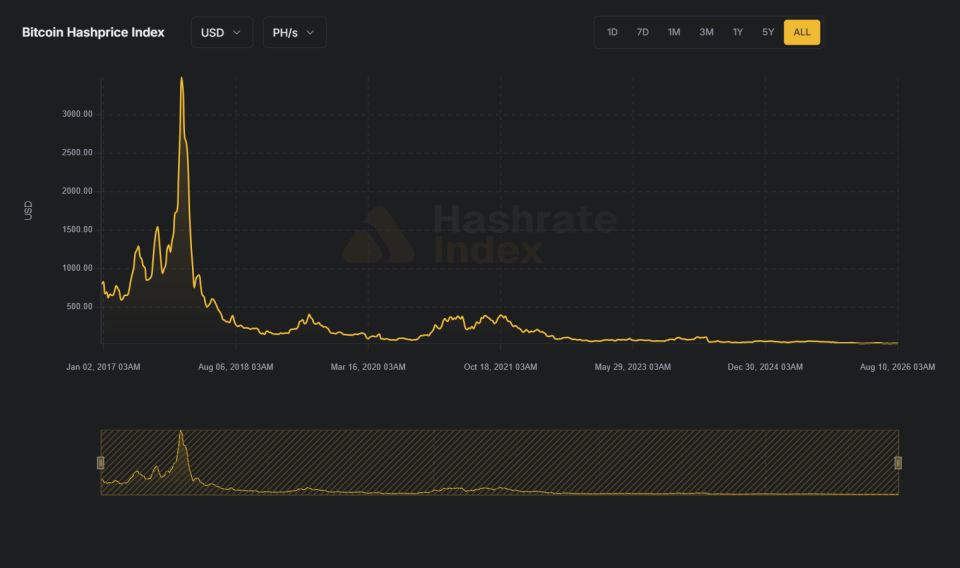
Source: hashrateindex.com

It turns out that large mining companies have faced realities where the economic feasibility of cryptocurrency mining has been called into question. Of course, the metrics above do not allow us to claim that Bitcoin mining suddenly became completely unprofitable everywhere. It's worth considering that miners in different countries and regions incur different costs: electricity and ASIC device prices vary, as do associated expenses like taxes, rent, and salaries for maintenance personnel. Equipment does not stand still and evolves, requiring timely replacement. Mining $BTC becomes less profitable for players unable to efficiently cover such costs.

However, there are other reasons for the shift to artificial intelligence.

Capital Availability

Let's clarify immediately: miners who previously mined Bitcoin do not themselves become AI operators. They merely provide their infrastructure to meet the needs of companies directly involved in artificial intelligence.

For providing their data centers, miners will receive very good money, which they did not have access to before. For example, HUT 8 signed a $7 billion deal to lease out its capacity, including the River Bend farm in Louisiana. The technical partners in the deal are the firm Anthropic, creator of the Claude neural network, and the cloud platform Fluidstack, with funding provided by tech giant Google and banks J.P. Morgan and Goldman Sachs.

IREN struck a deal with the world's largest software developer, Microsoft, for $9.7 billion. Microsoft thereby gains access to AI systems based on Nvidia GB-300 chips in Texas. And IREN will additionally purchase graphics processing units (GPUs) worth $5.8 billion from Dell Technologies, which is expected to bring in another $1.9 billion in annual revenue.

Economic Feasibility

Companies that have been exclusively mining cryptocurrency for years already have a certain infrastructure: specialized buildings, access to electricity, cooling systems. It's easier to repurpose a hypothetical data center from mining needs to AI needs than to build everything from scratch for the same Microsoft or Google. It's quite possible that fintech companies will someday switch to their own infrastructure, but that's not happening yet.

Speaking about converting mining farms for AI needs, it's necessary to understand that this doesn't happen in 100% of cases. New specialized data campuses will appear somewhere. Nevertheless, even here miners have it easier, as they know the specifics of data centers and have experience in organizational, operational-financial, and management issues. In other words, it is sometimes more profitable for large capital to delegate such matters to specialized companies.

Among the examples of infrastructure repurposing is the Bitdeer campus in the Norwegian municipality of Tydal.

ASIC Nuances

Modern large-scale cryptocurrency mining occurs primarily using highly specialized ASICs—equipment designed specifically for mining. Generally, an ASIC (Application Specific Integrated Circuit) is a special-purpose integrated circuit designed to solve one specific task. Such microchips can be implemented not only in mining but also in other fields where there is a need to minimize the cost of producing such equipment for specific needs.

ASIC miners themselves are different, which is related to the hashing algorithms used by specific coins. For example, Bitcoin uses the SHA-256 hashing algorithm, while Litecoin uses Scrypt. Manufacturers of such devices offer different and most often non-interchangeable units.

For instance, the manufacturer Bitmain releases the Antminer S21 model for the SHA-256 algorithm, the Antminer L9 for the Scrypt algorithm, and the Antminer D9—already for the X11 hashing algorithm. To explain in the simplest terms, an ASIC miner is a computing device from which everything unnecessary has been removed, increasing efficiency in mining cryptocurrencies and thereby reducing production costs.

On the other hand, advanced AI computations also require their own special technical capabilities. Moreover, even the efficiency of individual computations using graphics processing units (GPUs) varies depending on the manufacturer and specific model because their architectures differ fundamentally.

In other words, it's not enough to simply take down the "Mining" sign and hang up a new one—"Artificial Intelligence"—from a facility where coin mining previously took place and the corresponding ASICs stood. The equipment used will have to be replaced.

But did the reorientation of major American miners deal a decisive blow to Bitcoin?

What Happened to the Hashrate

The $BTC hashrate has definitely been influenced by miners moving into AI. From October 2025 to January 2026, the seven-day moving average of the hashrate fell by 28%, dropping from 1.15 EH/s to 0.83 EH/s. However, such dynamics shouldn't be too surprising, considering that American mining companies account for up to 40% of Bitcoin's total hashrate.
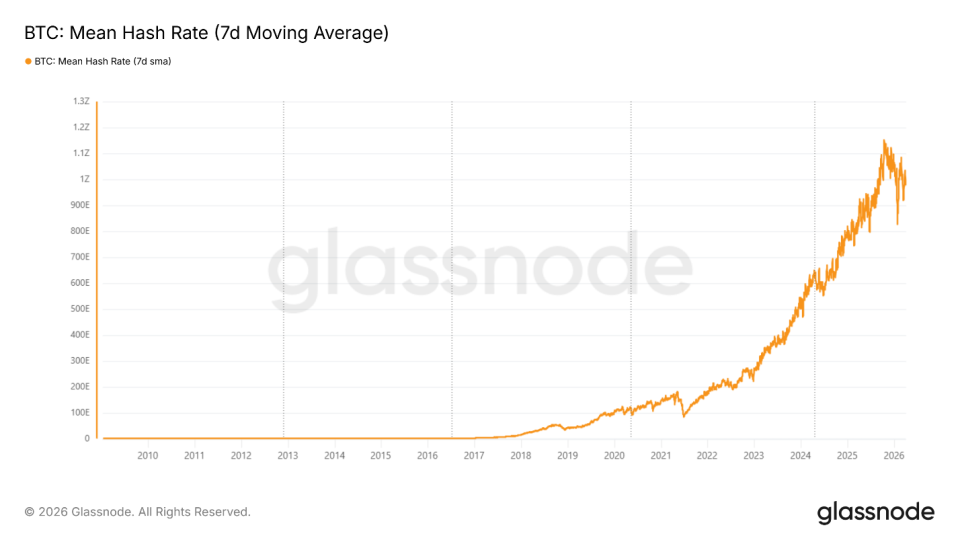
Source: studio.glassnode.com

By August 2026, some recovery in hashrate is already being observed. Its value fluctuates around 0.9 EH/s. Furthermore, according to CoinShares forecasts, the 1.8 EH/s mark should be broken by the end of the year, and by the end of 2027—2 EH/s.

It's worth remembering that reorienting towards AI does not mean miners are completely abandoning mining. In most cases, they are merely scaling back financial investments in this direction against the backdrop of expectations of greater profits from AI.

And how many bitcoins could miners potentially have mined if they hadn't reoriented to AI?

The Number of Missed Bitcoins

Actually, it's hardly possible to answer this question.

  • First, how to calculate it all? If miners had not started working on AI infrastructure, they would not have secured large contracts. Accordingly, this money cannot be factored into the potential expansion of the monetary base for mining. Similarly, the credit funds actively attracted by mining companies. From this angle—it seems the companies themselves may have earned even more than they could have without AI computing.

  • Second, the question: who missed out and how much? If we refer, for example, to Riot Platforms' report for the first quarter (data for the second quarter is not yet available), this company mined 1,473 $BTC. This is only 57 coins less than during the same period in 2025 (a 3.7% decrease). The change is more in the nature of a statistical error than a structural shift. Additionally, miners, without ceasing mining, are able to abandon further expansion in the field of mining and develop the AI direction as a short-term, highly profitable venture.

It is also worth considering here: if hypothetical IREN, TerraWulf, or HUT 8 did not mine $BTC, it means that only their balance sheets were not replenished. Bitcoin is still being mined as before, it's just that new coins went not to these companies' wallets but to other miners. The block reward remains fixed with predictable reduction during halvings and only the amount of network transaction fees changes. Moreover, if some major players suddenly switch off their power, it will become slightly easier for other participants to mine the cryptocurrency during the next network difficulty recalculation. In other words, these "bitcoins not mined by others" will still be mined somewhere in the world.

Miner Revenue

Amidst current economic/geopolitical instability, unfortunately, it's not yet possible to talk about exact figures. There are only forecast values. CoinShares believes that revenue from AI for mining companies will reach 70%, while at the beginning of the year it accounted for only 30%. In other words, the growth will be twofold. Essentially, if mining was the main activity for companies before, now it will become auxiliary. On the other hand, this doesn't mean mining will be abandoned for sure. Priorities will likely just be reassessed.

And how have such large-scale changes affected the stocks of cryptocurrency mining organizations?

Stocks and the Transition to AI

In most cases, the impact has been positive. Since the beginning of the year, the shares of five companies have shown price increases: IREN — 5.69%, Terra Wulf — 45.92%, MARA Holdings — 9.49%, Riot Platforms — 57.72%, Cipher Digital — 14.76%. The exception is Bitdeer, whose securities fell by 4.73%.

However, certain investor concerns regarding the transition to AI remain.

  • First, it's still unclear how successful this entire venture will be in the future. Will miners really be able to generate profits that cover all current and future costs?

  • Second, the transition from mining to developing infrastructure for artificial intelligence has forced a number of organizations to borrow huge sums. For TerraWulf — it's $5.7 billion, for IREN — $3.7 billion. Such a significant scale of debt load growth cannot but worry shareholders.

Conclusion

Large mining companies are transitioning from exclusively mining cryptocurrency to earning from AI due to economic feasibility and the availability of necessary infrastructure/management models. According to some forecasts, by the end of the year, the majority of their income will come from payments from AI operators, not from mining. The Bitcoin hashrate, after such companies reoriented their business, declined insignificantly and briefly but is already recovering. The stocks of most public miners are demonstrating price growth against the backdrop of business repurposing.

This material and the information in it are not individual or any other recommendation. The opinion of the editorial staff may not coincide with the opinions of analytical portals and experts.



end-content

Трендові криптовалюти

Пов'язані питання

QWhy are major Bitcoin mining companies shifting their business model away from pure cryptocurrency mining?

AThey are shifting due to the decreasing profitability of Bitcoin mining after events like the 2024 halving and the 2025 price drop, and the emergence of more lucrative opportunities in providing infrastructure for artificial intelligence (AI) and high-performance computing (HPC) for companies like Microsoft and Google.

QWhat are the key financial challenges that made Bitcoin mining less profitable for public US companies, according to the article?

AAccording to a CoinShares report, the average cost to mine one Bitcoin in the last quarter of the past year was $79,995, while the market price was around $70,000, making it unprofitable. Companies like TerraWulf even faced costs as high as $385,000 per coin at one point.

QHow do Bitcoin mining companies benefit from providing infrastructure for AI development?

AThey secure large, lucrative contracts by leasing their data centers and expertise. For example, HUT 8 secured a $7 billion deal, and IREN secured a $9.7 billion deal with Microsoft, providing them with revenue streams that were previously unavailable from mining alone.

QWhat was the impact on Bitcoin's hashrate when major miners began transitioning to AI, and what is the forecast?

ABitcoin's seven-day moving average hashrate dropped by 28%, from 1.15 EH/s to 0.83 EH/s between October 2025 and January 2026. However, it has since recovered to around 0.9 EH/s by August 2026. Forecasts predict it will reach 1.8 EH/s by the end of 2026 and 2 EH/s by the end of 2027.

QHow has the stock performance of major mining companies been affected by their pivot towards AI infrastructure?

AThe stock performance has been largely positive. Since the beginning of the year, shares of IREN, TerraWulf, MARA Holdings, Riot Platforms, and Cipher Digital have increased by 5.69%, 45.92%, 9.49%, 57.72%, and 14.76% respectively. Only Bitdeer's stock decreased by 4.73%.

Пов'язані матеріали

Robert Kiyosaki Shares His Mentor's Predictions About the Emergence of Bitcoin and AI

American entrepreneur and author of "Rich Dad Poor Dad," Robert Kiyosaki, discussed the influence of futurist R. Buckminster Fuller on his worldview, linking Fuller's past technological predictions to the emergence of Bitcoin and the development of artificial intelligence. In an X post, Kiyosaki also reflected on personal purpose, sharing his journey from the music business—where he worked with bands like The Police and Iron Maiden—to creating the "Cashflow" board game and writing his famous book. He described feeling an inner emptiness despite his success, a turning point that came after meeting Fuller, whom he studied with for three summers. Kiyosaki described Fuller as a "friendly genius" who foresaw world-changing developments like Bitcoin and AI. However, the core of his post focused on Fuller's philosophical impact, particularly a quote about belonging to the universe and finding purpose by dedicating one's life to the maximum benefit of others. The entrepreneur remains a vocal advocate for cryptocurrencies. He regularly advises buying Bitcoin during market panics, viewing it and assets like Ethereum, gold, and silver as hedges against traditional financial system failures. Kiyosaki has predicted a major market crash by 2026, seeing it as an opportunity for prepared investors, with long-term price targets including $750,000 for Bitcoin and $95,000 for Ethereum.

cryptonews.ru43 хв тому

Robert Kiyosaki Shares His Mentor's Predictions About the Emergence of Bitcoin and AI

cryptonews.ru43 хв тому

Etherealize CEO Calls Wall Street's Private Blockchains a 'Race to the Bottom'

Etherealize co-founder and CEO Vivek Raman criticized Wall Street's growing interest in private, permissioned blockchains, calling them a "race to the bottom." In an interview with CoinDesk, Raman argued that consortium networks fragment liquidity and return the industry to the siloed systems that blockchain technology was meant to overcome. He stated that closed networks do not interoperate, undermining two key advantages of the technology: system compatibility and liquidity concentration. Etherealize promotes Ethereum as an open, foundational layer for institutional players. Raman insists that privacy and access restrictions should be built on top of public infrastructure—at the application or L2 level—rather than creating separate, closed networks. He compared Ethereum to HTTP as a base layer, with additional permissioned and private layers akin to HTTPS. Examples of this new wave of "closed" solutions mentioned include Canton Network from Digital Asset, Circle's Arc project, and Stripe's Tempo. Raman termed this trend "consortium chains 2.0," recalling earlier initiatives like the R3 interbank consortium and the Hyperledger corporate ecosystem from 2016 that failed to gain significant traction. He reiterated his firm belief that a global, open, permissionless infrastructure is necessary as a foundational base layer. Raman previously noted in June that traditional financial institutions had begun implementing Ethereum-based solutions into real business processes.

cryptonews.ru45 хв тому

Etherealize CEO Calls Wall Street's Private Blockchains a 'Race to the Bottom'

cryptonews.ru45 хв тому

Торгівля

Спот

Популярні статті

Що таке BITCOIN

Розуміння HarryPotterObamaSonic10Inu (ERC-20) та його позиції у крипто-просторі Останніми роками ринок криптовалют спостерігав за зростанням популярності мем-коінів, які привертають інтерес не тільки трейдерів, але й тих, хто шукає спілкування та розважальну цінність. Серед цих унікальних токенів є HarryPotterObamaSonic10Inu (ERC-20), інтригуючий проект, що поєднує культурні посилання з тканинами криптовалюти. Ця стаття досліджує ключові аспекти HarryPotterObamaSonic10Inu, вивчаючи його механізми, спільноту та його взаємодію з ширшим крипто-ландшафтом. Що таке HarryPotterObamaSonic10Inu (ERC-20)? Як випливає з його назви, HarryPotterObamaSonic10Inu є мем-коіном, побудованим на блокчейні Ethereum, класифікованим за стандартом ERC-20. На відміну від традиційних криптовалют, які можуть підкреслювати практичну корисність або інвестиційний потенціал, цей токен процвітає завдяки розважальній цінності та силі своєї спільноти. Проект спрямований на створення середовища, де зацікавлені користувачі можуть об'єднуватися, ділитися ідеями та брати участь у заходах, натхненних різноманітними культурними явищами. Однією з примітних особливостей HarryPotterObamaSonic10Inu є нульовий податок на транзакції. Цей привабливий елемент має на меті заохочувати торгівлю та участь у спільноті, позбавлену додаткових витрат, які можуть відлякувати дрібних трейдерів. Загальна пропозиція монет становить один мільярд токенів, що позначає намір підтримувати суттєву циркуляцію в межах спільноти. Творець HarryPotterObamaSonic10Inu (ERC-20) Походження HarryPotterObamaSonic10Inu дещо окутане таємницею; деталі про творця залишаються невідомими. Розвиток цього токена позбавлений впізнаваної команди або чіткої стратегії, що не є рідкістю в секторі мем-коінів. Натомість проект виник органічно, а його розвиток значною мірою залежить від ентузіазму та участі його спільноти. Інвестори HarryPotterObamaSonic10Inu (ERC-20) Щодо зовнішніх інвестицій та підтримки, HarryPotterObamaSonic10Inu також залишається невизначеним. Токен не зазначає жодних відомих інвестиційних фондів або значної організаційної підтримки. Натомість життєва сила проекту полягає в його базовій спільноті, яка інформує про його зростання та стійкість через колективні дії та залученість у крипто-просторі. Як працює HarryPotterObamaSonic10Inu (ERC-20)? Як мем-коін, HarryPotterObamaSonic10Inu функціонує передусім поза традиційними рамками, що часто регулюють вартість активів. Є кілька відмінних аспектів, що визначають, як працює проект: Транзакції без податку: Завдяки відсутності податкових зборів на транзакції, користувачі можуть вільно купувати та продавати токен, не турбуючись про приховані витрати. Залучення спільноти: Проект процвітає завдяки взаємодії спільноти, використовуючи соціальні медіа для створення шуму та сприяння залученню. Обговорення, обмін контентом та залученість є ключовими елементами, що допомагають розширити його охоплення та зміцнити лояльність серед прихильників. Відсутність практичної корисності: Слід зазначити, що HarryPotterObamaSonic10Inu не пропонує конкретної корисності в рамках фінансової екосистеми. Натомість він класифікується як токен, що призначений в основному для розваги та спільнотних активностей. Культурне посилання: Токен кмітливо вплітає елементи популярної культури, щоб привернути інтерес, зв'язуючи з ентузіастами мемів та крипто-стежками. HarryPotterObamaSonic10Inu ілюструє, як мем-коіни функціонують інакше, ніж традиційні криптовалютні проекти, увійшовши на ринок як інноваційні соціальні конструкти, а не утилітарні активи. Хронологія HarryPotterObamaSonic10Inu (ERC-20) Історія HarryPotterObamaSonic10Inu відзначена кількома значними етапами: Створення: Токен виник з вірусного мему, захопивши уяву багатьох крипто-ентузіастів. Конкретні дати створення недоступні, що підкреслює його органічний розвиток. Лістинг на біржах: HarryPotterObamaSonic10Inu з'явився на різних біржах, дозволяючи зручніший доступ і торгівлю спільноти. Ініціативи залучення спільноти: Ведення діяльності, спрямованої на покращення взаємодії спільноти, включаючи конкурси, кампанії в соціальних мережах та створення контенту від фанатів та прихильників. Плани на майбутнє: Дорожня карта проекту включає запуск колекції NFT, мерчандайзинг та електронну комерцію, пов'язану з його культурними темами, що далі залучає спільноту та намагається додати більше вимірів до його екосистеми. Ключові моменти про HarryPotterObamaSonic10Inu (ERC-20) Спільнотний підхід: Проект надає пріоритет колективному внеску та креативності, забезпечуючи, щоб участь користувачів була в центрі його розвитку. Класифікація як мем-коін: Це є його епігенез розважальної криптовалюти, що відрізняється від традиційних інвестиційних інструментів. Жодного прямого відношення до Bitcoin: Незважаючи на схожість у назві, HarryPotterObamaSonic10Inu є відмінним і не має жодного зв’язку з Bitcoin або іншими усталеними криптовалютами. Зосередженість на співпраці: HarryPotterObamaSonic10Inu створено для того, щоб надати простір для співпраці та обміну історіями серед його власників, забезпечуючи шлях для творчості та спільного зв'язку. Перспективи на майбутнє: Амбіція розширитися за межі початкової концепції в NFT та мерчандайз відкриває шлях для проекту потенційно потрапити в більш мейнстрімні сфери цифрової культури. Оскільки мем-коіни продовжують захоплювати уяву спільноти криптовалют, HarryPotterObamaSonic10Inu (ERC-20) вирізняється своїми культурними зв'язками та орієнтованим на спільноту підходом. Хоча він може не відповідати типовій моделі утилітарного токена, його суть полягає в радощах і товариськості, що підтримуються серед його прихильників, підкреслюючи еволюційну природу криптовалют в усе більш цифрову епоху. Оскільки проект продовжує розвиватися, важливо спостерігати за тим, як динаміка спільноти вплине на його траєкторію в постійно змінюваному ландшафті технології блокчейн.

2.8k переглядів усьогоОпубліковано 2024.04.01Оновлено 2024.12.03

Що таке BITCOIN

Як купити BTC

Ласкаво просимо до HTX.com! Ми зробили покупку Bitcoin (BTC) простою та зручною. Дотримуйтесь нашої покрокової інструкції, щоб розпочати свою криптовалютну подорож.Крок 1: Створіть обліковий запис на HTXВикористовуйте свою електронну пошту або номер телефону, щоб зареєструвати обліковий запис на HTX безплатно. Пройдіть безпроблемну реєстрацію й отримайте доступ до всіх функцій.ЗареєструватисьКрок 2: Перейдіть до розділу Купити крипту і виберіть спосіб оплатиКредитна/дебетова картка: використовуйте вашу картку Visa або Mastercard, щоб миттєво купити Bitcoin (BTC).Баланс: використовуйте кошти з балансу вашого рахунку HTX для безперешкодної торгівлі.Треті особи: ми додали популярні способи оплати, такі як Google Pay та Apple Pay, щоб підвищити зручність.P2P: Торгуйте безпосередньо з іншими користувачами на HTX.Позабіржова торгівля (OTC): ми пропонуємо індивідуальні послуги та конкурентні обмінні курси для трейдерів.Крок 3: Зберігайте свої Bitcoin (BTC)Після придбання Bitcoin (BTC) збережіть його у своєму обліковому записі на HTX. Крім того, ви можете відправити його в інше місце за допомогою блокчейн-переказу або використовувати його для торгівлі іншими криптовалютами.Крок 4: Торгівля Bitcoin (BTC)Легко торгуйте Bitcoin (BTC) на спотовому ринку HTX. Просто увійдіть до свого облікового запису, виберіть торгову пару, укладайте угоди та спостерігайте за ними в режимі реального часу. Ми пропонуємо зручний досвід як для початківців, так і для досвідчених трейдерів.

5.6k переглядів усьогоОпубліковано 2024.12.12Оновлено 2026.06.02

Як купити BTC

Що таке $BITCOIN

ЦИФРОВЕ ЗОЛОТО ($BITCOIN): Комплексний аналіз Вступ до ЦИФРОВОГО ЗОЛОТА ($BITCOIN) ЦИФРОВЕ ЗОЛОТО ($BITCOIN) — це проект на основі блокчейну, що працює в мережі Solana, який має на меті поєднати характеристики традиційних дорогоцінних металів з інноваціями децентралізованих технологій. Хоча він має таку ж назву, як і Bitcoin, який часто називають “цифровим золотом” через його сприйняття як засобу збереження вартості, ЦИФРОВЕ ЗОЛОТО є окремим токеном, розробленим для створення унікальної екосистеми в ландшафті Web3. Його мета — позиціонувати себе як життєздатний альтернативний цифровий актив, хоча деталі щодо його застосувань і функціональностей все ще розробляються. Що таке ЦИФРОВЕ ЗОЛОТО ($BITCOIN)? ЦИФРОВЕ ЗОЛОТО ($BITCOIN) — це токен криптовалюти, спеціально розроблений для використання в блокчейні Solana. На відміну від Bitcoin, який виконує широко визнану роль зберігання вартості, цей токен, здається, зосереджується на більш широких застосуваннях і характеристиках. Помітні аспекти включають: Інфраструктура блокчейну: Токен побудований на блокчейні Solana, відомому своєю здатністю обробляти швидкі та низьковартісні транзакції. Динаміка постачання: ЦИФРОВЕ ЗОЛОТО має максимальне постачання, обмежене 100 квадрильйонами токенів (100P $BITCOIN), хоча деталі щодо його обігового постачання наразі не розголошуються. Утиліта: Хоча точні функціональності не викладені, є вказівки на те, що токен може бути використаний для різних застосувань, потенційно пов'язаних з децентралізованими додатками (dApps) або стратегіями токенізації активів. Хто є творцем ЦИФРОВОГО ЗОЛОТА ($BITCOIN)? На даний момент особа творців і команди розробників, що стоять за ЦИФРОВИМ ЗОЛОТОМ ($BITCOIN), залишається невідомою. Ця ситуація є типовою для багатьох інноваційних проектів у сфері блокчейну, особливо тих, що пов'язані з децентралізованими фінансами та феноменом мем-коінів. Хоча така анонімність може сприяти культурі, орієнтованій на спільноту, вона посилює занепокоєння щодо управління та підзвітності. Хто є інвесторами ЦИФРОВОГО ЗОЛОТА ($BITCOIN)? Доступна інформація вказує на те, що ЦИФРОВЕ ЗОЛОТО ($BITCOIN) не має жодних відомих інституційних спонсорів або помітних венчурних капіталовкладень. Проект, здається, працює за моделлю “рівний до рівного”, зосереджуючись на підтримці та прийнятті спільноти, а не на традиційних шляхах фінансування. Його активність і ліквідність переважно розташовані на децентралізованих біржах (DEX), таких як PumpSwap, а не на встановлених централізованих торгових платформах, що ще більше підкреслює його підхід знизу вгору. Як працює ЦИФРОВЕ ЗОЛОТО ($BITCOIN) Операційні механізми ЦИФРОВОГО ЗОЛОТА ($BITCOIN) можна детальніше розглянути на основі його дизайну блокчейну та характеристик мережі: Механізм консенсусу: Використовуючи унікальний proof-of-history (PoH) Solana в поєднанні з моделлю proof-of-stake (PoS), проект забезпечує ефективну валідацію транзакцій, що сприяє високій продуктивності мережі. Токеноміка: Хоча конкретні дефляційні механізми не були детально описані, велике максимальне постачання токенів вказує на те, що воно може задовольняти мікротранзакції або нішеві випадки використання, які ще потрібно визначити. Інтероперабельність: Існує потенціал для інтеграції з більш широкою екосистемою Solana, включаючи різні платформи децентралізованих фінансів (DeFi). Однак деталі щодо конкретних інтеграцій залишаються невизначеними. Хронологія ключових подій Ось хронологія, яка підкреслює значні віхи, пов'язані з ЦИФРОВИМ ЗОЛОТОМ ($BITCOIN): 2023: Початкове розгортання токена відбувається на блокчейні Solana, позначене його адресою контракту. 2024: ЦИФРОВЕ ЗОЛОТО набуває видимості, оскільки стає доступним для торгівлі на децентралізованих біржах, таких як PumpSwap, що дозволяє користувачам торгувати ним проти SOL. 2025: Проект спостерігає спорадичну торгову активність і потенційний інтерес до ініціатив, очолюваних спільнотою, хоча на даний момент не зафіксовано жодних значних партнерств або технічних досягнень. Критичний аналіз Сильні сторони Масштабованість: Основна інфраструктура Solana підтримує високі обсяги транзакцій, що може підвищити утиліту $BITCOIN у різних сценаріях транзакцій. Доступність: Потенційно низька торгова ціна за токен може привабити роздрібних інвесторів, сприяючи більш широкій участі завдяки можливостям дробового володіння. Ризики Відсутність прозорості: Відсутність публічно відомих спонсорів, розробників або процесу аудиту може викликати скептицизм щодо стійкості та надійності проекту. Волатильність ринку: Торгова активність сильно залежить від спекулятивної поведінки, що може призвести до значної волатильності цін і невизначеності для інвесторів. Висновок ЦИФРОВЕ ЗОЛОТО ($BITCOIN) постає як цікавій, але неоднозначний проект у швидко розвиваючійся екосистемі Solana. Хоча він намагається використати наратив “цифрового золота”, його відхід від встановленої ролі Bitcoin як засобу збереження вартості підкреслює необхідність чіткішого розмежування його передбачуваної утиліти та структури управління. Майбутнє прийняття та адаптація, ймовірно, залежатиме від вирішення поточної непрозорості та більш чіткого визначення його операційних та економічних стратегій. Примітка: Цей звіт охоплює синтезовану інформацію, доступну станом на жовтень 2023 року, і можуть відбутися події, що виходять за межі дослідницького періоду.

496 переглядів усьогоОпубліковано 2025.05.13Оновлено 2025.05.13

Що таке $BITCOIN

Обговорення

Ласкаво просимо до спільноти HTX. Тут ви можете бути в курсі останніх подій розвитку платформи та отримати доступ до професійної ринкової інформації. Нижче представлені думки користувачів щодо ціни BTC (BTC).

活动图片