Metaplanet Bets On Japan’s Bitcoin Boom With ¥4 Billion Infrastructure Push

bitcoinistОпубліковано о 2026-03-12Востаннє оновлено о 2026-03-12

Анотація

Metaplanet, a Tokyo-listed company, is expanding its Bitcoin strategy beyond treasury accumulation by establishing two new subsidiaries: Metaplanet Ventures and Metaplanet Asset Management. With a ¥4 billion infrastructure push, Metaplanet Ventures will invest in Japan's Bitcoin financial ecosystem, including lending, payments, custody, stablecoins, derivatives, and compliance. It will also launch an incubator and a grants program. The company believes Japan's regulatory framework for digital assets is already best-in-class and now requires execution at scale. An initial investment of up to ¥400 million will go to JPYC, Japan's first licensed yen stablecoin, highlighting a focus on building the financial rails needed for institutional Bitcoin adoption. The broader ambition is to position Metaplanet as a vertically integrated player—accumulating BTC, backing infrastructure, and acting as a capital markets intermediary—betting that Japan is Bitcoin's next major growth market.

Metaplanet is widening its Bitcoin strategy beyond treasury accumulation, setting up two wholly owned subsidiaries aimed at building out the financial rails it believes Japan will need as institutional adoption of BTC deepens. The move pairs a domestic infrastructure push with a new cross-border capital markets platform, giving the Tokyo-listed company a broader claim on what it sees as Bitcoin’s next growth market.

Metaplanet Deepens Bitcoin Play

In a post on X early Thursday, CEO Simon Gerovich said the company’s board had approved the creation of Metaplanet Ventures and Metaplanet Asset Management. The first will focus on Japan’s domestic ecosystem. The second, based in Miami, is designed as a digital credit and Bitcoin capital markets business linking Asian and Western markets across “yield, equity, credit, and volatility strategies.”

The more immediate signal came from Metaplanet Ventures. Gerovich said the subsidiary will invest ¥4 billion over the next few years into firms building Bitcoin financial infrastructure in Japan, spanning “lending, payments, custody,stablecoins, derivatives, compliance.” He added that the company is also launching an incubator for early-stage founders and a grants program for open-source developers, educators and researchers.

Gerovich framed the bet as a wager that regulation is no longer Japan’s bottleneck. “Japan has built the best regulatory framework in the world for digital assets. Now it needs the companies, the builders, and the infrastructure to match. We want to help make that happen,” he wrote. That positioning matters. Rather than pitching the market as one still waiting for legal clarity, Metaplanet is arguing that the rules are already in place and the missing piece is execution at scale.

Its first allocation reflects that thesis. Gerovich said Metaplanet Ventures plans to invest up to ¥400 million in JPYC, which he described as Japan’s first licensed yen stablecoin. He tied the investment directly to the institutionalization of markets: “Every Bitcoin transaction has two sides. Bitcoin and a currency. As this market goes institutional, that currency side goes digital. JPYC is building that rail in Japan and we want to be part of it.”

That stablecoin angle is notable because it suggests Metaplanet is not treating Bitcoin adoption as a single-asset story. The company appears to be building around the surrounding market structure: settlement, custody, payments, compliance and funding infrastructure that institutional participants would need if Bitcoin-denominated activity expands inside Japan.

Dylan LeClair, Director of Bitcoin Strategy at Metaplanet, cast the broader ambition in more aggressive terms. “Metaplanet is a perpetual Bitcoin accumulation machine. Our unwavering mandate is to utilize every capital markets tool available in one of the world’s deepest financial markets to acquire BTC, relentlessly and at scale,” he wrote. “The US had its moment in 2024; Japan is next, and our aim is vertical integration across the ecosystem to be ready for it.”

Taken together, the announcements suggest Metaplanet wants to be more than a listed BTC proxy. It is trying to position itself as a treasury vehicle, infrastructure backer and capital markets intermediary all at once, betting that Japan’s next phase of Bitcoin adoption will reward firms that own not just the asset, but the rails around it.

At press time, BTC traded at $70,135.
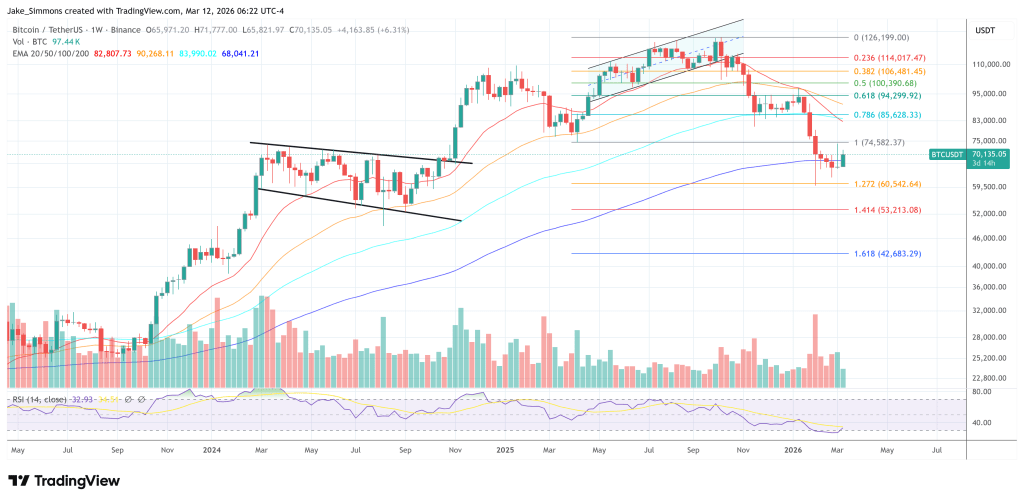
BTC faces the 1.0 Fib level, 1-week chart | Source: BTCUSDT on TradingView.com

Пов'язані питання

QWhat are the two new subsidiaries established by Metaplanet as part of its expanded strategy?

AMetaplanet established Metaplanet Ventures, focused on Japan's domestic Bitcoin ecosystem, and Metaplanet Asset Management, a Miami-based digital credit and Bitcoin capital markets business linking Asian and Western markets.

QHow much does Metaplanet Ventures plan to invest in Japan's Bitcoin infrastructure, and what areas will it focus on?

AMetaplanet Ventures plans to invest ¥4 billion into firms building Bitcoin financial infrastructure in Japan, spanning lending, payments, custody, stablecoins, derivatives, and compliance.

QWhy does Metaplanet believe Japan is ready for Bitcoin infrastructure development, according to CEO Simon Gerovich?

ACEO Simon Gerovich stated that Japan has built the best regulatory framework in the world for digital assets and now needs the companies, builders, and infrastructure to match, indicating that regulation is no longer a bottleneck.

QWhat is the significance of Metaplanet's investment in JPYC, and how does it relate to institutional adoption?

AMetaplanet's investment of up to ¥400 million in JPYC, Japan's first licensed yen stablecoin, is tied to the institutionalization of markets, as every Bitcoin transaction requires a currency side, which goes digital as the market institutionalizes.

QHow does Dylan LeClair, Director of Bitcoin Strategy at Metaplanet, describe the company's broader ambition?

ADylan LeClair described Metaplanet as a 'perpetual Bitcoin accumulation machine' with an unwavering mandate to utilize every capital markets tool available to acquire BTC relentlessly and at scale, aiming for vertical integration across the ecosystem in Japan.

Пов'язані матеріали

US Government Suddenly Halts Anthropic's Strongest Model, "Quasi-IPO Stock Price" Plunges 3.7% Overnight

U.S. Government Halts Anthropic's Top AI Models, 'Pre-IPO' Price Drops 3.7% On June 12, the U.S. government ordered Anthropic to shut down access to its two most powerful AI models, Claude Fable 5 and Claude Mythos 5, citing national security concerns. The directive, issued by the Department of Commerce, required Anthropic to block access for all foreign nationals, leading the company to disable the models globally for all users. Anthropic strongly opposed the move, arguing the government's basis was a "narrow jailbreak vulnerability" and warning that applying such a standard industry-wide would effectively halt all frontier model deployments. The news impacted Anthropic's implied valuation in speculative markets. The Anthropic perpetual contract on Hyperliquid fell approximately 3.7% to around $1,627, down from highs above $1,800 following the models' release. Unauthorized tokenized products linked to Anthropic on Solana also saw significant declines. The models, launched just days earlier on June 9, represented a major capability leap for Anthropic. Fable 5 was its first public release of a "Mythos"-tier model above its flagship Claude Opus. The shutdown creates an ironic situation for Anthropic, a company founded on "AI safety" principles, and adds uncertainty to its ongoing IPO preparations. The company is actively engaging with regulators to resolve what it calls a "misunderstanding" and restore service.

marsbit15 хв тому

US Government Suddenly Halts Anthropic's Strongest Model, "Quasi-IPO Stock Price" Plunges 3.7% Overnight

marsbit15 хв тому

SpaceX IPO Creates Trillion-Dollar Billionaire: Musk's Wealth Equals Half of Crypto Market

SpaceX's record-breaking IPO has propelled Elon Musk to become the first modern billionaire with a personal net worth exceeding $1 trillion, reaching $1.11 trillion according to Bloomberg. This staggering wealth surpasses the total market capitalization of all cryptocurrencies excluding Bitcoin and equals roughly half of the entire crypto market's value. The milestone highlights extreme wealth concentration and the significant devaluation of the altcoin market, whose total cap has nearly halved since late 2025 as capital flows into large tech stocks. SpaceX's Nasdaq debut saw its valuation hit $2.2 trillion, with shares soaring from a $135 offer price to close at $161. Its first-day trading volume of $85 billion set a new global IPO record. Musk owns 42% of the company. Despite his wealth dwarfing the altcoin sector, Musk maintains deep ties to digital assets. He personally holds Bitcoin, Ethereum, and Dogecoin, while his companies, SpaceX and Tesla, collectively hold over 30,000 Bitcoin, ranking among the top corporate BTC holders globally. His acquisition and integration of financial data tools into X (formerly Twitter) further connect his ecosystem to the markets. Ultimately, Musk's trillion-dollar status underscores the immense wealth controlled by tech founders, though this fortune remains largely tied to volatile stock prices rather than liquid assets.

Foresight News22 хв тому

SpaceX IPO Creates Trillion-Dollar Billionaire: Musk's Wealth Equals Half of Crypto Market

Foresight News22 хв тому

Hardcore First Look | Ocean Embodied Intelligence Company 'Shihang Intelligence' Secures Record-Breaking 1 Billion in Funding, Zhu Xiaohu, Temasek Place Bets

Breaking News | Ocean Embodied Intelligence company "Shihang Intelligent" secures a record-breaking 1 billion RMB (approximately 10 billion yuan) in Series A financing, with investment from Zhu Xiaohu and Temasek. Author: Qiu Xiaofen | Editor: Yuan Silai Ocean Embodied Intelligence company "Shihang Intelligent" has completed its Series A funding round, raising over 1 billion RMB. This marks the largest single funding round in the global marine robotics field to date. Investors include upstream momentum funds from chip companies "Moore Thread" and "Kunlunxin," Singapore's state-owned investment platform Vertex Growth, and listed company Dyneo, among others. Existing investors like GSR Ventures (whose founder Zhu Xiaohu has invested for the fifth time), Vertex Ventures China, Hua Ying Capital, and Long Capital also significantly increased their investments. Founder and CEO Chen Xiaobo, a 1989-born alumnus of Harbin Engineering University, is a long-time expert in underwater robotics. He received the National Defense Science and Technology Progress Award at age 28 (the youngest recipient) and led the development of China's first commercial underwater cleaning robot. The funds will be used for core technology R&D, global market expansion, and building the industry chain ecosystem to scale the application of marine robots in complex underwater scenarios. The ocean is considered one of the most challenging environments for robotics due to low light, high turbidity, complex currents, limited communication, high pressure, and corrosion. "Shihang Intelligent" focuses on developing core underlying technologies for marine robots, covering six key systems: power, control, sensing, navigation, sealing, and deployment. Its robots are capable of operating at depths from 0 to 10,000 meters with full degrees of freedom, performing complex maneuvers, autonomous navigation, and multi-robot collaboration. Applications include ship cleaning, underwater security, offshore wind power, marine ranching, and seabed inspection. The company's order value for the first half of 2026 alone has exceeded 1 billion RMB. Its "Orca Robot" is used by major shipping companies and has performed maintenance on over a thousand large vessels. In April of this year, the company launched its ocean embodied large model "Cangqiong CEORION." Unlike traditional remote-controlled or pre-programmed robots, this model integrates environmental perception, task understanding, and action generation into a single end-to-end architecture. Trained on millions of hours of commercial operation data and simulation data, it covers 12 major underwater operation scenarios. In simulations, it achieved over 90% task success rate and over 70% zero-shot adaptation capability to unseen environments. A built-in physics reasoning module reduces collision risk by 80%, enabling autonomous operation even with weak or no communication. Recently, "Shihang Intelligent" was selected as a core technology partner for Singapore's Maritime and Port Authority national hull inspection and cleaning program. These advancements indicate marine robotics is moving from pilot projects to scaled applications, with real-world operations generating valuable data to continuously improve robot capabilities. CEO Chen Xiaobo stated the company will continue investing in core marine robotics technology, the embodied intelligence model, and global application scenarios to expand into more high-risk, high-difficulty, and high-value underwater operations.

marsbit48 хв тому

Hardcore First Look | Ocean Embodied Intelligence Company 'Shihang Intelligence' Secures Record-Breaking 1 Billion in Funding, Zhu Xiaohu, Temasek Place Bets

marsbit48 хв тому

Three Months, 35 Billion Yuan: Investors Rush to Grab the OpenAI of the Physical World

Investors flock to a physical AI startup as the race for the "OpenAI of the physical world" heats up. Ji Jia Shi Jie (GigaWorld), a company dedicated to developing Artificial General Intelligence (AGI) for the physical world, has raised 3.5 billion RMB (approximately $490 million) in just three months, according to a report from investment media outlet Touzijie. The latest B2 funding round of 1 billion RMB attracted a wide range of top-tier investors, including sovereign wealth funds, industrial capital, and financial institutions. This brings the total funding for the young company, now valued over 10 billion RMB, to 3.5 billion RMB across three recent rounds. The company is led by Huang Guan, a post-90s Tsinghua University PhD with extensive experience in AI, autonomous driving, and entrepreneurship. Its core innovation is a "dual-pyramid" system comprising a five-layer data pyramid (from internet videos to real-world robot data) and a three-layer algorithm pyramid focused on world simulation, action alignment, and reinforcement learning. This system underpins its key models: the "World Action Model" (e.g., GigaBrain series for robot control) and the "World Generation Model" (e.g., GigaWorld series for simulating and understanding the physical world). Its models have reportedly achieved top rankings in global robotics benchmarks. Ji Jia Shi Jie argues that while current digital AGI excels in information processing, the next frontier is physical AGI—systems that can understand and interact with the real world. The company believes the field is approaching its "GPT-3 moment," a key inflection point in capability scaling. To achieve this, the company is pursuing a dual-market strategy. For the consumer (C) market, it launched the "SeeLight" brand and its S1 general-purpose humanoid robot, which has secured initial orders for deployment in real homes. For the business (B) market, it focuses on industrial automation with its Maker series robots, having signed agreements for large-scale deployment in factories, and its DriveDreamer world model for autonomous driving, which is already in use with over 30 automakers and tech companies. The report concludes that by bridging the gap between digital intelligence and physical action, Ji Jia Shi Jie aims to unlock a new wave of productivity, ultimately bringing physical AGI into everyday life.

marsbit1 год тому

Three Months, 35 Billion Yuan: Investors Rush to Grab the OpenAI of the Physical World

marsbit1 год тому

What's the Connection Between Pinduoduo's Huang Zheng and Blockchain?

This text explores the unexpected connection between Pinduoduo founder Colin Huang and blockchain, as suggested in his article *Turning Capitalism Upside Down*. Huang argues Pinduoduo's core business is about managing "uncertainty." He posits that wealth flows to the rich because they absorb life's uncertainties (e.g., illness, job loss) that devastate the poor, who pay a premium for certainty through insurance or stable prices. Pinduoduo's model attempts a "reverse insurance": by aggregating consumer demand via group-buying and flash sales, it creates a large, predictable order for manufacturers. This certainty allows factories to remove risk premiums, passing savings back as lower prices, thus partially reversing the wealth flow. The key obstacle, Huang notes, is that an individual's buying intent is an unreliable promise. He then asks if blockchain is the natural solution for this "reverse insurance." The text elaborates that blockchain, through smart contracts with binding deposits, could transform casual intent into a costly-to-break, enforceable commitment. This replaces interpersonal trust with coded rules, making promises credible, pricable, and resistant to fraud. Finally, the author draws a parallel to Bitcoin, framing two paths to creating certainty: the "Pinduoduo path" of aggregating decentralized will into scale, and the "Bitcoin path" of locking rules into immutable code. Both sacrifice something—personal freedom or system flexibility—to manufacture trust and predictability.

链捕手2 год тому

What's the Connection Between Pinduoduo's Huang Zheng and Blockchain?

链捕手2 год тому

Торгівля

Спот
Ф'ючерси

Популярні статті

Як купити PUSH

Ласкаво просимо до HTX.com! Ми зробили покупку Push Protocol (PUSH) простою та зручною. Дотримуйтесь нашої покрокової інструкції, щоб розпочати свою криптовалютну подорож.Крок 1: Створіть обліковий запис на HTXВикористовуйте свою електронну пошту або номер телефону, щоб зареєструвати обліковий запис на HTX безплатно. Пройдіть безпроблемну реєстрацію й отримайте доступ до всіх функцій.ЗареєструватисьКрок 2: Перейдіть до розділу Купити крипту і виберіть спосіб оплатиКредитна/дебетова картка: використовуйте вашу картку Visa або Mastercard, щоб миттєво купити Push Protocol (PUSH).Баланс: використовуйте кошти з балансу вашого рахунку HTX для безперешкодної торгівлі.Треті особи: ми додали популярні способи оплати, такі як Google Pay та Apple Pay, щоб підвищити зручність.P2P: Торгуйте безпосередньо з іншими користувачами на HTX.Позабіржова торгівля (OTC): ми пропонуємо індивідуальні послуги та конкурентні обмінні курси для трейдерів.Крок 3: Зберігайте свої Push Protocol (PUSH)Після придбання Push Protocol (PUSH) збережіть його у своєму обліковому записі на HTX. Крім того, ви можете відправити його в інше місце за допомогою блокчейн-переказу або використовувати його для торгівлі іншими криптовалютами.Крок 4: Торгівля Push Protocol (PUSH)Легко торгуйте Push Protocol (PUSH) на спотовому ринку HTX. Просто увійдіть до свого облікового запису, виберіть торгову пару, укладайте угоди та спостерігайте за ними в режимі реального часу. Ми пропонуємо зручний досвід як для початківців, так і для досвідчених трейдерів.

578 переглядів усьогоОпубліковано 2024.12.13Оновлено 2026.06.02

Як купити PUSH

Обговорення

Ласкаво просимо до спільноти HTX. Тут ви можете бути в курсі останніх подій розвитку платформи та отримати доступ до професійної ринкової інформації. Нижче представлені думки користувачів щодо ціни PUSH (PUSH).

活动图片













