Meta Joins the 'Selling Shovels' Game, Zuckerberg: 'Models Can Be Slow, but GPUs Must Earn'

marsbitОпубліковано о 2026-07-06Востаннє оновлено о 2026-07-06

Анотація

Meta pivots to selling AI infrastructure as internal model development lags. Facing setbacks like Gemini usage restrictions and slower-than-expected progress on its own AI agents, the company is reportedly launching "Meta Compute." This service would rent out its massive GPU capacity and data center resources—projected to reach over 10GW—to external clients. The move mirrors SpaceX's "neocloud" model, offering high-margin, flexible compute contracts. Meta also plans to host third-party models like Anthropic's Claude, creating a platform similar to Amazon Bedrock. This strategy provides immediate revenue while its in-house models (like the upcoming "Watermelon") continue development. Wall Street reacted positively, seeing it as a way to monetize heavy AI investments even if Meta's models aren't yet industry-leading.

Failing to make breakthroughs with models, Zuckerberg is now setting his sights on infrastructure.

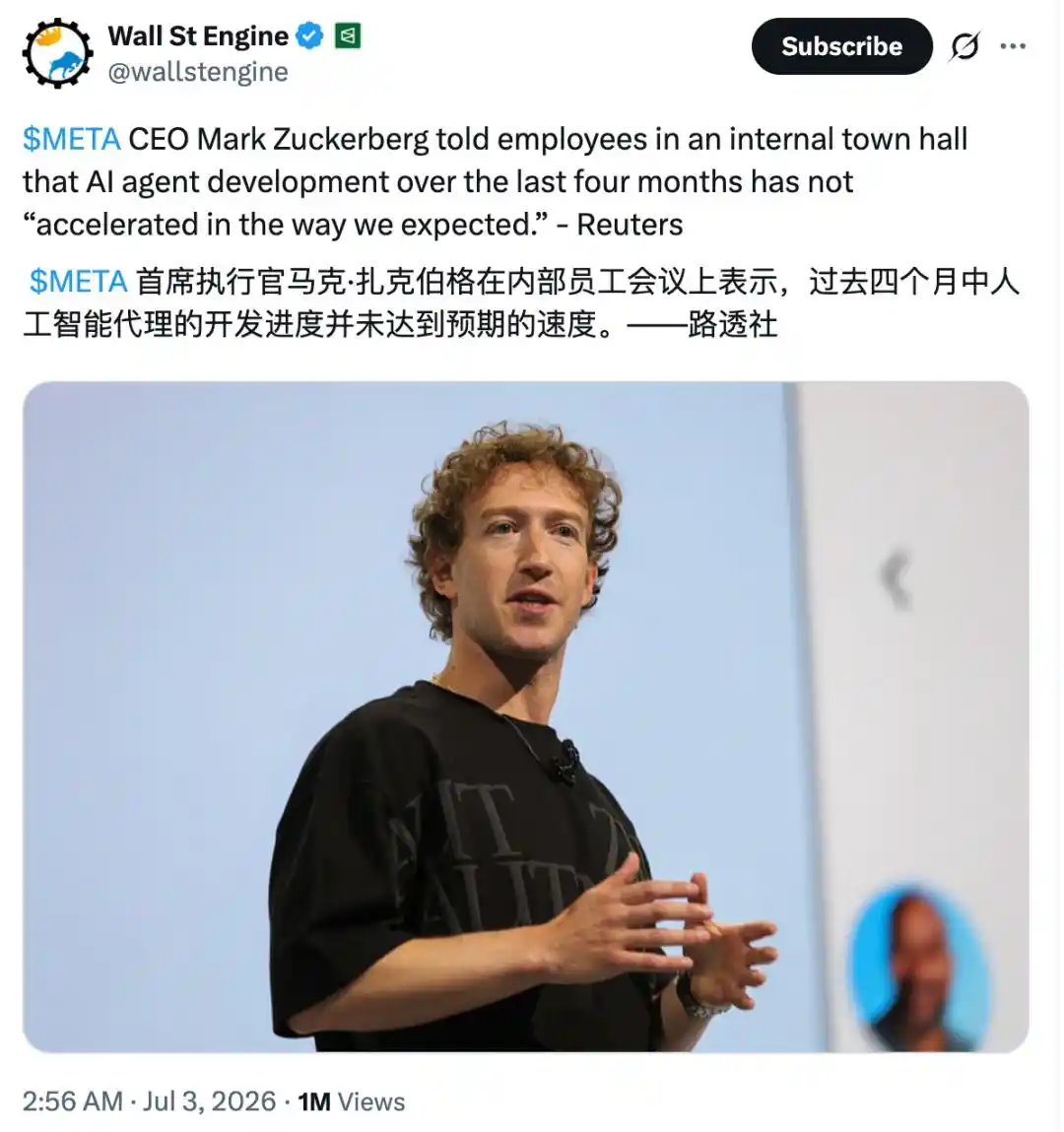
The trigger was a series of setbacks for Meta: Gemini model usage was restricted, Zuckerberg admitted internal AI agent tech was progressing slower than expected, employee morale hit a 20-year low...

It's just been a rough year.
But it's okay, Zuckerberg had a flash of inspiration and came up with a Plan B.

If our in-house models can't keep up, then we can just sell GPUs!!
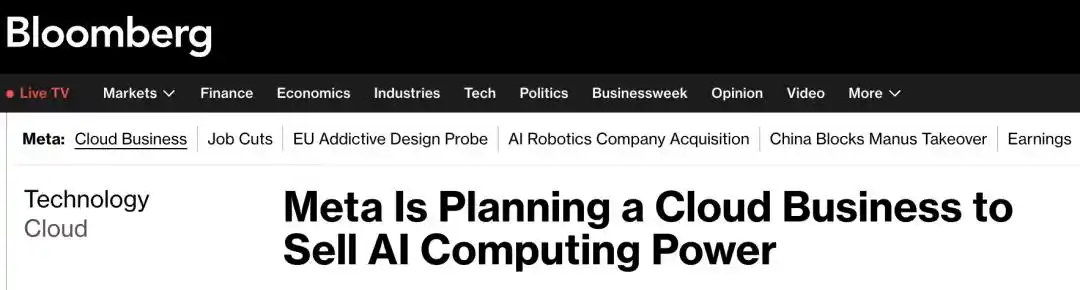
According to Bloomberg, Meta is considering launching Meta Compute, opening its vast AI infrastructure to external customers.

Wow, it seems everyone just wants to be in the shovel-selling business...

Meta Is Going to Sell GPUs

Now that they're selling shovels, just how many shovels does Meta have?

According to SemiAnalysis, Meta's data center and compute procurement isn't slowing down; it's actually accelerating.

In just the first half of this year, Meta has already signed contracts for over 5GW of capacity in cloud and colocation data centers. That's not even including its accelerated push into self-built data centers.

The two largest data center campuses Meta is currently building represent a combined 2.5GW of capacity.

And since the beginning of 2024, Meta has signed deals for data centers and compute capacity nearing 10GW.
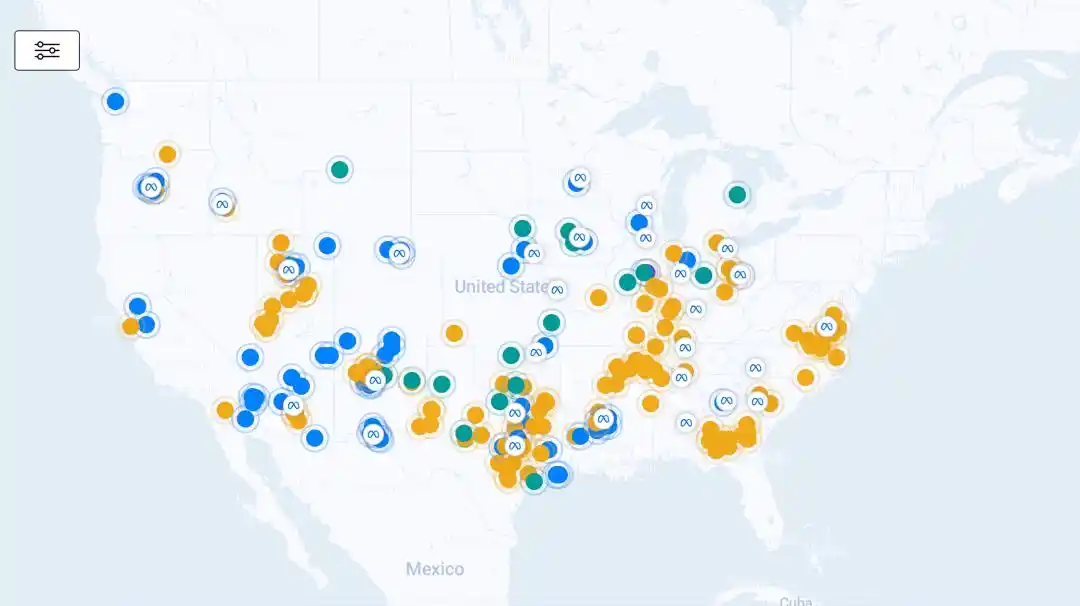
Those densely packed dots on the map are Zuckerberg's confidence in selling GPUs.

This massive compute power has a few potential destinations:

First, continue feeding it to its own models, like Alexander Wang's MSL's recently launched Muse Spark, and the next-generation model Watermelon currently in training.

Second, use it on the ad recommendation system. SemiAnalysis believes Meta might want to increase the complexity of its ad recommendation system by another 10x, using more training and inference compute to boost ad revenue.

Third, engage in neocloud deals similar to SpaceX's, leasing out a portion of compute at a premium to external clients.

If calculated based on high-compute leasing contracts like SpaceX's, each GW could generate annual revenue of about $50 billion.

If Meta allocates just 200MW of compute to external clients, it could bring in $10 billion in annual revenue, and at extremely high margins.

Tsk tsk, the potential profit is really not small~

And SpaceX has pioneered a new model: a three-year contract, but either party can cancel with 90 days' notice—essentially making it a three-month, auto-renewing deal.

This means Meta could reclaim the compute power for MSL's use at any time.

Fourth, host third-party models.

SemiAnalysis even judges that Meta is in final negotiations with Anthropic to gain private instance access to Claude.

In the future, Meta would create a model service platform similar to Amazon's Bedrock, Microsoft's Foundry, or Google's Vertex.

In other words, Meta could deploy third-party models like Claude on its own infrastructure and then package and sell them to enterprise customers.

For Meta, this has at least three uses:

First, of course, is internal use.

Google just restricted Meta's use of Gemini, and Meta might turn around and use Claude as a replacement.

After all, Meta's own AI projects require massive amounts of high-quality model tokens.

And Claude happens to be one of the strongest models currently available.

Second is external sales. Meta could sell Claude-as-a-service like Amazon's Bedrock.

Customers wouldn't need to contract with Anthropic, deploy, or maintain the model themselves; they could just call the model through Meta's platform.

Third is vertical applications. Meta could leverage its own ad platform to build sales and marketing SaaS, integrating cutting-edge AI Agents.

SemiAnalysis expects that Meta may soon announce a similar agreement, with Anthropic being the prime candidate, but OpenAI or Google could also join.

If Meta's compute business takes shape, then its competitors won't just be model companies like OpenAI, Anthropic, and Google.

It will also stand opposite AI cloud providers like AWS, Azure, Google Cloud, as well as neocloud companies like CoreWeave and Nebius.

As soon as the news broke, the capital market reacted immediately.

Meta's stock price surged nearly 9%, while neocloud companies like CoreWeave and Nebius saw sell-offs.

Wall Street clearly understood Zuckerberg's new story:

Our models might not be winning yet, but our GPUs can start earning money now!

Why Sell Compute? Building Models is Too Expensive

The most direct reason for Zuckerberg's pivot from models to selling shovels is:

Developing models really burns too much cash!!!

Meta's official capital expenditure guidance for 2026 has already been raised to $125-$145 billion.

For comparison, Meta's Q1 capital expenditure this year alone reached $19.84 billion.

But looking at Meta's model progress, it's hard not to feel nervous:

The Llama series is open-source and has significant ecosystem influence, but it's hard to directly translate that into revenue.

And Meta's latest in-house model, Muse Spark, hasn't truly put Meta back in the top tier yet.

Now Meta is internally training the next-generation model Watermelon, reportedly involving an order of magnitude more compute investment than Avocado.
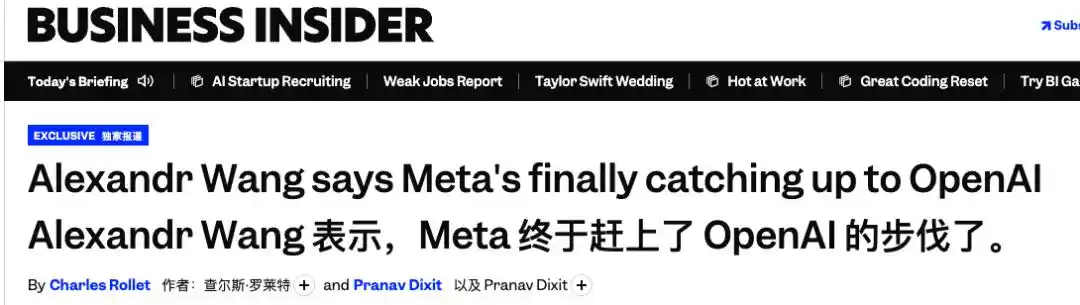
Alexander Wang states: Don't worry everyone, Watermelon has already caught up to GPT-5.5 levels.

Meanwhile, the current version of Muse Spark is about to be updated, with major improvements expected in coding capabilities and agent intelligence.

When users ask Wang when Meta will release a model comparable to Claude Opus, he says:

Very soon!

(Come on Xiao Wang, stop talking and just release it already)

Ultimately, Meta's AI ambitions have always revolved around a simple goal:

Catch up with OpenAI, Anthropic, and Google.

To achieve this, Zuckerberg has spared no expense. Chips, data centers, talent—almost everything has been invested at the highest level.

But the problem is, the money has been spent, yet Meta hasn't truly convinced developers and customers that its models are at the industry's cutting edge.

When model progress can't be immediately monetized, compute power becomes the asset most easily understood by Wall Street.

Because GPUs and data centers can at least be priced.

These resources can be rented out, can host models, can sell APIs, can serve advertisers, can be used for AI agent SaaS, and can also internally continue to improve the ad recommendation system.

It's like Meta was originally telling the market a distant story:

Trust us, we'll create superintelligence.

But now the story sounds much closer:

Even if superintelligence doesn't arrive that quickly, these GPUs aren't sunk costs.

Of course, selling compute doesn't mean Meta is giving up on its own models. Zuckerberg's Plan A is still superintelligence.

Keep poaching talent, keep stacking GPUs, keep training bigger models, keep chasing the big three.

On the path to ASI, Zuckerberg never gives up!

It's just that the uncertainty in the frontier model competition is too high, and a little compromise along the way is inevitable~

References:

[1]https://newsletter.semianalysis.com/p/meta-compute-everyone-wants-to-be

[2]https://www.bloomberg.com/news/articles/2026-07-01/meta-is-building-a-cloud-business-to-sell-excess-ai-compute

This article is from the WeChat public account "QbitAI", author: Tingyu

Пов'язані питання

QWhat is Meta's new plan to generate revenue from its AI infrastructure?

AMeta is planning to launch a service called 'Meta Compute' to rent out its excess AI compute capacity (GPUs and data centers) to external customers. This includes offering high-performance computing contracts similar to SpaceX's neocloud deals and creating a model platform to host third-party AI models like Anthropic's Claude.

QWhy is Meta shifting its focus towards selling compute resources according to the article?

AMeta is shifting focus because developing cutting-edge AI models is extremely expensive and its progress has been slower than expected. By monetizing its massive GPU and data center investments, Meta can generate high-margin revenue (like selling 'shovels' in a gold rush) while continuing its long-term AI research, making the story more tangible for Wall Street.

QWhat potential revenue could Meta generate from renting out a portion of its AI compute?

ABased on similar high-compute rental contracts like SpaceX's, the article suggests that each GW of compute capacity could generate about $50 billion in annual revenue. If Meta rents out 200 MW of its capacity, it could potentially bring in around $10 billion in high-margin yearly revenue.

QWhat are the four main uses for Meta's AI compute resources mentioned in the article?

AThe four main uses are: 1) Training and running its own AI models (like Muse Spark and Watermelon). 2) Powering its advertising recommendation systems to increase ad revenue. 3) Renting out compute capacity to external clients via services like Meta Compute. 4) Hosting third-party models (e.g., Anthropic's Claude) to offer them as a service to enterprise customers.

QHow did the financial markets react to the news about Meta's potential compute business?

AThe news positively impacted Meta's stock, which rose nearly 9%. Conversely, it triggered sell-offs in shares of specialized AI cloud companies like CoreWeave and Nebius, as investors saw Meta becoming a major competitor in the AI infrastructure market.

Пов'язані матеріали

DeepMind's Classic Masterpiece Crowned Again, ICML 2026 Awards Announced

ICML 2026 has announced its annual awards, with diffusion models and AI safety ethics taking center stage. The Outstanding Paper Award was shared by two diffusion model studies. One challenges a core assumption of diffusion language models (DLMs), arguing that their touted "arbitrary order generation" is a "flexibility trap" that harms performance. The other provides a high-accuracy sampling method, pushing the technical ceiling for diffusion models and log-concave distributions. A position paper winning the Outstanding Award raises a critical ethical concern: AI alignment research is unintentionally building a "censor's toolkit," where safety tools like RLHF can be repurposed for content control. Several papers received Honorable Mentions, spanning key areas: mapping where honesty emerges in RLHF-trained models, motion attribution in video generation, quantifying how much language models memorize, analyzing diffusion model consistency via random matrix theory, and providing a mathematical proof for the "grokking" phenomenon in a simple model. The Test of Time Award was given to DeepMind's 2016 seminal work "Asynchronous Methods for Deep Reinforcement Learning," recognizing the enduring impact of the A3C algorithm. Overall, the awards signal a shift in AI research from rapid expansion to deeper scrutiny—validating diffusion models as a major architectural contender while prompting serious ethical reflection within the safety community.

marsbit14 хв тому

DeepMind's Classic Masterpiece Crowned Again, ICML 2026 Awards Announced

marsbit14 хв тому

ARK's Massive Buying Spree in Crypto-Linked Stocks: Lower Risk, or Double the Pressure?

ARK Invest, led by Cathie Wood, significantly increased its holdings in crypto-related public stocks in June, purchasing $77 million worth of shares in Coinbase, Circle, and Bullish during Bitcoin's worst monthly performance in four years. The investment thesis is that these stocks offer regulated exposure to the crypto cycle without direct Bitcoin ownership. However, data analysis reveals significant downsides: these stocks exhibit nearly double the volatility of Bitcoin (68%-90% vs. 37.6% 30-day annualized volatility) and carry substantial company-specific risks like earnings, competition, and equity dilution, which account for much of their price movement. Only MicroStrategy closely tracks Bitcoin, acting as a leveraged proxy. Coinbase shows moderate correlation, while Circle and Robinhood have low correlation, being more influenced by stablecoin competition and diversified brokerage operations, respectively. Mining companies like RIOT and MARA have surged due to AI-related ventures, decoupling from Bitcoin's price. The case of Strategy highlights additional equity-structure risks, such as potential value erosion when its market value falls below its net asset value. Ultimately, investing in crypto stocks often means accepting amplified Bitcoin volatility or layering on unrelated business risks, rather than obtaining a safer alternative to direct cryptocurrency ownership.

Foresight News19 хв тому

ARK's Massive Buying Spree in Crypto-Linked Stocks: Lower Risk, or Double the Pressure?

Foresight News19 хв тому

Karpathy's Latest Outburst: A Single Sentence That Silenced the Entire Agent Developer Community

Andrej Karpathy, a core researcher at Anthropic, recently critiqued the current AI agent development frenzy. He argues that the biggest mistake is forcing agents to perform tasks without first thoroughly understanding the underlying large language models. Drawing from his 2016 "World of Bits" project at OpenAI—an early attempt at web-based agents that ultimately failed due to premature technology—he emphasizes that foundational model work is crucial. Karpathy offers three key pieces of advice: First, focus on getting the base models right before pushing agents. Second, recognize that creating a demo is easy, but building a real product takes a decade, akin to the journeys of autonomous driving and VR. Third, the product is the core capability, not the agent shell; a robust foundation will naturally enable advanced agents. He also suggests looking to neuroscience for inspiration, comparing agent components to brain structures like the hippocampus and thalamus. Despite his caution, Karpathy concludes that independent developers and startups, not large labs like OpenAI, are at the forefront of agent innovation. This is because the agent field is new, with no entity having a five-year head start, leveling the playing field for agile experimenters. His core message is not to abandon agent work, but to build it on a solid, deeply understood foundation.

marsbit19 хв тому

Karpathy's Latest Outburst: A Single Sentence That Silenced the Entire Agent Developer Community

marsbit19 хв тому

Tsinghua University's Special Award Winner, Gu Yuxian, Joins DeepSeek

Tsinghua University's prestigious Graduate Special Scholarship recipient and 2021 Ph.D. candidate, Yuxian Gu, has officially joined DeepSeek. This news coincides with DeepSeek's major recruitment drive and the imminent launch of DeepSeek V4, on whose research paper Gu is listed as an author. A doctoral student in the Conversational AI group under Professor Minlie Huang at Tsinghua, Gu's research focuses on enhancing efficiency throughout the entire lifecycle of large language models. His key contributions span three areas: innovative methods for pre-training data selection (e.g., PDS), advanced knowledge distillation techniques for model compression (notably MiniLLM), and the development of efficient model architectures like Jet-Nemotron. His work has gained significant recognition, with nearly 5,000 citations on Google Scholar. Key publications include the highly cited surveys and papers on pre-trained models and the MiniLLM distillation method. As first author, he has presented at top-tier AI conferences including NeurIPS, ICLR, and ACL. One of his notable achievements is the Jet-Nemotron architecture, which combines Post-Neural Architecture Search (PostNAS) and a novel linear attention module called JetBlock. This model series demonstrates state-of-the-art performance rivaling larger models while achieving substantial efficiency gains in inference. Gu's expertise in creating powerful yet efficient AI systems aligns with industry needs, as evidenced by the adoption of his MiniLLM method by leading tech companies. His move to DeepSeek is anticipated to contribute further advancements in the field.

marsbit44 хв тому

Tsinghua University's Special Award Winner, Gu Yuxian, Joins DeepSeek

marsbit44 хв тому

Торгівля

Спот
活动图片