Meme Watchlist: Who's Cultivating Real Fans, Who's Inflating Data

比推Опубліковано о 2026-03-06Востаннє оновлено о 2026-03-06

Анотація

The article "Meme Watchlist: Who's Building Real Communities vs. Who's Inflating Metrics" analyzes the memecoin sector, arguing that memecoins have achieved product-market fit as a form of crypto "gaming" driven by speculation, social interaction, and risk-reward dynamics. The report focuses on five memecoins—BONK, PEPE, SPX6900, PENGU, and USELESS—selected based on criteria including liquidity, global audience, cultural relevance, historical volatility, transparent on-chain data, and high beta correlation to Bitcoin. Key on-chain metrics are analyzed to assess holder conviction and staying power: - **Total Holders:** BONK leads with 985.9K, followed by PENGU (534.1K) and PEPE (505.7K). - **Small Holders (<$100):** BONK, PENGU, and PEPE show mature bases, while SPX6900 has a smaller but more dedicated community. - **Larger Holders:** SPX6900 demonstrates superior holder retention. When analyzing wallets that held $1,000 or $100,000 worth of tokens at their all-time high (ATH), SPX6900 consistently showed the highest rate of holders retaining their full position (in token units, stripping out price volatility). - **Whale Retention:** A significant majority (80%) of SPX6900's whales (wallets that once held >$100k) still hold over 50% of their peak token amount, far exceeding the retention rates of the other coins. The analysis concludes that SPX6900, with its strong community ethos centered around "Flipping the stock market," exhibits the most resilient and committed holder ...

Source: The DeFi Report

Author: Michael Nadeau

Compiled and Edited by: BitpushNews


Whether you like it or not, we believe memecoins are here to stay. This article will share a macro perspective on the industry and delve into the meme coins we are closely monitoring.

Let's begin.

Why Focus on Memecoins

Our Methodology

Some people love memecoins, others despise them. We try to step outside this debate and simply observe the market. From our observations, memecoins have taken root. From a "Product-Market Fit (PMF)" perspective, they seem to be the ultimate crypto "game." People love trading, love gambling, love the social aspect, and love the risk-reward play. And we believe participants are very aware of the game they are playing.

After witnessing PEPE's success in the Ethereum ecosystem, we caught onto BONK and Solana in late 2023. This led us to research the space more deeply, including on-chain data and additional investments like GIGA, PEPE, and SPX6900. Our goal is to uncover unique properties in holder data that indicate a token's Staying Power and the conviction of its holders.

Why BONK, PEPE, SPX6900, PENGU, and USELESS?

  1. Liquidity: Each token has ample liquidity and is tradable on major exchanges and retail channels.

  2. Audience Reach: Each token has global audience interest (not limited to niche memes like specific politics).

  3. Leadership/Embedded Culture: Each token is supported by at least one of the following: 1) A highly influential leader/holder community; 2) An established internet meme/culture; or 3) An existing popular brand.

  4. Historical Performance: Each token has experienced multiple massive rallies followed by sharp pullbacks. This price action shows broad market interest and helps distribute the holder base, laying the foundation for the next expansion.

  5. No Unlocks, No VCs: Only transparent on-chain data.

  6. High Beta: Each token exhibits a high beta coefficient relative to BTC and the L1 assets of its ecosystem. With proper allocation (we target 3-5%), coin selection, and entry points, this can significantly enhance risk-adjusted returns.

Now, let's dive into the on-chain data to separate the wheat from the chaff.

Total Token Holders
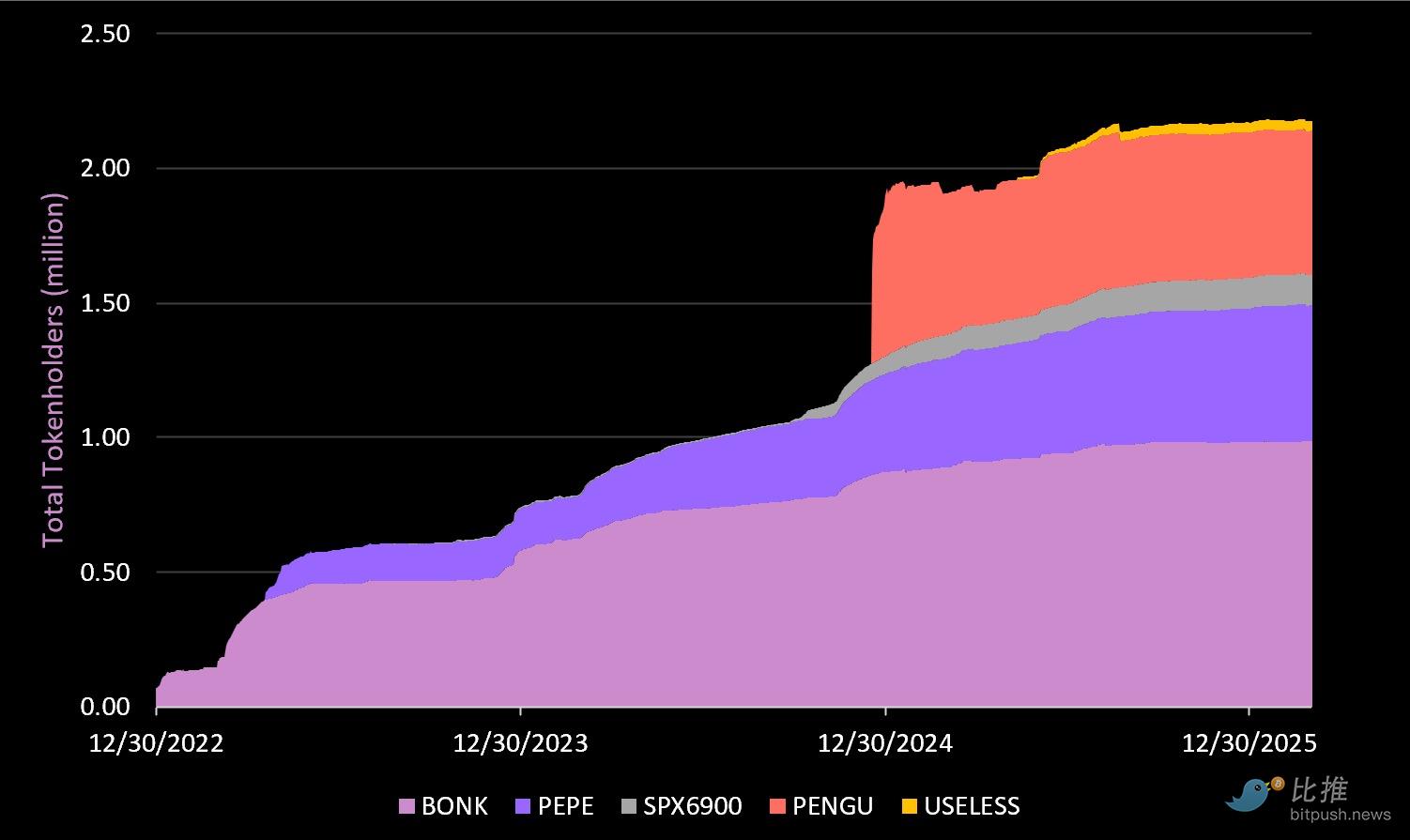
Data Source: The DeFi Report

  • BONK: 985.9K current holders (at an all-time high). BONK launched in Dec '22, is the largest memecoin in the Solana ecosystem, and is deeply integrated into various apps and wallets. Note: BONK executed a community-driven airdrop campaign, "seeding" a large number of wallets, which is reflected in the data in the table below.

  • PENGU: 534.1K holders (down 14% from peak). PENGU launched in Dec '24, representing social interest in the popular brand Pudgy Penguins. The total market cap of the Pudgy Penguins NFT collection today is ~$78.5M, while its memecoin market cap is $454M (5.7x the NFT collection, down from a $2.7B peak). We believe the value of the Pudgy Penguins brand (a strong crypto brand breaking into the mainstream) is likely to continue flowing to this memecoin.

  • PEPE: 505.7K current holders (down 1.51% from peak). PEPE launched in Apr '23. We believe PEPE is the purest expression of internet meme culture in crypto (especially on Ethereum). It's based on the globally recognized "Pepe the Frog," which has maintained a strong internet presence since the late 2010s.

  • SPX6900: 113K current holders (down 0.33% from peak). SPX6900 launched in Sep 2023, spawning a fervent internet community led by Murad, with the core ethos of "Flipping the stock market." The brand seems to combine financial satire with a "BTC-like" holder base that takes holding very seriously (as shown in the data below). We successfully traded SPX6900 in the last bull run and have been analyzing its community and on-chain data since Aug '24.

  • USELESS: 38.6K current holders (down 5.2% from peak). USELESS launched in May '25 as a satirical "Anti-utility" memecoin. It attracted a vertical and seemingly loyal community after its debut on LetsBONK (which took market share from Pump Fun at the time). Its current market cap is $44M with daily liquidity exceeding $10M (at bear market lows), and we believe USELESS could present interesting opportunities under the right market conditions.

Holders with Balances Under $100
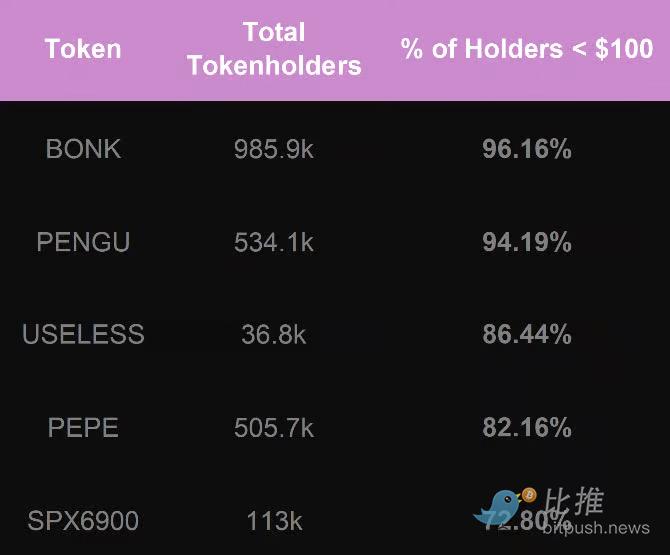
Conclusion:

BONK, PENGU, and PEPE already have very mature holder bases. SPX6900 shows a more resolute and loyal holder base (albeit smaller).

Holders with Balances Over $1,000
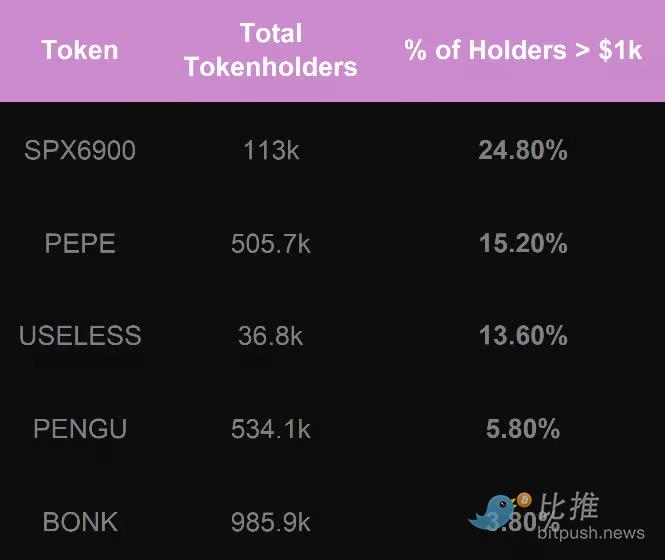
Note, $1,000 wallet classification: Split by the number of token units held at the token's All-Time High (ATH) price equivalent to $1,000.

Conclusion:

SPX6900 stands out here, as it consistently has since we started tracking this metric.

To better understand the retention of $1,000 holders, we normalized the ATH data for each token, calculating the number of token units required to be a "$1,000 holder" at that time.

Then, we tracked the holdings (number of units) of these wallets over time. This aims to strip out the noise of price fluctuations to more accurately gauge holder retention willingness.

Here are our findings:
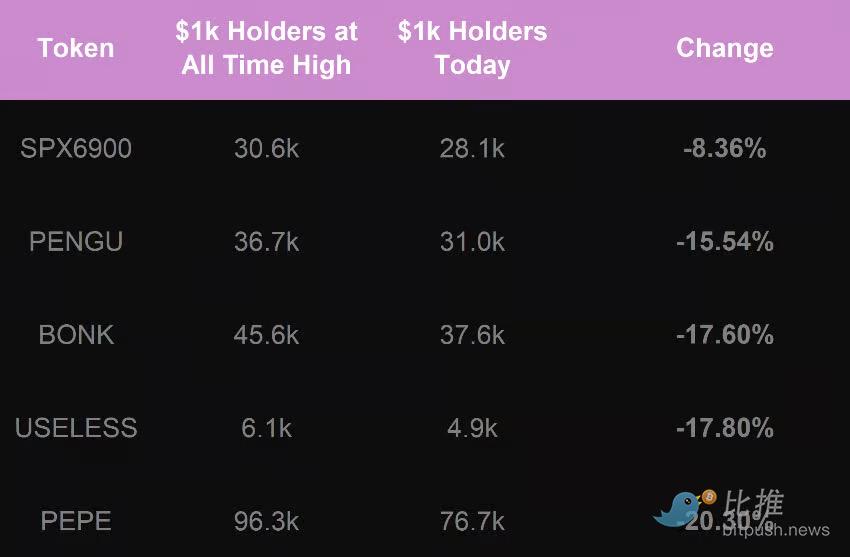
Conclusion:

In terms of "$1,000 holder" retention rate (measured in units to strip out price effects), SPX6900 seems to have separated itself from the pack.

Holders with Balances Over $100,000
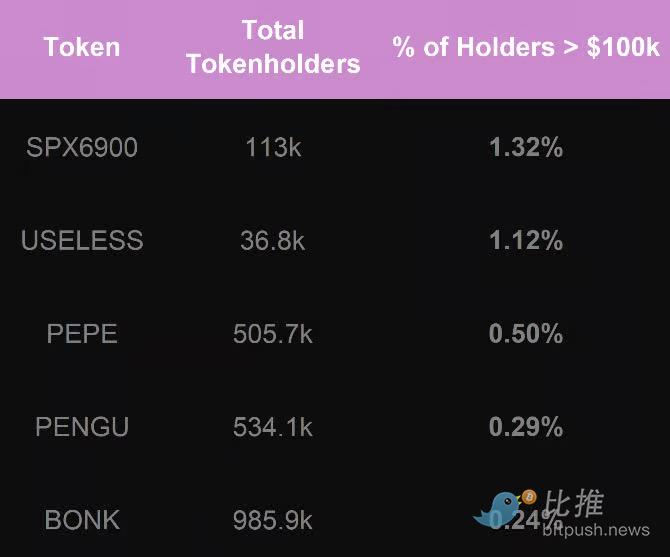
$100,000 wallet classification: Split by the number of token units held at the token's All-Time High (ATH) price equivalent to $100,000.

Retention Rate

Similar to the $1,000 holder data, we classified $100,000 wallets by their unit holdings at ATH.

Then, we tracked these wallets to determine the change in the total number of "$100,000 wallets" (by token units) over time.

Here are our findings:
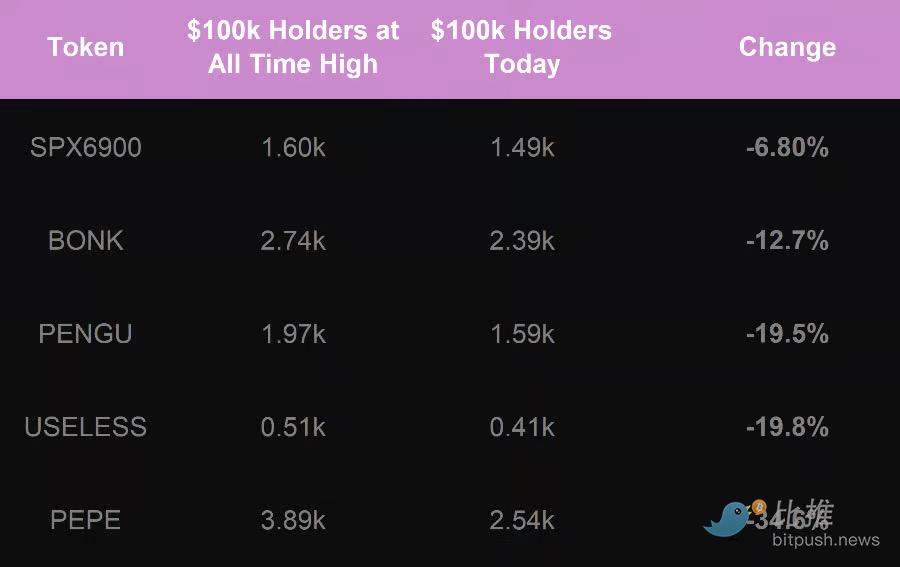
Conclusion:

Again, SPX6900 leads in the retention rate of holders at the $100,000 level.

Whale Retention Rate

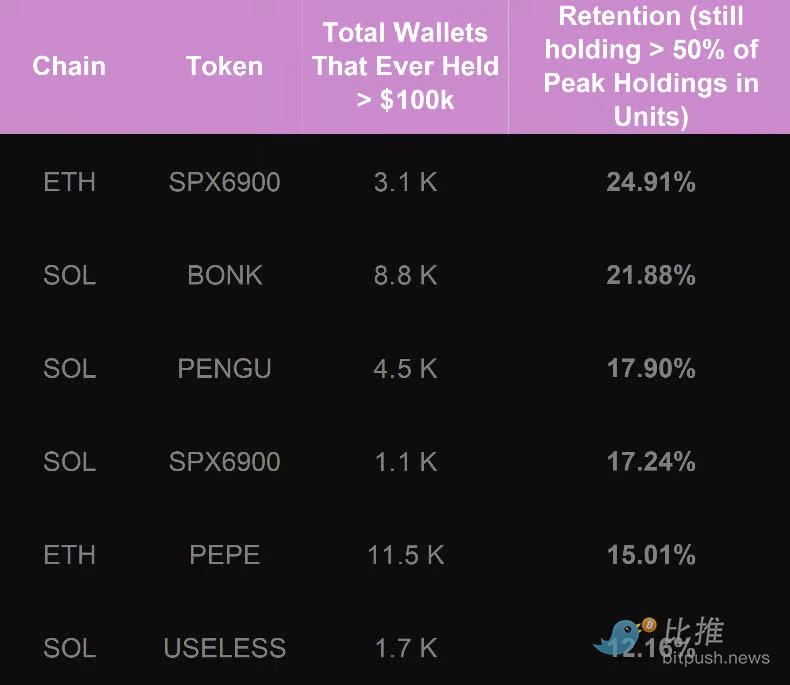
Another way to monitor whale retention is: Count all wallets that have ever held over $100,000 worth of the token and compare that to the number of wallets that still hold more than 50% of their peak holdings (in units).

Here are our findings:
Momentum & 50-Week Moving Average (WMA)

Relative Strength
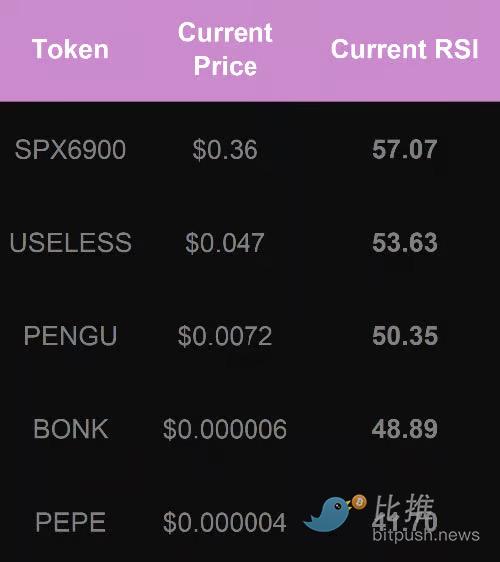
When we buy memecoins, we look for entry points where the 14-day RSI is at or near oversold territory (30).

50-Week Moving Average

  • SPX6900: Trading 64% below its 50 WMA.

  • BONK: Trading 62% below its 50 WMA.

  • PENGU: Trading 58% below its 50 WMA.

  • PEPE: Trading 57% below its 50 WMA.

Drawdown from All-Time High
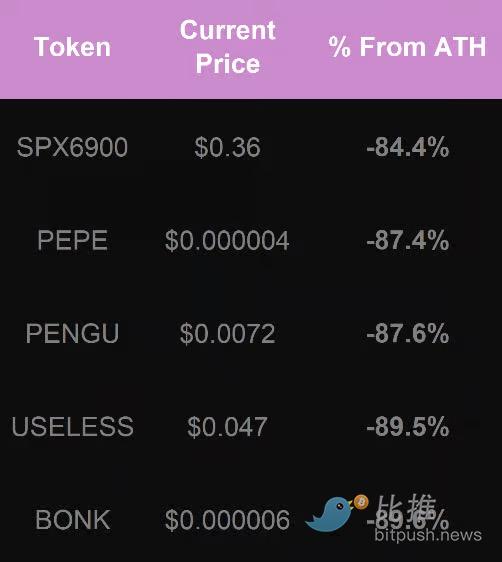
Given SPX6900's superior on-chain data, its relative resilience compared to the others is not surprising.

Conclusion

Given the industry's attention, we believe it is wise for crypto investors to pay attention to memecoins. We find them highly referential when monitoring broad risk-on/off sentiment and liquidity conditions in the crypto market.

Not to mention, with the right position sizing and entry points, the right assets can provide a "powerful catalyst" for a portfolio.

We successfully captured BONK and SPX6900 in the last bull run (exiting with a small portfolio allocation for 10x+ gains). We will look for similar entry opportunities in the future.


Twitter:https://twitter.com/BitpushNewsCN

Bitpush TG Discussion Group:https://t.me/BitPushCommunity

Bitpush TG Subscription: https://t.me/bitpush

Original link:https://www.bitpush.news/articles/7617562

Пов'язані питання

QWhat is the main purpose of the article's analysis of memecoins like BONK, PEPE, SPX6900, PENGU, and USELESS?

AThe article aims to analyze on-chain data to identify unique attributes in holder data that indicate a token's staying power and the conviction of its holders, moving beyond the debate of whether memecoins are good or bad to observe their market presence and potential.

QWhich memecoin showed the highest retention rate among holders with over $1,000 and $100,000 investments when measured in token units to strip out price volatility?

ASPX6900 showed the highest retention rate among holders with over $1,000 and $100,000 investments when measured in token units to account for price volatility.

QWhat criteria did the authors use to select the memecoins BONK, PEPE, SPX6900, PENGU, and USELESS for analysis?

AThe selection criteria included liquidity (ample liquidity and tradable on major exchanges), audience reach (global interest beyond niche memes), leadership/embedded culture (supported by influential leaders, established internet memes, or existing hot brands), historical performance (experienced large rallies and drawdowns), no unlocks or VC backing (transparent on-chain data only), and high beta (high sensitivity to BTC and ecosystem L1 assets).

QHow does the article describe the current holder count and historical performance of PENGU compared to its associated NFT collection?

APENGU has 534,100 current holders (down 14% from its peak) and represents social interest in the Pudgy Penguin brand. The Pudgy Penguin NFT collection has a total market cap of about $78.5 million, while its memecoin has a market cap of $454 million (5.7 times that of the NFT collection, down from a peak of $2.7 billion).

QWhat trading strategy do the authors mention for entering memecoin positions based on technical indicators?

AThe authors look for entry points when the 14-day RSI is at or near oversold territory (30) and consider the token's position relative to its 50-week moving average (WMA) to identify potential buying opportunities.

Пов'язані матеріали

As Consensus Accelerates, What Are Young Investors Betting On?

Title: As Consensus Forms Faster, What Are Young Investors Betting On? In the rapid evolution of tech investment, a new generation of young investors is navigating a landscape where AI, robotics, commercial aerospace, and quantum computing are advancing simultaneously. Traditional investment logic based on financial models is giving way to a need for deep technical understanding and the ability to act before industry consensus forms. An analysis of trends from the "WAIC FUTURE TECH" list of young investment leaders reveals key shifts in focus. The first major trend is the movement of AI from the digital screen into the physical world. Investment is shifting from large language models and chatbots towards embodied AI, robotics, AI hardware, and edge computing. While demonstrations generate excitement, the real challenge lies in achieving scalable, reliable, and cost-effective delivery in complex real-world environments like factories and logistics. Success depends not just on algorithms but on the integration of sensors, actuators, and control systems. Second, the competitive focus for large models is moving beyond raw capability toward building an "intelligence flywheel." The goal is to create self-reinforcing systems where user interaction generates data, improving the model, which in turn enhances the user experience and attracts more engagement. Companies that successfully embed AI into workflows to create these closed-loop systems can build lasting value that isn't easily erased by the next model upgrade. Third, facing a potential bottleneck in high-quality human-generated data, investors are looking at new underlying technologies. Reinforcement learning and self-play, as demonstrated by AlphaGo Zero, offer paths for AI to generate its own experience. Scientific foundation models, which aim to build general AI capabilities for fields like life sciences and materials discovery, represent a non-consensus direction that could unlock new frontiers of knowledge and data. Finally, in deep-tech areas like quantum computing, commercial aerospace, and space-based infrastructure, patient capital is essential. These fields have long, uncertain development and validation cycles involving complex engineering, supply chains, and regulations. Investment here requires a long-term view, focusing on foundational team capabilities and the eventual emergence of market demand, even if commercial returns are distant. Collectively, these trends illustrate how young investors are adapting to a new era. They are learning to make earlier, technically-informed judgments, balance hype with real-world viability, and provide the patient capital needed to build the deep-tech foundations of the future.

marsbit29 хв тому

As Consensus Accelerates, What Are Young Investors Betting On?

marsbit29 хв тому

Can Japan Buy Growth with AI? Will the Bond Market Believe It?

Japan's cabinet has introduced the 2026 Basic Policy on Economic and Fiscal Management and Reform, shifting its primary fiscal target. The new framework moves away from the traditional annual primary balance goal and instead prioritizes a stable reduction of the debt-to-GDP ratio. This change is tied to a strategy of increased "responsible proactive fiscal" spending, aiming to boost long-term growth through investments in strategic sectors like AI, semiconductors, energy, and robotics. The government estimates total public and private investment in 62 key technologies could exceed 370 trillion yen by 2040. The market reaction has been mixed and cautious. While equity markets may respond to policy signals, bond markets are focused on fiscal credibility. Concerns center on whether the weakening of the clear primary balance anchor could lead to looser fiscal discipline. If investors doubt that these strategic investments will generate sufficient productivity gains, tax revenue, and nominal growth to outpace rising interest costs, they may demand higher yields on Japanese Government Bonds (JGBs). Recent volatility in the yen and JGB yields, with the 10-year yield briefly reaching 2.9%, reflects this skepticism. The success of this new framework hinges on two factors: whether Japan can achieve a nominal growth rate consistently higher than its long-term interest rates, and whether future budgets demonstrate disciplined control over bond issuance. The government's narrative is that strategic investment is essential to break Japan's cycle of low growth, aging, and labor shortages. However, the bond market will continuously assess the credibility of this plan, pricing the risk that it may represent fiscal expansion rather than a viable growth strategy.

marsbit1 год тому

Can Japan Buy Growth with AI? Will the Bond Market Believe It?

marsbit1 год тому

Misjudged A-Shares: Resilience, Expectations, and Confidence

China's A-share market recently faced selling pressure, especially in tech sectors, initially triggered by a global tech sell-off that began in South Korea. However, the article argues this is a case of "mistaken injury" and highlights the market's underlying resilience. This resilience stems from three main pillars: **1) Tech Sector Fundamentals:** Unlike Korea's market dominated by a few memory chip stocks, China's tech sector is diversified across computing, communications, electronics, and semiconductors, supported by dual narratives of global AI supply chains and domestic substitution. Core areas like optical modules and fiber optics continue to show strong earnings growth. **2) "National Team" Support:** State-backed institutions and large corporations have made significant market purchases and announced buybacks, providing liquidity and signaling confidence. This is seen as a stabilizing policy signal, often associated with market bottoms. **3) Broader Market Pillars:** Other major sectors are showing endogenous recovery momentum. Consumer stocks benefit from stabilizing CPI and signs of sector recovery (e.g., liquor price hikes). Cyclical sectors like aluminum have high earnings, potential price increases due to tight supply, and low valuations. The financial sector offers stable dividends and low valuations. The conclusion is that the sell-off was driven by external contagion, not a collapse in fundamentals. With strong policy support and recovering momentum across key sectors, the A-share market possesses the toughness to regain stability.

marsbit1 год тому

Misjudged A-Shares: Resilience, Expectations, and Confidence

marsbit1 год тому

Торгівля

Спот
活动图片





