Market Divergence: SOL Becomes Institutional Darling, Terra Ecosystem Completely Collapses, ZEC Shorts Forced to 'Hold the Bag' by Whales?

金色财经Опубліковано о 2025-12-12Востаннє оновлено о 2025-12-12

Анотація

The cryptocurrency market is currently experiencing significant divergence, with some assets surging while others face severe downturns. Bitcoin (BTC) is testing a critical resistance zone between $92,000 and $94,000. A successful breakout could propel it toward $100,000, while failure may lead to a pullback below $90,000. Similarly, Ethereum (ETH) is approaching its key level at $3,400. Holding above this could push it to $3,700-$3,800, otherwise a retest of $3,000 support is likely. Solana (SOL) has emerged as a major institutional favorite. Despite market volatility, SOL ETFs continue seeing consistent inflows. Support from major platforms like Coinbase, which integrated Solana DEX functionality, and growing adoption by traditional finance giants like JPMorgan and Nasdaq, highlight strong fundamental strength. Accumulating SOL gradually is recommended. In contrast, the Terra ecosystem (LUNA, LUNC, USTC) has effectively collapsed. Founder Do Kwon received a 15-year prison sentence, and the project's $40 billion collapse triggered a broader market crisis. These assets are considered uninvestable. Zcash (ZEC) presents a cautionary tale for short sellers. Many are trapped in losing positions as large holders (whales) maintain price range, collecting funding rates systematically. This strategy allows whales to profit from perpetual funding while gradually squeezing shorts. The lesson: take profits quickly when shorting ZEC and avoid greed. Overall strategy: Wait for BTC/E...

The crypto space is truly a case of "some rejoice while others mourn"! Some coins are being frantically bought by institutions, some have been handed a death sentence, and others are leaving short sellers crying in the bathroom — this article breaks down the trading logic of the hot coins clearly. Save it now!

BTC/ETH: Stuck at Key Levels, Only a Breakout Brings Opportunity!

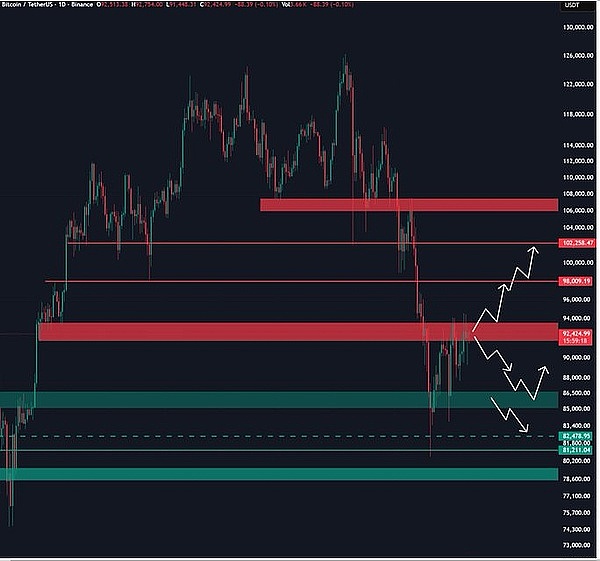
BTC: The $92k-$94k Line is a Matter of Life and Death

Big Brother Bitcoin is back in the $92,000-$94,000 resistance zone! Now it's up to the bulls: if they can break through this range, the next target is directly aiming for $100,000; if they can't break through, it will likely fall back below $90,000. This back-and-forth is so tedious~
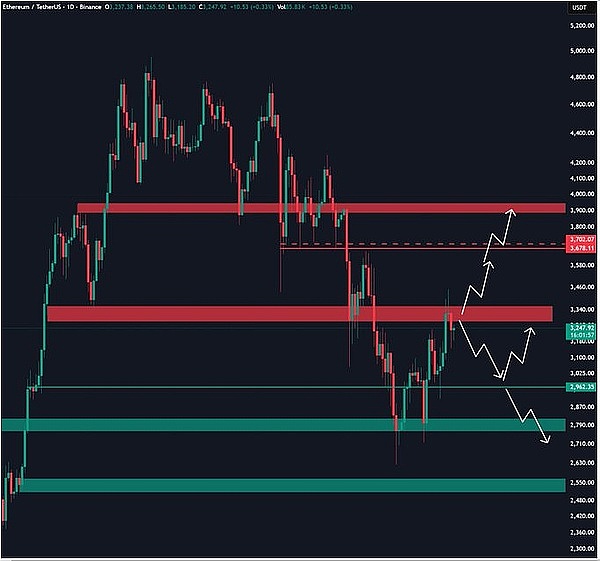
ETH: $3400 Determines the Direction

Ethereum is charging at the resistance level again! The key is to see if the daily chart can hold firmly above $3400: if it holds, it will run towards $3700-$3800; if it fails to hold, it will have to go back and test the $3000 support. Don't blindly chase the high, wait for a clear direction before acting!
SOL: The 'Potential Stock' Frenziedly Bought by Institutions, Buying a Little Daily is Worth It!

If we're talking about the altcoin most favored by institutions right now, SOL definitely takes first place! Its fund flows are too strong:

  • It's been almost two months since the ETF approval, and no matter how much the market falls, funds have been quietly adding to their positions, completely unfazed;

  • Coinbase directly added DEX trading functionality for the Solana ecosystem in its official App, essentially opening a "green channel" for SOL;

  • From JPMorgan to Nasdaq, traditional finance bigwigs are building on the Solana chain, making the ecosystem increasingly stable!

Remember: follow the market funds, don't be swayed by various bull/bear news! SOL is currently a key target for institutional布局 (layout). Buy a little bit daily and accumulate slowly, making money is just a matter of time~
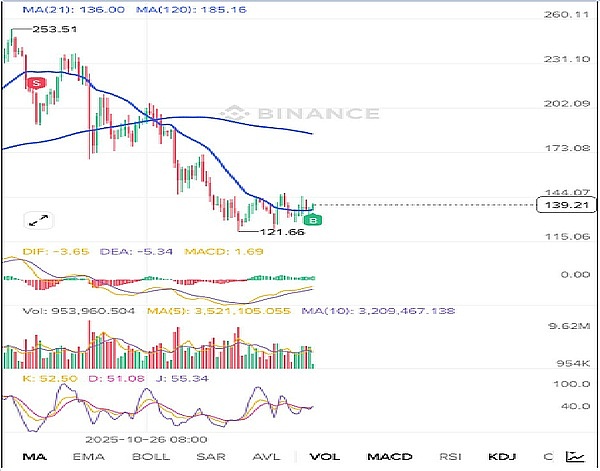
Terra Ecosystem (LUNA/LUNC/USTC): Game Over! Founder Sentenced, Paying for the $40 Billion Loss

The Terra ecosystem is completely finished! Founder Do Kwon has been sentenced to 15 years in prison. The "crash disaster" he created back then directly evaporated $40 billion and triggered a chain reaction: FTX collapsed next, trust in algorithmic stablecoins completely crumbled, and the crypto market went into winter~

LUNA, LUNC, and USTC are now completely battered by the fall. This isn't a simple pullback; it's the complete landing of negative news. There's little chance of a comeback later. Don't even think about buying the dip, don't touch them!

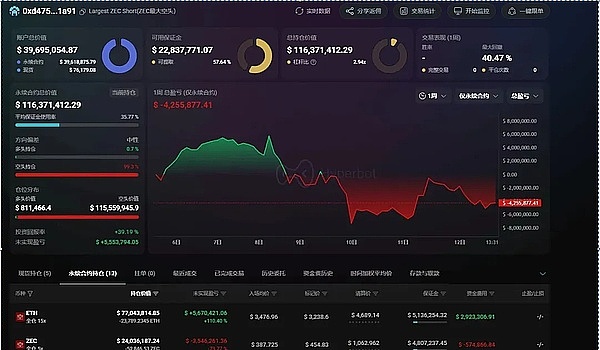
ZEC: Stubborn Shorts Get Trapped, Whales Profit by 'Sideways Movement'!

ZEC short sellers have had it rough lately! Many opened short positions hoping to make a profit, but ended up getting trapped deeper, and some fearless ones kept charging in, being extremely stubborn~

Especially the "top short seller" with the largest position, who was already profitable but didn't close the position, is now back in the red! Although they reduced their position a bit when the price dropped to the 300s, most of the position is still there. Fortunately, the whale has sufficient margin, with a liquidation point at $1057U, so they are safe for now, but the后续 (follow-up) is even more uncomfortable:

The whales have no intention of making big pumps or dumps; they just maintain the current price sideways, making money daily by collecting funding fees! Even though it's collected only every 8 hours, the large position size means they earn a significant amount~ They can even use the collected funding fees to slowly pump the price, wearing down these short sellers!

So ZEC isn't impossible to short, the key is to know when to stop, take profits and run quickly when you have them, don't linger. Money in hand is real money!
Summary: Wait for a breakout before acting on BTC/ETH, SOL can be accumulated daily with small positions, blacklist the Terra ecosystem entirely, don't be greedy when shorting ZEC.


Трендові криптовалюти

Пов'язані питання

QWhat is the key resistance range for Bitcoin (BTC) according to the article?

AThe key resistance range for Bitcoin (BTC) is $92,000 to $94,000. A successful break above this range could target $100,000, while a failure could see the price drop back below $90,000.

QWhy is Solana (SOL) considered a favorite among institutions?

ASolana (SOL) is favored by institutions because its ETFs have seen consistent capital inflows for nearly two months, Coinbase has integrated Solana ecosystem DEX trading, and major traditional finance players like JPMorgan and Nasdaq are building on its blockchain, indicating strong and stable ecosystem growth.

QWhat was the outcome for Terra's founder, Do Kwon, and its ecosystem tokens?

ATerra's founder, Do Kwon, was sentenced to 15 years in prison. The Terra ecosystem tokens (LUNA, LUNC, USTC) have crashed significantly following the $40 billion collapse, and the article advises against any investment in them as they are considered to have no recovery potential.

QWhat is the current trading strategy suggested for ZEC based on the article?

AThe article suggests that shorting ZEC can be done but advises taking profits quickly and not being greedy. It highlights that large holders (whales) are maintaining a sideways price action to collect funding fees from over-leveraged short sellers, making it risky to hold short positions for too long.

QWhat is the critical price level that Ethereum (ETH) needs to hold on a daily close for a bullish move?

AEthereum (ETH) needs to achieve a daily close above $3,400 to potentially move towards the $3,700-$3,800 range. If it fails to hold this level, it may fall back to test support at $3,000.

Пов'язані матеріали

As Consensus Accelerates, What Are Young Investors Betting On?

Title: As Consensus Forms Faster, What Are Young Investors Betting On? In the rapid evolution of tech investment, a new generation of young investors is navigating a landscape where AI, robotics, commercial aerospace, and quantum computing are advancing simultaneously. Traditional investment logic based on financial models is giving way to a need for deep technical understanding and the ability to act before industry consensus forms. An analysis of trends from the "WAIC FUTURE TECH" list of young investment leaders reveals key shifts in focus. The first major trend is the movement of AI from the digital screen into the physical world. Investment is shifting from large language models and chatbots towards embodied AI, robotics, AI hardware, and edge computing. While demonstrations generate excitement, the real challenge lies in achieving scalable, reliable, and cost-effective delivery in complex real-world environments like factories and logistics. Success depends not just on algorithms but on the integration of sensors, actuators, and control systems. Second, the competitive focus for large models is moving beyond raw capability toward building an "intelligence flywheel." The goal is to create self-reinforcing systems where user interaction generates data, improving the model, which in turn enhances the user experience and attracts more engagement. Companies that successfully embed AI into workflows to create these closed-loop systems can build lasting value that isn't easily erased by the next model upgrade. Third, facing a potential bottleneck in high-quality human-generated data, investors are looking at new underlying technologies. Reinforcement learning and self-play, as demonstrated by AlphaGo Zero, offer paths for AI to generate its own experience. Scientific foundation models, which aim to build general AI capabilities for fields like life sciences and materials discovery, represent a non-consensus direction that could unlock new frontiers of knowledge and data. Finally, in deep-tech areas like quantum computing, commercial aerospace, and space-based infrastructure, patient capital is essential. These fields have long, uncertain development and validation cycles involving complex engineering, supply chains, and regulations. Investment here requires a long-term view, focusing on foundational team capabilities and the eventual emergence of market demand, even if commercial returns are distant. Collectively, these trends illustrate how young investors are adapting to a new era. They are learning to make earlier, technically-informed judgments, balance hype with real-world viability, and provide the patient capital needed to build the deep-tech foundations of the future.

marsbit25 хв тому

As Consensus Accelerates, What Are Young Investors Betting On?

marsbit25 хв тому

Can Japan Buy Growth with AI? Will the Bond Market Believe It?

Japan's cabinet has introduced the 2026 Basic Policy on Economic and Fiscal Management and Reform, shifting its primary fiscal target. The new framework moves away from the traditional annual primary balance goal and instead prioritizes a stable reduction of the debt-to-GDP ratio. This change is tied to a strategy of increased "responsible proactive fiscal" spending, aiming to boost long-term growth through investments in strategic sectors like AI, semiconductors, energy, and robotics. The government estimates total public and private investment in 62 key technologies could exceed 370 trillion yen by 2040. The market reaction has been mixed and cautious. While equity markets may respond to policy signals, bond markets are focused on fiscal credibility. Concerns center on whether the weakening of the clear primary balance anchor could lead to looser fiscal discipline. If investors doubt that these strategic investments will generate sufficient productivity gains, tax revenue, and nominal growth to outpace rising interest costs, they may demand higher yields on Japanese Government Bonds (JGBs). Recent volatility in the yen and JGB yields, with the 10-year yield briefly reaching 2.9%, reflects this skepticism. The success of this new framework hinges on two factors: whether Japan can achieve a nominal growth rate consistently higher than its long-term interest rates, and whether future budgets demonstrate disciplined control over bond issuance. The government's narrative is that strategic investment is essential to break Japan's cycle of low growth, aging, and labor shortages. However, the bond market will continuously assess the credibility of this plan, pricing the risk that it may represent fiscal expansion rather than a viable growth strategy.

marsbit1 год тому

Can Japan Buy Growth with AI? Will the Bond Market Believe It?

marsbit1 год тому

Misjudged A-Shares: Resilience, Expectations, and Confidence

China's A-share market recently faced selling pressure, especially in tech sectors, initially triggered by a global tech sell-off that began in South Korea. However, the article argues this is a case of "mistaken injury" and highlights the market's underlying resilience. This resilience stems from three main pillars: **1) Tech Sector Fundamentals:** Unlike Korea's market dominated by a few memory chip stocks, China's tech sector is diversified across computing, communications, electronics, and semiconductors, supported by dual narratives of global AI supply chains and domestic substitution. Core areas like optical modules and fiber optics continue to show strong earnings growth. **2) "National Team" Support:** State-backed institutions and large corporations have made significant market purchases and announced buybacks, providing liquidity and signaling confidence. This is seen as a stabilizing policy signal, often associated with market bottoms. **3) Broader Market Pillars:** Other major sectors are showing endogenous recovery momentum. Consumer stocks benefit from stabilizing CPI and signs of sector recovery (e.g., liquor price hikes). Cyclical sectors like aluminum have high earnings, potential price increases due to tight supply, and low valuations. The financial sector offers stable dividends and low valuations. The conclusion is that the sell-off was driven by external contagion, not a collapse in fundamentals. With strong policy support and recovering momentum across key sectors, the A-share market possesses the toughness to regain stability.

marsbit1 год тому

Misjudged A-Shares: Resilience, Expectations, and Confidence

marsbit1 год тому

Торгівля

Спот

Популярні статті

Як купити ZEC

Ласкаво просимо до HTX.com! Ми зробили покупку Zcash (ZEC) простою та зручною. Дотримуйтесь нашої покрокової інструкції, щоб розпочати свою криптовалютну подорож.Крок 1: Створіть обліковий запис на HTXВикористовуйте свою електронну пошту або номер телефону, щоб зареєструвати обліковий запис на HTX безплатно. Пройдіть безпроблемну реєстрацію й отримайте доступ до всіх функцій.ЗареєструватисьКрок 2: Перейдіть до розділу Купити крипту і виберіть спосіб оплатиКредитна/дебетова картка: використовуйте вашу картку Visa або Mastercard, щоб миттєво купити Zcash (ZEC).Баланс: використовуйте кошти з балансу вашого рахунку HTX для безперешкодної торгівлі.Треті особи: ми додали популярні способи оплати, такі як Google Pay та Apple Pay, щоб підвищити зручність.P2P: Торгуйте безпосередньо з іншими користувачами на HTX.Позабіржова торгівля (OTC): ми пропонуємо індивідуальні послуги та конкурентні обмінні курси для трейдерів.Крок 3: Зберігайте свої Zcash (ZEC)Після придбання Zcash (ZEC) збережіть його у своєму обліковому записі на HTX. Крім того, ви можете відправити його в інше місце за допомогою блокчейн-переказу або використовувати його для торгівлі іншими криптовалютами.Крок 4: Торгівля Zcash (ZEC)Легко торгуйте Zcash (ZEC) на спотовому ринку HTX. Просто увійдіть до свого облікового запису, виберіть торгову пару, укладайте угоди та спостерігайте за ними в режимі реального часу. Ми пропонуємо зручний досвід як для початківців, так і для досвідчених трейдерів.

589 переглядів усьогоОпубліковано 2024.12.12Оновлено 2026.06.02

Як купити ZEC

Обговорення

Ласкаво просимо до спільноти HTX. Тут ви можете бути в курсі останніх подій розвитку платформи та отримати доступ до професійної ринкової інформації. Нижче представлені думки користувачів щодо ціни ZEC (ZEC).

活动图片












