Lightning Strikes Big: Bitcoin Layer-2 Surpasses $1 Billion In Monthly Activity

bitcoinistОпубліковано о 2026-02-21Востаннє оновлено о 2026-02-21

Анотація

Bitcoin's Lightning Network, a layer-2 scaling solution, surpassed $1.1 billion in monthly transaction volume in November, processing over 5 million transactions. This growth is increasingly driven by institutional players like exchanges and trading desks, rather than small-scale hobbyist use. A notable example includes a million-dollar transfer between Secure Digital Markets and Kraken, demonstrating the network's capacity for large, rapid settlements. Network capacity also reached a high of 5,606 BTC in December, improving liquidity for larger transactions. Despite mixed market conditions and Bitcoin's price volatility, Lightning activity continued to grow independently of price action. The network enables fast, low-cost payments by processing transactions off-chain, settling only net balances on the main blockchain. While future growth may be fueled by AI-driven micro-payments, broader adoption still depends on increased exchange support, liquidity, and merchant integration.

A clear sign of more than hobbyist use: monthly Lightning activity climbed past a big mark late last year. According to a report from River, November saw about $1.1 billion flow over the Bitcoin network.

That money, according to a report shared by River’s marketing chief Sam Wouters, moved through over 5 million transactions, which shows both volume and movement. It matters because money actually changed hands on Bitcoin’s second layer, not just price bets.

Adoption Driven By Bigger Players

Reports say many of the biggest gains were not from tiny tips or in-app experiments this time. Exchanges and merchant integrations are carrying a lot of the load.

Back in 2023, monthly transactions peaked at 6.6 million as apps tried out micropayments in gaming and chat. Now the shape of use looks different. Average payment sizes appear larger and the profile of users has shifted toward trading desks and businesses.

Institutional Transfers Show Network Muscle

A striking example came when Secure Digital Markets routed a million-dollar Lightning Network transfer to Kraken. That move showed big sums can be shifted quickly without waiting for on-chain confirmation.

Network capacity, which measures BTC tied up to keep channels open, reached 5,606 BTC in December. That increased liquidity matters for larger deals because it lowers the chance a large payment will fail for lack of routed funds.
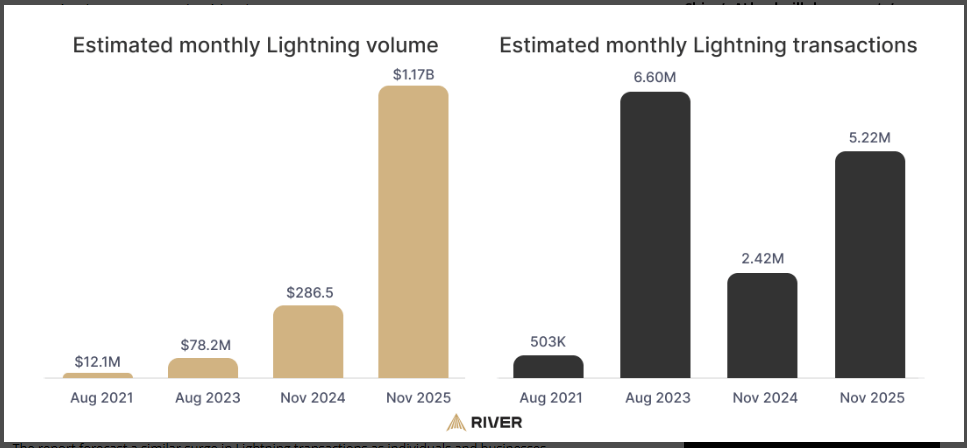
Estimated monthly Lightning transaction volume and number of transactions. Source: River

Bitcoin Price Action And Market Mood

Market conditions were mixed as the network grew. Bitcoin slid under key levels this week, and traders grew cautious as geopolitical headlines piled up.

Volume in spot markets has been muted at times, yet Lightning traffic rose despite that. Price swings still happen, and low trading days tend to amplify those moves, but the network’s payment activity did not simply mirror price spikes. In short, payments rose while BTC sometimes moved sideways.
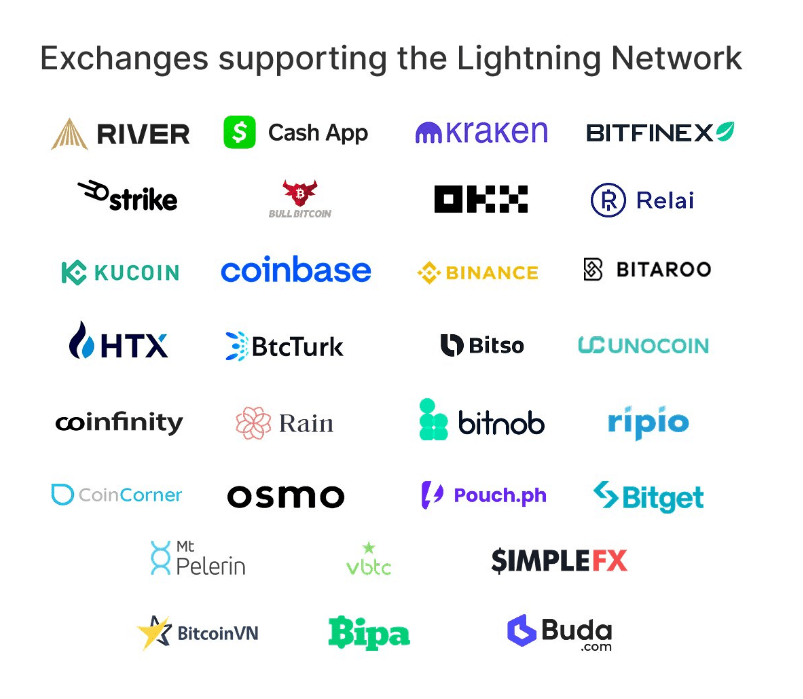
Some of the companies that provide Bitcoin Lightning Network services. Source: River

Why Lightning Is Different

The Lightning Network moves payments off the main chain by opening channels between parties. Transactions inside a channel settle almost instantly and at a fraction of the cost of a typical on-chain transfer.

Only the channel’s net balance is posted to Bitcoin when it’s closed. That design makes small and frequent payments practical, and it removes the 10-minute wait that can ruin buying something at a store.

BTCUSD now trading at $67,116. Chart: TradingView

Reports say Lightning transactions could climb if AI systems begin making automatic micro-payments for data and computing, but that shift still needs better software and clearer business models.

For the time being, the network’s growth signals progress toward everyday Bitcoin payments, though broader exchange support, deeper liquidity, and stronger merchant use will decide whether it becomes a common payment rail or stays a niche tool.

Featured image from Unsplash, chart from TradingView

Пов'язані питання

QWhat was the total value of transactions processed by the Bitcoin Lightning Network in November, as reported by River?

AThe total value of transactions processed by the Bitcoin Lightning Network in November was approximately $1.1 billion.

QAccording to the article, what is a key factor driving the recent adoption of the Lightning Network, as opposed to earlier experiments?

AThe recent adoption is being driven by bigger players such as exchanges and merchant integrations, rather than just small tips or in-app micropayment experiments.

QWhat was the significance of Secure Digital Markets routing a million-dollar transfer to Kraken on the Lightning Network?

AIt demonstrated that the network is capable of handling large financial transfers quickly without the need to wait for on-chain confirmations, showcasing its institutional utility.

QHow does the Lightning Network's design make it suitable for small, frequent payments compared to on-chain transactions?

AIt opens payment channels between parties, allowing for instant, low-cost transactions that are settled off-chain. Only the net balance of a channel is posted to the Bitcoin blockchain when it is closed, eliminating the typical 10-minute wait for on-chain confirmations.

QWhat does the article suggest is needed for the Lightning Network to evolve from a niche tool into a common payment rail?

ABroader exchange support, deeper liquidity, and stronger merchant adoption are needed for the Lightning Network to become a common payment rail.

Пов'язані матеріали

Fu Peng's First Public Speech in 2026: What Exactly Are Crypto Assets? Why Did I Join the Crypto Asset Industry?

Fu Peng, a renowned macroeconomist and now Chief Economist at New火 Group, delivered his first public speech of 2026 at the Hong Kong Web3 Festival. He explained his perspective on crypto assets and why he joined the industry, framing it within the context of macroeconomic trends and financial evolution. Fu emphasized that crypto assets are transitioning from an early, belief-driven phase to a mature, institutionally integrated asset class. He drew parallels to the 1970s-80s, when technological advances (like computing) revolutionized traditional finance, leading to the rise of FICC (Fixed Income, Currencies, and Commodities). Similarly, current advancements in AI, data, and blockchain are reshaping finance, with crypto assets becoming part of a new "FICC + C" (C for Crypto) framework. He noted that institutional capital, including traditional hedge funds, avoided early crypto due to its speculative nature but are now engaging as regulatory clarity emerges (e.g., stablecoin laws, CFTC classifying crypto as a commodity). Fu predicted that 2025-2026 marks a turning point where crypto becomes a standardized, financially viable asset for diversified portfolios, akin to commodities or derivatives in traditional finance. Fu defined Bitcoin not as "digital gold" in a simplistic sense but as a value-preserving, financially tradable asset. He highlighted that crypto's future lies in regulated, institutional adoption, moving away from retail-dominated trading. His entry into crypto signals this maturation, where traditional finance integrates crypto into mainstream asset management.

marsbit37 хв тому

Fu Peng's First Public Speech in 2026: What Exactly Are Crypto Assets? Why Did I Join the Crypto Asset Industry?

marsbit37 хв тому

Justin Sun Sues Trump Family: What $75 Million Bought Was Only a Blacklist

Justin Sun, founder of Tron, has filed a lawsuit in federal court against World Liberty Financial (WLF), alleging he was made the "primary target of a fraudulent scheme" after investing $75 million. Sun claims the investment secured him an advisor title and WLFI tokens, which were later frozen by WLF, causing "hundreds of millions in losses." The dispute began in late 2024 when Sun's investment helped revive WLF's struggling token sale, which ultimately raised $550 million. Shortly after, the SEC dropped its lawsuit against Sun following Donald Trump's inauguration. However, relations soured when Sun refused WLF's demands for additional funding. In August 2025, WLF added a "blacklist" function to its smart contract, allowing it to unilaterally freeze tokens. Sun's holdings, worth approximately $107 million, were frozen, and he was threatened with token destruction. The lawsuit highlights WLF's structure, which directs 75% of token sale profits to the Trump family, who had earned $1 billion by December 2025. WLF's CEO is Zach Witkoff, son of U.S. Middle East envoy Steve Witkoff. The project faces scrutiny for opaque operations, including a controversial loan arrangement on the Dolomite platform, co-founded by a WLF advisor. Despite Sun's history with the SEC, the case underscores centralization risks within DeFi, as WLF controls governance and holds powers to freeze assets arbitrarily. Sun's tokens remain frozen as legal proceedings begin.

marsbit45 хв тому

Justin Sun Sues Trump Family: What $75 Million Bought Was Only a Blacklist

marsbit45 хв тому

$500 to Buy OpenAI Stock: Silicon Valley's Most Respectable Liquidity Invitation

Silicon Valley's largest venture capital platform, AngelList, has launched a new fund called USVC, allowing U.S. retail investors to buy into high-profile AI companies like OpenAI, Anthropic, and xAI with a minimum investment of $500—no accredited investor status required. Promoted by AngelList co-founder Naval Ravikant, the fund is framed as an opportunity for ordinary people to access high-growth private tech investments traditionally reserved for VCs. However, critics argue it functions more like an exit vehicle for early insiders. USVC acquires shares not through primary rounds but largely via secondary transactions—purchasing stakes from early investors, VC funds, and employees looking to cash out at peak valuations. With companies like xAI heavily weighted in the portfolio, the fund effectively channels retail money into providing liquidity for insiders who entered at much lower valuations. The fund’s structure raises concerns: shares are illiquid, with no secondary market, and buybacks are limited and discretionary. The actual annual fee reaches 3.61%, far above the advertised 1% management fee. This model parallels the "low float, high fully diluted valuation" strategy seen in crypto, where early investors profit by selling to latecomers at inflated prices. The timing—alongside similar moves by platforms like Robinhood—suggests that Silicon Valley’s sudden interest in retail inclusion may be less about democratizing access and more about securing exits for insiders.

marsbit1 год тому

$500 to Buy OpenAI Stock: Silicon Valley's Most Respectable Liquidity Invitation

marsbit1 год тому

Торгівля

Спот
Ф'ючерси

Популярні статті

Як купити LAYER

Ласкаво просимо до HTX.com! Ми зробили покупку Solayer (LAYER) простою та зручною. Дотримуйтесь нашої покрокової інструкції, щоб розпочати свою криптовалютну подорож.Крок 1: Створіть обліковий запис на HTXВикористовуйте свою електронну пошту або номер телефону, щоб зареєструвати обліковий запис на HTX безплатно. Пройдіть безпроблемну реєстрацію й отримайте доступ до всіх функцій.ЗареєструватисьКрок 2: Перейдіть до розділу Купити крипту і виберіть спосіб оплатиКредитна/дебетова картка: використовуйте вашу картку Visa або Mastercard, щоб миттєво купити Solayer (LAYER).Баланс: використовуйте кошти з балансу вашого рахунку HTX для безперешкодної торгівлі.Треті особи: ми додали популярні способи оплати, такі як Google Pay та Apple Pay, щоб підвищити зручність.P2P: Торгуйте безпосередньо з іншими користувачами на HTX.Позабіржова торгівля (OTC): ми пропонуємо індивідуальні послуги та конкурентні обмінні курси для трейдерів.Крок 3: Зберігайте свої Solayer (LAYER)Після придбання Solayer (LAYER) збережіть його у своєму обліковому записі на HTX. Крім того, ви можете відправити його в інше місце за допомогою блокчейн-переказу або використовувати його для торгівлі іншими криптовалютами.Крок 4: Торгівля Solayer (LAYER)Легко торгуйте Solayer (LAYER) на спотовому ринку HTX. Просто увійдіть до свого облікового запису, виберіть торгову пару, укладайте угоди та спостерігайте за ними в режимі реального часу. Ми пропонуємо зручний досвід як для початківців, так і для досвідчених трейдерів.

273 переглядів усьогоОпубліковано 2025.02.11Оновлено 2025.03.21

Як купити LAYER

Обговорення

Ласкаво просимо до спільноти HTX. Тут ви можете бути в курсі останніх подій розвитку платформи та отримати доступ до професійної ринкової інформації. Нижче представлені думки користувачів щодо ціни LAYER (LAYER).

活动图片













