LayerZero Breaks Silence On $290 Million KelpDAO Crypto Exploit

bitcoinistОпубліковано о 2026-04-20Востаннє оновлено о 2026-04-20

Анотація

LayerZero has addressed the $290 million exploit affecting KelpDAO's rsETH, asserting it was not a protocol failure but a result of KelpDAO's decision to use a single-DVN (Decentralized Verifier Network) configuration. The company claims the attack was isolated to this specific setup and confirms no contagion risk to other assets or applications. Preliminary analysis suggests the attack was executed by a sophisticated state actor, likely North Korea's Lazarus Group. The method involved poisoning RPC infrastructure used by the LayerZero Labs DVN, swapping binaries on compromised nodes, and using DDoS attacks to force traffic to the malicious infrastructure. However, LayerZero states its least-privilege principles prevented a direct compromise. The exploit was only possible due to KelpDAO's 1-of-1 verifier setup, which contradicts LayerZero's recommended multi-DVN redundancy model. A properly configured system with multiple independent DVNs would have prevented the attack. LayerZero has deprecated affected nodes, restored its DVN, and will no longer support 1/1 configurations. Aave has frozen rsETH and WETH reserves on its platforms as a precaution while confirming rsETH on Ethereum mainnet remains fully backed.

KelpDAO’s $290 million rsETH exploit has moved into a new phase, with LayerZero and Aave now publicly outlining how the incident unfolded, why the damage appears contained, and what it could mean for crypto cross-chain security standards going forward.

The central claim from LayerZero is that the exploit was not a failure of the protocol itself, but the result of KelpDAO’s decision to run rsETH with a single-DVN configuration. That matters because the latest statements shift the market narrative away from generalized contagion risk across LayerZero-integrated assets and toward a narrower question: how much risk was concentrated in one application’s security design.

LayerZero Links KelpDAO Crypto Exploit To RPC Attack

In an incident statement from April 20, LayerZero said the April 18 attack targeted KelpDAO’s rsETH setup and was “isolated entirely to KelpDAO’s rsETH configuration as a direct consequence of their single-DVN setup.” The company added that it had conducted “a comprehensive review of active integrations” and could confirm “with confidence that there is zero contagion to any other asset or application.”

LayerZero framed the episode as a state-linked crypto infrastructure attack rather than a protocol exploit. According to the statement, “preliminary indicators suggest attribution to a highly-sophisticated state actor, likely DPRK’s Lazarus Group, more specifically TraderTraitor.”

It said the attack did not compromise the protocol, key management, or the DVN instances directly. Instead, the attacker allegedly poisoned downstream RPC infrastructure used by the LayerZero Labs DVN, swapped binaries on compromised op-geth nodes, and then used DDoS pressure on uncompromised RPCs to force failover toward the poisoned infrastructure.

That sequence is central to LayerZero’s argument. “Because of our least-privilege principles, they were unable to compromise the actual DVN instances,” the company wrote. “However, they used this pivot point to execute an RPC-spoofing attack.

Their malicious node used a custom payload designed explicitly to forge a message to the DVN with minimal warnings.” LayerZero said the manipulated node presented false data only to the DVN while returning truthful responses to other IPs, including its own monitoring infrastructure, in what it described as a deliberately stealthy effort to avoid detection.

Even so, LayerZero argues the exploit should have been stopped at the application layer had rsETH not relied on a 1-of-1 verifier setup. “The affected application was rsETH, issued by KelpDAO,” the statement said. “Their OApp configuration at the time of this incident relied on a 1-of-1 DVN setup, with LayerZero Labs as the sole verifier — a configuration that directly contradicts the multi-DVN redundancy model that LayerZero has consistently recommended to all integration partners.”

It added that “a properly hardened configuration would have required consensus across multiple independent DVNs, rendering this attack ineffective even in the event of any single DVN being compromised.”

The company said its DVN is live again, that affected RPC nodes have been deprecated and replaced, and that it will no longer sign or attest messages for applications using a 1/1 configuration. It also said it is working with law enforcement and industry partners, including Seal911, to track funds.

Aave said in an X update on late The protocol said its analysis shows “rsETH on Ethereum mainnet is fully backed,” but added that “out of an abundance of caution, rsETH remains frozen across Aave V3 and V4 and exposure to the incident is capped.” WETH reserves also remain frozen across the affected markets on Ethereum, Arbitrum, Base, Mantle, and Linea while the team continues to validate information and assess possible resolutions.

At press time, the total crypto market cap stood at $2.5 trillion.
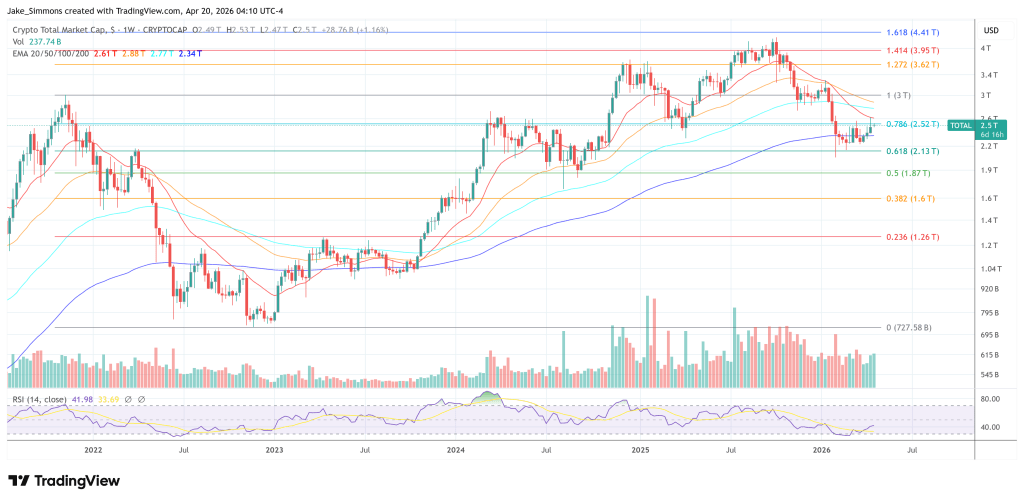
Total crypto market cap must overcome the 0.786 Fib, 1-week chart | Source: TOTAL on TradingView.com

Пов'язані питання

QWhat was the main reason for the $290 million KelpDAO crypto exploit according to LayerZero?

ALayerZero stated that the exploit was not a failure of its protocol but was the result of KelpDAO's decision to run its rsETH with a single-DVN (Decentralized Verifier Network) configuration, which contradicted LayerZero's recommended multi-DVN redundancy model.

QWhich sophisticated state actor is LayerZero preliminarily attributing the attack to?

ALayerZero's preliminary indicators suggest the attack is attributed to a highly-sophisticated state actor, likely the Lazarus Group from the Democratic People's Republic of Korea (DPRK), and more specifically, the subgroup known as TraderTraitor.

QHow did the attacker execute the RPC-spoofing attack without compromising the DVN instances directly?

AThe attacker poisoned downstream RPC infrastructure used by the LayerZero Labs DVN, swapped binaries on compromised op-geth nodes, and then used DDoS pressure on uncompromised RPCs to force failover toward the poisoned infrastructure, allowing them to forge a message to the DVN.

QWhat action has LayerZero taken regarding applications using a 1-of-1 DVN configuration after the incident?

ALayerZero announced that it will no longer sign or attest messages for any applications using a 1-of-1 DVN configuration, reinforcing its stance that a multi-DVN setup is necessary for security.

QWhat is the current status of rsETH on Aave V3 and V4 markets following the exploit?

AAave has stated that, out of an abundance of caution, rsETH remains frozen across its Aave V3 and V4 markets, and exposure to the incident is capped, although their analysis shows that rsETH on Ethereum mainnet is fully backed.

Пов'язані матеріали

As Consensus Accelerates, What Are Young Investors Betting On?

Title: As Consensus Forms Faster, What Are Young Investors Betting On? In the rapid evolution of tech investment, a new generation of young investors is navigating a landscape where AI, robotics, commercial aerospace, and quantum computing are advancing simultaneously. Traditional investment logic based on financial models is giving way to a need for deep technical understanding and the ability to act before industry consensus forms. An analysis of trends from the "WAIC FUTURE TECH" list of young investment leaders reveals key shifts in focus. The first major trend is the movement of AI from the digital screen into the physical world. Investment is shifting from large language models and chatbots towards embodied AI, robotics, AI hardware, and edge computing. While demonstrations generate excitement, the real challenge lies in achieving scalable, reliable, and cost-effective delivery in complex real-world environments like factories and logistics. Success depends not just on algorithms but on the integration of sensors, actuators, and control systems. Second, the competitive focus for large models is moving beyond raw capability toward building an "intelligence flywheel." The goal is to create self-reinforcing systems where user interaction generates data, improving the model, which in turn enhances the user experience and attracts more engagement. Companies that successfully embed AI into workflows to create these closed-loop systems can build lasting value that isn't easily erased by the next model upgrade. Third, facing a potential bottleneck in high-quality human-generated data, investors are looking at new underlying technologies. Reinforcement learning and self-play, as demonstrated by AlphaGo Zero, offer paths for AI to generate its own experience. Scientific foundation models, which aim to build general AI capabilities for fields like life sciences and materials discovery, represent a non-consensus direction that could unlock new frontiers of knowledge and data. Finally, in deep-tech areas like quantum computing, commercial aerospace, and space-based infrastructure, patient capital is essential. These fields have long, uncertain development and validation cycles involving complex engineering, supply chains, and regulations. Investment here requires a long-term view, focusing on foundational team capabilities and the eventual emergence of market demand, even if commercial returns are distant. Collectively, these trends illustrate how young investors are adapting to a new era. They are learning to make earlier, technically-informed judgments, balance hype with real-world viability, and provide the patient capital needed to build the deep-tech foundations of the future.

marsbit11 хв тому

As Consensus Accelerates, What Are Young Investors Betting On?

marsbit11 хв тому

Can Japan Buy Growth with AI? Will the Bond Market Believe It?

Japan's cabinet has introduced the 2026 Basic Policy on Economic and Fiscal Management and Reform, shifting its primary fiscal target. The new framework moves away from the traditional annual primary balance goal and instead prioritizes a stable reduction of the debt-to-GDP ratio. This change is tied to a strategy of increased "responsible proactive fiscal" spending, aiming to boost long-term growth through investments in strategic sectors like AI, semiconductors, energy, and robotics. The government estimates total public and private investment in 62 key technologies could exceed 370 trillion yen by 2040. The market reaction has been mixed and cautious. While equity markets may respond to policy signals, bond markets are focused on fiscal credibility. Concerns center on whether the weakening of the clear primary balance anchor could lead to looser fiscal discipline. If investors doubt that these strategic investments will generate sufficient productivity gains, tax revenue, and nominal growth to outpace rising interest costs, they may demand higher yields on Japanese Government Bonds (JGBs). Recent volatility in the yen and JGB yields, with the 10-year yield briefly reaching 2.9%, reflects this skepticism. The success of this new framework hinges on two factors: whether Japan can achieve a nominal growth rate consistently higher than its long-term interest rates, and whether future budgets demonstrate disciplined control over bond issuance. The government's narrative is that strategic investment is essential to break Japan's cycle of low growth, aging, and labor shortages. However, the bond market will continuously assess the credibility of this plan, pricing the risk that it may represent fiscal expansion rather than a viable growth strategy.

marsbit48 хв тому

Can Japan Buy Growth with AI? Will the Bond Market Believe It?

marsbit48 хв тому

Misjudged A-Shares: Resilience, Expectations, and Confidence

China's A-share market recently faced selling pressure, especially in tech sectors, initially triggered by a global tech sell-off that began in South Korea. However, the article argues this is a case of "mistaken injury" and highlights the market's underlying resilience. This resilience stems from three main pillars: **1) Tech Sector Fundamentals:** Unlike Korea's market dominated by a few memory chip stocks, China's tech sector is diversified across computing, communications, electronics, and semiconductors, supported by dual narratives of global AI supply chains and domestic substitution. Core areas like optical modules and fiber optics continue to show strong earnings growth. **2) "National Team" Support:** State-backed institutions and large corporations have made significant market purchases and announced buybacks, providing liquidity and signaling confidence. This is seen as a stabilizing policy signal, often associated with market bottoms. **3) Broader Market Pillars:** Other major sectors are showing endogenous recovery momentum. Consumer stocks benefit from stabilizing CPI and signs of sector recovery (e.g., liquor price hikes). Cyclical sectors like aluminum have high earnings, potential price increases due to tight supply, and low valuations. The financial sector offers stable dividends and low valuations. The conclusion is that the sell-off was driven by external contagion, not a collapse in fundamentals. With strong policy support and recovering momentum across key sectors, the A-share market possesses the toughness to regain stability.

marsbit1 год тому

Misjudged A-Shares: Resilience, Expectations, and Confidence

marsbit1 год тому

Торгівля

Спот
活动图片





