KuCoin taps Tomorrowland festivals as MiCA-era on-ramp for European fans

cointelegraphОпубліковано о 2025-12-17Востаннє оновлено о 2025-12-17

Анотація

KuCoin has signed an exclusive multi-year partnership with Tomorrowland music festivals from 2026 to 2028, becoming the event's official crypto and payments partner. This follows KuCoin’s recent acquisition of a MiCA-regulated license in the EU, allowing it to operate as a fully compliant crypto service provider. The collaboration aims to integrate cryptocurrency seamlessly into festival operations—including ticketing, merchandise, and concessions—without disrupting the user experience. Emphasizing security and regulatory compliance, KuCoin seeks to position crypto as a mainstream financial tool, learning from past failed Web3 partnerships like FTX’s with Tomorrowland. The goal is a smooth, invisible integration of digital assets into live events.

KuCoin announced an exclusive multiyear deal with Tomorrowland Winter and Tomorrowland Belgium from 2026 to 2028, making the exchange the music festival’s exclusive crypto and payments partner.

The move comes just weeks after KuCoin secured a Markets in Crypto-Assets Regulation (MiCA) service provider license in the European Union.

KuCoin’s MiCA play goes mass‐market

KuCoin EU Exchange recently obtained a crypto asset service provider license in Austria under the EU’s MiCA regime, giving it a fully regulated foothold in the bloc as Brussels’ new rulebook for exchanges, custody and stablecoins comes into force.

The Tomorrowland deal signals how KuCoin plans to use that status, not just to run a compliant trading venue, but to plug crypto rails directly into mainstream culture.
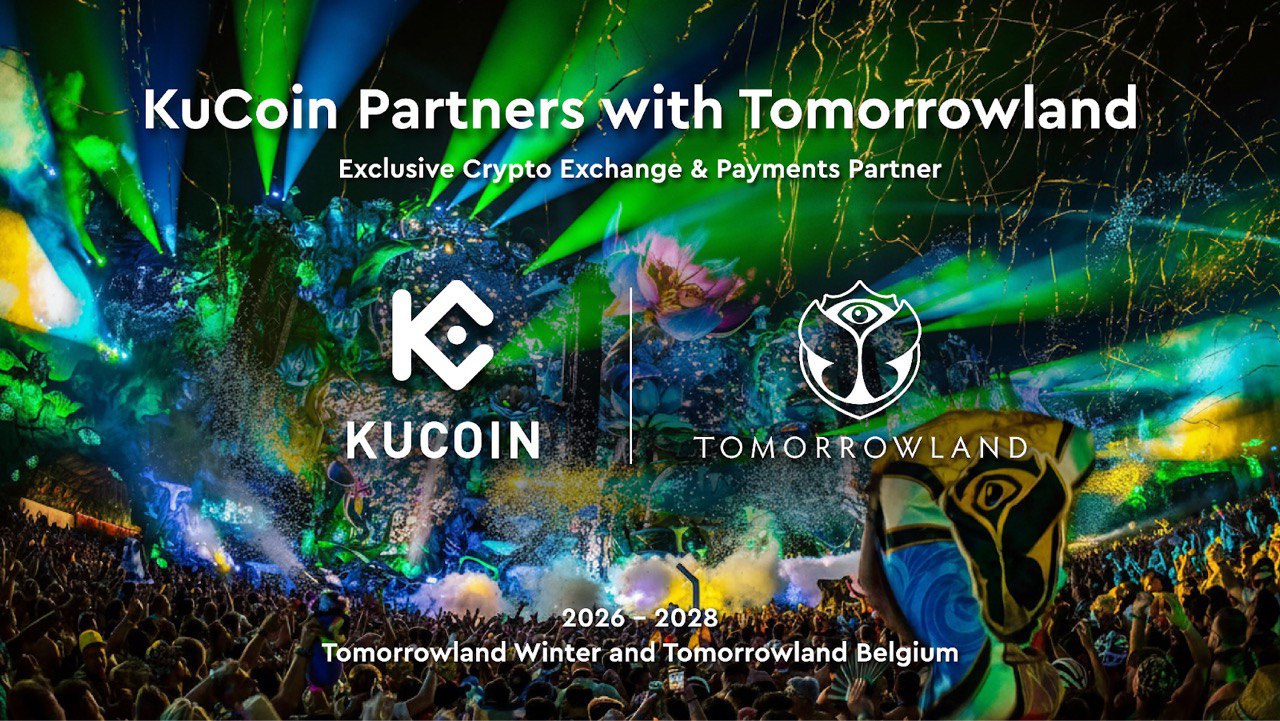
KuCoin joins forces with Tomorrowland. Source: KuCoin

KuCoin said the Tomorrowland deal will cover Tomorrowland Winter 2026 in Alpe d’Huez, France, and Tomorrowland Belgium 2026 in Boom, Belgium, with the same arrangement continuing through 2028.

Related: Burning Man-inspired festival in Bali goes full Web3: Here’s how

From sponsorship to payment rails

KuCoin insists this is not just a logo play. A spokesperson at KuCoin told Cointelegraph that as an exclusive payments partner, the exchange is working with Tomorrowland to weave crypto into the festival’s existing payments stack so that “financial tools” sit behind the scenes of ticketing, merch and food and drink.

The stated goal is to keep the rails “intuitive and invisible,” rather than forcing festivalgoers through clunky wallets or unfamiliar flows, with KuCoin positioning itself as facilitating the secure and efficient movement of value while fans focus on the music.

The company declined to spell out exactly which assets and rails will be supported on‐site, or whether every purchase will run natively onchain, but said that KuCoin’s “Trust First. Trade Next.” mantra runs through its messaging.

The spokesperson stressed advanced security, multi‐layer protection and adherence to EU standards as the foundation for taking crypto beyond the trading screen and into live events.

Related: What is Markets in Crypto-Assets (MiCA)?

Learning from FTX’s Tomorrowland flop

Tomorrowland’s organizers have been here before. In 2022, the festival announced a Web3 partnership with FTX Europe that promised NFTs and “the future of music festivals” before collapsing along with the exchange itself months later.

That experience makes the choice of a MiCA‐licensed partner, and the emphasis on user protection, more than cosmetic; it is a second attempt at bridging culture and crypto (this time with regulatory scaffolding and clearer guardrails).

Rather than setting public hard targets for user numbers or payment volumes by 2028, KuCoin is pitching success as “seamless integration” of crypto into the festival experience:

“We aim to demonstrate that digital assets can be a core component of global digital finance, moving from a niche technology to a mainstream utility. “

Related: Spain’s regulator sets out MiCA transition rules for crypto platforms

Трендові криптовалюти

Пов'язані матеріали

Annual Salary of Millions Competing for Electricians, Meta Rushes to Open Its Own Technical School

The AI boom is facing an unexpected bottleneck: a severe shortage of skilled construction workers and electricians. As tech giants like Meta, OpenAI, and Alphabet race to build massive data centers—such as OpenAI's $16 billion "Stargate" project—they are hitting a critical labor wall. The U.S. needs an estimated 130,000 more electricians, 240,000 construction workers, and 150,000 supervisors by 2030 for AI infrastructure alone, but tens of thousands of electrician jobs go unfilled each year. While AI companies offer high premiums, with electricians earning up to $280,000 annually, worker scarcity still causes massive losses—delays on a single project can cost $14.2 million per month. The complexity of building AI data centers, which require immense power (equivalent to powering hundreds of thousands of homes), sophisticated electrical systems, and advanced liquid cooling solutions, demands highly skilled technicians who are in short supply. To combat this, companies are investing heavily in training. Meta has committed $115 million to a free training school offering tuition, housing, and stipends, targeting 5,000 new workers. OpenAI is partnering with unions to secure skilled labor. These efforts are paying off, with a significant rise in Gen Z interest in trade schools over college. However, the power demands are staggering. AI data centers are driving a rapid surge in electricity consumption, projected to account for up to 12% of U.S. power use by 2028 and raising costs for consumers. Furthermore, the construction boom is project-based, leading to a potential future glut of trained workers once building peaks, which could depress wages industry-wide. The race for AI supremacy now depends as much on skilled hands as on advanced chips.

marsbit1 год тому

Annual Salary of Millions Competing for Electricians, Meta Rushes to Open Its Own Technical School

marsbit1 год тому

OpenAI No Longer Sells Its Most Expensive Model for Profit

OpenAI is shifting its business strategy away from promoting its most expensive, flagship models for every task. Recent price cuts—80% for GPT-5.6 Luna and 20% for Terra—signal a deeper change: the company now actively advises users that many tasks don't require the most powerful model. Instead, OpenAI recommends a tiered approach: use the high-end GPT-5.6 Sol for complex planning and analysis, then delegate execution to cheaper models like Luna. This mirrors moves by Anthropic, which recently launched Claude Opus 5 at half the price of its top model, Fable 5. Both companies are de-emphasizing flagship models as primary revenue drivers, using them instead for brand prestige and technological showcases. The industry is entering a "mass-market" phase, similar to automotive, where high-volume, cost-effective models handle daily operations and drive scale. OpenAI's price reductions are partly enabled by AI models themselves optimizing underlying code and infrastructure, creating a self-reinforcing cycle of efficiency gains and cost reduction. Competition is shifting from "who is smartest" to "who offers the best value." The goal is no longer selling individual models but fostering widespread API adoption and ecosystem lock-in. By making AI calls cheap and ubiquitous, companies like OpenAI aim to become the indispensable, utility-like infrastructure powering automated workflows—the "water and electricity" of software, quietly embedded everywhere.

marsbit1 год тому

OpenAI No Longer Sells Its Most Expensive Model for Profit

marsbit1 год тому

Торгівля

Спот

Популярні статті

Як купити ERA

Ласкаво просимо до HTX.com! Ми зробили покупку Caldera (ERA) простою та зручною. Дотримуйтесь нашої покрокової інструкції, щоб розпочати свою криптовалютну подорож.Крок 1: Створіть обліковий запис на HTXВикористовуйте свою електронну пошту або номер телефону, щоб зареєструвати обліковий запис на HTX безплатно. Пройдіть безпроблемну реєстрацію й отримайте доступ до всіх функцій.ЗареєструватисьКрок 2: Перейдіть до розділу Купити крипту і виберіть спосіб оплатиКредитна/дебетова картка: використовуйте вашу картку Visa або Mastercard, щоб миттєво купити Caldera (ERA).Баланс: використовуйте кошти з балансу вашого рахунку HTX для безперешкодної торгівлі.Треті особи: ми додали популярні способи оплати, такі як Google Pay та Apple Pay, щоб підвищити зручність.P2P: Торгуйте безпосередньо з іншими користувачами на HTX.Позабіржова торгівля (OTC): ми пропонуємо індивідуальні послуги та конкурентні обмінні курси для трейдерів.Крок 3: Зберігайте свої Caldera (ERA)Після придбання Caldera (ERA) збережіть його у своєму обліковому записі на HTX. Крім того, ви можете відправити його в інше місце за допомогою блокчейн-переказу або використовувати його для торгівлі іншими криптовалютами.Крок 4: Торгівля Caldera (ERA)Легко торгуйте Caldera (ERA) на спотовому ринку HTX. Просто увійдіть до свого облікового запису, виберіть торгову пару, укладайте угоди та спостерігайте за ними в режимі реального часу. Ми пропонуємо зручний досвід як для початківців, так і для досвідчених трейдерів.

599 переглядів усьогоОпубліковано 2025.07.17Оновлено 2026.06.02

Як купити ERA

Обговорення

Ласкаво просимо до спільноти HTX. Тут ви можете бути в курсі останніх подій розвитку платформи та отримати доступ до професійної ринкової інформації. Нижче представлені думки користувачів щодо ціни ERA (ERA).

活动图片