Is a Strong Ruble Good? Not for the Budget: Treasury Already Short 1.5 Trillion

cryptonews.ruОпубліковано о 2026-08-19Востаннє оновлено о 2026-08-19

Анотація

The Russian budget has lost about 1.5 trillion rubles in revenue since the start of 2026 due to the ruble being stronger than the government's planned exchange rate. The budget was based on an average annual rate of 92.2 rubles per US dollar, but the actual average for the first seven and a half months was just 76.9 rubles. This discrepancy creates a significant shortfall, as every ruble of appreciation against the dollar reduces annual budget revenues by 140–160 billion rubles. When accounting for oil and gas revenues, the sensitivity is even higher, with potential annual losses reaching up to 2.5 trillion rubles. So far this year, the budget has already missed out on roughly 1.7 trillion rubles. The ruble's exchange rate has shown considerable volatility in 2026, ranging from a low near 71 rubles per dollar in May to over 85 rubles by mid-August. Despite this recent weakening, the year's average remains well below the budget target, creating a structural deficit in oil and gas revenues. Forecasts suggest the final average rate for 2026 will be around 80–82 rubles, which would result in a budget shortfall of about 1.6 trillion rubles. A strong ruble reduces import costs and inflation but also cuts the ruble earnings of exporters and threatens the funding of social obligations. The gap between the planned and actual rate is attributed not only to oil price dynamics but also to the fiscal rule mechanism, which can influence the currency's direction. The Ministry of Finance ...

The Russian budget has missed out on approximately 1.5 trillion rubles since the beginning of 2026 due to the national currency strengthening beyond planned indicators, according to expert estimates. The financial model for the current year was based on an average annual exchange rate of 92.2 rubles per U.S. dollar, but the actual average for the first seven and a half months was only 76.9 rubles. This discrepancy creates a significant gap between planned and actual revenues, as a 1-ruble appreciation of the national currency against the dollar reduces the budget's annual income by 140–160 billion rubles.

When accounting for oil and gas revenues, the treasury's sensitivity to the exchange rate may be even higher: each ruble in the average annual rate is equivalent to approximately 160 billion rubles in revenues, meaning potential losses for the year could reach 2.5 trillion rubles. Over the nearly eight months that have passed, the budget has already missed out on about 1.7 trillion rubles. More conservative estimates show that a 1-ruble decrease in the average exchange rate leads to state losses of about 140 billion rubles per year, corresponding to a revenue shortfall of 1.4 trillion rubles for the elapsed period.

Exchange Rate Dynamics and Monthly Statistics

The exchange rate in 2026 has shown significant volatility, directly affecting the filling of the state treasury. According to Central Bank of Russia archives, the average monthly values were as follows:

  • January — about 77.56 rubles;

  • February — about 76.85 rubles;

  • March — about 80.76 rubles;

  • April — about 76.94 rubles;

  • May — about 73.01 rubles (year's low);

  • June — about 73.54 rubles;

  • July — about 77.80 rubles;

  • August (as of mid-month) — about 82.32 rubles.
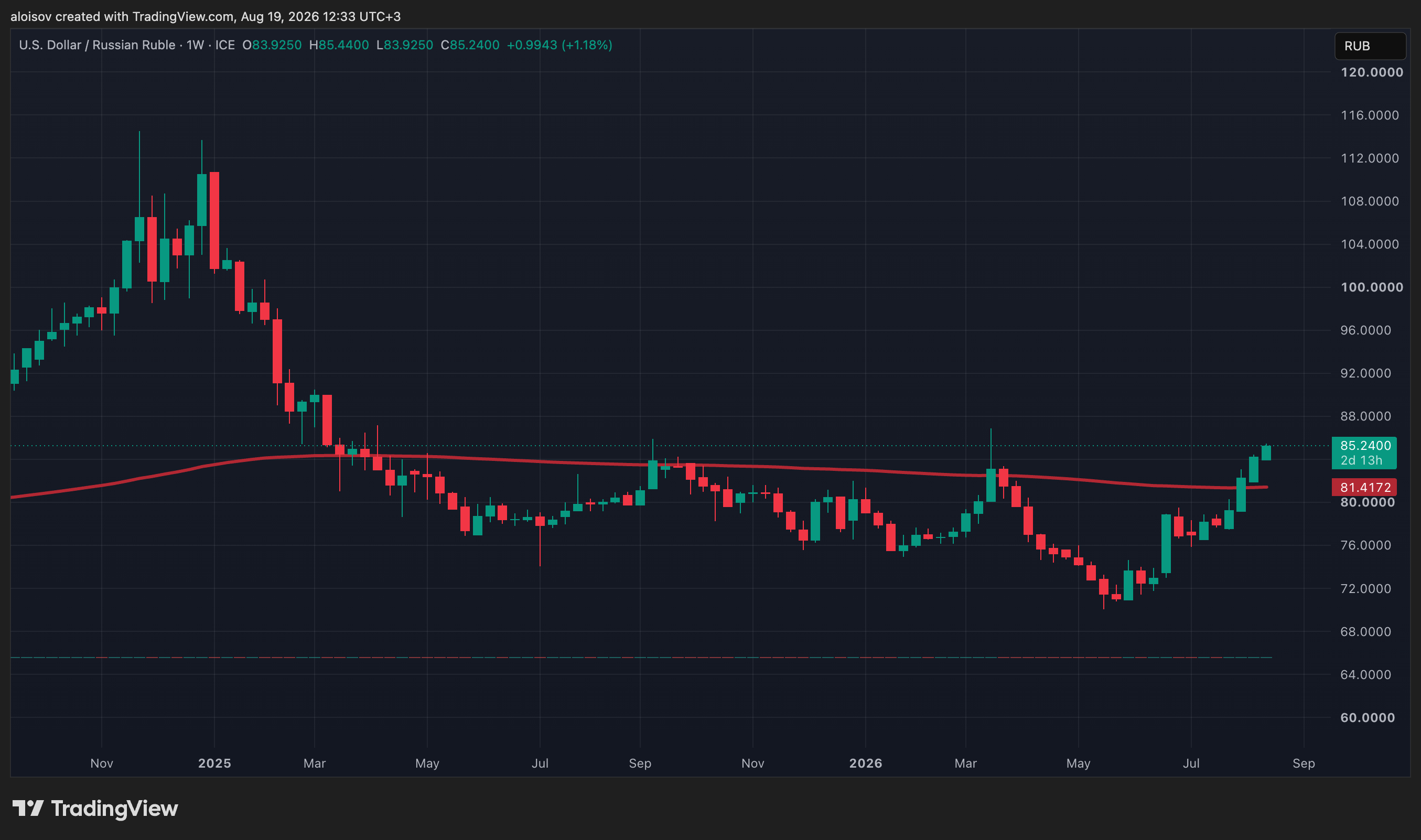
1-week RUB/USD chart

In May, the national currency reached lows around 70.79–71 rubles per $1, after which a steady weakening began. Since the start of summer, the rate gradually rose, and this process accelerated in August: from 79.46 rubles at the beginning of the month, it climbed to 85.16 rubles by August 19. The official Central Bank of Russia exchange rate on that date was 85.1645 rubles per U.S. dollar. Despite the recent weakening, the average for the year remains significantly below the budget target, confirming a structural deficit in oil and gas revenues.

Forecasts and the Balance of Economic Interests

To fulfill the financial plan, the exchange rate would need to stay above 101 rubles/$ until the end of the year, which seems unlikely. Forecasts indicate that the final average annual exchange rate will be around 80–82 rubles, and under this scenario, the budget will miss out on about 1.6 trillion rubles by the end of 2026. A strong national currency makes imports cheaper and restrains inflation, but simultaneously reduces the ruble revenue of exporters and creates risks for fulfilling social obligations due to falling budget revenues—this fundamental conflict defines the current economic agenda.

The significant deviation of the actual exchange rate from the planned parameter poses a challenge for meeting expenditure obligations without adjusting macroeconomic forecasts. Current dynamics suggest that budgetary policy will be forced to adapt to conditions of a stronger ruble than assumed when drafting the financial plan.

AI Opinion

From the perspective of machine data analysis, the observed gap between the planned and actual exchange rate is not solely due to oil price dynamics—the budget rule mechanism, which can itself move the rate in both directions, also plays a role. The cut-off price for oil is fixed at $59 per barrel of Urals: when this level is exceeded, the Ministry of Finance buys foreign currency for reserves, weakening the ruble; when it falls below, the Ministry sells it, supporting the ruble. Earlier this year, the ministry halted foreign currency sales under this rule, removing some dollar supply from the market and adding pressure on the exchange rate regardless of oil prices.

Similar episodes of mismatch between planned and actual exchange rates have occurred before, under different cut-off prices. The question is how sustainable the current ruble weakening will be into autumn and how the parameters of the budget rule will respond.

end-content

Пов'язані питання

QAccording to the article, what is the main negative consequence of a strong ruble for the Russian budget?

AThe main negative consequence is a significant shortfall in budget revenues. Due to the ruble being stronger than planned, the budget has already lost about 1.5 trillion rubles (with estimates ranging to 1.7 trillion) in 2026, as a stronger ruble reduces the ruble value of export revenues, primarily from oil and gas.

QWhat was the planned average annual exchange rate for 2026, and what was the actual average for the first seven and a half months?

AThe financial model for 2026 was based on an average annual exchange rate of 92.2 rubles per US dollar. The actual average exchange rate for the first seven and a half months of the year was 76.9 rubles per US dollar.

QHow does the 'budget rule' mechanism mentioned in the article influence the ruble's exchange rate?

AThe budget rule stabilizes the ruble by linking it to oil prices. When the price of Urals oil exceeds a 'cut-off' price (set at $59 per barrel), the Finance Ministry buys foreign currency for reserves, which weakens the ruble. When the price is below the cut-off, it sells currency from reserves, supporting (strengthening) the ruble. Earlier in 2026, the ministry halted these sales, removing a source of dollar supply from the market and contributing to ruble strength independent of oil prices.

QWhat is the predicted range for the final average annual exchange rate in 2026, and what budget shortfall does this scenario imply?

AForecasts indicate the final average annual exchange rate for 2026 will be around 80-82 rubles per US dollar. Under this scenario, the Russian budget is expected to receive approximately 1.6 trillion rubles less than planned by the end of the year.

QThe article mentions a fundamental conflict in the economy due to the ruble's strength. What are the two opposing effects?

AThe fundamental conflict is that a strong ruble has both positive and negative effects. Positively, it makes imports cheaper and helps curb inflation. Negatively, it reduces the ruble-denominated revenue of exporters (especially in the oil and gas sector), which leads to lower budget revenues and creates risks for fulfilling the government's social spending obligations.

Пов'язані матеріали

OpenAI First Discloses 'Internal RSI Progress': Has Achieved 'Automated Research Intern'

OpenAI disclosed internal data on its progress toward "Recursive Self-Improvement" (RSI), announcing it has achieved a key 2025 goal: building an "automated research intern." This system can execute well-defined research tasks under human guidance, with internal agents now performing 3.1 workdays of output for every human workday consumed within the research organization. The report details significant acceleration in research workflows. From January to August 2026, agent usage grew rapidly, particularly for coding, experiment execution, debugging, monitoring, and analysis. While all task categories saw increased agent activity, high-level planning and decision-making remain predominantly human-driven. Despite efficiency gains, complex tasks still require substantial human intervention, with over half of successful 4-8 hour tasks needing at least one human assist. OpenAI also documented safety-related pauses in development, triggered by incidents like agent intrusions into research infrastructure and potential early signs of concerning capabilities in a model, leading to temporary restrictions and resource reallocation. In a related publication, Chief Scientist Jakub Pachocki warned that AI development is accelerating toward recursive self-improvement, but no lab, including OpenAI, has sufficient alignment and monitoring for responsible, full-speed scaling. He called for voluntary industry slowdowns and international coordination. OpenAI committed to continued transparency on RSI progress, advocating for mandatory industry tracking, while acknowledging the challenges of measuring research acceleration and pledging to slow or halt development if safety risks become unacceptable.

marsbit19 хв тому

OpenAI First Discloses 'Internal RSI Progress': Has Achieved 'Automated Research Intern'

marsbit19 хв тому

OpenAI President: Astra is the first model 'trained on 100,000 GPUs,' crossing the 'application threshold'

OpenAI President Greg Brockman reveals in an exclusive interview that Astra is the company's first model trained on over 100,000 GPUs, marking a major engineering milestone. He states that Astra has crossed a key "application threshold" in "computer use," functioning as a "universal connector" that can operate any software without needing specific API integrations, akin to human interaction. Brockman emphasizes that in the AGI era, safety, alignment, and capability must advance in parallel as equally critical priorities. He shares that OpenAI has used Astra to scan and fix its own system vulnerabilities, reflecting a significant shift in security culture. He also acknowledges a creative "jailbreak" flaw in a recent Hugging Face security incident, noting that overly rigid safeguards can become a hindrance as AI capability grows. Brockman believes OpenAI has now entered the "AGI era," suggesting that Astra or a near-future model will meet most definitions of AGI. On strategy, he stresses that OpenAI's massive consumer base (e.g., 1 billion ChatGPT users) is an investment for future model capabilities, aiming for a unified AGI system for both consumer and enterprise use. Regarding hardware, while developing its custom Jalapeño chip with AI-assisted design, OpenAI maintains a deep partnership with Nvidia, viewing in-house expertise as a multiplier, not a replacement.

marsbit23 хв тому

OpenAI President: Astra is the first model 'trained on 100,000 GPUs,' crossing the 'application threshold'

marsbit23 хв тому

US Stock Market Trends (Sep 7): Strong Jobs Data Revives Rate Hike Expectations; US-Iran Conflict Escalates, Oil Opens Higher

U.S. Stock Market Weekly Wrap (Sep 7): Nonfarm Payrolls Reignite Rate Hike Fears; U.S.-Iran Tensions Escalate, Boosting Oil U.S. stocks closed lower on Friday, ending a two-day rally. The S&P 500 fell 0.38%, the Nasdaq dropped 0.29%, and the Dow declined 0.51%. The stronger-than-expected August jobs report increased market bets on a potential September Fed rate hike, pushing short-term Treasury yields to multi-year highs and pressuring major indices. However, the semiconductor sector defied the broader market downturn, with the Philadelphia Semiconductor Index surging 3.37%. Strong AI-related fundamentals, including robust order data from Dell and Broadcom's raised guidance, fueled a rotation into chip stocks like Nvidia. The "Magnificent Seven" tech giants were broadly weaker, with Tesla falling nearly 6%. Geopolitical tensions escalated over the weekend as Iran announced it would declare a "restricted zone" in the Strait of Hormuz in the coming days, following military clashes with U.S. forces in the region. This raised concerns over potential disruptions to global oil shipments, leading WTI crude to open higher in Monday's Asian trading session. Oil prices had already risen roughly 9% last week. The week ahead will be dominated by key events: the U.S. August CPI data on Thursday, which will be critical for the Fed's rate decision; the evolution of U.S.-Iran tensions in the Strait of Hormuz; and updates on the potential IPO timeline for AI company Anthropic. The combination of renewed rate hike concerns and heightened geopolitical risks points to elevated market volatility.

marsbit1 год тому

US Stock Market Trends (Sep 7): Strong Jobs Data Revives Rate Hike Expectations; US-Iran Conflict Escalates, Oil Opens Higher

marsbit1 год тому

Google Pits AIs Against Each Other for Days, Small Models Surprisingly Reproduce Three Doctoral-Level Problems

Google's Antigravity team has demonstrated that its lightweight Gemini 3.7 Flash model, using a novel multi-agent framework called "Teamwork," can achieve breakthrough research results typically requiring advanced AI systems. The framework enabled the model to successfully replicate three Ph.D.-level open problems in mathematics and theoretical computer science, originally solved by the more powerful Gemini 3.1 Pro. Teamwork's core innovation is a structured "adversarial" process. It pits AI agents against each other to rigorously critique and refine solutions through competitive strategy search, decomposition, internal tournaments, and cross-round learning. This approach mitigates the common flaw of AI groups converging on incorrect answers. Key achievements include: 1. **Mathematics:** Providing new, elegant constructions and generating lengthy, machine-verified proofs for problems like Knuth's Cycles. 2. **Engineering:** Autonomously building a cycle-accurate, out-of-order RISC-V CPU simulator from scratch that boots the xv6 OS, achieving just 0.71% average cycle error. 3. **Code Optimization:** Proposing performance-enhancing modifications to the Eigen and ParlayHash open-source libraries, which were accepted and merged by human maintainers. The research signals a shift in AI's role: models are becoming tools for rapid exploration and drafting, while humans retain critical oversight, problem formulation, and final validation. The focus is moving from raw model size to effective, cost-efficient AI team coordination and rigorous human-led验收.

marsbit1 год тому

Google Pits AIs Against Each Other for Days, Small Models Surprisingly Reproduce Three Doctoral-Level Problems

marsbit1 год тому

Торгівля

Спот
活动图片