IOSG: TAO is Elon Musk who invested in OpenAI, Subnet is Sam Altman

marsbitОпубліковано о 2026-04-14Востаннє оновлено о 2026-04-14

Анотація

The article presents a critical analysis of Bittensor (TAO), a decentralized AI marketplace, comparing its economic model to Elon Musk's early investment in OpenAI, where funders have no guaranteed return. TAO acts as a funding layer, distributing tokens to subnet operators (akin to labs or researchers) based on their subnet token performance. However, subnets are under no obligation to return any value—such as AI models, data, or services—back to the TAO ecosystem. This creates a risk of value extraction, where developers may use TAO incentives for research and then commercialize成果 independently. The bear case highlights the lack of binding mechanisms, potential capital drain through token inflation, and competition from well-funded centralized AI giants. The optimistic view argues that continuous resource needs may naturally retain subnets within Bittensor, leveraging crypto’s ability to aggregate resources at scale, similar to Bitcoin’s success with computation. Ultimately, investing in TAO is a speculative bet on a coordination miracle—where incentives align to keep valuable AI projects within the ecosystem—rather than a traditional equity-like claim on output. The outcome distribution is highly skewed: most scenarios lead to niche use or value leakage, while a few could result in TAO becoming a foundational decentralized AI asset.

The bullish case for TAO requires you to believe that a game theory miracle can happen. But such miracles have occurred before in the cryptocurrency industry.

Bittensor has one of the most elegant narratives in the cryptocurrency space: a decentralized marketplace for AI intelligence, where market mechanisms allocate capital to the most impactful research. TAO is the coordination layer, subnets are the labs, and the market is the funding committee.

Strip away the narrative, and you'll find something more unsettling.

Bittensor is a funding program where cryptocurrency speculators provide capital for AI R&D—and the funded parties have no obligation to return any value to TAO.

Think of TAO as Elon Musk—he was the first investor in OpenAI, a "non-profit" enterprise. Subnets are like Sam Altman—they are the builders who receive the funding, deliver the product, but have no contractual obligation to share the proceeds. They may ultimately choose to privatize the gains without returning any value to the original funding source.

Bittensor distributes TAO tokens to subnet operators and miners based on the price of the subnet's token. Once a subnet receives a TAO allocation, there is no enforcement mechanism requiring that the AI models, datasets, or services it generates must remain within the Bittensor ecosystem. Subnet operators can farm the TAO incentives from Bittensor and then take the real product elsewhere—deploy it on centralized cloud servers, package it as an independent API, or simply put a SaaS wrapper on it and sell it.

TAO holds no equity and has no licensing contracts. The only binding element is the subnet token—its price must be maintained to sustain access to resources. But this only works *before* the subnet "flies the coop": once the product is robust enough to stand on its own outside the Bittensor system, that tether is cut. The relationship between Bittensor and its subnets is less like venture capital and more like research grant funding—you get seed money, but they don't get your equity.

To put it bluntly, Bittensor is essentially a wealth transfer: from the pockets of token speculators to the accounts of AI researchers—or more plainly, from the retail investors to the technically savvy "miners".

The mechanism is simple: TAO investors are underwriting the entire ecosystem. They buy and hold TAO, propping up the price, and that price itself is the pipeline for capital flowing into the subnet incentive system. Subnet operators earn TAO inflation rewards by "demonstrating performance"—but in reality, "demonstrating performance" largely means keeping the price of their own subnet token looking good. The AI products built with this funding can walk away at any time—the only constraint is their continued need to access network resources.

This is a VC's worst nightmare: you provide the capital, they build the product, but they owe you nothing. What remains is a token emission schedule and a prayer.

The Optimist's Interpretation

Now, look at it from another angle. The optimistic view rests on two pillars:

Persistent resource needs mean AI companies are perpetually capital-constrained. Compute, data, and talent are expensive. If Bittensor can reliably provide these resources at scale, subnets have a rational incentive to stay—not because they are locked in, but because leaving means losing the supply channel.

There is a soft, logical underpinning: AI's hunger for resources is insatiable, and the scale TAO can provide is unattainable through independent financing. Following this logic, subnet teams will actively maintain their token's valuation; no enforcement mechanism is needed, and the TAO economy spontaneously forms a positive flywheel. Cryptocurrency excels at resource aggregation. Bitcoin aggregated a massive amount of computing power solely through token incentives. Ethereum's proof-of-work was also a tremendous success, a powerful magnet for computational resources.

Bittensor is applying the same playbook to AI. The "enforcement mechanism" is the token game itself—as long as TAO has value, the incentive to participate keeps growing.

If you ran 1000 simulations of Bittensor's future, the distribution of outcomes would be extremely skewed.

In most simulated scenarios, Bittensor remains a niche funding program. The AI outputs generated by subnets are insignificant. The best-performing subnets gain significant attention, capture the rewards, and then pivot to closed-source models, leaving no value for TAO. As token emissions outpace value creation, the TAO token depreciates.

In a minority of simulation paths, something actually takes off. A subnet creates a truly competitive AI service, and network effects begin to snowball. TAO becomes the de facto coordination layer for decentralized AI infrastructure—not by enforcing value capture, but through the gravitational pull of being the reserve asset of a functioning AI economy.

In a very few cases, TAO becomes the defining asset of a new category.

What Could Go Wrong

The bear case is simple: no stickiness. Once a subnet no longer needs the TAO token incentives, it leaves. Bittensor is a transitional phase, not a final destination. Centralized AI holds overwhelming advantage. Companies like OpenAI, Google, and Anthropic have orders of magnitude more compute and talent. TAO cannot compete with the firepower of venture capital and private equity markets. Therefore, the best talent will choose the traditional path. Emissions are a tax.

TAO's emission schedule subsidizes subnets by diluting holders. If the value created by subnets doesn't justify this dilution, it's a slow bleed disguised as a "growth mechanism".

The optimistic scenario, frankly, feels more like wishful thinking than a viable path to success.

Conclusion

The majority of capital deployed into TAO will ultimately subsidize development activities that return no value to token holders. But Crypto has repeatedly proven that coordination games driven by token incentives can produce results that all rational models fail to forecast.

Bitcoin shouldn't have worked, but it did—though this argument alone is not sufficient, and the industry has used it to back numerous projects that couldn't withstand first-principles scrutiny.

The core question for TAO isn't whether an enforcement mechanism exists—it doesn't, and efforts like dTAO haven't changed that. The core question is: are the game-theoretic incentives strong enough to keep the highest-quality subnets on the rails? Buying TAO is a bet that a "soft lock-in" will hold in the harsh face of reality.

This is either naivety or foresight.

Пов'язані питання

QWhat is the core concern raised about Bittensor's economic model in the article?

AThe core concern is that Bittensor functions as a wealth transfer from TAO token speculators to AI researchers (miners), with no mandatory mechanism forcing subnet operators to return any value (like AI models or profits) back to the TAO ecosystem. Subnets can take the TAO incentives and then take their successful products elsewhere.

QAccording to the optimistic view, what are the two main reasons subnets might choose to stay within the Bittensor ecosystem?

AThe two main reasons are: 1) A continuous, insatiable demand for AI resources (compute, data, talent), which Bittensor can provide at a scale that is hard to achieve alone. 2) The success of crypto token incentives in aggregating massive resources, as seen with Bitcoin and Ethereum, creating a powerful flywheel effect where the value of TAO itself becomes the enforcement mechanism.

QHow does the article use Elon Musk's investment in OpenAI as an analogy for the relationship between TAO and its subnets?

AThe article compares TAO to Elon Musk, the first investor in the 'non-profit' OpenAI. The subnets are compared to Sam Altman, the builders who receive the funding and deliver a product but have no contractual obligation to share the profits or returns with the original source of capital (TAO/Musk).

QWhat is the primary risk identified for TAO token holders regarding the token's emission schedule?

AThe primary risk is that the TAO emission schedule acts as a tax or dilution on token holders. If the value created by the subnets being subsidized does not justify the level of dilution, it becomes a form of slow bleeding of value under the guise of a 'growth mechanism'.

QWhat does the article conclude is the fundamental bet someone makes when buying TAO?

ABuying TAO is a bet that a 'soft guarantee' based on game theory incentives will hold up in reality. It is a gamble that the incentives will be powerful enough to keep the highest-quality subnets within the Bittensor ecosystem, creating a positive feedback loop, despite the lack of any hard, mandatory mechanism to force them to stay.

Пов'язані матеріали

Playing the "Decoupling" Card Again? Domestic Optical Modules Face a Stress Test

The U.S. Federal Communications Commission (FCC) is reportedly drafting a ban on importing new models of Chinese-made optical transceiver modules, with a potential implementation target of 2026. This "decoupling" move comes as Chinese firms, led by industry leaders like Zhongji Innolight and Eoptolink, dominate the global optical module market with over 60% share, and hold an even larger position in the high-speed 800G and 1.6T segments critical for AI data centers. Market reactions were mixed: U.S. optical module stocks initially rose, while Chinese A-shares opened lower but largely recovered by the close. Analysis suggests a complete U.S. decoupling from Chinese modules faces significant hurdles. North American cloud giants (Meta, Google, Microsoft, Amazon) and NVIDIA have massive demand for high-speed modules, estimated at around 40 million units in 2026. U.S. manufacturers' combined monthly production capacity for these modules is less than one-fifth that of a single major Chinese player like Zhongji Innolight, which reported production of 23.76 million units in 2025. Chinese companies are heavily reliant on the U.S. market, with over 90% of revenue for top firms coming from overseas, primarily the U.S. However, they have begun mitigating risks by establishing assembly plants in Southeast Asia and Mexico. Industry observers note the final impact depends on whether any potential U.S. restrictions target specific companies or products based on origin. Past U.S. sanctions on Chinese tech firms have often spurred increased domestic R&D and market diversification. Despite initial stock volatility, shares of major Chinese optical module companies pared losses, indicating market belief in the sector's resilience and the practical difficulties of abruptly replacing Chinese supply.

marsbit29 хв тому

Playing the "Decoupling" Card Again? Domestic Optical Modules Face a Stress Test

marsbit29 хв тому

When the Competition in Chip Manufacturing Equipment Stops Being Just About Who Is More Advanced

The competition in chip manufacturing equipment is no longer solely about who has the most advanced technology. While performance, yield, and cost remain key, U.S. export controls are adding a critical new dimension: long-term supply chain reliability. Major chipmakers like Samsung and SK Hynix, despite having mature supply chains with leading American and European vendors, are reportedly evaluating etching equipment from China's AMEC for their Chinese factories. This move is not primarily about immediate replacement or AMEC's current capabilities. Instead, it's a risk mitigation strategy. Companies are concerned that future U.S. policies could disrupt their access to spare parts, software updates, and maintenance for existing equipment over its decade-long lifespan. For chipmakers investing billions in fabs with long planning cycles, this policy-induced uncertainty is a significant new risk. The U.S., through its controls, is inadvertently eroding the very reliability and certainty that were foundational strengths of its equipment suppliers. This creates a pivotal shift for Chinese semiconductor equipment. Previously seen largely as a "domestic replacement" option when foreign gear was unavailable, they are now being assessed as potential "contingency suppliers" by global players—even before a supply disruption occurs. This provides a crucial entry point for validation in real production lines, which is essential for iterative improvement. Chinese equipment, particularly in areas like etching, has progressed from prototypes to participating in mass production within China, gaining valuable experience. However, this does not signify full global competitiveness. Gaps remain in advanced lithography, metrology, and other key tools. The current evaluations are largely confined to foreign firms' China-based fabs, not their global procurement networks. The core change is in the decision-making framework. Efficiency-driven globalization favored single, optimal suppliers. An era of heightened geopolitical risk is forcing companies to value "replaceability." While technical prowess remains paramount, supply chain certainty is now being factored into a device's competitive equation. Ultimately, U.S. policies have not made Chinese equipment more advanced, but they have given global customers a compelling reason to start testing it. The competition has expanded: it's no longer just about who is more advanced, but also about who can be relied upon to stay.

marsbit29 хв тому

When the Competition in Chip Manufacturing Equipment Stops Being Just About Who Is More Advanced

marsbit29 хв тому

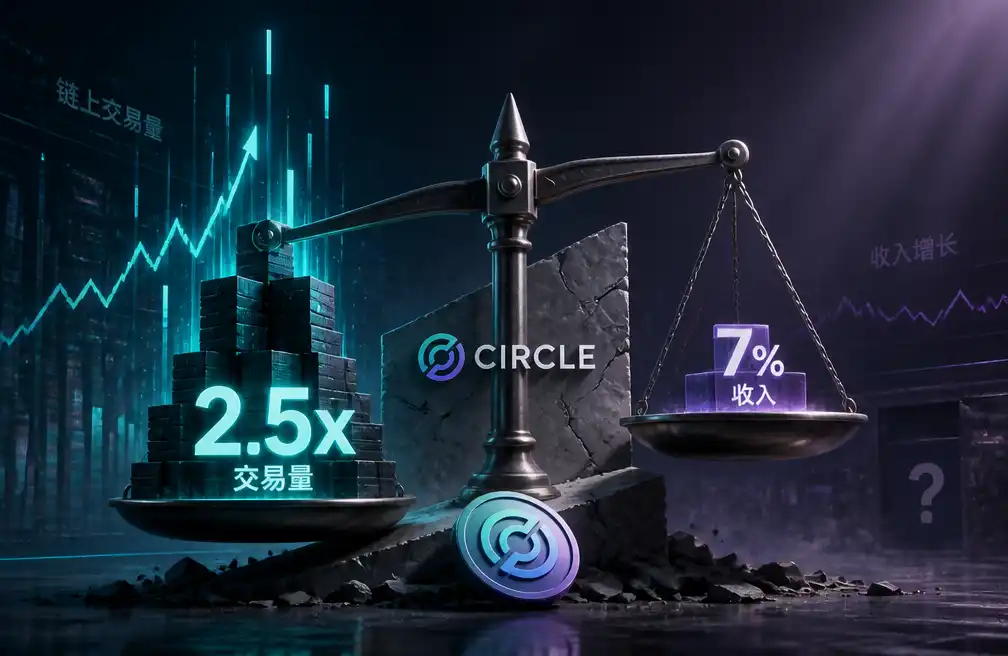
Trading Volume Increased by 2.5x, Why Did Circle's Revenue Only Grow by 7%?

Circle's Q2 performance presents a seemingly contradictory picture: the transaction volume of its stablecoin USDC surged 151% year-over-year to $14.8 trillion, while its "Total Revenue & Reserve Revenue" grew by only 7% to $701 million. This discrepancy highlights the core of Circle's business model. Revenue is primarily driven not by transaction volume, but by the average amount of USDC in circulation and the yield generated from its reserves. Key points: 1. **Revenue Drivers:** Over 90% of revenue comes from "reserve income," which is a function of average USDC circulation (up 25% YoY) and the reserve yield (which fell by 66 basis points). The net effect was a mere ~5% increase in reserve income. 2. **Transaction vs. Revenue:** High transaction volume indicates robust usage of USDC for payments and settlements, but does not translate directly to revenue. It must first convert into a sustained, average circulating balance. 3. **Cost Structure:** After accounting for distribution and other costs, the metric "Revenue Less Direct Costs" (RLDC) grew faster than total revenue, with its margin improving. However, rising operating expenses (up 23% YoY) meant that Adjusted EBITDA growth was limited to 8%. 4. **New Initiatives:** Circle reported progress on new networks like the Circle Payments Network and upcoming products (Arc, Agent Stack), but these are currently measured by adoption metrics (e.g., transaction run-rate, number of services) rather than material revenue contribution this quarter. In summary, the financial results are determined by the interplay of USDC circulation, reserve yields, and cost structures, while high transaction volume signals underlying network strength that has not yet fully flowed through to the income statement.

marsbit46 хв тому

Trading Volume Increased by 2.5x, Why Did Circle's Revenue Only Grow by 7%?

marsbit46 хв тому

Samsung China, Another Step Back

Samsung China Takes Another Step Back Samsung Electronics is further retreating from the Chinese consumer market. Following the exit of its home appliance business in May, its mobile phone division is now reportedly scaling down. Stores with monthly sales below 300,000 RMB are being closed in several cities. Data shows Samsung's smartphone market share in China has plummeted to 0.1% in Q2 2026, a stark contrast to its 22% global leadership. The decline is attributed to intense competition from domestic brands offering better value, higher specs (like faster charging), and superior localization in software and services. Samsung's premium pricing and less adapted One UI system have struggled against rivals like Huawei, Xiaomi, and Honor. This consumer electronics retreat coincides with Samsung's record-breaking semiconductor profits, driven by the AI boom. In Q2 2026, the chip division contributed nearly all operating profit, while the mobile and home appliance unit posted its first-ever operating loss. Internal dynamics, like the chip division charging market prices to the mobile unit, have increased cost pressures. Samsung's strategy now appears to be a focused retreat towards the ultra-premium segment in China, similar to its global push in high-end foldables like the Galaxy Z Fold8. The company is likely to retain only key stores in major cities to serve a niche, high-end clientele. While its deep semiconductor reserves offer a cushion, this shift away from mass-market consumer electronics reduces business diversification. The move is pragmatic but signifies a fundamental transformation; Samsung is ceding mass-market influence and betting heavily on its semiconductor strength and a narrowed premium product focus.

marsbit51 хв тому

Samsung China, Another Step Back

marsbit51 хв тому

Торгівля

Спот
活动图片