Interactive Brokers Opens 'Stablecoin Deposits': Why Is the Wall Street Giant Tearing Down the 'Payment Berlin Wall' at This Moment?

marsbitОпубліковано о 2025-12-16Востаннє оновлено о 2025-12-16

Анотація

Interactive Brokers (IBKR), a major global electronic brokerage, has announced a landmark update allowing clients to deposit funds using stablecoins—primarily USDC—to trade traditional assets like stocks, futures, and forex. This move effectively bridges a significant gap between crypto and traditional finance (TradFi), addressing long-standing inefficiencies in fiat payment channels. Traditionally, cross-border wire transfers via SWIFT are slow (taking 1-3 business days), costly, and limited to banking hours. By leveraging blockchain technology, IBKR enables near-instant, 24/7 settlements, drastically reducing friction and improving capital efficiency for traders. Behind the scenes, IBKR likely partners with regulated entities like Paxos or Circle to convert USDC to USD seamlessly, ensuring compliance while using the blockchain as a new settlement layer. This strategic shift aims to attract crypto-native high-net-worth clients and institutions holding significant wealth in stablecoins, offering them a secure, compliant path to invest in traditional markets. It also signals the evolution of stablecoins from mere trading instruments to a foundational global payment infrastructure. However, challenges remain, including stringent KYC/AML requirements, address screening, and enhanced tax transparency. Despite these hurdles, IBKR’s move is a decisive step toward erasing the boundaries between crypto wallets and securities accounts, setting a new standard for the industry.

Author: BlockWeeks

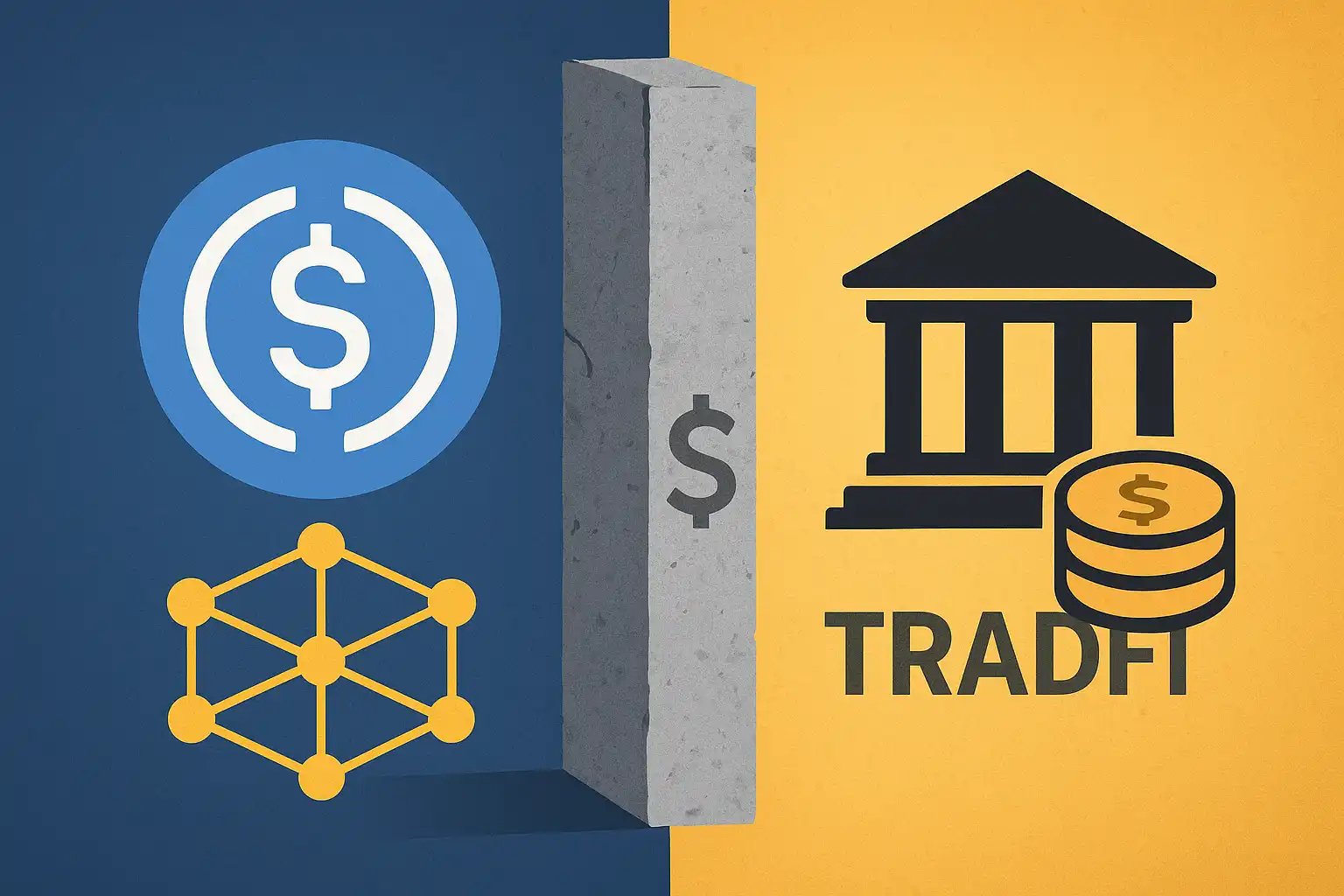
Between the cryptocurrency market and the traditional financial market (TradFi), there has long been an invisible wall: the friction cost of fiat currency channels.

Recently, the globally renowned electronic broker Interactive Brokers (IBKR) announced a milestone update: it now officially supports clients using stablecoins (primarily USDC) to deposit funds into their accounts for trading traditional assets such as stocks, futures, and foreign exchange.

At first glance, this might seem like a simple payment function update. But to observers well-versed in the transformation of financial infrastructure, this is a substantive acknowledgment of the "on-chain settlement network" by a top-tier Wall Street broker. When the US Dollar becomes USDC, and when SWIFT becomes ERC-20, it reflects a paradigm shift in the efficiency of global capital flow.
I. Breaking the Wall: A Dimensional Reduction Strike from "T+N" to "7×24"

For a long time, the biggest pain point for global investors (especially non-U.S. investors) using U.S. stock brokers has been depositing funds.

The traditional wire transfer path is: local bank foreign exchange purchase -> SWIFT cross-border transfer -> intermediary bank -> U.S. receiving bank -> broker account crediting. This process not only involves high fees (wire transfer fee + intermediary fee) but is also limited by bank working hours and the inefficiency of the SWIFT system, typically taking 1-3 business days.

Interactive Brokers' introduction of stablecoin deposits is essentially using blockchain as a "new clearing layer" to launch a dimensional reduction strike against traditional bank wire transfers:

  1. 24/7 Liquidity: On-chain transfers have no concept of "bank closing time." A deposit on Friday night no longer has to wait until Monday morning to be processed.

  2. Instant Settlement: Compared to the multi-layer confirmation of SWIFT, on-chain confirmation of USDC takes only seconds to minutes.

  3. Capital Efficiency Revolution: For high-frequency traders and cross-market arbitrageurs, the seamless transfer of funds between on-chain (Web3) and securities accounts (Web2) means a drastic reduction in capital occupancy costs.

Technical Black Box Revealed: It is important to clarify that Interactive Brokers does not directly "hold" these tokens for stock settlement. Its backend logic likely involves cooperation with compliant institutions like Paxos or Circle: users transfer in USDC -> the partner exchanges it 1:1 for USD -> instantly transfers it to the IBKR client's fiat balance. Superficially, it's coins; fundamentally, it's still money, but the channel has become the chain.

II. Open Strategy: Competing for the Asset Pricing Power of "Web3 Nouveau Riche"

Interactive Brokers is known for serving professional traders and institutions, with famously strict risk control. Why would such a conservative giant take the first step?

The answer lies in the competition for incremental wealth.

The past two bull markets have created a large number of "Crypto Natives" and Web3 institutions holding millions or even billions of dollars in assets. The wealth of this group primarily exists on-chain in the form of USDT/USDC or ETH.

In the past, if they wanted to allocate to U.S. stocks (such as buying NVIDIA or Coinbase stock), they had to go through a painful "off-ramp" process, facing not only the risk of bank risk control freezing their accounts but also enduring significant exchange rate losses.

Interactive Brokers' move is a typical "capital attraction open strategy":

  • For users: It is the safest "off-ramp channel." Depositing USDC into IBKR to buy U.S. Treasuries or the S&P 500 is currently the most compliant path for "traditionalizing crypto assets."

  • For IBKR: It directly locks in a group of high-net-worth clients with the most abundant liquidity and highest risk appetite globally. This is not just to earn commissions but also to accumulate huge amounts of client margin (Float).

III. Signal: Stablecoins Are Evolving into a "Supranational Version of SWIFT"

Zooming out, this event is a reverse mapping of the RWA (Real World Assets) narrative.

If RWA is about "moving" U.S. Treasuries onto the chain, then Interactive Brokers supporting stablecoin deposits is about "moving" liquidity from the chain back to traditional finance. This marks a qualitative change in the historical positioning of stablecoins (Stablecoin):

  • Era 1.0: Trading chips on exchanges.

  • Era 2.0: Safe-haven assets in DeFi protocols.

  • Era 3.0 (Now): A true global payment and settlement infrastructure.

When a Nasdaq-listed brokerage giant starts using a blockchain network instead of the SWIFT network to handle client funds, it indicates that the security, compliance, and efficiency of blockchain as a "payment pipeline" have passed the most stringent stress tests on Wall Street.

IV. Concerns and Games: The Sword of Damocles of Compliance

Despite the bright prospects, we cannot ignore the regulatory games involved.

  • KYC/AML Penetration Challenges: Interactive Brokers supporting stablecoin deposits will inevitably require extremely strict on-chain address reviews. Has the user's deposit address interacted with sanctioned entities (like Tornado Cash)? How to identify "black U"? This will test IBKR's compliance technology capabilities.

  • Tax Transparency: The opening of this channel also means a strong binding between on-chain assets and real-name securities accounts. For users hoping to avoid taxes through cryptocurrency, this channel is tantamount to "surrendering" to the tax authorities. This could be a double-edged sword.

Conclusion: The First Brick in Tearing Down the Berlin Wall

The small step taken by Interactive Brokers is a big step for financial integration.

It预示着 that within the next five years, the boundary between "securities accounts" and "crypto wallets" will completely blur. Future investors may not need to care whether they hold dollars in a bank ledger or USDC on the chain; they will only care about the appreciation of their assets.

For other brokers (such as Charles Schwab, Futu, etc.), the time left to follow suit is running out. In an era where liquidity is justice, whoever masters the stablecoin channel holds the key to the Web3 wealth vault.


Пов'язані питання

QWhat is the significance of Interactive Brokers (IBKR) announcing support for stablecoin deposits?

AIt represents a major step in bridging the gap between crypto and traditional finance by allowing clients to use stablecoins like USDC for funding accounts to trade stocks, futures, and forex, leveraging blockchain for faster, cheaper, and more efficient settlements compared to traditional banking systems like SWIFT.

QHow does using stablecoins for deposits improve upon traditional wire transfers?

AStablecoin deposits offer near-instant settlement (seconds to minutes), 24/7 availability without banking hours restrictions, and lower transaction costs, eliminating the delays and fees associated with multi-day SWIFT transfers and intermediary banks.

QWhy is Interactive Brokers targeting crypto-native users with this feature?

ATo attract high-net-worth individuals and institutions from the Web3 space who hold significant wealth in stablecoins, providing them a compliant and efficient path to invest in traditional assets like stocks and bonds, thereby capturing new sources of liquidity and client assets.

QWhat does the move signal about the evolution of stablecoins?

AIt indicates that stablecoins are transitioning from being mere trading instruments or DeFi assets to becoming a global payment and settlement infrastructure, capable of handling cross-border transactions with efficiency that meets Wall Street's rigorous standards.

QWhat are the regulatory challenges associated with stablecoin deposits in traditional finance?

AKey challenges include ensuring robust KYC/AML compliance to prevent interactions with sanctioned addresses or illicit funds, and addressing tax transparency issues as stablecoin transactions linked to verified accounts increase visibility for tax authorities.

Пов'язані матеріали

Understanding the New Economic Model of Tokenization

Understanding the New Token Economics Model The commercialization of AI applications is evolving from selling software and subscriptions to selling token call capacity. Tokens, the fundamental unit of information processing for large language models (LLMs), have become the basis for API billing and consumption. With call volumes exploding, tokens themselves are now being traded—procured, routed, split, and resold—forming a new intermediary market. This layer connects upstream LLM providers with downstream developers and enterprises, acting as a global wholesale-to-retail liquidity network. The rise of this business is fueled by a massive surge in China's daily token call volume—growing over a thousandfold from 100 billion in early 2024 to over 140 trillion by March 2026—and significant improvements in domestic LLM capabilities, which are now competitive globally. The core value of token distribution platforms extends beyond simple arbitrage. Key functions include aggregating multiple models (like GPT, Claude, and domestic models such as Kimi and DeepSeek) under a unified API, lowering network and payment barriers, and providing enterprise services like model selection, prompt engineering, and system integration. Profit models are diversifying: (1) resale margins; (2) technical premiums from proprietary inference acceleration (e.g., reducing costs to 1/10 of the industry standard); and (3) enterprise value-added services. High-consumption scenarios like marketing, short-form video, gaming, and e-commerce are primary drivers. Investment opportunities are seen in both companies with strong model capabilities (e.g., Alibaba, Tencent, MiniMax) and those with high-consumption client scenarios (e.g., marketing agencies with overseas reach). However, risks are significant: low entry barriers leading to intense competition, capital requirements and bad debt risks from advance payments, and dependency on policy changes from upstream LLM providers who control API pricing and access.

marsbit4 хв тому

Understanding the New Economic Model of Tokenization

marsbit4 хв тому

Farewell to the Copper Era: Understanding the Logic of the AI Silicon Photonics Industry Chain and Key US Stock Players

**Summary: The Era of Silicon Photonics and Key AI Infrastructure Stocks** The article delves into the transition from copper-based interconnects to silicon photonics (SiPh) as a critical enabler for next-generation AI data centers. It explains that copper faces fundamental physical limits—the bandwidth wall, density wall, and power wall—at high data rates (1.6T+), making a material shift essential. Silicon photonics, which integrates components like lasers, modulators, and detectors onto a silicon chip, offers a solution by leveraging mature CMOS manufacturing for cost-effective, high-volume production. A key challenge is that silicon itself is not an efficient light source, making Indium Phosphide (InP) lasers a critical and supply-constrained component. A major industry catalyst was NVIDIA's 2025 GTC announcement, declaring optical interconnects a "standard" from its Rubin platform onward, followed by strategic investments to secure the supply chain. The industry is structured in four key layers: 1. **Foundries:** TSMC leads with its COUPE platform, while Tower Semiconductor (specialized SiPh foundry) and GlobalFoundries are major players. 2. **Core Component Suppliers:** Lumentum is highlighted as the sole volume manufacturer of the crucial 200G/lane EML laser, with orders locked by NVIDIA through 2027. 3. **Module & System Manufacturers:** Coherent holds significant market share, with Chinese manufacturers like InnoLight also noted for scale. 4. **System Integrators:** NVIDIA, Broadcom, and Marvell dominate this layer, setting standards and integrating technology. The article identifies core public investment targets: **NVIDIA (NVDA)** as the ecosystem driver; **Broadcom (AVGO)** and **Marvell (MRVL)** in networking/switching chips; **Lumentum (LITE)** and **Coherent (COHR)** for critical components; and foundries **TSMC (TSM)** and **Tower Semiconductor (TSEM)**. Private companies Lightmatter and Ayar Labs are noted as key IPO candidates. The silicon photonics shift is driving a re-rating of company valuations, moving them from traditional telecom/industrial metrics to premium AI infrastructure multiples. The industry features high barriers to entry (e.g., multi-year lead times for InP laser capacity, complex 3D integration/thermal management, and lengthy customer qualification cycles), suggesting a "winner-takes-most" dynamic. Risks include dependence on hyperscaler capex cycles, potential technology disruption among competing optical approaches (LPO, CPO, OCS, Optical I/O), and a timeline where widespread CPO deployment may not occur until ~2028, with LPO serving as a transitional technology. The conclusion advises that betting on the overall industry trend may be safer than betting on any single company.

marsbit43 хв тому

Farewell to the Copper Era: Understanding the Logic of the AI Silicon Photonics Industry Chain and Key US Stock Players

marsbit43 хв тому

Deconstructing the Real Risks of DeFi Lending: Annual Loss Rate Only 0.03%

Deconstructing the true risks of DeFi lending reveals an annual loss rate of only 0.03% from hacks and exploits. Analysis of DeFi Llama data (excluding cross-chain bridge incidents) for EVM and Solana lending protocols shows that despite high historical attack frequency due to concentrated assets, the sector's security has matured significantly. Over the past year, non-cross-chain lending on these chains saw gross losses of $309M, with net losses after recoveries at $301M. Against a daily average TVL of $99.6B, this translates to a minimal annualized loss rate of approximately 0.03%. The Euler Finance case in 2023, where $197M was fully recovered, exemplifies improving asset recovery capabilities, which now account for roughly 20% of losses in this sector. Loss events follow a log-normal distribution: most are small-scale, with catastrophic losses being rare outliers. This pattern, combined with the massive scale of the total lending market, means single incidents rarely impact the broader ecosystem. It underscores the effectiveness of portfolio diversification and provides a basis for sustainable insurance models. The data indicates DeFi lending has entered a mature phase where risks are quantifiable, categorized, and manageable. The actual financial loss relative to the total capital deployed is extremely low, challenging prevailing narratives of systemic risk.

marsbit43 хв тому

Deconstructing the Real Risks of DeFi Lending: Annual Loss Rate Only 0.03%

marsbit43 хв тому

POLY's Appearance Hints Are Getting Denser, How Far Away Is the Polymarket Airdrop?

**POLY Debut Hints Grow More Frequent: How Far is the Polymarket Airdrop?** Recent continuous hints from Polymarket team members regarding the POLY token have sparked widespread analysis within airdrop communities about its launch timeline and potential scale. According to predict.fun data, the probability of "Polymarket launching its official token before year-end 2025" currently stands at 56%. Hints about POLY began in October 2024. CEO Shayne Coplan's social media post mentioning $POLY alongside major cryptocurrencies first fueled speculation. This was followed by Growth Lead William LeGate discussing "prospective airdrop farmers," and CMO Matthew Modabber explicitly confirming that "Polymarket will have a token, and there will be an airdrop." The momentum continued into 2025. In April, major crypto data platforms CoinGecko and CoinMarketCap created placeholder pages for POLY, further solidifying expectations. May saw discussions shift towards token utility and airdrop criteria. A team member's "Soon" reply to a question about staking POLY for fee reductions, and a leaked internal screenshot showing an "Airdrop" tab, significantly increased anticipation. LeGate also outlined potential airdrop qualifiers, mentioning badges for employees, high-volume/high-profit traders, and ecosystem builders. He suggested that linking a Polymarket account to X (Twitter), sharing trades and market insights, and actively engaging with the community might constitute part of the eligibility criteria, leading to a surge in related social media activity. Despite the growing hype, the article's author expresses a personal view that Polymarket might prioritize platform stability and infrastructure upgrades—especially with the upcoming World Cup—over an immediate token launch, opting for a post-event release. Their current strategy involves hedging positions across prediction markets, actively trading on Polymarket, and engaging on social media to potentially qualify for a future airdrop.

Odaily星球日报1 год тому

POLY's Appearance Hints Are Getting Denser, How Far Away Is the Polymarket Airdrop?

Odaily星球日报1 год тому

Торгівля

Спот
Ф'ючерси
活动图片