Illustrating Meta's Layoffs: Firing 700 Employees on the Same Day, Offering Executives a $9 Trillion Bet-Based Incentive

marsbitОпубліковано о 2026-03-26Востаннє оновлено о 2026-03-26

Анотація

On March 25, Meta laid off approximately 700 employees across departments including Reality Labs, Facebook, recruiting, and sales. On the same day, the SEC disclosed an executive stock option plan for six top executives, tied to a $9 trillion market cap target—the first such grant since Meta’s 2012 IPO. This reflects Meta’s strategic shift: fewer but higher-value talent and massive AI investment. Since its 2022 peak of 86,482 employees, Meta has cut nearly 8,000 roles. Meanwhile, annual revenue grew 72% to $201 billion by Q4 2025, and revenue per employee surged 89% to $2.55 million. Meta’s 2026 capital expenditure is projected to reach $115–135 billion, part of a collective $650 billion AI infrastructure push by Amazon, Google, Microsoft, and Meta. This spending is prioritized over short-term cash flow, with free cash flow expected to drop nearly 90% in 2026. The executive options are structured with tiered targets: the highest requires Meta’s market cap to reach $9 trillion—six times its current $1.5 trillion—by 2031. If achieved, top executives could gain up to $2.7 billion each. The underlying formula is clear: reallocating resources from broad headcount to elite talent and AI infrastructure, with leadership incentives aligned to extreme growth.

On March 25, Meta notified approximately 700 employees to leave, affecting five departments including Reality Labs, Facebook social media, recruitment, and sales. On the same day, the SEC disclosed an executive stock option plan, where six core executives will receive stock options tied to a $9 trillion market cap. This is the first time Meta has issued options to executives since its IPO in 2012.

Laying off employees while rolling out the most aggressive executive incentive plan in Silicon Valley history. These two actions taken by Meta on the same day are not contradictory; they are two sides of the same strategy. The AI race doesn't need more people; it needs more expensive people and more machines.

Fewer People, Each More "Valuable"

2022 was Meta's peak year for employees, with 86,482 people company-wide. That year, Zuckerberg bet heavily on the metaverse, hiring frantically, only to see annual revenue drop from the previous year's $117.9 billion to $116.6 billion. Revenue per employee fell to a trough of $1.35 million.

What happened next is known to all. In November 2022, 11,000 people were laid off, followed by another 21,000 in 2023, cutting a quarter of the company's workforce. Zuckerberg named 2023 the "Year of Efficiency".

The results of efficiency are written in the numbers. According to Meta's Q4 2025 earnings report, by the end of 2025, the company had 78,865 employees, nearly 8,000 fewer than the peak. However, annual revenue grew from $116.6 billion to $201 billion during the same period, an increase of 72%. Revenue per employee soared from $1.35 million to $2.55 million, an 89% increase.
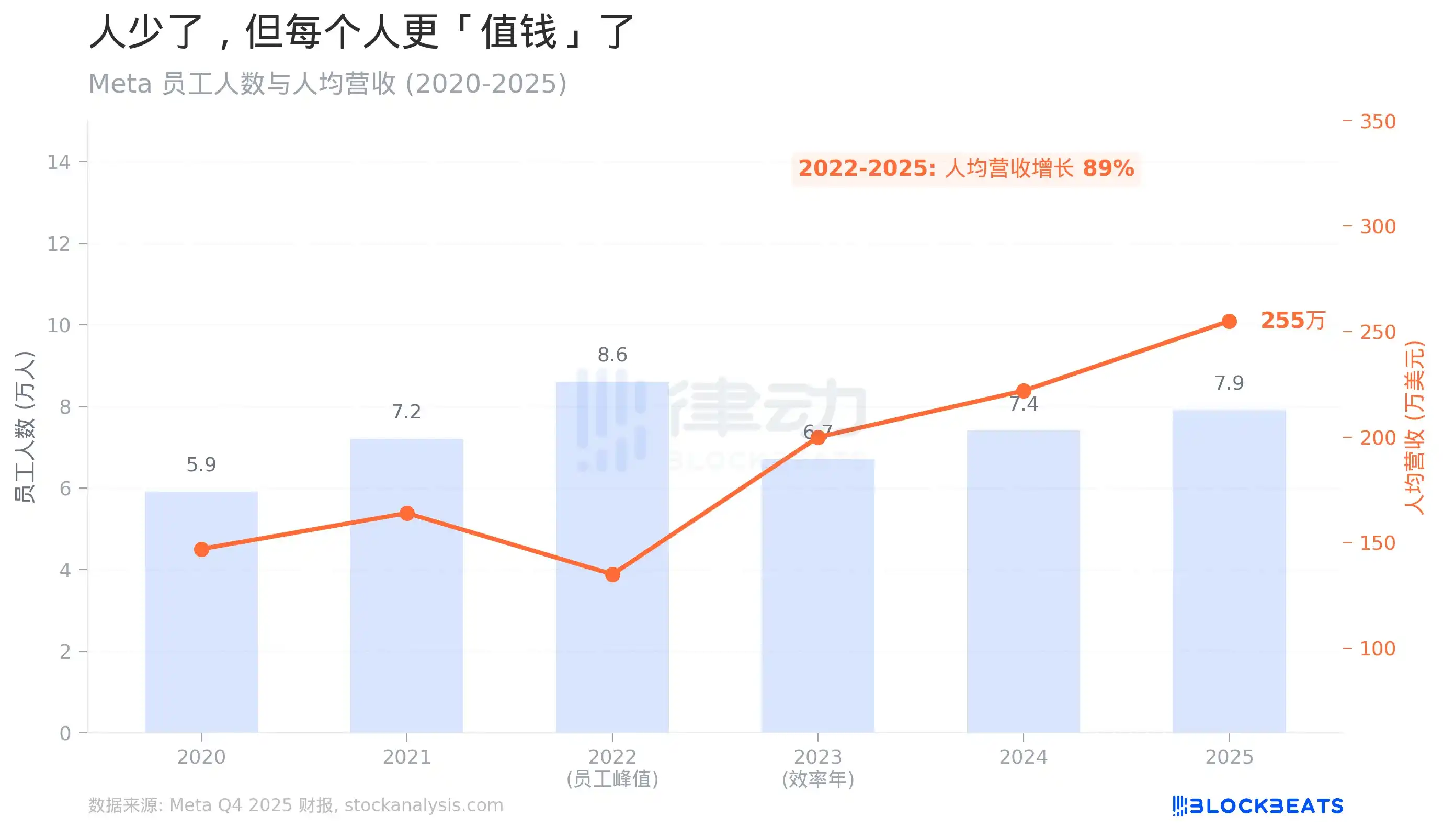
The meaning of these numbers is straightforward. Meta is making more money with fewer people. In 2022, the marginal revenue brought by each additional employee was declining. By 2024 and 2025, the revenue increase corresponding to each employee reduction was expanding. This is the typical scale effect of a technology company, but Meta accelerated this process through layoffs.

This is the background for this round of 700 layoffs in March 2026. According to The Register, this is already Meta's second round of layoffs this year, with about 1,000 people cut from Reality Labs in January. NBC News, citing informed sources, reported that there may be larger cuts later, potentially involving up to 20% of the total workforce, or about 15,000 people, which would bring Meta's total employee count back to 2021 levels.

Zuckerberg's exact words in the January earnings call were plans to "flatten teams," allowing excellent individual contributors to complete projects that previously required large teams. Meta's spokesperson's response was also templated, saying "teams periodically undergo restructuring or adjustments to ensure they are in the best position to achieve their goals."

Continuing to Bet on the AI Arms Race

Where did the money saved from the laid-off employees go? A look at capital expenditures makes it clear.

According to Q4 2025 earnings reports and public guidance from various companies, the combined capital expenditures of Amazon, Google, Microsoft, and Meta in 2026 will reach approximately $650 billion, a year-on-year increase of about 130%. This includes Amazon at about $200 billion (up 167%), Google at about $175 to $185 billion (up 140%), Microsoft annualized at about $145 billion (up 127%), and Meta at $115 to $135 billion (up 73%).

According to CNBC, this is the largest single-year capital expenditure in the history of the tech industry. The four companies' investment in AI infrastructure in one year exceeds Sweden's annual GDP.
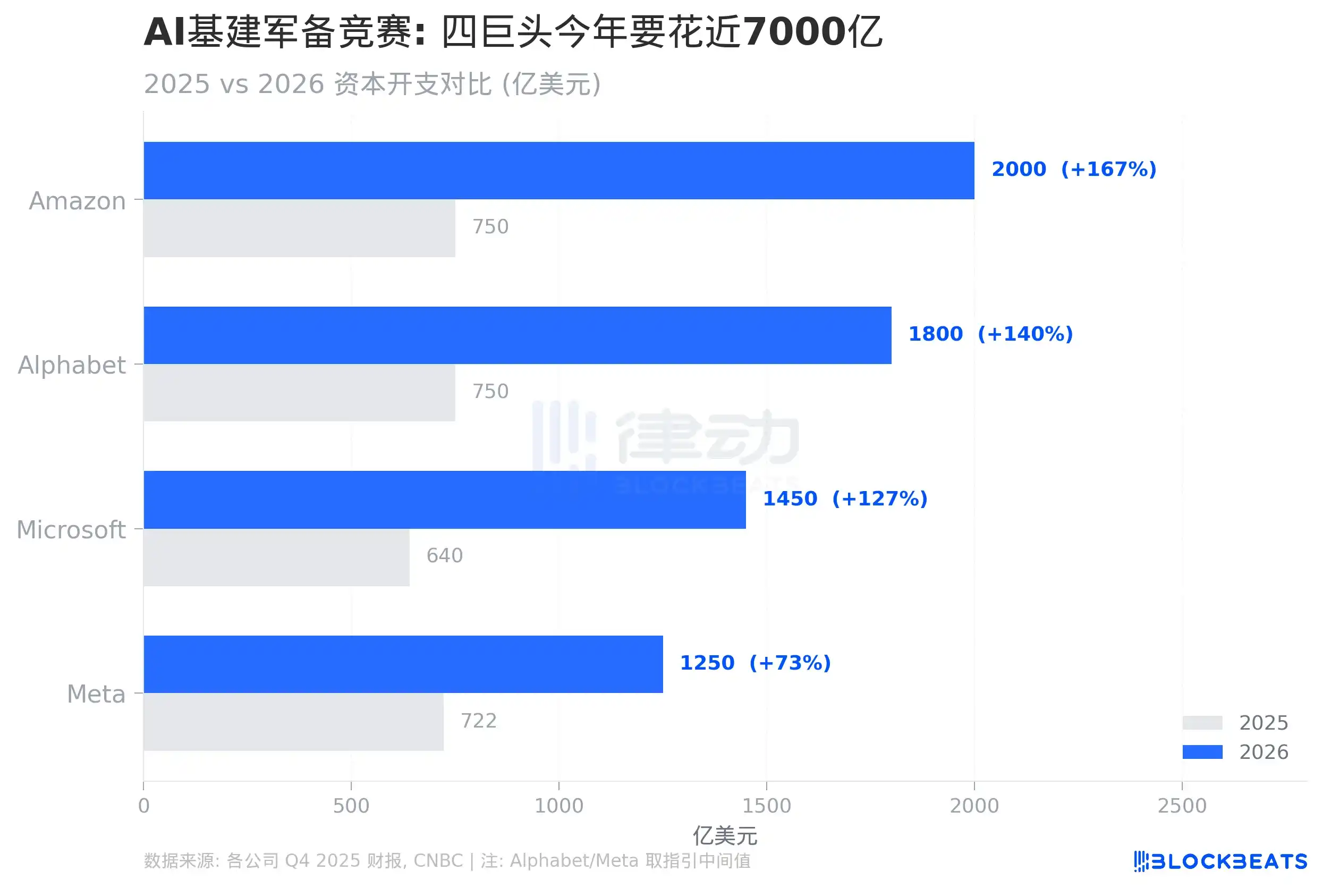
Meta's absolute value ranks fourth, but relative to its own size, the density of this investment is staggering. Calculated at the midpoint of $125 billion, Meta's AI infrastructure investment per employee is about $1.59 million, close to 62% of the revenue per employee ($2.55 million). Put another way, for every $100 Meta earns, it invests $62 into data centers.

The cost of this money is also direct. According to CNBC, citing Barclays analysts' estimates, Meta's free cash flow in 2026 will decline by nearly 90%. Amazon is even more aggressive; Morgan Stanley expects Amazon to have approximately negative $17 billion in free cash flow in 2026. All four giants are doing the same thing: trading today's cash flow for tomorrow's AI infrastructure.

The $9 Trillion Bet

Now look at the option plan. According to the SEC disclosure documents and analysis by Motley Fool, this plan covers 6 executives, including CTO Bosworth, CPO Cox, COO Olivan, CFO Susan Li, CLO Mahoney, and Vice Chairman McCormick. Zuckerberg is not on the list; his super-voting shares already make additional incentives unnecessary.

The option's exercise conditions are designed with tiered price thresholds. According to Motley Fool, the lowest exercise price is $1,116 per share, requiring the stock price to rise 88% from the current ~$615. The highest tier is $3,727 per share, corresponding to a market cap of about $9 trillion, six times the current $1.5 trillion. There is a five-year window for vesting before 2031. If Meta actually reaches a $9 trillion market cap, according to Motley Fool's calculations, the top four executives (Bosworth, Cox, Olivan, Susan Li) could each see potential gains of approximately $2.7 billion.

The signal of this plan is clear. Meta is not giving executives a bonus; it is using options to tie the core team to an extremely aggressive growth target. The current market cap is $1.5 trillion, the goal is $9 trillion. The difference of $7.5 trillion – Meta is betting that AI can create this value.
For a sense of scale: $9 trillion is roughly equivalent to the combined current market capitalization of Apple and Nvidia. No company in the world has ever reached this market cap. Meta has given its core executives five years to try and reach a number that doesn't exist in human commercial history.

One Formula

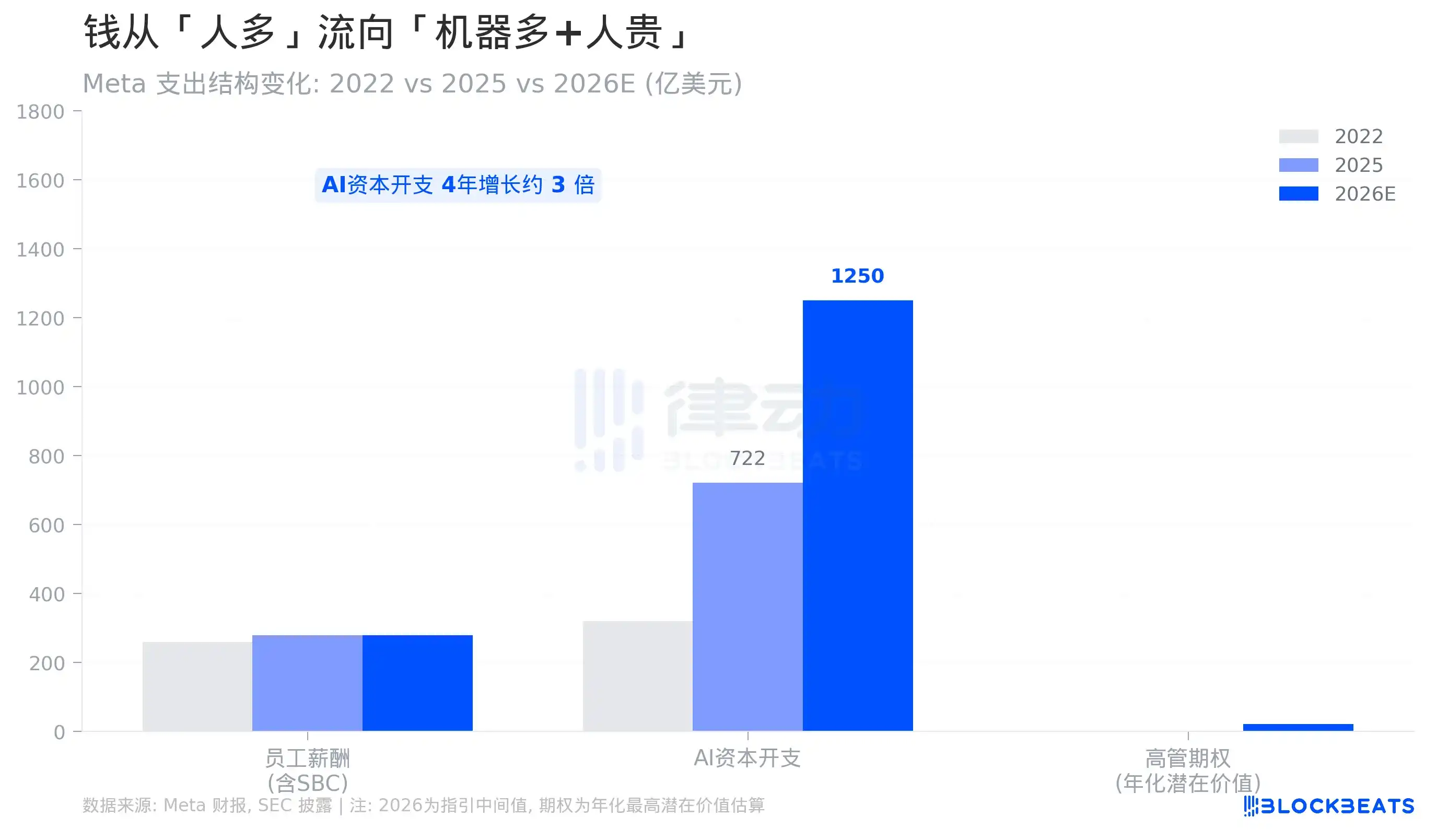
Looking at these three things together, Meta's logic is a simple resource allocation formula. Total employee compensation (including equity incentives) remained largely flat between 2022 and 2026, around $26 to $28 billion. But AI capital expenditures soared from $32 billion to $125 billion, a roughly 3-fold increase in four years. At the same time, a brand new executive option pool has appeared, locking the six most core people into the next five years.

According to Benzinga, Meta's stock-based compensation expense in 2025 was approximately $42 billion, already consuming most of its free cash flow. Signing bonuses for AI researchers have reached nine figures, with reports of researchers poached from OpenAI receiving packages in the $100 million range. The contrast between these numbers and the 700 laid-off employees makes Meta's pricing logic for "people" clear without any need for commentary.

The money saved from laying off 700 people is roughly equivalent to a day and a half of Meta's AI infrastructure spending.


Пов'язані питання

QWhat is the significance of Meta's dual actions on March 25th: laying off 700 employees while announcing a $9 trillion stock option plan for executives?

AThese actions represent two sides of the same strategic shift. Meta is reallocating resources from a larger, less focused workforce to massive AI infrastructure investments and highly compensated, elite talent. The layoffs improve efficiency (as seen in rising revenue per employee), while the unprecedented executive期权 plan aligns top leadership with an extremely aggressive growth target tied to AI's potential value creation.

QHow did Meta's employee count and financial performance change between its 2022 peak and the end of 2025?

AMeta's employee count decreased from a peak of 86,482 in 2022 to 78,865 by the end of 2025, a reduction of nearly 8,000 people. However, its annual revenue grew 72%, from $116.6 billion to $201.0 billion. Consequently, revenue per employee surged 89%, from $1.35 million to $2.55 million, demonstrating significantly improved efficiency.

QWhat are the scale and implications of the capital expenditure plans by major tech companies like Meta for 2026?

AAmazon, Google, Microsoft, and Meta plan a combined capital expenditure of approximately $650 billion in 2026, a 130% year-over-year increase. This represents the largest single-year capex in tech industry history, exceeding Sweden's GDP. For Meta specifically, its planned $115-135 billion capex translates to about $1.59 million in AI infrastructure investment per employee, which is roughly 62% of its revenue per employee.

QWhat are the specific terms and potential payouts of the new executive stock option plan at Meta?

AThe plan covers 6 core executives (excluding Zuckerberg). It features tiered exercise prices. The lowest tier requires the stock price to rise 88% from ~$615 to $1,116 per share. The highest tier is set at $3,727 per share, which would give Meta a market capitalization of approximately $9 trillion—six times its current $1.5 trillion value. If this top target is met within the 5-year window (by 2031), the top four executives could each see potential gains of around $2.7 billion.

QHow does Meta's resource allocation formula illustrate its new strategic priority towards AI?

AMeta's resource allocation has fundamentally shifted. Total employee compensation (including stock awards) remained flat at around $26-28 billion between 2022 and 2026. Meanwhile, AI capital expenditure skyrocketed nearly 3x, from $32 billion to $125 billion. This shows a massive reallocation of cash flow from human resources to AI infrastructure. Furthermore, the new executive期权 pool and reports of nine-figure signing bonuses for top AI researchers highlight a focus on investing in a smaller number of 'more expensive' people critical to AI development.

Пов'язані матеріали

Trading Volume Increased by 2.5x, Why Did Circle's Revenue Only Grow by 7%?

Circle's Q2 performance presents a seemingly contradictory picture: the transaction volume of its stablecoin USDC surged 151% year-over-year to $14.8 trillion, while its "Total Revenue & Reserve Revenue" grew by only 7% to $701 million. This discrepancy highlights the core of Circle's business model. Revenue is primarily driven not by transaction volume, but by the average amount of USDC in circulation and the yield generated from its reserves. Key points: 1. **Revenue Drivers:** Over 90% of revenue comes from "reserve income," which is a function of average USDC circulation (up 25% YoY) and the reserve yield (which fell by 66 basis points). The net effect was a mere ~5% increase in reserve income. 2. **Transaction vs. Revenue:** High transaction volume indicates robust usage of USDC for payments and settlements, but does not translate directly to revenue. It must first convert into a sustained, average circulating balance. 3. **Cost Structure:** After accounting for distribution and other costs, the metric "Revenue Less Direct Costs" (RLDC) grew faster than total revenue, with its margin improving. However, rising operating expenses (up 23% YoY) meant that Adjusted EBITDA growth was limited to 8%. 4. **New Initiatives:** Circle reported progress on new networks like the Circle Payments Network and upcoming products (Arc, Agent Stack), but these are currently measured by adoption metrics (e.g., transaction run-rate, number of services) rather than material revenue contribution this quarter. In summary, the financial results are determined by the interplay of USDC circulation, reserve yields, and cost structures, while high transaction volume signals underlying network strength that has not yet fully flowed through to the income statement.

marsbit3 хв тому

Trading Volume Increased by 2.5x, Why Did Circle's Revenue Only Grow by 7%?

marsbit3 хв тому

Samsung China, Another Step Back

Samsung China Takes Another Step Back Samsung Electronics is further retreating from the Chinese consumer market. Following the exit of its home appliance business in May, its mobile phone division is now reportedly scaling down. Stores with monthly sales below 300,000 RMB are being closed in several cities. Data shows Samsung's smartphone market share in China has plummeted to 0.1% in Q2 2026, a stark contrast to its 22% global leadership. The decline is attributed to intense competition from domestic brands offering better value, higher specs (like faster charging), and superior localization in software and services. Samsung's premium pricing and less adapted One UI system have struggled against rivals like Huawei, Xiaomi, and Honor. This consumer electronics retreat coincides with Samsung's record-breaking semiconductor profits, driven by the AI boom. In Q2 2026, the chip division contributed nearly all operating profit, while the mobile and home appliance unit posted its first-ever operating loss. Internal dynamics, like the chip division charging market prices to the mobile unit, have increased cost pressures. Samsung's strategy now appears to be a focused retreat towards the ultra-premium segment in China, similar to its global push in high-end foldables like the Galaxy Z Fold8. The company is likely to retain only key stores in major cities to serve a niche, high-end clientele. While its deep semiconductor reserves offer a cushion, this shift away from mass-market consumer electronics reduces business diversification. The move is pragmatic but signifies a fundamental transformation; Samsung is ceding mass-market influence and betting heavily on its semiconductor strength and a narrowed premium product focus.

marsbit7 хв тому

Samsung China, Another Step Back

marsbit7 хв тому

Helium, Naphtha, and Photoresist: The Three Critical Vulnerabilities of Semiconductor Fabs

The article "Helium, Naphtha, Photoresist: The Three Achilles' Heels of Semiconductor Fabs" analyzes a hypothetical 2026 supply crisis triggered by geopolitical conflict in the Middle East, focusing on three critical materials for semiconductor manufacturing: helium, naphtha, and photoresist. A key attack on a Qatari LNG facility and the blockade of the Strait of Hormuz threaten the global supply of helium (a byproduct of LNG) and naphtha (a petroleum product). This creates a triple threat of shortages that could halt chip production. Helium is essential, particularly for precise wafer temperature control in dry etching processes; a shortage would cause an immediate "instant failure" in these steps. Naphtha is the foundational raw material for numerous equipment consumables and, crucially, for photoresist chemicals. Japan dominates the photoresist market, relying on a single key supplier for intermediates. The analysis shows the impacts would differ. The tiny fraction of global naphtha used for semiconductors (under 0.1%) makes securing supply for photoresist relatively easier. Helium is the greater vulnerability. Qatar supplies about one-third of the world's helium, exceeding the total annual consumption of the semiconductor industry (21-24% of global supply). While short-term buffers like corporate reserves, recycling, and prioritization (e.g., cutting balloon use first) can delay the crisis, helium cannot be stored long-term due to boil-off. Fabs typically hold only days to weeks of inventory. The consequences would be severe and tiered. Advanced logic nodes (e.g., 2nm, 3nm) using complex processes like GAA would be hit hardest, potentially stopping within three months. Mature nodes for automotive and power semiconductors would also eventually halt (within 6-12 months), which could be catastrophic for the auto industry due to stringent certification requirements. The crisis would unfold not as a sudden global stop, but through a sequence of allocation, severe price spikes, reduced output of low-margin products, and partial fab shutdowns by region and company if the shortage persists beyond a year.

marsbit8 хв тому

Helium, Naphtha, and Photoresist: The Three Critical Vulnerabilities of Semiconductor Fabs

marsbit8 хв тому

Post-World Cup, HIP-4 Awaits Its ‘Election Day’

Following its significant success driven by World Cup trading, Hyperliquid's HIP-4 prediction market is now looking toward the upcoming US midterm elections as its next major opportunity. Initially viewed as an extension for hedging crypto positions, HIP-4 unexpectedly saw nearly 48% of its total volume come from sports markets, primarily the World Cup. However, activity plummeted over 90% after the tournament, highlighting the platform's heavy reliance on major real-world events. To address this dependency and enable continuous market creation, Hyperliquid launched a permissionless deployment feature for HIP-4 on its testnet on July 31. This new system allows approved third-party deployers to create markets using pre-approved templates, requiring a 500,000 HYPE stake and offering up to 50% of trading fees. The goal is to decentralize the sourcing of timely, high-interest markets. The imminent US midterm elections present a critical test case. While competitors like Polymarket and Kalshi already offer extensive political markets, HIP-4 currently has none. If the permissionless system launches on mainnet in time, deployers could build a comprehensive election trading suite. Missing this window would mean relying on manual validator creation again, forfeiting a chance to prove that external deployers can sustainably supply popular markets. The coming weeks will be crucial for HIP-4's evolution beyond sporadic event-driven spikes.

marsbit10 хв тому

Post-World Cup, HIP-4 Awaits Its ‘Election Day’

marsbit10 хв тому

Crypto finance company BIT predicts gold and bitcoin will rise together! Here are the details

Crypto finance company BIT (formerly Matrixport) forecasts that potential US dollar weakness and expectations of interest rate cuts could simultaneously support the prices of both Bitcoin and gold. Their analysis suggests that current macroeconomic conditions may positively impact both risk assets and the safe-haven gold. Technical indicators hint that gold may be forming a significant low and could be poised for a new upward trend, with Bitcoin likely to benefit from similar macro factors. BIT highlights that while markets expect the US Federal Reserve to hike rates twice this year, this scenario is not certain. If economic data differs, the Fed might not raise rates at all in 2023. Such a development could weaken the US dollar and strengthen market expectations for rate cuts. A weaker dollar is a traditional key support for gold prices, and Bitcoin has shown sensitivity to similar macro dynamics in recent years. Increased global liquidity and rate cut expectations could drive investors toward alternative assets. Market experts believe low interest rates enhance the appeal of both gold and Bitcoin, as they lower the opportunity cost of holding non-yielding assets and encourage their use as inflation hedges. However, analysts caution that monetary policy expectations can shift rapidly based on incoming economic data, particularly inflation, employment, and growth figures, which will remain crucial in determining the Fed's future actions. *This is not investment advice.

cryptonews.ru11 хв тому

Crypto finance company BIT predicts gold and bitcoin will rise together! Here are the details

cryptonews.ru11 хв тому

Торгівля

Спот
活动图片