If You Bought One Deep OTM Bitcoin Put Option Every Month Since 2018, Could You Make Money in the Long Run?

marsbitОпубліковано о 2026-03-16Востаннє оновлено о 2026-03-16

Анотація

Based on a systematic backtest from 2018 to 2026, this study examines the long-term profitability of a monthly strategy of buying one deep out-of-the-money (OTM) put option on Bitcoin (BTC) and Ethereum (ETH), with a target delta of 0.01 and a 30-day expiration. The results are highly divergent. The strategy is not a stable source of profit but a classic, path-dependent tail insurance tool characterized by extreme right skew, very low win rates, and severe drawdowns. For BTC, the strategy yielded a final total return of 97.62% (CAGR: 8.66%), while for ETH, it resulted in a -73.07% loss (CAGR: -14.78%). The performance difference is attributed to BTC's extreme payouts being sufficient to cover the long-term cost of premiums, whereas ETH's were not. Key characteristics of the strategy include: * Extremely low win rates (BTC: 2.04%, ETH: 1.02%). * Catastrophic maximum drawdowns (BTC: -97.24%, ETH: -93.82%). * The median trade return was -100% for both assets. * Profits are driven entirely by a few extreme winning trades, with the top 5 trades contributing over 10x the net profit for BTC. * Notably, not all major market crashes (e.g., March 2020, LUNA, FTX) resulted in profitable positions due to timing and strike price placement. Parameter sensitivity analysis showed that a delta of 0.02 offered a more balanced risk-return profile across metrics. The strategy is best suited for investors who can tolerate years of continuous losses, view it as portfolio insurance ra...

Author: Michel Athayde, Bitget Wallet BD Ambassador

Abstract

In traditional financial markets, consistently buying deep out-of-the-money (OTM) Put options is often seen as a typical "black swan insurance" strategy: it continuously loses premium payments during normal times, only to break even or make a large profit during extreme risk events. The question is, does this logic still hold in the more volatile and crash-prone crypto market?

The answer from this backtest is not straightforward. Based on historical data from 2018-01-01 to 2026-03-14, we systematically tested BTC and ETH: buying one fixed deep OTM Put every month, holding until expiration, with no market timing. The results show this is not a "stable money-making" strategy, but rather a tail risk insurance tool characterized by extreme right skew, very low win rate, and strong path dependency. Under the baseline portfolio, the final total return for BTC was 97.62%, while for ETH it was -73.07%; meaning the same logic can yield completely opposite long-term results on different assets.

Research Background

"Buying insurance long-term" has always been one of the most debated strategies. Proponents argue that what ultimately determines the fate of long-term capital is not daily fluctuations, but a few systemic crashes; opponents believe that paying premiums year after year is essentially using certain losses to bet on uncertain disasters.

The crypto market makes this debate more interesting. On one hand, the volatility of BTC and ETH is much higher than traditional assets, and sharp drops are not rare; on the other hand, extreme market movements occur more frequently, theoretically making it more suitable for tail risk hedging survival. Thus, a key question arises: if one does not time the market or judge cycles, but mechanically buys one deep OTM Put every month starting from 2018, can this "simplest" form of tail insurance ultimately make money in the long run?

Strategy Design

The rules for this test are very simple and strict. Open a position on the first calendar day of each month; if there is no raw data for that day, postpone to the next available trading day; buy 1 European-style Put, hold until expiration, no early profit-taking or stop-loss. The target Delta for the baseline portfolio is 0.01, expiration is 30 days later, initial capital is $2000, investing 2% of the current account net value each time. If the budget is insufficient to buy a full contract, scale the position according to the budget.

For sensitivity analysis, the backtest was extended to Delta 0.02, 0.05, investment proportions of 1%, 2%, 5%, and expiration days of 14, 30, 45, totaling 54 parameter combinations.

Backtest Methodology

Pricing used the Black-Scholes model, assuming a risk-free rate of 0, with the annualized volatility proxied by the past 30 days' daily return volatility. The strike price was not arbitrarily set but derived by inverting the target Delta. Data-wise, the daily samples for BTC and ETH both cover up to 2026-03-14. After cleaning, BTC has 3055 records, ETH has 3048 records, with no missing dates or closing prices needing repair. In the entire parameter grid, skipped trades were solely due to "expiration date exceeding the backtest end date," with no silent failures.

In other words, these conclusions are not based on a small sample or incomplete data, but on a complete historical review of BTC and ETH under the same set of rules.

Backtest Results

First, look at the baseline portfolio, the version closest to the proposition "buy one fixed deep OTM Put every month": Delta 0.01, invest 2%, hold for 30 days.

The results are highly divergent. BTC executed 98 trades in total, with a final total return of 97.62% and an annualized compound growth rate (CAGR) of 8.66%; ETH also executed 98 trades, but the total return was only -73.07%, with a CAGR of -14.78%. Looking solely at the conclusion, one could say: this strategy can make money long-term on BTC, but not on ETH.

But what is truly noteworthy is not the return itself, but its cost. The maximum drawdown for the BTC baseline portfolio was as high as -97.24%, and for ETH it reached -93.82%. The win rate for BTC was only 2.04%, and for ETH even lower at 1.02%. The median return per trade for both was -100%, and the worst trade for both was also -100%. This means that most of the time, this strategy doesn't "lose a little"; it loses the entire premium at expiration.
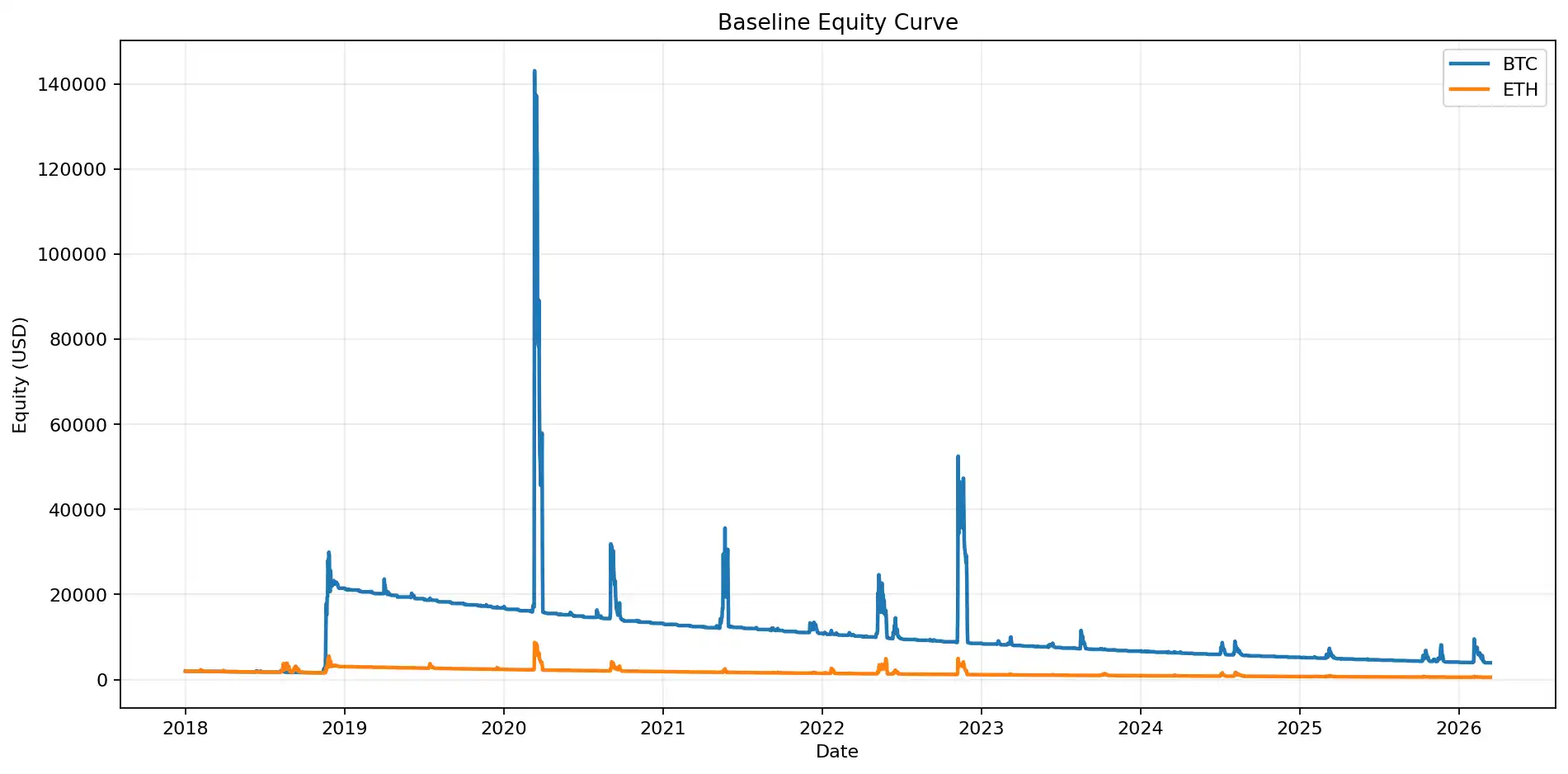
Figure 1: The equity curve of the baseline portfolio shows a clear divergence in long-term results between BTC and ETH. BTC ultimately achieved a positive return, while ETH's net value declined over the long term.
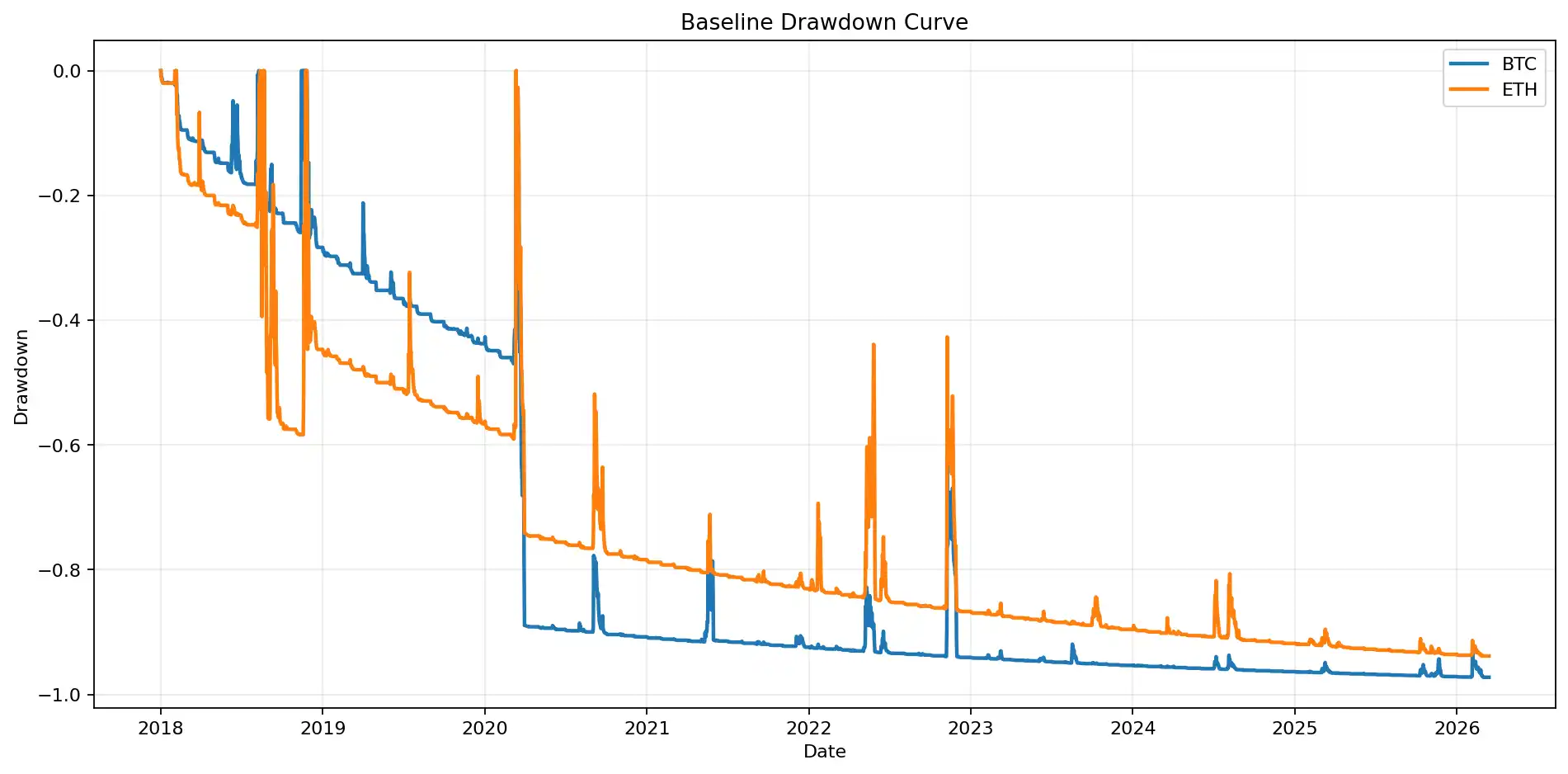
Figure 2: The drawdown curve illustrates that even if such strategies ultimately make money, they can remain deeply underwater for long periods. The maximum drawdown for the BTC baseline portfolio reached -97.24%, and for ETH it was -93.82%.

This is visually clear from the charts. The equity curve does not rise smoothly; instead, it lingers at low levels for long periods, occasionally pulled up by extreme profits in jumps. The drawdown curve remains deeply negative for extended periods. The histogram of single-trade returns is clearly left-skewed, densely clustered at -100%, with only a very few extreme large profits on the right. It is not a traditional "win-rate strategy" but a typical "positive skewness strategy."
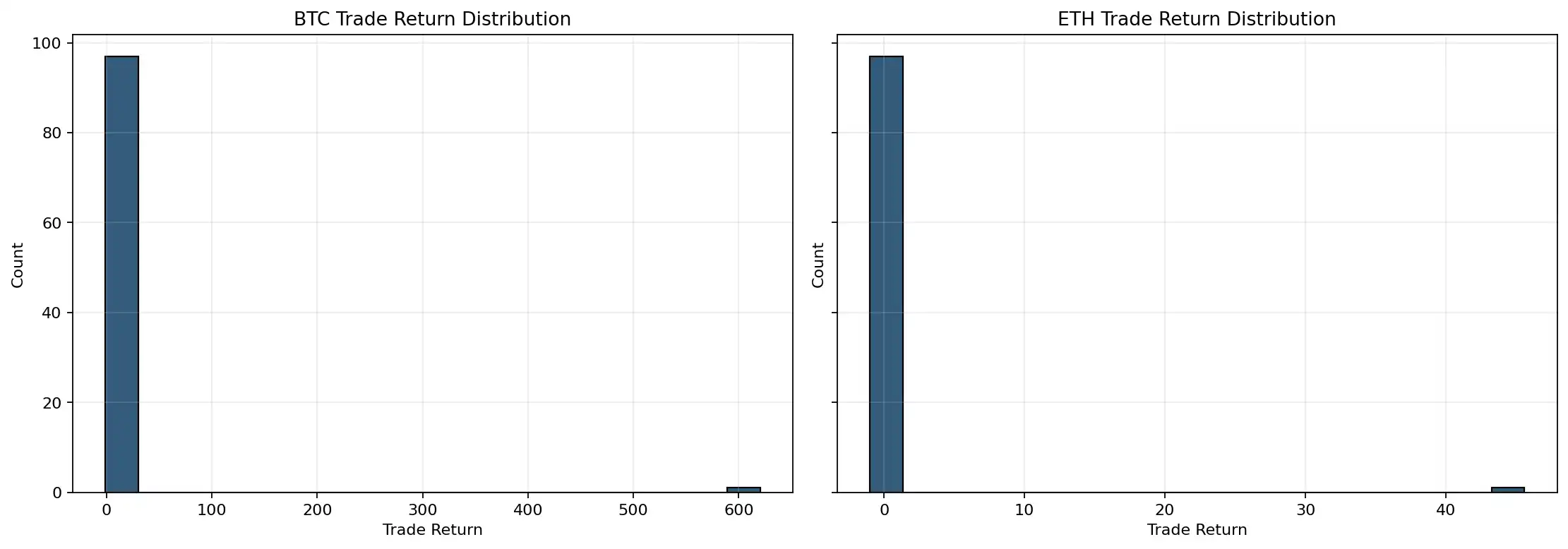
Figure 3: The distribution of single-trade returns is highly right-skewed. Premiums expire worthless in the vast majority of months; a few extremely profitable trades determine the long-term outcome.

Profit Source Analysis

The core feature of this strategy is that profits do not come from "making money in most months" but from "making a lot of money in very few months."

The proportion of profitable months for the BTC baseline portfolio was only 4.08%, and for ETH only 2.04%. The longest consecutive losing months for BTC reached 57 months, and for ETH it reached 87 months. This means that even if it ultimately makes money, an investor might have to endure years of continuous losses and the feeling of the strategy failing.

On the other hand, the single best trade return for the BTC baseline portfolio was over 620 times, and the average single trade return was pulled up to 5.36 by extreme profits; the skewness of the return distribution reached 9.90, and the kurtosis approached 98. The top 5 profitable trades contributed 10.54 times the total net profit for BTC. These numbers almost spell out the nature of this strategy: it doesn't make money through stable carry but relies on a few extreme moments to "reimburse" years of premiums at once.

ETH's structure has similar characteristics, but the problem is that ETH's extreme profits are insufficient to cover the long-term costs. Under the baseline portfolio, ETH paid a total premium of $2984.47 and recovered only $1523.06 at expiration, resulting in a Premium Burn Ratio of 48.97%; whereas BTC paid a total of $18903.47 and recovered $20855.85, resulting in a Premium Burn Ratio of -10.33%, indicating that on BTC, extreme events ultimately covered the premium losses and even left a surplus.
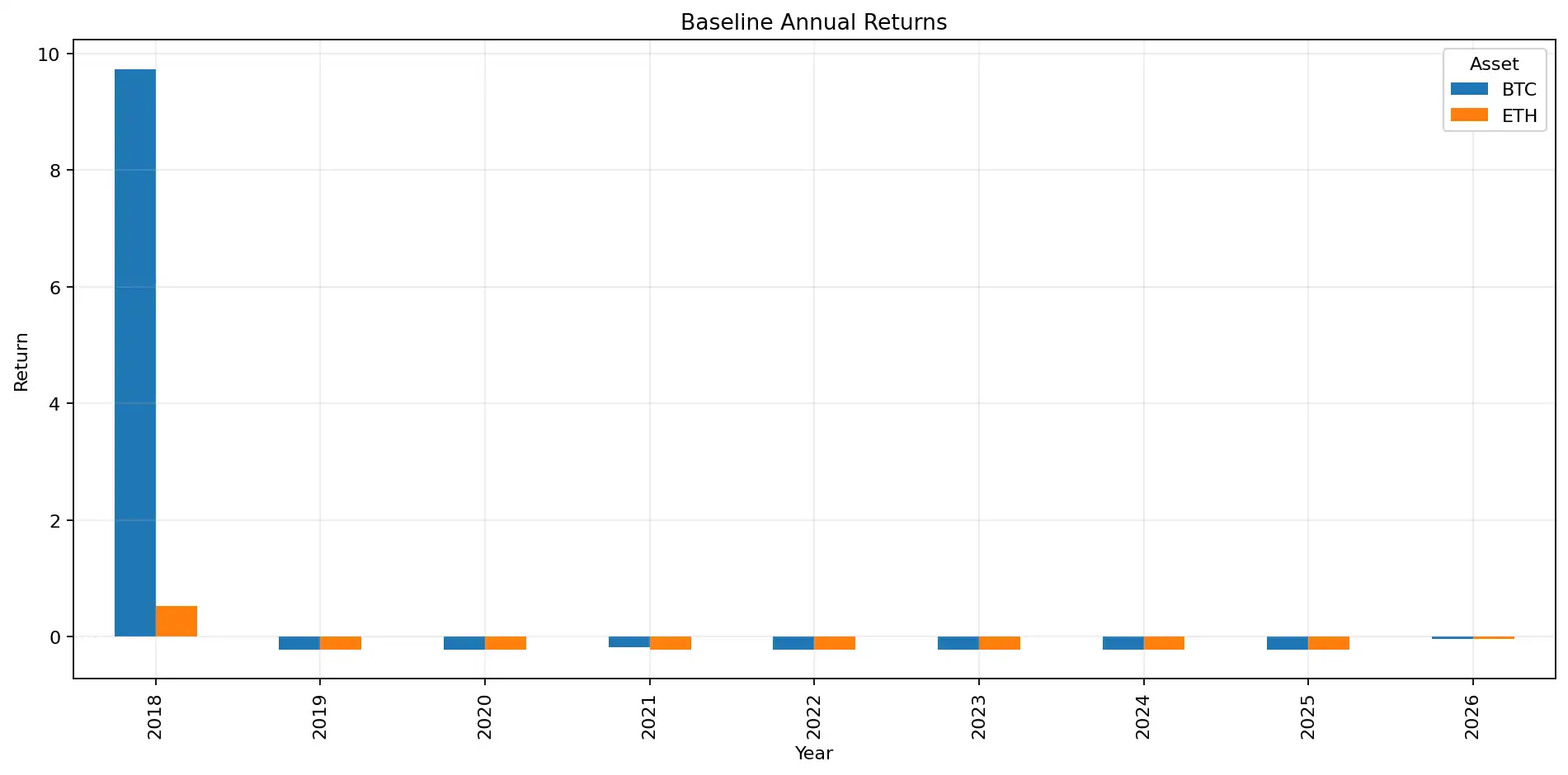
Figure 4: The extreme profit contribution chart shows that BTC's long-term profits are almost entirely driven by a few top trades, which is typical for tail insurance strategies.

Contribution of Extreme Market Conditions to Strategy Returns

A very interesting finding is that "a major market crash occurs" does not equal "your Put will definitely make money." Under the baseline portfolio, we specifically examined the performance of holdings around the March 2020 pandemic crash, the May 2021 crypto crash, the May 2022 LUNA event, and the November 2022 FTX event.

The results are not romantic. For BTC, only the May 2021 event window was profitable, with a single trade return of 127.09%, a recovery multiple of 2.27 times at expiration, contributing 15.87% to the total net profit. The holdings corresponding to March 2020, May 2022, and November 2022 all lost 100% of the premium. For ETH, it was more extreme: all four event windows resulted in 100% losses.

This shows that tail insurance is not "automatically profitable whenever a black swan occurs"; it highly depends on the entry timing, remaining time to expiration, and strike price level. Fixed monthly rolling purchases ensure you are "in the game long-term" but do not guarantee you "hold the most profitable contract at the right time."

BTC vs. ETH Performance Difference

Looking at the average results across the full parameter grid, BTC clearly outperforms ETH. The average total return for all parameter combinations for BTC was 1326.06%, with an average CAGR of 23.87% and an average Tail Insurance Score of 0.544; for ETH, these figures were 519.48%, 13.39%, and 0.362, respectively. In the baseline portfolio, BTC was positive and ETH was negative. This difference is also very evident in the net value comparison charts across different Deltas and durations.

More importantly, BTC's extreme profits are more capable of covering long-term premium costs, while ETH is more prone to remain in a state of "paying premiums long-term without necessarily getting paid back at critical moments." Simply put, when buying tail insurance, BTC is more like "insurance that pays out," while ETH is more like "insurance that is more expensive and harder to claim."
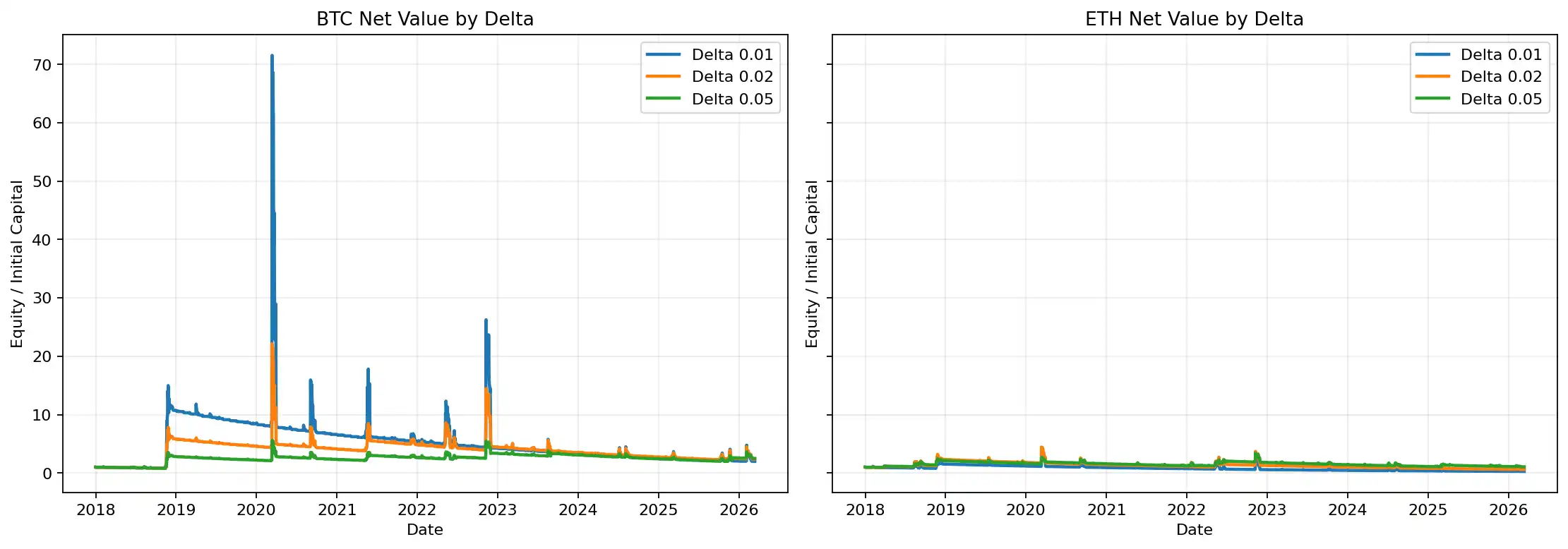
Figure 5: The baseline strategy comparison chart for BTC and ETH shows that although both assets experience extreme volatility, BTC's tail insurance efficiency is higher.

Parameter Sensitivity: Is Deeper Out-of-the-Money Better?

The parameter comparison results provide a more complete picture. Sorted by total return, the highest-yielding combination was for BTC: Delta 0.01, invest 2%, 45 days to expiration, achieving a total return of 9747.06%, corresponding to a CAGR of 74.99%. If looking only at "profitability," deeper OTM, longer duration, and适度杠杆 combinations perform extremely well on BTC.

But if considering risk constraints, the answer is not so simple. The combination with the lowest maximum drawdown was for ETH: Delta 0.05, invest 1%, 14 days, with a maximum drawdown of -37.89%. Looking at comprehensive average metrics, Delta 0.02 offers a better balance between Total Return, Calmar Ratio, and Premium Burn Ratio, making it the most "reasonable" Delta in this full parameter grid.

Figure 6: Net value curves for different Deltas show that the deeper the Delta, the more the strategy resembles typical black swan insurance; when Delta is slightly higher, more balanced combinations appear between returns and capital experience.

Figure 7: Comparison of different investment proportions说明, position size significantly amplifies return elasticity but also同步放大 long-term drawdown and path risk.

Strategy Advantages and Disadvantages

The advantages of this type of strategy are very distinct. First, simple structure, fixed rules, no reliance on subjective judgment. Second, extremely strong convexity; once extreme行情 are hit, the profit elasticity is astonishing. Third, its logic is completely different from mainstream long strategies; it is closer to a risk coverage tool in asset allocation rather than a directional trade.

But the disadvantages are equally harsh. First, the long-term capital experience is extremely poor; low win rate, long periods of drawdown, and consecutive years of losses are all possible. Second, it is highly sensitive to the "holding path"; even if the market crashes, you might not be holding the most profitable Put. Third, although this backtest is strict, it is still based on Black-Scholes and historical volatility proxy; implied volatility skew, liquidity, fees, and slippage in the real market would further affect live results.

What Type of Investor is This Strategy Suitable For?

It is more suitable for three types of people. First, institutional capital that treats it as portfolio insurance, not a primary profit strategy. Second, highly disciplined investors who can withstand years of "appearing to lose continuously." Third, those who explicitly want convex returns in extreme markets, not追求 daily high win rates.

It is not suitable for investors who view it as a "stable money-making model," nor for capital with short-term evaluation cycles that cannot tolerate long-term underwater performance. Because, as the backtest results show, even the ultimately profitable BTC baseline portfolio experienced a -97.24% maximum drawdown and 57 consecutive months of losses. Without极强的 capital endurance, this strategy is almost impossible to hold.

Final Conclusion

If you started buying one deep OTM Put every month since 2018, could you make money in the long run? The answer from this backtest is: Yes, but not in the普遍 sense of "yes." On BTC, the baseline portfolio ultimately achieved a 97.62% total return; on ETH, the same logic lost 73.07%. This means it is not a money-printing machine that works stably across assets and environments.

Is it a strategy purely reliant on extreme markets? Based on the backtest results, essentially yes. The extremely low win rate, the very low proportion of profitable months, the high skewness and kurtosis, and the overwhelming contribution of the top 5 profitable trades to the final net profit all indicate that it is not a strategy that "works hard long-term, collecting a salary monthly," but rather one that "pays premiums long-term, waiting for a few fateful moments."

If one must draw a more practical conclusion from these results, it is this: BTC is more suitable for this type of tail insurance than ETH; Delta 0.02 is a more balanced choice, as it offered better overall value in the full parameter comparison; and if investors seek more extreme convexity, Delta 0.01 remains the most aggressive and most "black swan insurance" like version.

In the end, consistently buying deep OTM Puts is not the most expensive strategy, nor the best strategy. It is more like an expensive but sometimes irreplaceable配置 tool. The question is never "is it worth buying," but rather whether you actually need this insurance, and whether you can withstand the long wait before the真正的理赔 arrives.

Пов'язані питання

QBased on the backtest, does consistently buying a deep out-of-the-money (OTM) put option on Bitcoin (BTC) every month since 2018 result in a net profit?

AYes, for Bitcoin, the benchmark strategy (Delta 0.01, 2% allocation, 30-day expiry) resulted in a total return of 97.62% and a Compound Annual Growth Rate (CAGR) of 8.66%.

QWhy did the same strategy perform so differently on Ethereum (ETH) compared to Bitcoin?

AThe strategy resulted in a -73.07% total return for ETH. The key difference is that the extreme profitable events on ETH were not large enough to cover the long-term cost of the premiums paid, whereas they were for Bitcoin.

QWhat are the main characteristics of the returns from this 'tail insurance' strategy?

AThe returns are characterized by extreme right skew, very low win rate (2.04% for BTC, 1.02% for ETH), and high kurtosis. The vast majority of trades lose 100% of the premium, while the entire net profit is driven by a very small number of extremely large winning trades.

QWhat was the most important factor identified for improving the strategy's risk-return profile?

AAdjusting the target Delta. While the deepest OTM puts (Delta 0.01) offered the highest potential returns, a Delta of 0.02 provided a better balance between total return, risk (Calmar Ratio), and premium burn ratio across the full parameter grid.

QWhat type of investor is this strategy most suitable for, according to the article?

AIt is suitable for three types of investors: 1) Institutional funds using it as portfolio insurance, not a primary strategy. 2) Highly disciplined investors who can withstand years of apparent losses. 3) Those seeking convex payoffs in extreme events, not high win rates. It is not suitable for investors seeking stable returns or those with short-term performance horizons.

Пов'язані матеріали

Торгівля

Спот
Ф'ючерси

Популярні статті

Що таке BITCOIN

Розуміння HarryPotterObamaSonic10Inu (ERC-20) та його позиції у крипто-просторі Останніми роками ринок криптовалют спостерігав за зростанням популярності мем-коінів, які привертають інтерес не тільки трейдерів, але й тих, хто шукає спілкування та розважальну цінність. Серед цих унікальних токенів є HarryPotterObamaSonic10Inu (ERC-20), інтригуючий проект, що поєднує культурні посилання з тканинами криптовалюти. Ця стаття досліджує ключові аспекти HarryPotterObamaSonic10Inu, вивчаючи його механізми, спільноту та його взаємодію з ширшим крипто-ландшафтом. Що таке HarryPotterObamaSonic10Inu (ERC-20)? Як випливає з його назви, HarryPotterObamaSonic10Inu є мем-коіном, побудованим на блокчейні Ethereum, класифікованим за стандартом ERC-20. На відміну від традиційних криптовалют, які можуть підкреслювати практичну корисність або інвестиційний потенціал, цей токен процвітає завдяки розважальній цінності та силі своєї спільноти. Проект спрямований на створення середовища, де зацікавлені користувачі можуть об'єднуватися, ділитися ідеями та брати участь у заходах, натхненних різноманітними культурними явищами. Однією з примітних особливостей HarryPotterObamaSonic10Inu є нульовий податок на транзакції. Цей привабливий елемент має на меті заохочувати торгівлю та участь у спільноті, позбавлену додаткових витрат, які можуть відлякувати дрібних трейдерів. Загальна пропозиція монет становить один мільярд токенів, що позначає намір підтримувати суттєву циркуляцію в межах спільноти. Творець HarryPotterObamaSonic10Inu (ERC-20) Походження HarryPotterObamaSonic10Inu дещо окутане таємницею; деталі про творця залишаються невідомими. Розвиток цього токена позбавлений впізнаваної команди або чіткої стратегії, що не є рідкістю в секторі мем-коінів. Натомість проект виник органічно, а його розвиток значною мірою залежить від ентузіазму та участі його спільноти. Інвестори HarryPotterObamaSonic10Inu (ERC-20) Щодо зовнішніх інвестицій та підтримки, HarryPotterObamaSonic10Inu також залишається невизначеним. Токен не зазначає жодних відомих інвестиційних фондів або значної організаційної підтримки. Натомість життєва сила проекту полягає в його базовій спільноті, яка інформує про його зростання та стійкість через колективні дії та залученість у крипто-просторі. Як працює HarryPotterObamaSonic10Inu (ERC-20)? Як мем-коін, HarryPotterObamaSonic10Inu функціонує передусім поза традиційними рамками, що часто регулюють вартість активів. Є кілька відмінних аспектів, що визначають, як працює проект: Транзакції без податку: Завдяки відсутності податкових зборів на транзакції, користувачі можуть вільно купувати та продавати токен, не турбуючись про приховані витрати. Залучення спільноти: Проект процвітає завдяки взаємодії спільноти, використовуючи соціальні медіа для створення шуму та сприяння залученню. Обговорення, обмін контентом та залученість є ключовими елементами, що допомагають розширити його охоплення та зміцнити лояльність серед прихильників. Відсутність практичної корисності: Слід зазначити, що HarryPotterObamaSonic10Inu не пропонує конкретної корисності в рамках фінансової екосистеми. Натомість він класифікується як токен, що призначений в основному для розваги та спільнотних активностей. Культурне посилання: Токен кмітливо вплітає елементи популярної культури, щоб привернути інтерес, зв'язуючи з ентузіастами мемів та крипто-стежками. HarryPotterObamaSonic10Inu ілюструє, як мем-коіни функціонують інакше, ніж традиційні криптовалютні проекти, увійшовши на ринок як інноваційні соціальні конструкти, а не утилітарні активи. Хронологія HarryPotterObamaSonic10Inu (ERC-20) Історія HarryPotterObamaSonic10Inu відзначена кількома значними етапами: Створення: Токен виник з вірусного мему, захопивши уяву багатьох крипто-ентузіастів. Конкретні дати створення недоступні, що підкреслює його органічний розвиток. Лістинг на біржах: HarryPotterObamaSonic10Inu з'явився на різних біржах, дозволяючи зручніший доступ і торгівлю спільноти. Ініціативи залучення спільноти: Ведення діяльності, спрямованої на покращення взаємодії спільноти, включаючи конкурси, кампанії в соціальних мережах та створення контенту від фанатів та прихильників. Плани на майбутнє: Дорожня карта проекту включає запуск колекції NFT, мерчандайзинг та електронну комерцію, пов'язану з його культурними темами, що далі залучає спільноту та намагається додати більше вимірів до його екосистеми. Ключові моменти про HarryPotterObamaSonic10Inu (ERC-20) Спільнотний підхід: Проект надає пріоритет колективному внеску та креативності, забезпечуючи, щоб участь користувачів була в центрі його розвитку. Класифікація як мем-коін: Це є його епігенез розважальної криптовалюти, що відрізняється від традиційних інвестиційних інструментів. Жодного прямого відношення до Bitcoin: Незважаючи на схожість у назві, HarryPotterObamaSonic10Inu є відмінним і не має жодного зв’язку з Bitcoin або іншими усталеними криптовалютами. Зосередженість на співпраці: HarryPotterObamaSonic10Inu створено для того, щоб надати простір для співпраці та обміну історіями серед його власників, забезпечуючи шлях для творчості та спільного зв'язку. Перспективи на майбутнє: Амбіція розширитися за межі початкової концепції в NFT та мерчандайз відкриває шлях для проекту потенційно потрапити в більш мейнстрімні сфери цифрової культури. Оскільки мем-коіни продовжують захоплювати уяву спільноти криптовалют, HarryPotterObamaSonic10Inu (ERC-20) вирізняється своїми культурними зв'язками та орієнтованим на спільноту підходом. Хоча він може не відповідати типовій моделі утилітарного токена, його суть полягає в радощах і товариськості, що підтримуються серед його прихильників, підкреслюючи еволюційну природу криптовалют в усе більш цифрову епоху. Оскільки проект продовжує розвиватися, важливо спостерігати за тим, як динаміка спільноти вплине на його траєкторію в постійно змінюваному ландшафті технології блокчейн.

1.7k переглядів усьогоОпубліковано 2024.04.01Оновлено 2024.12.03

Що таке BITCOIN

Як купити BTC

Ласкаво просимо до HTX.com! Ми зробили покупку Bitcoin (BTC) простою та зручною. Дотримуйтесь нашої покрокової інструкції, щоб розпочати свою криптовалютну подорож.Крок 1: Створіть обліковий запис на HTXВикористовуйте свою електронну пошту або номер телефону, щоб зареєструвати обліковий запис на HTX безплатно. Пройдіть безпроблемну реєстрацію й отримайте доступ до всіх функцій.ЗареєструватисьКрок 2: Перейдіть до розділу Купити крипту і виберіть спосіб оплатиКредитна/дебетова картка: використовуйте вашу картку Visa або Mastercard, щоб миттєво купити Bitcoin (BTC).Баланс: використовуйте кошти з балансу вашого рахунку HTX для безперешкодної торгівлі.Треті особи: ми додали популярні способи оплати, такі як Google Pay та Apple Pay, щоб підвищити зручність.P2P: Торгуйте безпосередньо з іншими користувачами на HTX.Позабіржова торгівля (OTC): ми пропонуємо індивідуальні послуги та конкурентні обмінні курси для трейдерів.Крок 3: Зберігайте свої Bitcoin (BTC)Після придбання Bitcoin (BTC) збережіть його у своєму обліковому записі на HTX. Крім того, ви можете відправити його в інше місце за допомогою блокчейн-переказу або використовувати його для торгівлі іншими криптовалютами.Крок 4: Торгівля Bitcoin (BTC)Легко торгуйте Bitcoin (BTC) на спотовому ринку HTX. Просто увійдіть до свого облікового запису, виберіть торгову пару, укладайте угоди та спостерігайте за ними в режимі реального часу. Ми пропонуємо зручний досвід як для початківців, так і для досвідчених трейдерів.

4.3k переглядів усьогоОпубліковано 2024.12.12Оновлено 2025.03.21

Як купити BTC

Що таке $BITCOIN

ЦИФРОВЕ ЗОЛОТО ($BITCOIN): Комплексний аналіз Вступ до ЦИФРОВОГО ЗОЛОТА ($BITCOIN) ЦИФРОВЕ ЗОЛОТО ($BITCOIN) — це проект на основі блокчейну, що працює в мережі Solana, який має на меті поєднати характеристики традиційних дорогоцінних металів з інноваціями децентралізованих технологій. Хоча він має таку ж назву, як і Bitcoin, який часто називають “цифровим золотом” через його сприйняття як засобу збереження вартості, ЦИФРОВЕ ЗОЛОТО є окремим токеном, розробленим для створення унікальної екосистеми в ландшафті Web3. Його мета — позиціонувати себе як життєздатний альтернативний цифровий актив, хоча деталі щодо його застосувань і функціональностей все ще розробляються. Що таке ЦИФРОВЕ ЗОЛОТО ($BITCOIN)? ЦИФРОВЕ ЗОЛОТО ($BITCOIN) — це токен криптовалюти, спеціально розроблений для використання в блокчейні Solana. На відміну від Bitcoin, який виконує широко визнану роль зберігання вартості, цей токен, здається, зосереджується на більш широких застосуваннях і характеристиках. Помітні аспекти включають: Інфраструктура блокчейну: Токен побудований на блокчейні Solana, відомому своєю здатністю обробляти швидкі та низьковартісні транзакції. Динаміка постачання: ЦИФРОВЕ ЗОЛОТО має максимальне постачання, обмежене 100 квадрильйонами токенів (100P $BITCOIN), хоча деталі щодо його обігового постачання наразі не розголошуються. Утиліта: Хоча точні функціональності не викладені, є вказівки на те, що токен може бути використаний для різних застосувань, потенційно пов'язаних з децентралізованими додатками (dApps) або стратегіями токенізації активів. Хто є творцем ЦИФРОВОГО ЗОЛОТА ($BITCOIN)? На даний момент особа творців і команди розробників, що стоять за ЦИФРОВИМ ЗОЛОТОМ ($BITCOIN), залишається невідомою. Ця ситуація є типовою для багатьох інноваційних проектів у сфері блокчейну, особливо тих, що пов'язані з децентралізованими фінансами та феноменом мем-коінів. Хоча така анонімність може сприяти культурі, орієнтованій на спільноту, вона посилює занепокоєння щодо управління та підзвітності. Хто є інвесторами ЦИФРОВОГО ЗОЛОТА ($BITCOIN)? Доступна інформація вказує на те, що ЦИФРОВЕ ЗОЛОТО ($BITCOIN) не має жодних відомих інституційних спонсорів або помітних венчурних капіталовкладень. Проект, здається, працює за моделлю “рівний до рівного”, зосереджуючись на підтримці та прийнятті спільноти, а не на традиційних шляхах фінансування. Його активність і ліквідність переважно розташовані на децентралізованих біржах (DEX), таких як PumpSwap, а не на встановлених централізованих торгових платформах, що ще більше підкреслює його підхід знизу вгору. Як працює ЦИФРОВЕ ЗОЛОТО ($BITCOIN) Операційні механізми ЦИФРОВОГО ЗОЛОТА ($BITCOIN) можна детальніше розглянути на основі його дизайну блокчейну та характеристик мережі: Механізм консенсусу: Використовуючи унікальний proof-of-history (PoH) Solana в поєднанні з моделлю proof-of-stake (PoS), проект забезпечує ефективну валідацію транзакцій, що сприяє високій продуктивності мережі. Токеноміка: Хоча конкретні дефляційні механізми не були детально описані, велике максимальне постачання токенів вказує на те, що воно може задовольняти мікротранзакції або нішеві випадки використання, які ще потрібно визначити. Інтероперабельність: Існує потенціал для інтеграції з більш широкою екосистемою Solana, включаючи різні платформи децентралізованих фінансів (DeFi). Однак деталі щодо конкретних інтеграцій залишаються невизначеними. Хронологія ключових подій Ось хронологія, яка підкреслює значні віхи, пов'язані з ЦИФРОВИМ ЗОЛОТОМ ($BITCOIN): 2023: Початкове розгортання токена відбувається на блокчейні Solana, позначене його адресою контракту. 2024: ЦИФРОВЕ ЗОЛОТО набуває видимості, оскільки стає доступним для торгівлі на децентралізованих біржах, таких як PumpSwap, що дозволяє користувачам торгувати ним проти SOL. 2025: Проект спостерігає спорадичну торгову активність і потенційний інтерес до ініціатив, очолюваних спільнотою, хоча на даний момент не зафіксовано жодних значних партнерств або технічних досягнень. Критичний аналіз Сильні сторони Масштабованість: Основна інфраструктура Solana підтримує високі обсяги транзакцій, що може підвищити утиліту $BITCOIN у різних сценаріях транзакцій. Доступність: Потенційно низька торгова ціна за токен може привабити роздрібних інвесторів, сприяючи більш широкій участі завдяки можливостям дробового володіння. Ризики Відсутність прозорості: Відсутність публічно відомих спонсорів, розробників або процесу аудиту може викликати скептицизм щодо стійкості та надійності проекту. Волатильність ринку: Торгова активність сильно залежить від спекулятивної поведінки, що може призвести до значної волатильності цін і невизначеності для інвесторів. Висновок ЦИФРОВЕ ЗОЛОТО ($BITCOIN) постає як цікавій, але неоднозначний проект у швидко розвиваючійся екосистемі Solana. Хоча він намагається використати наратив “цифрового золота”, його відхід від встановленої ролі Bitcoin як засобу збереження вартості підкреслює необхідність чіткішого розмежування його передбачуваної утиліти та структури управління. Майбутнє прийняття та адаптація, ймовірно, залежатиме від вирішення поточної непрозорості та більш чіткого визначення його операційних та економічних стратегій. Примітка: Цей звіт охоплює синтезовану інформацію, доступну станом на жовтень 2023 року, і можуть відбутися події, що виходять за межі дослідницького періоду.

75 переглядів усьогоОпубліковано 2025.05.13Оновлено 2025.05.13

Що таке $BITCOIN

Обговорення

Ласкаво просимо до спільноти HTX. Тут ви можете бути в курсі останніх подій розвитку платформи та отримати доступ до професійної ринкової інформації. Нижче представлені думки користувачів щодо ціни BTC (BTC).

活动图片