Hyperliquid gains strength from 2 key areas: What this means for HYPE’s demand

ambcryptoОпубліковано о 2026-03-29Востаннє оновлено о 2026-03-29

Анотація

Recent on-chain activity indicates a shift in demand for Hyperliquid (HYPE), driven by significant whale accumulation and protocol buybacks. A whale deposited $4 million USDC and acquired over $2.1 million worth of HYPE, followed by a TWAP order targeting 99,000 tokens, signaling sustained buying that absorbed supply without major price disruption. This demand, coupled with ongoing token buybacks and a reduction of 37.5 million HYPE through burns, has tightened circulating supply (approx. 238.4 million of 962 million total), increasing price sensitivity to new demand. However, sustainability remains uncertain as buybacks rely on trading volume, and monthly distributions or whale selling could reintroduce supply. While deflation supports stability, lasting price strength depends on consistent demand and a shrinking float; fading activity may expose HYPE to downside pressure.

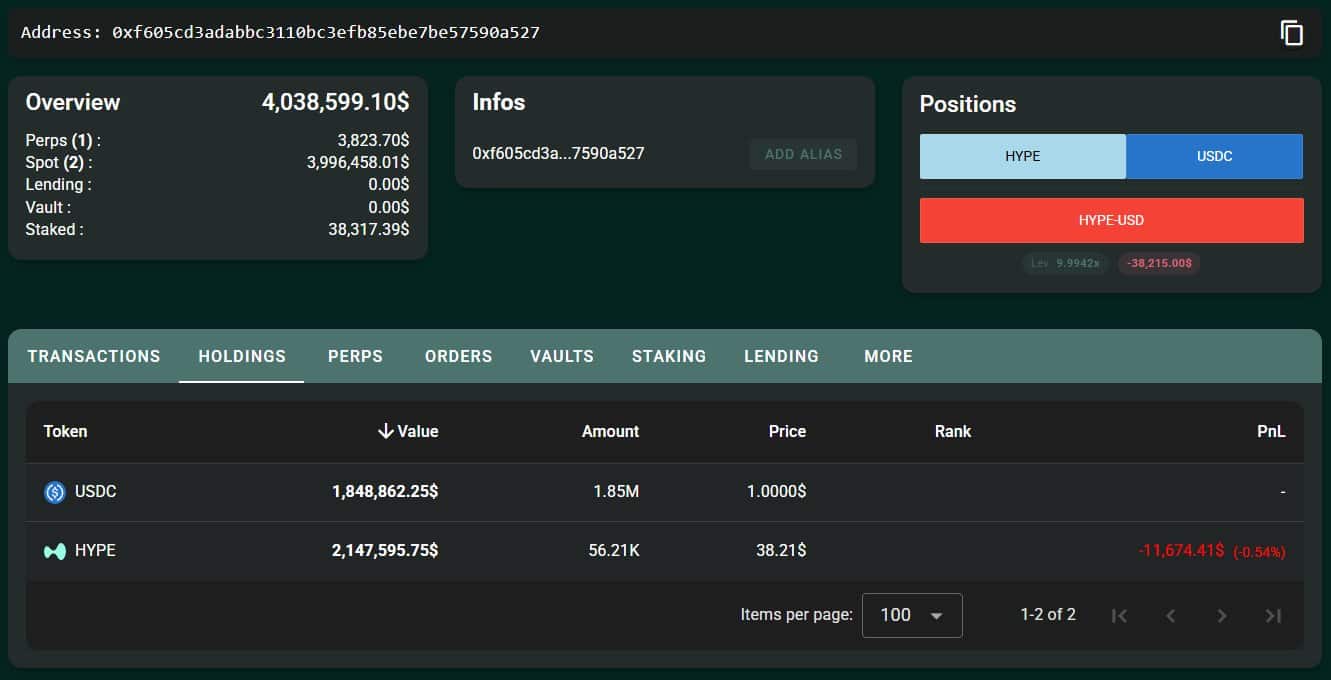
Recent on-chain activity shows a clear shift in how demand forms around Hyperliquid [HYPE]. A whale deposited $4 million USDC, then acquired about 56,208 HYPE worth roughly $2.1 million at $38.21.

As accumulation continued, a TWAP order targeted 99,000 HYPE over 10 hours, signaling sustained buying rather than a single entry. This steady execution absorbed supply while limiting price disruption.
Source: X

This dual flow tightened supply while reinforcing support, especially as prices held above $40, despite prior $22 million selling pressure. As a result, HYPE increasingly behaved like a revenue-linked asset driven by usage rather than narrative momentum.

HYPE deflation grows, but float still controls price

This demand-driven setup now shifted attention toward how supply actually behaves in the market. Hyperliquid removed about 37.5 million HYPE through burns, while daily buybacks continue absorbing tokens.

As these flows persist, circulating supply was near 238.4 million out of a total of 962 million at press time, leaving a large portion locked or inactive. This matters because price responds to tradable float rather than headline reductions.

As buybacks move tokens into system addresses and long-term wallets, float tightens, increasing sensitivity to fresh demand. However, monthly distributions of about 1.2 million HYPE and whale selling during rallies reintroduce supply.

This interaction shows deflation supports price stability, yet sustained upside depends on whether float keeps shrinking while demand remains consistent.

Is HYPE demand durable or flow-driven?

Price strength now shifts attention from who is buying to whether that demand can actually hold. Recent support reflects structured inflows, yet the market now tests if this strength can persist without visible drivers.

This happens because protocol buybacks depend on trading volume, which keeps demand active only while activity remains elevated. As volumes stay strong, price holds firm; however, any slowdown quickly reduces this underlying support.

Controlled accumulation also signals intent, yet it does not confirm long-term holding, especially if buyers target short-term positioning. Markets often absorb such flows if broader demand fails to follow.

This creates a fragile balance, where sustained demand confirms strength, while fading activity exposes price to downside pressure once temporary support weakens.


Final Summary

  • Hyperliquid shows strong demand from buybacks and whale accumulation, yet sustainability depends on continued trading volume and follow-through demand.
  • HYPE’s outlook depends on shrinking float and sustained absorption, as fading activity or whale distribution could weaken support and limit upside.


Трендові криптовалюти

Пов'язані питання

QWhat recent whale activity indicates a shift in demand formation for Hyperliquid (HYPE)?

AA whale deposited $4 million USDC and then acquired approximately 56,208 HYPE worth about $2.1 million, followed by a TWAP order targeting 99,000 HYPE over 10 hours, signaling sustained buying rather than a single entry.

QHow has Hyperliquid's token supply been affected by its economic mechanisms?

AHyperliquid has removed about 37.5 million HYPE through token burns, and daily buybacks continue to absorb tokens. The circulating supply is approximately 238.4 million out of a total supply of 962 million, with a large portion locked or inactive.

QWhat is the relationship between HYPE's price and its tradable float?

AThe price of HYPE responds to the tradable float rather than the headline supply reduction. As buybacks move tokens into system addresses and long-term wallets, the float tightens, making the price more sensitive to new demand.

QWhat is the primary driver of the protocol's buyback mechanism, and what risk does this create?

AProtocol buybacks depend on trading volume. This creates a risk because demand remains active only while trading activity is elevated; any slowdown in volume quickly reduces this underlying buyback support.

QAccording to the article, what two factors are critical for HYPE's sustained price strength?

ASustained price strength depends on the float continuing to shrink while demand remains consistent. It is a fragile balance where fading activity or whale distribution could weaken support and limit upside.

Пов'язані матеріали

10 Billion Repurchase Fails to Halt HYPE's Decline, Are Core Members and Multicoin Quietly Selling Tokens?

Foresight News reports that despite a massive $1 billion buyback program by the Assistance Fund, the HYPE token has fallen from its July high of $70 to around $52.40. Analyst MLM tracked data showing that since team token vesting began in December 2025, approximately 4.93 million HYPE (worth ~$270M) were allocated to core contributors. Of these, 1.19 million (~$32.5M) were sold on the open market, and 3.14 million (~$132M) were transferred to OTC desks. However, the report argues that direct team selling is not the primary driver of the price decline. In the same period, the protocol's Assistance Fund used 99% of trading fees to repurchase about 9.8 million HYPE for approximately $364 million, a rate more than double the team's selling pressure. The analysis points to other significant factors: major venture capital firms like Multicoin Capital and a16z have been unstaking and moving substantial amounts of HYPE to exchanges, with some confirming sales for portfolio management. Additionally, HYPE spot ETFs have experienced consistent daily net outflows since early July, reversing the strong inflows seen in May and June. The report concludes that while protocol buybacks absorb team selling, declining trading volume reduces this buyback power, and combined selling pressure from large investors and ETFs has significantly impacted the price.

marsbit8 хв тому

10 Billion Repurchase Fails to Halt HYPE's Decline, Are Core Members and Multicoin Quietly Selling Tokens?

marsbit8 хв тому

Wall Street Morning News: V-shaped Rebound at Month-end, but Nasdaq Suffers Worst July in 12 Years; Funds Accelerate Concentration Towards Cloud Giants

Despite a V-shaped rebound at the end of July, the Nasdaq posted its worst July since 2004, while the S&P 500 had its worst July since 2014. Markets were jolted by geopolitical shifts, as President Trump canceled a planned strike on Iran, leading WTI crude to plunge over 8%. This, alongside OPEC+ announcing a supply increase, reversed crude's sharp July gains. Treasury yields surged, with the 10-year yield rising over 30 basis points in July—its largest July increase since 2005. In a rare move, the US and Japan jointly intervened to weaken the USD/JPY, aiming to prevent potential Japanese sales of US Treasuries. While the tech sector faced deleveraging pressure throughout July, cloud giants staged a massive rally on strong earnings. Microsoft, Amazon, and Google collectively added nearly $1.5 trillion in market value last week. Amazon soared over 15% on accelerating AWS growth, Microsoft extended historic gains, Google fully recovered post-earnings losses, and Meta ended an 11-day losing streak. In contrast, Apple tumbled over 7% on supply chain and guidance concerns, ceding its "world's most valuable company" title to Nvidia. The memory and storage sector corrected sharply. Gold edged up 0.91% in July, with analysts viewing the ~30% pullback from January highs as a potential basing period, supported by long-term central bank demand. Key events to watch this week include earnings from Palantir, AMD, SpaceX (its first post-IPO report), and memory giants like Western Digital. The US July non-farm payrolls report on Friday will be critical for gauging the Fed's policy path. SpaceX also faces a significant lock-up expiration, testing market liquidity.

marsbit54 хв тому

Wall Street Morning News: V-shaped Rebound at Month-end, but Nasdaq Suffers Worst July in 12 Years; Funds Accelerate Concentration Towards Cloud Giants

marsbit54 хв тому

Rubin Ultra Makes Major Cuts, Even Nvidia Can't Handle Memory Price Hikes?

NVIDIA's Rubin Ultra, the top-tier variant of the newly announced Rubin AI accelerators, has reportedly seen significant specification downgrades, according to an industry report from SemiAnalysis. Initially designed with four compute dies (4-die), the Rubin Ultra is now said to be reduced to a 2-die design. Key changes highlighted in the report include: * **No increase in peak theoretical compute performance**, remaining at 35 PFLOPs like the standard Rubin. * **Severe reduction in memory capacity** to 192GB using 8-Hi HBM stacks, which is less than the standard Rubin's 288GB using 12-Hi stacks. * **Negligible memory bandwidth improvement** of only 1 TB/s. * **Slightly higher chip-level power consumption**. * The **primary upgrade is a massive increase in scale-up interconnect capacity**, supporting connections for up to 576 GPUs via NVLink, compared to 72 for the standard Rubin. The report suggests the redesign is primarily a cost-optimization move driven by the sharp rise in HBM (High-Bandwidth Memory) prices. By reducing the expensive HBM content and shifting investment towards enhanced system-scale networking, NVIDIA aims to maintain the platform's value for large-scale AI training clusters while managing soaring material costs. The news reportedly triggered a sell-off in South Korean memory stocks, with SK Hynix and Samsung shares falling around 8%, as markets grew concerned that NVIDIA—a major HBM buyer—might be reducing its reliance on high-capacity memory, potentially capping future pricing power for memory makers.

Odaily星球日报1 год тому

Rubin Ultra Makes Major Cuts, Even Nvidia Can't Handle Memory Price Hikes?

Odaily星球日报1 год тому

Торгівля

Спот

Популярні статті

Як купити HYPE

Ласкаво просимо до HTX.com! Ми зробили покупку Hyperliquid (HYPE) простою та зручною. Дотримуйтесь нашої покрокової інструкції, щоб розпочати свою криптовалютну подорож.Крок 1: Створіть обліковий запис на HTXВикористовуйте свою електронну пошту або номер телефону, щоб зареєструвати обліковий запис на HTX безплатно. Пройдіть безпроблемну реєстрацію й отримайте доступ до всіх функцій.ЗареєструватисьКрок 2: Перейдіть до розділу Купити крипту і виберіть спосіб оплатиКредитна/дебетова картка: використовуйте вашу картку Visa або Mastercard, щоб миттєво купити Hyperliquid (HYPE).Баланс: використовуйте кошти з балансу вашого рахунку HTX для безперешкодної торгівлі.Треті особи: ми додали популярні способи оплати, такі як Google Pay та Apple Pay, щоб підвищити зручність.P2P: Торгуйте безпосередньо з іншими користувачами на HTX.Позабіржова торгівля (OTC): ми пропонуємо індивідуальні послуги та конкурентні обмінні курси для трейдерів.Крок 3: Зберігайте свої Hyperliquid (HYPE)Після придбання Hyperliquid (HYPE) збережіть його у своєму обліковому записі на HTX. Крім того, ви можете відправити його в інше місце за допомогою блокчейн-переказу або використовувати його для торгівлі іншими криптовалютами.Крок 4: Торгівля Hyperliquid (HYPE)Легко торгуйте Hyperliquid (HYPE) на спотовому ринку HTX. Просто увійдіть до свого облікового запису, виберіть торгову пару, укладайте угоди та спостерігайте за ними в режимі реального часу. Ми пропонуємо зручний досвід як для початківців, так і для досвідчених трейдерів.

400 переглядів усьогоОпубліковано 2024.12.11Оновлено 2026.06.02

Як купити HYPE

Обговорення

Ласкаво просимо до спільноти HTX. Тут ви можете бути в курсі останніх подій розвитку платформи та отримати доступ до професійної ринкової інформації. Нижче представлені думки користувачів щодо ціни HYPE (HYPE).

活动图片