Stock contracts, as innovative products connecting traditional financial markets with the crypto derivatives system, are reshaping the on-chain trading landscape at an astonishing pace. We will delve into the product nature, growth logic, technical architecture, and market ecosystem of this emerging track, and conduct a systematic analysis of its regulatory challenges and future prospects. Research finds that stock perpetual contracts are not merely conceptual innovations but structural opportunities built upon the foundation of the global stock market's over $160 trillion market capitalization, combined with the mature trading paradigm of perpetual contracts. Currently, leading Perp DEXs such as Hyperliquid, Aster, and Lighter have taken the lead in constructing a comprehensive matrix of stock perpetual products, establishing significant advantages in trading depth, user experience, and asset coverage. However, regulatory uncertainty remains the biggest constraint for this track, and the exploration of compliant product pathways will directly impact its long-term development space. From a trend perspective, stock perpetuals are expected to drive the evolution of the on-chain derivatives market from crypto-native assets towards "perpetualization of all assets," becoming the next potential growth pole with trillion-dollar scale.
I. Product Essence: Structural Integration of Traditional Assets and On-Chain Derivatives
The essence of a stock perpetual contract is an on-chain synthetic derivative that tracks the price fluctuations of traditional stocks. By depositing stablecoin as margin, users gain long or short exposure to the price movements of US stock标的 such as Apple, Tesla, and Nvidia, without actually holding the stocks themselves or enjoying shareholder rights such as dividends and voting. This product design cleverly combines the asset base of traditional financial markets with the mature perpetual contract mechanisms of the crypto market, creating a new financial instrument that retains the price risk characteristics of stocks while possessing the flexibility of on-chain trading.
From a product positioning perspective, it is essential to clearly distinguish the fundamental differences between stock perpetual contracts and tokenized stocks (RWA Stock Tokens). Tokenized stocks typically involve a custodian actually holding the corresponding stocks and issuing tokenized certificates on the chain that represent real equity, with legal attributes and regulatory frameworks highly consistent with traditional securities. In contrast, stock perpetual contracts do not involve any equity relationship at all; they merely track stock prices through oracles and build a pure price risk trading market on the chain based on funding rate, margin, and liquidation mechanisms. This difference places them in completely different tracks: the former is a custody and circulation solution for on-chain assets, while the latter is a derivative innovation for risk trading.
The rise of stock perpetual contracts is not accidental but the result of multiple factors working together. From the demand side, there is a long-term pent-up demand for US stock trading among global users—traditional brokerages have cumbersome account opening processes, restricted cross-border capital flows, and fixed trading hours, which starkly contrast with the trading habits of crypto users: "24/7, stablecoin settlement, high leverage flexibility." Stock perpetual contracts provide users with an alternative path to bypass the traditional financial system and directly participate in US stock price fluctuations. From the supply side, the maturity of oracle technology since 2025, the proliferation of high-performance chain infrastructure, and the intensifying competition among Perp DEXs have provided the technical foundation and market momentum for the productization of stock perpetuals. More importantly, stock perpetuals happen to stand at the intersection of the two major narrative themes: "RWA (Real World Assets)" and "on-chain derivatives." They possess both the vast capital base of traditional assets and the high-growth potential of crypto derivatives, naturally becoming the focus of market attention.
II. Underlying Mechanisms: The Triple Challenge of Price, Liquidation, and Leverage
The stable operation of stock perpetual contracts relies on a precisely designed underlying mechanism, covering multiple dimensions such as price discovery, asset synthesis, risk control, and leverage management. Among these, the price source (oracle) is the cornerstone of the entire system. Since on-chain protocols cannot directly access real-time quotes from Nasdaq or the NYSE, decentralized oracles must reliably transmit price data from traditional markets to the blockchain. Current mainstream solutions include Pyth Network, Switchboard, Chainlink, and some protocols' self-developed Oracle systems. Pyth emphasizes high-frequency updates and anti-manipulation by obtaining first-hand quotes directly through partnerships with market makers and exchanges; Switchboard provides highly customizable price source aggregation solutions, allowing protocols to switch update strategies based on different time periods; Chainlink relies on a decentralized node network to provide robust, continuous, and verifiable price feeds. A few leading protocols like Hyperliquid use self-developed Oracles, achieving a higher degree of pricing autonomy through multi-source quote aggregation, internal index construction, and off-chain risk control verification.
The core problems that oracles need to solve go far beyond data transmission. The US stock market has unique structural features such as trading hour restrictions (not 24/7), pre-market and after-hours volatility, and trading halts, which require oracles to intelligently handle market state switches. Mainstream solutions introduce mechanisms like market open/close markers, TWAP smoothing algorithms, and outlier filtering to ensure that on-chain prices do not deviate from the real anchor during US market closures, while avoiding price manipulation risks due to insufficient liquidity. For example, after the US market closes, the oracle may automatically switch to a low-frequency update mode or generate an internal reference price based on the last valid price combined with on-chain supply and demand, maintaining trading continuity while controlling tail risks.
At the synthetic asset construction level, stock perpetual contracts do not mint tokens representing real equity but create virtual positions linked to the price of the underlying stock through smart contracts. Users deposit stablecoins like USDC as margin to open long or short positions, and their profits and losses are entirely determined by the contract price and settlement rules. The protocol adjusts the long-short balance through a funding rate mechanism—when positions are overly concentrated in one direction, the funding rate incentivizes users to open positions in the opposite direction, keeping the system's overall risk exposure relatively neutral. Compared to crypto perpetuals, the funding rate for stock perpetuals also needs to consider additional factors such as the overnight cost of US stocks themselves and the trading rhythm of the real market, presenting more complex cyclical characteristics.
The liquidation mechanism is the core link of the stock perpetual risk control system, and its challenge lies in simultaneously responding to volatility in two unsynchronized markets: US stocks trade only during specific hours, while the crypto market operates 24/7. When the US market is closed and the crypto market experiences剧烈波动, the value of user collateral may shrink rapidly, causing stock perpetual positions to face liquidation risk. To address this, mainstream protocols have introduced cross-asset risk engines and dynamic parameter adjustment mechanisms. During US market closures, the system automatically increases maintenance margin rates, lowers maximum leverage limits, and advances liquidation thresholds to cope with the gap risk brought by discontinuous information. Once the US market opens, risk control parameters gradually return to normal. This design preserves the continuity of on-chain trading while reducing systemic risks caused by cross-market mismatches through dynamic risk control.
Leverage design also reflects the differences between traditional assets and crypto products. In crypto asset perpetual contracts, some platforms offer leverage of hundreds of times or even higher, but in the stock perpetual领域, mainstream protocols generally cap leverage between 5x and 25x. This is based on multiple considerations: First, stock prices are influenced by fundamental factors such as company earnings, macro events, and industry policies, resulting in a volatility structure different from crypto assets; second, US stocks have special scenarios like gap openings and after-hours trading, where high leverage can easily trigger chain liquidations; finally, regulators have always maintained a cautious attitude towards stock-related derivatives, and restrained leverage helps reduce compliance risks. Even if the platform interface displays a maximum of 20x leverage, the actual available leverage is often dynamically adjusted based on market conditions,标的 liquidity, user position density, and other factors, forming a risk control system that is "flexible on the surface but strict at the core."
III. Market Landscape: Differentiated Competition and Ecosystem Evolution of Perp DEXs
The current stock perpetual contract market has formed a competitive landscape dominated by leading Perp DEXs such as Hyperliquid, Aster, Lighter, and ApeX, with significant differentiation in their technical architectures, product designs, and liquidity strategies.
Hyperliquid, leveraging its high-performance underlying self-developed chain and the HIP-1 third-party builder framework, quickly entered the stock perpetual track through projects like Trade.xyz. Its core advantage lies in its deep order book and institutional-grade liquidity—the XYZ100 (synthetic contract for the Nasdaq 100 index) can achieve daily trading volumes at the $300 million level, and open interest for标的 like SILVER and GOLD remains stable at tens of millions of dollars. Hyperliquid uses a multi-source median pricing mechanism, integrating external oracle prices, internal EMA smoothed values, and order book market prices to generate robust mark prices for liquidation and margin calculation. This dual-channel design of "professional-grade matching + synthetic pricing" strikes a good balance between high-frequency trading and risk control.
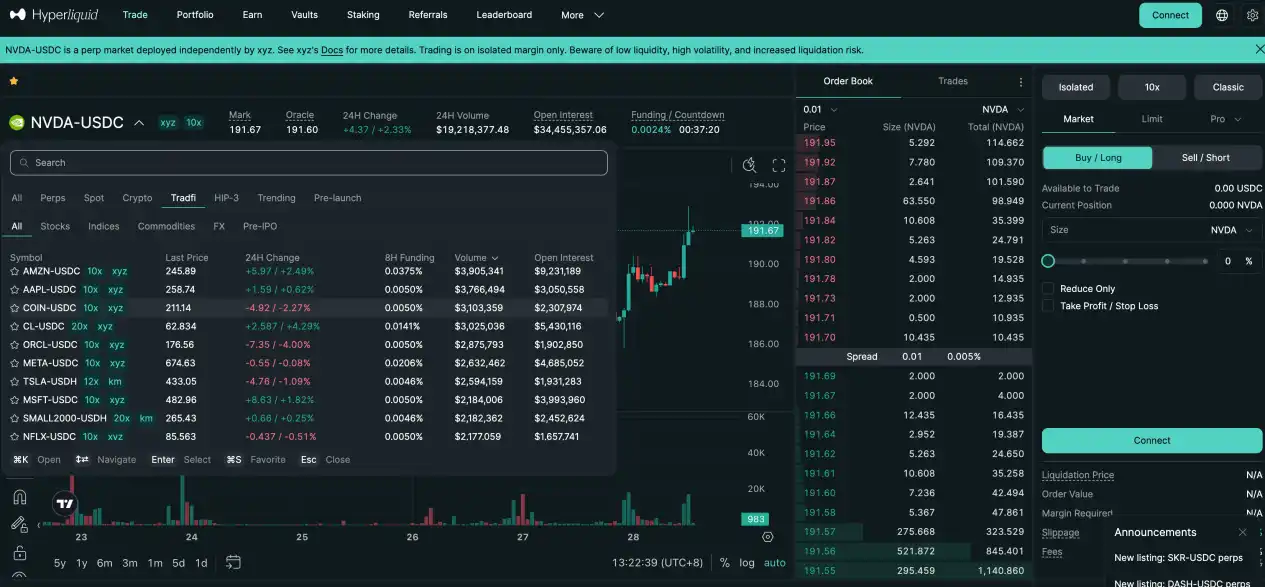
Aster innovatively launched a dual-mode parallel architecture of Simple and Pro, catering to user groups with different risk appetites. The Simple mode uses an AMM liquidity pool mechanism, allowing users to open and close positions with one click and trade with zero slippage, suitable for high-frequency, small-amount, short-term operations, with a stock perpetual leverage cap of 25x. The Pro mode is based on an on-chain order book, supporting advanced order types like limit orders and hidden orders, providing deeper liquidity and more precise strategy execution, with a stock perpetual leverage cap of 10x. Data performance shows that contracts for tech stocks like NVDA under the Pro mode maintain daily trading volumes in the millions of dollars, with open interest growing steadily, indicating continued participation by professional traders. Through this two-tier design of "traffic entry + deep market," Aster has effectively stratified its user structure and expanded its ecosystem.
Lighter's core selling point is its zk-rollup provable matching system, where all trading and liquidation processes can be verified on-chain through zero-knowledge proofs, emphasizing transparency and fairness. Its stock perpetuals currently support 10 US stock标的, with leverage uniformly set at 10x, demonstrating a relatively稳健 risk control orientation. The liquidity structure shows明显的头部集中特征—COIN (Coinbase) often突破 daily trading volume of $10 million, while标的 like NVDA, though with moderate trading volume, have high open interest, reflecting the stay of medium to long-term strategic funds. Lighter skillfully balances user experience: the front-end interaction is extremely simple, suitable for beginners to get started quickly; the underlying layer is still a professional order book, meeting institutional execution needs.
It is worth noting that the traffic入口 for stock perpetuals is expanding from单一官网 to a多元生态. Based.one provides a more consumer-grade trading interface by aggregating Hyperliquid's contract engine; Base.app integrates Lighter as a built-in trading module, allowing users to open positions without leaving their wallets; super apps like UXUY further simplify the operational path, packaging stock perpetuals into an experience closer to Web2 products. This division of labor and collaboration between "underlying protocols + application layer entry points" is lowering the barrier to entry for users and driving the evolution of stock perpetuals from niche professional tools to mass trading products.
IV. Regulatory Challenges: Finding Balance Between Innovation and Compliance
The greatest uncertainty facing stock perpetual contracts comes from the regulatory层面. Although there is no specialized legislation targeting such products globally yet, regulatory agencies are already paying close attention to their potential risks. The core issue lies in the界定 of their legal attribute: Do stock perpetual contracts constitute unregistered securities derivatives?
From regulatory practice, the US SEC has consistently adopted a substance-over-form principle for derivatives based on security prices. As long as the economic substance of the product is highly correlated with regulated securities, regardless of its technical packaging, it may fall under the jurisdiction of securities laws. Europe's ESMA has also emphasized多次 under the MiCA framework that on-chain derivatives锚定 traditional financial assets still need to comply with existing financial regulations. This means that although stock perpetuals do not involve real equity custody, their close correlation with US stock prices may lead to their classification as securities derivatives or Contracts for Difference (CFDs), thereby triggering a series of compliance requirements such as licensing, disclosure, and investor protection.
The current regulatory focus is still concentrated on products like tokenized stocks that directly map实物, but for synthetic risk exposures like stock perpetuals, regulatory attitudes are still in the observation stage. Possible future regulatory paths include: strengthening the compliance responsibilities of front-end operating entities (e.g., trading interface providers, liquidity guides); requiring price indices and oracle data sources to be公开透明; restricting high leverage, strengthening KYC and geographic access; and explicitly bringing products under existing derivative regulatory frameworks.
Strategies for protocols to reduce compliance risks include: clearly distinguishing between "price tracking" and "equity tokens," emphasizing the synthetic nature and risk hedging attributes of the product; adopting multi-source decentralized oracles to avoid price manipulation suspicions; setting reasonable leverage caps and risk parameters to avoid excessive speculation; and fully disclosing product risks and legal disclaimers in user agreements. In the long run, the compliant development of stock perpetuals may require exploring paths such as cooperation with licensed institutions, serving restricted jurisdictions, or innovative pilots based on regulatory sandboxes.
Beyond regulatory risk, stock perpetuals also face a series of market and technical risks. Oracle failures or malicious manipulation may lead to erroneous liquidations; cross-market volatility mismatches may amplify tail risks; insufficient liquidity may cause extreme slippage and difficulty closing positions; smart contract vulnerabilities may be exploited causing fund losses. These risks require protocols to establish a multi-layered risk control system, including but not limited to: multi-oracle redundancy and anomaly detection, dynamic margin adjustment, insurance fund buffering, contract security audits, and bug bounty programs.
V. Future Outlook: From Niche Innovation to Mainstream Financial Infrastructure
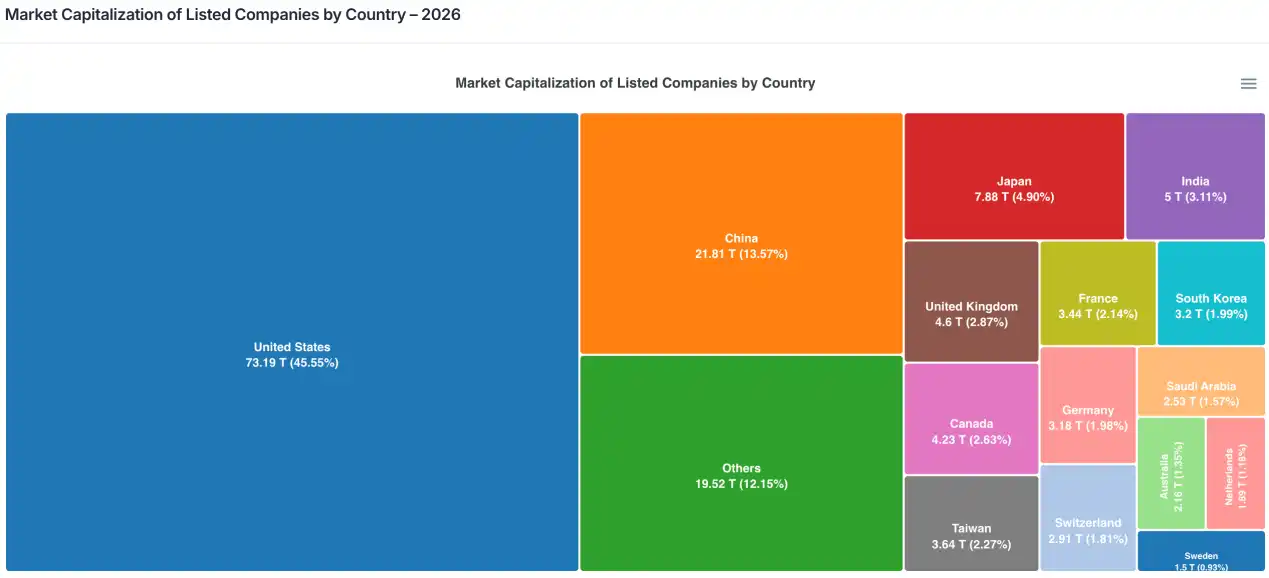
From a market size perspective, the potential space for stock perpetual contracts is extremely broad. The total market capitalization of global listed companies is接近 $160 trillion, with non-US markets accounting for over half, forming a vast asset pool of approximately $80 trillion. Even if only a tiny fraction of capital participates through perpetual contracts, its absolute scale could easily reach hundreds of billions of dollars. Referring to the structural characteristic where crypto market perpetual contract trading volume is already over 3 times that of spot, stock perpetuals have the potential to replicate a similar derivatization trend in the traditional asset领域.
In terms of product evolution, stock perpetuals may only be the starting point of the "perpetualization of all assets" wave. As pricing mechanisms,清算 systems, and liquidity infrastructure mature, macro assets such as commodities (gold, crude oil), stock indices (S&P, Nasdaq), foreign exchange (Euro, Yen), and even interest rates could potentially be introduced into the perpetual contract framework. Perp DEXs will gradually evolve from crypto-native trading platforms into comprehensive derivative markets covering multiple asset classes, becoming key interfaces connecting traditional finance with the on-chain ecosystem.
The regulatory environment will gradually move from模糊 to清晰. It is expected that within the next 2-3 years, major jurisdictions will issue classification guidelines and regulatory frameworks for on-chain derivatives, and the compliance boundaries for stock perpetuals will become clear accordingly. This may bring short-term pain, but will be beneficial for industry clearance and standardized development in the long run. Platforms that can提前布局 compliance capabilities, establish risk management systems, and maintain communication with regulators will gain a competitive advantage under the new rules.
In conclusion, stock perpetual contracts are at a critical breakthrough period from zero to one. They are both an inevitable choice for Perp DEXs seeking new growth narratives and a testing ground for the integration of traditional assets and crypto finance. Although the road ahead is still filled with technical challenges and regulatory uncertainty, the huge market demand and asset scale behind them determine that this is destined to be a track that cannot be ignored. In the future, stock perpetuals may not only become a pillar category of the on-chain derivatives market but also potentially reshape the way global retail investors participate in US stock and even global asset trading, truly realizing borderless, 24/7, and democratized financial markets. In this process, protocols that can balance innovation, risk, and compliance are most likely to become the builders of the new era's financial infrastructure.