HSBC Bank and Anchorpoint Financial win Hong Kong’s first stablecoin licenses – Details

ambcryptoОпубліковано о 2026-04-10Востаннє оновлено о 2026-04-10

Анотація

Hong Kong has issued its first stablecoin licenses to institutional, bank-backed entities HSBC Bank and Anchorpoint Financial (backed by Standard Chartered, Animoca Brands, and HKT). This marks the formal launch of the city's strict stablecoin regulatory framework, which prioritizes established players with strong compliance, capital reserves, and regulatory respect. The cautious, limited approval process may slow broader market participation and innovation in the near term but is designed to ensure user protection, risk management, and overall trust. The regime, which came into effect in August 2025, includes stringent rules on reserves, governance, and anti-money laundering controls.

Hong Kong has granted its first stablecoin issuer licenses. The initial batch is small and institutional, which sets a cautious tone.

Here’s what you need to know.

Bank-backed issuers dominate first approvals

The first stablecoin licenses went to Anchorpoint Financial and HSBC’s Hong Kong banking arm, both well-known TradFi players. Anchorpoint itself is backed by Standard Chartered, Animoca Brands, and HKT.

The initiative is happening under a new framework, led by the Hong Kong Monetary Authority (HKMA). Both entities are set to begin operations in the coming months.

These approvals are the formal launchpad for the city’s stablecoin regime, which took effect in August 2025.
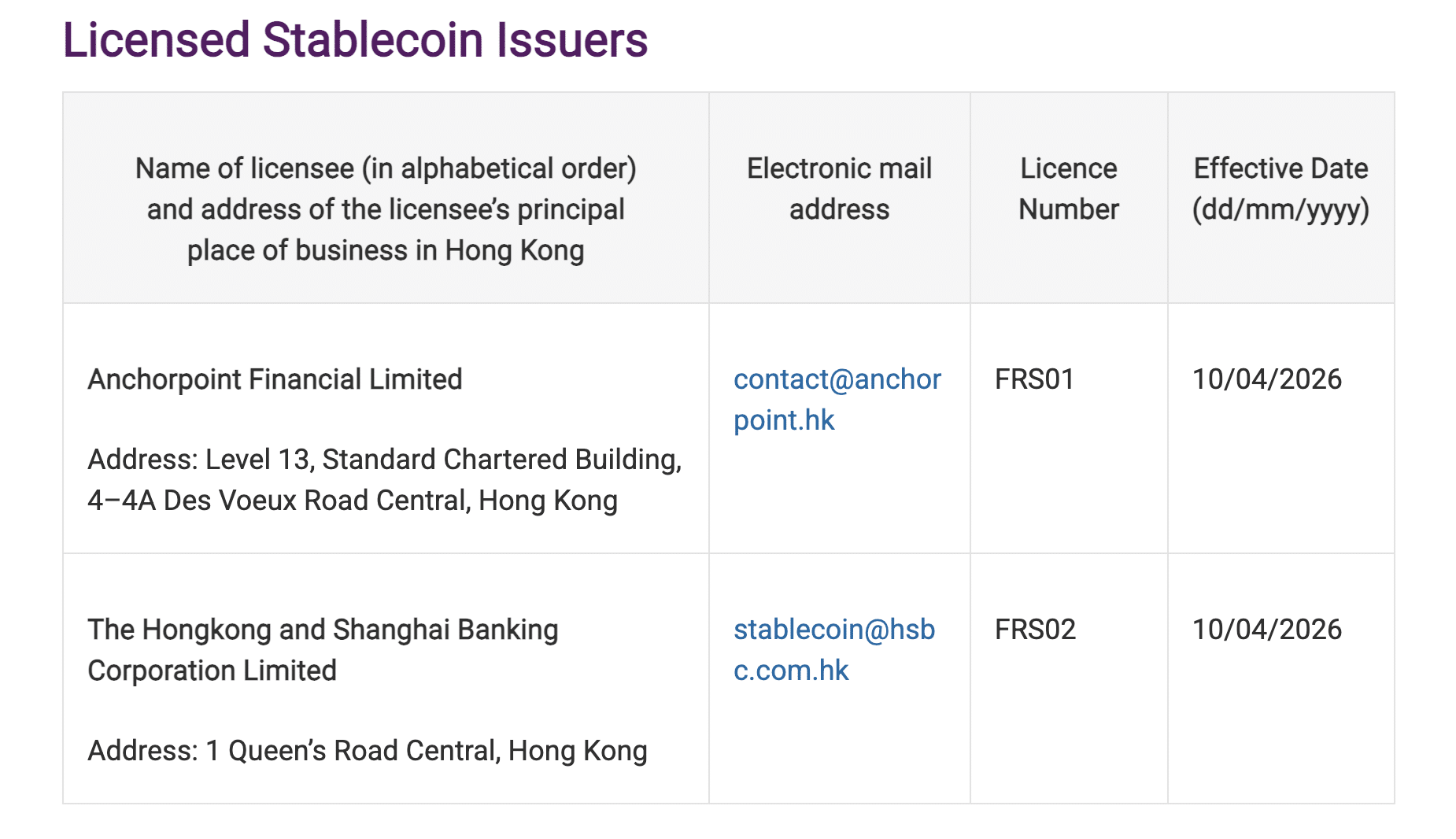
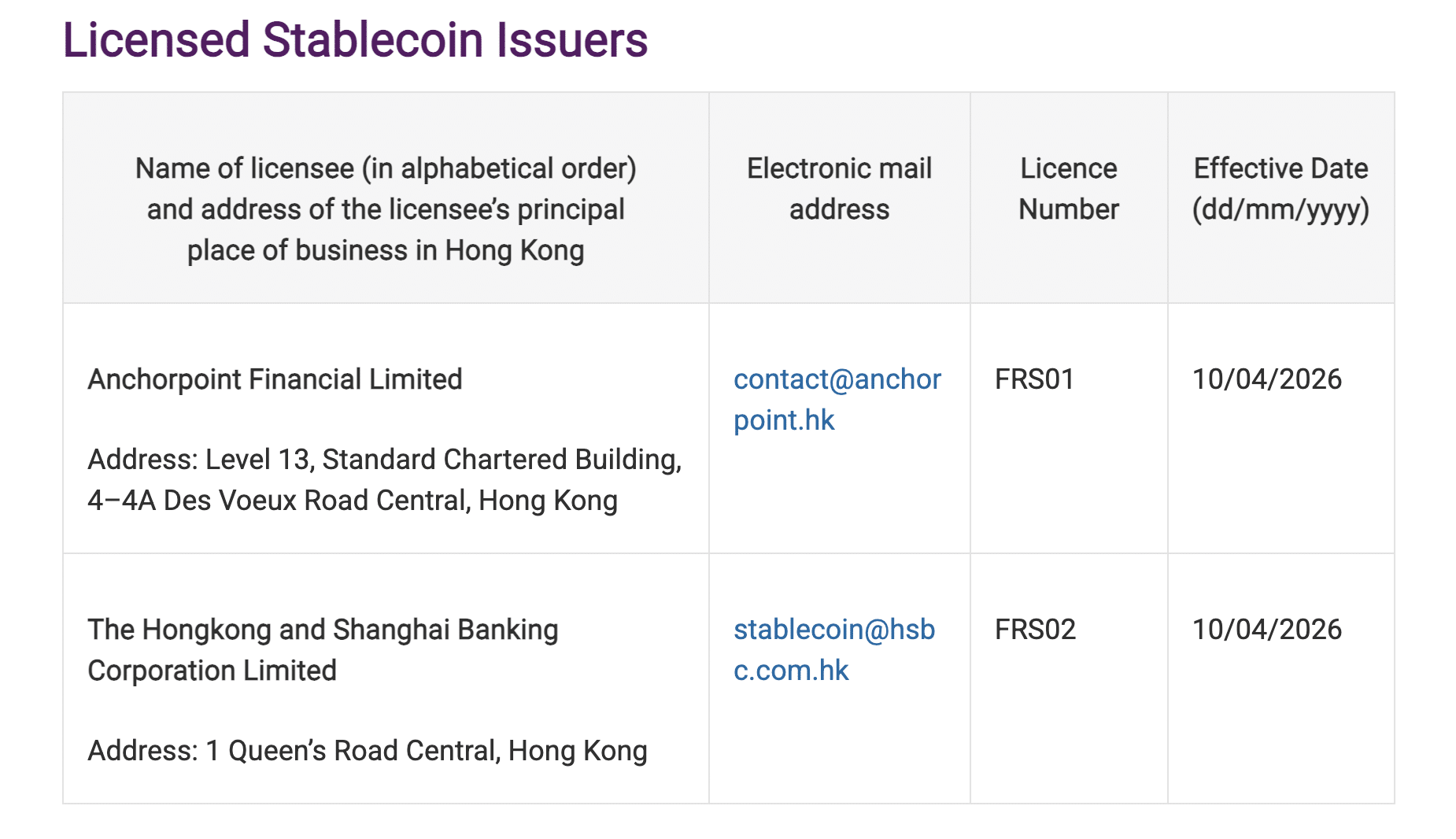
Source: HKMA

They’re prioritizing entities with established compliance systems, capital backing, and regulatory respect.

HKMA Chief Executive Eddie Yue stated that the regime would provide –

An orderly operating environment... while ensuring robust user protection and effective risk management.

AMBCrypto previously reported that Hong Kong expanded its licensing regime to cover crypto dealers and custodians. This brought trading and asset storage under the same regulatory perimeter.

The announcement came after a delayed timeline

The HKMA had earlier stated that initial licenses could be issued as early as March. However, approvals only materialized in April.

This is in line with the regime itself, with its strict requirements on reserve backing, redemption mechanisms, governance, and AML controls. The framework also lays out enforcement powers, including fines and license revocations.

Institutions first, broader access later?

In the near term, Hong Kong’s stablecoin market is likely to remain held by institutional players. Limited licenses and stringent compliance thresholds will slow participation from crypto-native firms.

It will certainly increase trust and stability among the masses, but early innovation impediment is a concern. The key question in time, will be whether the HKMA expands access or maintains a bank-led model.


Final Summary

  • Hong Kong’s first stablecoin licenses go to bank-backed players.
  • Strict rules and limited approvals could slow innovation but increase trust.

Пов'язані питання

QWhich two companies received Hong Kong's first stablecoin licenses?

AHSBC's Hong Kong banking arm and Anchorpoint Financial received the first stablecoin licenses.

QWhich regulatory authority is leading the new stablecoin framework in Hong Kong?

AThe Hong Kong Monetary Authority (HKMA) is leading the new stablecoin framework.

QWhat are some of the key requirements of Hong Kong's stablecoin regime?

AThe regime has strict requirements on reserve backing, redemption mechanisms, governance, and Anti-Money Laundering (AML) controls.

QWhat is a potential concern regarding the new licensing approach according to the article?

AA potential concern is that limited licenses and stringent compliance could slow participation from crypto-native firms and create an early innovation impediment.

QWhen did Hong Kong's stablecoin regulatory regime officially take effect?

AThe stablecoin regulatory regime took effect in August 2025.

Пов'язані матеріали

Anthropic's IPO Launch: Commercial Miracle or Valuation Bubble?

Anthropic has confidentially filed for an IPO, led by Morgan Stanley and Goldman Sachs, potentially going public by October. Following its latest $650 billion funding round, its pre-IPO valuation stands at $965 billion, with projections reaching up to $2 trillion at listing, which would make it the highest-valued private company ever. The article, written by Fu Sheng, addresses skepticism that this represents an AI bubble akin to the 2000 dot-com crash. It argues the current situation differs fundamentally. Unlike the internet bubble era, which relied on speculative narratives with little revenue, Anthropic's valuation is backed by unprecedented, measurable financial performance. Key data points include: * **Revenue Growth:** ARR skyrocketed from $10 billion in early 2025 to $470 billion by May 2026, targeting $100 billion by year-end—a growth curve unmatched in business history. * **Profitability:** It achieved operating profitability in Q2 2026 with an estimated $5.6 billion profit. * **Efficiency:** With ~3,000 employees and ~$470 billion ARR, its revenue per employee exceeds $10 million. Products like Claude Code, launched less than a year ago, already generate $25 billion in annualized revenue. * **Enterprise Adoption:** It boasts a strong enterprise client base, with 8 of the Fortune 10 and over 1,000 large firms spending over $1 million annually on Claude. The valuation is framed using a traditional SaaS model (e.g., a 10x Price-to-Sales multiple on $100 billion revenue). The author contends the core question for analysts has shifted from "How big could this be?" to "How much is it earning and will earn next quarter?" The discussion extends beyond Anthropic to a broader paradigm shift: the transition from a "carbon-based" to a "silicon-based" economy. Companies are increasingly prioritizing investment in compute and AI capabilities over human resources, as these directly scale productivity and competitive advantage. Anthropic's IPO is thus positioned not just as a corporate milestone, but as a price anchor for this new economic era.

链捕手2 год тому

Anthropic's IPO Launch: Commercial Miracle or Valuation Bubble?

链捕手2 год тому

Near Returns to the AI Stage: Transformation into a Public Chain Due to 'Payroll Difficulties,' Agent and Privacy Emerge as New Growth Narratives

NEAR Returns to AI Origins: From Payroll Struggles to Blockchain, Now Focusing on AI Agents and Privacy NEAR Protocol's journey began not with grand blockchain ambitions, but from a practical hurdle: its AI startup founders, including Transformer paper co-author Illia Polosukhin, couldn't efficiently pay international developers in 2017. This led them to pivot and build a high-performance, scalable blockchain. After years navigating various crypto narratives like sharding and cross-chain interoperability, NEAR is now leveraging its AI roots to re-enter the AI arena. A key driver is its "NEAR Intents" layer, which abstracts complex cross-chain transactions. Users simply state their goal (e.g., swap BTC for ETH), and a solver network finds the optimal route. This system has processed over $20B in cross-chain volume, generating significant fee revenue. A major growth area is private transactions via "Confidential Intents/Swaps," which hide trade details until settlement to protect against MEV and front-running. Remarkably, private swaps recently accounted for over 40% of NEAR's transaction volume, highlighting strong demand but also potential regulatory scrutiny. With its AI-founder pedigree, NEAR is positioning itself at the intersection of blockchain, AI agents, and privacy, aiming to become infrastructure for the emerging agent economy while navigating the challenges of its rapid adoption.

marsbit4 год тому

Near Returns to the AI Stage: Transformation into a Public Chain Due to 'Payroll Difficulties,' Agent and Privacy Emerge as New Growth Narratives

marsbit4 год тому

Торгівля

Спот
Ф'ючерси

Популярні статті

Як купити WIN

Ласкаво просимо до HTX.com! Ми зробили покупку WINkLink (WIN) простою та зручною. Дотримуйтесь нашої покрокової інструкції, щоб розпочати свою криптовалютну подорож.Крок 1: Створіть обліковий запис на HTXВикористовуйте свою електронну пошту або номер телефону, щоб зареєструвати обліковий запис на HTX безплатно. Пройдіть безпроблемну реєстрацію й отримайте доступ до всіх функцій.ЗареєструватисьКрок 2: Перейдіть до розділу Купити крипту і виберіть спосіб оплатиКредитна/дебетова картка: використовуйте вашу картку Visa або Mastercard, щоб миттєво купити WINkLink (WIN).Баланс: використовуйте кошти з балансу вашого рахунку HTX для безперешкодної торгівлі.Треті особи: ми додали популярні способи оплати, такі як Google Pay та Apple Pay, щоб підвищити зручність.P2P: Торгуйте безпосередньо з іншими користувачами на HTX.Позабіржова торгівля (OTC): ми пропонуємо індивідуальні послуги та конкурентні обмінні курси для трейдерів.Крок 3: Зберігайте свої WINkLink (WIN)Після придбання WINkLink (WIN) збережіть його у своєму обліковому записі на HTX. Крім того, ви можете відправити його в інше місце за допомогою блокчейн-переказу або використовувати його для торгівлі іншими криптовалютами.Крок 4: Торгівля WINkLink (WIN)Легко торгуйте WINkLink (WIN) на спотовому ринку HTX. Просто увійдіть до свого облікового запису, виберіть торгову пару, укладайте угоди та спостерігайте за ними в режимі реального часу. Ми пропонуємо зручний досвід як для початківців, так і для досвідчених трейдерів.

313 переглядів усьогоОпубліковано 2024.12.11Оновлено 2025.03.21

Як купити WIN

Обговорення

Ласкаво просимо до спільноти HTX. Тут ви можете бути в курсі останніх подій розвитку платформи та отримати доступ до професійної ринкової інформації. Нижче представлені думки користувачів щодо ціни WIN (WIN).

活动图片