How Weakening US Labor Data Could Impact Bitcoin Market — Report

bitcoinistОпубліковано о 2026-03-29Востаннє оновлено о 2026-03-29

Анотація

A report analyzes how weakening US labor data could negatively impact Bitcoin and broader financial markets. Citing analysis from Alphractal CEO Wedson, the article highlights a steep decline in the US labor force participation rate (LFP), an underrated macroeconomic signal. Historically, a falling LFP—indicating fewer people working, less consumption, and weaker economic output—has preceded downturns in the S&P 500. Similarly, Bitcoin has shown vulnerability to such macro stress, as seen during the 2008 crisis and the 2020 COVID lockdowns. The key risk for Bitcoin is a potential macro shock that triggers a risk-off sentiment, causing investors to flee to safety. Unlike in 2020, there is currently no massive liquidity injection to cushion this blow and propel prices higher. This bearish outlook is further supported by a steadily declining Coinbase Premium, indicating waning demand from US investors. At the time of writing, Bitcoin's price is approximately $66,750, down over 5% for the week despite a minor 24-hour gain.

The global macro environment has been one of the major defining factors in Bitcoin and the broader crypto market so far this year. From the brewing geopolitical tensions in the Middle East to the rising inflation expectations in the United States, the global financial markets have barely caught a break in 2026. A prominent market expert has come forward with interesting US labor data, breaking down how the rising macroeconomic pressure could impact Bitcoin and the broader financial markets.

Macro Shock Could Trigger Risk-Off Behavior Among BTC Investors

In a March 28th post on the X platform, Alphractal founder and CEO shared that the participation of the United States labor force has been in a steep decline over the past few weeks. According to the crypto pundit, the Labor Force Participation is one of the most underrated macroeconomic signals in the current market landscape.

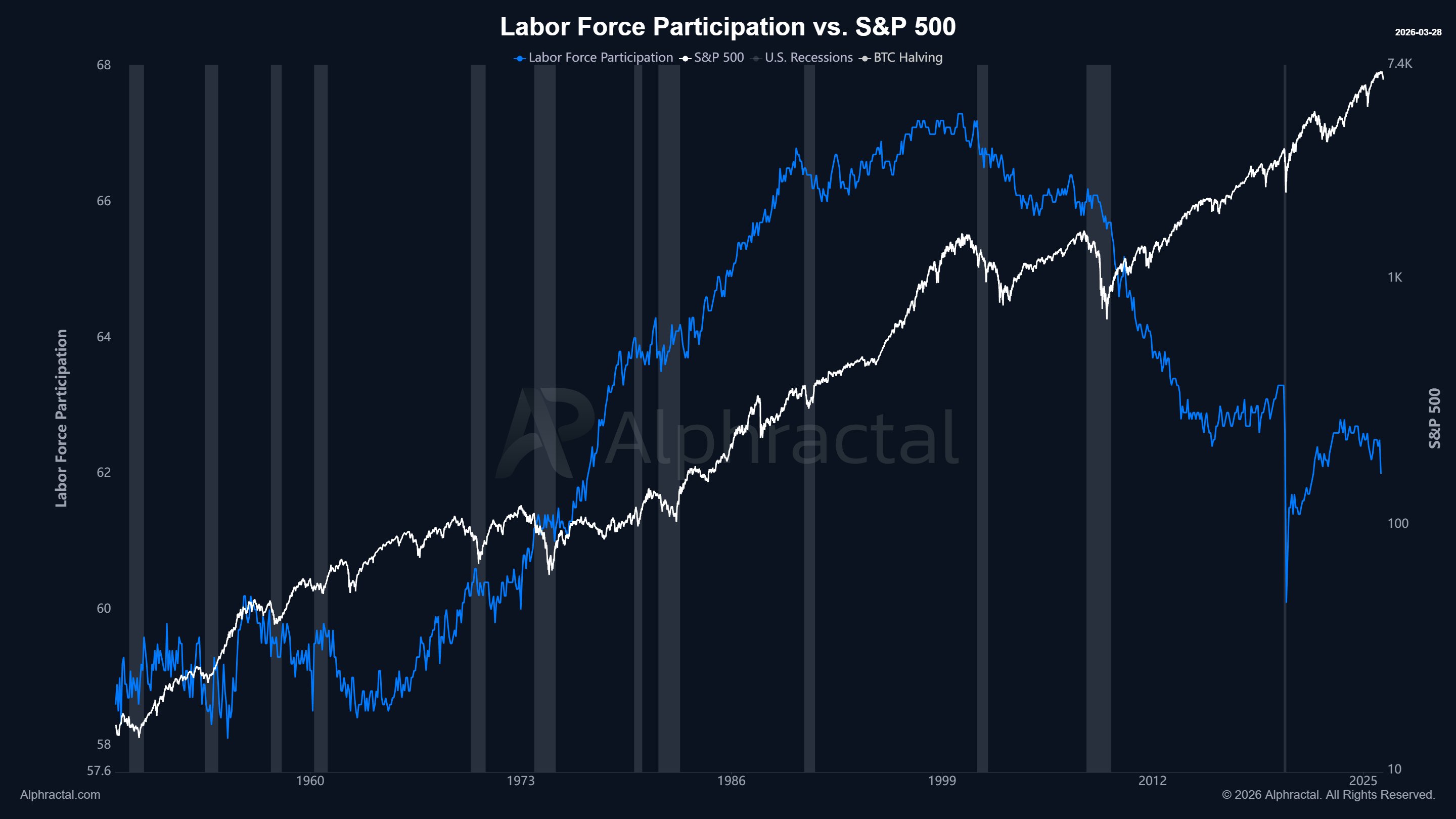
Wedson highlighted the major trends of the Labor Force Participation over the last two decades and its impact on the S&P 500 index. According to the highlighted data, participation reached its peak around 2000, before collapsing during 2008 financial crisis, briefly recovering, and then falling to historic lows during the COVID-19 pandemic.
Source: @joao_wedson on X

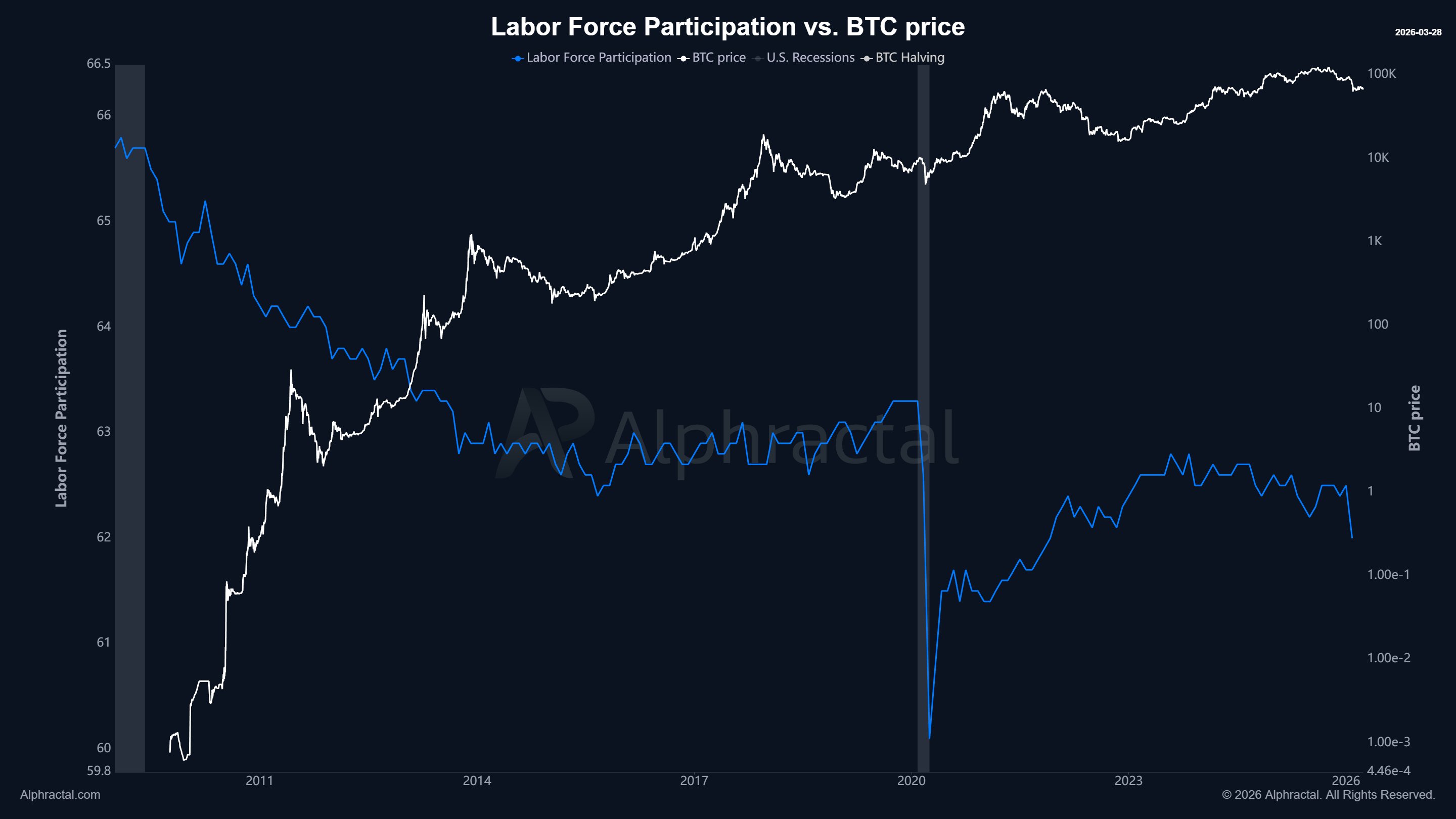
As the labor force participation rate dwindled, the S&P 500 soon followed despite its initial show of resilience. The same can be seen for Bitcoin in the chart below, which seemed to succumb to the macro stress each time the LFP suffered a nosedive.
Source: @joao_wedson on X

Wedson noted that, before the “liquidity” flood sent the Bitcoin price to new highs, the market leader initially fell to cycle lows as the labor participation crashed during the COVID lockdown in 2020. What’s different now is that there’s no obvious liquidity fuel to take advantage in the current labor participation plunge.

Wedson wrote in his post:

A falling participation rate means fewer people working, less consumption, weaker real economic output. The stock market can diverge from that reality for a while but not forever.

According to the Alphractal founder, the specific risk for Bitcoin is a macro shock that triggers a risk-off behavior among investors, with most market participants fleeing to safety before the next accumulation phase begins. And, as rightly baked in the steadily-declining Coinbase Premium, the demand for BTC among US investors seems to be in a steady downturn.

Bitcoin Price Overview

As of this writing, the flagship cryptocurrency is valued at around $66,750, reflecting a roughly 1% jump in the past 24 hours. The single-day action has not been enough to wipe out losses from the past week, which still stand at more than 5%.

The price of BTC on the daily timeframe | Source: BTCUSDT chart on TradingView


Пов'язані питання

QWhat is the main macroeconomic factor discussed in the article that could impact the Bitcoin market?

AThe weakening US labor data, specifically the decline in Labor Force Participation, is highlighted as a major macroeconomic factor that could impact the Bitcoin market.

QAccording to the expert, what does a falling labor force participation rate indicate for the economy?

AA falling labor force participation rate means fewer people working, less consumption, and weaker real economic output.

QWhat specific risk does the Alphractal founder identify for Bitcoin in the current market environment?

AThe specific risk for Bitcoin is a macro shock that triggers a risk-off behavior among investors, causing them to flee to safety.

QHow did the article describe the current demand for Bitcoin among US investors?

AThe demand for BTC among US investors is in a steady downturn, as indicated by the steadily declining Coinbase Premium.

QWhat was the price of Bitcoin at the time of writing, and what was its weekly performance?

AAt the time of writing, Bitcoin was valued at around $66,750, reflecting a weekly loss of more than 5% despite a 1% gain in the last 24 hours.

Пов'язані матеріали

The Value Distribution of Stablecoins

**Summary: The Value Distribution of Stablecoins** The article argues that stablecoins are evolving from mere trading tools into broader channels for dollar access. It divides the stablecoin ecosystem into four layers to analyze how value is distributed: 1. **Issuance Layer:** Mints stablecoins, holds reserve assets, and captures the spread between reserve yield and user costs (e.g., Tether, Circle). This layer currently earns the largest profit margin. 2. **Infrastructure Layer:** Connects stablecoins to the traditional financial system, handling fiat on/off-ramps, banking integration, compliance (KYC/AML), and asset management (e.g., Bridge, BVNK). This is the "unglamorous" but critical work, building the essential bridges between crypto and real-world finance. 3. **Acquiring/Distribution Layer:** Integrates stablecoins into merchant systems, manages payment flows, and provides enterprise financial software (e.g., Stripe, Coinbase). They act as the access point for businesses. 4. **Application Layer:** The end-users and businesses that ultimately use stablecoins for payments, settlements, or as a store of value. They benefit from convenience but have little pricing power. The core thesis is that while the issuance layer currently dominates profits, the often-overlooked **infrastructure layer holds significant long-term potential**. The real challenge and barrier to mass adoption is not the on-chain transfer of stablecoins (which is simple), but the complex "last mile" integration into existing business workflows, banking systems, and regulatory frameworks across different countries. Companies in this layer are currently in a "land grab" phase, investing heavily to build networks, secure bank partnerships, and establish compliance pathways. While their position is currently pressured by the profitable issuers above and distribution platforms below, the article suggests that if stablecoins become a default financial rail for businesses, the infrastructure providers who have done the hard work of integration will ultimately gain strong pricing power and become entrenched, essential players.

marsbit5 год тому

The Value Distribution of Stablecoins

marsbit5 год тому

The Value Distribution of Stablecoins

The Value Distribution of Stablecoins The article argues that stablecoins are evolving from a mere trading tool into a broad "dollar channel." It analyzes the industry's value chain through four layers: 1. **Issuance Layer (e.g., Tether, Circle):** The top layer that mints stablecoins, holds reserve assets, and captures the thickest interest rate spread. 2. **Infrastructure Layer (e.g., Bridge, BVNK):** Connects stablecoins to the traditional financial system, handling critical but complex "dirty work" like fiat on/off-ramps, banking integration, compliance (KYC/AML), and cross-border settlement. 3. **Acquiring/Distribution Layer (e.g., Stripe, Coinbase):** Embeds stablecoins into merchant systems, manages payment flows, and integrates with enterprise software. 4. **Application Layer:** End-users and businesses that ultimately use stablecoins for payments, settlement, or storing value. The author posits that while the issuance layer currently captures the most profit, the most overlooked and potentially critical layer is infrastructure. The core challenge for stablecoin adoption isn't the on-chain transfer (which is simple), but bridging the gap between blockchain and the real-world financial system. This involves solving practical problems for businesses: fiat conversion, reconciliation, tax handling, and user onboarding. Infrastructure companies are currently in a difficult "land-grab" phase—building networks, securing banking relationships, and achieving compliance country-by-country. They face pressure from both the profitable issuance layer above and distribution platforms below. However, the author suggests this layer is building a crucial moat. Once stablecoins become a default business rail, the infrastructure players who have done the hard work of integration may gain significant, durable value and pricing power.

链捕手5 год тому

The Value Distribution of Stablecoins

链捕手5 год тому

Торгівля

Спот
Ф'ючерси

Популярні статті

Як купити ONE

Ласкаво просимо до HTX.com! Ми зробили покупку Harmony (ONE) простою та зручною. Дотримуйтесь нашої покрокової інструкції, щоб розпочати свою криптовалютну подорож.Крок 1: Створіть обліковий запис на HTXВикористовуйте свою електронну пошту або номер телефону, щоб зареєструвати обліковий запис на HTX безплатно. Пройдіть безпроблемну реєстрацію й отримайте доступ до всіх функцій.ЗареєструватисьКрок 2: Перейдіть до розділу Купити крипту і виберіть спосіб оплатиКредитна/дебетова картка: використовуйте вашу картку Visa або Mastercard, щоб миттєво купити Harmony (ONE).Баланс: використовуйте кошти з балансу вашого рахунку HTX для безперешкодної торгівлі.Треті особи: ми додали популярні способи оплати, такі як Google Pay та Apple Pay, щоб підвищити зручність.P2P: Торгуйте безпосередньо з іншими користувачами на HTX.Позабіржова торгівля (OTC): ми пропонуємо індивідуальні послуги та конкурентні обмінні курси для трейдерів.Крок 3: Зберігайте свої Harmony (ONE)Після придбання Harmony (ONE) збережіть його у своєму обліковому записі на HTX. Крім того, ви можете відправити його в інше місце за допомогою блокчейн-переказу або використовувати його для торгівлі іншими криптовалютами.Крок 4: Торгівля Harmony (ONE)Легко торгуйте Harmony (ONE) на спотовому ринку HTX. Просто увійдіть до свого облікового запису, виберіть торгову пару, укладайте угоди та спостерігайте за ними в режимі реального часу. Ми пропонуємо зручний досвід як для початківців, так і для досвідчених трейдерів.

363 переглядів усьогоОпубліковано 2024.12.12Оновлено 2026.06.02

Як купити ONE

Обговорення

Ласкаво просимо до спільноти HTX. Тут ви можете бути в курсі останніх подій розвитку платформи та отримати доступ до професійної ринкової інформації. Нижче представлені думки користувачів щодо ціни ONE (ONE).

活动图片