How to spot a crypto scam or a rug pull?

ambcryptoОпубліковано о 2026-07-21Востаннє оновлено о 2026-07-21

Анотація

Rug pulls typically begin with seemingly legitimate projects exhibiting rising prices and active communities, but end with developers withdrawing liquidity. These scams often involve manufacturing trust through locked liquidity and renounced contracts, then creating hype on social media. The process from hype to exit can occur in 48-72 hours. There are "hard" rug pulls involving immediate liquidity drainage and "soft" ones that gradually erode value through insider selling or abandoned development. Key warning signs include high wallet concentration (e.g., top 5-10 holders controlling over 30% of supply), lack of vesting for developer allocations, and quickly expiring liquidity locks. Smart contract risks stem from unverified code, hidden mint functions, upgradeable contracts, and sell restrictions. Market behavior red flags are rapid price surges driven by influencer promotion, low organic trading volume, and slowing holder growth before large developer withdrawals. Common exploit types are honeypots (trapping investors by blocking sells, accounting for ~98k scam tokens), hidden mint functions (~61k cases allowing post-launch supply inflation), and fake ownership renunciations (~49k cases). Ultimately, genuine decentralization is determined by developers relinquishing control through transparent vesting, verified code, and third-party audits.

Imagine discovering a promising new token with thousands of holders, rising prices, and an active community. Everything appears legitimate until the liquidity suddenly disappears. That is how a rug pull begins.

Rather than simply siphoning off your money, developers first manufacture trust through locked liquidity and renounced contracts. Later on, they create a buzz around their token via active social media platforms and coordinated hype.

The stronger the community grows, the easier it becomes to attract fresh capital and deepen investor confidence. The entire process often unfolds within 48-72 hours, from hype-creation to exit.

Hard rug pulls drain liquidity in one move through developer wallet dumps or pool withdrawals, while soft rugs quietly erode value through insider selling, token unlocks, or abandoned roadmaps.

Eventually, the developer withdraws the proceeds, and the TVL begins to collapse, revealing what the hype concealed all along. As a result, this leaves the token on-chain but with little practical market value or investor confidence.

The patterns behind most rug pulls

Not every token is as decentralized as it first appears. A project can attract thousands of holders and still leave most of the control in a few developer wallets. That is where the real risk begins.

Historical rug pull cases reveal that warning signs rarely emerge in isolation. Instead, multiple indicators tend to appear together long before liquidity is removed.

The smart contract then determines whether that risk becomes reality. Hidden mint functions, retained ownership, upgradeable contracts, or sell restrictions can quietly give developers more control than investors expect.

On-chain data consistently associates high wallet concentration, where the top 5 to 10 holders control more than 30% of supply, with increased manipulation risk. Furthermore, that exposure grows when developer allocations lack meaningful vesting or liquidity locks expire quickly after the launch of the project.

Contract architecture adds another layer of concern. Unverified source code, active mint functions, upgradeable proxies, and adjustable sell restrictions allow developers to retain control after deployment.

Market behavior often reinforces these structural risks. This happens through rapid price appreciation supported by influencer-driven promotion. This is in addition to low organic volume and decreasing holder growth rates that occur prior to large developer wallet transfers and declining liquidity pools.

For instance, cases such as SQUID and LIBRA followed similar trajectories despite different narratives. Collectively, these patterns suggest rug pulls are better identified through converging on-chain, contract, and behavioral signals rather than any single metric alone.

That being said, not all projects follow that trajectory. The use of transparent vesting, verified code, and third-party audit processes makes manipulation extremely difficult. Ultimately, decentralization is determined by how much control developers are willing to relinquish.

The exploits that trap investors

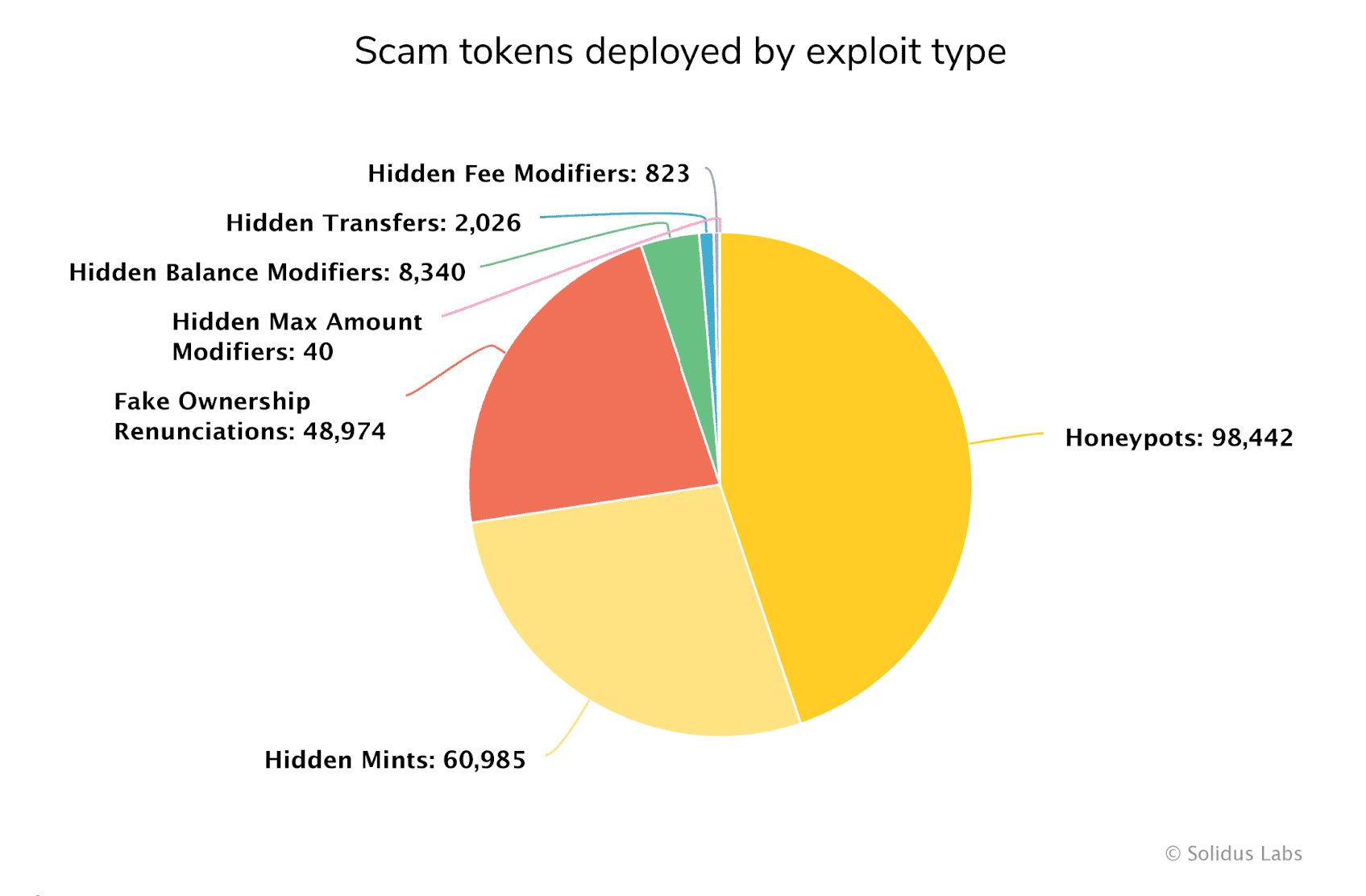
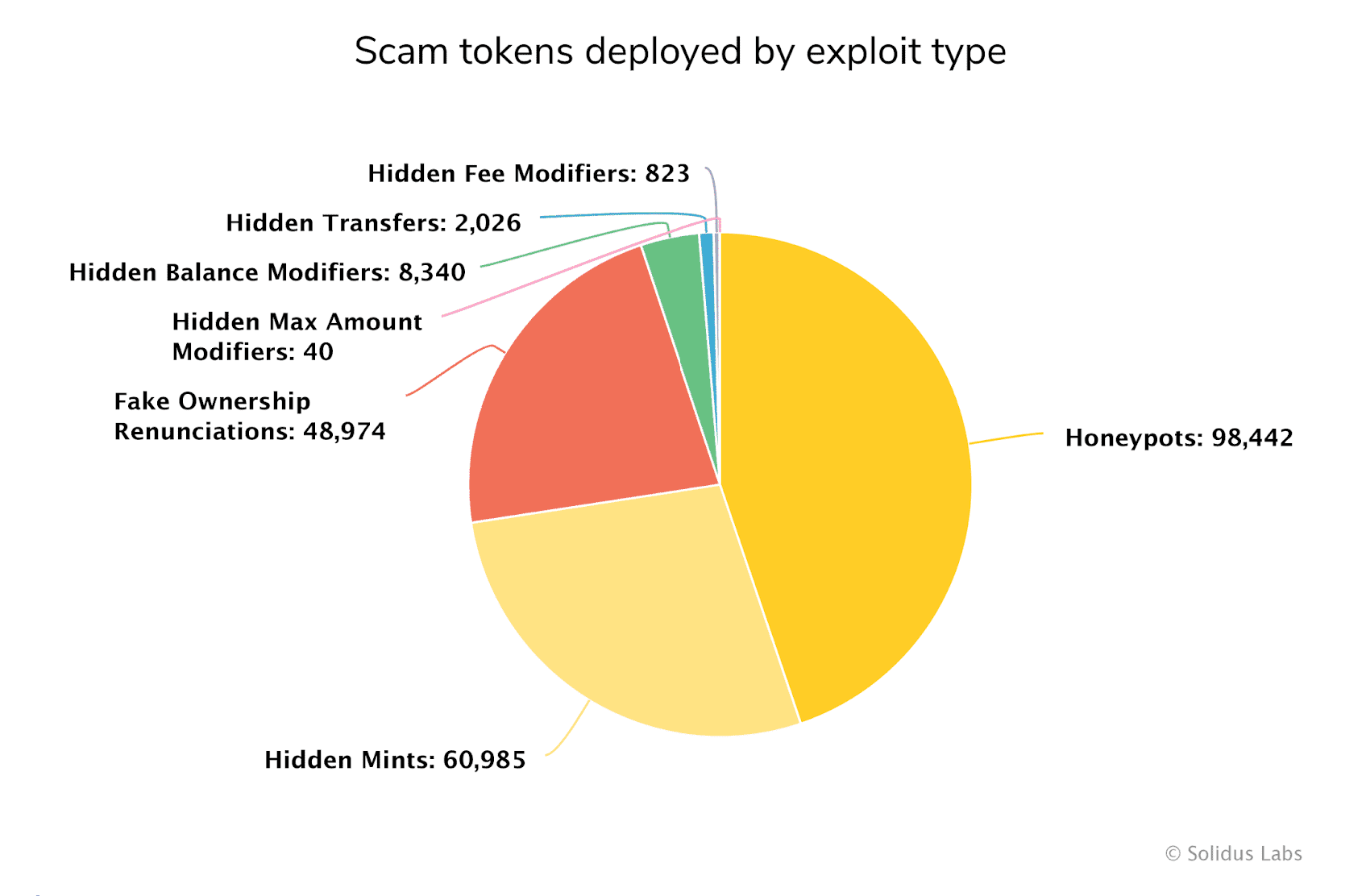
That control often reveals itself through the type of exploit developers choose. Honeypots remain the most common, accounting for 98,442 scam tokens. These contracts let investors buy normally but prevent or heavily restrict selling, effectively trapping funds once enough liquidity enters.
Source: Solidus Labs

Hidden mint functions follow with 60,985 cases, allowing developers to inflate the supply after launch and dilute existing holders. Fake ownership renunciations appear in another 48,974 tokens, reinforcing how control can remain hidden despite claims of decentralization.

That said, the growing variety of exploits suggests scammers are adapting faster, making smart contract scrutiny as important as price action before investing.


Final Summary

Пов'язані питання

QWhat are the two main types of rug pulls described in the article?

AThe article describes hard rug pulls and soft rug pulls. Hard rug pulls drain liquidity in one move through developer wallet dumps or pool withdrawals, while soft rugs quietly erode value through insider selling, token unlocks, or abandoned roadmaps.

QAccording to the article, what on-chain data pattern is consistently associated with increased manipulation risk?

AThe article states that on-chain data consistently associates high wallet concentration, where the top 5 to 10 holders control more than 30% of the token supply, with increased manipulation risk.

QWhat are the most common types of scam token exploits mentioned, and which one is the most prevalent?

AThe most common types of scam token exploits mentioned are honeypots, hidden mint functions, and fake ownership renunciations. Honeypots are the most prevalent, accounting for 98,442 scam tokens.

QWhat timeframe does the article suggest the typical rug pull process often unfolds within?

AThe article suggests that the entire rug pull process, from hype-creation to the developer's exit, often unfolds within 48 to 72 hours.

QWhat contract features can give developers more control than investors expect, according to the article?

AAccording to the article, hidden mint functions, retained ownership, upgradeable contracts, or sell restrictions within the smart contract can quietly give developers more control than investors expect.

Пов'язані матеріали

Must-Watch Events Next Week|CLARITY Act Could Face Senate Vote; SpaceX, Circle to Report Earnings (8.3-8.9)

**Summary: Key Events and Developments to Watch (August 3-9)** The upcoming week is marked by significant financial disclosures, key legislative deadlines, and notable product updates. **Major Financial Events:** Several companies are scheduled to release their Q2 2026 earnings. American Bitcoin (ABTC) will report on August 3, followed by SpaceX and Hut 8 Mining Corp. on August 4, and Circle on August 5. Notably, a significant portion of SpaceX shares (up to 12% of total shares) will be unlocked on August 6 following their earnings release. **Key Legislative Deadline:** The U.S. Senate faces an August 7 deadline to secure 60 votes for the CLARITY Act, a bipartisan bill aiming to establish a federal regulatory framework for cryptocurrencies. The Senate may hold a full vote on the bill during the week. **Economic Data:** The U.S. July Non-Farm Payrolls report will be released on August 7, providing crucial labor market data. **Technology & Product Updates:** * **Shutdowns:** DeFi portfolio tracker Zapper and wallet app Ctrl Wallet will cease operations on August 3. * **Upgrades:** LayerZero will deprecate its v1 relayers on August 3. XRP Ledger's new version 3.3.0, featuring five new functions, is expected next week. * **AI:** Elon Musk announced that the advanced Grok 4.6 AI model is set for release around August 7. * **Bitcoin:** The BIP-110 forced signaling for a potential Bitcoin network change is scheduled to begin around August 8. **Other Notable Events:** Chinese robotics firm Unitree Tech has set its preliminary price inquiry for its IPO for August 5. South Korean exchange Upbit will delist AQT and AERGO tokens on August 3.

marsbit1 год тому

Must-Watch Events Next Week|CLARITY Act Could Face Senate Vote; SpaceX, Circle to Report Earnings (8.3-8.9)

marsbit1 год тому

Stocks Are Plummeting More Sharply Than Cryptocurrencies. Where Has the Money Gone?

Stock Markets Plunge Deeper Than Cryptocurrencies: Where Did the Money Go? In late July, Seoul's Kospi index triggered circuit breakers for two consecutive days, plummeting over 40% from its June high. The collapse was led by heavyweight stocks like SK Hynix, whose record profits still disappointed investors, and devastating leveraged ETFs, with one major product losing over 83% of its value. This signaled a global, forced deleveraging targeting the most crowded trades. Interestingly, while stocks exhibited extreme volatility akin to crypto markets, Bitcoin rose nearly 15% in July after a prior steep drop. Analysis shows the money fleeing equities did not flow into Bitcoin. Instead, Bitcoin had already absorbed its sell-off in May-June, when U.S. spot Bitcoin ETFs saw historic outflows. The true safe-haven beneficiary was gold, whose price rose over 20% year-on-year, highlighting a decoupling between Bitcoin and gold as "digital gold." The sell-off was a targeted unwinding of leveraged positions in tech and semiconductors, accelerated by broker-dealer risk management and shifts in the AI narrative, including new competition from Chinese memory chipmakers. The retreat path was clear: from high-valuation tech stocks to cash and U.S. Treasuries, then to gold. For Bitcoin to attract sustained institutional inflows, conditions like eased global liquidity pressure, a "soft-landing" Fed rate cut, and U.S. regulatory clarity via legislation like the stalled CLARITY Act are needed. Currently, Bitcoin is not a safe haven but an already-cleared asset. Its low correlation with tech stocks, however, makes it a potential diversification play for institutional portfolios once the storm passes. The money isn't here yet, but the positioning is underway.

marsbit1 год тому

Stocks Are Plummeting More Sharply Than Cryptocurrencies. Where Has the Money Gone?

marsbit1 год тому

In Conversation with Ray Dalio: We Are Currently in an AI Bubble, with 1% of My Portfolio in Bitcoin

Ray Dalio, founder of Bridgewater Associates, warns in an interview that the current AI boom shows classic bubble characteristics, which could lead to significant economic downturns as seen in past cycles like 1929 or 2000. He explains that speculative enthusiasm, fueled by debt and overvaluation, often precedes a crash when rising rates or taxation force asset sales, causing widespread losses and recession. Dalio also outlines his "Big Cycle" theory, describing an approximate 80-year pattern where widening wealth gaps, massive government deficits, and shifting geopolitical power (like China's rise) create internal conflict and global instability. He emphasizes that we are in a late-cycle, transitional phase where traditional powers like the US and UK face decline. For personal wealth protection, Dalio advises diversification beyond cash into assets like stocks, bonds, real estate, and particularly gold, which he prefers over Bitcoin. While he holds about 1% of his portfolio in Bitcoin as a non-printable hard asset, he views gold as more secure from technological or governmental threats. Regarding AI's impact, Dalio believes it will disproportionately benefit capital owners, worsening inequality by replacing both physical and cognitive labor. He suggests that human intuition and emotional intelligence, combined with AI, will be key for future workers. On taxation, Dalio argues that wealth taxes are impractical and risk triggering asset sell-offs, reducing productive investment. He points to the UK as a cautionary example of debt, low productivity, and political strife. Geopolitically, Dalio foresees a more regionalized world, with the US showing weakness in prolonged conflicts like with Iran, akin to past imperial declines. The ideal outcome, he suggests, is coexisting powerful blocs (e.g., Americas, China-Asia Pacific) without major war.

marsbit5 год тому

In Conversation with Ray Dalio: We Are Currently in an AI Bubble, with 1% of My Portfolio in Bitcoin

marsbit5 год тому

Торгівля

Спот
活动图片





