How Did Cardano Token NIGHT Ignite Nearly $10 Billion in Daily Trading Volume?

比推Опубліковано о 2025-12-24Востаннє оновлено о 2025-12-24

Анотація

The Cardano-based privacy token NIGHT, associated with the Midnight sidechain, recently recorded nearly $10 billion in daily trading volume across major exchanges like Binance, OKX, and Bybit. Its price surged over 300% in less than two weeks after launch, reaching a fully diluted valuation of over $2.5 billion before settling around $0.08. Midnight, developed by Cardano’s parent company IOG, focuses on programmable data protection using zero-knowledge proofs (ZKPs) packaged into developer-friendly TypeScript APIs. It employs a dual-token model: NIGHT for governance and generating DUST, the utility token used for transaction and privacy fees. This design aims to meet regulatory requirements by separating governance from transactional assets. The token’s rapid growth is attributed to a massive airdrop campaign targeting 37 million addresses across multiple blockchains, alongside distribution partnerships with top exchanges. With Cardano planning major upgrades in 2025—including scaling solutions, Midnight’s mainnet launch, native stablecoin integration, and enhanced interoperability—NIGHT’s rise may signal renewed momentum for the ecosystem.

Author: Eric, Foresight News

Original Title: A Token with Nearly $10 Billion in Daily Trading Volume, Actually from Cardano?


Recently, a token named NIGHT, which was listed for spot or contract trading on Bitget, Binance, OKX, and Bybit earlier this month, saw its 24-hour global trading volume exceed $9 billion, approaching $10 billion. Bybit even surpassed Binance in 24-hour spot trading volume thanks to NIGHT.

NIGHT was officially launched on December 9. According to CoinGecko data, the token's price rose from around $0.025 to nearly $0.114 in less than two weeks, a increase of over 3 times. Its FDV once exceeded $2.5 billion, which would place it within the top 50 by market capitalization. At the time of writing, NIGHT price has retraced to around $0.08.
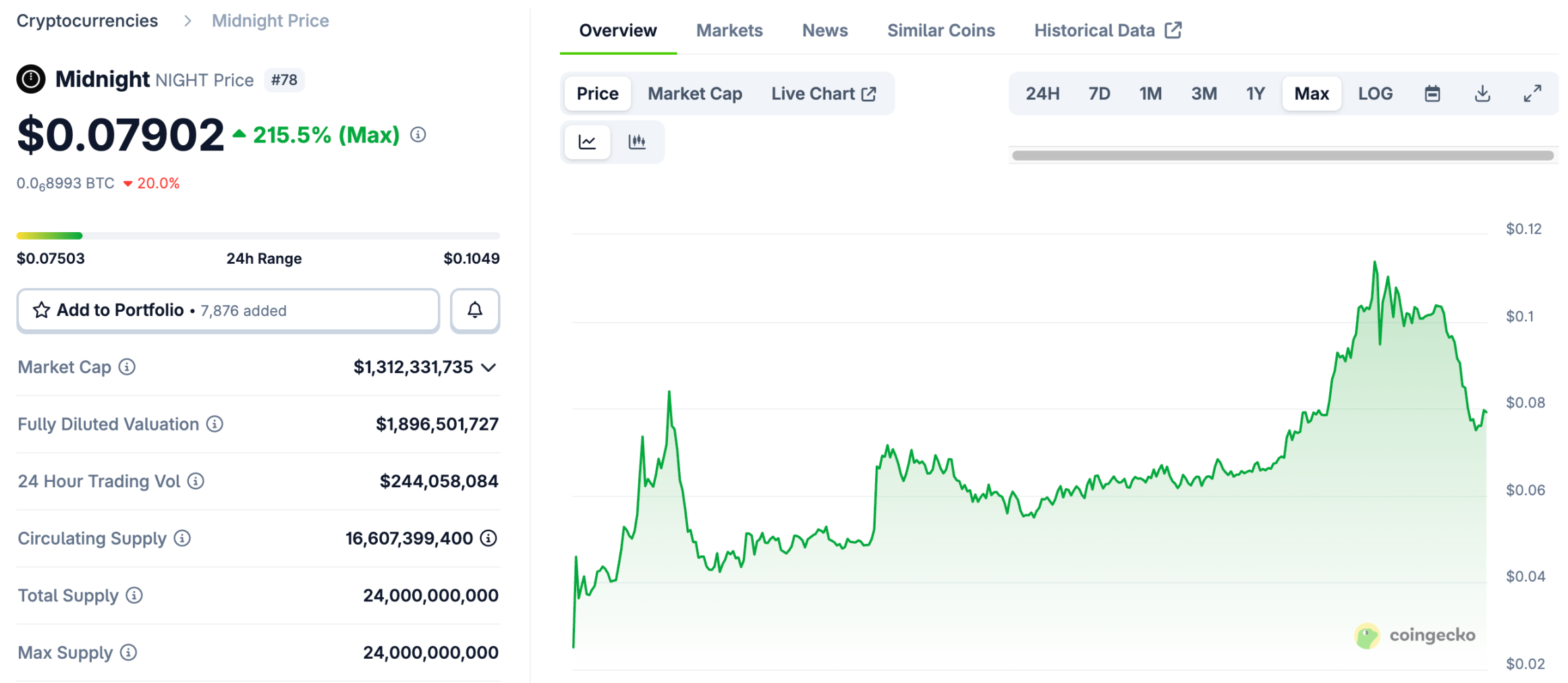
Such performance from a token listed on several major exchanges simultaneously is not entirely unexpected. However, the interesting part is that NIGHT is the token of Midnight, a privacy-focused sidechain of Cardano. The explosive power of a project bearing both the "Cardano" and "privacy" labels truly surprised most people.

What Makes Midnight "Valuable"?

Midnight is a sidechain developed by Input Output Global (IOG, the parent company of Cardano) with "programmable data protection" as its core selling point. It packages zero-knowledge proofs (ZKP) into a ready-to-use TypeScript API, allowing Web2 developers to implement "selective disclosure" on-chain without needing to learn cryptography. The entire network uses Cardano as its consensus layer and Halo2 as its ZK backend, employing a dual-token model (NIGHT+DUST). The goal is first to land the "data availability without visibility" that enterprises care about most, and then gradually expand to scenarios like DeFi, RWA, and on-chain compliant identity.

Overall, it doesn't seem particularly unique. It adopts ZKP privacy technology but doesn't natively protect privacy; instead, it makes privacy features optional to address practical needs.

IOG first publicly announced the plan to develop Midnight in November 2022, but the testnet wasn't launched until nearly two years later, in October 2024. This is indeed IOG's style—it took almost 5 years from announcing smart contracts for Cardano to actual implementation, which wasn't achieved until September 2021, long after the bull market had passed.

In May of this year, Midnight established a foundation, with Fahmi Syed, former CFO of Polkadot development team Parity, as chairman, signaling the first step towards TGE (Token Generation Event). Just two days after announcing the foundation's establishment, Cardano founder Charles Hoskinson revealed plans to airdrop tokens to 37 million addresses on 8 major blockchains, stating that the airdrop would target only retail users, with no VC participation in the project.

Perhaps what truly ignited market sentiment was Midnight's "massive airdrop." In addition to the airdrop, Midnight also distributed nearly 3 billion NIGHT tokens in collaboration with Binance, OKX, and Bybit. This large-scale approach, which contrasts sharply with the recent popular ICO models, garnered a positive market response.
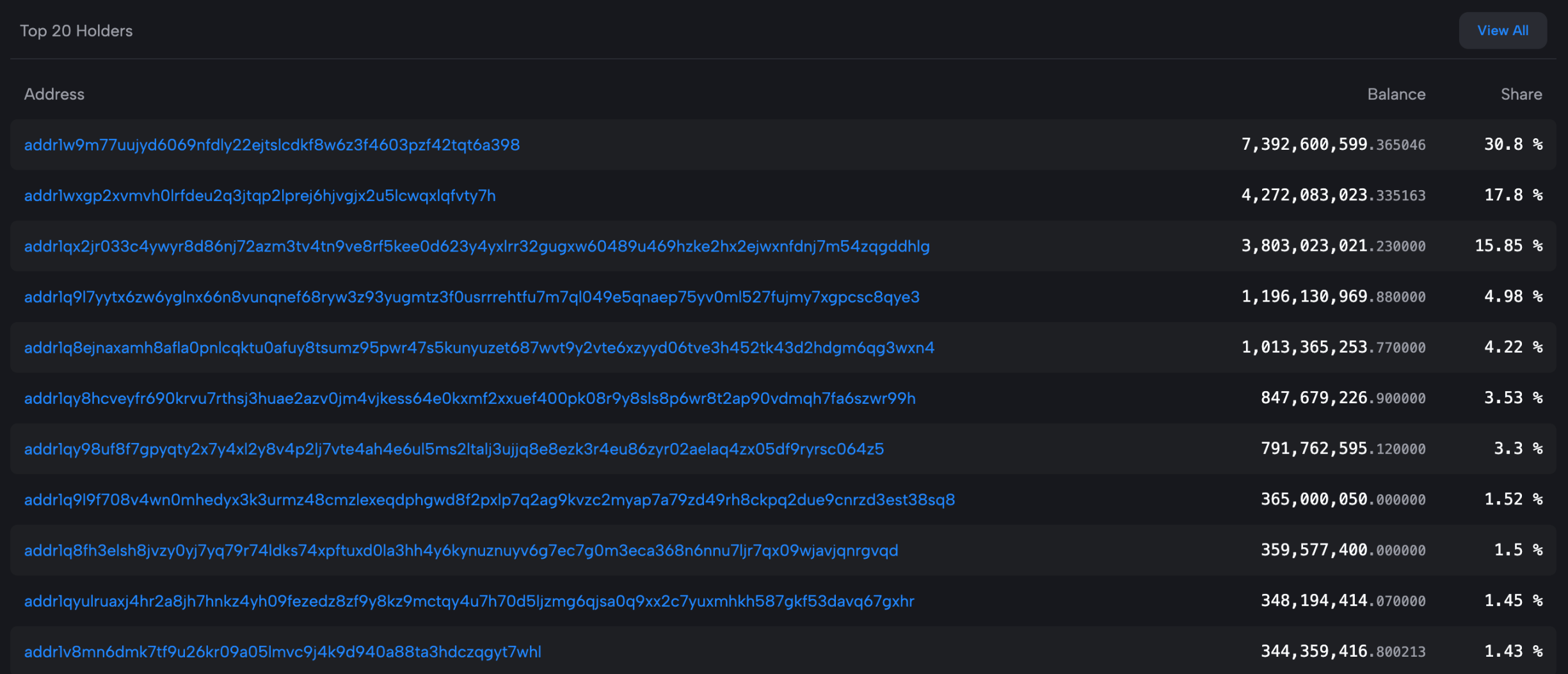
Looking at the block explorer, aside from the top three addresses which likely belong to IOG or the Midnight Foundation, the holdings of the remaining addresses are relatively decentralized. According to data provided on the official website, the author estimates that the airdrop itself, combined with exchange collaboration events, distributed nearly one-third of the total supply (24 billion tokens), which indeed qualifies as a massive effort.

Midnight's tokenomics feature not just NIGHT, but a "NIGHT+DUST" dual-token model. This rare design isn't based on some "whimsical idea" but rather aims to ensure regulatory compliance. NIGHT can be used for network governance, incentives, and generating the other token, DUST. NIGHT itself is not related to privacy and supports on-chain auditing.

DUST, generated by holding NIGHT, is used to pay for transaction fees, similar to Gas. Additionally, DUST will be used to pay for privacy fees—if one wants to add optional privacy features to on-chain transactions, they must pay DUST. DUST is automatically distributed to NIGHT holders' accounts with each block produced and "decays" over time to prevent malicious hoarding and network attacks.

Thus, Midnight's "equity" token, NIGHT, does not participate in paying on-chain transaction fees but exists solely as a governance token and a generator for the actual on-chain fuel, DUST. DUST itself, as a "renewable resource" generated by NIGHT and constantly decreasing over time, would be considered a resource rather than an asset from a regulatory perspective, potentially satisfying regulatory requirements in various jurisdictions.

Cardano to Heavily Invest in On-Chain Ecosystem Next Year

According to Cardano's roadmap, next year will be focused on comprehensively boosting on-chain activity.

First and foremost, Cardano will undergo a network upgrade to increase throughput to 1000-10,000 TPS through parallel block processing and a layered structure for vertical scaling, while maintaining security and decentralization. Following this will be the mainnet launch of the protagonist of this article, Midnight. Cardano believes Midnight's launch will bring more DeFi activity and TVL through its optional privacy features. Additionally, the Cardano Treasury will allocate funds to support the native issuance of major stablecoins like USDT and USDC on Cardano.

The last point, which the author finds most important, is Cardano's plan to focus on interoperability—not simple cross-chain functionality, but enabling users from other chains to interact directly with DApps on Cardano by paying gas fees on their source chain.

Last week, Cardano achieved atomic swaps between BTC and ADA through Fluid, not via cross-chain bridges, wrapped tokens, or centralized custody, but directly through underlying script-to-script transactions, which is somewhat facilitated by Cardano's own UTXO ledger model. Two days ago, interactions between Cardano stake pool operators and Solana's co-founder on X also confirmed this development direction.

Accompanying the strategic and product plans is capital investment. The Cardano Foundation plans to increase its marketing budget by 12% and "make an appearance" at events like TOKEN2049 and Consensus. Venture Hub will also invest 2 million ADA to support startups and ecosystem projects. Furthermore, the Cardano Foundation plans to inject tens of millions of ADA into on-chain DeFi to improve liquidity and attract institutional participation.

From this perspective, driving up the price of NIGHT might just be the appetizer Cardano is serving for a series of plans. Perhaps 2026 is really the year to keep an eye on this project, which launched its mainnet back in 2017 and has been almost forgotten by the mainstream Web3 market.


Twitter:https://twitter.com/BitpushNewsCN

Bitpush TG Discussion Group:https://t.me/BitPushCommunity

Bitpush TG Subscription: https://t.me/bitpush

Original link:https://www.bitpush.news/articles/7598128

Трендові криптовалюти

Пов'язані питання

QWhat is NIGHT and which blockchain is it from?

ANIGHT is the native token of Midnight, a privacy-focused sidechain developed by Input Output Global (IOG), the parent company of Cardano.

QWhat was the 24-hour trading volume of NIGHT that sparked significant attention?

ANIGHT achieved a 24-hour trading volume of nearly $9 billion, approaching $10 billion, which was a major point of discussion.

QWhat is the core technological feature of the Midnight blockchain?

AMidnight's core feature is 'programmable data protection,' offering TypeScript APIs for zero-knowledge proofs (ZKPs) to enable 'selective disclosure' without requiring developers to learn cryptography.

QHow does Midnight's dual-token model (NIGHT and DUST) work and why was it designed this way?

ANIGHT is used for governance and generating DUST, while DUST acts as gas for transaction fees and privacy features. This design helps comply with regulatory requirements by separating the governance token from the transactional resource.

QWhat are some of Cardano's key plans for its ecosystem in the coming year as mentioned in the article?

ACardano plans to upgrade network throughput to 1000-10,000 TPS, launch the Midnight mainnet, support native issuance of stablecoins like USDT and USDC, focus on interoperability allowing users to interact with DApps using their native chain's gas tokens, and invest in marketing and liquidity.

Пов'язані матеріали

Must-Watch Events Next Week|CLARITY Act Could Face Senate Vote; SpaceX, Circle to Report Earnings (8.3-8.9)

**Summary: Key Events and Developments to Watch (August 3-9)** The upcoming week is marked by significant financial disclosures, key legislative deadlines, and notable product updates. **Major Financial Events:** Several companies are scheduled to release their Q2 2026 earnings. American Bitcoin (ABTC) will report on August 3, followed by SpaceX and Hut 8 Mining Corp. on August 4, and Circle on August 5. Notably, a significant portion of SpaceX shares (up to 12% of total shares) will be unlocked on August 6 following their earnings release. **Key Legislative Deadline:** The U.S. Senate faces an August 7 deadline to secure 60 votes for the CLARITY Act, a bipartisan bill aiming to establish a federal regulatory framework for cryptocurrencies. The Senate may hold a full vote on the bill during the week. **Economic Data:** The U.S. July Non-Farm Payrolls report will be released on August 7, providing crucial labor market data. **Technology & Product Updates:** * **Shutdowns:** DeFi portfolio tracker Zapper and wallet app Ctrl Wallet will cease operations on August 3. * **Upgrades:** LayerZero will deprecate its v1 relayers on August 3. XRP Ledger's new version 3.3.0, featuring five new functions, is expected next week. * **AI:** Elon Musk announced that the advanced Grok 4.6 AI model is set for release around August 7. * **Bitcoin:** The BIP-110 forced signaling for a potential Bitcoin network change is scheduled to begin around August 8. **Other Notable Events:** Chinese robotics firm Unitree Tech has set its preliminary price inquiry for its IPO for August 5. South Korean exchange Upbit will delist AQT and AERGO tokens on August 3.

marsbit21 хв тому

Must-Watch Events Next Week|CLARITY Act Could Face Senate Vote; SpaceX, Circle to Report Earnings (8.3-8.9)

marsbit21 хв тому

Stocks Are Plummeting More Sharply Than Cryptocurrencies. Where Has the Money Gone?

Stock Markets Plunge Deeper Than Cryptocurrencies: Where Did the Money Go? In late July, Seoul's Kospi index triggered circuit breakers for two consecutive days, plummeting over 40% from its June high. The collapse was led by heavyweight stocks like SK Hynix, whose record profits still disappointed investors, and devastating leveraged ETFs, with one major product losing over 83% of its value. This signaled a global, forced deleveraging targeting the most crowded trades. Interestingly, while stocks exhibited extreme volatility akin to crypto markets, Bitcoin rose nearly 15% in July after a prior steep drop. Analysis shows the money fleeing equities did not flow into Bitcoin. Instead, Bitcoin had already absorbed its sell-off in May-June, when U.S. spot Bitcoin ETFs saw historic outflows. The true safe-haven beneficiary was gold, whose price rose over 20% year-on-year, highlighting a decoupling between Bitcoin and gold as "digital gold." The sell-off was a targeted unwinding of leveraged positions in tech and semiconductors, accelerated by broker-dealer risk management and shifts in the AI narrative, including new competition from Chinese memory chipmakers. The retreat path was clear: from high-valuation tech stocks to cash and U.S. Treasuries, then to gold. For Bitcoin to attract sustained institutional inflows, conditions like eased global liquidity pressure, a "soft-landing" Fed rate cut, and U.S. regulatory clarity via legislation like the stalled CLARITY Act are needed. Currently, Bitcoin is not a safe haven but an already-cleared asset. Its low correlation with tech stocks, however, makes it a potential diversification play for institutional portfolios once the storm passes. The money isn't here yet, but the positioning is underway.

marsbit21 хв тому

Stocks Are Plummeting More Sharply Than Cryptocurrencies. Where Has the Money Gone?

marsbit21 хв тому

In Conversation with Ray Dalio: We Are Currently in an AI Bubble, with 1% of My Portfolio in Bitcoin

Ray Dalio, founder of Bridgewater Associates, warns in an interview that the current AI boom shows classic bubble characteristics, which could lead to significant economic downturns as seen in past cycles like 1929 or 2000. He explains that speculative enthusiasm, fueled by debt and overvaluation, often precedes a crash when rising rates or taxation force asset sales, causing widespread losses and recession. Dalio also outlines his "Big Cycle" theory, describing an approximate 80-year pattern where widening wealth gaps, massive government deficits, and shifting geopolitical power (like China's rise) create internal conflict and global instability. He emphasizes that we are in a late-cycle, transitional phase where traditional powers like the US and UK face decline. For personal wealth protection, Dalio advises diversification beyond cash into assets like stocks, bonds, real estate, and particularly gold, which he prefers over Bitcoin. While he holds about 1% of his portfolio in Bitcoin as a non-printable hard asset, he views gold as more secure from technological or governmental threats. Regarding AI's impact, Dalio believes it will disproportionately benefit capital owners, worsening inequality by replacing both physical and cognitive labor. He suggests that human intuition and emotional intelligence, combined with AI, will be key for future workers. On taxation, Dalio argues that wealth taxes are impractical and risk triggering asset sell-offs, reducing productive investment. He points to the UK as a cautionary example of debt, low productivity, and political strife. Geopolitically, Dalio foresees a more regionalized world, with the US showing weakness in prolonged conflicts like with Iran, akin to past imperial declines. The ideal outcome, he suggests, is coexisting powerful blocs (e.g., Americas, China-Asia Pacific) without major war.

marsbit4 год тому

In Conversation with Ray Dalio: We Are Currently in an AI Bubble, with 1% of My Portfolio in Bitcoin

marsbit4 год тому

Daily 7.2 Trillion KRW: Foreign Capital's Record Net Buying on Friday! Wall Street Says Headwinds for Korean Stock Fund Flows Have Subsided

South Korean stock market sees a dramatic shift in fund flows. On July 31, foreign investors made a record net purchase of approximately KRW 7.2 trillion in KOSPI stocks, marking a fundamental reversal from the persistent large-scale net outflows seen in previous months. This contributed to a significant narrowing of foreign net selling in July to KRW 9.8 trillion, down sharply from KRW 48.4 trillion in June and KRW 44.5 trillion in May. Simultaneously, domestic institutional pressure eased. South Korean pension funds and asset managers turned to a net buying position in July, purchasing KRW 1.0 trillion worth of KOSPI shares, contrasting with net sales in May and June. Market volatility is expected to be dampened by new financial regulations. Effective July 31, the Financial Services Commission tightened access for retail investors to single-stock leveraged ETFs by raising the minimum cash deposit requirement. Trading volumes for these products subsequently dropped to about 50% of their monthly average. Citigroup Research maintains its year-end KOSPI target of 10,000 points. The firm cites several supportive factors: the substantial easing of headwinds from capital outflows, a robust fundamental outlook for the semiconductor sector, historically low market valuations, strong economic fundamentals, and the potential for policy support from financial authorities if needed.

marsbit4 год тому

Daily 7.2 Trillion KRW: Foreign Capital's Record Net Buying on Friday! Wall Street Says Headwinds for Korean Stock Fund Flows Have Subsided

marsbit4 год тому

Торгівля

Спот

Популярні статті

Як купити ADA

Ласкаво просимо до HTX.com! Ми зробили покупку Cardano (ADA) простою та зручною. Дотримуйтесь нашої покрокової інструкції, щоб розпочати свою криптовалютну подорож.Крок 1: Створіть обліковий запис на HTXВикористовуйте свою електронну пошту або номер телефону, щоб зареєструвати обліковий запис на HTX безплатно. Пройдіть безпроблемну реєстрацію й отримайте доступ до всіх функцій.ЗареєструватисьКрок 2: Перейдіть до розділу Купити крипту і виберіть спосіб оплатиКредитна/дебетова картка: використовуйте вашу картку Visa або Mastercard, щоб миттєво купити Cardano (ADA).Баланс: використовуйте кошти з балансу вашого рахунку HTX для безперешкодної торгівлі.Треті особи: ми додали популярні способи оплати, такі як Google Pay та Apple Pay, щоб підвищити зручність.P2P: Торгуйте безпосередньо з іншими користувачами на HTX.Позабіржова торгівля (OTC): ми пропонуємо індивідуальні послуги та конкурентні обмінні курси для трейдерів.Крок 3: Зберігайте свої Cardano (ADA)Після придбання Cardano (ADA) збережіть його у своєму обліковому записі на HTX. Крім того, ви можете відправити його в інше місце за допомогою блокчейн-переказу або використовувати його для торгівлі іншими криптовалютами.Крок 4: Торгівля Cardano (ADA)Легко торгуйте Cardano (ADA) на спотовому ринку HTX. Просто увійдіть до свого облікового запису, виберіть торгову пару, укладайте угоди та спостерігайте за ними в режимі реального часу. Ми пропонуємо зручний досвід як для початківців, так і для досвідчених трейдерів.

1.1k переглядів усьогоОпубліковано 2024.12.10Оновлено 2026.06.02

Як купити ADA

Обговорення

Ласкаво просимо до спільноти HTX. Тут ви можете бути в курсі останніх подій розвитку платформи та отримати доступ до професійної ринкової інформації. Нижче представлені думки користувачів щодо ціни ADA (ADA).

活动图片













