Author: danny
Many people study on-chain data to find out "if this coin has a whale behind it," and then try to avoid, embrace, or follow it. But the truth is—coins without whales won't rise at all. So the truly useful question isn't "is there a whale?" but "what stage is the whale in?"—accumulation, markup, distribution, or has it already left?
Let's get straight to the point: you will definitely find whales, because whales are everywhere.
This article provides you with a framework of on-chain + off-chain signals. It's not about playing detective to catch the manipulators, but about quickly determining: at this moment, is this market in a stage that is friendly to retail investors?
I. On-Chain Signals: What Chips and Capital Are Saying
Remember: This cycle isn't short on capital or data; it's short on capital willing to enter the market. Like all games, everything revolves around getting you to "pay to play." As long as you keep paying attention, there's a thousand memes with a thousand faces, and there's always one tailored for you.
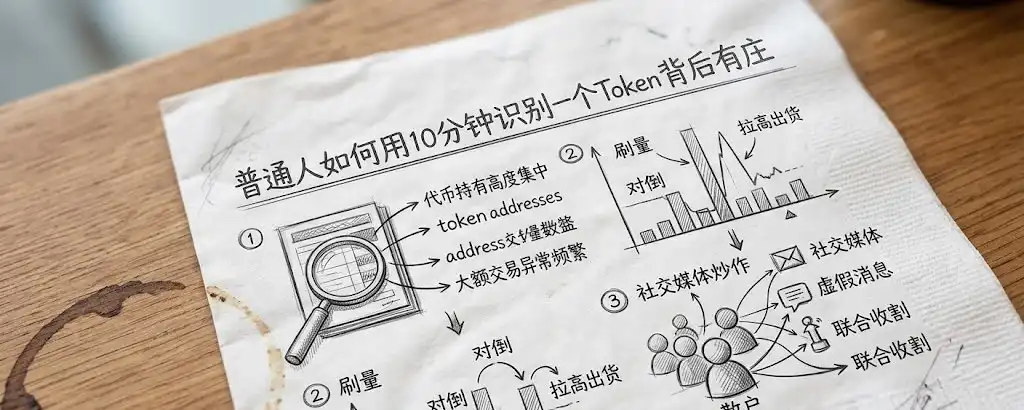
1: Token Concentration — Consolidate related wallets. Concentration itself isn't important; the degree of concentration is. Don't just look at the "Top 10 Holders %". Anyone can see that number, and it's easily disguised—a whale can split holdings into 50 wallets, each holding only 1%, making the Top 10 look "healthy." The right approach is to open a professional tracker and look at the bubble chart, consolidating addresses with connections (direct transfer relationships). Three wallets each holding 2% that have transferred to each other mean one entity holds 6%. Then look at the buy-in time of these related addresses—if they were all accumulated on the same day or even within the same hour, do you believe in coincidences?

Funding Source Tracing (Funding Wallet Analysis) — Where did the initial ETH/BNB for these wallets come from? If the gas fees for 50 wallets all came from the same CEX withdrawal address or the same funding wallet, even if there are no direct transfers between them, they are likely the same person. If someone is spending money to accumulate, what do you think they want to do?
2: Trading Volume Authenticity — Vol / Holder (OI) Ratio 24h Trading Volume ÷ Total Number of Holders = Average trading volume contributed per holder. If a coin with only 800 holders has a 24h volume of $2 million, that's $2500 per person on average—this is most likely a few addresses wash trading疯狂对倒刷量, or bots running. Why would someone spend money to inflate the volume?
3: DEX Liquidity Pool Monitoring Observe the addition/removal of LP (Liquidity Pool) — A whale removing LP / adding thick LP is a signal of preparing to exit / stir things up. If the LP is not locked (unlocked), or the lock is about to expire, the risk is extremely high. Also observe changes in LP depth. If the price is rising but the LP depth is thinning, it indicates the whale might be quietly withdrawing liquidity to minimize their losses when they exit, and vice versa.
4: Turnover Rationality — 24h Vol / Market Cap Measures "what percentage of the market cap is traded in a day." Break it down by hour. If the volume spikes significantly in a few specific hours far exceeding other periods, it indicates concentrated wash trading. Normal retail trading time distribution is relatively smooth; sudden spikes are likely the prelude to manipulation. Furthermore, net buy volume is more valuable than total volume.
5: Number of Trades vs. Trading Volume — Large Order Percentage Look at the average value per transaction within 24 hours. If the top 10% of large transactions account for over 60% of the total volume, this market is driven by a minority of addresses, and the price action depends entirely on these few addresses. (A better method is to quantify the concentration of trading volume using the Gini coefficient, between 0 and 1; the closer to 1, the more concentrated). When these addresses stop moving is more important than when they move.
6: Address/Account/OI Growth Rate vs. Price Change Rate — Determining the Whale's Stage Combine the calculations from the previous 5 indicators (must be processed, screened, and calculated), then use the data analysis to determine which stage the asset is currently in:
-
Accumulation Stage: Price consolidates at low levels or even dips slightly, on-chain large addresses buy slowly, wallet/account count changes little. The whale is quietly accumulating chips. (The number of linked addresses doesn't count here).
-
Markup Stage (Pump): For example: price rises 30%, but wallet/account count only increases 5% → Chips haven't been distributed; a minority is pumping it themselves.
-
Distribution Stage (Most Dangerous): Price consolidates or even dips slightly, but wallet/account count increases (sometimes also in long/short ratio) by 20% → The whale is slowly distributing at high to retail; it looks like "the community is growing," but actually the whale is retreating.
-
Exited Stage: Price falls, wallet/account count doesn't decrease → Retail is bag-holding, the whale has finished exiting.
II. After Reading This, Then What?
Okay, you spent time confirming there's a whale, and it's in the xxx stage. Then what? Switch to another one? The next one will also have a whale. Because—
III. Whales Aren't a Bug; They Are the Underlying Structure of This Game
What makes a Token rise? Pumping requires two things: Chips + Capital. Combined, these are called Pricing Power. If chips aren't concentrated enough, and there isn't sufficient stake, no one has the incentive to pump the price.
Chip concentration isn't a conspiracy; it's a prerequisite for a pump. No whale, no rally.
IV. How Do Whales Win Against You?
Pricing power is just the entry ticket. What really makes whales win steadily is that their way of trading is completely different from yours. You operate on feeling; they operate with a system.
-
Whale's Cost Awareness: Calculate the profit of pumping and distributing, act if Expected Value (EV) is positive. Retail FOMOs in based on screenshots.
-
Whale's Probabilistic Thinking: Continuously adjust probabilities and position sizing. Retail repeatedly gambles.
-
Whale's Exploitation of Psychology: Create FOMO, exploit sunk cost fallacy to make you hold bags.
-
Whale's Tool Advantage: Ability to hedge, possess cost/information advantages, operational dimensions and error tolerance crush retail.
V. Then How Can Retail Win?
On the whale's home turf, using the whale's rules, retail cannot win. The asymmetry in information, tools, and psychology is comprehensive. But there is one asymmetry that can be broken.
VI. Retail's Biggest Structural Flaw: Can Only Go Long
In the era before perpetual contracts (perp), whales indeed could only go long, but they didn't need to short. The reason lies in cost.
The whale's chip cost is close to zero (gas fees or extremely low early prices). Even if it drops 90%, they are still profitable, just "less profitable." Ultra-low cost gives them enormous error tolerance.
But retail buys in during the FOMO phase, with a cost potentially 50 times higher than the whale's. Your cost structure determines that you cannot withstand drawdowns. Retail lacks both shorting tools and a low-cost safety net. The only profitable scenario is: buy, then it rises, and sell before it falls.
One direction, one window, almost zero error tolerance. This is structural unfairness.
VII. What If Retail Could Also Short?
When signals point to the distribution stage, false prosperity—you aren't just "running away," you can open a short, turning the whale's distribution into your profit. When truth reverts, you can be on the winning side. Your analytical skills are finally not wasted.
VIII. Mechanism Perspective: With Shorting Rights, Can Retail Master Pricing Power?
Straight to the conclusion: No.
The formula for pricing power is always: Chips + Capital. The essence of retail is a dispersed, uncoordinated group of capital. No matter how clever the mechanism, it cannot turn a pile of sand into a cannon. However, introducing decentralized spot leverage and lending protocols isn't about making retail "become the whale," but about breaking the whale's "absolute monopoly" on pricing power.
Deconstructing the mechanism, this reshapes the structure in three dimensions:
-
Creating "Selling Pressure" Out of Thin Air, Depriving Unilateral Control: In a pure spot market, if the whale doesn't sell, there is no selling pressure; they can pump the price by trading with themselves. But with shorting mechanisms介入, retail can borrow tokens through over-collateralized loans and sell them into the market, turning previously "locked" dead筹码 into active selling pressure. This forcibly increases the real capital cost for the whale to continue pumping. To keep pumping, the whale must use real money to buy up the sell orders created by shorting.
-
Symmetry in Price Discovery: Popping "False Narratives": Previously, upon discovering whale distribution or narrative invalidation, retail could only "not buy"; bad news couldn't be reflected in price drops. Shorting mechanisms allow retail to convert "bearish information" into substantive sell orders, making price action no longer a one-sided game drawn by the whale, but the real result of long-short博弈.
-
Transformation from "Sitting Duck" to "Hunter": Shorting mechanisms actually accelerate the lifecycle of Meme coins. This mechanism doesn't let you become the rule-making whale, but it transforms retail from "bag-holders who can only take hits" into "hunters with guns."
IX. But Shorting Isn't a Panacea — Risks You Must Know
Shorting Meme coins is extremely high risk, with theoretically unlimited losses. What whales excel at is short squeezing (Short Squeeze). Intentionally pump the price to trigger short liquidations, using your liquidation funds to push the price even higher. Wrong timing means losing even if the direction is right. Plus, poor liquidity and high slippage make shorting costly.
Shorting isn't "make money if you understand"; it gives you an additional directional option. You still need to control position size and set stop losses. Shorting turns you from "chips" into a "player," and players can also lose—but they lose with more dignity.
Finally
This article teaches you not "how to avoid whales," but to understand:
-
Whales are everywhere. Don't look for "coins without whales"; the key is to judge which stage the whale is in.
-
Retail's biggest disadvantage is unidirectional exposure. Whales have low costs as a safety net; you don't. Understanding a rise can make money; understanding a fall can only make you run—this is不合理 unreasonable.
-
The right to short is the final piece of the puzzle for retail to go from "being harvested" to "sitting at the table."
It is a weapon, not a talisman. Even if this gun has the risk of backfiring, having a gun and not having a gun are two completely different levels of博弈 game theory. What we need is "symmetrical armament," allowing retail to also possess two-way gaming capabilities.