Housing Price "Shorting Tool" Emerges as Polymarket Launches Real Estate Prediction Market

Odaily星球日报Опубліковано о 2026-01-06Востаннє оновлено о 2026-01-06

Анотація

A new real estate prediction market has been launched on Polymarket in collaboration with Parcl, a blockchain-based real estate platform. The partnership integrates Parcl’s daily housing price indices into Polymarket’s prediction markets, enabling users to trade on future price movements of real estate in major U.S. cities such as New York, Miami, San Francisco, and Austin. The markets will allow participants to speculate on whether housing prices will rise or fall over monthly, quarterly, or annual periods, using USDC on the Polygon blockchain. Settlement is based on Parcl’s transparent and independently verifiable data, addressing delays and subjectivity in traditional real estate reporting. This initiative introduces a form of “shorting tool” for real estate, enabling users to hedge against or bet on housing market declines without needing to buy or sell physical property. The move is seen as a significant step in bringing liquidity and real-time price discovery to an otherwise illiquid market, while also incorporating real-world asset (RWA) data into the crypto ecosystem.

Original | Odaily Planet Daily (@OdailyChina)

Author | Asher (@Asher_ 0210)

The credibility of "everything is predictable" continues to rise.

On the evening of January 5th, the on-chain real estate platform Parcl announced a collaboration with the prediction market Polymarket, aiming to introduce Parcl's daily housing price index into Polymarket's new real estate prediction market. Following this news, Parcl's token PRCL surged by over 150% at its peak, though it has since retraced slightly. The current price is $0.042, with a market capitalization of $19 million.
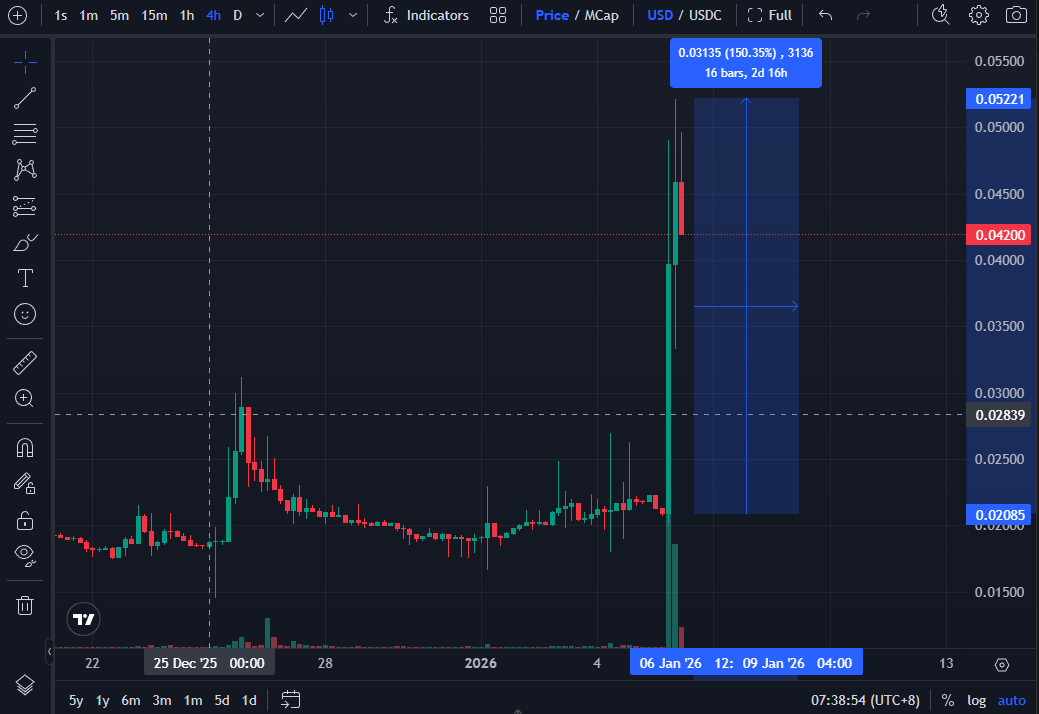
PRCL Price Chart

Operational Details of Polymarket's Real Estate Prediction Market Section

Collaboration Details:

  • Parcl provides a daily housing price index as an independent, transparent reference data for market settlement;
  • Polymarket is responsible for listing and operating the markets, where users can trade using USDC on the Polygon chain;
  • Market settlements are based on Parcl's publicly verifiable index, avoiding the delays (typically monthly) and subjectivity of traditional real estate data.

Market Types:

  • Predicting whether housing prices will rise or fall within a month, quarter, or year;
  • Threshold markets: e.g., whether housing prices exceed a specific level;
  • Each market is linked to a dedicated settlement page on Parcl, displaying the final value, historical data, and index calculation methods.

Coverage:

  • Initially starting with high-liquidity U.S. cities, such as New York, Miami, San Francisco, Austin, etc.;
  • Additional cities and market types will be expanded based on user demand.

Example Display:

Currently, this section has 7 monthly real estate prediction events listed, with relatively low liquidity. The event with the highest trading volume, "U.S. Los Angeles Housing Agent Price on February 1st," has only $3,700 in volume.
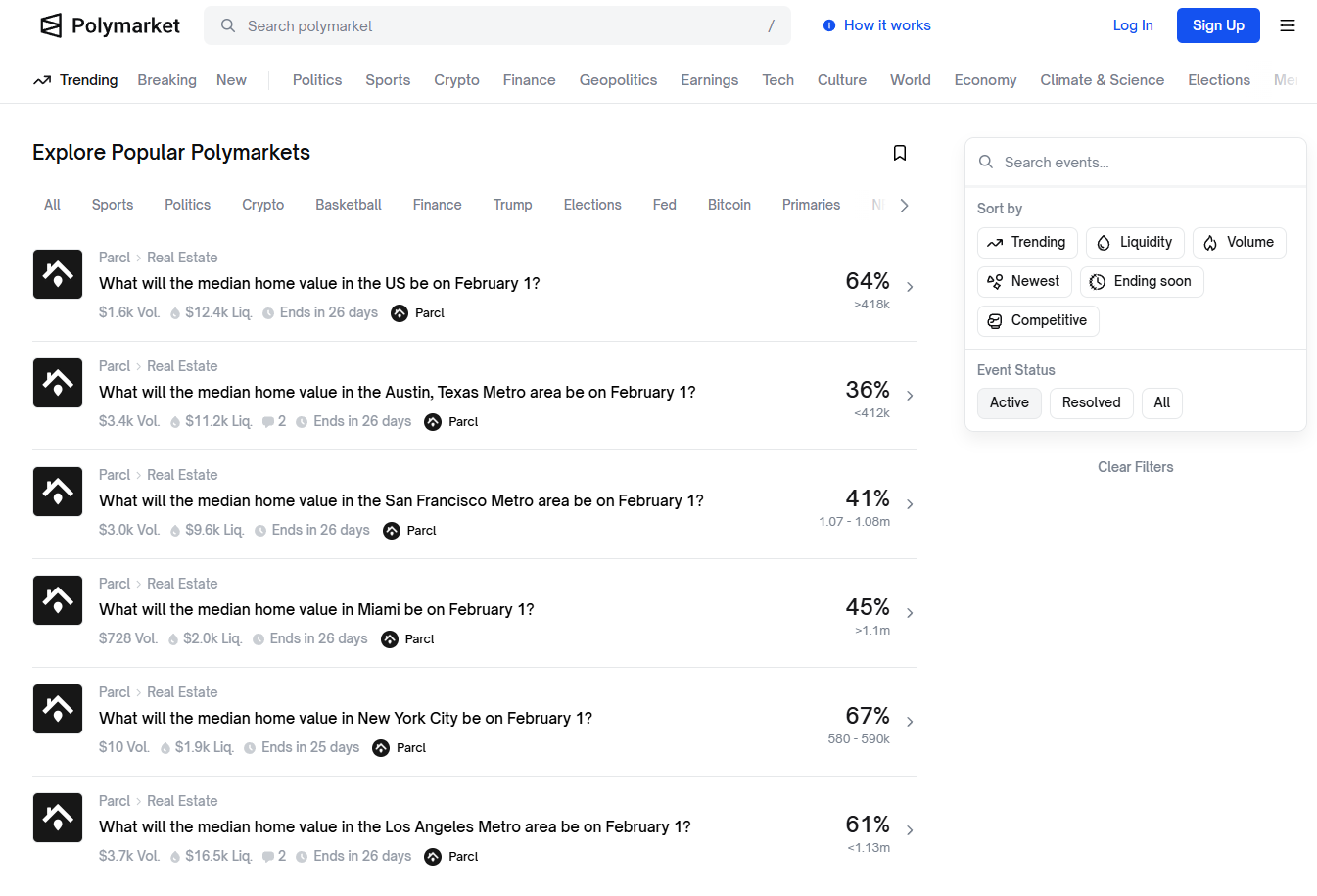
Polymarket's New Real Estate Prediction Market Section

In traditional real estate markets, whether bullish or bearish, such expectations are difficult to express directly, let alone form continuous market signals. Polymarket's introduction essentially separates "judgments on housing prices" from asset transactions. As long as there is a clear settlement standard, expectations themselves can be priced independently.

The Real Estate Market Finally Has a "Shorting Tool"

An easily overlooked fact is that the potential demand for real estate-related markets does not solely originate from native speculators.

In the traditional financial system, "falling housing prices" are almost a risk that cannot be directly hedged. Whether holding property or having asset structures and income sources highly dependent on a particular city's real estate cycle, the practical response is often to continue holding or directly sell physical assets—both of which involve high transaction costs, long cycles, and lack flexible intermediate options. As KOL 0xMarioNawfal (@RoundtableSpace) stated: "This is far more than just betting; it's about bringing liquidity to one of the world's most illiquid markets. Imagine housing prices are at historic highs, and you expect a crash but can't sell your house—now you can hedge and short the market."

The introduction of prediction markets abstracts the decline in housing prices into a tradable risk judgment. When housing prices are high and market expectations begin to weaken, the trend of real estate prices itself can be priced separately without having to dispose of underlying assets for risk management.

Through Polymarket, the downside risk of real estate prices is abstracted into a tradable judgment rather than requiring the disposal of physical assets. From this perspective, Polymarket's real estate prediction market is closer to a simplified macro hedging mechanism than a mere speculative game around price movements. It does not change the liquidity structure of real estate assets themselves but provides a trading layer that can reflect expectations in real time for a traditionally low-liquidity market.

Polymarket CMO Matthew Modabber stated: "Prediction markets are best suited for events with clear, verifiable data. Parcl's daily housing price index provides us with a transparent, consistent settlement foundation. Real estate should become a first-class category in prediction markets."

The collaboration between Polymarket and Parcl also introduces traditional real estate price signals into the crypto system: Originally low-frequency, closed, and high-barrier assets are broken down into index results that are settleable, verifiable, and tradable, resembling stock indices or crypto derivatives. This may represent a more practical and demand-aligned implementation path within the RWA narrative.


Пов'язані питання

QWhat is the significance of the partnership between Parcl and Polymarket in the real estate market?

AThe partnership introduces Parcl's daily housing price indices into Polymarket's prediction markets, enabling users to trade on real estate price movements using USDC on Polygon. This provides a transparent, verifiable, and low-cost way to speculate on or hedge against real estate price changes, effectively creating a 'shorting tool' for the traditionally illiquid real estate market.

QHow does the real estate prediction market on Polymarket work?

AUsers can trade on predictions about whether real estate prices in specific U.S. cities (e.g., New York, Miami) will rise or fall over monthly, quarterly, or annual periods. Markets are settled based on Parcl's publicly verifiable daily price indices, avoiding the delays and subjectivity of traditional real estate data.

QWhat problem does this new prediction market solve for traditional real estate investors?

AIt allows investors to hedge against or speculate on real estate price declines without needing to sell physical assets, which is typically costly and time-consuming. This provides a flexible, intermediate option for managing risk in a historically illiquid market.

QWhich cities are initially covered by Polymarket's real estate prediction markets?

AThe initial coverage includes high-liquidity U.S. cities such as New York, Miami, San Francisco, and Austin, with plans to expand to more cities based on user demand.

QWhat impact did the announcement have on Parcl's native token PRCL?

AFollowing the announcement, Parcl's token PRCL surged by over 150% in the short term, reaching a price of $0.042 and a market capitalization of $19 million, though it later experienced some pullback.

Пов'язані матеріали

380,000 Apps Exposed, 2,000+ Apps Leaked Secrets: AI Programming Turns 'Intranet' into Public Internet

Israeli cybersecurity firm RedAccess uncovered a severe data exposure trend linked to "vibe coding" or AI-powered software development tools. Their research found approximately 38,000 publicly accessible web applications built with platforms like Lovable, Base44, Netlify, and Replit. Of these, an estimated 2,000 apps exposed sensitive corporate and personal data, including medical records, financial information, internal strategic documents, and customer chat logs. In some cases, access even granted administrative privileges. The core issue stems from default privacy settings that make applications public by default, combined with a lack of built-in security controls (like authentication) in the AI-generated code. This allows employees without security expertise—"citizen developers"—to easily create and deploy applications that bypass standard corporate security reviews. The exposed apps, often indexed by search engines, are trivially discoverable. While some platform providers (Replit, Lovable, Wix/Base44) argue that security configuration is the user's responsibility and question the validity of some findings, security researchers confirm the widespread reality of such exposures. This pattern, also noted in prior studies, highlights a critical security gap as AI democratizes app creation, potentially leading to massive, unintentional data leaks.

marsbit46 хв тому

380,000 Apps Exposed, 2,000+ Apps Leaked Secrets: AI Programming Turns 'Intranet' into Public Internet

marsbit46 хв тому

Attracting Global Capital, Asia's New 'Super Cycle' Is Unfolding

Investors are turning to Asia as the next frontier for global equity growth, with a new "super cycle" unfolding across the region. Driven by the AI revolution, Asian markets, particularly South Korea, have seen significant rallies. According to Morgan Stanley analysis, the underlying drivers of Asia's industrial cycle are shifting from traditional sectors like real estate and manufacturing to massive investments in AI infrastructure, energy security and transition, and supply chain resilience. Fixed asset investment in Asia is projected to grow from around $11 trillion in 2025 to $16 trillion by 2030, with a 7% annual growth rate from 2026-2030. The AI wave is a primary catalyst, driving immense capital expenditure for chips, servers, data centers, and power systems. Asia is central to this hardware supply chain. In China, AI investment is focused on building a full-system domestic capability, with the local AI chip market potentially reaching $86 billion by 2030. Beyond AI, China's export story is expanding from EVs and batteries to robotics. The country already captures about half of new global industrial robot demand and over 90% of humanoid robot shipments. This growth phase mirrors the early stages of China's EV export boom. Simultaneously, energy security investments, spurred by AI's massive power needs, are rising, with China benefiting from its leadership in solar, batteries, and EVs. Regional defense spending is also increasing structurally, supporting demand for advanced manufacturing. The main beneficiaries are China, South Korea, and Japan, positioned in core supply chain areas. However, risks remain, including potential overcapacity, profit margin pressures from competition, persistent technological restrictions, geopolitical friction, and workforce displacement due to AI-driven automation. Market volatility is also expected to increase as investor expectations diverge on the realization of these capital investment and export themes.

marsbit47 хв тому

Attracting Global Capital, Asia's New 'Super Cycle' Is Unfolding

marsbit47 хв тому

Funding Weekly Report | 14 Public Funding Events, Kalshi Completes $10B New Funding Round at $220B Valuation Led by Coatue Management

Weekly Funding Roundup: 14 Deals and $10.49B+ in Total Funding, Led by Kalshi's $1B Round Last week (5.4-5.10) saw 14 notable funding events in the global blockchain ecosystem, raising over $10.49 billion in total. Key highlights include Kalshi, a prediction market platform, securing a $1 billion round led by Coatue Management, reaching a $22 billion valuation. The platform now boasts ~2 million MAUs and $178B in annualized trading volume. In DeFi, regulated on-chain reinsurer OnRe raised $5 million in Series A funding, and Bitcoin-backed credit protocol Saturn Credit completed a $2 million seed round. For Infrastructure & Tools, OpenTrade raised $17 million to expand its stablecoin yield infrastructure, and RWA platform Balcony secured $12.7 million to deploy its property settlement service in the US. Centralized Finance saw one deal: AI-driven trading platform Stockcoin.ai completed a seed round led by Amber Group. In the prediction market sector alongside Kalshi, AI-powered platform Elastics raised $2 million. Other notable deals include SC Ventures' strategic investment in crypto market maker GSR and Centrifuge securing a "seven-figure" investment from Coinbase to become a core RWA partner for Base. On the investor side, Haun Ventures raised a new $1 billion fund targeting crypto and AI, and Multi Investment raised ~$616 million to focus on blockchain and Web3 investments.

marsbit1 год тому

Funding Weekly Report | 14 Public Funding Events, Kalshi Completes $10B New Funding Round at $220B Valuation Led by Coatue Management

marsbit1 год тому

Торгівля

Спот
Ф'ючерси
活动图片