Hoskinson Warns Of Cardano ‘Wave of Failures’ After TapTools Shutdown

bitcoinistОпубліковано о 2026-06-03Востаннє оновлено о 2026-06-03

Анотація

Cardano founder Charles Hoskinson warns the ecosystem could face a "wave of failures" following the shutdown announcement of data and analytics platform TapTools. Citing leadership departures and unsustainable platform economics, TapTools is winding down operations despite serving over a million users. Hoskinson framed this not as an isolated incident but as a symptom of broader funding, coordination, and incentive problems within Cardano. He predicts more project failures in the second half of the year due to difficult market conditions. Hoskinson expressed frustration that proposed solutions, like a sovereign wealth fund or strategic acquisitions, have failed to gain sufficient support or faced criticism for centralization. He emphasized his lack of unilateral control over Cardano's governance, treasury, or direction, shifting responsibility to DReps and delegators to choose a clear growth strategy. The livestream concluded with a critique of Cardano's political culture and a discussion of potential extreme measures, including governance reform or even a new chain, if the current structure cannot support builders.

Charles Hoskinson warned that Cardano could face a broader “wave of failures” across its ecosystem after TapTools said it is preparing to wind down operations over the next two weeks, citing leadership departures and difficult platform economics.

The June 2 livestream marked one of Hoskinson’s sharpest public interventions on Cardano’s current governance and commercialization debate. Responding to TapTools’ shutdown statement, the Cardano founder framed the episode not as an isolated project failure, but as a symptom of deeper funding, coordination and incentive problems inside the ecosystem.

TapTools, a widely used Cardano data, analytics and discovery platform, said it had become difficult to responsibly keep operating after the departure of multiple senior team members. According to the statement read by Hoskinson, two co-founders, including the CTO and COO, had left earlier this year. A back-end developer had stepped into the CTO role, but that person has now also decided to move on.

“The technical knowledge required to responsibly operate and maintain TapTools cannot be replaced overnight,” the team said. “At the same time, the economics of running a platform like this remain challenging. Infrastructure costs are real. Development costs are real. Support costs are real.”

TapTools said it had served more than one million users, supported hundreds of projects through its API, published hundreds of articles, generated hundreds of millions of social impressions and helped bring visibility to builders across Cardano. The team said it would remain open to acquisition talks or other resources that could allow the platform to continue sustainably.

Hoskinson Says More Cardano Projects Could Follow

Hoskinson said TapTools had been part of his “daily ritual” and argued that its exit reflected a problem he had warned about earlier in the year: ecosystem projects running out of runway in poor market conditions.

“This is where we’re at as an ecosystem,” Hoskinson said. “I said at the beginning of the year, we’re going to see a lot of people collapse because the markets are really bad and we need some way to bail out our ecosystem and get them the lifeblood that they need to get to the next level.”

He pointed to JPEG Store and TapTools as examples of projects already affected, adding that he expects more failures in the second half of the year. “I would suspect others are coming very soon,” he said. “There’s going to be a wave of failures in the ecosystem.”

Hoskinson said he had previously proposed several mechanisms to address the issue, including a Cardano sovereign wealth fund, an ecosystem index and strategic acquisitions. He argued that these ideas either failed to gain sufficient support or were criticized as attempts to centralize the ecosystem. He cited his acquisitions of Nami and Blockfrost as examples of infrastructure he had tried to preserve and commercialize, while saying similar interventions often drew backlash.

The broader frustration, according to Hoskinson, is that Cardano governance has not yet produced an effective mechanism for deploying treasury resources into commercial infrastructure. He said Draper had received a large amount of ADA, but suggested that venture capital funding would likely flow mostly into new ventures rather than distressed existing platforms that may not be in an investable state.

Governance, Treasury And Commercialization

Hoskinson repeatedly rejected the idea that he has unilateral control over Cardano’s direction. He said he does not have governance keys, cannot initiate a hard fork or protocol parameter change, does not control the treasury and does not own the Cardano trademark.

“I’d really like to understand what my agency is here,” he said. “I don’t have any special powers with Cardano. I don’t have any governance keys. I don’t have any ability to even initiate a hard fork, much less a protocol parameter change.”

The livestream then turned into a wider critique of Cardano’s political culture. Hoskinson accused parts of the ecosystem of opposing commercialization while also blaming leadership when commercial infrastructure fails. He directed much of his message at DReps and delegators, arguing they need to evaluate whether their representatives are enabling growth or blocking it.

“You need to pick a leader. You need to pick a vision. You need to pick a strategy and fix it,” Hoskinson said. “You need to or you cannot and let it die. That’s your choice.”

He also floated more extreme options, including constitutional changes, treasury reform, changes to executive function and, at the outer edge, a new Cardano launched through a proof-of-burn mechanism. Hoskinson described that as the “nuclear option,” while presenting it as one of several possible responses if the current governance structure cannot support builders.

At press time, ADA traded at $0.2177.
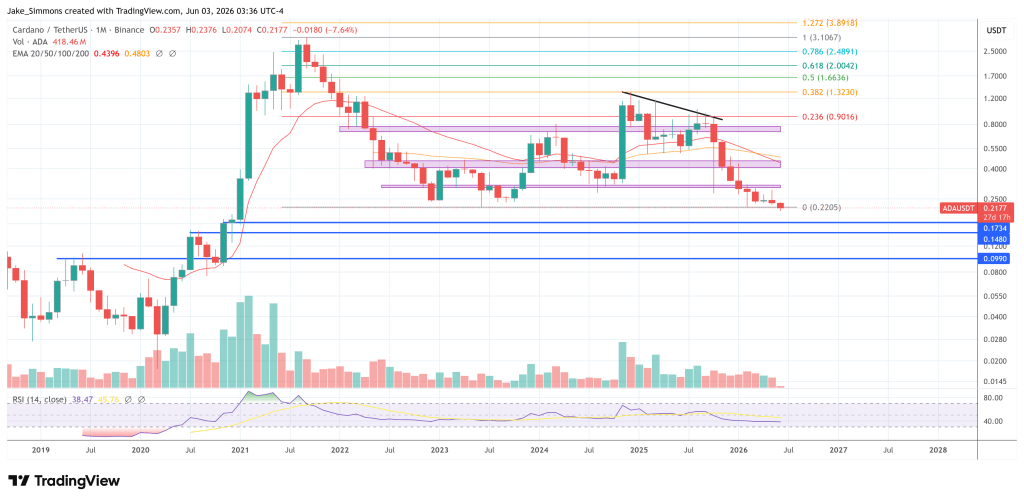
ADA drops below key support, 1-day chart | Source: ADAUSDT on TradingView.com

Трендові криптовалюти

Пов'язані питання

QWhat is the main reason TapTools gave for shutting down operations according to the article?

ATapTools cited the departure of multiple senior team members, including two co-founders (the CTO and COO) and a back-end developer who had stepped into the CTO role, as well as difficult platform economics involving high infrastructure, development, and support costs.

QHow does Charles Hoskinson frame the shutdown of TapTools in relation to the Cardano ecosystem?

AHoskinson frames it not as an isolated project failure, but as a symptom of deeper funding, coordination, and incentive problems within the ecosystem. He warns it could signal the start of a broader 'wave of failures' for projects running out of financial runway in poor market conditions.

QWhat mechanisms has Hoskinson previously proposed to address ecosystem funding issues, and what was the outcome?

AHe proposed mechanisms like a Cardano sovereign wealth fund, an ecosystem index, and strategic acquisitions. He stated these ideas either failed to gain sufficient support or were criticized as attempts to centralize control over the ecosystem.

QAccording to Hoskinson, what is a key frustration regarding Cardano's governance and treasury?

AHis key frustration is that Cardano's governance has not yet produced an effective mechanism for deploying treasury resources to support commercial infrastructure projects within the ecosystem.

QWhat extreme 'nuclear option' did Hoskinson mention as a possible response if current governance cannot support builders?

AHe mentioned the possibility of launching a new version of Cardano through a proof-of-burn mechanism as the most extreme 'nuclear option' among several potential responses to governance failure.

Пов'язані матеріали

STAR 50 Soars 10.73%, Why Did A-Shares Stage a "V-Shaped Reversal"?

After a prolonged decline, the Chinese A-share market staged a strong rally on July 21. The STAR 50 index surged 10.73%, its largest single-day gain in nearly a year, leading a broad-based "V-shaped" reversal. The Shanghai Composite Index rose 1.79%, the Shenzhen Component Index gained 4.81%, and the ChiNext Index jumped 7.05%. Total market turnover reached 2.97 trillion yuan, an increase of 256.1 billion yuan from the previous session, with over 3,100 stocks advancing. The semiconductor sector spearheaded the rebound, with related ETFs posting significant gains. Analysts attribute the surge to three converging factors. First, coordinated capital inflows from "national team" institutions, insurance funds, listed company buybacks, and fund house self-purchases have bolstered market liquidity and confidence. Second, supportive policy signals, including commitments from regulators to ensure stable market operations, provided a favorable backdrop. Third, a stabilization and recovery in overseas markets, notably South Korea, created a positive external environment. Institutions suggest the most severe panic selling phase for the tech sector has likely passed, following a significant digestion of crowded positions and leveraged funds. While short-term volatility may persist, the medium to long-term outlook remains underpinned by enduring trends like AI computing demand expansion and semiconductor localization. The market's focus now shifts to the sustainability of supportive fund flows, earnings reports, and upcoming catalysts from the global AI industry chain.

marsbit38 хв тому

STAR 50 Soars 10.73%, Why Did A-Shares Stage a "V-Shaped Reversal"?

marsbit38 хв тому

U.S. Tech Momentum Stocks Post Largest Single-Day Gain Ever, But Is the Plunge Over?

US tech momentum stocks staged a sharp rebound on Tuesday (July 21st). Morgan Stanley's TMT Momentum Factor surged over 12%, marking its largest single-day gain on record, exceeding even peaks from the 2000 dot-com bubble. Key momentum indices from Goldman Sachs also posted their strongest daily performances in years. The rally was led by semiconductors, with the Philadelphia Semiconductor Index jumping 4.6%. This rebound followed three consecutive down days and a cumulative 33% plunge in momentum stocks, one of the steepest drawdowns since the dot-com era. Analysts attribute the surge largely to a short squeeze. Heavy selling had pushed high-beta momentum stocks into deeply oversold territory, forcing many short sellers, particularly in Asia, to cover their positions, creating a self-reinforcing buying spiral. However, the rebound's internals appear weak. Trading volume was notably low, and advancing stocks still lagged decliners on the S&P 500, indicating a narrow, concentrated rally rather than broad market participation. Diverging views emerge on the outlook. BTIG warns the bounce has hit key resistance and recommends selling into strength, citing extreme volatility and historical parallels to past market tops. Conversely, Goldman Sachs and UBS believe the momentum unwind is nearing its end, suggesting it may be time to gradually add exposure, as positioning has been significantly reduced. They caution, however, that high volatility warrants a measured approach, potentially using defined-risk strategies. The upcoming earnings season, particularly reports from major tech firms like Alphabet, is seen as a critical test for the rally's sustainability. Simultaneously, bond markets flashed a warning, with yields rising partly due to spiking oil prices. Analysts note that if long-term Treasury yields break decisively higher, it could pose a significant headwind for equities, especially growth stocks.

marsbit45 хв тому

U.S. Tech Momentum Stocks Post Largest Single-Day Gain Ever, But Is the Plunge Over?

marsbit45 хв тому

U.S. Tech Momentum Stocks Record Largest Single-Day Gain Ever, but Has the Rout Ended?

U.S. tech momentum stocks staged a dramatic rebound on Tuesday, July 21st. Key momentum indices like the Morgan Stanley TMT Momentum Factor and Goldman Sachs' High Beta Momentum Long Index posted historic or near-historic single-day gains, fueled largely by semiconductor stocks. This sharp rally followed a severe three-day sell-off that saw momentum stocks plunge 33%, marking one of the steepest pullbacks since the dot-com bubble. Analysts attribute the bounce primarily to a short squeeze, as forced covering from over-leveraged traders, particularly in Asia, created a buying spiral. However, the rally's health is questioned due to weak market breadth—overall trading volume was low, and decliners outnumbered advancers in the S&P 500 despite the index's gain—suggesting a narrow, concentrated surge rather than broad recovery. Opinions on the sustainability diverge. BTIG strategists warn the rebound has hit key resistance levels, citing extreme volatility and historic stock dispersion as signs of an ongoing broader correction, and recommend selling into strength. Conversely, Goldman Sachs and UBS view the aggressive momentum unwinding as nearing its end, noting reduced positioning and a lack of new fundamental catalysts. They suggest the sell-off presents a selective opportunity to add exposure, albeit cautiously and gradually using defined-risk strategies. The immediate trajectory hinges on the ongoing earnings season, with market focus on Alphabet's capital expenditure guidance for AI investment clarity. Meanwhile, bond markets present a risk, with rising Treasury yields—potentially heading toward 5.5%—and widening credit spreads for mega-cap tech companies posing a threat to equity valuations. The combination of technical factors, earnings results, and macro conditions leaves the durability of the rebound in doubt.

链捕手47 хв тому

U.S. Tech Momentum Stocks Record Largest Single-Day Gain Ever, but Has the Rout Ended?

链捕手47 хв тому

Long-Divided Must Unite, Long-United Must Divide: When L1 Becomes Its Own Rollup, What Is Ethereum's Endgame?

"The Inevitable Cycle: When L1 Becomes Its Own Rollup – What is Ethereum's Endgame?" For years, the Ethereum community grappled with concerns that L2s were fragmenting the ecosystem and eroding L1's value. While L2s provided cheaper execution, they also splintered liquidity and the unified user experience of a single chain. This has prompted a fundamental reassessment of the relationship between L1 and L2. Ethereum's roadmap is evolving. The "Scale" initiative merges L1 and L2 expansion into a holistic framework. L1 itself is advancing with higher gas limits, statelessness, and zkEVM verification, no longer content to be just a low-throughput settlement layer. Consequently, the primary value proposition of L2s is shifting from merely providing cheap blockspace to offering L1 cannot easily provide: application-specific optimizations, privacy features, and flexible governance models. L2s are becoming a spectrum of execution environments with varying degrees of security inheritance from Ethereum. A critical challenge in this multi-chain future is interoperability. The vision is to make Ethereum "feel like one chain again." This relies on advancements in native account abstraction (like EIP-7702) and intent-based architectures (Open Intents Framework), where users declare desired outcomes, and solvers handle the complex cross-chain execution. Furthermore, shortening Ethereum's finality time from minutes to seconds is crucial, as it underpins trust between chains for bridges, stablecoins, and cross-chain applications. Perhaps the most provocative idea is that Ethereum L1 itself could become a form of "its own Rollup." As zkEVM and proof systems mature, high-performance nodes could execute transactions and generate validity proofs. Regular validators would then verify these proofs instead of re-executing all transactions. This blurs the traditional L1/L2 hierarchy, making "Rollup" more of a general execution-verification architecture. Native Rollup aims to integrate L2 validation more directly into the Ethereum protocol, allowing L2s to inherit L1's security more fully and move away from reliance on security councils. In the end, L2s are not destined to replace L1 or be made obsolete by it. The likely future is a unified system where diverse execution environments—each optimized for specific use cases like DeFi, gaming, or privacy—coexist. They will share a common foundation of security, liquidity, and verifiable state, seamlessly connected to restore a cohesive user experience. The next phase for Ethereum is not just about scaling through separation, but about intelligently reintegrating what was separated back into a coherent whole.

链捕手1 год тому

Long-Divided Must Unite, Long-United Must Divide: When L1 Becomes Its Own Rollup, What Is Ethereum's Endgame?

链捕手1 год тому

Торгівля

Спот

Популярні статті

Як купити ADA

Ласкаво просимо до HTX.com! Ми зробили покупку Cardano (ADA) простою та зручною. Дотримуйтесь нашої покрокової інструкції, щоб розпочати свою криптовалютну подорож.Крок 1: Створіть обліковий запис на HTXВикористовуйте свою електронну пошту або номер телефону, щоб зареєструвати обліковий запис на HTX безплатно. Пройдіть безпроблемну реєстрацію й отримайте доступ до всіх функцій.ЗареєструватисьКрок 2: Перейдіть до розділу Купити крипту і виберіть спосіб оплатиКредитна/дебетова картка: використовуйте вашу картку Visa або Mastercard, щоб миттєво купити Cardano (ADA).Баланс: використовуйте кошти з балансу вашого рахунку HTX для безперешкодної торгівлі.Треті особи: ми додали популярні способи оплати, такі як Google Pay та Apple Pay, щоб підвищити зручність.P2P: Торгуйте безпосередньо з іншими користувачами на HTX.Позабіржова торгівля (OTC): ми пропонуємо індивідуальні послуги та конкурентні обмінні курси для трейдерів.Крок 3: Зберігайте свої Cardano (ADA)Після придбання Cardano (ADA) збережіть його у своєму обліковому записі на HTX. Крім того, ви можете відправити його в інше місце за допомогою блокчейн-переказу або використовувати його для торгівлі іншими криптовалютами.Крок 4: Торгівля Cardano (ADA)Легко торгуйте Cardano (ADA) на спотовому ринку HTX. Просто увійдіть до свого облікового запису, виберіть торгову пару, укладайте угоди та спостерігайте за ними в режимі реального часу. Ми пропонуємо зручний досвід як для початківців, так і для досвідчених трейдерів.

1.0k переглядів усьогоОпубліковано 2024.12.10Оновлено 2026.06.02

Як купити ADA

Обговорення

Ласкаво просимо до спільноти HTX. Тут ви можете бути в курсі останніх подій розвитку платформи та отримати доступ до професійної ринкової інформації. Нижче представлені думки користувачів щодо ціни ADA (ADA).

活动图片













