High-Frequency Trading, $100K Annual Income: The Most 'Boring' Profit Myth on Polymarket

marsbitОпубліковано о 2026-02-11Востаннє оновлено о 2026-02-11

Анотація

A user known as planktonXD (0x4ffe49ba2a4cae123536a8af4fda48faeb609f71) has generated over $106,000 in profit on Polymarket within a year by executing more than 61,000 predictions—averaging around 170 trades per day. This high-frequency, automated strategy focuses on exploiting small, certain opportunities rather than betting on high-risk, high-reward outcomes. The approach is characterized by market-making and micro-arbitrage: placing orders on both sides of the order book to capture spreads or profiting from mispriced options in low-liquidity markets. The largest single win was only $2,527, illustrating a disciplined, risk-managed method that avoids large drawdowns. The bot operates across diverse categories—sports, weather, crypto prices, politics—constantly scanning for pricing inefficiencies. Notable examples include buying heavily undervalued options in niche markets, such as esports matches or extreme crypto price movements, where probability is mispriced due to emotional trading or thin order books. For instance, a $16 bet on SOL falling to $130 (priced at 0.7¢, implying <1% chance) returned $1,574 during a volatile period. Key takeaways: The strategy highlights the power of compounding small gains, the necessity of automation and API tools, and the superiority of high-probability opportunities over high-risk bets. In prediction markets, the most advanced approach isn’t forecasting—it’s managing probability and liquidity.

Original Author: Ma He, Foresight News

Another miracle has emerged on Polymarket.

Through extensive monitoring and frenzied betting, an address has netted $100,000 in just one year by compounding small profits.

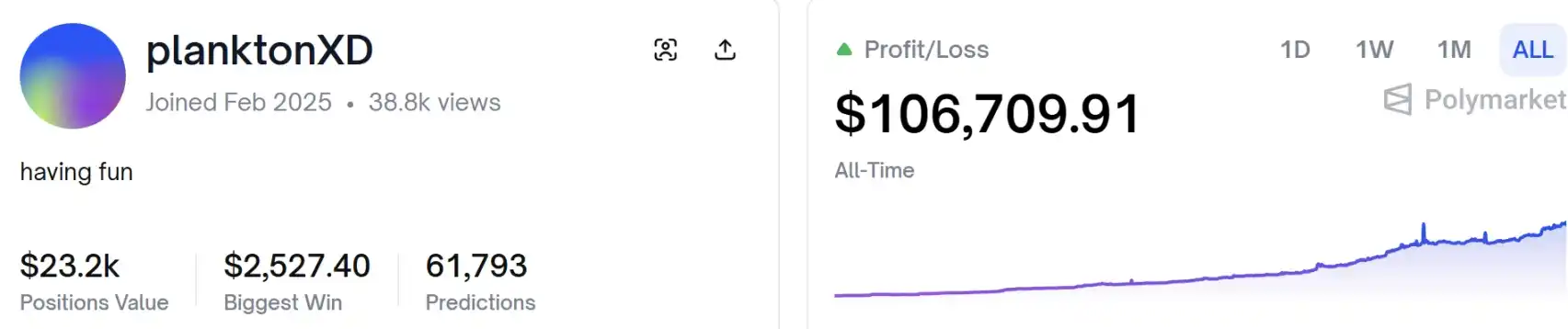
The address we are reviewing, planktonXD (0x4ffe49ba2a4cae123536a8af4fda48faeb609f71), is an extremely typical high-frequency quantitative trader. From February 2025 to the present, in just one year, it has generated a net profit of $106,000 through over 61,000 predictions.
In prediction markets, most people are gambling on "black swans" or chasing big news, but planktonXD takes a completely different path: extreme certainty and terrifying execution frequency.

Looking at planktonXD's historical trading data, the most astonishing aspect is its 61,000 predictions. From February 2025 to February 2026, it averages about 170 transactions per day.

This frequency far exceeds the limits of manual human operation, confirming that this player uses an automated trading script (Bot). It is not "predicting" outcomes but "harvesting" price differences.

A very interesting phenomenon is that planktonXD's "Biggest Win" is only $2,527.4. Compared to its total profit of $100,000, this single largest gain appears very "small" (only about 2% of the total profit).

Some retail players always hope to make a big score, betting all their chips on a confident judgment.

Winning is good, of course, but losing makes it hard to get back to the table.

Even if every ALL-IN could win, just one loss would mean a big defeat.

Reviewing its trading history, it never goes all-in on a single extreme event, nor does it bet on high odds. Its profit curve shows a perfect 45-degree smooth rise with almost no significant drawdowns. This indicates it employs a market-making strategy: placing orders on both sides of the order book to earn the bid-ask spread, or performing micro-arbitrage using price fluctuations between different markets.
It does not always hold positions long-term (Buy and Hold) but frequently enters and exits the market. This "light position, fast turnover" approach greatly reduces single-point risk. Even if an unexpected event occurs in a prediction market (like a sudden election result change), its impact on the total capital pool is minimal.

This quantitative robot does not specialize in trading vertical sectors like weather but places bets across multiple sectors: sports, weather, coin prices, politics, etc. It monitors thousands of prediction markets on the platform 24/7, looking for moments of pricing inefficiency.

VALORANT Challengers is a classic实战 case study for this trader.

You can think of it as the "minor league" or "regional league" of the esports circle. Fuego and LYON are professional teams in the Latin American region. Because such matches have a small audience and extremely high information asymmetry, they become a "套利天堂" (arbitrage paradise) for quantitative robots.

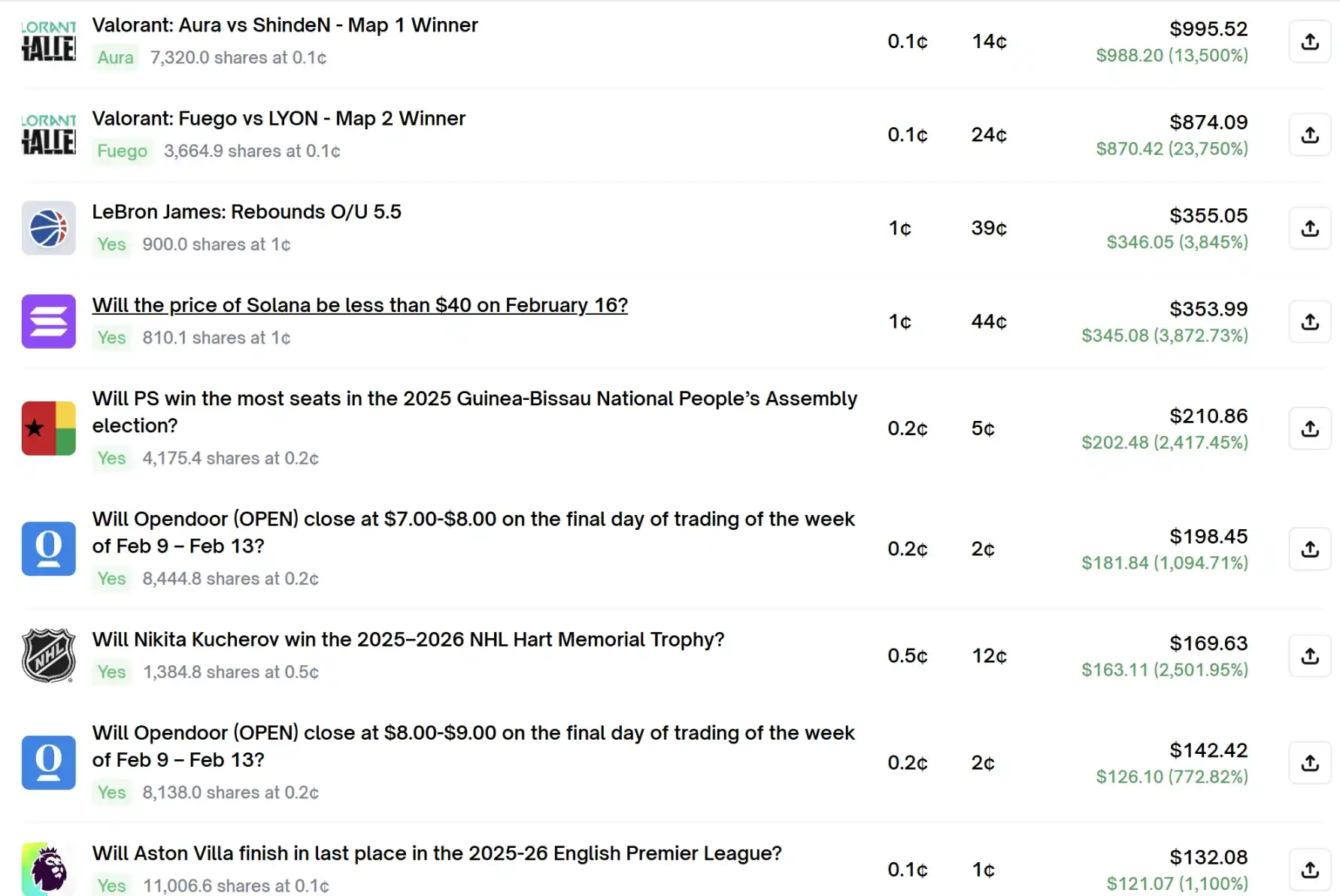
It bought 3,664.9 shares of Fuego winning at a unit price of $0.001, and this trade ultimately yielded a return of $874.09, with a staggering return rate of 23,750%!

This is a typical "small position, big odds" play. In long-tail markets with extremely poor liquidity or where the public is extremely bearish on a certain option (like the round results of esports matches), it uses a Bot to monitor options that are mispriced to near "zero." It doesn't need to predict who will win; it only needs to know that Fuego's probability of winning is definitely not 0.1%. This is essentially harvesting the market's "extreme sentiment" and "lack of liquidity."

When it comes to sentiment, coin prices embody it most vividly.
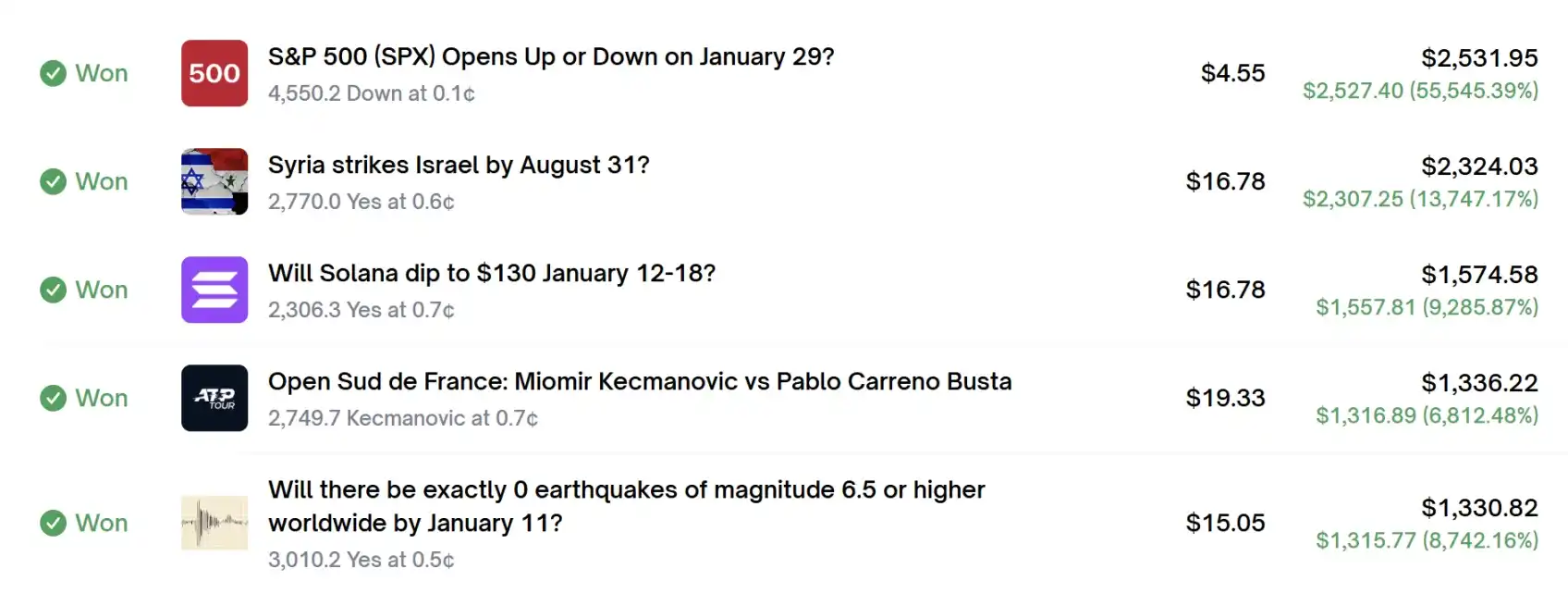
Will the SOL price drop to $130 between January 12-18?

It invested about $16 at $0.007 (the market believed the probability of success was less than 1%) and ultimately took away $1,574, with an amazing return rate of 9,285%.

Why did this "almost impossible" prediction allow it to make big money at that time?

During periods of剧烈波动 (sharp volatility) in the cryptocurrency market, mainstream predictions tend to be bullish or sideways. planktonXD would捕捉 (capture) those "extremely bearish" options priced at $0.001 - $0.01 around the clock. These options are like worthless paper to ordinary people, but they are extremely cheap insurance to quant traders. As long as the market experiences a deep wick or sudden bad news, these "worthless papers" can instantly surge thousands of times. Additionally, in specific price ranges (e.g., SOL < $40), because the current price is far from the predicted price, the order book is often very thin. planktonXD uses automated scripts to place orders in these "no-man's land," eating up the cheap shares抛出的 (thrown out) due to panic or misoperation, essentially acting as a probability搬运工 (mover).

planktonXD's SOL strategy shows that on Polymarket, buying the "impossible" does not mean it believes it will happen, but because the "probability of it happening" is underestimated by the market. It uses a few dollars to buy out the market's one-in-ten-thousand possibility of panic. This is a typical "antifragile" trade.

planktonXD's success offers three core启示 (insights) for ordinary retail users:

The power of compound interest should not be underestimated. Earning 0.5% daily through high-frequency trading yields much more stable returns after a year than betting on a 10x coin. Technology is the killer skill. In the Crypto era, quantitative tools and API capabilities are standard for top players. Finally, certainty is greater than odds. In prediction markets,寻找 (finding) those small profit opportunities with extremely high probability (e.g., 90%+ certainty) is easier to survive than gambling on 50/50 major events.

After all, the highest level of play in prediction markets is not predicting the future, but managing probability and liquidity.


Пов'язані питання

QWhat is the key strategy used by the address planktonXD to earn over $100,000 on Polymarket in a year?

AThe key strategy is high-frequency automated trading (using a bot) that focuses on small, certain profits through market making and micro-arbitrage, rather than betting on high-risk, high-reward events. It executed over 61,000 predictions in a year, averaging about 170 trades per day.

QHow does planktonXD achieve such a smooth profit curve with minimal drawdowns?

AIt achieves this by using a market maker strategy: placing orders on both sides of the order book to capture the bid-ask spread, and engaging in micro-arbitrage across different markets. This 'light position, fast turnover' approach minimizes single-point risk and avoids large bets on volatile outcomes.

QWhat type of markets does planktonXD typically target for its trades?

AIt targets multiple sectors including sports, weather, cryptocurrency prices, and politics. It monitors thousands of prediction markets 24/7 to identify mispriced opportunities, especially in illiquid or emotionally driven markets where extreme mispricing occurs.

QCan you give an example of a high-return trade made by planktonXD and explain why it was successful?

AOne example is buying 3,664.9 shares of Fuego winning a VALORANT Challengers match at 0.1¢ each, which resulted in an 874.09 USD profit with a 23,750% return. The success came from exploiting extreme mispricing in a low-liquidity, information-asymmetric market where the probability of Fuego winning was significantly higher than the market price reflected.

QWhat are the three key lessons for retail traders from planktonXD's success on Polymarket?

A1. The power of compounding: small daily gains through high-frequency trading can yield more stable returns than betting on high-risk events. 2. Technology is essential: automated tools and API capabilities are crucial for top performers. 3. Certainty over odds: seeking high-probability, small-profit opportunities is more sustainable than gambling on 50/50 outcomes.

Пов'язані матеріали

This Week's Key Events Preview | U.S. to Release April CPI Data; U.S. Senate Banking Committee to Review "Digital Asset Market Structure Act of 2025"

Weekly News Preview: Key events for May 12-16 include major economic and crypto industry developments. On Tuesday, May 12, the U.S. will release its April CPI data. Additionally, the gaming blockchain Ronin will begin a 10-hour migration to an Ethereum Layer 2, built on OP Stack with EigenDA for data availability. This aims to leverage Ethereum's security and settle RON's annual inflation below 1%. Base's first independent network upgrade, "Base Azul," is scheduled for mainnet activation on Wednesday, May 13, focusing on security, performance, and developer experience enhancements. Thursday, May 14, sees the U.S. Senate Banking Committee voting on the "Digital Asset Market Structure Act of 2025." In other news, Solana DeFi protocol Carrot will shut down, setting a final withdrawal deadline due to impacts from the Drift exploit. The Moscow Exchange will launch futures trading for Solana, Ripple, and Tron indices (RUB-settled) for qualified investors. Multiple service closures are scheduled for Friday, May 15. Dmail Network will begin winding down due to unsustainable infrastructure costs and failed commercialization. Users must export data before this date. Separately, the Cosmos-based lending blockchain UX Chain will fully shut down. Finally, on Saturday, May 16, gaming infrastructure provider Lattice will wind down operations, with its Redstone Layer 2 network ceasing. Users are urged to withdraw assets, especially from contracts like Uniswap pools, before the shutdown.

链捕手59 хв тому

This Week's Key Events Preview | U.S. to Release April CPI Data; U.S. Senate Banking Committee to Review "Digital Asset Market Structure Act of 2025"

链捕手59 хв тому

Morning Post | Trump Media Group Releases Q1 Financial Report; Top Three DeFi Applications Return Nearly $100 Million in Revenue to Token Holders in 30 Days; Michael Saylor Shares Bitcoin Tracker Info Again

**Title: Daily Briefing | Trump Media Group Releases Q1 Report; Top 3 DeFi Apps Return Nearly $100M to Token Holders; Michael Saylor Signals Potential Bitcoin Buy** **Summary:** Key developments in the past 24 hours include: * **Economic Outlook:** Goldman Sachs has pushed back its forecast for the next two Federal Reserve interest rate cuts to December 2026 and March 2027, citing persistent inflationary pressures from energy costs. This delayed timeline is expected to tighten liquidity flow into risk assets, including cryptocurrencies. * **DeFi & Revenue:** Data from DefiLlama shows that three leading DeFi applications—Hyperliquid, Pump.fun, and EdgeX—collectively distributed $96.3 million in revenue to their token holders over the last 30 days. This trend highlights a shift in the crypto community's focus towards real protocol earnings and sustainable economic models. * **Corporate Bitcoin Moves:** Michael Saylor, founder of MicroStrategy (note: referred to as 'Strategy' in the text, likely a typographical error), has signaled potential upcoming Bitcoin purchases by posting a "Bitcoin Tracker" update, following a pattern that typically precedes the company's official disclosure of new acquisitions. * **Market Integrity:** Prediction market platform Polymarket announced updates to address platform issues, including identifying and banning clusters of accounts involved in "ghost-fill" activities and implementing measures to prevent bulk account creation. * **Regulation:** The Bank of England Governor warned that stablecoin regulation could lead to tensions between US and international regulators. In South Korea, the National Tax Service has launched a pilot program to entrust seized virtual assets to private custody firms for management. * **Meme Token Trends:** GMGN data lists the top trending meme tokens on Ethereum (e.g., HEX, SHIB), Solana (e.g., FWOG, TROLL), and Base (e.g., SKITTEN, PEPE) over the past day. **Financial Note:** Trump Media & Technology Group reported a Q1 loss of approximately $4 billion, primarily attributed to unrealized losses on its Bitcoin and other digital asset holdings.

链捕手1 год тому

Morning Post | Trump Media Group Releases Q1 Financial Report; Top Three DeFi Applications Return Nearly $100 Million in Revenue to Token Holders in 30 Days; Michael Saylor Shares Bitcoin Tracker Info Again

链捕手1 год тому

Telegram Takes Direct Control of TON, Social Traffic Rewrites the Public Chain Narrative

Telegram founder Pavel Durov announced that Telegram will replace the TON Foundation as the core driver and largest validator of The Open Network (TON). Key initiatives include a sixfold reduction in transaction fees, performance upgrades, and improved developer tools within the next few weeks. This marks a strategic shift from Telegram merely providing user access to deeply integrating TON into its platform's core infrastructure. The goal is to transform Telegram's massive social traffic into sustainable on-chain activity. While viral mini-apps like Notcoin have demonstrated Telegram's ability to drive user adoption, TON aims to support frequent, low-value transactions inherent to social platforms—such as tipping, in-app payments, and game rewards. Ultra-low fees and sub-second finality (0.6 seconds) are crucial to making blockchain interactions seamless and nearly invisible within the Telegram user experience. However, Telegram's increased central role raises questions about network decentralization. Durov argues that Telegram's participation will attract more large validators, thereby enhancing decentralization. TON also offers high annual staking rewards (18.8%), aiming to retain capital within its ecosystem. The fundamental challenge for TON is no longer leveraging Telegram's user base, but becoming an indispensable, seamless infrastructure layer for Telegram's everyday applications—moving from an adjacent chain to an embedded utility.

marsbit1 год тому

Telegram Takes Direct Control of TON, Social Traffic Rewrites the Public Chain Narrative

marsbit1 год тому

Торгівля

Спот
Ф'ючерси
活动图片




