Heavy Recommendation in Less Than a Month, Goldman Sachs Suggests "Going Short" on HALO Trade

marsbitОпубліковано о 2026-03-19Востаннє оновлено о 2026-03-19

Анотація

Goldman Sachs has executed a sharp reversal in its investment recommendation regarding the HALO (Heavy Assets, Low Obsolescence) trade within a month. After actively promoting the HALO narrative in late February, citing the AI-driven surge in capital expenditure from tech giants and structural tailwinds for physical assets, the bank now recommends shorting a specific basket of U.S. stocks, labeled GSXUHALT. This basket targets companies with high asset density but zero or negative earnings growth expectations, whose stock prices have rallied excessively alongside the broader HALO theme without fundamental support. Goldman's analysis indicates the market has been indiscriminately buying heavy-asset stocks, pushing some low-quality names to outperform higher-quality counterparts. The bank's data shows this basket peaked in late February and has begun to decline. The shift signals that the HALO trade's initial phase may be over, and internal differentiation is crucial. Goldman advises pairing this short position with thematic long opportunities, noting that the recent market pullback has created significant "buy-the-dip" potential in other sectors. The core message is that not all heavy-asset stocks are equal; investors must now distinguish between those with durable competitive advantages and those merely riding the trend.

Goldman Sachs executed a rare strategic about-face in less than a month—transitioning from actively pitching the HALO concept to investors to proactively shorting its "overheated" component stocks, reflecting concerns about the crowding in heavy-asset trades.

On Tuesday, Faris Mourad, head of Goldman's thematic trading team, introduced the short basket GSXUHALT in a latest report, specifically targeting U.S. companies that are asset-intensive but have zero or negative earnings growth expectations, yet whose stock prices have surged significantly with the HALO trend. Goldman believes the market's pursuit of heavy-asset stocks has become indiscriminate, with gains in some individual stocks severely disconnected from fundamentals.

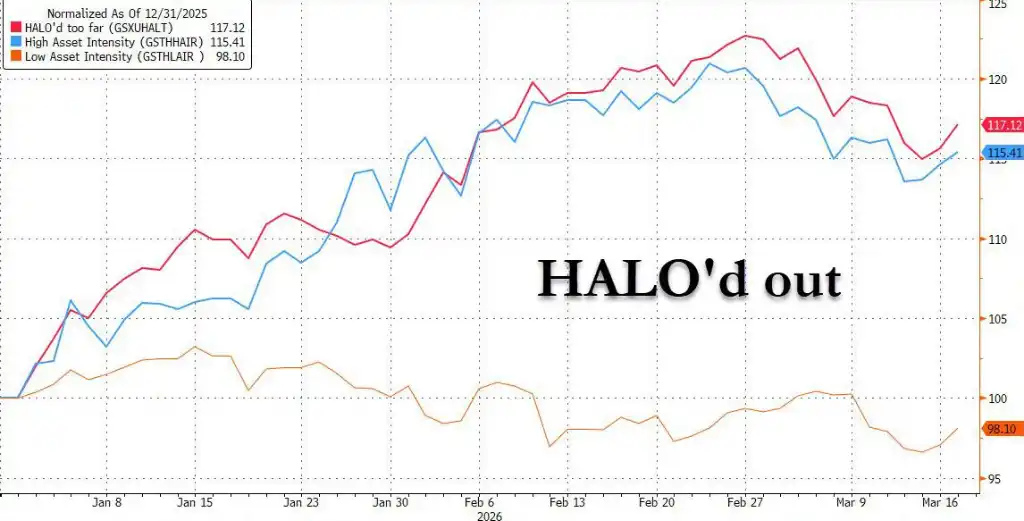
The immediate implication of this shift for the market is that the honeymoon period for the HALO trade may be over. Goldman data shows the GSXUHALT basket has begun to decline after peaking at the end of February, and the firm recommends investors pair this short position with their favored thematic long opportunities.
One Month Ago: Goldman Strongly Promoted HALO, Heavy-Asset Narrative Swept Wall Street

Going back to February 24th, Goldman Sachs Global Investment Research published a report titled "The HALO Effect: Heavy Assets, Low Obsolescence in the AI Era," joining major banks like JPMorgan in actively promoting the HALO concept—the combination of Heavy Assets and Low Obsolescence.

The logic at the time was clear and powerful: The rapid rise of AI is creating a dual impact on light-asset industries. On one hand, AI is disrupting profitability expectations in sectors like software and IT services, leading the market to reassess the terminal value of these industries; on the other hand, tech giants have embarked on an unprecedented capital expenditure cycle to maintain a competitive advantage in computing power—according to Goldman data, the top five U.S. tech giants are expected to have capital expenditures of approximately $1.5 trillion between 2023 and 2026, with spending in 2026 alone potentially exceeding $650 billion, surpassing their total pre-AI era spending.

Goldman's data at the time was equally impressive: Since 2025, its heavy-asset portfolio (GSSTCAPI) has cumulatively outperformed its light-asset portfolio (GSSTCAPL) by 35%. At the macro level, higher real interest rates, geopolitical fragmentation, and supply chain restructuring were seen as collective structural tailwinds for heavy-asset stocks.

About-Face: Indiscriminate Market Pursuit, Some Heavy-Asset Stock Gains Have Lost Fundamental Support

However, just one month later, Goldman's stance changed significantly.

Mourad pointed out in the latest report that the companies covered by the GSXUHALT basket are those that rose with the overall heavy-asset trend but themselves have no earnings growth expectations and returns that significantly lag behind high-quality HALO targets. In other words, the market, in chasing "AI-insulated" attributes, has indiscriminately poured funds into all heavy-asset stocks, no longer distinguishing between high and low quality.

Data confirms this judgment: The GSXUHALT basket's gains have actually surpassed those of the high-quality high asset intensity basket (GSTHHAIR), meaning low-return, no-growth heavy-asset stocks have instead beaten truly competitive peers. Meanwhile, the basket's stock price movement was still in sync with earnings expectations until late last year, after which a significant divergence appeared.

In screening for GSXUHALT components, Goldman selected companies from the highest asset-intensity industries in the Russell 1000 index, while剔除 all targets related to long-term trends like satellites, robotics, quantum computing, and AI, retaining only stocks with significant year-to-date gains but flat or downward revised earnings expectations. The basket's average asset intensity ratio is approximately 1.4.

Valuation Signal: Heavy-Asset Premium at Historically Medium-High Levels

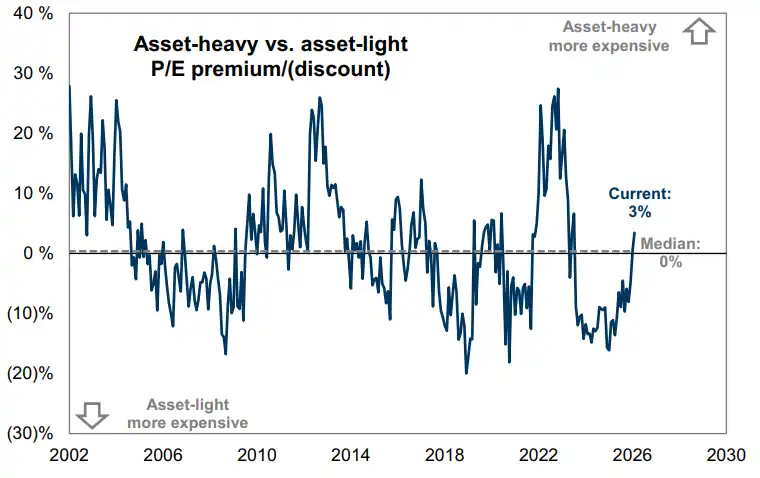
Goldman's research last month already indicated that heavy-asset stocks are currently trading at a valuation premium relative to light-asset stocks. As of last month, the P/E premium for heavy-asset stocks was about 3%, sitting at the 62nd percentile over the past few decades. While still below historical peaks seen in 2004, 2012, and 2022, they are no longer cheap.
Since last November, Goldman's sector-neutral heavy-asset basket (GSTHHAIR) has cumulatively outperformed the light-asset basket (GSTHLAIR) by about 20%. In Goldman's view, the root of this strong performance by heavy assets lies in investors' strong demand for "AI-insulated" assets—namely, the search for physical asset-class stocks that are less susceptible to AI disruption and have underperformed for years.

Goldman recommends pairing the GSXUHALT short position with the firm's favored thematic long opportunities. The report notes that recent market adjustments have created the largest "buy the dip" opportunity in global equities since "Liberation Day," allowing investors to establish long exposure in directions supported by long-term trends while shorting heavy-asset stocks lacking fundamental support.

Behind this strategic shift is Goldman's clear judgment on the internal differentiation within the HALO trade: Not all heavy-asset stocks are worth holding. The time has come to distinguish between targets with true competitive moats and upward earnings momentum and those merely riding the coattails of the "heavy asset" label.


Пов'язані питання

QWhat is the HALO concept that Goldman Sachs initially promoted, and why did they recommend it?

AThe HALO concept, promoted by Goldman Sachs in late February, stands for 'Heavy Assets, Low Obsolescence.' It referred to companies with significant physical assets that are less likely to be disrupted by AI. Goldman recommended it because the rise of AI was seen as a threat to 'light asset' industries like software and IT services, while simultaneously driving an unprecedented capital expenditure cycle from major tech giants to maintain a competitive advantage in computing power.

QWhy did Goldman Sachs perform a strategic U-turn' and create the GSXUHALT basket?

AGoldman Sachs performed a strategic 'U-turn' and created the GSXUHALT basket because the market's pursuit of 'AI-insulated' assets had become indiscriminate. They observed that many heavy-asset stocks with zero or negative earnings growth expectations and low returns had seen their stock prices rise significantly alongside the broader HALO theme, becoming disconnected from their fundamentals.

QWhat specific criteria did Goldman Sachs use to select stocks for its GSXUHALT short basket?

AGoldman Sachs selected stocks for the GSXUHALT basket from the Russell 1000 index by focusing on companies in the highest asset-intensity sectors. They then剔除 (excluded) all companies related to long-term trends like satellites, robotics, quantum computing, and AI. Finally, they only kept stocks that had significant year-to-date price gains but had flat or downward revised earnings expectations. The basket's average asset intensity ratio is about 1.4.

QAccording to Goldman's data, what is the current valuation premium for heavy-asset stocks, and what does it indicate?

AAccording to Goldman Sachs's data from the previous month, heavy-asset stocks were trading at a price-to-earnings (P/E) premium of approximately 3% compared to light-asset stocks. This premium was at the 62nd percentile of its historical range over recent decades, indicating that while it is not at its historical peak, these stocks are no longer cheap and are valued at a medium-to-high level historically.

QWhat trading strategy does Goldman Sachs recommend alongside the GSXUHALT short position?

AGoldman Sachs recommends pairing the GSXUHALT short position with thematic long opportunities that they favor. They suggest that investors can short the heavy-asset stocks lacking fundamental support while simultaneously establishing long exposure in directions supported by long-term trends, taking advantage of what they see as the largest 'buy the dip' opportunity in global equities since 'Liberation Day'.

Пов'язані матеріали

From South Korea to the United States: Blue-Collar Jobs Are Becoming Increasingly Popular, Thanks to AI

AI is reshaping the labor market's value proposition. The traditional four-year college degree is losing its appeal as a guaranteed career path, while skilled blue-collar trades like electricians, welders, and plumbers are experiencing historic demand and wage premiums. This shift is driven by dual pressures: AI's displacement of certain white-collar roles and a booming need for physical infrastructure and data center construction. Data confirms the trend. In the U.S., vocational school revenue surged, and a significant portion of recent layoffs are AI-related. Surveys show a majority of Gen Z adults plan to pursue blue-collar work, citing better job security against AI automation. Vocational education interest has exploded recently. Experts cite a psychological shift as younger generations seek tangible, AI-resistant careers and avoid high student debt. In many cases, salaries for skilled trades now match or exceed those requiring a bachelor's degree. In South Korea, semiconductor vocational high schools boast near-total employment, with graduates securing high-paying roles at companies like Samsung. The shortage is structural, exacerbated by a retiring baby boomer workforce and massive infrastructure projects. Companies like JPMorgan Chase, Meta, and Lowe's are investing heavily in training programs. However, overcoming historical stigma and a "perception gap" around trade careers remains a key challenge to closing the talent gap.

marsbit24 хв тому

From South Korea to the United States: Blue-Collar Jobs Are Becoming Increasingly Popular, Thanks to AI

marsbit24 хв тому

Qualcomm: AI Hype Subsides, When Will Smartphones Emerge from the Gloom?

Qualcomm reported its Q3 FY2026 results (ending June 2026), with revenue of $9.95B, down 4% YoY but above expectations. Gross margin declined to 53.1%, pressured by rising costs across manufacturing and memory. Key business segments showed mixed performance: Handset revenue fell 19.6% YoY to $5.09B, dragged by an 11% decline in non-Apple Android shipments and weaker high-end mix. Conversely, Automotive revenue surged 61% to $1.59B, and IoT grew 9% to $1.83B. Core operating profit dropped 41% YoY due to margin compression and higher expenses. Management's Q4 FY2026 guidance projects revenue of $9.7B-$10.5B, in line with consensus, but Non-GAAP EPS guidance of $2.05-$2.25 fell short of expectations. Amidst persistent weakness in its core handset market, Qualcomm is pursuing growth in AI, focusing on Edge AI (smartphones, PCs, automotive) and Data Center AI. Its data center strategy includes four pillars: AI accelerators (e.g., AI200), commercial CPUs (Dragonfly C1000), custom silicon, and connectivity solutions. While these initiatives initially boosted its stock, concerns over AI capital expenditure sustainability have since erased those gains. The company targets $5B in data center revenue for FY2027 and $15B for FY2029. The report concludes that with the traditional handset business still under pressure, the data center opportunity is currently viewed as a longer-term option, and a more conservative valuation based on core operations may be warranted until AI contributions materialize.

marsbit28 хв тому

Qualcomm: AI Hype Subsides, When Will Smartphones Emerge from the Gloom?

marsbit28 хв тому

From TPU to Self-Evolving Agents: How Jeff Dean Predicts the Next Step in AI

At the 2026 YC Startup School, Jeff Dean outlined his vision for AI's next phase, shifting focus from simply scaling models to building intelligent, autonomous systems. He believes AI's progress is no longer just about creating smarter models, but about integrating them into systems capable of long-term, iterative work, automated experimentation, and continuous learning. This evolution moves the competition from "who has the bigger model" to "who can best organize intelligence." Dean suggests AI capabilities are now comparable to a junior engineer, enabling the automation of complex workflows. However, the true challenge and opportunity lie in managing these AI "workers" at scale. He emphasizes the importance of **context engineering**—structuring tools, memory, and feedback loops—over raw model power. For startups, this means building deep expertise in niche domains where general models currently fail (near 0-1% success rates), leveraging proprietary data, specialized tools, and domain-specific evaluators. A recurring theme is re-examining fundamental constraints. Dean's past work, like moving Google's search index to memory or creating the TPU, stemmed from questioning outdated assumptions about hardware and cost. He sees similar inflection points today, particularly in **specialized inference hardware** to drastically reduce latency and energy consumption for real-time Agent operation. Notably, he points out that in modern AI systems, the dominant cost is often not computation but **data movement**. Reliable, long-running Agents require robust system design, borrowing concepts from distributed computing like checkpointing, state management, and parallel exploration to handle failures and maintain progress over days or weeks. As AI automates execution, the scarcest human skills will shift to **defining clear specifications**, **judging what problems are worth solving** (taste), and designing effective feedback loops. Ultimately, Dean's framework prioritizes understanding the problem deeply, identifying the true bottlenecks, and systematically building closed-loop systems where AI can not only perform tasks but also improve AI itself.

marsbit28 хв тому

From TPU to Self-Evolving Agents: How Jeff Dean Predicts the Next Step in AI

marsbit28 хв тому

Торгівля

Спот
活动图片