Original Author: Grayscale research team
Compiled by: Peggy, BlockBeats
Editor's Note: After years of high volatility and narrative-driven cycles, crypto assets are entering a distinctly different phase. Rising uncertainty in the fiat system, the gradual formation of regulatory frameworks, and the advancement of spot ETPs, stablecoin legislation, and institutional allocation are reshaping how capital enters the crypto market.
The core thesis of Grayscale's "2026 Digital Asset Outlook" is that the dominant force in the crypto market is shifting from retail cycles to institutional capital. Prices are no longer primarily dependent on emotional, explosive rallies but are increasingly driven by compliant channels, long-term capital, and sustainable fundamentals. The narrative of the "four-year cycle" is weakening.
This article systematically outlines ten potential investment themes that could shape the market in 2026, from value storage and stablecoins to asset tokenization, DeFi, AI, and privacy infrastructure, sketching a picture of a crypto ecosystem gradually integrating into the mainstream financial system. The report also clearly identifies which hot topics are more like "noise" rather than decisive variables in the short term.
The following is the original text:
Key Takeaways
We anticipate that 2026 will accelerate a structural shift in digital asset investment, primarily driven by two overarching themes: increased macro demand for alternative stores of value and significantly improved regulatory clarity. Combined, these are expected to introduce new sources of capital, broaden digital asset adoption (particularly among wealth management advisors and institutional investors), and drive a more comprehensive integration of public blockchains into mainstream financial infrastructure.
Based on these trends, we judge that digital asset valuations will generally trend higher in 2026, while the so-called "four-year cycle" (the theory that crypto market movements follow a fixed four-year rhythm) will come to an end. In our view, Bitcoin's price is highly likely to reach a new all-time high in the first half of the year.
Grayscale expects that bipartisan-supported structural legislation for crypto markets will formally become U.S. law in 2026. This will further deepen the convergence between public blockchains and traditional finance, promote the compliant trading of digital asset securities, and potentially allow startups and established companies to conduct on-chain offerings.
The outlook for the fiat system is becoming increasingly uncertain; in contrast, we can be almost certain that the 20 millionth Bitcoin will be mined in March 2026. Against the backdrop of rising fiat risks, digital currency systems like Bitcoin and Ethereum, which feature transparent, programmable, and ultimately scarce supply characteristics, are expected to see stronger demand.
We expect that more crypto assets will become available to investors through Exchange-Traded Products (ETPs) in 2026. These products have had a strong start, but many platforms are still conducting due diligence and integrating crypto assets into their asset allocation processes. As this process matures, slower-moving but substantial institutional capital is expected to continue entering the market throughout 2026.
We have also compiled ten key crypto investment themes for 2026, reflecting the emerging wide range of applications for public blockchain technology. Each theme corresponds to relevant crypto assets:
1. Dollar devaluation risks drive demand for monetary alternatives
2. Improved regulatory clarity supports digital asset adoption
3. Stablecoin influence continues post-GENIUS Act passage
4. Asset tokenization reaches a critical inflection point
5. Blockchain goes mainstream, increasing demand for privacy solutions
6. AI centralization calls for blockchain-based solutions
7. DeFi accelerates, led by lending
8. Mainstream adoption forces next-gen infrastructure upgrades
9. Increased focus on sustainable revenue models
10. Investors will "default" to seeking staking yields
Finally, we also point out two topics that are not expected to substantially impact crypto markets in 2026:
Quantum Computing: We believe research and preparation for post-quantum cryptography will continue, but it is unlikely to impact market valuations within the next year.
Digital Asset Treasuries (DATs): Despite significant media attention, we judge they will not be a key variable determining digital asset market trends in 2026.
2026 Digital Asset Outlook: The Dawn of the Institutional Era
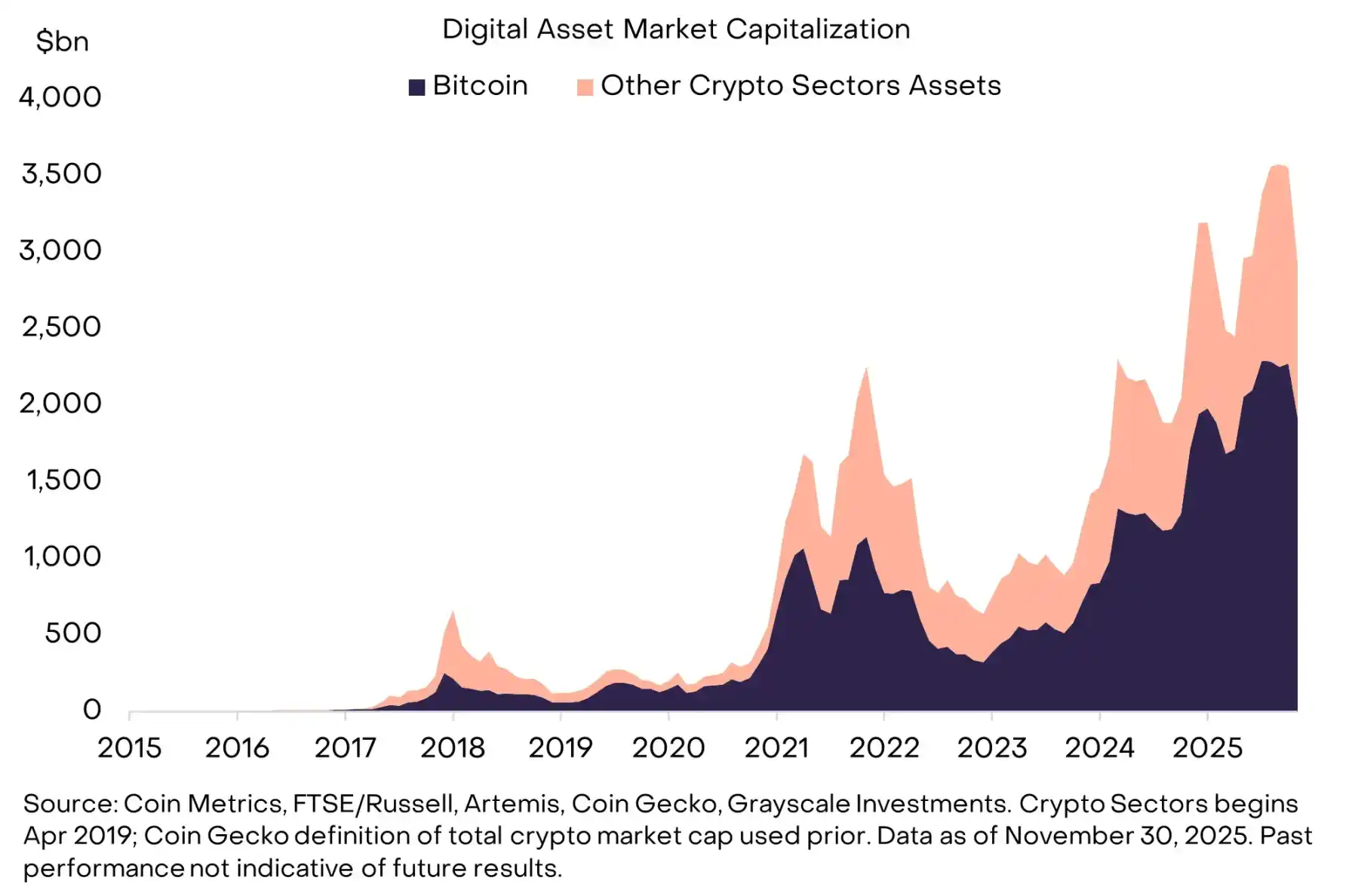
Fifteen years ago, cryptocurrency was still an experimental endeavor: there was only one asset, Bitcoin, with a market cap of approximately $1 million. Today, cryptocurrency has developed into a nascent industry and grown into a medium-sized alternative asset class, consisting of millions of tokens with a total market cap of around $3 trillion (see Chart 1).
As major economies gradually establish more complete regulatory architectures, the integration of public blockchains with the traditional financial system is deepening, continuously attracting long-term oriented capital into this market.
Chart 1: Crypto assets have grown into a medium-sized alternative asset class
Throughout the development of crypto assets, token valuations have experienced four major cyclical drawdowns, roughly following a four-year rhythm (see Chart 2). In three of these cases, the cyclical peaks occurred approximately 1 to 1.5 years after Bitcoin halving events; Bitcoin halvings themselves also occur on a four-year cycle.
The current bull market has lasted over three years, with the most recent Bitcoin halving occurring in April 2024, more than 1.5 years ago. Therefore, some market participants, based on historical patterns, judge that Bitcoin's price may have peaked in October, and 2026 could be a challenging year for crypto asset returns.
Chart 2: Rising valuations in 2026 would mark the end of the "four-year cycle" theory
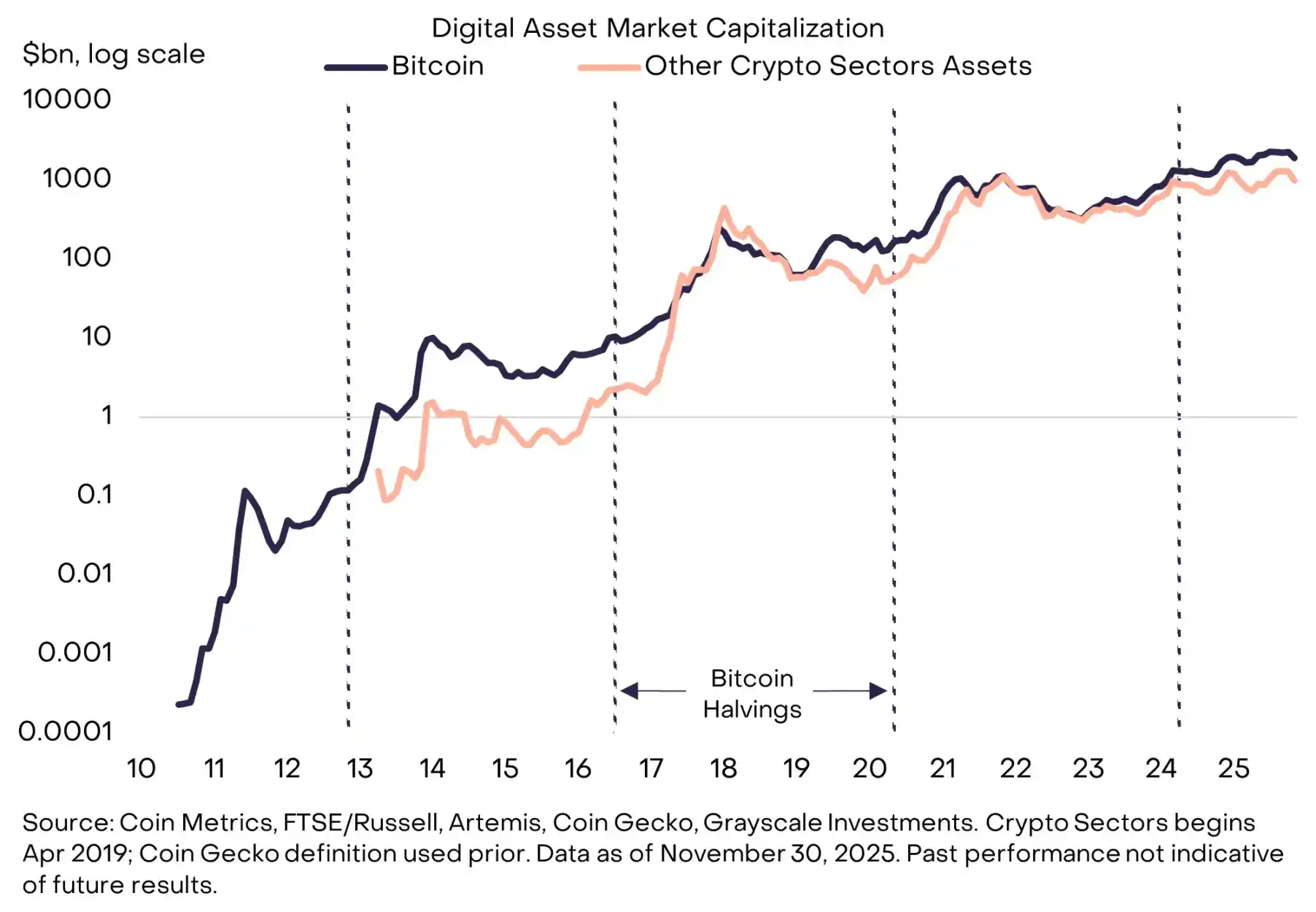
Grayscale believes the crypto asset class is in a sustained bull market, and 2026 will be a key year marking the end of the so-called "four-year cycle." We expect valuations across six major crypto asset sectors to rise overall in 2026 and judge that Bitcoin's price is likely to break its previous all-time high in the first half of the year.
Our optimism is primarily based on two core pillars:
First, macro demand for alternative stores of value will persist.
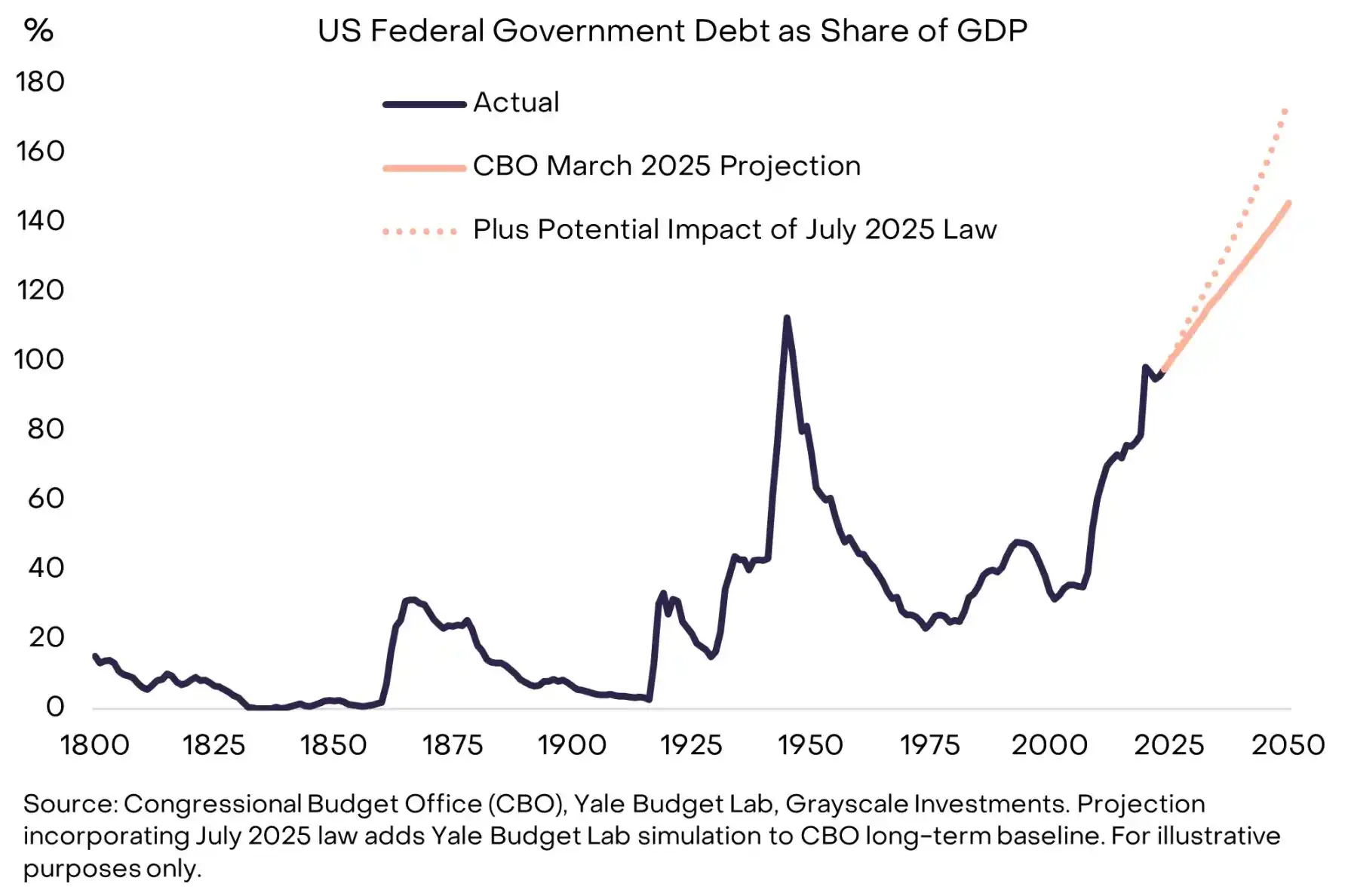
By market capitalization, Bitcoin and Ethereum are the two largest crypto assets today and can be viewed as scarce digital commodities and alternative monetary assets. Meanwhile, the fiat system (and assets denominated in fiat) face additional risks, as high and rising public sector debt could create inflationary pressures over the medium to long term (see Chart 3).
In this context, scarce commodities, whether physical like gold and silver or digital like Bitcoin and Ethereum, can act as "ballast" in portfolios hedging against fiat risk. In our view, as long as the risk of fiat devaluation continues to rise, portfolio demand for Bitcoin and Ethereum is likely to strengthen concurrently.
Chart 3: U.S. debt issues undermine the credibility of low inflation expectations
Second, regulatory clarity is driving institutional capital into the public blockchain space.
This is easily overlooked, but until this year, the U.S. government was still investigating and/or litigating against several leading crypto industry entities, including Coinbase, Ripple, Binance, Robinhood, Consensys, Uniswap, and OpenSea. Even today, exchanges and other crypto intermediaries still lack clear, unified regulatory guidance at the spot market level.
However, the situation is slowly but decidedly shifting.
In 2023, Grayscale won its lawsuit against the U.S. Securities and Exchange Commission (SEC), paving the way for crypto spot exchange-traded products (ETPs);
In 2024, Bitcoin and Ethereum spot ETPs officially entered the market;
In 2025, the U.S. Congress passed the GENIUS Act for stablecoins, and regulators began adjusting their stance towards the crypto industry, emphasizing consumer protection and financial stability while collaborating with the industry to provide clearer guidance;
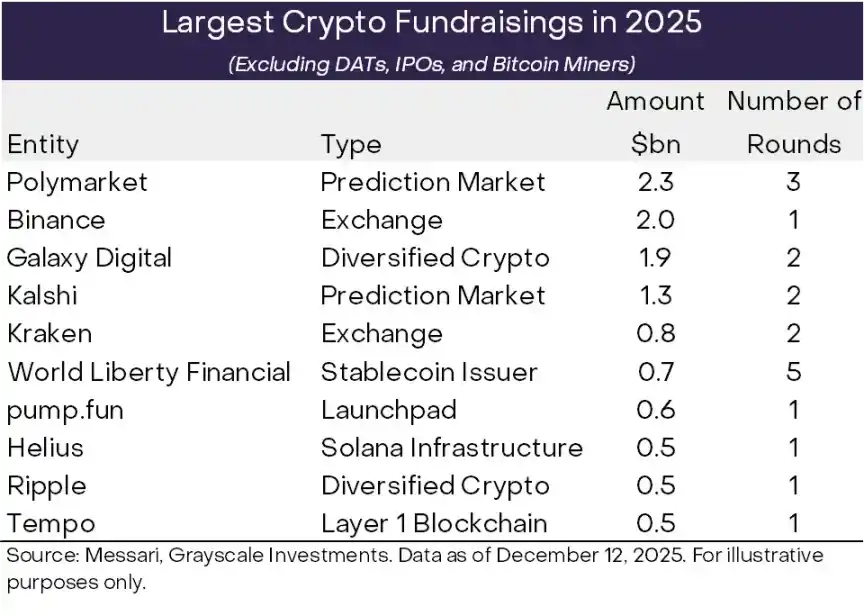
In 2026, Grayscale expects Congress to pass bipartisan crypto market structure legislation, which could institutionally solidify the role of blockchain finance in U.S. capital markets and further drive sustained inflows of institutional investment (see Chart 4).
Chart 4: Rising financing scale may reflect growing institutional confidence
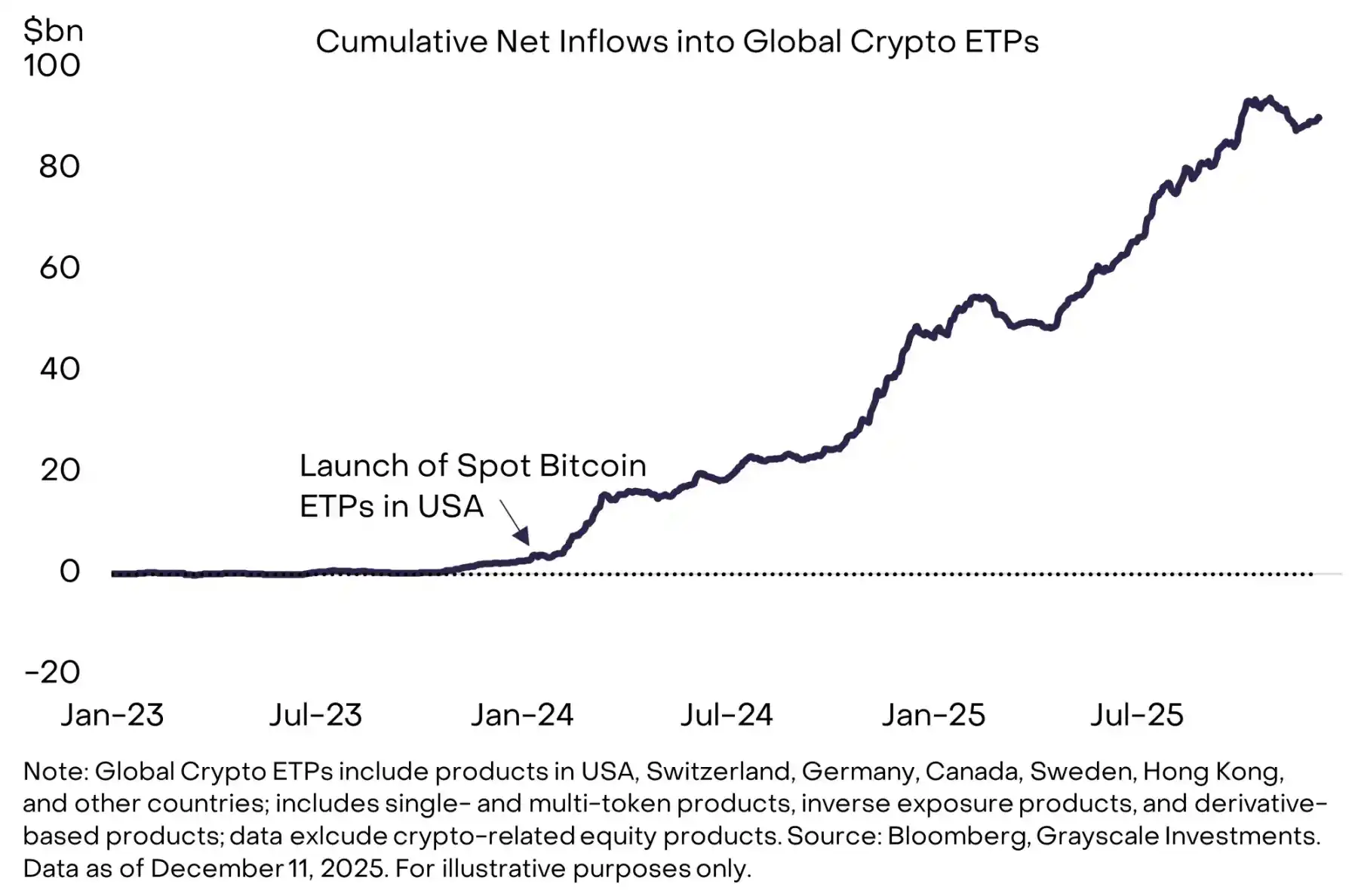
In our view, new capital entering the crypto ecosystem will primarily flow in through spot ETPs. Since Bitcoin spot ETPs launched in the U.S. in January 2024, global crypto ETPs have recorded approximately $87 billion in net inflows (see Chart 5).
Although these products achieved significant success upon launch, the process of integrating crypto assets into mainstream investment portfolios is still in its early stages. Grayscale estimates that less than 0.5% of U.S. trustee/advisor-managed wealth is currently allocated to crypto assets. As more investment platforms complete due diligence, establish corresponding capital market assumptions, and include crypto assets in model portfolios, this percentage is expected to rise steadily.
Beyond wealth management channels, some pioneering institutions have already allocated crypto ETPs in their institutional portfolios, including Harvard Management Company and Mubadala (one of Abu Dhabi's sovereign wealth funds). We expect this list of institutions to expand significantly by 2026.
Chart 5: Crypto spot ETPs continue to attract net inflows
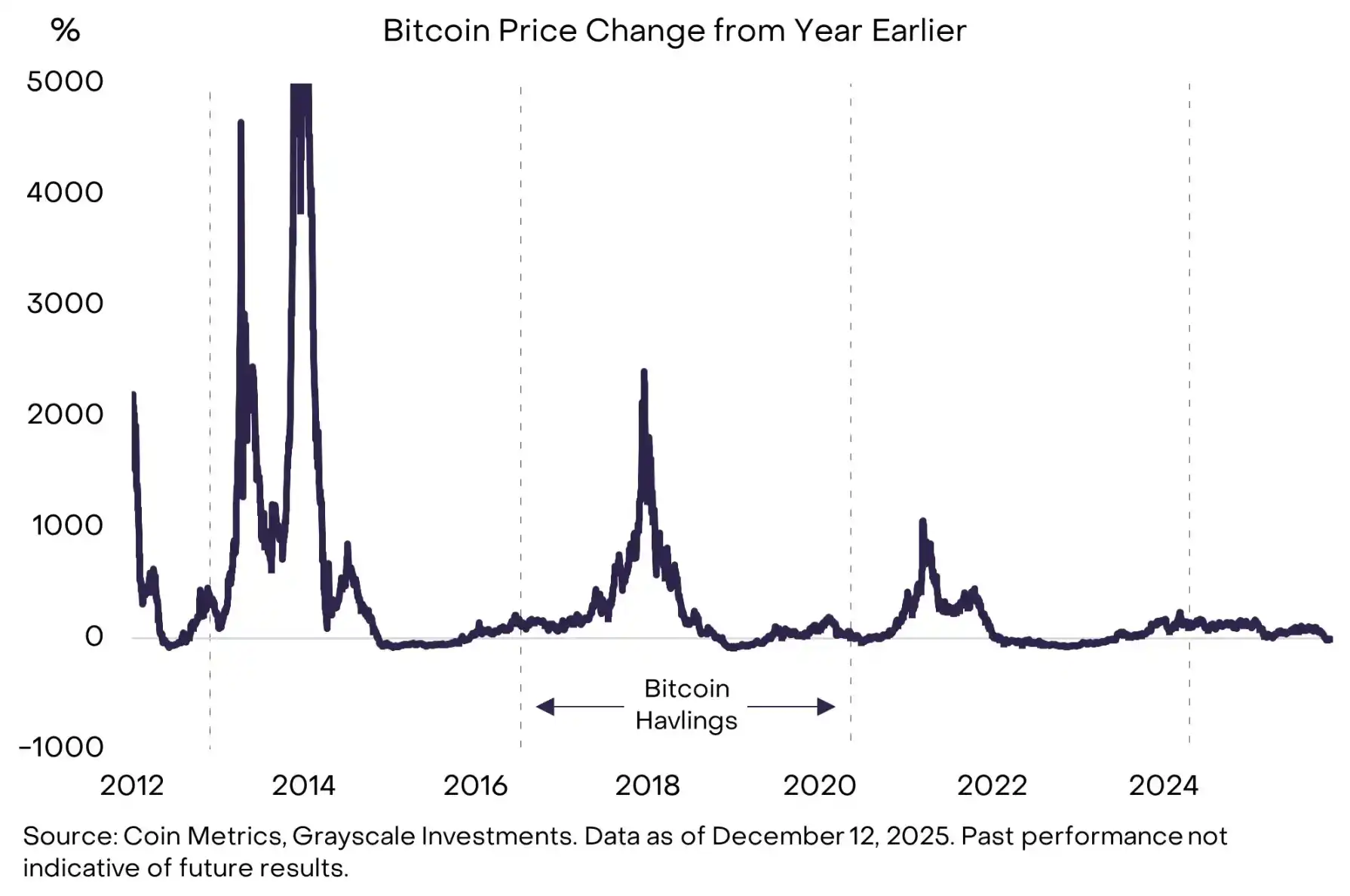
As crypto markets are increasingly driven by institutional capital inflows, the characteristics of price performance have also changed. In each previous bull market, Bitcoin's price rose by at least 1000% within a year (see Chart 6). In the current cycle, the peak year-over-year increase was approximately 240% (as of the period ending March 2024).
We believe this difference reflects more robust, sustained institutional buying behavior recently, rather than the retail sentiment-driven FOMO patterns of past cycles. Although crypto asset investment still carries significant risks, at the time of writing this report, we judge the probability of a deep and prolonged cyclical drawdown is relatively low. In contrast, the possibility of more平稳, gradual price appreciation, driven by sustained institutional inflows, is greater and likely to dominate the trend next year.
Chart 6: Bitcoin's price has not experienced a sharp spike this cycle
A relatively friendly macro market environment may also provide some buffer against downside risks for token prices in 2026.
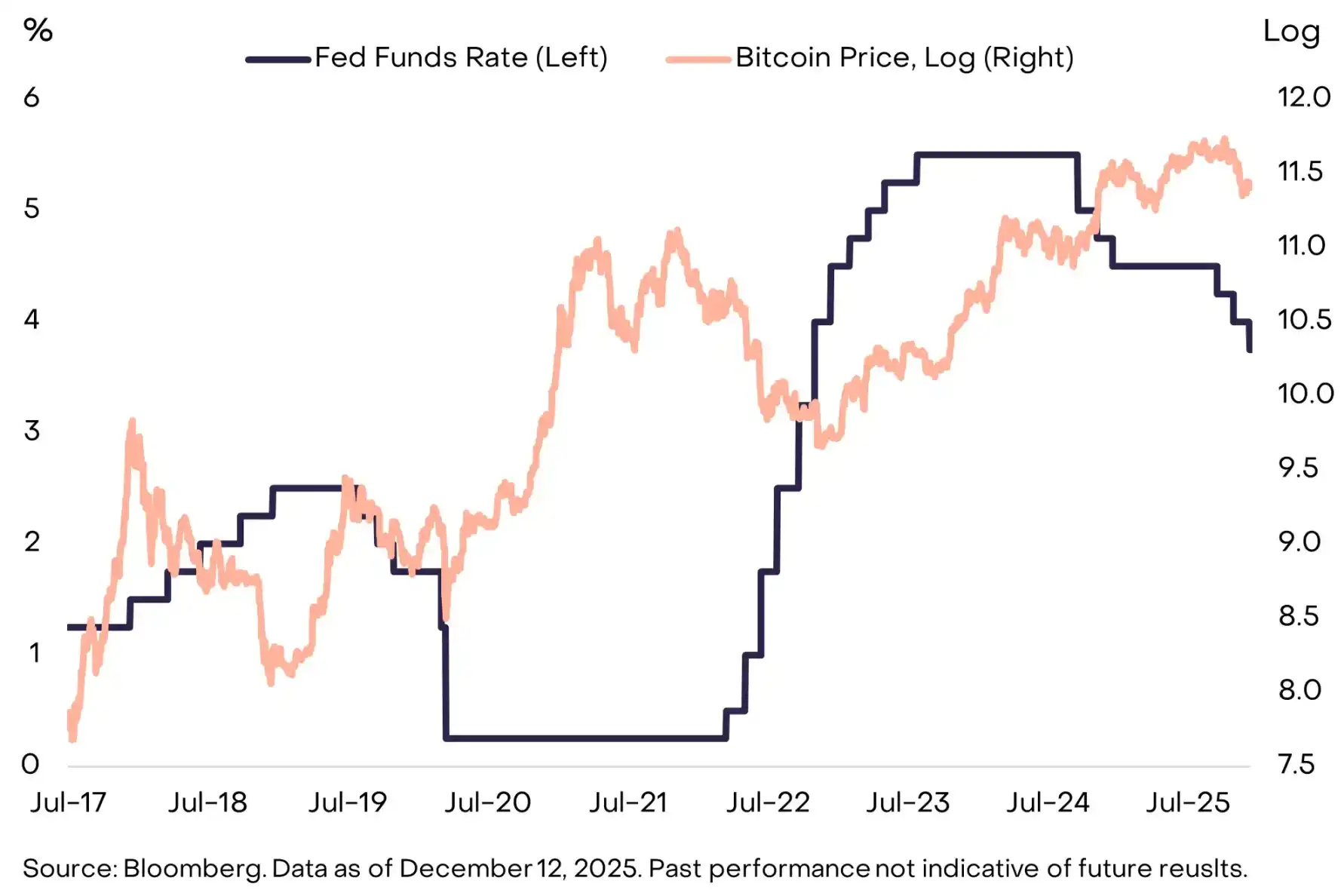
Historically, the previous two cyclical peaks occurred during Federal Reserve rate hiking phases (see Chart 7). In contrast, the Fed has cut rates three times in 2025 and is expected to continue lowering rates next year.
Kevin Hassett, seen as a potential successor to Jerome Powell as Fed Chair, recently stated on "Face the Nation": "The American people can expect that President Trump will choose someone who will help them get cheaper car loans and get a mortgage more easily at lower rates."
Overall, economic growth combined with a accommodative Fed policy environment typically favors increased risk appetite among investors and creates potential upside for risk assets, including crypto assets.
Chart 7: Previous cyclical peaks often coincided with Fed rate hikes
Like other asset classes, crypto asset prices are driven by both fundamentals and capital flows. Commodity markets are cyclical, and crypto assets may also experience prolonged cyclical drawdowns at some future stages. However, we do not believe 2026 presents such conditions.
From a fundamental perspective, the supporting factors remain solid: sustained macro demand for alternative stores of value and institutional capital entry facilitated by improved regulatory clarity are laying a long-term foundation for public blockchain technology. Meanwhile, new capital continues to enter the market. By the end of next year, crypto ETPs are likely to be present in more investment portfolios. This cycle has not seen a single, concentrated wave of retail capital; instead, it has been characterized by sustained, stable allocation demand for crypto ETPs from various portfolios. In an overall friendly macro environment, we believe this is the key condition for the crypto asset class to reach new highs in 2026.
Top 10 Crypto Investment Themes for 2026
Crypto assets are a highly diversified asset class, reflecting the multitude of applications covered by public blockchain technology. The following section outlines Grayscale's assessment of the ten most important crypto investment themes for 2026, plus two additional "red herrings." For each theme, we list the tokens we view as most relevant. For a classification of investable digital asset types, refer to our Crypto Sectors framework.
Theme 1: Dollar Devaluation Risks Drive Demand for Monetary Alternatives
Relevant Crypto Assets: BTC, ETH, ZEC
The U.S. economy faces structural debt issues (refer back to Chart 3), which could pressure the U.S. dollar's status as a store of value over the medium to long term. Other countries face similar challenges, but as the dollar remains the world's most important international currency today, the credibility of U.S. policy is particularly critical for potential cross-border capital flows.
In our view, only a small subset of digital assets are viable as stores of value, requiring sufficient adoption, highly decentralized network structures, and constrained supply growth. The most typical representatives are the two largest crypto assets by market cap—Bitcoin and Ethereum. Similar to physical gold, their value stems partly from their scarcity and autonomy.
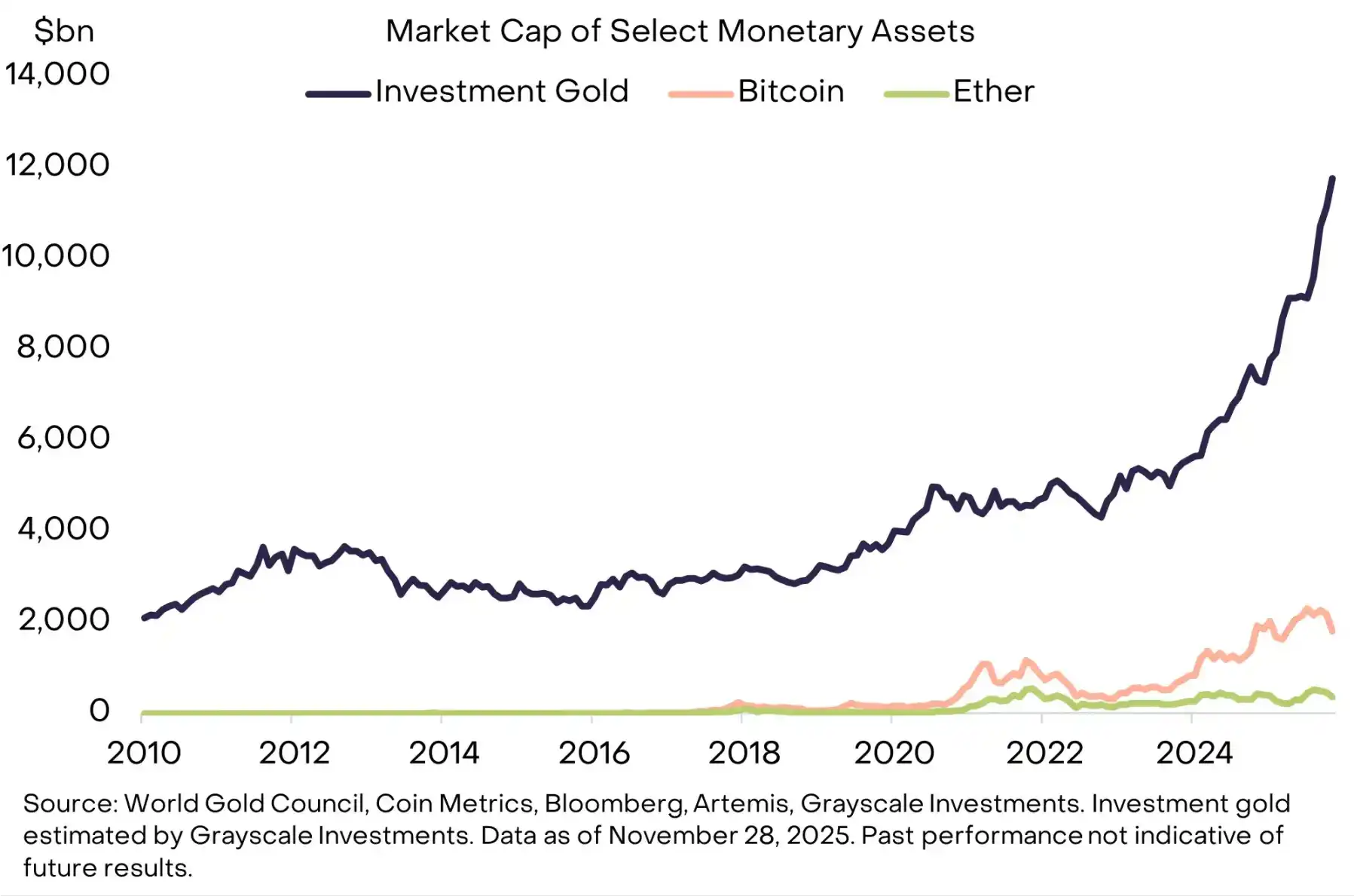
Bitcoin's total supply is permanently capped at 21 million coins, determined entirely by programmatic rules. For example, we can be highly certain that the 20 millionth Bitcoin will be mined in March 2026. This transparent, predictable, and ultimately scarce digital currency system is conceptually simple, but its appeal is growing in the current environment where the fiat system faces tail risks. As long as the macro imbalances causing fiat risks continue to worsen, portfolio demand for alternative store-of-value assets is likely to keep increasing (see Chart 8).
Additionally, Zcash, a smaller, privacy-focused decentralized digital currency, may also be suitable for portfolio allocations hedging dollar devaluation risk (see Theme 5 for details).
Chart 8: Macro imbalances may drive increased demand for alternative stores of value
Theme 2: Improved Regulatory Clarity Supports Broader Digital Asset Adoption
Relevant Crypto Assets: Nearly All
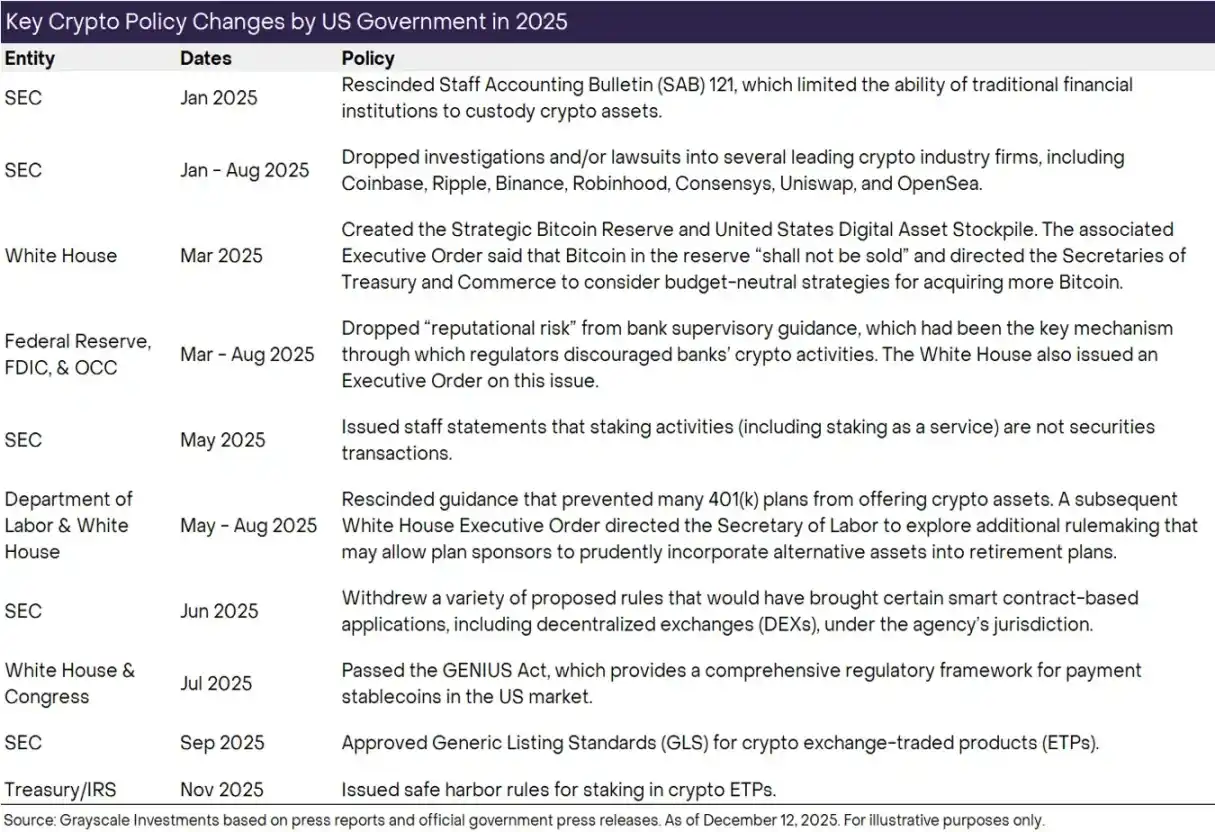
The U.S. took key steps towards crypto regulatory clarity in 2025, including: passing the GENIUS Act for stablecoins, repealing the SEC's Staff Accounting Bulletin No. 121 (SAB 121, related to custody accounting), introducing universal listing standards for crypto ETPs, and addressing crypto industry access to the traditional banking system (see Chart 9).
Looking ahead to 2026, we expect an even more decisive step—the passage of bipartisan crypto market structure legislation. The U.S. House of Representatives passed its version of the bill, the Clarity Act, in July, and the Senate subsequently initiated its own legislative process. Although specific provisions require further negotiation, the overall framework suggests this legislation will provide a rule set for crypto capital markets analogous to traditional finance, covering registration and disclosure requirements, classification standards for crypto assets, and rules governing insider conduct.
Practically, a more complete regulatory framework taking shape in the U.S. and other major economies means regulated financial services institutions may formally incorporate digital assets onto their balance sheets and begin transacting on blockchains. This could also facilitate on-chain capital formation—both startups and established companies might issue compliant on-chain tokens. By further unlocking the potential of blockchain technology, regulatory clarity could lift the value anchor of the crypto asset class overall.
Given the potential importance of regulatory clarity for driving crypto asset development in 2026, we believe significant partisan disagreement or breakdown in the relevant legislative process should be viewed as a material downside risk.
Chart 9: The U.S. significantly advanced crypto regulatory clarity in 2025
Theme 3: Stablecoin Influence Expands Post-GENIUS Act Passage
Relevant Crypto Assets: ETH, TRX, BNB, SOL, XPL, LINK
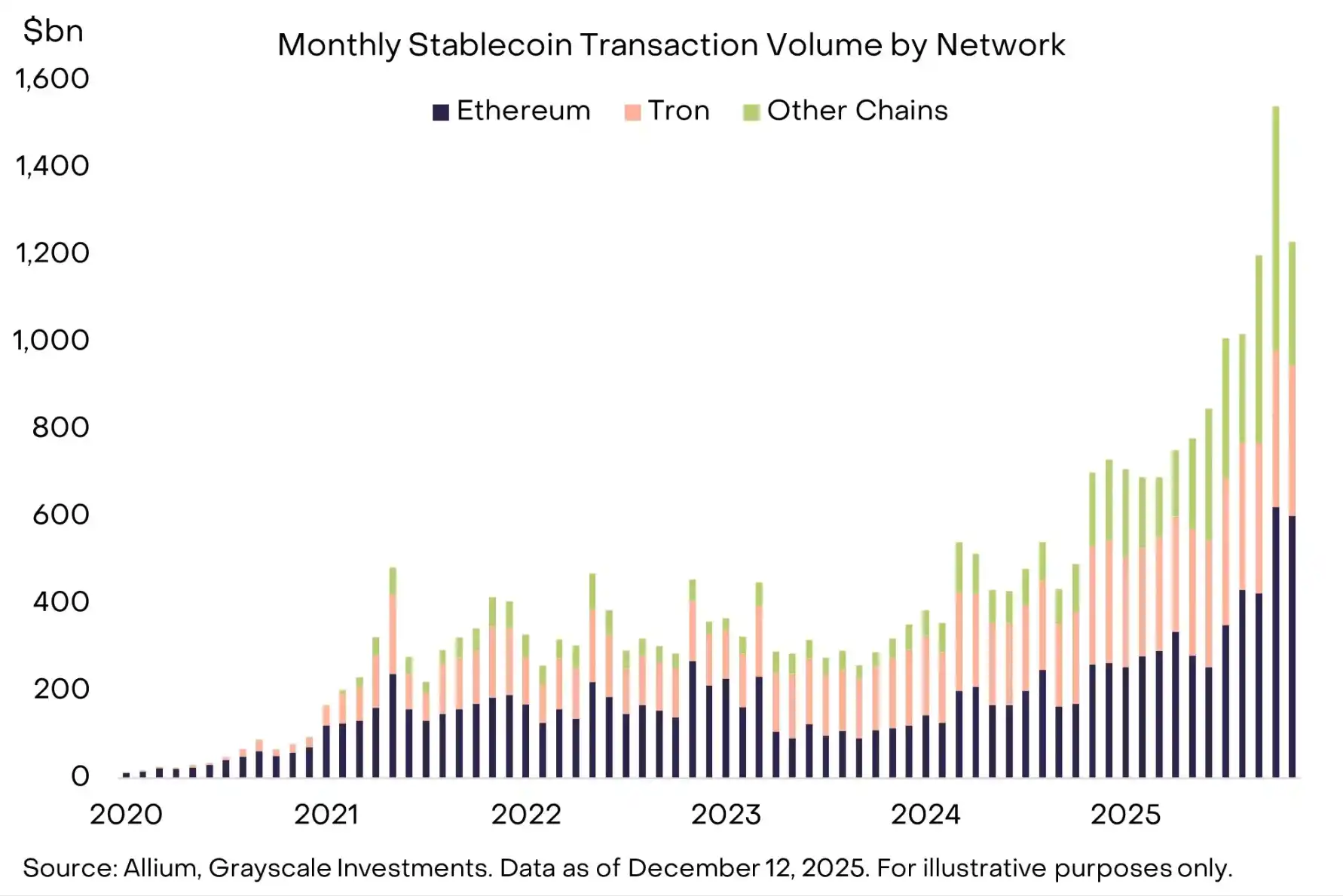
Stablecoins had a true "breakout moment" in 2025: their outstanding supply grew to approximately $300 billion, with average monthly trading volume around $1.1 trillion over the past six months through November; meanwhile, the U.S. Congress passed the GENIUS Act, and substantial institutional capital began accelerating into this space (see Chart 10).
Looking to 2026, we expect these changes to translate into practical applications: stablecoins will be more widely embedded in cross-border payment services; used as collateral on derivative exchanges; appear on corporate balance sheets; and serve as an alternative to credit cards in online consumer payments. Concurrently, the continued heating up of prediction markets may further generate new demand for stablecoins.
Sustained growth in stablecoin trading volume will directly benefit the blockchain networks that host these transactions (e.g., ETH, TRX, BNB, SOL, etc.), while also driving the development of supporting infrastructure (like LINK) and decentralized finance (DeFi) applications (see Theme 7 for details).
Chart 10: Stablecoins reach a critical breakout period
Theme 4: Asset Tokenization Reaches a Critical Inflection Point
Relevant Crypto Assets: LINK, ETH, SOL, AVAX, BNB, CC
From a current scale perspective, tokenized assets remain negligible: they account for only about 0.01% of the total global stock and bond market capitalization (see Chart 11). Grayscale expects asset tokenization to experience accelerated growth in the coming years as blockchain technology matures and regulatory clarity improves.
In our view, it is not unimaginable for the scale of tokenized assets to grow approximately 1000-fold by 2030. This expansion process is likely to create significant value for blockchain networks processing tokenized asset transactions and various supporting applications.
Currently, leading public chains in the tokenized asset space include Ethereum (ETH), BNB Chain (BNB), and Solana (SOL), but this landscape could still change in the future. Among supporting applications, Chainlink (LINK) is seen as having a particularly strong competitive advantage due to its unique and comprehensive software technology stack.
Chart 11: Tokenized assets have enormous room for growth

Theme 5: Blockchain Goes Mainstream, Increasing Demand for Privacy Solutions
Relevant Crypto Assets: ZEC, AZTEC, RAIL
Privacy is a fundamental component of the financial system. Most people assume their salary, tax information, asset size, and spending habits should not be publicly displayed on a public ledger. However, most blockchains are designed by default to be highly transparent. If public blockchains are to integrate more deeply into the financial system, they must be accompanied by more mature and robust privacy infrastructure—and this is becoming increasingly evident as regulation drives the convergence of blockchain and traditional finance.
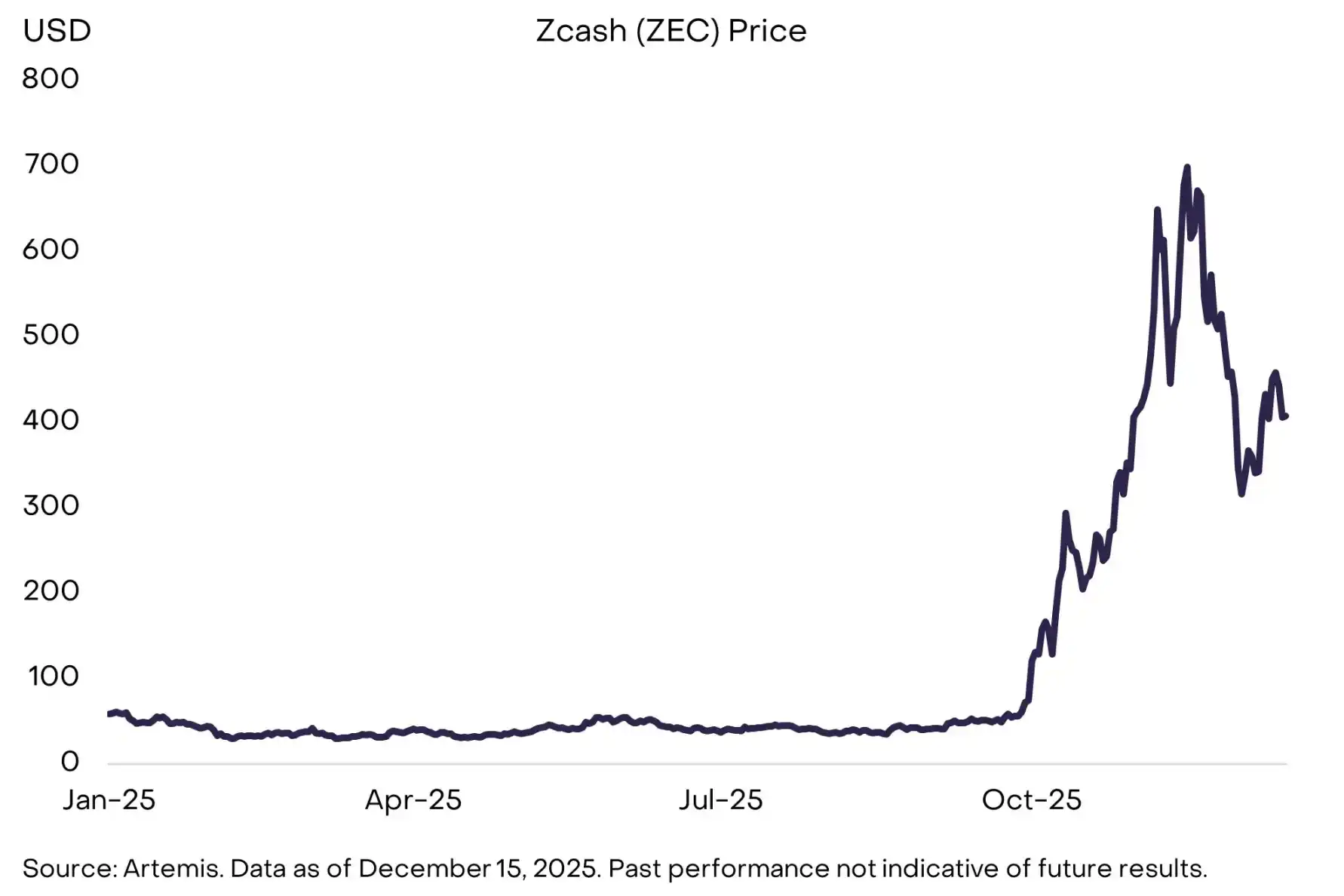
Amid rising investor focus on privacy issues, one potential beneficiary is Zcash (ZEC): a decentralized digital currency structurally similar to Bitcoin but with built-in privacy features. Zcash saw significant gains in Q4 2025 (see Chart 12). Other important projects include Aztec (a privacy-focused Ethereum Layer 2) and Railgun (privacy middleware for DeFi).
Additionally, we may see mainstream smart contract platforms more widely adopt "confidential transaction" mechanisms, such as Ethereum's ERC-7984 standard and Solana's Confidential Transfers token extension. Meanwhile, the improvement of privacy tools may also force simultaneous upgrades in identity verification and compliance infrastructure within the DeFi space.
Chart 12: Crypto investors' attention to privacy features is increasing
Theme 6: AI Centralization Calls for Blockchain-Based Solutions
Relevant Crypto Assets: TAO, IP, NEAR, WORLD
The underlying fit between crypto technology and artificial intelligence has never been clearer or stronger. Currently, AI systems are increasingly centralizing around a few leading companies, raising concerns about trust, bias, and ownership; crypto technology offers a set of primitives that directly address these risks.
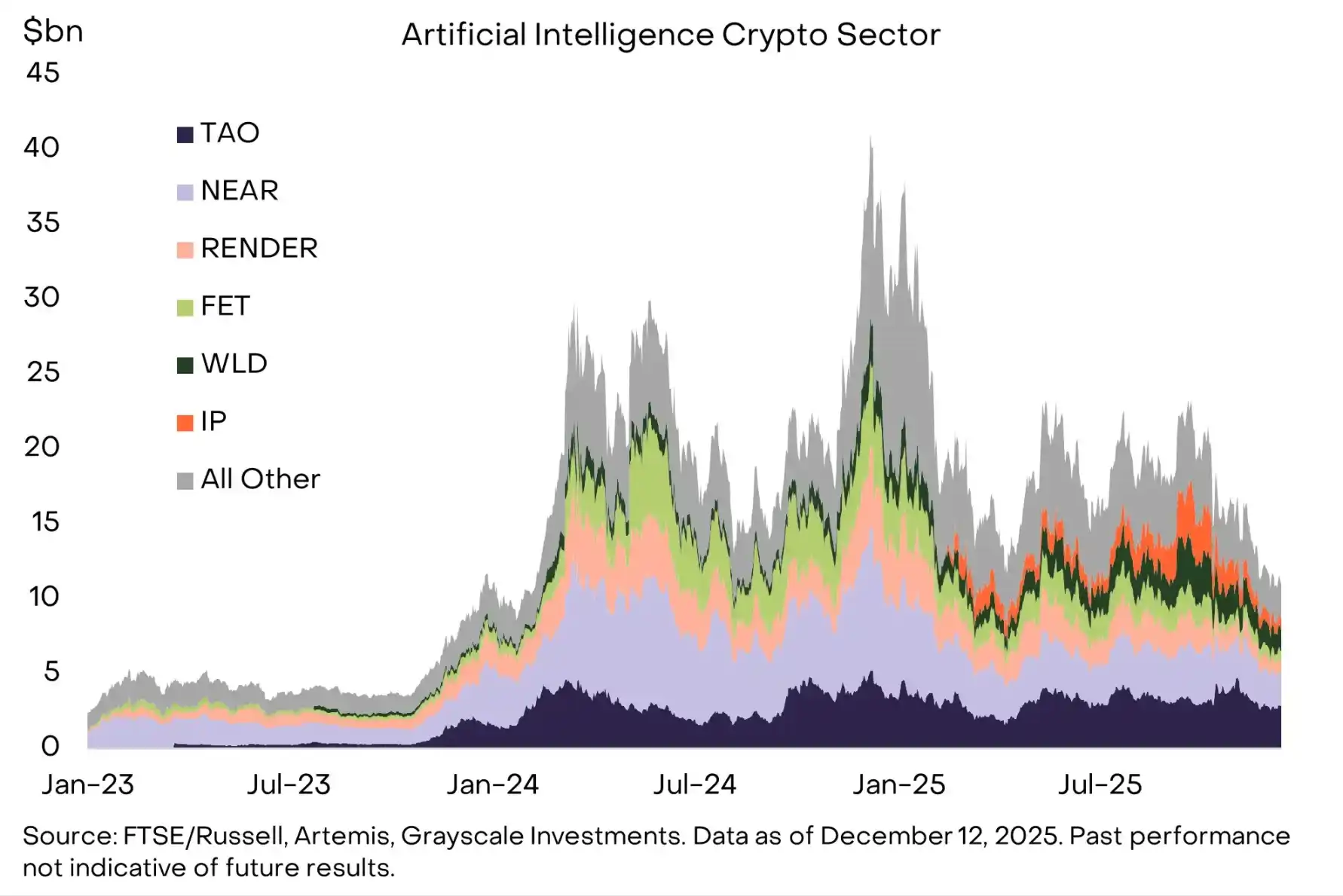
For example, decentralized AI development platforms like Bittensor aim to reduce reliance on centralized AI technology; World's verifiable "Proof of Personhood" attempts to distinguish real humans from AI agents in an environment flooded with synthetic activity; and networks like Story Protocol provide transparent, traceable on-chain expression for intellectual property in an era where the origin of digital content is becoming harder to identify. Meanwhile, tools like X402, a zero-fee stablecoin payment open layer running on Base and Solana, provide the low-cost, instant micropayment capability needed for economic interaction between agents or between machines and humans.
These elements collectively form the early infrastructure of the so-called "agent economy": a system where identity, computing power, data, and payments must be verifiable, programmable, and censorship-resistant. Although this ecosystem is still early and unevenly developed, the intersection of crypto and AI remains one of the most imaginative long-term application directions in the entire industry. As AI becomes more decentralized, autonomous, and economically capable, protocols building real infrastructure are poised to be potential beneficiaries (see Chart 13).
Chart 13: Blockchain offers solutions to key risks posed by AI
Theme 7: DeFi Accelerates, Led by the Lending Track
Relevant Crypto Assets: AAVE, MORPHO, MAPLE, KMNO, UNI, AERO, RAY, JUP, HYPE, LINK
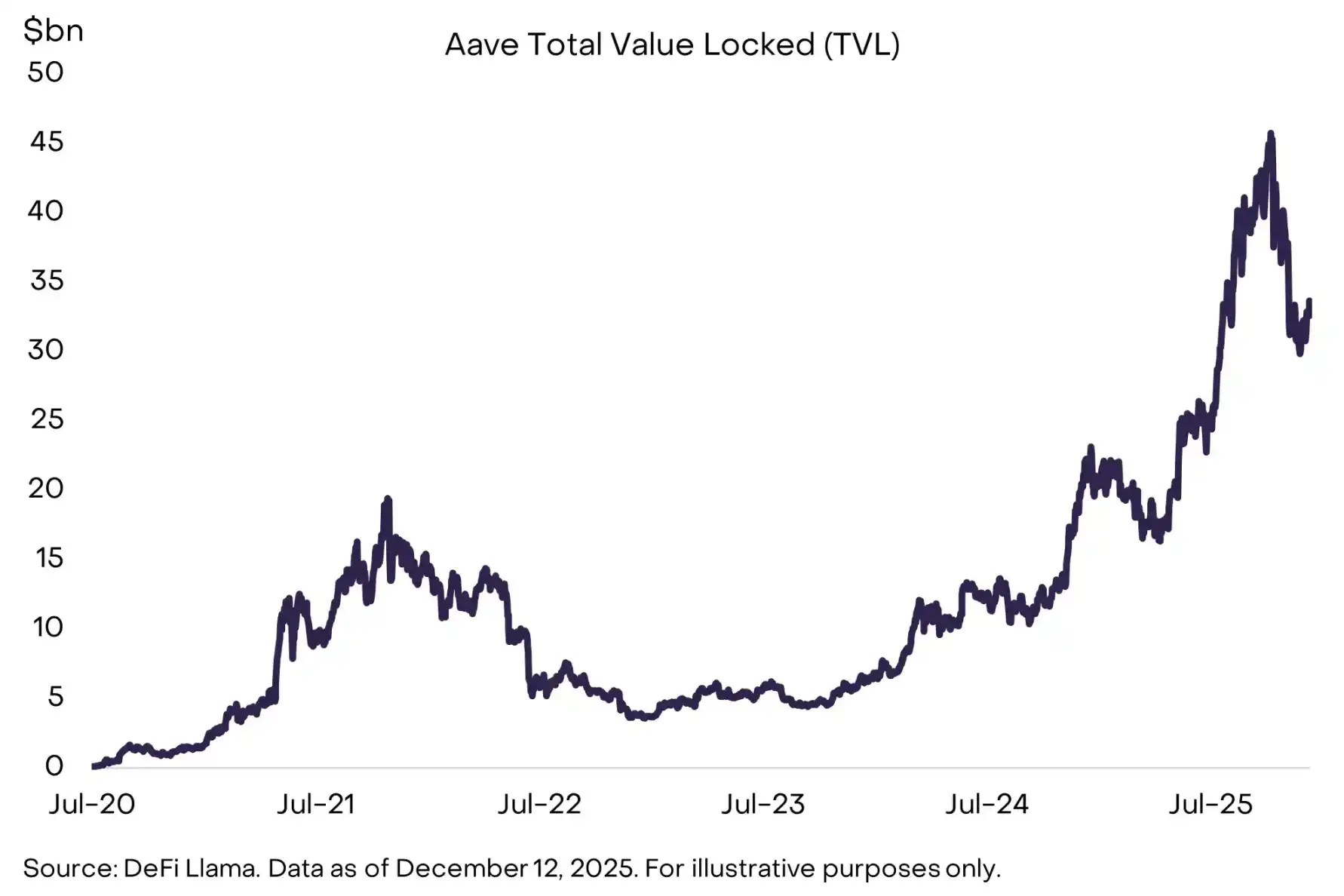
Driven by both improved technological maturity and a better regulatory environment, DeFi applications significantly accelerated in 2025. The growth of stablecoins and tokenized assets are the most prominent success stories, but meanwhile, the DeFi lending space also achieved substantial expansion, led by protocols like Aave, Morpho, and Maple Finance (see Chart 14).
Concurrently, decentralized perpetual futures exchanges (like Hyperliquid) have consistently approached, and even rivaled, some large centralized derivative exchanges in metrics like open interest and daily trading volume. Looking ahead, as liquidity improves, cross-protocol interoperability strengthens, and connections with real-world price systems become tighter, DeFi is gradually becoming a credible alternative for users wishing to conduct financial activities directly on-chain.
We expect more DeFi protocols to partner with traditional fintech companies to leverage their mature infrastructure and existing user bases. In this process, core DeFi protocols are likely to continue benefiting—including lending platforms (e.g., AAVE), decentralized exchanges (e.g., UNI, HYPE), and related infrastructure protocols (e.g., LINK); simultaneously, the public chain networks hosting most DeFi activity (e.g., ETH, SOL, BASE) will also benefit.
Chart 14: DeFi scale and forms continue to expand, ecosystem increasingly diverse
Theme 8: Mainstream Adoption Forces Next-Generation Infrastructure Upgrades
Relevant Crypto Assets: SUI, MON, NEAR, MEGA
New generations of blockchains are constantly pushing the technological boundaries forward. However, some investors believe that more block space is not needed currently because demand on existing public chains has not been fully absorbed. Solana was once a classic case of this: an extremely fast but underutilized public chain, it was seen as "excess block space" until subsequent application waves arrived, transforming it into one of the industry's most successful examples.
Not all current high-performance public chains will replicate Solana's path, but we believe a few projects among them have the potential to break through. Superior technology does not necessarily lead to adoption, but the architecture of these next-generation networks gives them unique advantages in emerging application scenarios, such as: AI micropayments, real-time gaming loops, high-frequency on-chain trading, and intent-based systems.
In this tier, we expect Sui to be particularly prominent, benefiting from clear technical leadership and a highly integrated development strategy (see Chart 15). Other projects worth watching include Monad (parallelized EVM architecture), MegaETH (ultra-fast Ethereum Layer 2), and Near (a blockchain focused on AI and making progress on its Intents product).
Chart 15: Next-gen blockchains like Sui enable faster, lower-cost transactions

Theme 9: Increased Focus on Sustainable Revenue Capability
Relevant Crypto Assets: SOL, ETH, BNB, HYPE, PUMP, TRX
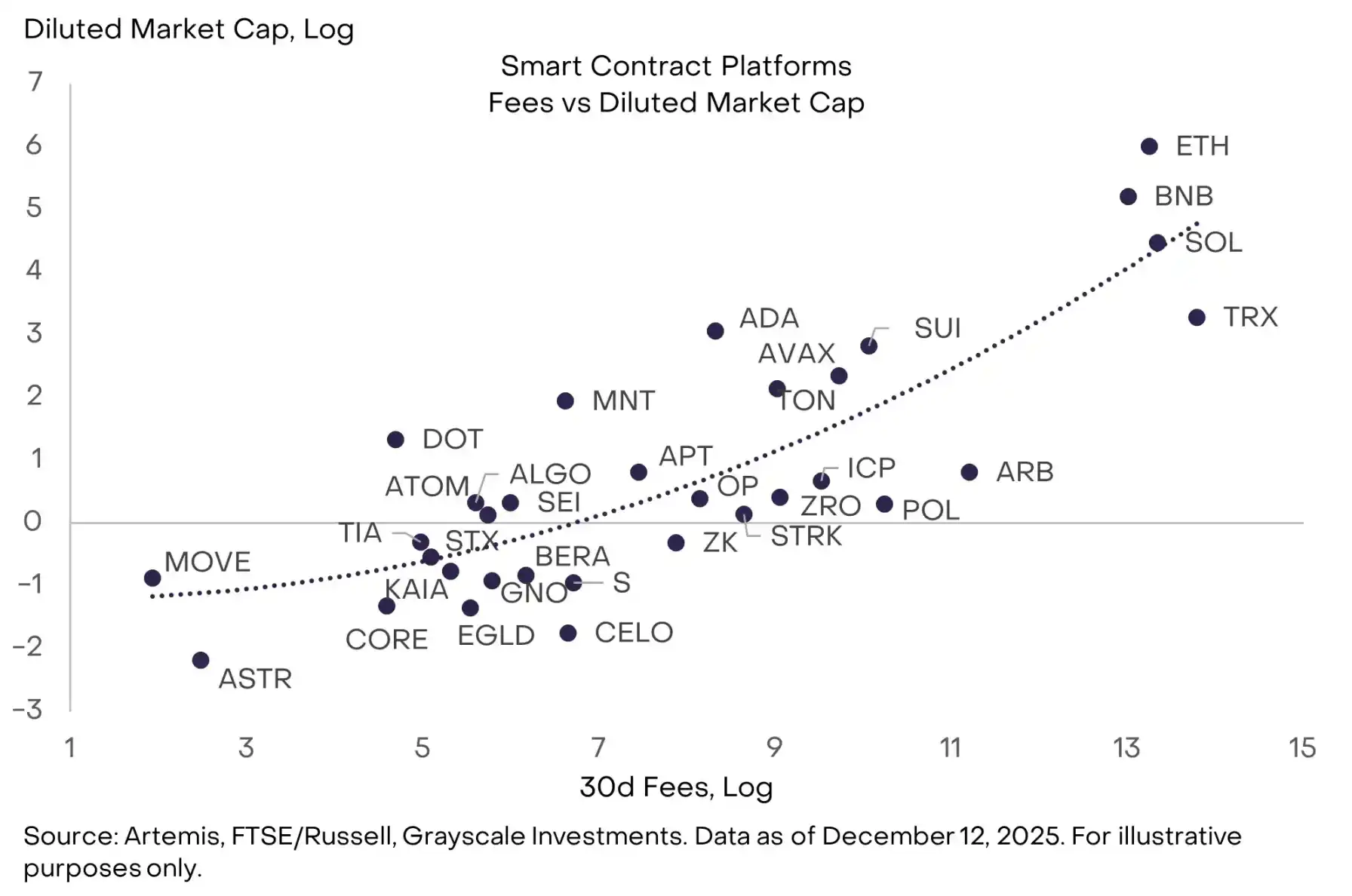
Blockchains are not traditional companies, but they do have quantifiable fundamental metrics, including: user count, number of transactions, fees, total value locked (TVL), developer size, and application ecosystem. Among these metrics, Grayscale believes transaction fees are the most valuable single fundamental metric, as they are the most difficult to manipulate artificially and offer higher comparability across different blockchains (while also showing the best empirical fit).
From a traditional corporate finance perspective, transaction fees can be analogized to "revenue." For blockchain applications, a further distinction is needed between protocol-layer fees/revenue and "supply-side" fees/revenue. As institutional investors begin systematically allocating to crypto assets, we expect they will pay more attention to blockchains and applications with high or clearly growing fee revenue levels (Bitcoin excepted).
Currently, among smart contract platforms, those with relatively high fee revenue include TRX, SOL, ETH, and BNB (see Chart 16); among application-layer assets, those with high revenue performance include HYPE, PUMP, and others.
Chart 16: Institutional investors may scrutinize blockchain fundamentals more strictly
Theme 10: Investors Will "Default" to Staking
Relevant Crypto Assets: LDO, JTO
U.S. policymakers made two key adjustments regarding staking mechanism in 2025, paving the way for more token holders to participate in staking activities:
The U.S. Securities and Exchange Commission (SEC) clearly stated that liquid staking activities do not constitute securities transactions;
The Internal Revenue Service (IRS) and Treasury Department confirmed that investment trusts and exchange-traded products (ETPs) can stake digital assets.
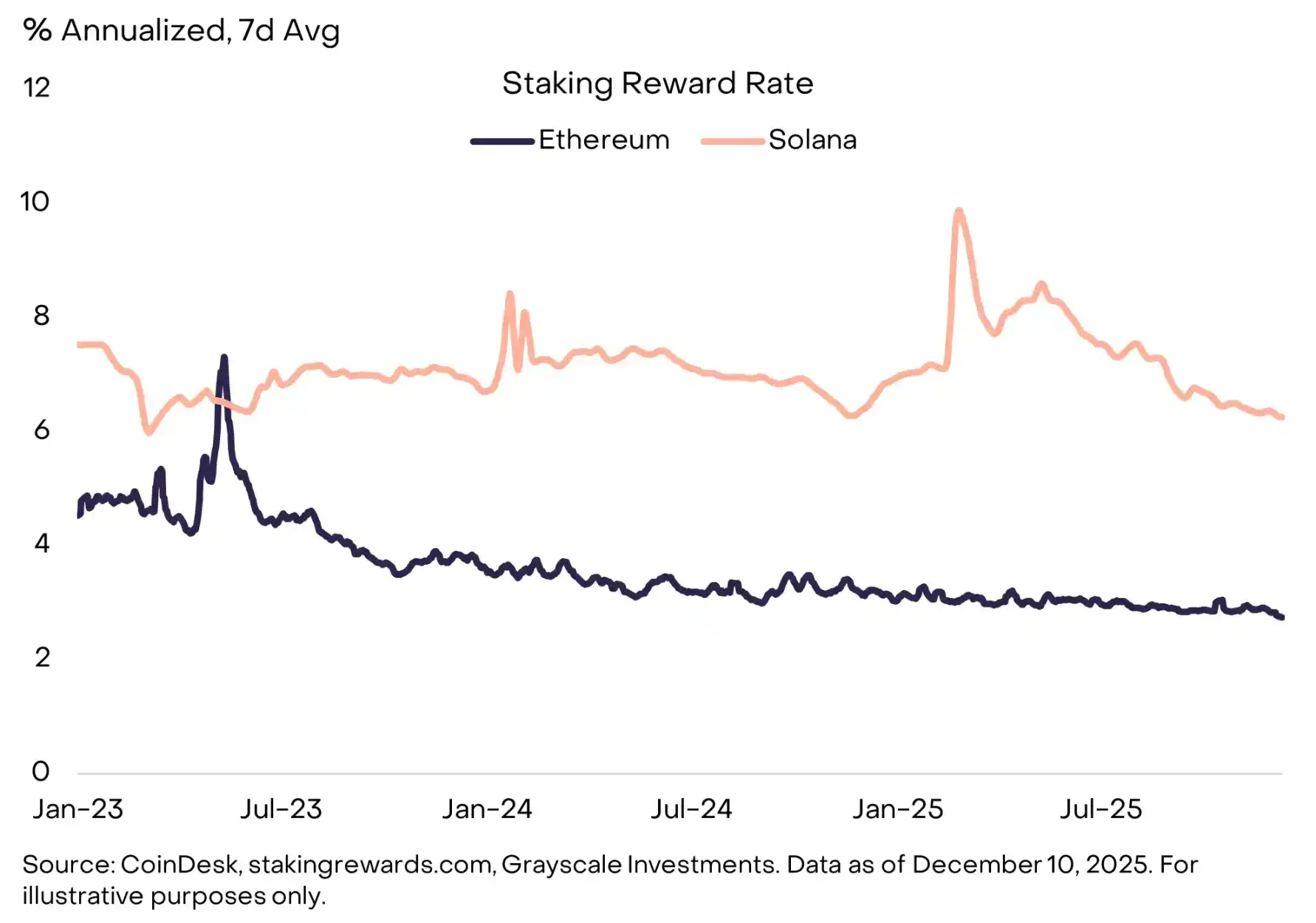
Regulatory guidance around liquid staking services is expected to directly benefit Lido and Jito—the leading liquid staking protocols by TVL (Total Value Locked) in the Ethereum and Solana ecosystems, respectively. From a broader perspective, the ability of crypto ETPs to participate in staking will likely make "staking as the default holding method" the standard structure for Proof-of-Stake (PoS) token investments, thereby pushing up the overall staking ratio and exerting some downward pressure on staking yields (see Chart 17).
In an environment where staking is more widely adopted, custodial staking through ETPs will provide investors with a convenient way to obtain staking yields; while on-chain, non-custodial liquid staking has unique advantages in terms of composability within the DeFi ecosystem. We expect this dual-track structure to persist for quite some time.
Chart 17: Proof-of-Stake (PoS) tokens inherently have a staking yield mechanism
2026's "Red Herrings"
We expect all the investment themes above to have a practical impact on crypto market development in 2026. But there are also two topics, despite high discussion volume, that we do not believe will substantially influence crypto market trends next year: the potential threat of quantum computing to cryptography, and the evolution of Digital Asset Treasuries (DATs). Significant ink will be spilled围绕 these two issues, but in our view, they are not core variables determining the market outlook.
On Quantum Computing
If quantum computing technology continues to advance, most blockchains will eventually need to upgrade their cryptographic systems. Theoretically, a sufficiently powerful quantum computer could reverse-engineer a private key from a public key, thereby generating a valid digital signature and transferring user funds. Therefore, Bitcoin and the vast majority of blockchains,乃至 the entire modern economy reliant on cryptography, will need to transition to post-quantum cryptographic tools in the long term. However, experts generally believe that quantum computers capable of breaking Bitcoin's cryptography are unlikely to appear before 2030 at the earliest. We expect research into quantum risk and community-level preparation work will accelerate in 2026, but this theme is unlikely to have a material impact on prices in the short term.
On Digital Asset Treasuries (DATs)
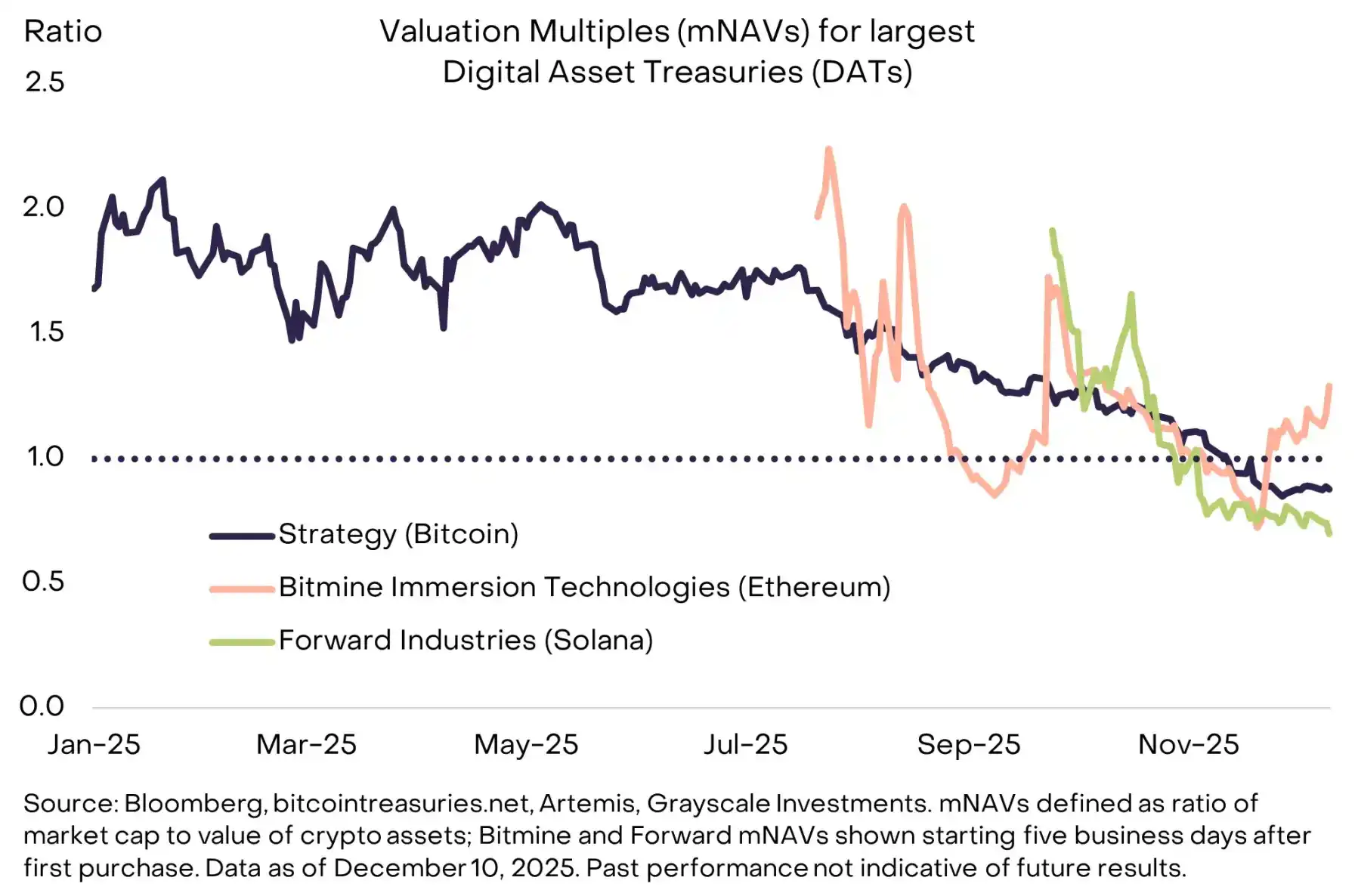
The strategy of "incorporating digital assets into corporate balance sheets," pioneered by Michael Saylor, spawned dozens of imitators in 2025. By our estimates, DATs currently hold 3.7% of Bitcoin's total supply, 4.6% of Ethereum's, and 2.5% of Solana's. However, demand for such instruments has cooled since the peak in mid-2025: the largest DATs now see their mNAV (market price to Net Asset Value) fall back to near 1.0 levels (see Chart 18).
It is important to note that most DATs do not employ excessive leverage (or are completely unleveraged), so they are unlikely to be forced to sell assets in a market downturn. The largest DAT by market cap, Strategy, recently established a USD reserve fund to ensure it can continue paying preferred stock dividends even if Bitcoin's price falls. We expect most DATs will behave more like closed-end funds: trading within a range around their NAV, occasionally at a premium or discount, but rarely actively liquidating assets.
Overall, these instruments are likely to become a permanent part of the crypto investment landscape, but in our view, they are neither likely to be a major source of new token demand in 2026 nor a significant source of selling pressure.
Chart 18: DAT premiums have significantly收敛, but large-scale asset sales are unlikely
Conclusion
We hold a positive view on the prospects for digital assets in 2026, primarily supported by the resonance of two forces: sustained macro demand for alternative stores of value and continuously improving regulatory clarity. Next year's key themes will likely involve further deepening the connectivity between blockchain finance and traditional finance, alongside sustained institutional capital inflows. Tokens gaining institutional adoption often have clear use cases, sustainable revenue models, and access to compliant trading venues and application systems. Investors can also expect the range of crypto assets investable through ETPs to continue expanding, with staking mechanisms enabled by default where conditions allow.
Concurrently, the processes of regulatory clarification and institutionalization will also raise the bar for mainstream success. For example, crypto projects seeking entry into regulated exchanges may need to meet new registration and disclosure requirements. Institutional investors are also more likely to ignore crypto assets lacking clear use cases—even if those assets currently have relatively high market capitalizations. The GENIUS Act legally distinguishes regulated payment stablecoins (which enjoy corresponding rights and obligations under U.S. law) from other stablecoins (which do not have equivalent rights). Similarly, we expect the institutional era for crypto assets will further widen the gap between assets that can access compliant channels and institutional capital and those that cannot.
The crypto industry is entering a全新的 phase, and not every token will successfully transition from the old era to the new one.
Трендові криптовалюти











Пов'язані питання
QWhat are the two core pillars supporting Grayscale's optimistic outlook for the crypto market in 2026?
AThe two core pillars are: 1) Sustained macro demand for alternative stores of value due to fiat currency risks, and 2) Improved regulatory clarity driving institutional capital inflows.
QAccording to the report, which major event is expected to mark the end of the 'four-year cycle' theory in crypto?
AThe report states that a broad-based valuation increase across six crypto sectors in 2026, with Bitcoin potentially reaching a new all-time high in the first half of the year, will mark the end of the 'four-year cycle' theory.
QName three of the ten key investment themes for 2026 outlined in the Grayscale report.
AThree of the ten themes are: 1) Dollar devaluation risk driving demand for monetary alternatives, 2) Regulatory clarity supporting digital asset adoption, and 3) The continued expansion of stablecoin influence post-GENIUS Act.
QWhat two topics does the report identify as 'red herrings' that are unlikely to substantially impact the market in 2026?
AThe two 'red herrings' are: 1) Quantum computing's threat to cryptography, and 2) Digital Asset Treasuries (DATs).
QHow does the report characterize the nature of capital inflows in the current cycle compared to previous ones?
AThe report characterizes the current inflows as more steady and sustained institutional buying, driven by factors like ETPs and regulatory clarity, rather than the retail-driven, sentiment-fueled surges that defined previous cycles.
Пов'язані матеріали


Торгівля
Популярні статті
Що таке $S$
Розуміння SPERO: Комплексний огляд Вступ до SPERO Оскільки ландшафт інновацій продовжує еволюціонувати, виникнення технологій web3 та криптовалютних проектів відіграє ключову роль у формуванні цифрового майбутнього. Один з проектів, який привернув увагу в цій динамічній сфері, — це SPERO, позначений як SPERO,$$s$. Ця стаття має на меті зібрати та представити детальну інформацію про SPERO, щоб допомогти ентузіастам та інвесторам зрозуміти його основи, цілі та інновації в рамках web3 та крипто-сектору. Що таке SPERO,$$s$? SPERO,$$s$ — це унікальний проект у криптопросторі, який прагне використати принципи децентралізації та технології блокчейн для створення екосистеми, що сприяє залученню, корисності та фінансовій інклюзії. Проект розроблений для полегшення взаємодії між користувачами новими способами, надаючи їм інноваційні фінансові рішення та послуги. У своїй основі SPERO,$$s$ прагне надати можливості індивідам, забезпечуючи інструменти та платформи, які покращують користувацький досвід у криптовалютному просторі. Це включає в себе можливість більш гнучких методів транзакцій, сприяння ініціативам, що підтримуються спільнотою, та створення шляхів для фінансових можливостей через децентралізовані додатки (dApps). Основна концепція SPERO,$$s$ обертається навколо інклюзивності, прагнучи зменшити розриви в традиційній фінансовій системі, використовуючи переваги технології блокчейн. Хто є творцем SPERO,$$s$? Особистість творця SPERO,$$s$ залишається дещо невідомою, оскільки є обмежені публічно доступні ресурси, що надають детальну інформацію про його засновників. Ця відсутність прозорості може бути наслідком зобов'язання проекту до децентралізації — етики, яку багато проектів web3 поділяють, ставлячи колективні внески вище за індивідуальне визнання. Зосереджуючи обговорення навколо спільноти та її колективних цілей, SPERO,$$s$ втілює суть наділення без виділення конкретних осіб. Таким чином, розуміння етики та місії SPERO є більш важливим, ніж ідентифікація єдиного творця. Хто є інвесторами SPERO,$$s$? SPERO,$$s$ підтримується різноманітними інвесторами, починаючи від венчурних капіталістів до ангельських інвесторів, які прагнуть сприяти інноваціям у крипто-секторі. Зосередження цих інвесторів зазвичай узгоджується з місією SPERO — пріоритет надається проектам, які обіцяють технологічний прогрес у суспільстві, фінансову інклюзію та децентралізоване управління. Ці інвесторські фонди зазвичай зацікавлені в проектах, які не лише пропонують інноваційні продукти, але й позитивно впливають на спільноту блокчейн та її екосистеми. Підтримка з боку цих інвесторів підкріплює SPERO,$$s$ як значного конкурента в швидко змінюваній сфері крипто-проектів. Як працює SPERO,$$s$? SPERO,$$s$ використовує багатогранну структуру, яка відрізняє його від традиційних криптовалютних проектів. Ось деякі ключові особливості, які підкреслюють його унікальність та інноваційність: Децентралізоване управління: SPERO,$$s$ інтегрує моделі децентралізованого управління, надаючи користувачам можливість активно брати участь у процесах прийняття рішень щодо майбутнього проекту. Цей підхід сприяє відчуттю власності та відповідальності серед членів спільноти. Корисність токена: SPERO,$$s$ використовує свій власний криптовалютний токен, розроблений для виконання різних функцій в екосистемі. Ці токени дозволяють здійснювати транзакції, отримувати винагороди та полегшувати послуги, що пропонуються на платформі, підвищуючи загальну залученість та корисність. Шарова архітектура: Технічна архітектура SPERO,$$s$ підтримує модульність та масштабованість, що дозволяє безперешкодно інтегрувати додаткові функції та додатки в міру розвитку проекту. Ця адаптивність є надзвичайно важливою для збереження актуальності в постійно змінюваному крипто-ландшафті. Залучення спільноти: Проект підкреслює ініціативи, що підтримуються спільнотою, використовуючи механізми, які стимулюють співпрацю та зворотний зв'язок. Підтримуючи сильну спільноту, SPERO,$$s$ може краще задовольняти потреби користувачів та адаптуватися до ринкових тенденцій. Фокус на інклюзію: Пропонуючи низькі комісії за транзакції та зручні інтерфейси, SPERO,$$s$ прагне залучити різноманітну базу користувачів, включаючи осіб, які раніше не брали участі в крипто-просторі. Це зобов'язання до інклюзії узгоджується з його загальною місією наділення через доступність. Хронологія SPERO,$$s$ Розуміння історії проекту надає важливі уявлення про його розвиток та етапи. Нижче наведено пропоновану хронологію, що відображає значні події в еволюції SPERO,$$s$: Етап концептуалізації та ідеації: Початкові ідеї, що стали основою SPERO,$$s$, були сформовані, тісно пов'язані з принципами децентралізації та фокусом на спільноті в індустрії блокчейн. Запуск білого паперу проекту: Після концептуального етапу був випущений комплексний білий папір, що детально описує бачення, цілі та технологічну інфраструктуру SPERO,$$s$, щоб залучити інтерес та зворотний зв'язок від спільноти. Створення спільноти та ранні залучення: Активні зусилля були спрямовані на створення спільноти ранніх прихильників та потенційних інвесторів, що полегшило обговорення цілей проекту та отримання підтримки. Подія генерації токенів: SPERO,$$s$ провів подію генерації токенів (TGE) для розподілу своїх рідних токенів серед ранніх прихильників та встановлення початкової ліквідності в екосистемі. Запуск початкового dApp: Перший децентралізований додаток (dApp), пов'язаний з SPERO,$$s$, став доступним, дозволяючи користувачам взаємодіяти з основними функціями платформи. Постійний розвиток та партнерства: Безперервні оновлення та вдосконалення пропозицій проекту, включаючи стратегічні партнерства з іншими учасниками блокчейн-простору, сформували SPERO,$$s$ у конкурентоспроможного та еволюціонуючого гравця на крипто-ринку. Висновок SPERO,$$s$ є свідченням потенціалу web3 та криптовалют для революціонізації фінансових систем та наділення індивідів. Завдяки зобов'язанню до децентралізованого управління, залучення спільноти та інноваційно спроектованих функцій, він прокладає шлях до більш інклюзивного фінансового ландшафту. Як і з будь-якими інвестиціями в швидко змінюваному крипто-просторі, потенційним інвесторам та користувачам рекомендується ретельно досліджувати та обдумано взаємодіяти з поточними подіями в SPERO,$$s$. Проект демонструє інноваційний дух крипто-індустрії, запрошуючи до подальшого дослідження його численних можливостей. Хоча подорож SPERO,$$s$ ще триває, його основні принципи можуть справді вплинути на майбутнє того, як ми взаємодіємо з технологією, фінансами та один з одним у взаємопов'язаних цифрових екосистемах.
284 переглядів усьогоОпубліковано 2024.12.17Оновлено 2024.12.17

Що таке AGENT S
Агент S: Майбутнє автономної взаємодії в Web3 Вступ У постійно змінюваному ландшафті Web3 та криптовалюти інновації постійно переосмислюють, як люди взаємодіють з цифровими платформами. Один з таких новаторських проектів, Агент S, обіцяє революціонізувати взаємодію людини з комп'ютером через свою відкриту агентну структуру. Прокладаючи шлях для автономних взаємодій, Агент S прагне спростити складні завдання, пропонуючи трансформаційні застосування в штучному інтелекті (ШІ). Це детальне дослідження заглиблюється в складності проекту, його унікальні особливості та наслідки для сфери криптовалюти. Що таке Агент S? Агент S є революційною відкритою агентною структурою, спеціально розробленою для вирішення трьох основних викликів в автоматизації комп'ютерних завдань: Набуття специфічних знань у галузі: Структура інтелектуально навчається з різних зовнішніх джерел знань та внутрішнього досвіду. Цей подвійний підхід дозволяє їй створити багатий репозиторій специфічних знань у галузі, покращуючи її продуктивність у виконанні завдань. Планування на довгих горизонтах завдань: Агент S використовує планування з підкріпленням досвіду, стратегічний підхід, який полегшує ефективний розподіл та виконання складних завдань. Ця функція значно підвищує її здатність ефективно та результативно управляти кількома підзавданнями. Обробка динамічних, неоднорідних інтерфейсів: Проект представляє Інтерфейс Агент-Комп'ютер (ACI), інноваційне рішення, яке покращує взаємодію між агентами та користувачами. Використовуючи багатомодальні великі мовні моделі (MLLMs), Агент S може безперешкодно орієнтуватися та маніпулювати різноманітними графічними інтерфейсами користувача. Завдяки цим новаторським функціям Агент S надає надійну структуру, яка вирішує складнощі, пов'язані з автоматизацією людської взаємодії з машинами, прокладаючи шлях для численних застосувань у ШІ та за його межами. Хто є творцем Агент S? Хоча концепція Агент S є фундаментально новаторською, конкретна інформація про його творця залишається невідомою. Творець наразі невідомий, що підкреслює або початкову стадію проекту, або стратегічний вибір зберегти засновників у таємниці. Незважаючи на анонімність, акцент залишається на можливостях та потенціалі структури. Хто є інвесторами Агент S? Оскільки Агент S є відносно новим у криптографічній екосистемі, детальна інформація про його інвесторів та фінансових спонсорів не задокументована. Відсутність публічно доступних відомостей про інвестиційні фонди або організації, що підтримують проект, викликає питання щодо його фінансової структури та дорожньої карти розвитку. Розуміння підтримки є критично важливим для оцінки стійкості проекту та потенційного впливу на ринок. Як працює Агент S? В основі Агент S лежить передова технологія, яка дозволяє йому ефективно функціонувати в різних умовах. Його операційна модель побудована навколо кількох ключових функцій: Взаємодія з комп'ютером, подібна до людської: Структура пропонує розширене планування ШІ, прагнучи зробити взаємодії з комп'ютерами більш інтуїтивними. Імітуючи людську поведінку при виконанні завдань, вона обіцяє підвищити досвід користувачів. Наративна пам'ять: Використовується для використання високорівневого досвіду, Агент S використовує наративну пам'ять для відстеження історій завдань, тим самим покращуючи свої процеси прийняття рішень. Епізодична пам'ять: Ця функція надає користувачам покрокові інструкції, дозволяючи структурі пропонувати контекстуальну підтримку в міру виконання завдань. Підтримка OpenACI: Завдяки можливості працювати локально, Агент S дозволяє користувачам зберігати контроль над своїми взаємодіями та робочими процесами, узгоджуючи з децентралізованою етикою Web3. Легка інтеграція з зовнішніми API: Його універсальність і сумісність з різними платформами ШІ забезпечують те, що Агент S може безперешкодно вписатися в існуючі технологічні екосистеми, роблячи його привабливим вибором для розробників та організацій. Ці функціональні можливості колективно сприяють унікальному положенню Агент S у крипто-просторі, оскільки він автоматизує складні, багатоступеневі завдання з мінімальним втручанням людини. У міру розвитку проекту його потенційні застосування в Web3 можуть переосмислити, як відбуваються цифрові взаємодії. Хронологія Агент S Розробка та етапи Агент S можуть бути узагальнені в хронології, яка підкреслює його значні події: 27 вересня 2024 року: Концепція Агент S була представлена в комплексній науковій статті під назвою “Відкрита агентна структура, яка використовує комп'ютери як людина”, що демонструє основи проекту. 10 жовтня 2024 року: Наукова стаття була опублікована на arXiv, пропонуючи детальне дослідження структури та її оцінки продуктивності на основі бенчмарку OSWorld. 12 жовтня 2024 року: Було випущено відеопрезентацію, що надає візуальне уявлення про можливості та особливості Агент S, ще більше залучаючи потенційних користувачів та інвесторів. Ці маркери в хронології не лише ілюструють прогрес Агент S, але й вказують на його прихильність до прозорості та залучення громади. Ключові моменти про Агент S У міру розвитку структури Агент S кілька ключових характеристик виділяються, підкреслюючи її новаторський характер та потенціал: Інноваційна структура: Розроблена для забезпечення інтуїтивного використання комп'ютерів, подібного до людської взаємодії, Агент S пропонує новий підхід до автоматизації завдань. Автономна взаємодія: Здатність автономно взаємодіяти з комп'ютерами через GUI означає стрибок до більш інтелектуальних та ефективних обчислювальних рішень. Автоматизація складних завдань: Завдяки своїй надійній методології він може автоматизувати складні, багатоступеневі завдання, роблячи процеси швидшими та менш схильними до помилок. Безперервне вдосконалення: Механізми навчання дозволяють Агенту S покращуватися на основі минулого досвіду, постійно підвищуючи свою продуктивність та ефективність. Універсальність: Його адаптивність до різних операційних середовищ, таких як OSWorld та WindowsAgentArena, забезпечує його здатність служити широкому спектру застосувань. Оскільки Агент S займає своє місце в ландшафті Web3 та криптовалюти, його потенціал покращити можливості взаємодії та автоматизувати процеси означає значний прогрес у технологіях ШІ. Завдяки своїй інноваційній структурі Агент S є прикладом майбутнього цифрових взаємодій, обіцяючи більш безперешкодний та ефективний досвід для користувачів у різних галузях. Висновок Агент S представляє собою сміливий крок вперед у поєднанні ШІ та Web3, з можливістю переосмислити, як ми взаємодіємо з технологією. Хоча проект все ще на ранніх стадіях, можливості для його застосування є величезними та переконливими. Завдяки своїй комплексній структурі, що вирішує критичні виклики, Агент S прагне вивести автономні взаємодії на передній план цифрового досвіду. У міру того, як ми заглиблюємося в сфери криптовалюти та децентралізації, проекти, подібні до Агент S, безсумнівно, відіграватимуть ключову роль у формуванні майбутнього технологій та співпраці людини з комп'ютером.
894 переглядів усьогоОпубліковано 2025.01.14Оновлено 2025.01.14
Як купити S
Ласкаво просимо до HTX.com! Ми зробили покупку Sonic (S) простою та зручною. Дотримуйтесь нашої покрокової інструкції, щоб розпочати свою криптовалютну подорож.Крок 1: Створіть обліковий запис на HTXВикористовуйте свою електронну пошту або номер телефону, щоб зареєструвати обліковий запис на HTX безплатно. Пройдіть безпроблемну реєстрацію й отримайте доступ до всіх функцій.ЗареєструватисьКрок 2: Перейдіть до розділу Купити крипту і виберіть спосіб оплатиКредитна/дебетова картка: використовуйте вашу картку Visa або Mastercard, щоб миттєво купити Sonic (S).Баланс: використовуйте кошти з балансу вашого рахунку HTX для безперешкодної торгівлі.Треті особи: ми додали популярні способи оплати, такі як Google Pay та Apple Pay, щоб підвищити зручність.P2P: Торгуйте безпосередньо з іншими користувачами на HTX.Позабіржова торгівля (OTC): ми пропонуємо індивідуальні послуги та конкурентні обмінні курси для трейдерів.Крок 3: Зберігайте свої Sonic (S)Після придбання Sonic (S) збережіть його у своєму обліковому записі на HTX. Крім того, ви можете відправити його в інше місце за допомогою блокчейн-переказу або використовувати його для торгівлі іншими криптовалютами.Крок 4: Торгівля Sonic (S)Легко торгуйте Sonic (S) на спотовому ринку HTX. Просто увійдіть до свого облікового запису, виберіть торгову пару, укладайте угоди та спостерігайте за ними в режимі реального часу. Ми пропонуємо зручний досвід як для початківців, так і для досвідчених трейдерів.
1.9k переглядів усьогоОпубліковано 2025.01.15Оновлено 2026.06.02

